
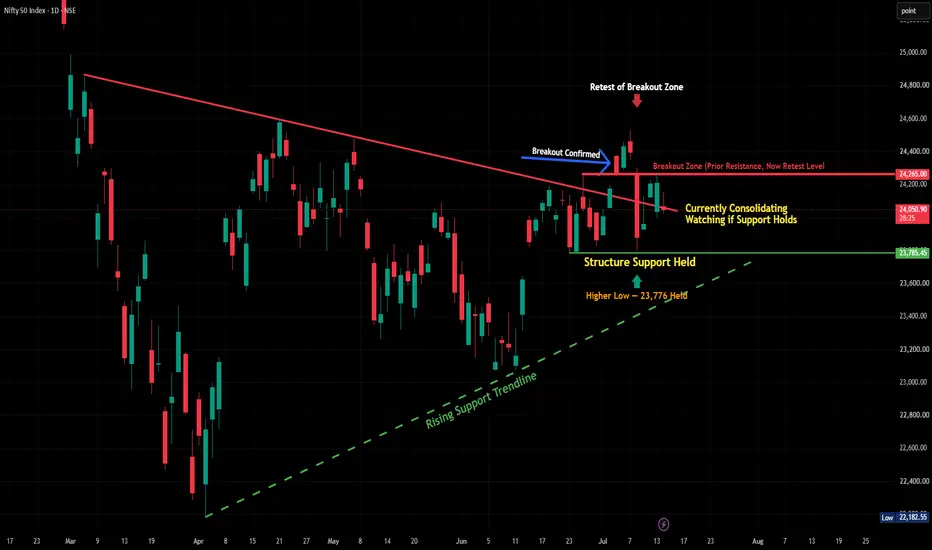
Introduction
One of the most common questions beginner traders ask is: "Price just broke out — should I jump in right now?" The honest answer is almost always: wait and watch what happens next. This tutorial covers one of the most important concepts in technical analysis — the retest — and why understanding it can save you from a lot of false starts.
What Is a Retest?
When price breaks above a resistance level (or below a support level), it doesn't always continue in a straight line. Very often, price will pull back toward the level it just broke, "retest" it, and then either:
Hold — the old resistance now acts as new support (or vice versa for breakdowns), and price resumes in the breakout direction, or
Fail — price falls back through the level, suggesting the breakout was a false move
This behavior happens because the price level that acted as resistance for weeks or months doesn't just disappear the moment it's broken — it takes time for the market to "agree" that the level has flipped roles.
Why Retests Happen
Think of a resistance zone as a level where sellers have consistently shown up in the past. When price finally breaks above it, some of those same sellers may try one more time to push price back down, since they remember that zone as a place where selling worked before. If buyers are strong enough to absorb that selling and hold the level, it confirms the breakout is genuine. If buyers can't hold it, the breakout often fails.
How to Read a Retest
A few things to watch when a retest is happening:
Does the pullback stay shallow? A retest that barely dips back to the breakout level and quickly bounces is generally healthier than one that plunges deep back into the old range.
Is there a clear rejection candle at the level? A candle with a long wick and a strong close back above the breakout zone is a good sign buyers are defending the level.
What do the moving averages say? If a key EMA (like the 50 or 200) lines up near the retest zone, that adds confluence and makes the level more significant.
How many sessions does it take? Retests can resolve quickly (same day) or take several sessions. Give it time rather than reacting to the first candle after the breakout.
A Common Beginner Mistake
Many new traders buy the moment a breakout happens, driven by excitement or fear of missing out (FOMO). When the inevitable retest comes and price dips back toward the breakout zone, they panic and sell — right before the level holds and price continues higher. Understanding that retests are a normal part of price behavior, not a sign that something has gone wrong, can help you avoid this trap.
What a Failed Retest Looks Like
Not every retest holds. If price breaks back through the level with strong momentum and closes clearly below it (for an upside breakout), that's usually a sign the breakout has failed, and the prior range or downtrend may reassert itself. This is exactly why waiting for confirmation — rather than assuming every breakout will hold — protects you from getting caught on the wrong side.
Key Takeaway
A breakout is not the end of the analysis — it's often just the beginning of the real test. Whether price is testing a trendline, a horizontal support/resistance zone, or a chart pattern's boundary, the retest phase tells you far more about the strength of the move than the initial breakout candle does. Learning to wait for this confirmation, rather than chasing the first move, is one of the simplest ways to improve your trade timing.
Conclusion
Next time you see a breakout on your charts, resist the urge to act immediately. Watch how price behaves on the retest — that reaction will tell you whether the breakout has real conviction behind it or not. Patience during this phase is often the difference between a well-timed entry and an emotional, premature one.
For educational purposes only. Not financial advice.

📈 HK Trading Community | Market Structure & Indicator Updates
Telegram: t.me/trendstrike1000
Website: quantumedgepro.netlify.app/
Real traders are built through learning,not tip hunting.So Start Learning How the Market Really Works
Telegram: t.me/trendstrike1000
Website: quantumedgepro.netlify.app/
Real traders are built through learning,not tip hunting.So Start Learning How the Market Really Works
Disclaimer
The information and publications are not meant to be, and do not constitute, financial, investment, trading, or other types of advice or recommendations supplied or endorsed by TradingView. Read more in the Terms of Use.