
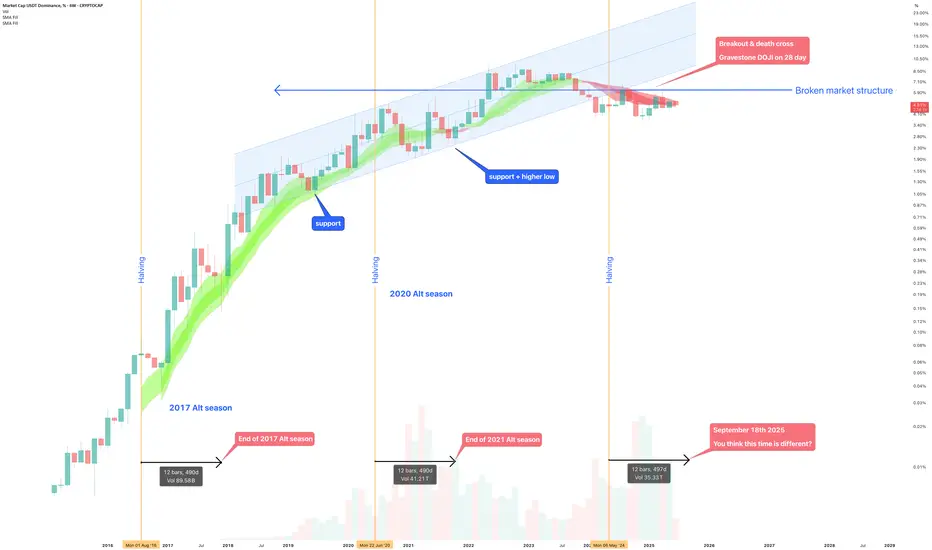
Firstly, it is not the intention of this post to spread FUD (Fear, uncertainty, & doubt), but rather a word of caution to all who use USDT. You should read this idea in conjunction with the recently published “Is Alt season dead? - June 2025” idea, there’s a remarkable alignment between them, should you understand what the 6 week chart above is telling you.
The argument presented here is for a failed redemption request on the Tether network, ultimately resulting in the collapse of the Tether stable coin. The event is expected to occur during the month of September, which will be the expected end of the Bitcoin bull market.
Throughout the years freshly printed USDT has been the life blood of alt tokens, that’s a fact. As supply and dominance increase, so does the size of the alt token market (including Ethereum). Those two conditions are an undeniable fact, look left. Fresh USDT is the alt token traders drug, they're addicted. Jump down to Reason 3 for a detailed comparison.
We’re now heading into a period of time where the opposite appears to be unfolding, and no one is talking about it. No one. But more on that later. This is about Tether itself.
Whatever is about to happen to Tether, it will be a first in its near 11 year history. You only need look left to see, this time is very different from previous market cycles. In the near term (weeks ahead) a collapse in Tether dominance is likely to print. Ultimately this will be at first a good thing for the alt token market, at least that’s how it will be perceived, but afterwards..
If you’ve studied the $1 peg failure of Terra Luna’s stable coin, then you’re likely looking at USDT.d chart and wondering where you’ve seen this before. The Luna crypto network collapsed in what's considered the largest crypto crash ever, with an estimated $60 billion wipeout, life savings were lost, dreams crushed. Many lost a great deal of money they thought was safe. Could the same happen with Tether? And what could cause such an event?
Let’s explore this…
What is the Tether stable coin?
The collapse - but how?
Reason 1 - BONDs, Precious metals, & Bitcoin market exposure…
Reason 2 - Inability to meet redemption demands
Reason 3 - An important alignment with "Is Alt season dead? - June 2025” idea
Reason 4 - The chart
Notice the marking for each 4 year cycle alt token end point? Make a note of that!
Ww
Signature Bank before collapse

The argument presented here is for a failed redemption request on the Tether network, ultimately resulting in the collapse of the Tether stable coin. The event is expected to occur during the month of September, which will be the expected end of the Bitcoin bull market.
Throughout the years freshly printed USDT has been the life blood of alt tokens, that’s a fact. As supply and dominance increase, so does the size of the alt token market (including Ethereum). Those two conditions are an undeniable fact, look left. Fresh USDT is the alt token traders drug, they're addicted. Jump down to Reason 3 for a detailed comparison.
We’re now heading into a period of time where the opposite appears to be unfolding, and no one is talking about it. No one. But more on that later. This is about Tether itself.
Whatever is about to happen to Tether, it will be a first in its near 11 year history. You only need look left to see, this time is very different from previous market cycles. In the near term (weeks ahead) a collapse in Tether dominance is likely to print. Ultimately this will be at first a good thing for the alt token market, at least that’s how it will be perceived, but afterwards..
If you’ve studied the $1 peg failure of Terra Luna’s stable coin, then you’re likely looking at USDT.d chart and wondering where you’ve seen this before. The Luna crypto network collapsed in what's considered the largest crypto crash ever, with an estimated $60 billion wipeout, life savings were lost, dreams crushed. Many lost a great deal of money they thought was safe. Could the same happen with Tether? And what could cause such an event?
Let’s explore this…
What is the Tether stable coin?
The core idea behind USDT is that each token is backed 1-to-1 by real U.S. dollar reserves. This is what's supposed to give a "stablecoin" its value, it should always be tradable with $1 USD. Unlike a bank, Tether does not create money, it digitises it, which is sort of how you use your debit card to make purchases every day. Real cash never touches your fingers, the only difference is the money in your bank is insured, protected by the government in the event of default, whereas your USDT.. it is a private company, if it fails, it’s gone.
Naturally Tether does not maintain a real cash equivalent for each USDT token in circulation, that would be impractical for a profit making business. Ironically, Tether is more liquid than most high street banks. And yet, there’s a growing risk ignored by the market. In fact, during research of this idea, it is surprising how far under the RADAR this risk has gone unnoticed. It is the same risk that allowed US Banks, Silicon Valley Bank and Signature Bank to fail (chart at bottom of page, does it look familiar to above?).
The collapse - but how?
Reason 1 - BONDs, Precious metals, & Bitcoin market exposure…
Tether has become one of the largest holders of US Treasury bills globally. Reports indicate that exposure to US Treasuries (direct and indirect, via money market funds and reverse repo agreements) has approached or exceeded $120 billion as of Q1 2025. As a matter of fact it is said so on their own website.
In the last audit (March 2025) where it was recorded, a U.S. Treasury Bill exposure of $98.5b “with a residual average maturity of less than 90 days”, to use their own words.
Source:
In their own words “The breakdown of the reserve backing the fiat denominated Tether tokens in circulation is.. . “, the highlights:
A precious metal exposure @ $6.6 billion and spot Bitcoin reserves @ $7.6 billion and somehow secured loans of $8.8 billion (plot twist, Micro strategy! Or Strategy as they’ve now chosen to name themselves) and around $64 million in cash.
The total assets as reported tied up in various financial instruments: $149,274,515,988, with approximately 66% tied up in the Bond market (and let’s ignore both Bitcoin and Gold are at historic overbought levels, $13.2billion is at considerable exposure to volatility.)
Circulating tokens: 158.6 billion
$149,274,515,988 (Reserves) / 158,600,000,000 (Tokens) ≈ 0.9412 per token
At this moment in time should the market exercise a full redemption request (very unlikely), 94 cents is the best they could offer, which is I stress, better than most high street banks. However the argument is not the backing, it is the access to it. Just as with Silicon and Signature banks, Tether appears to have ample liquid assets, but can it access them when it needs to?
If Tether needs to increase its cash position to support the network with real cash during a sudden demand spike, treasuries must first be sold. You may have noticed, but right now buyers for US treasuries are not exactly lining up outside the door to offer America cash. You don’t want to be a large holder of US treasuries during a period of rapid falling demand.
90 day US Bond market is on the verge of collapse. Imagine one of the largest holders of 90 day treasuries at this juncture. Sell into strength, not collapse.
Reason 2 - Inability to meet redemption demands
Tether's peg relies entirely on the market's belief that 1 USDT can always be redeemed for $1 USD, regardless if the liquidity is there. This uncertainly ultimately caused Terra Luna’s stable coin to de-couple. Trust took years to build hours to lose.
If this belief falters, or if the mechanism for redemption breaks even if only for hours, the peg collapses. Bond market exposure introduces several pathways to this breakdown:
Liquidity Mismatch, the "Run on the Bank”:
The Problem: Bonds, even highly rated ones, are not instant cash. Selling large quantities of bonds takes time, and doing so quickly can depress their price, especially if the market for those specific bonds is thin or stressed.
Imagine a widespread loss of confidence in Tether (perhaps due to rumours, a major regulatory action, or a general crypto market crash). Millions or even billions of dollars worth of USDT holders rush to redeem their tokens for actual USD.
The de-peg: If Tether's $120 billion (or a significant portion) is tied up in bonds that cannot be sold quickly enough at their face value, Tether would be unable to meet all redemption requests promptly. This would lead to a backlog of redemptions.
As the market sees that Tether isn't honoring redemptions on demand, panic sets in. USDT holders would then try to sell their USDT on secondary markets (exchanges) for less than $1, accepting a discount just to get out. This is the decoupling.
Reason 3 - An important alignment with "Is Alt season dead? - June 2025” idea
Historically, the relationship between USDT dominance and alt token performance is often seen as inverse. Here's why:
USDT as a "Safe Haven" when the crypto market is in a risk off phase, or experiencing uncertainty, investors tend to move their capital into stable coins like USDT. This increases USDT dominance, as a larger percentage of the total crypto market cap is held in USDT. During such time alt coins often struggle as capital flows out of them.
Capital rotation into alt coins (aka alt season): Conversely, a decrease in USDT dominance is often interpreted as a bullish signal for alt coins. It suggests that capital is moving out of stable coins and into riskier assets, including Bitcoin and then alt coins, in search of higher returns. This period is often referred to as "alt season" where alt coins significantly outperform Bitcoin. (This worked well prior to the Bitcoin ETF as liquidity entered spot Bitcoin, which would then eventually turn to the alt token market. However in this cycle the liquidity is trapped inside ETFs (Exchange Traded Funds). But this dichotomy will not arrest the enthusiasm of rose tinted glasses wearing influencers.)
Is it that really true, a general fall in dominance is good for the alt token market?
An overlay of TOTAL2 (market capitalisation of all tokens except Bitcoin) on the chart of Tether Dominance since 2016 (below) reveals a contradiction to this popular belief that declining dominance benefits alt tokens.
The chart clearly shows that strong Tether dominance is necessary for strong alt token market performance, especially after each Halving (vertical yellow lines). Influencers throughout the space are now calling for amazing performance well into 2026, how can this be compatible with a clear trend reversal in USDT dominance?
6 week TOTAL2 compared with USDT dominance since 2016
Why is this change in Dominance a de-pegging risk?
Recall in reason 1 the Bond risk, the time it might take Tether to liquidate treasuries to service redemption requests (remember the business is operating with a small cash position as percentage of their market capital). Keep this number in mind. Now flip over to the “Alt season dead? - June 2025” idea, notice the bear flag forecast? It calls for a correction of around $200 billion, returning the market to 2017 levels. A 50% correction across OTHERS, if into USDT, would demand the complete liquidation of Tethers Bond position. But why? In a word, contagion. Especially amongst DeFi protocols.
It is worth remembering the OTHERS market total ticker is limited to the top 125 tokens excluding Bitcoin, Ethereum, Tether, XRP, and BNB. The market will more than likely try to escape into USDT, but what if that is not possible? The supply of Tether tokens is finite. What if the supply is increased to service the sudden demand without the backing?
A loss of confidence. If USDT dominance collapses and alt coins fail, it could suggest a loss of confidence in Tether or stable coins in general.
A de-pegging event: A major de-pegging of USDT from the US dollar (i.e. USDT trading significantly below $1) would be a primary cause. This would erode trust in USDT as reliable store of value and a medium for trading, leading to a mass exodus.
Liquidity criss: USDT is the most widely used stablecoin for trading alt coins. If its dominance collapses due to a lack of trust, it would severely impact liquidity across the alt coin market.
Contagion effect: A collapse in USDT could trigger a wider contagion throughout the crypto system:
DeFi instability. Many DeFi protocols rely on stable coins as collateral, especially USDT. A USDT collapse would lead to liquidation events of a size never seen before in the alt token space.
Bitcoin as the “Ultimate safe haven”. I keep asking myself, where is the liquidity for Bitcoin’s final push to the $145-150k market top coming from? While Bitcoin is volatile as old wallets liquidate their positions at all time highs, in extreme crisis, Bitcoin is often seen as the last resort in crypto due to decentralised nature and first mover advantage.
Reason 4 - The chart
The chart informs us something no user of USDT should ignore. For the first time in its almost 11 year history, dominance has printed:
1. A post Halving dominance collapse. Look left.
2. Broken market structure.
3. A Death Cross (available across multiple time frames)
4. Failed legacy support since 2018.
5. A collection of bearish engulfing and Gravestone DOJI candles.
If an increasing USDT dominance has historically been positive for alt tokens, then a macro reversal implies something very bearish for the alt token market going forward.
Notice the marking for each 4 year cycle alt token end point? Make a note of that!
Ww
Signature Bank before collapse
Note
Because Bitcoin is so wonderful we've chosen to invest our depositors money in Gold.The irony.
All while Gold is in bubble territory. Couldn't make this up.
"Stablecoin group Tether holds talks to invest in gold miners"
"Tether, the world’s biggest stablecoin company, has held talks about investing in gold mining, seeking to deploy its vast crypto profits into bullion.
The company has held discussions with mining and investment groups about investing in the entire gold supply chain, from mining and refining to trading and royalty companies, according to four people familiar with the recent talks."
ft.com/content/135fb3dd-2395-4f04-8cc6-7fb0e87cd092
Note
100% in agreement with this "Stablecoins could crash the economy"For anyone still reading this idea, when the market top is in... avoid using stable coins as your exit, use real cash.
youtube.com/watch?v=qDJ3u_mljcI
Note
Cryptofiat111 ask’s“Do you forsee USDC following USDT into the abyss?”
=========
Is a great question. You would assume that if one stable coin is to falter, especially a stable coin that’s been with the crypto sector since 2016, that all others would face the same fate.
The monthly USDC.d (dominance) chart at this moment prints a “Dragonfly DOJI” candle, in 8 days. This signal follows the life cross that printed in March. The candle print occurs on the back of past resistance, a bull flag. The combination paints a significant bullish outlook for Circles backed and audited stable coin, USDC.
Now compare that chart with USDT.d. It is clear there’s a huge shift in the control for stable coin dominance. Whether this control is an effort to undermine USDT or the market is adopting USDC as the preferred stable coin, will leave that to the speculators… USDT continues to move far more volume.
It worth repeating the 90 Bond market exposure by Tether. The 90 Bond is crashing, ergo Tether’s position in this market and the increases to it is questionable at this stage of the bull market.
All these events are connected, never in isolation. Whatever is about to happen, it would be my recommendation to avoid using USDT as an exit from any crypto euphoria as this bull market comes to an end.
Note
“Stablecoin issuer Circle examines ‘reversible’ transactions in departure for crypto”This will kill Tether stone dead if it goes through.
ft.com/content/5b00127e-1f26-4b36-9b19-d20b38392e8c
“Circle, the world’s second-biggest issuer of stablecoins, is examining ways to make it possible to reverse transactions involving its tokens, in a rare admission by a major crypto firm that it needs to take lessons from the traditional financial sector.
Circle president Heath Tarbert said a mechanism that allowed money to be refunded in cases of fraud or disputes would help the stablecoin industry’s push to become part of the financial mainstream. “We are thinking through . . . whether or not there’s the possibility of reversibility of transactions, right, but at the same time, we want settlement finality,” Tarbert told the Financial Times.”
Note
USDC sellers are demanding more $$ for their USDT, a de-pegging is a real risk, but not confirmed.Have you noticed the spot prices in various alt-usdt token pairs could not match the order books when selling into USDT during the panic?
The OTHERS dropped $160 billion as folks tried to exit, this is $40billion more than Tether has available in cash at the moment.
Note
The OTHERS market cap total is suggesting a $100+ billion wipeout.. this could place significant pressure on Tether, with cash on hand below $40 billion. They'd have to liquidate their Bond market positions to release more cash, a position that is also losing value with each pass day.The conditions for a full on meltdown exist however unlikely.

Note
"S&P downgrades Tether’s assets to lowest level"ft.com/content/974926ba-d295-4679-a4ed-7846b7f4242e
"Tether’s ability to maintain its peg to the US dollar has been called into question by S&P Global Ratings, which downgraded the stablecoin operator’s reserves to its lowest measure due to rising exposure to high-risk assets.
In a note on Wednesday, the rating agency downgraded its assessment of Tether’s assets to “weak” from “constrained”. It also flagged “an increase in high-risk assets” backing the stablecoin, with corporate bonds, precious metals, bitcoin and secured loans accounting for 24 per cent of total reserves at the end of September, up from 17 per cent a year ago."
The reason given by the agency run parallel with the reason provided in this idea.
So.. when this Bitcoin market top is in, avoid the use of USDT for the long term.

Related publications
Disclaimer
The information and publications are not meant to be, and do not constitute, financial, investment, trading, or other types of advice or recommendations supplied or endorsed by TradingView. Read more in the Terms of Use.
Related publications
Disclaimer
The information and publications are not meant to be, and do not constitute, financial, investment, trading, or other types of advice or recommendations supplied or endorsed by TradingView. Read more in the Terms of Use.