This drawing tool aims to draw auto Fibonacci Retracement Levels on desired indicators.
Users can define the target indicator to draw Auto Fibo Lines, from the "settings tab":
There are six commonly used indicators below the charts that can be selected to draw Fibonacci Retracement lines on:
RSI : Relative Strength Index
CCI : Commodity Channel Index
MFI : Money...
Library "VolumeIndicators"
This is a library of 'Volume Indicators'.
It aims to facilitate the grouping of this category of indicators, and also offer the customized supply of the source, not being restricted to just the closing price.
Indicators:
1. Volume Moving Average (VMA):
Moving average of volume. Identify trends in trading volume.
2. Money Flow...
Introduction
Heyo, here I made a normalized Chaikin Money Flow (CMF) indicator with Inverse Fisher Transform (IFT) and some smoothing techniques.
I had to normalize the indicator in order to fit it to the IFT range (-1 -> 1).
Moreover, the good old adaptive mode is also included in this indicator. It uses Ehlers superb dominant cycle techniques.
It also has...
This overlays CMF of the underlying (solid histogram) and a CMF of the ticker you are comparing it too. The pink line is the correlation coefficient of both CMFs. Experiment/work in progress.
this is a revised classic CMF indicator, with some additional features
Features:
4 different Exchanges:Tickers (clouds).
your current exchanges:ticker (white)
an averaged cmf over all 5 tickers (black)
a selectable time frame for all tickers
3 buy and 3 sell lines (visual H-lines only)
autocentering over ghosts
color scheme is for a dark theme, change in...
This is a first attempt to automate what my current strategy when trading is.
It uses 2 timeframes: the one you are currently using to see the chart and an "anchor trend" which is a higher order frame.
Supported timeframes are: 1m, 5m, 15m, 30m, 1H, 4H, 1D, 1W
The Strategy relies on two indicators:
Squeeze Momentum Indicator
CMF
How does it works?
It...
This study is intented to be used as a part of buy/sell strategy.
Smooth feature: enable this to make CMF line smooth using MA
Bg Highlight: highlights the background depending on the bull/bear condition
This ia full strategy made with a combination of a trender, volume, volatility and oscillator.
In this case we only go long.
Indicators used:
Default PSAR
Default CMF
Modified RSI logic, not using OB/OS
ADX with EMA applied
The rules are : we check if we are in a uptrend on psar, together with a positive value in volume, rsi is above the middle line(50), using...
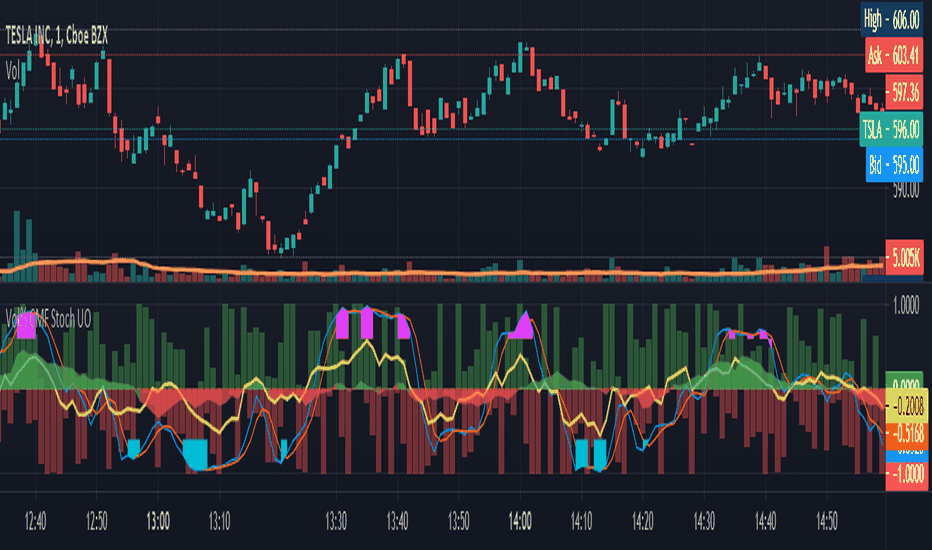
Plots % Buy / Sell Volume , Chaikin Money Flow , Stochastic Oscillator, and Ultimate Oscillator on same axis, bound -1 to 1.
Show Volume Percentage, displaying buying as green and positive, selling as red and negative.
Showing the CMF, with green / red fill for positive / negative values.
Modified Stochastic Oscillator, converting bounds to -1 and 1, moving...
Showing the CMF, with green / red fill for positive / negative values, overlaid with Volume Percentage, displaying buying as green and positive, selling as red and negative.
Hello Everyone . Sometimes we need some indicators and each one needs seperated window. with this tool we can see indicators by choosing it from pull down menu, in the same window.
Currently you can choose RSI, MACD, Commodity Channel Index (CCI), Momentum, Stochastic, Stochastic RSI, Directional Movement Index (DMI), Chaikin Money Flow (CMF), On-Balance Volume...
The well known Chaikin Money Flow Indicator as oscillator version.
General Usage
The indicator runs both above and below zero, made to denote whether an asset is in a bullish (above zero) or bearish (below zero) trend.
It can be used to confirm trends, as well as spot possible trading signals due to divergences.
A benefit of the oscillator version is that it...
The Chaikin Oscillator is basically an oscillator version of the Accumulation / Distribution Index, also known as ADL Indicator.
General Usage
The indicator runs both above and below zero, made to denote whether an asset is in a bullish (above zero) or bearish (below zero) trend.
It can be used to confirm trends, as well as spot possible trading signals due to...
The oscillator version of the Price Volume Trend indicator (PVT) can be considered as a leading indicator of future price movements. The PVT Indicator is similar to the On Balance Volume indicator as it is also used to measure the strength of a trend.
The difference between the OBV and the PVT is that where the OBV adds all volumes when price achieves higher...
The oscillator version of the well known On Balance Volume Indicator (OBV).
General Usage
Plain old OBV can be used to confirm trends, as well as spot possible trading signals due to divergences.
A benefit of the oscillator version is that it can produce LONG or SHORT signals on zero line cross.
Moving Averages
4 different Moving Averages are available:
...
Money Flow Index (MFI) is the technical indicator, which indicates the rate at which money is invested into a security and then withdrawn from it.
Construction and interpretation of the indicator is similar to Relative Strength Index with the only difference that volume is important to MFI.
Usage:
When analyzing the money flow index one needs to take into...
an underlying asset.
It is determined by the changes in price and volume. The volume acts as a weighting coefficient at the change of price — the higher the coefficient (the volume) is the greater the contribution of the price change (for this period of time) will be in the value of the indicator. The indicator is also known as Accumulation / Distribution...
by this script you can see the average level of macd, macd-asprey, rsi, stochastic, cci, momentum, obv, DI, volume weighted macd, cmf indicators within a period. It also calculates and creates the same graph for higher time frame, so you can see average levels for current and higher time frame. you can also check it for divergence/convergence. You can use it as...


![BTCUSD.P: [MAD] CMF 5x MTF BTC](https://s3.tradingview.com/g/GkwSFdr4_mid.png "[MAD] CMF 5x MTF BTC")


![AUDUSD: Multi Timeframe Chaikin Money Flow [Takazudo]](https://s3.tradingview.com/b/B1SGdS8j_mid.png "Multi Timeframe Chaikin Money Flow [Takazudo]")




![BTCUSD: CMF Osc - Chaikin Money Flow Oscillator [UTS]](https://s3.tradingview.com/g/gDS00E4g_mid.png "CMF Osc - Chaikin Money Flow Oscillator [UTS]")

![SPX500USD: Chaikin Oscillator (ADL Oscillator) [UTS]](https://s3.tradingview.com/z/ZNMqHlPJ_mid.png "Chaikin Oscillator (ADL Oscillator) [UTS]")
![SPX500USD: PVT Osc - Price Volume Trend Oscillator [UTS]](https://s3.tradingview.com/z/zRe2J3M5_mid.png "PVT Osc - Price Volume Trend Oscillator [UTS]")
![SPX500USD: OBV Osc - On Balance Volume Oscillator [UTS]](https://s3.tradingview.com/g/gf8889i2_mid.png "OBV Osc - On Balance Volume Oscillator [UTS]")
![SPX500USD: MFI - Money Flow Index [UTS]](https://s3.tradingview.com/u/UrFYXELY_mid.png "MFI - Money Flow Index [UTS]")
![ETHUSD: ADL - Accumulation Distribution Line [UTS]](https://s3.tradingview.com/u/uRMAN1ho_mid.png "ADL - Accumulation Distribution Line [UTS]")
