U.S. Dollar / Japanese Yen
No trades
No trades
Peers for comparison
Pair info
Also known as trading the “gopher” the USDJPY pair is one of the most traded pairs in the world. The value of these currencies when compared to each other is affected by the interest rate differential between the Federal Reserve and the Bank of Japan.
USDJPY BEARISH REVERSAL? | 158.50–159.00 Supply → 155.80USDJPY is approaching a key resistance/supply zone. 📉
Price has recovered strongly from the September low, but is now trading directly beneath the 158.50–159.00 supply area.
🔴 Major Supply: 158.50–159.00
⚠️ Current Price: ~157.70
🎯 Downside Target: 155.83
📌 Key idea: Watch for rejection and bearis
USD/JPY Coiled for Impact A sharp drop followed by a tight symmetrical triangle — the market is coiling for its next big move. With an entry marked at 154.00, this setup highlights a high‑stakes battle between bulls and bears. The green target zone signals potential upside momentum, while the red stop‑loss zone keeps risk in
USDJPY Drops Sharply: Buy the Rebound, Sell at Higher LevelsUSDJPY has seen a sharp decline as the Japanese yen strengthened rapidly, supported by expectations that the BOJ may continue tightening monetary policy. Japan is also showing strong determination to control the exchange rate and support the yen.
From a technical perspective, 153 is the current pri
USDJPY: Break of Uptrend Line Signals Sellers Taking ChargeSellers on USDJPY are finally making their move. The rejection from the top was sharp and fast, showing real conviction behind the selling pressure.
The key development is the break of the uptrend line that had supported price throughout the entire prior rally — and buyers weren't able to reclaim it
USD/JPY Intraday (18/08/2026) – Long Retest Setup Above 159.The USD/JPY 15-minute chart exhibits a strong bullish structure, highlighted by powerful impulsive expansion legs pushing higher out of lower base support around 159.320 – 159.289. Price recently experienced a sharp breakout higher, driving through intermediate resistance at 159.644 to test a local
USDJPY Swing Trade Idea (Bullish Breakout)USDJPY has broken above a short-term consolidation range and continues to respect an ascending trendline. The breakout above the 159.65–159.70 resistance zone suggests bullish momentum remains intact, with higher highs and higher lows supporting the uptrend.
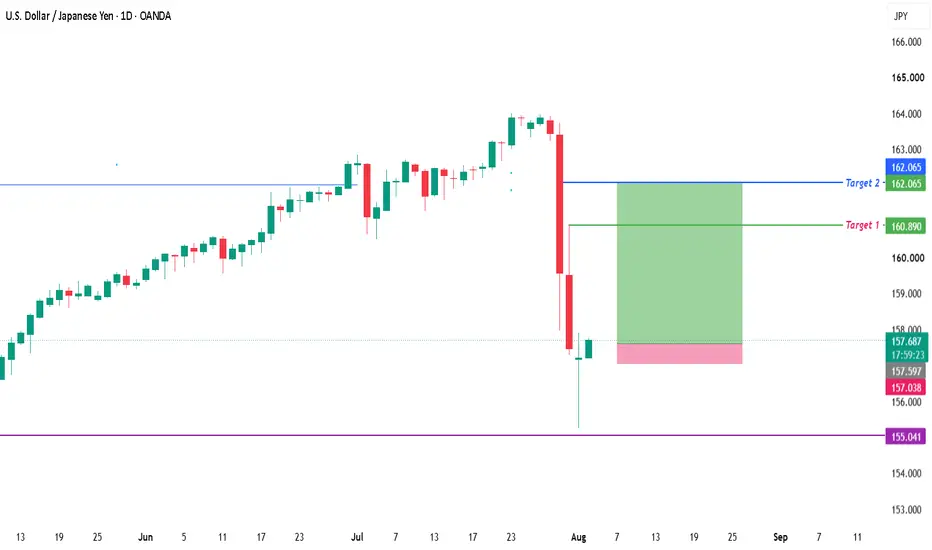
USD/JPY Eyes Rate Hike RallyThe U.S. Dollar is gaining momentum against the Yen as markets anticipate a potential Fed rate hike. On the daily chart, price has broken above 157.70, holding firm above support at 155.04.
Targets: Upside projections point to 160.89 (Target 1) and 162.06 (Target 2).
Stop‑Loss: Risk is managed ne
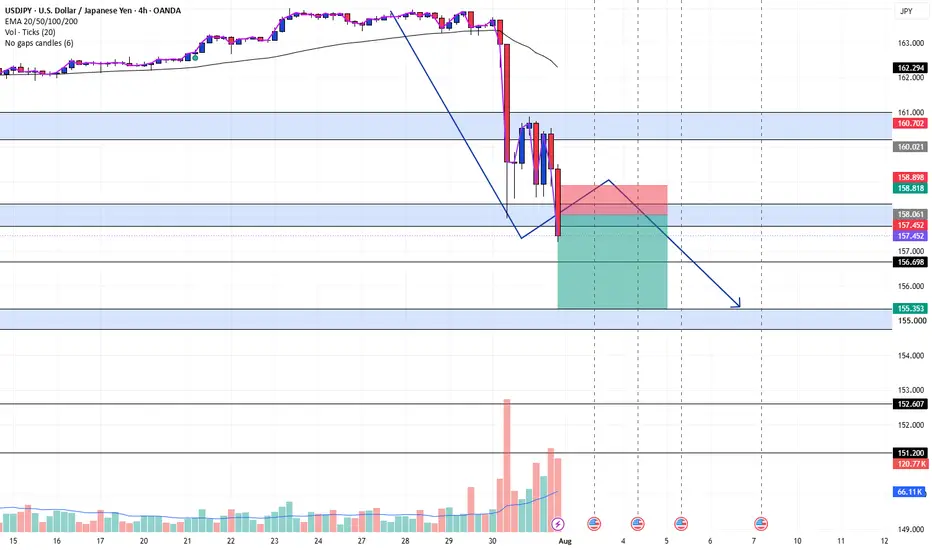
USDJPY BEARISH TRAPUSDJPY Weekly Bearish Setup – Rejection From Major Resistance
USDJPY experienced a strong rejection after sweeping liquidity above the 163.00–164.00 area. Price has now dropped back below the major weekly resistance zone around 158.90–160.70, showing that sellers are regaining control.
The current
See all ideas
Summarizing what the indicators are suggesting.
Oscillators
Neutral
Oscillators
Neutral
Summary
Neutral
Summary
Neutral
Summary
Neutral
Moving Averages
Neutral
Moving Averages
Neutral
Displays a symbol's price movements over previous years to identify recurring trends.
Frequently asked questions
Today, USD/JPY rate is 159.705 JPY.
For broader market analysis, dive into the technicals on the USDJPY live chart and read the latest USDJPY news:
– JAPAN OCT CGPI IMPORT INDEX +24.8% Y/Y IN YEN TERMS FOR 11TH STRAIGHT RISE VS. REVISED +23.8% IN SEPT
– JAPAN OCT CGPI: NON-FERROUS METALS +31.7% VS. +40.3% IN SEPT AS GLOBAL PRICES STAY HIGH ON AI-RELATED DEMAND AND SUPPLY SHORTAGE
– JAPAN OCT CGPI KEY ENERGY PRICES: CRUDE OIL/COAL PRODUCTS +15.9% VS. SEPT +11.5%
Markets don't sleep, here's what's going on with USDJPY at the moment:
– JAPAN OCT CGPI IMPORT INDEX +24.8% Y/Y IN YEN TERMS FOR 11TH STRAIGHT RISE VS. REVISED +23.8% IN SEPT
– JAPAN OCT CGPI: NON-FERROUS METALS +31.7% VS. +40.3% IN SEPT AS GLOBAL PRICES STAY HIGH ON AI-RELATED DEMAND AND SUPPLY SHORTAGE
– JAPAN OCT CGPI KEY ENERGY PRICES: CRUDE OIL/COAL PRODUCTS +15.9% VS. SEPT +11.5%
See more updates in real-time with our News Flow.
The safest way to trade USDJPY is through a reliable broker. Create an account, fund it, and place a buy order.
You can trade USDJPY directly from TradingView:
– Choose a broker: Explore our supported trading partners and pick one that fits your needs
– Compare options: View available brokers side by side to evaluate fees and features
– Connect your account: Open Supercharts, click "Trade", select your broker, and log in
– Start trading: Place orders without leaving the chart
Tip: If you're new to trading, try paper trading first — it lets you practice strategies in real market conditions without risking funds.
It's worth checking USDJPY rate change for various periods to get the full picture:
– 1 day — +0.23%
– 1 week — +0.30%
– 1 month — +0.60%
USDJPY's all-time low was 75.558 JPY (Oct 31, 2011), and its highest price is 278.310 JPY (Nov 4, 1982). Track the dynamics with the latest forex news right on TradingView.
– 1 day — +0.23%
– 1 week — +0.30%
– 1 month — +0.60%
USDJPY's all-time low was 75.558 JPY (Oct 31, 2011), and its highest price is 278.310 JPY (Nov 4, 1982). Track the dynamics with the latest forex news right on TradingView.
When trading USDJPY, one should keep in mind many factors.
First, analyze the fundamentals:
– Macroeconomic data: Inflation, GDP, employment, and other key indicators in the economies behind both currencies
– Central bank policy: Interest rate decisions and monetary policy from the respective central banks
– Market sentiment: Check what other traders anticipate
– News flow: Geopolitical events and economic releases
Then check technical ratings:
– Today — buy
– 1-week — strong buy
– 1-month — buy
Identify the trend, watch key levels (support and resistance), consider volatility and upcoming economic events. Then, you'll be closer to an informed decision.
USDJPY is a major currency pair, meaning it combines one of the world's most traded currencies with the US dollar.
What it means for traders:
– High liquidity: Actively traded with large market participation
– Tight spreads: Typically lower trading costs
– Global relevance: Often reflects major economic trends
What you should remember about major pairs:
– Macro-driven: Influenced by key economic data and central bank decisions
– Stable execution: High volume usually means smoother price movement
– Popular among traders: Widely used for both short-term and long-term strategies
Track rate movements on the USDJPY chart and follow the latest forex news to stay updated.
USDJPY volatility measures how much the exchange rate fluctuates over time, i.e. how quickly and how strongly it moves up or down.
The current volatility rating is 0.22%.
What it means for traders:
– Higher volatility: Larger and faster price swings → higher risk and opportunity
– Lower volatility: More stable price movement → smaller trading ranges
– Market behavior: Volatility often increases during major economic news or central bank decisions
Volatility helps traders estimate risk and position sizing. It's also useful for adapting strategies to market conditions.
How to use volatility:
– Compare volatility across other currency pairs
– Combine with technical analysis (trends, support/resistance)
– Monitor economic events that may increase market movement
USDJPY is quoted as how many JPY (quote currency) it takes to buy one USD (base currency).
For example, if the pair trades at 1.50, it means 1 USD = 1.50 JPY.
What can influence the rate:
– Supply and demand: Driven by trade, investment flows, and speculation
– Economic data: Inflation, GDP, employment reports
– Central bank policy: Interest rates and monetary decisions
Follow these and more events in the Economic Calendar.