Banks
Tamilnad Mercantile Bank – 1D Chart | Strong Resistance Zone🟢 Tamilnad Mercantile Bank (TMB) – 1D Chart | Strong Resistance Zone Ahead
📊 Chart Setup:
TMB is testing its major 1-year resistance zone around ₹510, a key level that has capped price movements for months. A strong daily close above ₹510 could trigger momentum towards higher targets.
🔹 Resistance: ₹510 (Major 1-year resistance)
🔹 Targets on Breakout: ₹535 / ₹600
🔹 Supports: ₹466 / ₹440
🔹 View: Price consolidating near breakout zone. Sustained close above ₹510 can signal trend continuation.
🏦 Fundamental Update – Q2 FY26 Results Highlights:
Tamilnad Mercantile Bank delivered steady performance with profit growth and improved asset quality.
• Net Profit: ₹318 Cr ↑ (▲4.95% YoY)
• Total Business: ↑11.40%
• Deposits: ₹55,421 Cr ↑12.32%
• Advances: ↑10.5%
• Net Interest Income: ₹597 Cr ↑0.17%
• Gross NPA: ↓ to 1.01%
• Net NPA: ↓ to 0.26%
• Capital Adequacy Ratio (CAR): Strong at 30.96%
➡️ Stable performance, improving asset quality, and strong capital base add confidence to the technical setup.
📈 For educational purpose only. Not a buy/sell recommendation.
CANARA BANK BREAKOUTCANARA BANK
ADD ON YOUR WATCHLIST
If you see in the chart, the rounding pattern has broken out and it is in the weekly time frame
You can buy at Rs 125 and go up to the target of 146 and 163. The Stop-loss can be kept at 117.50
Note: Our posts are posted for learning purposes. You are responsible for any profit or loss you make from the advice given in the channel. Before investing in the stock market, you must consult your financial advisor.
WE ARE NOT A SEBI REGISTERED
CANARA BANK ROUNDDING PATERN BREAKOUTCANARA BANK ( W )
ADD ON YOUR WATCHLIST
If you see in the chart, the rounding pattern has broken out and it is in the weekly time frame
You can buy at Rs 125 and go up to the target of 146 and 163. The stop loss can be kept at 117.50
Note: Our posts are posted for learning purposes. You are responsible for any profit or loss you make from the advice given in the channel. Before investing in the stock market, you must consult your financial advisor.
WE ARE NOT A SEBI REGISTERED
RBLBANK ( M ) BREAKOUTStock Name : RBL BANK ( M )
Friends, after a long time, this stock has broken out in the monthly time frame after about five years and eight months. This type of breakout is considered very strong and there are only two days left for the completion of this month's candle. So we can consider this as a complete breakout. If you look at the range of the breakout, it was Rs 180. Then you can add the stock to your watch list.
Target 1 : 396 - 400
Target 2 : 475 - 500
Note: Our posts are posted for learning purposes. You will be responsible for any profit or loss you make from the advice given in the channel. Before investing in the stock market, you must consult your financial advisor.
WE ARE NOT A SEBI REGISTERED
YES BANK BY KRS Charts2nd Sept 2025 / 10:01 AM
Why Yes Bank ?
1. last few years YES BANK is making HH & HLs in Monthly & Weekly TFs . It has potential technically, but will check our patience.
2. Above Chart it fills up all the FVGs - Fair Value Gaps and bounced back in Month of April. As we can see in Chart mentioned recently also same FVG reversal is visible.
3. Also Potential of Reversal chart pattern at bottom of trend is also visible.🤞
4. Less than 2 Rs Risk and Almost 5 Rs Reward is making this trade Safe 👍
5. Point to be noted 20.25 Rs is nearest Resistance and Pattern Target of 28 Rs unlock After breakout of neckline at 22 Rs.
Retail Trading vs Institutional TradingIntroduction
The financial markets are a dynamic ecosystem composed of diverse participants ranging from individual investors to large financial institutions. These participants can be broadly categorized into retail traders and institutional traders. While both aim to generate profits from the markets, they operate on fundamentally different scales, use different strategies, and face varying levels of regulation and risk exposure.
This article explores the essential differences between retail and institutional trading, comparing their objectives, tools, advantages, limitations, and market impact. Understanding this distinction is crucial for traders, investors, and market analysts alike.
1. What is Retail Trading?
Retail trading refers to the buying and selling of securities by individual investors who manage their own money. These traders typically use brokerage platforms such as Zerodha, Upstox, Robinhood, or Interactive Brokers to place trades in stocks, bonds, derivatives, mutual funds, and ETFs.
Key Characteristics of Retail Traders:
Trade using personal funds
Use online trading platforms
Typically trade in small volumes
Limited access to advanced tools and research
Often influenced by market sentiment and news
Operate independently
Common Participants:
Individual investors
Self-directed traders
Hobbyists and part-time traders
Beginner investors using mobile apps
2. What is Institutional Trading?
Institutional trading is conducted by large organizations that manage vast amounts of capital on behalf of clients or stakeholders. These include mutual funds, hedge funds, insurance companies, pension funds, investment banks, and proprietary trading firms.
Key Characteristics of Institutional Traders:
Trade large volumes of securities
Use proprietary algorithms and data analytics
Employ teams of analysts, economists, and quants
Can influence market trends due to trade size
Often get better pricing (e.g., lower spreads, negotiated commissions)
Subject to stricter regulatory requirements
Common Participants:
Mutual funds
Hedge funds
Pension funds
Insurance companies
Sovereign wealth funds
Family offices
Asset management firms
3. Core Differences Between Retail and Institutional Trading
Aspect Retail Trading Institutional Trading
Capital Size Small (thousands to lakhs) Large (crores to billions)
Tools & Technology Basic to moderate tools High-end proprietary tools & infrastructure
Access to Information Public and delayed data Real-time data, deep analytics, and research
Trading Costs Higher relative commissions Lower commissions due to bulk discounts
Market Impact Minimal Significant due to trade size
Investment Horizon Short-term to medium-term Varies—can be short, medium, or long-term
Speed & Execution Slower execution High-speed execution using smart order routing
Risk Management Often basic or emotional Systematic with hedging and quantitative models
Regulatory Compliance Limited oversight Extensive regulations and audits
Leverage Availability Limited Significant leverage (with risk controls)
4. Tools & Technologies
Retail Traders:
Trading apps (e.g., Zerodha Kite, Robinhood)
Charting platforms (e.g., TradingView)
Technical indicators (MACD, RSI, Bollinger Bands)
Social media and forums for sentiment analysis
Institutional Traders:
Direct Market Access (DMA)
High-Frequency Trading (HFT) infrastructure
Bloomberg Terminal and Reuters Eikon
Algorithmic trading engines
Risk Management Systems (RMS)
Machine Learning & AI models for prediction
5. Strategies Used
Retail Trading Strategies:
Day Trading: Buying and selling within the same day
Swing Trading: Capturing price swings over a few days
Position Trading: Holding for weeks or months
Momentum Trading: Riding price momentum
Technical Analysis: Relying on chart patterns and indicators
Institutional Trading Strategies:
Arbitrage: Exploiting price differences across markets
Quantitative Models: Using mathematical models to trade
High-Frequency Trading (HFT): Executing thousands of trades per second
Long/Short Equity: Simultaneously buying undervalued and shorting overvalued stocks
Portfolio Hedging: Using options and futures to manage risk
Dark Pool Trading: Executing large trades without impacting the market
6. Advantages & Disadvantages
Retail Trading Advantages:
Flexibility: Can enter and exit positions quickly
No Mandates: No pressure to follow institutional mandates
Wide Choices: Can explore niche assets (e.g., penny stocks, crypto)
Learning Curve: Great platform to learn and experiment
Retail Trading Disadvantages:
Lack of Access: No early access to IPOs or insider pricing
Emotional Decisions: Prone to fear and greed
Higher Costs: Commissions and spreads are relatively higher
Limited Research: Often rely on social media or basic tools
Institutional Trading Advantages:
Deep Research: Backed by teams of analysts and economists
Negotiated Costs: Lower execution costs
Market Access: Access to IPO allocations, block deals, dark pools
Risk Management: Strong systems and frameworks in place
Institutional Trading Disadvantages:
Slower Flexibility: Large trades require strategic execution
Regulatory Burden: Heavily regulated and audited
Crowded Trades: Many institutions follow similar models, leading to herd behavior
7. Regulatory Landscape
Retail Traders:
Must comply with basic market regulations set by authorities like SEBI (India), SEC (USA), or FCA (UK)
Brokers manage KYC/AML compliance
Retail participation is encouraged for market democratization
Institutional Traders:
Face heavy scrutiny and reporting requirements
Subject to detailed disclosures, audits, and risk controls
Must adhere to fund mandates, client transparency norms, and regulatory caps
8. Market Influence
Retail Impact:
Retail traders often move smaller-cap stocks due to low liquidity. However, when acting in mass (e.g., during meme stock frenzies like GameStop in 2021), they can disrupt even large-cap stocks temporarily.
Institutional Impact:
Institutions shape long-term trends. Their decisions impact indices, bond yields, sectoral allocations, and global flows. For example, when FIIs (Foreign Institutional Investors) sell off Indian equities, the market often sees sharp corrections.
9. Case Studies
GameStop (2021) – Retail Power:
A short squeeze initiated by Reddit's r/WallStreetBets community caused GameStop shares to skyrocket, hurting hedge funds and proving that coordinated retail action can temporarily disrupt institutional strategies.
LIC IPO (India 2022) – Institutional Influence:
India’s largest-ever IPO saw massive institutional participation, shaping investor confidence and price discovery even before listing.
10. Risk Profiles
Retail Risks:
Lack of diversification
Overtrading or using excessive leverage
Chasing trends without research
Emotional bias
Institutional Risks:
Portfolio concentration in similar assets
Black swan events affecting large positions
Regulatory or compliance breaches
Liquidity mismatches in stressed times
Conclusion
Retail and institutional trading represent two ends of the financial market spectrum. While institutions control the majority of market volume and influence, retail traders are growing rapidly in number, especially in emerging markets like India.
Each has its strengths and weaknesses. Retail traders enjoy flexibility and personal control but lack the tools and scale of institutions. On the other hand, institutions command influence and resources but face regulatory and structural limitations.
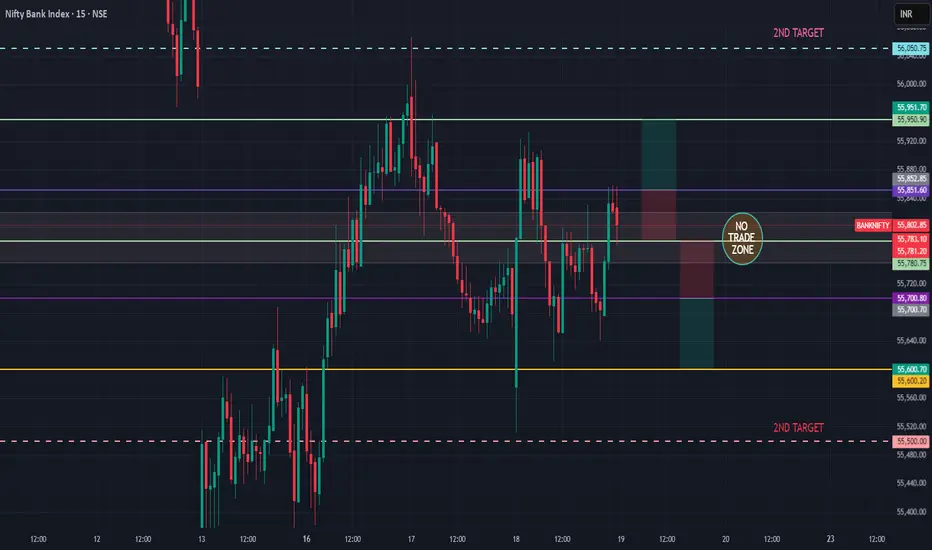
NIFTY BANK Intraday levels (Educational purpose only)📈 Upside Trade Setup (Long Entry):
Buy Above: 55,850
Entry Confirmation: 1-minute candle close above 55,850 with volume
Targets:
🎯 Target 1: 55,950
🎯 Target 2: 56,050
🎯 Target 3: 56,160
Stop Loss: 55,780
📉 Downside Trade Setup (Short Entry):
Sell Below: 55,700
Entry Confirmation: Strong red candle close below 55,700
Targets:
🎯 Target 1: 55,600
🎯 Target 2: 55,500
🎯 Target 3: 55,400
Stop Loss: 55,780
CITY UNION BANK - Buy above 188₹BUY BUY BUY CUB - Dont miss opportunity if 188₹ levels are broken
Ascending triangles tend to be bullish as they indicate the continuation of an upward trend. In some cases, they may point to the reversal of a downtrend. A descending triangle is bearish. That's because it points to the continuation of a downtrend or the reversal of an uptrend.
Kotak bank consolidation breakoutKotak bank breaking out from consolidation rectangle pattern of about 3.18Y. Rectangle is a continuous pattern and likely to continue the uptrend. Soon ATH breakout and would reach 161.8% fib level after pivot target of 2376.5. RSI also had a clear breakout in weekly timeframe. Also higher timeframe looks good.
YES BANK - TECHNICAL#yesbank stock has been under scrutiny due to its performance. It has seen a decline over four consecutive days, amounting to a total drop of 7.11% as of February 11, 2025. The stock is trading below several key moving averages, which might indicate broader market pressures or specific challenges for the bank.
#BANKNIFTY - 11 NOVEMBER !!NSE:BANKNIFTY
#NIFTYBANK ⚡
Observe, understand, then implement 👍🏻
Strategy name : Higher Highs and Higher Lows
This strategy is commonly used in trending markets to identify potential buy opportunities during an uptrend.
Key Components of the Strategy:
1. Higher Highs and Higher Lows: In an uptrend, price action creates successive peaks (higher highs) and troughs (higher lows). These are signals of bullish momentum, where buyers are consistently pushing prices higher.
2. Trend Channel: The image shows a channel formed by connecting the higher lows with a trendline (lower boundary) and higher highs with another trendline (upper boundary). This channel helps traders identify the price range within which the trend is moving.
3. Entry Points:
- The strategy suggests buying near the trendline at each higher low, which represents a potential support area within the trend. In the image, these points are marked as "BUY" or "ENTRY."
- Buying near these higher lows increases the chance of entering trades at favorable prices during pullbacks in the uptrend.
4. Profit Targets:
- Profit targets are set near the upper trendline or at subsequent higher highs. In the image, these points are marked as "PROFITS" with checkmarks.
- This method helps traders secure profits as the price reaches the higher end of the channel.
Managing the Trade:
- After the first entry and a successful profit, traders can re-enter the market on the next pullback to a higher low.
- Stop losses are typically placed below the previous higher low to manage risk in case the trend reverses.
Summary:
This strategy aims to capture gains in a trending market by entering trades at higher lows and exiting near higher highs within a channel. It works well in a stable, consistent uptrend but requires careful monitoring of trend changes to avoid potential losses if the trend breaks down.
Ps note : I'm not SEBI Registere 🙏🏻
Any queries @thetradeforecast 🇮🇳
State Bank of India for 40% gainsDate: 4 Nov’24
Symbol: SBIN
Timeframe: Weekly
SBI seems to be in Wave IV of 3 which could likely come down towards 750-740 levels. As seen in the chart, Wave V of 3 could then move up towards 1050 (~40% from where Wave IV ends).
Banks have been largely consolidating in this market fall and could lead the next rally up. Please note nothing in the market is a given. Be very watchful.
This is not a trade recommendation. Please do your own analysis. And I have the right to be wrong.
HINGLISH VERSION
Aisa lagta hai ki SBI 3 ki Wave IV mein hai jo lagbhag 750-740 ke star par samaapt ho sakti hai. Jaisa ki chart mein dikh raha hai, 3 ki Wave V phir 1050 ki taraf badh sakti hai (jahaan Wave IV samaapt hoti hai vahaan se ~40%).
Bazaar ki is giraavat mein Banking shares bade paimaane par majaboot hi rahe hain aur agli teji ka netritva kar sakte hain. Kripya dhyaan den ki bazaar mein kuch bhi pakka nahin hota. Hamesha satark rahein.
Yah koi trade lene ki salah nahin hai. Kripya apana vishleshan khud karen. Aur mujhe galat hone ka adhikaar hai.
BANKNIFTY: INSTITUTIONAL LEVELS FOR 22/10/2024QUICK GUIDE
- Use 5 minute timeframe
- Try to take enters at retest
- Use multiple confirmation
- Read full description before investing
- Try to take ATM options or above
Explanation:
This is a very useful trading system. This means that you should not take a trade blindly, but rather that there is another confirmation to take the trade you can use this for perfect entry and perfect exit
This trading opportunity is based on volume, previous price, and price range , are included
Entry/Exit point's:
- It has very easy entry and exit points
- In this pair of lines with two colors are given (RED AND BLUE)
- In this the blue line is used to take long entry and the red line is used to take short entry (But it is all based on a more conformation from your trading plan)
Stop Loss/Take Profit:
Stop Loss
- According to this, if you take a long trade, its stop loss will be the red line just below ( A trade can exit either when the price crosses the red line or the 5 minute candlestick crosses the red line. (This can be done according to your preference) )
- A short entry should use the opposite rules to a long entry
Take Profit
-When you take a long entry according to the profit to be booked is on the next red line above. ( Or if there are other reasons, it can be a safe exit )
- Opposite rules for booking profit on long entry are to book profit on short trade. ( The blue line above is the stop loss of short entry )
Timeframe:
According to this, the time frame you should use while taking trades is 5 minutes time frames . (5 minute time frame works well in this)
Risk Disclaimer:
Trading carries significant risk and is not suitable for all traders. You may lose some or all of your capital in a matter of minutes or hours. Market conditions can change rapidly, and prices can move against you quickly. You may not always be able to exit at a favorable price, and you may be required to hold a position overnight, exposing yourself to additional risk. Day trading involves high risk, high leverage, and high stakes, and you should only trade with funds you can afford to lose. Please carefully consider your financial situation, risk tolerance, and trading objectives before engaging in day trading.
Engagement:
Share your insights, ask questions, and learn from others in the community. Whether you're a seasoned pro or just starting out, we're all in this together.
What's your take on the current market conditions? Which trading strategies are working for you? Let's discuss and help each other grow as traders!
Comment below and let's get the conversation started!
Original Content:
This trading setup is the result of my own innovation and expertise, and is not based on any publicly available information or third-party systems. It is a reflection of my dedication to developing a competitive edge in the markets.
BANKNIFTY: INSTITUTIONAL LEVELS FOR 18/10/2024QUICK GUIDE
- Use 5 minute timeframe
- Try to take enters at retest
- Use multiple confirmation
- Read full description before investing
- Try to take ATM options or above
Explanation:
This is a very useful trading system. This means that you should not take a trade blindly, but rather that there is another confirmation to take the trade you can use this for perfect entry and perfect exit
This trading opportunity is based on volume, previous price, and price range , are included
Entry/Exit point's:
- It has very easy entry and exit points
- In this pair of lines with two colors are given (RED AND BLUE)
- In this the blue line is used to take long entry and the red line is used to take short entry (But it is all based on a more conformation from your trading plan)
Stop Loss/Take Profit:
Stop Loss
- According to this, if you take a long trade, its stop loss will be the red line just below ( A trade can exit either when the price crosses the red line or the 5 minute candlestick crosses the red line. (This can be done according to your preference) )
- A short entry should use the opposite rules to a long entry
Take Profit
-When you take a long entry according to the profit to be booked is on the next red line above. ( Or if there are other reasons, it can be a safe exit )
- Opposite rules for booking profit on long entry are to book profit on short trade. ( The blue line above is the stop loss of short entry )
Timeframe:
According to this, the time frame you should use while taking trades is 5 minutes time frames . (5 minute time frame works well in this)
Risk Disclaimer:
Trading carries significant risk and is not suitable for all traders. You may lose some or all of your capital in a matter of minutes or hours. Market conditions can change rapidly, and prices can move against you quickly. You may not always be able to exit at a favorable price, and you may be required to hold a position overnight, exposing yourself to additional risk. Day trading involves high risk, high leverage, and high stakes, and you should only trade with funds you can afford to lose. Please carefully consider your financial situation, risk tolerance, and trading objectives before engaging in day trading.
Engagement:
Share your insights, ask questions, and learn from others in the community. Whether you're a seasoned pro or just starting out, we're all in this together.
What's your take on the current market conditions? Which trading strategies are working for you? Let's discuss and help each other grow as traders!
Comment below and let's get the conversation started!
Original Content:
This trading setup is the result of my own innovation and expertise, and is not based on any publicly available information or third-party systems. It is a reflection of my dedication to developing a competitive edge in the markets.
AU BANK - This Range is No Joke !Please pay attention to the range 695 to 755
If there is reakout or breakdown then consider trading that side, also keep boosting or liking this so that I am reminded to trade the same too !
Honestly, In my opinion there is a great accumulation or distribution happening (I cant figure out between the two) but I surely know that this is the preparation for a trending move 100%.
Keep watching this script and believe me, I've seen these a lot of times.
ICT-3 ICT concepts coupled with price action
575 was the best entry as it formed a FVG after a MSS and sell side liquidity was taken out.
Au bank released its earnings and although profits fell, NPA,GPA were down as well showing strong management. NII was up 10% which is another major sign and it beat estimates.
Technical signals
Bullish flag with a bullish engulfing candle which is validated by volume and on the 50ema couples with ICT also trading makes it a high probability set up.
Keep It Simple
18 Apr - BankNifty Algos did well as it was not expiry todayBankNifty Analysis — Stance Bearish⬇️
“The power of a strong support/resistance zone will help you in your technical analysis” — Anonymous.
See what happened today, BN started strong and was keeping its head above the 47465 support for a long time. Between 10.19 to 10.31, there was an attempt to break this SR, but it failed. BN reclaimed the 47700 levels and was coasting perfectly when the flash crash happened. Between 13.23 to 13.27, BN gave away 557pts ~ 1.17% also ensuring the SR breach.
By 13.39, the breach was confirmed and BN continued its downward moves. A session low of 46982 was hit at 15.15 post which we had a 240+ pts recovery.
The last 4 candles on the 63mts TF are all red and the support of 47465 has yielded. I am yet to mark the next support level, which I will do by tomorrow. I wish to hold on to my bearish view for tomorrow as well.
The Algo on BN was in good shape till the 13.23 impact took away the gains. Ended the day with a loss of 40,724.
CANARA BANK LONG TRADEGood to buy CANBK @306-310
Stop Loss : 290
Targets : 320/340/360/400max+++
CANBK is taking good support from the trendline. Good breakout of Bearish trend in longer Timeframe.
Thanks.
Disclaimer: This idea is only for the Educational purpose. Trade at your own risk.
If you like the idea kindly support.