Bank Nifty – 1 Day Timeframe✅ Closing Summary:
Closing Price: ₹56,283.00
Change: −₹545.80 (−0.96%)
Opening Price: ₹56,524.25
Intraday High: ₹56,705.15
Intraday Low: ₹56,204.85
Bank Nifty showed broad weakness throughout the session, closing nearly 1% lower as major banking stocks came under pressure due to weak earnings and cautious sentiment in the financial sector.
🔍 Key Reasons for the Decline:
Earnings Pressure:
Axis Bank posted disappointing Q1 earnings, with higher non-performing assets and weaker loan growth.
This spooked investors, leading to sell-offs in other major banks like HDFC Bank, ICICI Bank, and Kotak Bank.
FIIs Turn Net Sellers:
Foreign Institutional Investors have been consistently selling financial stocks amid global uncertainty, which accelerated the downtrend.
Domestic buying was not strong enough to offset the outflows.
Global Economic Concerns:
Concerns about U.S. Fed interest rate hikes, inflation, and trade tensions globally made investors risk-averse.
Financials, being interest-rate sensitive, felt the brunt of the negative sentiment.
Technical Breakdown:
The index failed to hold above the crucial ₹56,500–₹56,700 range, which acted as a support in the previous few sessions.
This triggered technical selling and stop-loss hits.
📈 Technical Outlook (Short-Term):
Support Zone: ₹56,200 to ₹56,000
If this range is broken convincingly, the index could head toward ₹55,500.
Resistance Zone: ₹56,700 to ₹57,000
A move above this zone is needed for short-term recovery and renewed bullishness.
Indicators:
RSI (Relative Strength Index): Trending below 45, indicating growing bearish momentum.
MACD: Bearish crossover visible, confirming weakness.
Volume: Heavy selling pressure with above-average volumes shows institutional exit.
📆 Recent Trend Performance:
1-Day Return: −0.96%
1-Week Return: −1.12%
1-Month Return: +2.4%
6-Month Return: +14.8%
1-Year Return: +11.3%
Despite the day’s drop, medium- and long-term performance remains strong, backed by sector fundamentals and banking credit growth.
🧠 What Traders & Investors Should Know:
Intraday Traders: Can watch for bounce plays near the ₹56,200 zone, or short positions if ₹56,000 is broken with momentum.
Swing Traders: May wait for confirmation of reversal candles or bullish divergence in RSI before entering new long positions.
Long-Term Investors: Today’s fall could offer buy-on-dip opportunities, especially in quality private banks, provided fundamentals stay strong.
💬 Conclusion:
Bank Nifty faced strong bearish pressure in today’s session, largely due to disappointing bank earnings and negative institutional flows. With key support at ₹56,200 and resistance at ₹56,700–57,000, the next few days will be crucial to determine the short-term direction. If support holds, a technical bounce is possible. However, a breakdown below ₹56,000 could lead to deeper corrections
Forex
FinNifty – 1 Day Timeframe✅ Closing Summary:
Closing Price: ₹26,556.15
Change: −₹253.30 (−0.94%)
Opening Price: ₹26,809.45
Intraday High: ₹26,785.35
Intraday Low: ₹26,513.80
The FinNifty index saw a sharp drop today, primarily driven by weakness in key financial stocks and negative investor sentiment.
🔍 Key Reasons for the Decline:
Banking Sector Weakness:
One of the biggest drags was a major bank (e.g., Axis Bank) that reported weaker-than-expected quarterly earnings.
This led to panic selling in other banking and financial institutions as well.
Foreign Institutional Investors (FII) Selling:
Significant outflows from FIIs contributed to the negative sentiment.
Investors remained cautious ahead of upcoming major earnings reports and global cues.
Global Market Pressure:
Concerns about U.S. interest rate policies, inflation data, and global recessionary fears kept the broader financial market under pressure.
Psychological Level Break:
The index broke key psychological support around ₹26,600, triggering technical selling and increased volatility.
📈 Technical Outlook (Short-Term):
Support Zone: ₹26,500 to ₹26,400
This area provided some buying interest during the day, but a break below could open doors to ₹26,200 or lower.
Resistance Zone: ₹26,750 to ₹26,900
This region needs to be reclaimed for any positive momentum to sustain.
Momentum Indicators:
RSI (Relative Strength Index): Trending downward, approaching oversold conditions (~38–42).
MACD (Moving Average Convergence Divergence): Showing bearish crossover, confirming short-term weakness.
Volume: Above average during the sell-off, suggesting institutional participation in the decline.
📆 Recent Trend Performance:
1-Day Return: −0.94%
1-Week Return: −0.65%
1-Month Return: +1.35%
6-Month Return: +18.6%
1-Year Return: +13.4%
Despite the daily fall, the medium-to-long-term trend remains bullish, supported by overall strong fundamentals and earnings growth expectations.
🧠 What Traders & Investors Should Know:
Short-Term Traders: Should be cautious. Look for a bounce near the support zone for short-covering opportunities or fresh entries with tight stop-losses.
Swing Traders: May wait for confirmation of support holding at ₹26,500 before considering long trades.
Long-Term Investors: The decline could be seen as a healthy correction in an otherwise strong uptrend. Ideal for staggered buying in quality financial stocks.
💬 Conclusion:
FinNifty is currently experiencing short-term pressure due to earnings misses, global uncertainty, and FII outflows. However, its long-term chart remains constructive. Today’s 1-day candle represents a bearish move, but unless ₹26,400 breaks decisively, a recovery is possible in the coming sessions—especially if upcoming results from top banks like HDFC and ICICI meet or exceed expectations
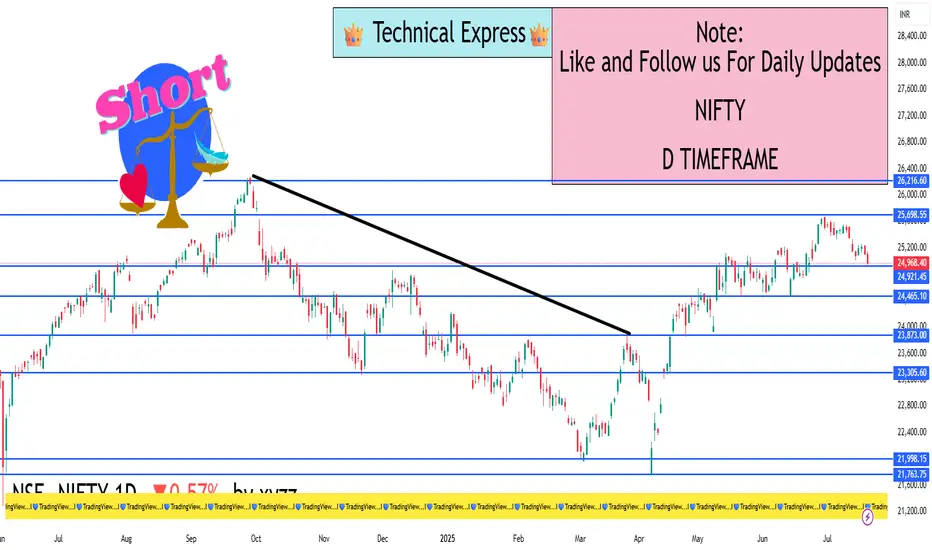
Nifty 50 – 1 Day Timeframe✅ Closing Summary:
Closing Price: ₹24,968.30
Change: −₹143.55 (−0.57%)
Opening Price: ₹25,108.55
Intraday High: ₹25,144.20
Intraday Low: ₹24,919.10
Nifty 50 traded in a narrow but bearish range throughout the session, losing nearly 0.6%, as market sentiment remained weak due to earnings pressure and global cues.
🔍 Key Reasons for the Decline:
Banking Sector Drag:
Major private sector banks like Axis Bank reported weaker-than-expected earnings, sparking a broad sell-off in financials.
Financial stocks make up a large portion of Nifty 50, pulling the entire index lower.
Cautious Investor Sentiment:
Global uncertainty regarding U.S. Federal Reserve interest rate decisions and economic slowdown concerns weighed on overall risk appetite.
Investors are also being cautious ahead of major Indian corporate earnings from companies like HDFC Bank, ICICI Bank, Reliance Industries, and others.
Foreign Institutional Selling (FII):
FIIs continued to sell Indian equities, especially large-cap financials and IT stocks.
This added selling pressure even as some domestic institutional investors tried to buy the dips.
Technical Weakness:
The index slipped below the 25,000 psychological support level, a sign of short-term technical weakness.
Intraday recoveries were capped near resistance, confirming the bearish tone.
📈 Technical Outlook (Short-Term):
Support Zone: ₹24,900 to ₹24,850
This is the next critical area. If broken, further decline toward ₹24,600 is likely.
Resistance Zone: ₹25,150 to ₹25,300
Bulls need to reclaim this zone for the trend to turn positive again.
Momentum Indicators:
RSI: Slipping below 45, showing weakening momentum.
MACD: Bearish crossover; trend remains under pressure.
Volume: Slightly above average, indicating serious selling interest at the top.
📆 Recent Trend Performance:
1-Day Return: −0.57%
1-Week Return: −0.35%
1-Month Return: +2.10%
6-Month Return: +12.8%
1-Year Return: +10.9%
Nifty 50 remains in a medium- to long-term uptrend, but short-term correction is underway, largely due to sector-specific drag and earnings volatility.
🧠 What Traders & Investors Should Know:
Day Traders: Watch for quick reversals near support at ₹24,900; consider shorting near resistance if recovery fails.
Swing Traders: Wait for either a bullish reversal candle or RSI bounce before entering fresh long positions.
Long-Term Investors: Despite the dip, the market remains healthy. This could be a buy-on-dip opportunity, especially in sectors like auto, pharma, and capital goods that are holding well.
💬 Conclusion:
Nifty 50 showed weakness on July 18 due to negative earnings surprises and bearish sentiment in financials. While technical indicators suggest short-term downside pressure, the broader long-term trend remains intact. Key support at ₹24,900 is crucial. A bounce from that zone can trigger a recovery, but a sustained break below it could accelerate the decline
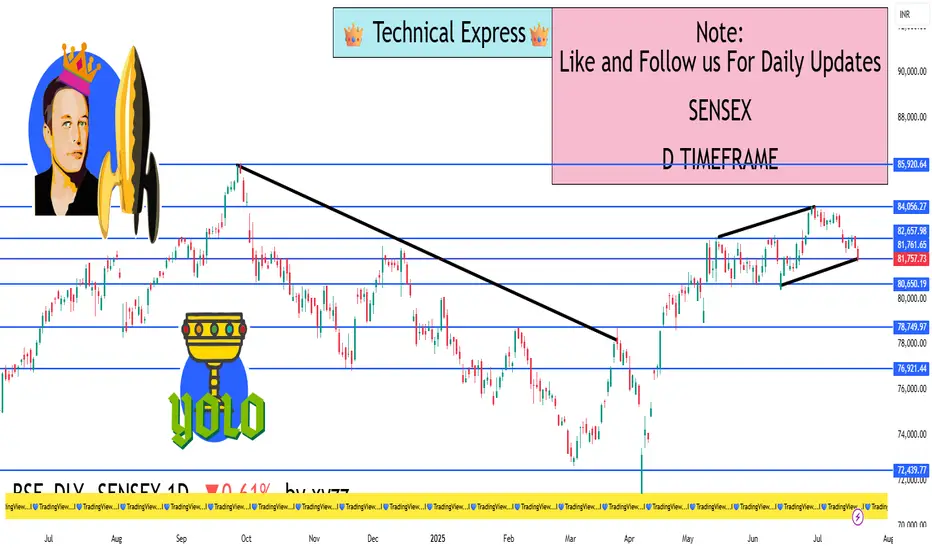
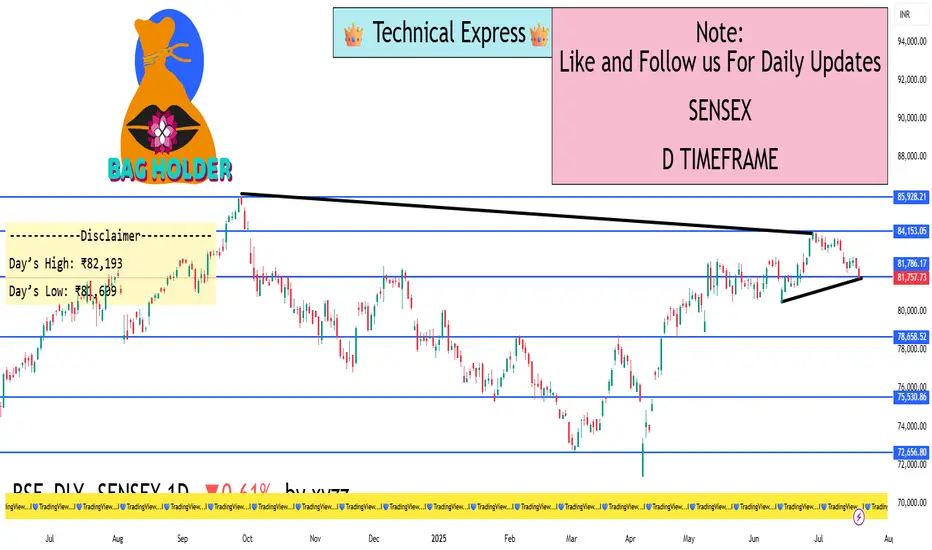
Sensex – 1 Day Timeframe✅ Closing Summary:
Closing Price: ₹82,540.65
Change: −₹501.34 (−0.60%)
Opening Price: ₹83,081.80
Intraday High: ₹83,114.95
Intraday Low: ₹82,488.25
The Sensex fell over 500 points, reflecting broad-based selling across banking, IT, and financial services. The index struggled to hold gains and faced resistance at higher levels throughout the day.
🔍 Key Reasons for the Decline:
Weak Earnings from Financials:
Axis Bank and other financial stocks reported disappointing quarterly results.
As financial stocks hold significant weight in the Sensex, this created negative sentiment across the board.
IT and Tech Sector Pressure:
Global uncertainty, U.S. Fed rate concerns, and weak guidance from global tech firms contributed to a fall in Indian IT stocks like Infosys and TCS, dragging the index.
Foreign Institutional Investor (FII) Selling:
FIIs were net sellers in July, putting pressure on large-cap blue-chip stocks.
Persistent outflows created downward pressure on the index despite support from domestic institutional buyers.
Global Market Cues:
Mixed global signals, rising oil prices, and uncertain interest rate outlooks kept risk sentiment subdued.
Caution ahead of major global economic data further prevented buying enthusiasm.
📈 Technical Outlook (Short-Term):
Support Zone: ₹82,300 to ₹82,000
This is a key demand zone. A breakdown below could lead to further downside towards ₹81,500.
Resistance Zone: ₹83,150 to ₹83,500
Any bounce-back will face selling near this region unless backed by strong buying volume.
Indicators:
RSI: Dropped below 45, indicating weakening strength.
MACD: Shows a bearish crossover, confirming short-term negative momentum.
Volume: Heavier than average, signaling increased institutional activity on the sell side.
📆 Recent Trend Performance:
1-Day Return: −0.60%
1-Week Return: −0.45%
1-Month Return: +1.85%
6-Month Return: +12.3%
1-Year Return: +11.7%
The index remains strong over the long term, but the short-term chart reflects a corrective phase amid sectoral weakness.
🧠 What Traders & Investors Should Know:
Short-Term Traders: Monitor the 82,300 level for signs of bounce or breakdown. Potential intraday setups are forming, but caution is advised.
Swing Traders: Wait for a confirmation candle—like a bullish engulfing or hammer—near the support before entering long positions.
Long-Term Investors: This correction may offer a healthy buy-on-dip opportunity, particularly in stocks with strong fundamentals in auto, capital goods, and FMCG sectors.
💬 Conclusion:
The Sensex declined nearly 0.60% due to earnings pressure from major financials and global uncertainty impacting IT and large-cap stocks. While the market sentiment remains weak in the short term, the long-term uptrend is still intact. Key support around ₹82,300 will determine the near-term direction. If held, a rebound may follow next week, especially if major earnings turn out better than expected.
Bitcoin (BTC/USD) – 1D Timeframe✅ Closing Summary:
Closing Price: ~$119,138 USD
Change: +$836 (+0.7%)
Opening Price: ~$118,302
Intraday High: ~$120,714
Intraday Low: ~$117,715
Bitcoin continued to show resilience by holding above the crucial $118,000 support level, despite facing overhead resistance near its previous high. The price action reflects bullish consolidation following recent surges above $120,000.
🔍 Key Reasons Behind the Price Action:
Institutional Demand Strengthening:
Bitcoin ETFs in the U.S. are witnessing rising inflows.
Hedge funds and family offices are seen increasing allocations, especially as digital assets gain legitimacy post-regulation discussions.
Regulatory Momentum:
U.S. Congress is pushing clearer frameworks around crypto taxation and stablecoins.
Global regulatory certainty (from EU & Japan) boosts confidence among investors and traders.
Weakening U.S. Dollar Index (DXY):
The DXY declined slightly, indirectly aiding BTC’s upward momentum.
Bitcoin remains a favored alternative store of value during fiat uncertainty.
Limited Miner Selling:
On-chain data shows a decline in miner distribution, meaning less sell-side pressure.
Miners seem optimistic about long-term prices and are holding reserves.
📈 Technical Outlook (Short-Term):
Support Zone: $117,500 to $118,000
Price found strong buyers in this range. It’s crucial that Bitcoin holds this level to maintain bullish structure.
Resistance Zone: $120,700 to $122,500
Previous highs around $122K serve as the next resistance. A daily candle close above this may trigger momentum buying.
Indicators:
RSI (Relative Strength Index): ~62 (bullish but not overbought)
MACD: Bullish crossover confirmed
Volume: Moderate, but above 20-day average
📆 Recent Trend Performance:
1-Day Return: +0.7%
1-Week Return: +2.1%
1-Month Return: +12.8%
3-Month Return: +35.4%
YTD Return: +61.2%
Bitcoin continues to outperform traditional asset classes, showing strong long-term growth despite short-term volatility.
🧠 What Traders & Investors Should Know:
Short-Term Traders: Consider range trading between $118K–$122K. Breakout above $122K may signal fresh upside potential.
Swing Traders: Watch for bullish continuation patterns (bull flags or cup-and-handle). Enter long if price closes above $121.5K on high volume.
Long-Term Investors: Accumulation at current levels could be ideal before the next halving cycle and broader adoption via ETFs and institutions.
🛠️ Chart Behavior and Candlestick Analysis:
Candle Type: Bullish candle with long lower wick, indicating buying pressure near support.
Pattern: Minor flag formation with potential breakout above $121K on next daily move.
🧭 Macro-Level Catalysts to Watch:
U.S. Bitcoin ETF weekly flows (Friday updates)
Fed interest rate guidance (next FOMC meeting)
Crypto regulation developments in U.S., EU, and APAC
On-chain metrics: exchange inflow/outflow, whale accumulation
💬 Conclusion:
BTC/USD is showing solid structure in the 1D chart. With strong institutional demand, improving global regulation, and technical support holding, Bitcoin is in a healthy uptrend. The short-term outlook remains bullish as long as BTC holds above $118K. A breakout above $122K could fuel the next leg towards $125,000–$130,000.
LEARN INSTITUTIONAL TRADING✅ What is Institutional Trading?
Institutional trading focuses on understanding how big money flows in the market. Institutions trade in huge quantities, and their strategies revolve around manipulating prices to collect liquidity, triggering stop-losses, and creating false breakouts. Retail traders often lose money because they follow trends without understanding the market structure set by these institutions.
✅ What You Will Learn in Institutional Trading
1. Smart Money Concepts (SMC):
Learn how smart money (institutions) traps retail traders using fake breakouts, stop hunts, and liquidity grabs.
2. Market Structure:
Higher Highs (HH), Higher Lows (HL), Lower Highs (LH), Lower Lows (LL)
Break of Structure (BOS) and Change of Character (CHOCH)
This helps you predict market direction with logic, not emotions.
3. Order Blocks:
These are zones where institutions place large orders. You’ll learn how to identify them and trade with the big players.
4. Liquidity Pools:
Find out where stop-losses and pending orders are sitting in the market so you can trade smartly by targeting liquidity zones.
5. Entry & Exit Strategies:
Master high-probability entry techniques and learn proper risk management like institutional traders.
✅ Why Learn Institutional Trading?
Retail Trading Institutional Trading
Random entries Planned entries based on logic
Easily manipulated Trades follow the footprint of big players
Low win rate Higher win rate with patience
Emotional trading Rule-based, stress-free trading
✅ Benefits of Mastering Institutional Trading
🎯 Accurate Trades – Follow the market makers.
💸 Better Risk-Reward – Small stop-loss, bigger targets.
⏰ Trade Less, Earn More – No overtrading, only quality setups.
🧠 No Indicators Needed – Pure price action and market reading.
✅ Who Can Learn Institutional Trading?
✅ Beginners who want to start right.
✅ Retail traders who keep losing.
✅ Part-time traders looking for consistency.
✅ Anyone serious about becoming a profitable trader.
✅ Final Words:
Institutional trading teaches you how to trade with the smart money instead of against it. Once you master these strategies, you will understand market moves like a professional and make more consistent profits
Technical Class✅ What You Learn in a Technical Class
1. Introduction to Technical Analysis
What is price action?
Difference between Technical and Fundamental Analysis
Basics of Candlestick Charts
2. Candlestick Patterns
Bullish and Bearish Patterns
Reversal Patterns (Doji, Hammer, Shooting Star)
Continuation Patterns (Flags, Pennants)
3. Chart Patterns
Double Top, Double Bottom
Head and Shoulders
Triangles (Ascending, Descending)
4. Indicators and Oscillators
Moving Averages (MA, EMA)
RSI (Relative Strength Index)
MACD (Moving Average Convergence Divergence)
Bollinger Bands
5. Support and Resistance
How to Identify Strong Support Zones
How to Use Resistance Levels for Entries/Exits
6. Trend Analysis
How to Spot a Trend (Uptrend, Downtrend, Sideways)
Trendlines and Channels
Breakouts and Fakeouts
7. Volume Analysis
Importance of Volume in Confirming Moves
Volume Spikes and Market Reversals
8. Risk Management
How to Protect Your Capital
Stop Loss and Take Profit Strategies
Risk-Reward Ratio
✅ Who Should Attend a Technical Class?
✅ Stock Market Beginners
✅ Intraday Traders
✅ Swing Traders
✅ Option Traders
✅ Anyone who wants practical market knowledge
Advance Option Trading✅ What is Advanced Options Trading?
At the advanced level, traders use option combinations, multi-leg strategies, and hedging techniques to:
Maximize profits
Minimize risks
Take advantage of market volatility and time decay (Theta)
You don’t just predict direction; you trade direction, volatility, and time decay together.
✅ Core Concepts in Advanced Options Trading
1. Greeks Mastery
Delta: Measures how much the option price moves with the underlying asset.
Gamma: Rate of change of Delta.
Theta: Time decay — how much the option loses value every day.
Vega: Sensitivity to volatility changes.
Rho: Impact of interest rate changes (used less by retail).
Understanding Greeks helps you manage profits and risks more precisely
3. Volatility Trading
Institutions trade implied volatility (IV), not just price direction. Advanced traders use tools like IV Rank and IV Percentile to:
Sell options when IV is high (premium rich)
Buy options when IV is low (cheap options)
4. Hedging Techniques
Use options to protect your portfolio from major losses.
Example: Holding stocks and buying Protective Puts to limit downside risk.
Example: Selling Covered Calls to generate monthly income on stock holdings.
✅ Benefits of Advanced Options Trading
💸 Profit in Any Market Condition (up, down, sideways)
⏳ Earn from Time Decay (Theta Decay)
🛡️ Control Risk with Defined Risk Strategies
🎯 Higher Probability of Consistent Returns
📉 Less Capital, More Leverage
✅ Who Should Learn Advanced Option Trading?
✅ Traders with basic options knowledge
✅ Investors wanting to hedge portfolios
✅ Intraday or positional traders
✅ Those seeking consistent monthly income
✅ Final Thoughts
Advanced Options Trading transforms you from a simple buyer/seller to a strategic trader who uses market forces smartly. You don’t chase trades — you set up calculated, high-probability positions and let the market work for you.
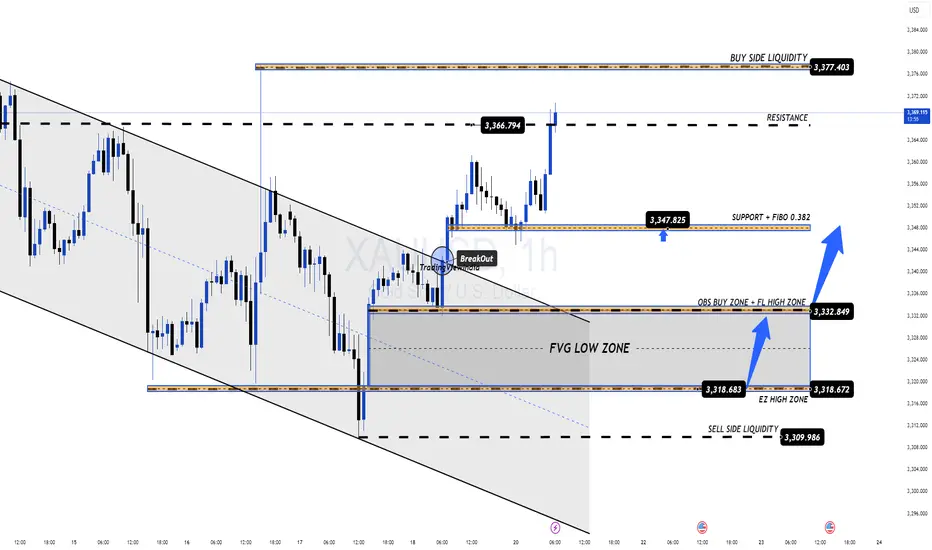
Gold's Short-Term DeclineHello everyone, what do you think about gold?
Today, gold continues its short-term downtrend. After new data was released at the end of yesterday’s trading session, the USD rose by 0.3%, and U.S. Treasury yields also increased, reducing the appeal of gold. Additionally, the latest unemployment claims data shows improvement in the U.S. economy, which has contributed to the drop in the precious metal.
As of writing, gold is trading around the EMA 34, 89 levels at 3,336 USD. With the recent news, the market is expected to maintain its current stance throughout the day, as no new significant updates are expected.
From a technical standpoint, the downtrend remains in place, with prices continuing to be capped below the trendline. The series of lower highs and lows could likely lead XAUUSD to test lower levels, with the possibility of reaching the 3,300 USD mark.
What do you think about the price of gold today? Let us know in the comments!
Gold Weekly Recap – XAU/USD OutlookOANDA:XAUUSD experienced sharp volatility last week as investors reacted to escalating U.S. tariff announcements and shifting expectations around the Federal Reserve’s rate policy. Although prices dropped early in the week, gold quickly bounced back with three consecutive bullish sessions—highlighting strong buying interest amid growing inflation fears and trade tensions.
Analysts remain split: half foresee more upside, while others maintain a neutral stance. Yet, most agree on one thing—gold continues to serve as a defensive fortress during times of uncertainty, especially with markets grappling with both fiscal and monetary headwinds.
Technically, gold is fluctuating within a tight range around 3,360 USD. While no clear breakout from consolidation has occurred, supportive factors like a weakening U.S. dollar, the U.S. national debt surpassing 37 trillion dollars, and safe-haven inflows from reserve funds are helping keep prices stable.
📍If upcoming CPI data or new tariff announcements from the U.S. further pressure the dollar, gold could test the 3,400 resistance level. Otherwise, a sideways trend may dominate if negative news is absorbed smoothly.
Trend Bias: Neutral – leaning bullish if 3,300 holds strong.
So, are you siding with the bulls or waiting for a clear breakout?
Drop your thoughts in the comments! 💬
Gold Prices Volatile Amid Economic Data and Trade TensionsGold prices saw strong fluctuations yesterday, dropping near 3,320 USD/ounce before quickly recovering and rising to 3,370 USD/ounce, a difference of about 50 USD, fueled by U.S. PPI data. However, by the end of the session, the price dropped back and is now trading around 3,340 USD/ounce, with little change compared to the same time yesterday.
The U.S. June PPI rose 2.3% year-on-year, lower than May's 2.6% increase and the forecasted 2.5%. Core PPI rose 2.6%, also lower than May's 3% and the forecasted 2.7%. Month-on-month, the PPI remained unchanged at 0%, below the 0.3% increase in May and the forecasted 0.2%, while core PPI also held steady.
This data suggests that inflation may decrease, especially after the U.S. adjusts its tax policies. Markets expect the Fed to cut interest rates in September, weakening the USD. Additionally, trade tensions between the U.S. and the EU have intensified after President Trump announced a 30% tariff on European imports, prompting a similar response from the EU.
These factors are driving investors back into gold as a safe-haven asset. Gold is expected to continue consolidating in anticipation of a potential breakout.
Gold’s Next Move After False Headlines & Liquidity sweepXAUUSD 17/07 – MMF Insights: Gold’s Next Move After False Headlines & Liquidity Sweep
🧭 Market Sentiment: Macro Distractions Fuel Uncertainty
The gold market remains under pressure as conflicting geopolitical news and central bank rumors stir volatility. The week opened with rumors that Donald Trump might fire Fed Chair Jerome Powell, sending temporary fear across markets. While Trump later denied the claim, the damage was already done – sentiment remains fragile.
Other active drivers:
Israel’s airstrikes in Syria increase global tension.
EU proposes tariffs on US imports, adding trade friction.
BlackRock warns of delayed inflation pressure as tariffs begin impacting electronics & consumer goods.
💡 All these elements support gold’s potential role as a hedge, but technical signals suggest the market remains undecided.
🔍 MMF Technical Flow Outlook
According to MMF analysis, price structure is unfolding in line with expected liquidity sweeps and order block reactions:
Price rejected from key supply zones near 3,342 – 3,344 (OB + CP structure).
Current bounce around 3,330 – 3,320 signals possible accumulation.
If buyers hold above 3,310, we may see price test the upper OB/VPOC zones again.
Break below 3,310 opens the door toward the MMF liquidity trap zone at 3,296 – 3,294.
🎯 Trade Plan – Precision Entries
🟩 Buy Zone
Entry: 3,312 – 3,310
Stop Loss: 3,306
Take Profits:
→ 3,316 → 3,320 → 3,324 → 3,328 → 3,335 → 3,340 → 3,350
✅ This zone aligns with MMF liquidity retention and H1 continuation structure. Watch for bullish confirmation candles before entry.
🟥 Sell Zone
Entry: 3,362 – 3,364
Stop Loss: 3,368
Take Profits:
→ 3,358 → 3,354 → 3,350 → 3,345 → 3,340
⚠️ Ideal for short-term scalping or reversal confirmation setups. Rejection at VPOC or CP structure validates this zone.
⚠️ Key Notes for Indian Traders
Today’s sentiment is fragile and can shift fast with any unexpected statement from US Fed or geopolitical update.
Apply MMF structure in lower timeframes (M15/H1) for cleaner confirmation.
Avoid early entries. Wait for reaction signals near the marked zones.
💬 What Do You See Ahead?
Will MMF signals lead the market toward the deep FVG zone around 3,296?
Or are bulls getting ready to reclaim 3,360+ zones?
👇 Share your view and let’s trade smarter together with MMF precision.
KOTAKBANK 1D TimeframeWhy KOTAKBANK?
Kotak Mahindra Bank is one of India’s most reputed private banks. It’s known for its conservative lending practices, healthy balance sheet, and strong retail plus corporate banking mix. Over the past few quarters, the bank has focused on digital transformation, stable asset quality, and maintaining margins despite rising interest rate pressures. Because of this, it’s always on the radar of long-term investors.
Now in 2025, with the financial sector showing resilience, KotakBank is gaining attention again—especially among those looking to buy on dips or add during consolidation phases.
✅ Current Price Range
As of mid-July 2025, KotakBank is trading near ₹2,185–₹2,190.
On the 1-day chart, it is showing signs of sideways consolidation with support at lower levels and limited upside pressure—this is perfect for long-term accumulation.
🔍 Key Investment Levels (Support & Resistance)
Let’s break it down into zones:
🟩 Support Zones (Ideal Buy Areas)
These are the levels where buyers often enter and prices tend to bounce back.
₹2,160 – ₹2,175
→ This is your first buy zone. It’s a cushion where the price may fall and stabilize before heading back up. Great for small quantity entry.
₹2,140 – ₹2,154
→ A stronger support zone. If the stock dips further, this is where serious long-term buyers often start accumulating. This level has held up multiple times in the past few months.
₹2,125 – ₹2,130
→ This is the last major support level on the daily timeframe. If the price falls below this zone, it might signal short-term weakness, and one should be cautious or wait for stability.
🟥 Resistance Zones (Profit Booking Areas)
These are levels where the stock might face selling pressure, especially short-term traders looking to book profits.
₹2,194 – ₹2,196
→ This is the first resistance area. If you’re already holding from lower levels, consider partial profit booking here.
₹2,209 – ₹2,228
→ A stronger resistance zone. This has acted as a ceiling for the stock recently. If KotakBank closes above this with strong volume, it may break out for fresh highs.
Above ₹2,228
→ If the stock closes above this level on the daily chart, it could start a new rally towards ₹2,260–₹2,300 zone. This level becomes a breakout confirmation point.
🧠 How to Use These Levels (Simple Plan)
🟢 If You’re a Long-Term Investor:
Start buying small quantities if KotakBank dips to ₹2,160–₹2,175.
Add more at ₹2,140–₹2,154 only if market sentiment remains stable.
Stop-loss: If price goes below ₹2,125 and stays there, pause further buying. It may need time to consolidate.
🔵 If You Already Hold the Stock:
Watch for price to approach ₹2,194–₹2,228.
Book partial profits if you’re short-term focused.
If it breaks above ₹2,228, consider holding more or adding for the breakout rally.
Keep trailing your stop-loss upward as the price moves.
📈 Price Behavior (Technical Summary)
Trend: Currently neutral to slightly bullish.
Volume: Not too aggressive, but steady—shows strong hands are holding.
Momentum: RSI (Relative Strength Index) near 50–55 zone on daily timeframe; neither overbought nor oversold.
Volatility: Controlled; perfect for accumulation, not short-term speculation.
📝 Final Thoughts – Human Summary
KotakBank is not in a breakout mode right now, but it’s forming a base.
If you’re a long-term investor, this is the kind of setup you wait for: clear supports, low volatility, and no hype.
The ₹2,140–₹2,175 area is your opportunity zone.
Just make sure to manage your risk below ₹2,125 and don’t go all-in at once. Gradual accumulation works best in these setups.
If it breaks ₹2,228, get ready for action. That’s your green signal for the next rally
HDFCBANK 1d investment levelKey Support (Buy-on-Dip) Levels
(Where buyers tend to show up)
₹1,985 – ₹1,986 (S1 – Classic Pivot)
First support zone based on classic pivot calculations
₹1,973 – ₹1,974 (S2 – Fibonacci Pivot)
Stronger cushion in case of deeper pullbacks
₹1,954 – ₹1,955 (S3 – Classic Pivot)
Final buffer zone—breaking it may signal deeper weakness
🚧 Key Resistance (Profit-Taking) Levels
(Where selling might appear)
₹2,015 – ₹2,016 (R1 – Classic/Fibonacci Pivot)
Immediate resistance and possible profit-booking zone
₹2,033 – ₹2,034 (R2 – Classic/Fibonacci Pivot)
Next hurdle; be prepared to take partial profits
₹2,045 (R3 – Classic Pivot)
A stronger resistance zone; breaking it could signal fresh upside
🎯 Action Tips
Buying: Enter around ₹1,985, and add at ₹1,973 if dip deepens. Use ₹1,954 as a stop-loss trigger.
Selling (Profit Booking): Trim part of your position near ₹2,015, and more near ₹2,033–₹2,045 if momentum slows.
Breakout Strategy: A clean daily close above ₹2,045 with volume may trigger fresh upside moves.
Risk Control: If price dives below ₹1,954, re-evaluate—broader market risk may be rising.
🧠 Why These Levels Matter
Pivot levels are watched closely by traders and algorithms, making them natural turning points in daily price action
HDFC Bank’s technical signals are currently neutral to slightly bearish, making dip-buying near supports more advantageous than chasing highs .
✅ Final Word (Plain Language)
Look to buy dips in the ₹1,985–1,974 range with a tight stop below ₹1,954.
Take profits around ₹2,015 and ₹2,033–₹2,045 based on your risk appetite.
Watch closely above ₹2,045—that’s your breakout level for potential new highs
BANKNIFTY 1D TimeframeCurrent Context
The index is trading near 56,900 – 57,000. Overbought signals have appeared but the overall trend remains bullish to neutral
🔄 Classic Pivot Points for Bank Nifty (Today)
Level Value Description
R1 57,323.5 First resistance—sell/reduce on strength
Pivot 57,180.7 Central bias: above = bullish, below = cautious
S1 57,070.75 First support—gentle dip-buy zone
S2 56,927.95 Deeper support—stronger buy zone
S3 56,818 Last buffer before bearish risk increases
🛡️ Support Zones (Where Buyers Typically Step In)
₹57,070 – ₹57,080 (S1): Good for light entries on dips
₹56,930 – ₹56,940 (S2): Solid zone to add more
₹56,818 (S3): Final defense—watch carefully for breakdown risk
🚧 Resistance Levels (Where Profit Booking May Kick In)
₹57,323 (R1): Near-term ceiling—consider booking profit
Above ₹57,323 with follow-through: Momentum may push toward R2 (~57,600–57,700)
🎯 Simple Strategy Guide
✅ If You’re Holding:
Stay invested while above 57,070.
Consider trimming near 57,320–57,400, especially if signs of overbought persist.
🟢 Looking to Buy the Dip?
Start buying at dips to 57,070–57,080 (S1).
Add more near 56,930–56,940 (S2) if momentum stays healthy.
🔵 Breakout Play:
A clean close above 57,323 with volume could open momentum to 57,600–57,700.
You can add post-breakout with confidence.
🛑 Risk Control:
If Bank Nifty closes below 56,818 (S3), reel in exposure—market direction may turn uncertain.
🧭 Quick Snapshot
Support: 57,070 → 56,930 → 56,818
Resistance: 57,323 → 57,600+ on breakout
Action Zones:
Buy zones: 57,070 / 56,930
Book profits: ~57,323
Add on breakout: above 57,323
🧠 Why Use These Levels?
Pivot-based zones are widely used by traders and algos, acting as natural turning points in daily price action
. Combining them with observed overbought conditions gives you a structured approach: buy smart, book gains, and manage risk effectively.
NIFTY 1D TimeframeToday’s Pivot Levels & Zones
(Data sourced from Moneycontrol – based on previous day’s trading range)
Level Type Price (₹)
Pivot Point 25,196
Resistance 1 (R1) 25,271
Resistance 2 (R2) 25,330
Resistance 3 (R3) 25,405
Support 1 (S1) 25,137
Support 2 (S2) 25,062
Support 3 (S3) 25,003
🛡️ Support Levels (Potential Buy Zones)
₹25,137 (S1) – The first support level where buying interest usually emerges during mild pullbacks.
₹25,062 (S2) – A deeper support and safer buying zone if the dip extends.
₹25,003 (S3) – Significant support; break below this may signal deeper correction.
🚧 Resistance Levels (Exit or Caution Zones)
₹25,271 (R1) – Immediate ceiling where profit-taking could occur.
₹25,330 (R2) – Next hurdle; a daily close above this could spark a bullish breakout.
₹25,405 (R3) – Major resistance; a strong move past this would pave the way for higher targets.
✅ How to Trade or Invest Based on These Levels
🔹 If You’re Already Holding
Stay invested while Nifty trades above ₹25,062 (S2).
Consider trimming positions around ₹25,271–25,330 on strength.
🟢 Looking to Buy on Dips?
Enter in tranches at S1 ₹25,137, and add more at S2 ₹25,062.
If Nifty drops toward S3 ₹25,003, you can accumulate more conservatively.
🔵 Planning for a Breakout?
A clean daily close above R2 (₹25,330) can be a signal to add strongly.
Post-breakout, the next target is R3 at ₹25,405.
🛑 Risk Management
If Nifty falls below ₹25,003 (S3), consider reducing exposure—trend bias may shift downward.
🎯 Quick Strategy Summary
Buy Zones: ₹25,137 → ₹25,062
Profit Zones: ₹25,271 → ₹25,330
Breakout Target: Clear above ₹25,330 → aim for ₹25,405
Watch-Out Level: Break below ₹25,003 → trend at risk
SENSEX 1D TimeframeCalculated Pivot Levels for Today
Classic Pivots:
Resistance 1 (R1): 82,831.8
Resistance 2 (R2): 83,029.2
Resistance 3 (R3): 83,273.7
Pivot Point (PP): 82,587.4
Support 1 (S1): 82,390.0
Support 2 (S2): 82,145.6
Support 3 (S3): 81,948.2
Fibonacci Pivots:
R1: 82,756.2
R2: 82,860.4
R3: 83,029.2
PP: 82,587.4
S1: 82,418.6
S2: 82,314.4
S3: 82,145.6
Camarilla Pivots:
R1: 82,675.0
R2: 82,715.5
R3: 82,756.0
PP: 82,587.4
S1: 82,594.0
S2: 82,553.5
S3: 82,513.0
📊 Why These Levels Matter
Pivot Point (PP) is the central reference — if Sensex trades above it, bias is bullish; below → bearish
Support Levels (S1–S3): potential zones to buy on dips.
Resistance Levels (R1–R3): profit-booking zones or areas where upside may pause.
🧭 How to Use This Today
✅ Trade Ideas
If Sensex stays above 82,587, the trend is positive — look to hold or buy dips.
Ideal dip buys:
Around 82,390–82,400 (S1) for gentle pullbacks.
82,145–82,150 (S2) for deeper retracement buyers.
🚀 Upside Strategy
Consider booking partial gains near 82,831–83,029 (R1–R2).
On breakout above 83,029, next target is 83,273–83,300 (R3).
🛑 Risk Control
If Sensex closes below 81,948 (S3), broader market risk rises — consider reducing exposure
Key Takeaway (Simple Terms)
Above 82,587? Trend remains upbeat — look for dip-buying opportunities.
Between S1 and PP (82,390–82,587)? Good entry zone for cautious buying.
Between R1 and R2 (82,831–83,029)? A likely profit-taking region—watch closely.
Breakouts above 83,029? Potential for new highs (up to R3).
Drop below S3 (81,948)? Consider tightening risk—market may shift downward
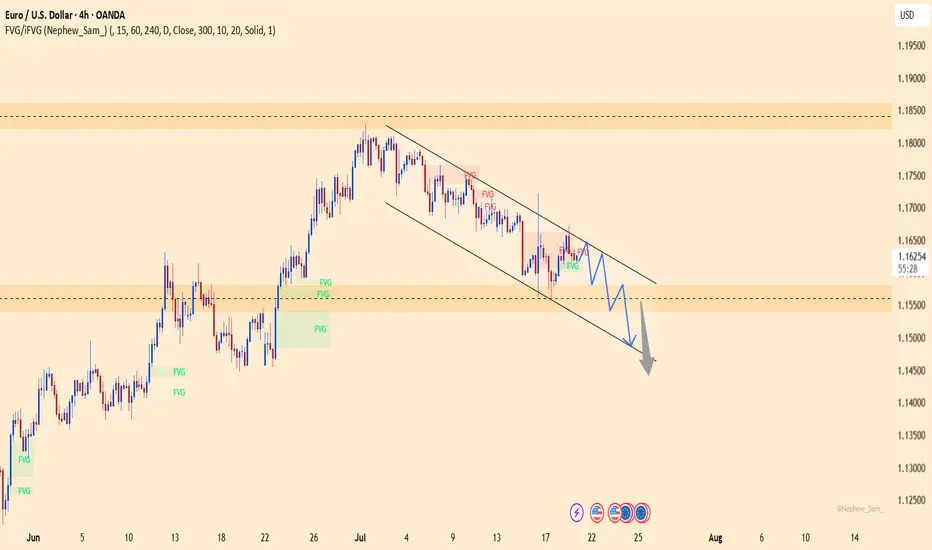
Euro Slips Further as Safe-Haven Demand for USD GrowsThe EUR/USD pair is facing strong selling pressure as global financial markets continue to reel from geopolitical and trade-related tensions. The Euro is weakening as investors increasingly turn to the U.S. Dollar as a safe haven, following a series of aggressive tariff policies announced by the United States.
Adding to the Euro’s struggles is the lack of positive economic data from the Eurozone, which has further diminished hopes for a meaningful recovery. Traders are now closely watching for monetary policy signals from both the ECB and the Federal Reserve, but so far, the bearish trend remains firmly in place.
On the technical front, EUR/USD continues to move within a descending channel, while the bearish crossover of the EMA 34 and 89 keeps sellers in control. With risk sentiment leaning defensive and capital flowing toward safe-haven assets, the pair may see further downside unless surprise bullish catalysts emerge from upcoming data or central bank remarks.
BTCUSDT – Breakout confirmed, bullish momentum continuesBTCUSDT has officially broken above a long-standing resistance channel, confirming a breakout and establishing a base around the nearest Fair Value Gap. The price action maintains a clear uptrend structure with consecutive higher lows and higher highs, supported by consistent buying pressure after minor pullbacks.
In terms of news, the U.S. decision to temporarily delay stricter regulations on spot Bitcoin ETFs, along with stable interest rate signals from the Fed, has boosted market sentiment. Capital continues to flow into crypto, especially as altcoins show limited recovery, making BTC the preferred asset.
As long as BTCUSDT holds above the nearest support zone, the pair is likely to advance toward the next psychological resistance. Any pullbacks could offer a buy-on-dip opportunity in line with the current trend.
EUR/USD Under Pressure: Will the Downtrend Continue?The EUR/USD exchange rate remains under pressure today, fluctuating below the 1.1700 level as the U.S. dollar gains strength following President Trump's announcement of new tariff letters directed at his two largest trade partners, boosting demand for safe-haven assets.
The downtrend may be further reinforced in the near term, if not in the short run. On the chart, a wedge pattern is forming, and breaking this pattern could add fresh momentum to EUR/USD.
Do you agree with my view?
Leave your comments below and don’t forget to like the post for extra luck!
Gold XAUUSD Trading Strategy on July 16, 2025Gold XAUUSD Trading Strategy on July 16, 2025:
Yesterday's trading session was in line with our prediction, the gold price corrected strongly after meeting the resistance zone of 336x. However, the support zone of 333x did not help the gold price continue to maintain the sideway range.
Basic news: The US CPI reached 2.7%, higher than the forecast of 0.1% and higher than the previous 0.3%; positively affecting the USD, helping the gold price to decrease sharply.
Technical analysis: Currently, the gold price has broken the sideway range of 3335 - 3375 and is likely to compress in the 3300 area. RSI of the H1, H4 and D1 time frames are moving towards the buying zone. This could be a good long-term trading opportunity for us.
Important price zones today: 3338 - 3343, 3350 - 3355 and 3300 - 3305.
Today's trading trend: SELL (BUY hold).
Recommended orders:
Plan 1: SELL XAUUSD zone 3341 - 3343
SL 3346
TP 3338 - 3328 - 3318 - 3308.
Plan 2: SELL XAUUSD zone 3353 - 3355
SL 3358
TP 3350 - 3340 - 3330 - 3300.
Plan 3: BUY XAUUSD zone 3300 - 3302
SL 3297
TP 3305 - 3315 - 3335 - 3350 - Open (small volume).
Wish you a safe, favorable and profitable trading day.🌟🌟🌟🌟🌟
Tech & Digital Transformation (AI, Automation, EV)Introduction
We live in a time where machines can think, cars can drive themselves, and businesses are run by algorithms and automation. This isn’t a sci-fi movie — it’s happening now.
In 2025, the technology and digital transformation wave is in full swing in India. From Artificial Intelligence (AI) to robotic automation, and from electric vehicles (EVs) to cloud-based services, industries across the board are being reshaped.
This isn’t just about fancy tech buzzwords. It’s about:
Creating new businesses
Changing how old industries operate
Giving rise to new investment and trading opportunities
Let’s break down this major trend in a way that’s simple, clear, and real — so whether you’re a trader, investor, student, or entrepreneur, you’ll understand exactly what’s going on and how you can benefit.
🔍 What Is Digital Transformation?
Digital Transformation means using technology to make businesses smarter, faster, and more efficient.
For example:
A factory installs sensors and AI software to reduce waste
A hospital uses AI to detect diseases faster
A cab company replaces petrol cars with electric vehicles and uses an app to manage rides
It’s not just about using computers — it’s about rethinking how we do things using modern technology.
🚀 What’s Driving the Tech Transformation in 2025?
Let’s look at what’s fueling this massive shift:
✅ 1. Government Support & Policies
India’s government is pushing hard for:
AI adoption in governance, education, and healthcare
EV ecosystem with PLI schemes, subsidies, and charging infra
Digital India 2.0 for internet access, 5G, and digital services
This strong policy backing is giving tech companies the freedom to scale quickly.
✅ 2. Rise of Young Tech-Savvy Population
India has over 700 million internet users and a median age of 29. That means:
More digital consumption
More startups building tech products
More users adopting AI, EVs, and online services
✅ 3. Global Tech Trends Are Local Now
AI models like ChatGPT, MidJourney, and Copilot are being used in:
Schools
Small businesses
Customer service
Indian firms are localizing this tech — using it for regional languages, agriculture, finance, etc.
✅ 4. Corporate India Is Adopting Automation
From TCS to Tata Steel, companies are:
Automating HR, finance, supply chains
Using AI for predictive maintenance and demand forecasting
Adopting cloud computing for scale and security
This saves time, reduces cost, and improves profits — which markets love.
🧠 Let’s Dive Into 3 Key Areas
1️⃣ Artificial Intelligence (AI)
💡 What is AI?
AI is when machines are programmed to “think” like humans — they learn from data and make smart decisions.
Examples:
Google Maps finding fastest routes
YouTube recommending videos
Chatbots answering your bank queries
Indian AI Stocks to Watch
Tata Elxsi – AI in automotive, healthcare, media
Persistent Systems – AI in BFSI and digital transformation
Happiest Minds – AI-powered automation, analytics
LTTS (L&T Tech) – AI in industrial automation
Cyient DLM – Smart systems for defence and manufacturing
📈 Why AI Is a Hot Investment Theme
AI is not just a cost-saver — it creates entirely new business models
Global demand is exploding (even SMEs are adopting it)
India has rich data + cheap talent = AI leadership potential
2️⃣ Automation & Robotics
🤖 What is Automation?
Automation is when machines or software handle repetitive tasks without human help.
From factory robots to chatbots, automation is everywhere.
🏭 Where India Is Using Automation in 2025
Smart Factories: Robots assembling products, AI managing inventory
Warehousing: Amazon-style automated fulfillment
Banks: Robotic Process Automation (RPA) for account management, KYC
Transportation: Drones for delivery, automated traffic systems
🧑💼 Impact on Jobs & Skills
While some repetitive jobs may reduce, automation is creating new roles in:
Robotics management
AI training and supervision
Tech repair and integration
Data analytics
In short: Humans + Machines = Powerful combo
📊 Indian Automation Stocks to Watch
ABB India – Robotics & factory automation
Honeywell Automation – Process control tech
KPIT Tech – Automotive software automation
LTTS – Industrial and smart city automation
Tata Elxsi – Automation in EVs, healthcare, and rail
3️⃣ Electric Vehicles (EVs)
⚡ What are EVs?
EVs are vehicles powered by electric batteries instead of petrol/diesel.
They are:
Cleaner (no tailpipe emissions)
Cheaper to run (₹1/km vs ₹6/km for petrol)
Quieter and more efficient
🚗 Why India Is Going Electric in 2025
High petrol/diesel prices
Pollution control targets
Government incentives (FAME II, state subsidies)
Massive charging infra expansion
🏭 Companies Driving the EV Revolution
EV Manufacturers:
Tata Motors – India’s EV leader (Nexon EV, Tiago EV)
Mahindra & Mahindra – Born-EV architecture
Ola Electric – Two-wheelers and upcoming EV cars
Battery & Charging:
Exide Industries
Amara Raja Energy
Servotech Power
HBL Power Systems
Ancillary (parts, controllers, software):
Sona Comstar
Samvardhana Motherson
Electra EV (private)
📈 EV Investment Trend
Investors are eyeing battery tech, charging infra, and lightweight materials
Many EV stocks are already multi-baggers
PLI Scheme for battery storage and EV parts = big boost
📊 Performance Snapshot: Tech & Digital Leaders (Jan 2023 – July 2025)
Stock Jan 2023 Price July 2025 Price Approx. Gain
Tata Elxsi ₹6,500 ₹10,200 57%+
LTTS ₹3,800 ₹6,200 63%+
KPIT Tech ₹750 ₹1,560 108%+
Persistent Systems ₹4,000 ₹6,850 71%+
Servotech Power ₹45 ₹210+ 360%+
Tata Motors ₹400 ₹950+ 130%+
🧭 The Bigger Picture: Digital India 2.0
The Indian government is pushing:
5G/6G rollout
Smart city automation
AI in governance
Digital healthcare
Universal EV adoption by 2030
All of this means huge tailwinds for technology companies, startups, and R&D investments.
✅ Final Thoughts
The Tech & Digital Transformation theme in 2025 is not a bubble — it’s a fundamental shift in how India works, moves, learns, and grows.
AI is no longer future tech — it’s today’s business driver.
Automation is making Indian industries globally competitive.
EVs are no longer a dream — they’re on every city road.
This megatrend is not going away anytime soon. Whether you’re an investor, trader, or entrepreneur, now is the time to understand, explore, and ride the digital wave
Power & Utilities in 2025 Introduction: Why Power & Utilities Are Buzzing in 2025
Imagine running a growing city — there are electric buses on the roads, factories running 24/7, smart homes everywhere, and electric cars being charged in every neighborhood. Behind all of this is one invisible but powerful engine: electricity.
In 2025, India's power and utility sector is not just surviving — it is booming, evolving, and attracting massive investor interest. Whether it’s traditional power giants like NTPC or new-age energy plays like Tata Power and Servotech, this space is heating up because:
Power demand is at an all-time high
Government support is stronger than ever
Clean energy goals are transforming old players
The PLI scheme (Production Linked Incentive) is pushing domestic manufacturing
This is not just another sectoral rally — it's a structural shift. Let’s explore what’s driving this change and what it means for traders and investors in simple language.
🔌 What Is the Power & Utilities Sector?
The power and utilities sector includes companies that:
Generate electricity (thermal, hydro, solar, wind, nuclear)
Transmit and distribute it to homes, businesses, and factories
Make components like transformers, wires, batteries, solar modules
Operate infrastructure like smart grids, substations, power lines
These are the companies that light up India, literally.
Traditionally, this sector was slow-moving and PSU-dominated. But now, with renewables, EV charging, energy storage, and smart grids, it’s become a major growth story.
🌟 What’s Driving the Power Sector Boom in 2025?
Let’s break this into 6 easy-to-understand points:
✅ 1. Exploding Electricity Demand
India’s electricity demand is growing at 8–10% annually, faster than any major economy. Why?
Urbanization
More factories and data centers
EV charging needs
Heatwaves and air conditioners
Rural electrification
In short: More people + more machines = more electricity needed
✅ 2. Government Push for Renewable Energy
India is aiming for 500 GW of non-fossil fuel energy by 2030. This means huge support for:
Solar
Wind
Hydropower
Green hydrogen
Big players like NTPC, Adani Green, Tata Power, and ReNew Power are investing billions in clean energy. The budget also offers tax breaks, low-interest loans, and faster clearances.
✅ 3. PLI Scheme: Game-Changer for Power Equipment
PLI (Production Linked Incentive) is a government scheme that gives incentives to manufacturers based on their output.
In the power sector, PLI is being used for:
Solar panel/module manufacturing
Advanced battery storage
EV charging infrastructure
Smart meters and grid tech
This means companies making power equipment within India get rewarded — boosting domestic manufacturing and exports.
Examples of PLI Winners:
Tata Power Solar
Waaree Energies
Servotech Power
Amara Raja Energy
Exide Industries (battery PLI)
✅ 4. Modernization of Grid & Infrastructure
India’s power infrastructure is being upgraded and digitized.
Smart meters replacing old meters
Smart grids to manage load more efficiently
Underground cables, better transmission
PSUs like Power Grid Corporation, REC Ltd, and NHPC are leading this transformation. These upgrades improve efficiency, reduce loss, and bring more reliability.
✅ 5. EV Revolution = New Opportunity
Electric vehicles are the future. Every EV needs:
A charging station
Stable power supply
Smart grid support
So companies setting up EV charging infra (like Servotech, Tata Power, NTPC) are seeing new business models emerge. This link between mobility and energy is a major opportunity.
✅ 6. Private + PSU Partnership Model
Unlike the past, today’s power ecosystem sees collaboration between private players and PSUs. For example:
NTPC and Indian Oil working on hydrogen
Tata Power partnering with states for solar rooftops
Servotech tying up with PSUs for EV charging
This reduces risk, increases scale, and boosts trust for investors.How to Understand Different Power Stocks
🔌 Generation Stocks:
These companies produce electricity.
NTPC (thermal + renewable)
NHPC (hydropower)
SJVN (solar, hydro)
Adani Green (solar, wind)
⚡ Transmission & Distribution Stocks:
They carry electricity from plants to homes/factories.
Power Grid Corporation
Torrent Power
Tata Power
🔋 Equipment & Infra Stocks:
They make batteries, inverters, smart meters, charging stations
Servotech Power
Amara Raja Energy
Exide Industries
Hitachi Energy India
📈 Trading Strategies for Power Stocks
🛠️ For Swing Traders:
Watch for breakouts from consolidation patterns
Use indicators like volume + RSI divergence for entry
Example: Servotech consolidates for 3–5 days → breakout candle + high volume = entry
💼 For Long-Term Investors:
Pick companies with:
Consistent revenue/profit growth
Low debt
Green energy roadmap
SIP into leaders like NTPC, Tata Power, Power Grid
🔁 For Momentum Traders:
Use sector rotation charts (Nifty Energy Index)
Trade around policy news, budget updates, energy shortages, or global oil price moves
Outlook for 2025–2030
India’s power sector is not just about keeping lights on anymore. It’s about:
Powering a digital, electric, and green economy
Becoming a global energy exporter
Creating jobs and wealth through Make in India
Here’s what we can expect in coming years:
Massive growth in battery storage capacity
Rooftop solar + net metering in most cities
Hydrogen-based vehicles and fuel stations
India becoming a solar module export hub
In simple words: The power sector of tomorrow is smart, clean, connected — and investable.
✅ Final Thoughts
The Power & Utilities sector in 2025 is at a tipping point — supported by government policy, modern tech, global ESG demand, and rising consumption. It’s no longer “boring” or “slow.”
Whether it’s green energy leaders like Tata Power, efficient PSUs like NTPC, or disruptors like Servotech — this space is full of opportunity