How Funds Actually Make Money From Bitcoin📰 I’ve followed financial markets long enough to notice a strange paradox:
spend more than five minutes scrolling Crypto TikTok (YouTube or X isn’t much different), and you’d think the entire crypto market is run by a few whale clicks and a handful of flashy headlines.
You’re constantly told that:
📉 Someone is “buying the dip”
📈 Someone else is “selling the top”
🐋 And a major institution is “deciding the fate of the market”
It sounds reasonable.
But in reality… it’s far more complex than that.
📣 I’ve watched hundreds of videos like these. The script is always the same.
Glossy thumbnails, rushed voices, and absolute statements:
“BlackRock is buying — PRICE IS GOING UP!”
“Whales are selling — THE MARKET IS ABOUT TO CRASH!”
“Institutional money is here!!!”
🎭 But beneath the drama, what’s really there?
No nuance. No structure. And almost no understanding of how institutions actually make money.
🔍 Here’s the truth I’ve learned after years of observing the markets:
Whether BlackRock buys or sells Bitcoin has very little to do with you.
Large funds don’t trade on emotion, nor do they survive by predicting direction like retail traders do.
They don’t need Bitcoin to go up.
They don’t need Bitcoin to go down.
🎯 What they need is volatility — calculated, measured, and modeled.
🧠 This is the part most TikTok content completely ignores.
A fund can buy Bitcoin and at the same time:
🛡️ Hedge 100% of its risk
⚖️ Stay delta-neutral
📊 Maintain a neutral market view
🔒 Be protected against both upside and downside moves
👉 For them, buying BTC is not a gamble.
It’s simply the first layer of a multi-leg trading structure.
What matters isn’t how much they buy,
but what comes next — the steps most retail traders have never even heard of.
📉📈 I often ask myself:
Why do so many “TikTok analysts” talk about institutions every day, yet never mention delta, gamma, hedging, or basis?
The answer is simple:
👉 Because they don’t understand it.
If someone:
screams “bullish” and “bearish” in every video
believes institutions are “pumping prices”
but can’t explain delta-neutral hedging
then their opinion on what BlackRock is “doing” has no analytical value.
📊 To really understand this, let’s look at how a fund actually makes money.
Assume Bitcoin is trading at $100,000.
The fund doesn’t care whether price goes up or down.
They deploy a neutral options structure, betting on volatility , not direction.
When price rises:
they sell part of the position to rebalance risk
profit comes from selling at higher levels
When price falls:
they buy back at lower prices
profit comes from buying cheaper
🔁 Price up → sell high
🔁 Price down → buy low
👉 Repeat. With discipline. Without emotion.
This is gamma scalping — the quiet, persistent profit engine behind institutional trading.
💰 So where does their real profit come from?
Not from news.
Not from influencers.
Not from ETF headlines.
It comes from:
continuous hedge adjustments
realized volatility exceeding expectations
direction-neutral structures
strict mathematical discipline
⛔ The rare moment they struggle?
When the market… doesn’t move at all.
🧭 And here’s what I want to say to you directly, as a market professional:
You are not BlackRock.
You don’t have their infrastructure.
You don’t have their capital, speed, or risk models.
👉 Trying to predict or mimic their actions won’t make you a better trader — it will only make you more confused.
✍️ My conclusion is very clear:
Watching what large funds do without understanding the structure behind it
is the fastest path to losses.
BlackRock doesn’t trade narratives.
They don’t trade emotions.
And they certainly don’t trade TikTok stories.
🎯 They trade structure.
And you?
Stop watching what they do.
Start understanding what you should do.
That’s the difference between surviva l and being washed out by the market.
PS: BlackRock and TikTok are used purely as illustrative examples.
Gamma
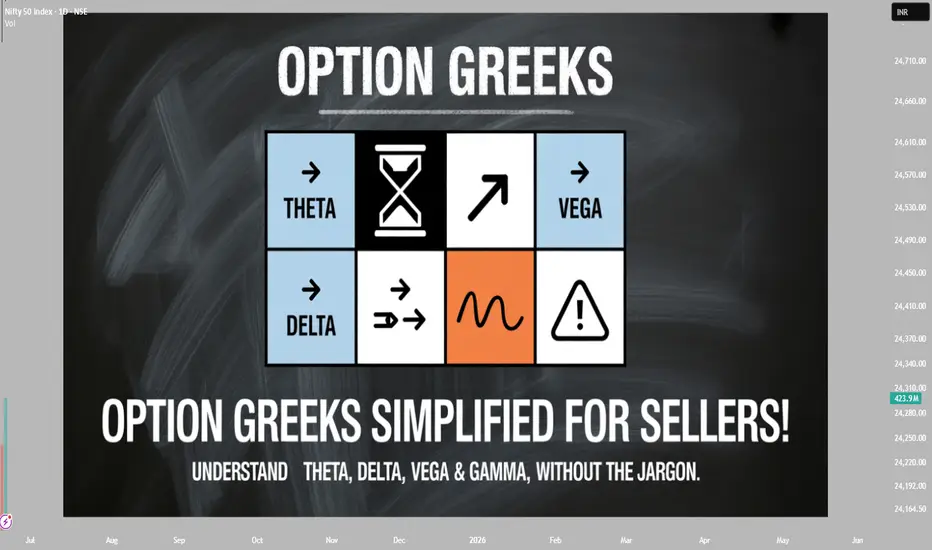
Know all about Greeks - I have Simplified for Option Writers!Hello Traders!
If you're into option writing, understanding Option Greeks is non-negotiable. But don’t worry — you don’t need to be a math genius. You just need to know how each Greek affects your premium, risk, and time decay . So, let’s simplify the Greeks in a way that every option seller can use — practically.
Key Option Greeks Every Writer Must Know
Theta – The Time Decay King:
This is your best friend. Theta tells you how much premium the option loses each day. As an option seller, you profit when time erodes the premium. The closer to expiry, the faster Theta works for you.
Delta – Directional Risk Manager:
Delta shows how sensitive the option is to price movement. For sellers, a low delta means less directional risk. Always monitor Delta when selling near-the-money options.
Vega – Volatility Impact:
Vega tells you how much the option price will change with volatility. High Vega means more premium — but also more risk. Avoid writing options when IV is very low, and be cautious when IV is about to rise (like before events).
Gamma – The Risk Multiplier:
Gamma increases your Delta exposure rapidly when the price nears the strike. For option writers, high Gamma = high risk, especially near expiry. Always track Gamma if you're selling options close to the money.
Rahul’s Tip
You don’t need to memorize formulas — just feel how each Greek impacts your trade. That’s how professional option writers stay ahead of retail noise.
Conclusion
Mastering the Option Greeks helps you sell smarter, avoid traps, and adjust your trades with confidence. Use Theta to earn , Delta to hedge , Vega to time entries , and Gamma to manage risk near expiry . Keep it simple, and you’ll stay profitable over time.
Do you track Greeks while writing options? Which one helps you the most? Drop your thoughts below!
WHAT IS OPTION GREEKS ?NSE:BANKNIFTY
Introduction
Option trading is an exciting process and almost every market participant has at least experienced the thrill of trading options, almost all the time with unsatisfactory results.
To avoid such accidents an option trader seeks different tools to trade sucssessfully,
The most important of tools are the Option Greeks and they are usually the first metric looked upon by option traders.
What are Option Greeks?
Options are derivatives of underlying assets ( curd is a derivative of milk, so the change in the quality of milk will result in a change in the quality of the curd derived ) similarly, Greeks are a way to measure the sensitivity of the price of the option to various factors.
The price of the option premium does not always move in conjunction with the price of the underlying asset and it is important to understand the different factors that affect the change in the price of the premium. With the help of the option greeks, a trader will be able to measure the rate of change of different factors affecting the option premium.
# You can check the option greeks by using zerodha option chain or any other trading platform
What is DELTA?
The first Greek is Delta, which quantifies how much an option's price is projected to fluctuate for every $1 that the underlying securities or index changes in price.
For example,A Delta of 0.50 indicates that the option's price will fluctuate 50 point for every 100 point movement in the price of the underlying stock or index.
#Delta for call option ranges between 0 to 1 and for put option ranges between -1 to 0.
>ATM options have a delta of 0.5
>ITM option have a delta of close to 1
>OTM options have a delta of close to 0.
Delta = Change in option premium/ Unit change in the price of the underlying asset.
#The following example should help you understand this better –
Nifty is currently trading at 16000
Option Strike = 15900 Call Option
Premium = 150
Delta of the option = + 0.60
Nifty is expected to reach 16200
What is the likely option premium value at 16200 ?
Well, this is fairly easy to calculate. We know the Delta of the option is 0.60, which means for every 1 point change in the underlying the premium is expected to
change by 0.60 points.
We are expecting the underlying to change by 200 points (16200 – 16000), hence the premium is supposed to increase by
= 200*0.60
= 120
the new option premium is expected to trade around 150 + 120 = 270
What ia gamma?
Gamma is used to measure the delta’s change relative to the changes in the price of the underlying asset.
If the price of the underlying asset increases by 1point, the option’s delta will change by the gamma amount.
The gamma value will also range between 0 and 1.
Gamma = Change in an options delta / Unit change in the price of the underlying asset.
What is Theta?
The Theta or time decay factor is the rate at which an option loses value as time passes. Theta is expressed in points lost per day when all other conditions remain the same.
theta is always shown as negative number because option value is depriciating as the time is passing.
Theta is the biggest enemy of option buyer cause it reduces the favourable outcome of option buyer by depriciating the option price.
for example,A Theta of -15 indicates that the option premium will lose -15 points for every day that passes by.
if an option is trading at Rs.290/- with a theta of -15 then it will trade at Rs.275/- the following day when other factors remain constant.
Theta = Change in an option premium / Change in time to expiry.
This is the graph of how premium erodes as a time to expiry approaches. This is also called the ‘Time Decay’ graph.
What is Vega ?
It is intended to tell you how much an option’s price should move when the volatility of the underlying security or index increases or decreases. It is the change of an option premium for a given change (typically 1%) in the underlying volatility.
1. Vega measures how the implied volatility (IV) of a stock affects the price of the options on that stock.
2. Volatility is one of the most important factors affecting the value of options.
3.A drop in Vega will typically cause both calls and puts to lose value.
4. An increase in Vega will typically cause both calls and puts to gain value.
Vega = Change in an option premium / Change in volatility.
What can option Greeks do for you?
1.Help you measure the possibility that an option will expire in the money (Delta).
2.Estimate how much the Delta will change when the stock price changes (Gamma).
3.Get a feel for how much value your option might lose each day as it approaches expiration (Theta).
4.Understand how sensitive an option might be to large price swings in the underlying stock (Vega).
“With the help of Greeks, an options trader can make more analyzed decisions about which options to trade, which strike price to trade and when to trade.
Since there are a variety of market factors that can affect the price of an option in some way, assuming all other factors remain unchanged,
we can use Greeks and determine the impact of each factor when its value changes.”
I Hope you found this helpful.
Please like and comment.
Happy Trading!