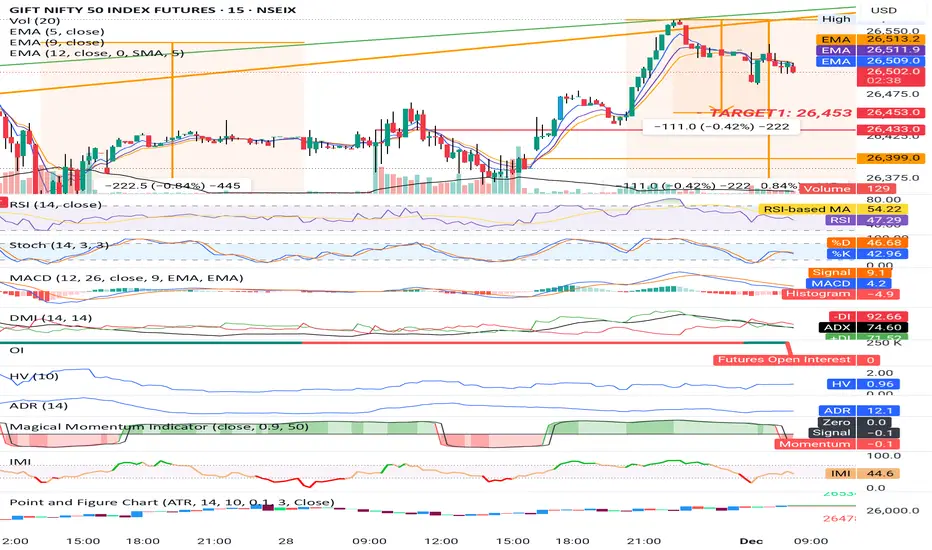
GIFT NIFTYGIFT NIFTY is moving at high but with very less volume. Which shows the correction in market. Gift nifty is showing bearish in short term view with target 26,400 and strong support atbsame level, if support was not taken we can expect further downside with a target of 26,120. If Gift Nifty took support and moves above 26,600 we can see upside target 26,800.
This is just my analysis
Giftnifty
How GIFT Nifty Strengthens India’s Financial Market PresenceWhy GIFT Nifty matters: key features & advantages
Here are the main reasons why GIFT Nifty is strategically important and how it helps India boost its financial market presence:
1. Extended trading hours & global connectivity
Unlike domestic derivatives markets that operate in Indian local hours, GIFT Nifty contracts are available for many more hours, spanning Asia, Europe, and U.S. trading windows.
That means global investors (institutional, proprietary traders, foreign funds) can trade exposure to Indian equities around the clock or across time zones, which allows hedging, arbitrage, or reacting to global events.
This helps price discovery by letting global information (overnight U.S./Europe developments, commodities, geopolitical events) feed into the derivative price, which in turn influences domestic markets.
2. On-shore jurisdiction & regulatory control
By hosting the derivative contract on Indian soil and in Indian jurisdiction (in GIFT City), regulatory oversight rests with Indian regulators (through IFSCA, related bodies).
That reduces reliance on foreign offshore derivative venues, meaning India retains control over contract design, fees, settlement, data licensing, etc.
This helps capture revenue from derivative trading (brokerage, clearing, settlement fees) that might otherwise go to offshore exchanges.
3. Liquidity, volume growth & market depth
GIFT Nifty has seen explosive growth in turnover. For example, by May 2025, monthly turnover was about US$102.35 billion.
Earlier as of September 2024, since full-scale operations in July 2023, cumulative turnover had reached ~$1.18 trillion across contracts.
The high volumes mean the market gets more liquidity, narrower bid-ask spreads, and better ability for large institutional players to take positions without excessive impact.
4. Benchmarking & market signal
GIFT Nifty also acts as an early indicator for how Indian equity markets might open, since it trades ahead of domestic markets. Traders watch the derivative to gauge global sentiment, overnight moves, global cues feeding into India.
Analysts often refer to futures of GIFT Nifty to anticipate the opening direction of domestic indices such as Nifty 50 or broader markets.
This gives market participants better ability to hedge or adjust positions before the domestic market opens.
5. Attracting foreign institutional investors
Because the contract is denominated in USD (or foreign currency) and traded in a relatively liberal, tax-neutral, special financial hub, foreign investors find it easier to participate without the complexities of onshore currency restrictions or heavy regulatory overhead.
The structure is more friendly to global funds, proprietary traders, hedge funds, etc., helping bring more foreign capital into Indian markets or allow foreign exposure to Indian equities.
This helps deepen the investor base, diversify sources of capital, and reduce dependence on purely domestic flows.
6. Enhancing India’s financial hub ambitions
GIFT City is being pitched as an international financial services centre rivaling global hubs like Dubai, Singapore, etc.
By hosting major derivative contracts for Indian equities in this hub, India raises its financial credibility and shows ability to host global financial infrastructure.
This helps in building ancillary infrastructure (clearing, settlement, foreign exchange, custody, banks, regulatory frameworks) around the hub, strengthening the ecosystem.
7. Improved settlement / FX infrastructure
The hub is working on enabling real-time foreign exchange settlements by domestic banks. Recently there were initiatives to reduce settlement times drastically (from ~24 hours to ~30 seconds for USD clearing inside GIFT City).
This means foreign exchange required for derivative trades or cross-border flows becomes faster, cheaper, and more efficient, making the hub more attractive.
That helps reduce friction for global participants, improving overall efficiency of derivative trades tied to foreign currency exposures.
Implications for Indian financial markets and economy
Here are the implications or effects of all of the above on India’s financial markets and economy:
A. Stronger integration with global capital
Because global participants can trade Indian equity derivatives with fewer regulatory constraints or currency friction, capital flows become more integrated with global markets. That means global shocks or global capital reallocation can feed into Indian markets faster, but also India has more visibility internationally.
B. Improved price discovery & market efficiency
With extended trading hours and global participation, information from foreign markets (U.S., Europe, Asia) gets incorporated earlier into derivative prices. That helps domestic markets start from a more informed base (less gap or surprise).
It improves efficiency, means domestic traders can react earlier, hedging becomes easier, and arbitrage between onshore and offshore markets is reduced.
C. Retaining derivative revenue domestically
Before GIFT Nifty, many offshore derivative products (like the former SGX Nifty in Singapore) allowed foreign trading of Nifty futures outside India. That meant India was losing out on transaction fees, clearing, and data licensing revenue.
Now with derivatives parked in GIFT City, India captures those fees, clearing, and infrastructure income, boosting domestic financial sector revenues.
D. Boosting competitiveness & ecosystem
Setting up global derivatives, FX settlement, custody, clearing houses, market infrastructure in GIFT City helps build a comprehensive ecosystem of financial services: brokers, banks, clearing participants, global fund offices. This increases job creation, knowledge transfer, regulatory sophistication, and financial innovation.
E. Attractive proposition to international investors
Foreign investors see reduced regulatory friction, extended hours, easier access. That can lead to more foreign institutional inflows into Indian equity exposures (both via derivatives and via hedged exposures).
This helps India attract more global capital, which can also support domestic equity valuations, provide more liquidity, reduce volatility, and provide deeper markets.
F. Enhancing India’s reputation globally
By hosting one of the key offshore / international derivative contracts on its soil, India signals that it is capable of being a financial hub, with regulatory infrastructure, transparency, and global linkages. That helps raise the country’s credibility in global financial markets.
Challenges, risks & considerations
Of course, this is not all smooth sailing; there are some risks or challenges that need to be addressed:
Regulatory oversight and risk management
Though GIFT City offers more liberal rules, regulators have to ensure risk controls (especially with derivatives trading) so that volatility or spillovers don’t affect domestic markets excessively.
Derivative positions can be large, and if not managed properly, could create risks for clearing houses or systemic risk.
Arbitrage or basis risk
Differences may still exist between onshore Nifty futures (in domestic exchanges) and derivative prices in the offshore contract. Basis / spread differences must be managed, arbitrageurs will adjust quickly.
Market participants need to watch price differences, settlement semantics, currency exposures.
Foreign investor restrictions
Though many foreign / proprietary / institutional participants are allowed, there still might be rules restricting retail Indian participation in these USD-denominated derivatives. For example, in many cases, resident Indians may not be allowed or have limited participation.
That means some segments may not benefit fully from the product.
Volatility & global shocks
Because it is open across global hours, derivative contracts will reflect global shocks (global equity crash, currency risk, U.S. interest rate changes). Domestic markets may then see overnight / pre-opening shocks that domestic participants aren’t used to.
That might increase volatility or lead to gap moves in domestic markets.
Competition from other hubs
Other financial hubs (Dubai, Singapore, etc.) may still compete for global derivative flows or other financial products. GIFT City needs to maintain competitive regulatory, tax, infrastructure environment.
Evidence / milestones & performance metrics
To back up how significant GIFT Nifty has been in practice:
It has crossed US$100 billion monthly turnover in recent times.
In one month (May 2025) it recorded a turnover of $102.35 billion, reflecting strong adoption and liquidity growth.
Earlier, in September 2024, it had recorded ~$100.7 billion turnover in that month, surpassing previous levels and showing consistent growth in contract volumes.
Also, as part of regulatory reforms, derivatives on Nifty and other indices (Bank Nifty, Nifty IT, etc.) are being offered in the GIFT IFSC (International Financial Services Centre), enhancing product breadth.
Future outlook & recommendations
Here are some thoughts about where things might go and what to watch out for:
Expansion of product range: More derivatives (options, zero-day expiry, multiple expiries) likely to be introduced to increase attractiveness. Indeed there are already plans for daily or more frequent expiries.
Real-time FX settlement: The initiative to enable domestic banks to settle foreign exchange trades in real time (reducing from 24 hours to seconds) will only increase attractiveness and reduce friction for foreign participants.
Improved regulatory clarity: Ensuring that risk management, margin requirements, and clearing infrastructure are robust will reduce risk for participants and improve confidence.
Integration with domestic markets: As derivatives flows feed into domestic markets, spillover effects will be more immediate, helping align offshore and onshore liquidity.
Competition & regulatory benchmarking: GIFT City must maintain competitive regulatory / tax regime to compete with other global hubs; continuous improvements will be needed.
Conclusion
The introduction and growth of GIFT Nifty (in GIFT City / NSE International Exchange) is a landmark step in India’s journey to strengthen its financial market presence on the global stage. It combines extended trading hours, favorable regulatory environment, and high liquidity, making it more attractive to foreign and global institutional investors. It helps India retain derivative trading volumes, improve price discovery, connect with global markets more deeply, and build its aspiration as a global financial hub.
The evidence of increasing turnover (over US$100bn monthly) shows strong adoption; combined with regulatory and infrastructure push (real-time FX settlement, liberal derivatives frameworks), it is helping shape India into a more mature, integrated, and internationally respected financial market.
Ind–Pak Tension Sparks Panic! Gift Nifty Crashes 436 Points Now!Tension across the India–Pakistan border isn’t just making headlines — it’s shaking the markets too.
As per recent reports, there’s been a rise in military activity and geopolitical instability, which triggered a massive reaction in Gift Nifty.
Overnight, Gift Nifty tanked 436 points (~1.8%), with back-to-back red candles and volume spikes confirming a fear-driven move.
Sharp fall on the 30-min chart with increased volume — signs of panic selling.
Geo-political fear is real — institutions hate uncertainty, and this newsflow rattled sentiment.
Key support zones are broken — intraday structure now shifts toward the bearish side.
Volatility likely to spike in today’s opening — option premiums can go wild.
Premium sellers need to stay cautious — blindly deploying short straddles/condors can backfire.
This isn’t just a technical breakdown — it’s a sentiment-driven move.
When fear enters the market, logic takes a back seat — so best is to wait and watch the price behavior post opening.
Watch List: Nifty, Bank Nifty, and Defence sector stocks like HAL, BEL, BDL — expect heightened volatility.
Rahul’s View:
Don’t try to be a hero when headlines are hot. Smart traders protect capital and adapt to risk. Let price stabilize, then take calculated trades — not emotional ones.
GIFT Nifty Projections for week 3 of March and beyondFundamentals/Basis :
Due to most uncertainties of the US related news including Trump Tariff wars, US shutdown vote, Russia Ukraine war ceasefire talks, US possible recession, most of the global economies were in downward trend including US,excepting china which is seeing correction /growth.
How India will deal with US tariffs is a wait and watch , which could come into effect starting April. With Ministers flying to US to negotiate and trying to find middle path, one can expect a reasonable middle ground with US tariffs, by increasing US supplies,reducing tariffs etc from the Indian govt. At this moment, Indian government might not go for a tit-for-tat approach , which will hurt its interests.
Technicals :
Most of the corrections had happened since the election of Trump, the Nifty had been on the decline since its highs of oct last year and is at lower than yearly lows.
Price of Gift Nifty gives an early indication of the Nifty 50 movement.
Price is moving in a channel ,shown in the rectangular box and has a minor breakout.
Trade Idea:
If the Price breaks out of 22600, can test 22720-780- and after a retrace to a max of 450 can bounce again to 22940-23080
If the price could not break or sustain 22600 ,probable to fall with the channel again and test 22280-320.
These higher and lower levels mentioned will be decision points for further trends for the rest of the year.
Disclaimer : Analysis expressed are my own personal analysis and views. Not a SEBI registered analyst. Plan and trade as per your analysis.
Nifty Trading Strategy for 24th Feb 2025📊 NIFTY INTRADAY TRADING PLAN 📊
🔹 Strategy:
This plan is based on the breakout of a key level after a confirmed 15-minute candle close.
🟢 Buy Setup (Bullish Breakout)
✅ Entry Condition: Enter a buy position above the high of the 15-minute candle that closes above 22,921.
✅ Targets:
🎯 First Target: 22,966
🎯 Second Target: 23,038
🎯 Final Target: 23,099
✅ Stop Loss: Below the low of the entry candle.
✅ Risk Management: Follow a risk-reward ratio of at least 1:2.
🔴 Sell Setup (Bearish Breakdown)
✅ Entry Condition: Enter a sell position below the low of the 15-minute candle that closes below 22,700.
✅ Targets:
🎯 First Target: 22,653
🎯 Second Target: 22,608
🎯 Final Target: 22,562
✅ Stop Loss: Above the high of the entry candle.
✅ Risk Management: Avoid overleveraging and use a stop-loss strategy.
⚠ Important Notes:
📌 Wait for levels to come into play – If there is a big gap-up or gap-down, do not rush into a trade. Instead, wait for price action confirmation at the key levels.
📌 A lost opportunity could be capital saved – Patience is key! If the setup doesn't align, it's better to stay out than force a trade.
📌 Avoid trading during high-impact news events – Volatility can cause sudden price movements.
🚨 Disclaimer:
This analysis is for educational and informational purposes only and should not be considered financial or investment advice. I am not SEBI-registered. Trading in financial markets involves significant risk, and past performance is not indicative of future results. Trade responsibly and use proper risk management. 🚀📉
Nifty Analysis – Today’s Game Plan! (31st December 2024)🔥 Nifty Analysis – Today’s Game Plan!
Let’s Break It Down:
The Nifty is currently trading at 23,658.65, sitting in a zone where things can go either way. With clear support and resistance levels, the market is poised for its next big move.
📍 Levels You Can’t Ignore:
🚀 Strong Resistance Zone: 24,055
⚡ Immediate Resistance: 23,878
🛡️ Support Zone: 23,535
🔒 Strong Support Zone: 23,318
What Could Happen?
💥 Bullish Scenario:
If Nifty manages to break above 23,878, it’s likely heading toward the 24,055 mark. This breakout could mean strong momentum, so watch for increased buying volumes.
⚠️ Bearish Scenario:
If Nifty struggles to stay above 23,535, a slide to 23,318 might be on the cards. Breaking this level would bring more pain for the bulls.
Here’s the Plan:
For Buyers:
Go long only above 23,878, aiming for 24,055. Keep your stop-loss tight around 23,750.
For Sellers:
Consider shorting below 23,535, with a target of 23,318. Protect your trade with a stop-loss near 23,650.
Something to Think About:
RSI Levels: Showing signs of possible recovery—are the bulls gearing up?
Volume Watch: A breakout without volume isn’t reliable. Let the market show its hand!
Market Open Impact: GIFT Nifty hints the market might open near these zones. Be ready for action!
Final Words:
Markets are unpredictable, but preparation is key. Know your levels, set your stop-loss, and trade like a pro. Remember, discipline beats emotions every time!
Disclaimer: This is not financial advice—just a trader sharing insights. Trade smart, trade safe!
Dear traders, If you like my work then do not forget to hit like and follow me, and guy's let me know what do you think about this idea in comment box, i would be love to reply all of you guy's.
Thankyou.
Nifty Intraday Levels | 1-OCT-2024This trading strategy focuses on scalping Nifty options based on institutional support and resistance zones and executing trades using order flow data. Here's a quick summary of the key points:
1️⃣ Zones to Focus on:
👉Green Zone: Represents institutional support.
👉Red Zone: Indicates institutional resistance.
👉Gap Between Zones: Typically ranges from 100-200 points.
👉Zone Creation: Uses pivot points and Fibonacci levels.
👉Price Action: An advanced version for refined entries and exits.
👉Chart Reference: Trades are executed based on the Nifty futures chart.
2️⃣ Trade Execution:
👉Order Flow Data: Trades are triggered by tracking the market's order flow.
👉Timeframes: Focus on the 1-minute and 5-minute charts for quick scalps.
👉Risk-Reward Ratio: Strict 1:2 (Risk 1 to gain 2).
👉Strike Price: Target at-the-money (ATM) or slightly in-the-money (ITM) options.
👉Position Sizing: Customize based on personal risk tolerance.
3️⃣ House Rules:
👉Sharp Execution: Be ready at 9:15 AM for market open.
👉Risk Management: Always a priority.
👉Quick Trades: Fast execution "morning breakfast".
👉Strict Stop-Loss: Set at 10 points to limit losses.
This method is well-structured for traders who prioritize risk management and quick scalping opportunities in the Nifty market.
#ThankU For Checking Out Our IDEA , We Hope U Liked IT 📌
🙏 FOLLOW for more content!
👍 LIKE if you found it useful!
✍️ COMMENT below with your thoughts and feedback!
#FocusedScalping #RiskManagement #NiftyOptions
Nifty Intraday Levels | 25-SEP-2024#Optionbuyers
#Niftyoptionscalping
1️⃣ Zones you always Like:-
👉Green zone- Institutional support
👉Red zone - Institutional resistance
👉Gap between institutional zones is always of 100-200 points
👉Zone is created with the help of pivot points and Fibonacci
👉Advance version of price action
👉Trades based on Nifty future chart
2️⃣ Trade Execution:-
👉Trade based on order flow data
👉Timeframe - 1 min and 5 min
👉Risk Reward Ratio always 1:2
👉Strike price always ATM & slightly ITM
👉Maintain Position sizing according to your own method
3️⃣ House Rules in trading:-
👉Sharp at 9:15 AM
👉Priority to risk management
👉Fast execution (morning breakfast)
👉Stop-loss 10 points (strictly)
#ThankU For Checking Out Our IDEA , We Hope U Liked IT 📌
🙏FOLLOW for more !
👍LIKE if useful !
✍️COMMENT Below your view !
Nifty Intraday Levels | 23-SEP-2024#Optionbuyers
#Niftyoptionscalping
1️⃣ Zones you always Like:-
👉Green zone- Institutional support
👉Red zone - Institutional resistance
👉Gap between institutional zones is always of 100 points
👉Zone is created with the help of pivot points and Fibonacci
👉Advance version of price action
👉Trades based on Nifty future chart
2️⃣ Trade Execution:-
👉Trade based on order flow data
👉Timeframe - 1 min and 5 min
👉Risk Reward Ratio always 1:2
👉Strike price always ATM & slightly ITM
👉Maintain Position sizing according to your own method
3️⃣ House Rules in trading:-
👉Sharp at 9:15 AM
👉Priority to risk management
👉Fast execution (morning breakfast)
👉Stop-loss 10 points (strictly)
#ThankU For Checking Out Our IDEA , We Hope U Liked IT 📌
🙏FOLLOW for more !
👍LIKE if useful !
✍️COMMENT Below your view !
GIFT NIFTY broke from the sell zone mentioned in last postNSEIX:NIFTY1! GIFT NIFTY once again felt the pressure of sell zone at the top and gave the fall while reacting to buy zones marked in previous post, now we need to follow the next fresh buy sell zones to plan the trades accordingly,
if we break the current buy zone, below are the 3 target marked, above current zell zone we may test the next sell zone.
NIFTY FUTURE hits the down target , NOW WHAT?NSEIX:NIFTY1! as mentioned in the last ide shared, nifty future started creating fresh lower highs and lower lows and finally gave the target mentioned in the last post, now we need to see if nifty future breaks above previous resistance or breaks current support to create new lower low.