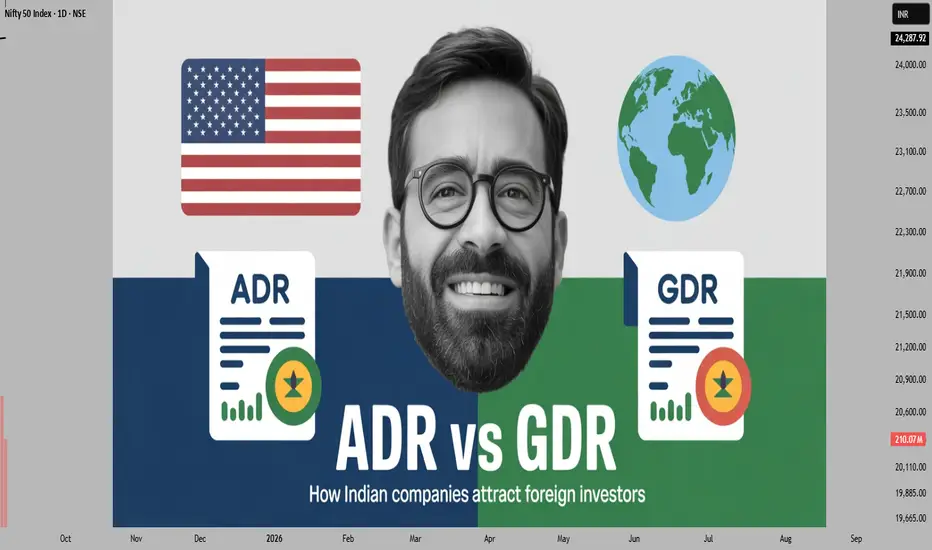
What is ADR/GDR – How Indian Companies Get Foreign Investors!Hello Traders!
You may have heard terms like ADR and GDR when companies talk about raising money abroad. These instruments allow Indian companies to get international investors without directly listing on foreign stock exchanges. Let’s understand them in simple words.
What is an ADR?
ADR stands for American Depository Receipt .
It is a certificate issued by a US bank that represents shares of a foreign company (like an Indian company). These ADRs trade on US stock exchanges just like normal US stocks.
Example: Infosys and Wipro have ADRs listed in the US.
Advantage: US investors can buy Indian companies without dealing with Indian exchanges.
What is a GDR?
GDR stands for Global Depository Receipt .
It works the same way as ADR, but instead of being limited to the US, GDRs are listed on global exchanges like London or Luxembourg.
Example: Many Indian companies raise funds through GDRs in Europe.
Advantage: Gives access to a larger pool of foreign investors.
Why Do Companies Issue ADR/GDR?
Access to Foreign Capital: Helps Indian companies raise funds from global investors.
Better Visibility: Being listed abroad increases global recognition of the company.
Diversified Investor Base: Attracts institutional investors who may not invest directly in Indian markets.
Liquidity: Allows more trading activity and easier buying/selling internationally.
Rahul’s Tip:
ADR/GDR listings are a sign that a company wants to expand globally and attract foreign capital. But as an investor, always check if the company is fundamentally strong before getting influenced by the “global listing” tag.
Conclusion:
ADR and GDR are simple tools that connect Indian companies with foreign investors.
While ADRs are limited to the US, GDRs open doors to global markets.
For long-term investors, these instruments show how Indian companies are scaling globally.
If this post made ADR/GDR clear for you, like it, share your thoughts in comments, and follow for more market education in simple language!
Globalinvesting
Dare to Be Different: John Templeton's Guide to Smart InvestingJohn Templeton: The Pioneer of Global Investing
Hello everyone, I hope you're all doing great in your trading journey. Today, I bring you an educational post on one of the greatest investors of all time— Sir John Templeton . Known for his contrarian approach and global investing strategies , he turned market crises into opportunities, proving that disciplined investing can lead to extraordinary success. Let’s dive into his key principles and see how we can apply them to our own trading and investing journey!
John Templeton’s Timeless Investing Principles
Be a Contrarian Investor: "Buy when there’s maximum pessimism, sell when there’s maximum optimism." Templeton believed that the best opportunities arise when the market is fearful.
Think Globally: He was one of the first investors to recognize the power of international markets. Diversifying across global opportunities reduces risk and increases potential returns.
Avoid Market Euphoria: Templeton warned against following market fads. When everyone is rushing into an asset, it's often overpriced.
Focus on Fundamentals: Strong earnings, solid management, and long-term growth potential matter more than short-term trends.
Be Patient & Disciplined: Investing is a long-term game. Templeton’s strategy emphasized holding great investments through market cycles rather than seeking quick gains.
Control Emotions: Fear and greed are an investor’s biggest enemies. Staying rational and sticking to a strategy ensures better decision-making.
Learn from Mistakes: Every investor makes errors, but the key is to analyze them, learn, and adapt your approach.
What This Means for Traders and Investors
John Templeton’s approach teaches us that patience, discipline, and a willingness to go against the crowd can lead to exceptional investing success. His strategies remain highly relevant, especially in volatile markets.
Outcome
By applying these principles, you can build a well-diversified and resilient portfolio while avoiding common emotional pitfalls in the market.