Index Funds vs ETFs – Which is Better for Retail Investors?Hello Traders!
When it comes to passive investing, two options always come up, Index Funds and ETFs (Exchange Traded Funds) .
Both track an index like Nifty or Sensex, but the way they work is different.
Let’s break them down so you know which one suits you better.
1. What are Index Funds?
Index funds are mutual funds that replicate a market index like Nifty 50.
You can invest directly through SIP or lump sum, just like other mutual funds.
They don’t trade on the stock exchange; instead, you buy/sell via the fund house.
NAV is calculated once a day, you get units at that day’s NAV.
2. What are ETFs?
ETFs also track an index like Nifty or BankNifty, but they trade like stocks on the exchange.
You need a demat account to buy/sell ETFs.
You can trade them intraday, just like shares.
Price changes throughout the day as they trade live in the market.
3. Key Differences You Must Know
Liquidity: ETFs depend on exchange volumes. Index funds are more stable since you transact with the AMC.
Ease of Use: Index funds are simpler for beginners (no demat needed). ETFs suit traders who want flexibility.
Costs: ETFs usually have lower expense ratios, but you pay brokerage. Index funds may have slightly higher costs but no brokerage.
Investment Style: Index funds are great for long-term SIPs. ETFs are better for those who want intraday liquidity or tactical entries.
Rahul’s Tip:
If you’re just starting and prefer SIPs without worrying about trading, go for index funds.
If you’re comfortable with demat and want real-time flexibility, ETFs give you more control.
Conclusion:
Index funds and ETFs both are powerful tools for retail investors.
The “better” choice depends on your style, simple and steady with index funds, or flexible and active with ETFs.
This educational idea By @TraderRahulPal (TradingView Moderator) | More analysis & educational content on my profile
If this post made the difference clear for you, like it, drop your choice in comments, and follow for more simple investing insights!
Investmenttips
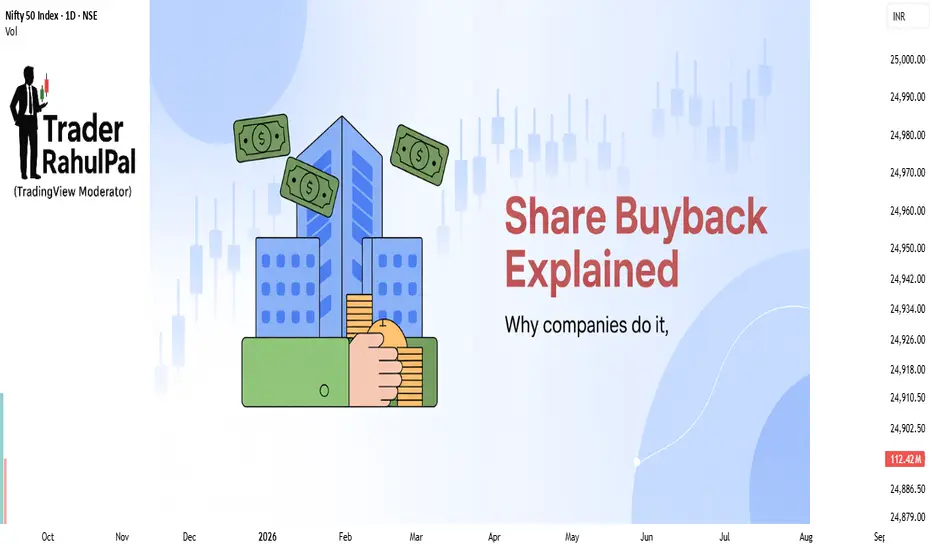
What is Buyback & Why Companies Do It?Hello Traders!
Every now and then, you’ll hear the news, “XYZ company announces share buyback.”
But what exactly is a buyback, and why do companies spend so much money to purchase their own shares? Let’s break it down in simple terms.
1. What is a Buyback?
A buyback (also called share repurchase) happens when a company buys its own shares from the stock market.
This reduces the number of shares available in the market, which can increase the value of the remaining shares.
2. Why Do Companies Do Buybacks?
To Increase Shareholder Value: With fewer shares in circulation, earnings per share (EPS) goes up, often supporting a higher stock price.
Utilize Excess Cash: Instead of keeping large cash reserves idle, companies return value to shareholders by buying back shares.
Signal of Confidence: A buyback is often seen as management’s confidence that the stock is undervalued.
Better Than Dividends (Sometimes): Unlike dividends, buybacks can be more tax-efficient for both the company and investors.
3. Does Buyback Always Mean Positive?
Not necessarily, Sometimes companies use buybacks to artificially boost EPS without real growth. If the business fundamentals are weak, a buyback is just a short-term push and doesn’t solve deeper issues.
Rahul’s Tip:
Don’t buy a stock just because of a buyback announcement. Always check if the company has strong fundamentals, healthy cash flows, and a genuine reason behind the buyback.
Conclusion:
A buyback is a powerful tool, but only when backed by strong business performance.
It can reward long-term shareholders and show management’s faith in the company.
But as smart investors, we should look beyond the headline and judge the real financial health.
By @TraderRahulPal (TradingView Moderator) | More analysis & educational content on my profile!
If this post made buybacks clear for you, like it, share your view in comments, and follow for more simple investing insights!
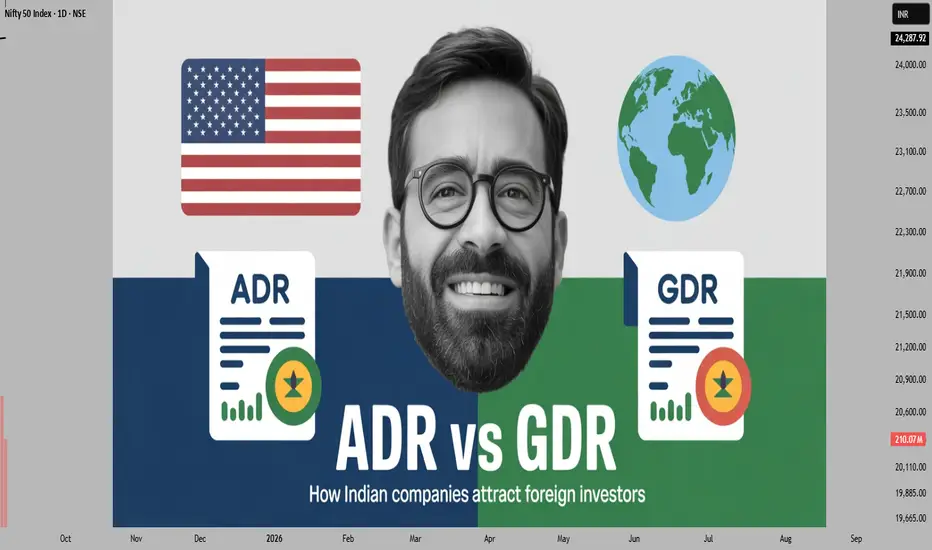
What is ADR/GDR – How Indian Companies Get Foreign Investors!Hello Traders!
You may have heard terms like ADR and GDR when companies talk about raising money abroad. These instruments allow Indian companies to get international investors without directly listing on foreign stock exchanges. Let’s understand them in simple words.
What is an ADR?
ADR stands for American Depository Receipt .
It is a certificate issued by a US bank that represents shares of a foreign company (like an Indian company). These ADRs trade on US stock exchanges just like normal US stocks.
Example: Infosys and Wipro have ADRs listed in the US.
Advantage: US investors can buy Indian companies without dealing with Indian exchanges.
What is a GDR?
GDR stands for Global Depository Receipt .
It works the same way as ADR, but instead of being limited to the US, GDRs are listed on global exchanges like London or Luxembourg.
Example: Many Indian companies raise funds through GDRs in Europe.
Advantage: Gives access to a larger pool of foreign investors.
Why Do Companies Issue ADR/GDR?
Access to Foreign Capital: Helps Indian companies raise funds from global investors.
Better Visibility: Being listed abroad increases global recognition of the company.
Diversified Investor Base: Attracts institutional investors who may not invest directly in Indian markets.
Liquidity: Allows more trading activity and easier buying/selling internationally.
Rahul’s Tip:
ADR/GDR listings are a sign that a company wants to expand globally and attract foreign capital. But as an investor, always check if the company is fundamentally strong before getting influenced by the “global listing” tag.
Conclusion:
ADR and GDR are simple tools that connect Indian companies with foreign investors.
While ADRs are limited to the US, GDRs open doors to global markets.
For long-term investors, these instruments show how Indian companies are scaling globally.
If this post made ADR/GDR clear for you, like it, share your thoughts in comments, and follow for more market education in simple language!
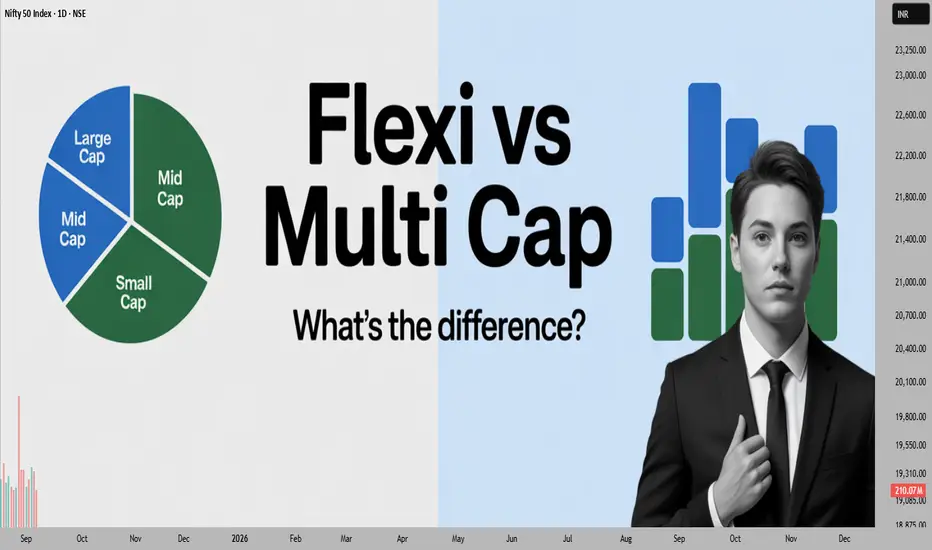
Flexi Cap Funds vs Multi Cap Funds – What’s the Difference?Hello Traders!
When it comes to equity mutual funds, many investors get confused between Flexi Cap and Multi Cap funds. Both invest across large, mid, and small-cap stocks, but there’s a key difference in how they are managed. Let’s break it down in simple words.
What are Multi Cap Funds?
Multi Cap Funds are required by SEBI rules to invest a minimum of 25% each in large-cap, mid-cap, and small-cap stocks.
This means:
They are compulsory diversified .
Even if small caps are risky at the moment, the fund manager must still hold at least 25% exposure.
Good for investors who want fixed diversification across all categories.
What are Flexi Cap Funds?
Flexi Cap Funds, as the name suggests, have full flexibility. The fund manager can invest in large, mid, or small-cap in any proportion, depending on market conditions.
This means:
No fixed rule for allocation.
The fund manager can go 70% large-cap in volatile times or shift more to small/mid-caps when opportunities are strong.
Good for investors who trust the fund manager’s judgment.
Key Differences You Should Know
Flexibility: Multi Cap = fixed allocation, Flexi Cap = flexible allocation.
Risk Level: Multi Cap has balanced risk due to compulsory exposure. Flexi Cap risk depends on manager’s calls.
Return Potential: Flexi Cap may deliver better returns in the hands of a skilled manager, but also comes with higher dependency on their decisions.
Investor Type: Multi Cap suits investors wanting rule-based diversification. Flexi Cap suits investors comfortable with dynamic allocation.
Rahul’s Tip:
If you want steady exposure across all market caps, Multi Cap funds are safer. But if you believe in the fund manager’s ability and want more flexibility, Flexi Cap funds can give you better opportunities.
Conclusion:
Both categories have their place in a portfolio. The choice depends on your risk appetite and trust in active fund management.
Remember, what matters most is not just category, but consistent performance and fund manager track record.
If this post cleared your confusion, like it, share your view in the comments, and follow for more simple investing insights!
STT Explained – The Silent Tax That Eats Into Your Profits!Hello Traders!
Many traders calculate their profit after entry and exit, but forget a hidden cost that reduces it every single time: STT (Securities Transaction Tax) .
It doesn’t look big on paper, but over time it silently eats into your profits. Let’s break it down in simple terms.
What is STT?
STT is a tax charged on the value of every buy/sell transaction in equities, derivatives, and ETFs.
It was introduced to generate revenue for the government and applies to all market participants.
Example: If you buy shares worth ₹1,00,000, you pay a small percentage as STT. The same applies when you sell. In options and futures, it’s mostly charged on the sell side.
Where Does STT Apply?
Equity Delivery: STT applies on both buy and sell transactions.
Equity Intraday: STT is charged only on the selling side.
Futures: STT applies only on the sell side of the contract.
Options: STT applies on the sell side, but at a higher rate compared to futures.
Why Traders Must Care About STT
It Reduces Net Profit: Even if your trade looks profitable on the chart, STT takes away a portion. In short-term trading, these small cuts add up.
Impacts Scalpers & Option Sellers Most: Since they do high-frequency trading, STT can eat into a large chunk of their returns.
Hidden in Brokerage Statements: Many traders blame “brokerage” for high costs, but in reality, STT is often the bigger factor.
Rahul’s Tip:
Always calculate the real cost of trading , not just entry and exit points. Brokerage, STT, GST, exchange fees, all matter.
Sometimes the best trade is not the most frequent one, but the one with the best cost-to-profit balance.
Conclusion:
STT may look small, but it has a big impact over time.
The difference between a losing trader and a winning trader is often not the strategy, but how well they manage costs like STT.
If this post cleared your doubts on STT, like it, drop your experience in comments, and follow for more trading education that really matters!
Fundamentals Don’t Make You Rich Fast They Make You Rich ForeverHello Traders!
Most new investors want quick returns. They search for shortcuts, tips, and hot stocks to double their money overnight. But the reality is, wealth built on shortcuts usually disappears just as fast.
Fundamentals may feel boring because they don’t promise overnight success. But in the long run, they are the only reason you can create wealth that lasts. Let’s break this down.
1. Fundamentals Build Strong Foundations
A stock backed by consistent earnings, low debt, and strong management may not give you 50% returns in a week.
But over 5–10 years, such companies quietly multiply your money with stability.
2. Quick Gains Fade, Fundamental Gains Stay
A stock bought on hype can double quickly, but the same hype can collapse just as fast.
On the other hand, companies with strong fundamentals recover even after market crashes, because the business itself is valuable.
3. Time Works With Fundamentals
The longer you stay invested in a fundamentally strong company, the more compounding works in your favor.
Markets reward patience, fundamentals give you the confidence to hold.
Rahul’s Tip:
Don’t confuse speed with success.
The goal is not to get rich fast, but to stay rich forever. Fundamentals may be slow, but they are steady, and steady wins in wealth creation.
Conclusion:
Fast money comes and goes, but fundamental investing creates permanent wealth.
If you want to stop chasing quick profits and build a portfolio that lasts, start focusing on the strength of the business, not the speed of price moves.
If this post gave you clarity, like it, share your thoughts in the comments, and follow for more simple and practical investing wisdom!
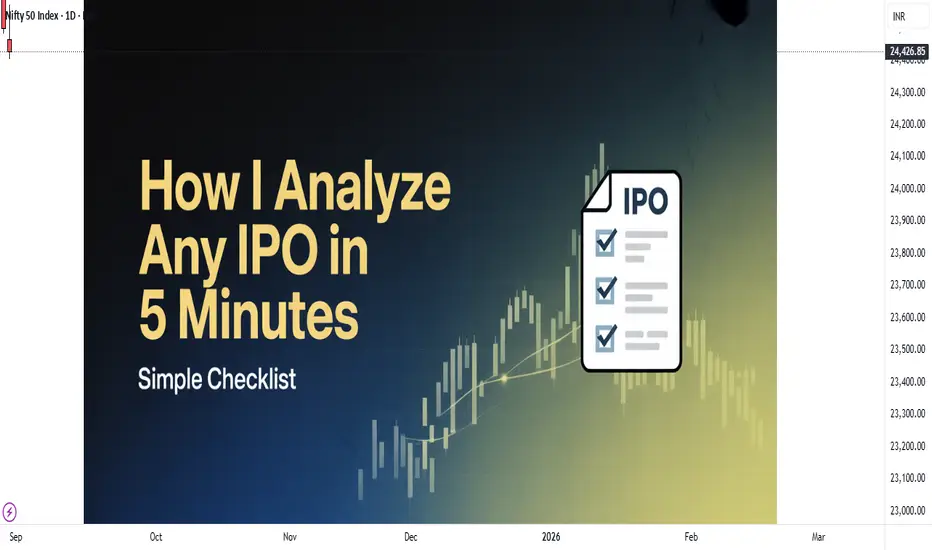
How I Analyze Any IPO in 5 Minutes (Simple Checklist)Hello Traders!
IPOs always create excitement. Retail investors often rush in because of hype, but smart traders know how to quickly separate strong opportunities from risky bets.
You don’t need hours of research, a simple checklist can give you clarity in just 5 minutes.
Here’s the process I follow before looking at any IPO.
1. Understand the Business Model
Before anything else, ask: What does the company actually do? Is it solving a real problem, or just another crowded business?
If you cannot explain the business in one simple line, it’s better to avoid.
2. Revenue and Profit Trend
Check the last 3 years’ financials. Are sales and profits consistently growing, or is the IPO just timed after one good year?
A company with unstable profits may not sustain growth once the IPO buzz fades.
3. Promoter and Management Quality
Look at promoter background, experience, and any red flags. Are they increasing their stake or selling heavily in the IPO?
If promoters themselves are exiting big, you need to be cautious.
4. Debt Levels and Cash Flow
High debt or weak cash flow is a danger sign. IPO money should ideally be used for growth, not just to repay loans.
Companies with positive cash flow and low debt are much safer bets.
5. Valuation vs Peers
Even a good company can be a bad investment if the price is too high. Compare P/E and other valuation ratios with similar listed companies in the sector.
If it looks overpriced, it may be better to wait and buy later.
Rahul’s Tip:
Don’t get trapped in IPO hype. Most strong companies will give you chances to buy even after listing. Focus on fundamentals, not emotions.
Conclusion:
Analyzing an IPO doesn’t need to be complicated.
With this 5-minute checklist, business model, growth, promoters, debt, and valuation — you’ll quickly know if the IPO is worth your time or better avoided.
If this helped you, like the post, share your IPO checklist in the comments, and follow for more simple investing insights!
What Smart Money is Doing When You’re Panicking?Hello Traders!
If you’ve been in the market long enough, you’ve seen this happen: the market suddenly drops, red candles everywhere, and social media explodes with fear. Retail investors start selling in panic, desperate to protect whatever is left.
But here’s the truth, when retail is panicking, smart money is calmly preparing to profit . Let’s understand exactly how.
1. Smart Money Buys When Retail Sells
Retail investors often believe that falling prices mean danger. For smart money, falling prices mean discounts . When everyone rushes to exit, prices get pushed far below their true value. That’s the exact moment institutions step in quietly to accumulate quality stocks.
Example: During COVID-19 crash, while retail was rushing to sell at 8,000 Nifty levels, institutions were loading up. Two years later, Nifty doubled. Retail sold in fear, smart money doubled their wealth.
The lesson? When you sell in panic, someone else is buying, and that “someone” is usually smarter than you.
2. They Focus on Value, Not Headlines
Retail reacts to news, WhatsApp forwards, and TV anchors shouting “Market crash!” Smart money reacts to fundamentals . They don’t care if Nifty fell 300 points today, they’re looking at earnings, cash flow, debt levels, and long-term trends.
For them, a temporary correction doesn’t change the long-term story of a strong company. They wait for such moments because panic-driven prices give them a margin of safety.
So while retail sells HDFC Bank in fear of a 5% fall, smart money sees it as an opportunity to accumulate a fundamentally strong business.
3. They Manage Risk, Not Emotions
The biggest difference between smart and retail money is not knowledge, it’s discipline. Retail enters big positions without planning, and when price falls, emotions take over. That’s why they panic-sell.
Smart money, on the other hand, sizes their positions correctly, uses hedges, and accepts that volatility is normal. They don’t panic when markets fall because they already prepared for it. For them, volatility is a feature, not a bug.
Rahul’s Tip:
Whenever you feel the urge to panic-sell, pause and ask yourself:
“Who is on the other side of my trade?”
If you are selling in fear, someone with deeper research and bigger pockets is buying with confidence. Don’t make it easy for them. Train yourself to think like the smart money, calm, patient, and disciplined.
Conclusion:
Markets will always move in cycles of fear and greed. Most retail investors buy when everything looks safe and sell when fear is highest. Smart money does the exact opposite, and that’s why they consistently outperform.
If you want to change your results, you need to change your behavior. Don’t let panic dictate your decisions. Think like the institutions: focus on fundamentals, manage risk, and stay calm when others lose control.
If this post helped you see the difference between smart and retail money, like it, drop your thoughts in the comments, and follow for more real-world trading psychology insights!
3 Signs a Smallcap Can Become a Multibagger!Hello Traders!
Smallcap stocks are like hidden treasure chests in the stock market, most people ignore them until they explode in value.
But how do you separate future multibaggers from risky bets?
Here are 3 signs that can help you spot the potential winners early.
1. Strong & Consistent Revenue Growth
A company that’s steadily increasing its sales is building a strong foundation.
In smallcaps, consistent revenue growth shows the business is gaining market share and customer trust.
Look for companies that can grow even in slower economic conditions.
2. Low or Zero Debt
Debt can crush small companies during tough times.
A low-debt or debt-free balance sheet means the company can focus on growth instead of paying interest.
It also makes them more attractive to institutional investors.
3. Expanding Profit Margins
If a company can improve its margins while growing sales, it means they’re becoming more efficient.
Better margins often lead to higher profits, which can push the stock price up significantly.
Rahul’s Tip:
Smallcaps can be multibaggers, but they can also be wealth destroyers if chosen poorly.
Always check management quality, industry potential, and whether the company is transparent with its investors.
Conclusion:
Finding the next multibagger isn’t about luck, it’s about spotting strong fundamentals early.
When you find a smallcap with growing sales, low debt, and improving margins, you might just be looking at your next big winner.
If this post gave you ideas, like it, share your views in the comments, and follow for more stock market insights you can actually use!
Free Cash Flow – The Most Ignored Metric That Can Save You!Hello Traders!
When most people look at a company’s financials, they stop at profits.
But smart investors know that profits on paper don’t always mean cash in hand.
That’s where Free Cash Flow (FCF) comes in, the metric that reveals the real financial strength of a business.
What is Free Cash Flow?
Free Cash Flow is the money a company has left after paying all operating expenses and making necessary investments in its business.
It’s the cash available to pay dividends, buy back shares, reduce debt, or reinvest for growth.
Why It Matters More Than Reported Profits
Cash is King:
A company might report high profits but still struggle if it doesn’t have actual cash flow.
FCF shows if the business can fund itself without borrowing.
Signals Financial Health:
Consistently positive FCF means the company generates enough money to grow and reward shareholders.
Negative FCF for many years can be a red flag unless it’s due to planned growth investments.
Protects During Tough Times:
Companies with strong FCF can survive economic slowdowns without cutting essential spending or taking on expensive debt.
How to Check It
You can find FCF in the company’s cash flow statement:
FCF = Operating Cash Flow – Capital Expenditures
Rahul’s Tip:
Don’t just chase high profits.
Always check if the company is actually generating cash, because without cash, growth and survival both become impossible.
Conclusion:
Free Cash Flow might be the most ignored metric in investing, but it’s also one of the most powerful.
It tells you if a company can stand on its own feet, grow sustainably, and protect your investment in tough markets.
If you found this useful, like the post, share your view in the comments, and follow for more practical investing tips!
Free Cash Flow – The Most Ignored Metric That Can Save You!Hello Traders!
When most people look at a company’s financials, they stop at profits.
But smart investors know that profits on paper don’t always mean cash in hand.
That’s where Free Cash Flow (FCF) comes in, the metric that reveals the real financial strength of a business.
What is Free Cash Flow?
Free Cash Flow is the money a company has left after paying all operating expenses and making necessary investments in its business.
It’s the cash available to pay dividends, buy back shares, reduce debt, or reinvest for growth.
Why It Matters More Than Reported Profits
Cash is King:
A company might report high profits but still struggle if it doesn’t have actual cash flow.
FCF shows if the business can fund itself without borrowing.
Signals Financial Health:
Consistently positive FCF means the company generates enough money to grow and reward shareholders.
Negative FCF for many years can be a red flag unless it’s due to planned growth investments.
Protects During Tough Times:
Companies with strong FCF can survive economic slowdowns without cutting essential spending or taking on expensive debt.
How to Check It
You can find FCF in the company’s cash flow statement:
FCF = Operating Cash Flow, Capital Expenditures
Rahul’s Tip:
Don’t just chase high profits.
Always check if the company is actually generating cash, because without cash, growth and survival both become impossible.
Conclusion:
Free Cash Flow might be the most ignored metric in investing, but it’s also one of the most powerful.
It tells you if a company can stand on its own feet, grow sustainably, and protect your investment in tough markets.
If you found this useful, like the post, share your view in the comments, and follow for more practical investing tips!
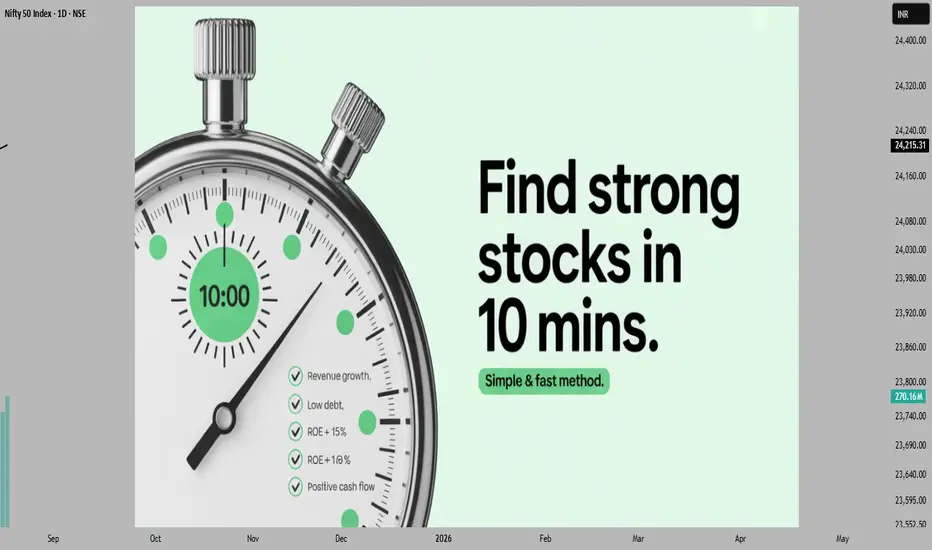
How I Shortlist Fundamentally Strong Stocks in Just 10 Minutes!Hello Traders!
Finding fundamentally strong stocks doesn’t have to be a week-long research project.
With the right process, you can filter out weak companies and shortlist potential winners in just 10 minutes.
Here’s exactly how I do it.
Step 1: Check Revenue & Profit Growth
I look at the last 5 years’ data to see if both sales and profits are growing steadily.
A consistent upward trend means the company has a stable business model and strong demand for its products.
Step 2: Look at Debt Levels
A fundamentally strong company should have low or zero debt.
Too much debt can eat into profits and create risk during market slowdowns.
Step 3: Review Free Cash Flow
I check if the company is actually generating cash after expenses.
Positive free cash flow shows the business is self-sustainable and not dependent on constant borrowing.
Step 4: Check Return on Equity (ROE)
An ROE above 15% usually means management is using shareholders’ money efficiently.
It’s a sign of strong leadership and good capital allocation.
Step 5: See Valuation Ratios
I compare the P/E and P/B ratios with industry averages.
A great company bought at an overvalued price can still give poor returns, so valuation matters.
Rahul’s Tip:
Don’t overcomplicate the process.
Focus on these 5 points and you’ll quickly filter out the junk, leaving you with stocks worth deeper research.
Conclusion:
Stock analysis doesn’t have to be overwhelming.
With a structured checklist, you can shortlist fundamentally strong companies in minutes — and spend the rest of your time tracking their performance.
If this process helped you, like the post, share your thoughts in the comments, and follow for more simple investing strategies!
How Promoter Holding Tells You the Real Story of a Company!Hello Traders!
When you invest in a company, you’re putting your money into the vision and decisions of its promoters.
One of the most powerful yet overlooked indicators of a company’s future is its promoter holding , the percentage of shares owned by the people who run the business.
Here’s why it matters and how to read it.
1. High Promoter Holding Shows Confidence
If promoters own a large portion of the company, it means they have a big personal stake in its success.
They win only when shareholders win, which often aligns their interests with yours.
2. Falling Promoter Holding Can Be a Red Flag
If promoters are consistently reducing their stake without clear reasons, it could mean they are losing confidence or need cash for other purposes.
This trend needs deeper investigation before you invest.
3. Pledged Shares Tell Another Story
Sometimes promoters pledge their shares to take loans.
If a large percentage of holdings is pledged, it’s a risk, because if the loan isn’t repaid, lenders can sell those shares, pushing the stock price down.
4. Stability Over Time is a Good Sign
A steady promoter holding over years shows trust in the business and signals that promoters are in it for the long run.
Rahul’s Tip:
Promoter holding should never be looked at in isolation.
Always check it alongside fundamentals, financial health, and industry outlook before making any decision.
Conclusion:
Promoter holding can reveal the real confidence level of the people behind the company.
When the promoters are heavily invested, and not pledging their shares, it’s usually a sign you’re looking at a solid long-term bet.
If this post gave you a new perspective, like it, drop your thoughts in the comments, and follow for more practical stock market insights!
How to Use Quarterly Results for Investment Decisions!Hello Traders!
Every three months, listed companies announce their quarterly results.
While many traders react instantly to the numbers, smart investors know how to read them in context before making a move.
Here’s how you can use quarterly results to make better investment decisions.
1. Compare With Previous Quarters
Don’t just look at the latest figures in isolation.
Compare revenue, profit, and margins with the last 3–4 quarters to see if the business is improving or declining.
2. Check Year-on-Year Growth
Seasonal factors can distort quarter-to-quarter results.
That’s why comparing the same quarter of the previous year (YoY) gives a clearer picture of long-term growth trends.
3. Watch for Margin Changes
Rising sales with falling margins can mean rising costs or pricing pressure.
Stable or improving margins show operational efficiency and pricing power.
4. Look Beyond Profits
Also track debt levels, cash flow, and promoter commentary in the results report.
Sometimes profits rise due to one-time gains, which don’t indicate real growth.
5. See Market Reaction – But Think Independently
Stock prices may jump or fall sharply after results.
Don’t follow the herd; understand the data yourself before taking a position.
Rahul’s Tip:
Quarterly results are snapshots, not the full movie.
Use them as a check-in point to confirm if your investment thesis still holds.
Conclusion:
Quarterly results can be a powerful tool if you know what to look for.
By focusing on growth trends, margins, and underlying financial health, you can make smarter investment decisions and avoid knee-jerk reactions.
If this helped you, like the post, share your thoughts in the comments, and follow for more practical stock market insights!
Dividend Yield vs Growth – What Kind of Investor Are You?Hello Traders!
Every investor has a different style, but when it comes to building wealth, two popular approaches dominate, focusing on dividend yield or chasing growth stocks .
Both have their pros and cons, and the right choice depends on your financial goals and risk appetite.
1. Dividend Yield Investors
These investors look for companies that pay regular and high dividends.
It’s like receiving a steady paycheck from your investments without selling your shares.
When it Works Best:
If you want stable income, lower volatility, and are happy with moderate capital appreciation, dividend investing can be ideal.
Example:
Large, mature companies like utilities, FMCG, and blue-chip banks often have high dividend yields.
2. Growth Investors
These investors focus on companies with rapidly growing revenues and profits, even if they pay little or no dividend.
The idea is that the money reinvested in the business will generate higher long-term returns.
When it Works Best:
If you are okay with higher volatility and want maximum wealth creation over the long term, growth stocks could be the way.
Example:
Tech companies, emerging sector leaders, and innovative startups usually fall into this category.
3. Finding Your Fit
You don’t have to be 100% one or the other.
Some investors create a balanced portfolio with both dividend-paying and high-growth stocks to get the best of both worlds.
Rahul’s Tip:
Choose your strategy based on your life stage, cash flow needs, and risk tolerance, not on what’s trending in the market.
Conclusion:
There’s no one-size-fits-all answer.
Whether you prefer the stability of dividend yield or the excitement of growth, the key is to align your strategy with your goals and stick to it with discipline.
If you found this comparison useful, like the post, share your style in the comments, and follow for more practical investing tips!
How to Read a Balance Sheet – Simple Breakdown for Traders!Hello Traders!
Most traders ignore the balance sheet because it looks “too accounting-heavy.”
But understanding just the basics can give you an edge, especially when you want to know if a company is financially healthy.
Today, let’s simplify the balance sheet so you can read it with confidence.
What is a Balance Sheet?
A balance sheet is a snapshot of a company’s financial position at a specific point in time.
It tells you what the company owns, what it owes, and what’s left for shareholders.
Three Main Sections You Must Know
Assets:
Everything the company owns that has value, cash, buildings, machinery, inventory, and money owed to it.
Assets show the company’s ability to generate future income.
Liabilities:
Everything the company owes to others, loans, unpaid bills, and other obligations.
High liabilities compared to assets can be a warning sign.
Shareholder’s Equity:
The value left for shareholders after liabilities are subtracted from assets.
It’s like the “net worth” of the company.
Key Ratios to Look At
Debt-to-Equity Ratio:
Shows how much of the company is funded by debt versus shareholder capital. Lower is generally better.
Current Ratio:
Compares current assets to current liabilities. If it’s above 1, the company can likely pay short-term debts.
Return on Equity (ROE):
Measures how efficiently management is using shareholder funds to generate profit.
Rahul’s Tip:
You don’t need to be an accountant to read a balance sheet.
Focus on big-picture numbers, assets, liabilities, and equity, and see if the business is stable, growing, and not overloaded with debt.
Conclusion:
A balance sheet tells you if the company can survive tough times and fund future growth.
Once you understand it, you’ll never look at a stock the same way again.
If this helped you, like the post, share your view in the comments, and follow for more practical investing insights!
What is ROE and Why It’s the True Test of Management Efficiency!Hello Traders!
When it comes to judging how well a company is run, one ratio quietly reveals the truth, ROE (Return on Equity) .
It’s not just a number; it’s a measure of how effectively management uses shareholders’ money to generate profits.
Today, let’s understand what ROE is, why it matters, and how to use it the right way.
What is ROE?
Return on Equity:
ROE shows how much profit a company generates for every ₹1 of shareholder equity.
Example: An ROE of 18% means the company earns ₹0.18 for every ₹1 invested by shareholders.
Formula:
ROE = (Net Profit ÷ Shareholder Equity) × 100
The Higher, The Better, But…:
A high ROE often signals strong management and efficient use of resources, but it’s important to check how that ROE is achieved.
Why ROE is the True Test of Management Efficiency
Measures Profitability from Shareholder’s View:
ROE focuses on returns that actually belong to shareholders, not just overall profits.
Reveals How Capital is Used:
High ROE means the company is using its capital effectively to grow the business.
Filters Out Average Management:
Companies with consistently high ROE often have skilled leaders and a solid strategy.
Exposes Debt-Driven Illusions:
Sometimes ROE looks high only because the company is taking on huge debt. Always check debt-to-equity ratio alongside ROE.
Rahul’s Tip:
Don’t look at ROE in isolation. Compare it with peers in the same industry, and check if it’s consistent over several years.
A one-time spike in ROE doesn’t mean management has suddenly become brilliant.
Conclusion:
ROE is a powerful tool to judge management’s efficiency, but only when used with other checks.
Look for companies with steady, high ROE and reasonable debt.
That’s where strong management and sustainable growth usually go hand in hand.
If you found this useful, like the post, share your view in the comments, and follow for more easy investing insights!
P/E Ratio Explained – And Why It’s Not Enough Alone!Hello Traders!
Most beginners hear about the P/E ratio and think it’s the holy grail of stock analysis.
But the truth is, while P/E ratio is useful, it’s not enough on its own to decide whether a stock is worth buying.
In today’s post, let’s break down what the P/E ratio actually tells you, and where it can mislead you if used blindly.
What is P/E Ratio?
Price-to-Earnings Ratio (P/E):
It tells you how much the market is willing to pay for ₹1 of a company’s earnings.
Example: A stock with a P/E of 20 means investors are paying ₹20 for every ₹1 of earnings.
High P/E = Expensive or Growth Stock:
A high P/E may mean the stock is overvalued or it could be a fast-growing company investors believe in.
Low P/E = Undervalued or Risky:
A low P/E could indicate a value buy or it might be a signal of weak future growth or company problems.
Why P/E is Not Enough
Doesn’t Show Debt or Cash Flow:
A company might have great earnings but poor cash flow or high debt, which P/E doesn’t reveal.
Earnings Can Be Manipulated:
Accounting tricks can inflate earnings temporarily. That makes P/E look good but misleads investors.
Doesn’t Consider Growth Potential:
Two companies can have the same P/E, but one is growing fast while the other is stagnant. Which one would you prefer?
Needs Peer Comparison:
A P/E of 25 may be high in one industry and low in another. Always compare with sector peers.
Rahul’s Tip:
Use P/E as a starting point, not a final decision-maker.
Combine it with other ratios like PEG ratio, ROCE, debt-equity, and free cash flow to get the real picture.
Also, check management quality and business model strength.
Conclusion:
P/E ratio is like checking someone’s temperature, it gives you a clue but not the full diagnosis.
Dig deeper. Understand what drives earnings and how sustainable they are.
If this post made P/E clearer, like it, drop your view in comments, and follow for more real-world investing insights!