Silver respecting 200 EMA on 45MIN chartSilver respecting 200 EMA on 45MIN chart perfect example of Bullmarket corrections are fast & furious.by isandeeppasi1
Massive crash in the market⚠️ Massive sell-off across global markets ⚠️ A sharp wave of panic hit both metals and equities within the last hour, wiping out trillions in market value: • Gold plunged 8.2%, erasing nearly $3 trillion in market capitalization • Silver crashed 12.2%, losing around $760 billion • S&P 500 slipped 1.23%, wiping out $780 billion • Nasdaq dropped over 2.5%, cutting roughly $760 billion Heavy risk-off sentiment is clearly dominating as investors rush to reduce exposure across asset classes.by siripireddyvenu2
Midnifty Intraday Analysis for 29th January 2026NSE:NIFTY_MID_SELECT Index has immediate resistance near 13500 – 13525 range and if index crosses and sustains above this level then may reach 13650 – 13675 range. Midnifty has immediate support near 13250 – 13225 range and if this support is broken then index may tank near 13100 – 13075 range. Markets are expected to react at the opening to the outcome of tonight's US Fed FOMC decision. A rate cut typically weakens the Dollar, providing a bullish signal for equities and metals. Meanwhile, with the Economic Survey set to be tabled on January 29, 2026, investors will also be closely monitoring the survey data for further direction. by RKMAURYAUpdated 1
Highlight of the Day: Nifty Metal Index up by 3%Metal index rally led by steel, zinc and copper stocks today. Further uptrend could be seen as long as Dollar is under pressure.Longby Indrayan_TradeWithNandi2
IPCA Labs – Trend Reversal After Long ConsolidationNSE:IPCALAB has successfully transitioned from a downtrend into a bullish structure after months of sideways consolidation. The breakout above the falling trendline followed by a controlled pullback suggests accumulation. As long as price holds above ₹1450, the trend remains positive and a fresh breakout above ₹1500 can open the door for further upside.Longby JunaidSayyed1
GOLD (XAU/USD) – Bullish Continuation Toward Higher Highs🔍 Technical Analysis (H1): Market Structure: Gold remains in a strong bullish structure with clear higher highs & higher lows ✔️, firmly respecting the ascending trendline 📈. Breakout & Momentum: Multiple clean breakouts above previous resistance zones confirm strong buying pressure 💪. Each breakout is followed by healthy pullbacks, showing controlled bullish momentum. POI → Pivot Support: Previous POI zones have successfully flipped into support 🔄, and price is currently holding above the Pivot Point zone, which strengthens bullish continuation bias 🟢. Current Price Action: Price is consolidating above the pivot area, suggesting a brief pause before the next impulsive move higher ⏳➡️⬆️. 🎯 Upside Targets: Target 1: 5,300 🎯 Target 2: 5,330 🎯🎯 Extended Target: 5,360+ 🚀 (if bullish momentum accelerates) 🛡️ Invalidation / Support to Watch: Bullish bias remains valid as long as price holds above the Pivot Point zone. A break below may trigger a deeper pullback, not trend reversal ⚠️. 📌 Conclusion: Overall trend is bullish, structure is healthy, and price action favors a continuation toward the marked target zone after minor consolidation 📦➡️🚀. ✨ Trade with the trend & manage risk wisely! 💼📊Longby Pipshunter27Updated 1
XAUUSD – Bullish trend, focus on Buy pullbacks to 5,700Market Context (M30) Gold continues to trade in a strong bullish continuation after a clean impulsive leg higher. The recent consolidation above former resistance shows acceptance at higher prices, not exhaustion. This behavior suggests the market is rebalancing liquidity before the next expansion leg. On the macro side, USD remains under pressure, while safe-haven demand stays firm. Even though bond yields are relatively stable, capital flows continue to favor gold, keeping the upside bias intact. ➡️ Intraday bias: Bullish – trade with the trend, not against it. Structure & Price Action • Market structure remains bullish with Higher Highs – Higher Lows • Previous resistance has flipped into demand and is being respected • No bearish CHoCH or structural breakdown confirmed • Current pullbacks are corrective moves within an active uptrend Key takeaway: 👉 As long as price holds above key demand, pullbacks are opportunities for continuation. Trading Plan – MMF Style Primary Scenario – Buy the Pullback Patience is key. Avoid chasing price into extensions. • BUY Zone 1: 5,502 – 5,480 (Minor demand + short-term rebalancing zone) • BUY Zone 2: 5,425 – 5,400 (Trendline support + deeper liquidity zone) ➡️ Only execute BUYs after clear bullish reaction and structure confirmation. ➡️ No FOMO at highs. Upside Targets • TP1: 5,601 • TP2: 5,705 (upper Fibonacci extension / expansion target) Alternative Scenario If price holds above 5,601 without a meaningful pullback, wait for a break & retest to join the next continuation leg. Invalidation A confirmed M30 close below 5,400 would weaken the bullish structure and require reassessment. Summary Gold remains in a controlled bullish expansion supported by both structure and macro flow. The edge lies in discipline — buying pullbacks into demand while the trend stays intact, not predicting tops. ➡️ As long as structure holds, higher prices remain the path of least resistance.Longby MMFlowTrading1
SbinThe daily time frame chart shows that the price is bouncing from the trend line support. In the lower time frame, the price has formed a rounding bottom. Buy above 1048 with the stop loss of 1040 for the targets 1054, 1060, 1068 and 1076. A rounding bottom pattern can form a candle if it has a pullback. At the same time, in the daily chart, the price should hold the trend line support. Always do your analysis before taking any trade.by vanathiUpdated 3328
25500 might cause some trouble for NIFTY As we can see NIFTY has shown great upmove after getting rejected from important demand zone as analysed in the analysis. Moreover we ca see NIFTY forming more like an W kinda pattern in smaller time frame but there can be seen an immediate SUPPORT turned RESISTANCE so until and unless NIFTY manages to sustain itself above that demand zone every rise can be sold so plan your trades accordingly and keep watching everyone by Kaushalfin1
Finnifty Intraday Analysis for 29th January 2026 NSE:CNXFINANCE Index has resistance near 27550 - 27600 range and if index crosses and sustains above this level then may reach near 27825 - 27875 range. Finnifty has immediate support near 27125 – 26075 range and if this support is broken then index may tank near 26850 – 26800 range. Markets are expected to react at the opening to the outcome of tonight's US Fed FOMC decision. A rate cut typically weakens the Dollar, providing a bullish signal for equities and metals. Meanwhile, with the Economic Survey set to be tabled on January 29, 2026, investors will also be closely monitoring the survey data for further direction. by RKMAURYAUpdated 1
Oil Supply and Demand Balances1. Understanding Oil Supply Oil supply refers to the total quantity of crude oil and petroleum products available for consumption at a given time. It can be categorized into several sources: a) Crude Oil Production: Crude oil production is the primary component of oil supply and is influenced by geological availability, technological capabilities, investment in exploration, and political factors. Major oil-producing countries such as Saudi Arabia, the United States, Russia, and members of the Organization of Petroleum Exporting Countries (OPEC) play a pivotal role in global production levels. b) Inventories and Stockpiles: Strategic and commercial oil reserves contribute to supply. Strategic reserves are maintained by governments to stabilize domestic markets in times of disruption, while commercial stockpiles are held by oil companies to meet demand fluctuations. Changes in inventory levels can signal either oversupply or shortages, impacting market prices. c) Refinery Output: Oil supply also depends on the capacity of refineries to process crude oil into usable products such as gasoline, diesel, jet fuel, and heating oil. Refinery utilization rates, maintenance schedules, and technological improvements can affect the amount of refined products available in the market. d) Geopolitical Factors: Supply is highly sensitive to geopolitical events. Conflicts in oil-producing regions, sanctions, or trade restrictions can constrain supply, while agreements among producers to cut or increase output (such as OPEC+ decisions) directly influence global supply levels. e) Technological Advances and Unconventional Sources: The development of unconventional sources, such as shale oil and oil sands, has significantly expanded supply options. Advances in hydraulic fracturing and horizontal drilling, particularly in the U.S., have shifted the global supply landscape by increasing production flexibility. 2. Understanding Oil Demand Oil demand represents the quantity of crude oil and petroleum products that consumers are willing and able to purchase at prevailing prices. It is shaped by multiple factors: a) Economic Activity: Oil is a critical input for industrial production, transportation, and power generation. Economic growth drives higher energy consumption, especially in emerging economies such as China and India, which have rapidly growing industrial sectors and expanding transportation networks. b) Transportation Sector: The transportation sector accounts for the largest portion of oil demand. Demand for gasoline, diesel, and jet fuel is highly correlated with vehicle ownership, freight movement, and air travel. Shifts toward electric vehicles and public transportation can gradually reduce oil demand growth. c) Seasonal Variations: Oil demand fluctuates seasonally. For example, gasoline consumption typically rises during the summer driving season, while heating oil demand peaks in winter in colder regions. These seasonal patterns create temporary imbalances in supply and demand. d) Energy Policy and Substitutes: Government policies, such as fuel efficiency standards, carbon taxes, and subsidies for renewable energy, can affect oil demand. Increased adoption of alternative energy sources, biofuels, and electric mobility reduces reliance on oil and shifts the demand curve downward. e) Population Growth and Urbanization: Long-term oil demand trends are influenced by population growth and urbanization. Growing populations increase energy consumption, while urbanization often leads to higher transportation fuel usage, expanding the overall demand for oil. 3. Balancing Supply and Demand The balance between oil supply and demand is crucial for maintaining price stability. When supply exceeds demand, inventories build up, leading to falling prices. Conversely, when demand outstrips supply, inventories decline, creating upward pressure on prices. This balance can be analyzed in several ways: a) Global Oil Market Equilibrium: Oil markets aim to reach an equilibrium where the quantity supplied matches the quantity demanded at a certain price. This equilibrium is rarely static due to continuous changes in production, consumption patterns, and external shocks. b) Short-term vs Long-term Balances: Short-term balances are influenced by seasonal fluctuations, weather events, refinery outages, and geopolitical crises. For instance, hurricanes in the Gulf of Mexico can temporarily disrupt U.S. production, tightening supply and pushing prices higher. Long-term balances are determined by structural factors such as new oil field developments, technological innovation, energy transitions, and long-term economic growth trends. c) Market Signals: Oil prices serve as a signal for both producers and consumers. High prices incentivize increased production and energy efficiency, while low prices can reduce exploration investment and promote consumption. Futures markets also reflect expectations about future supply-demand balances. 4. Factors Disrupting the Balance Oil supply-demand balances are highly sensitive and prone to disruption. Key disruptive factors include: Geopolitical Tensions: Wars, sanctions, and political instability in oil-producing regions can reduce supply unpredictably. Natural Disasters: Hurricanes, earthquakes, and other natural events can damage infrastructure, affecting both production and transportation. Technological Changes: Breakthroughs in extraction or renewable energy can shift the balance. For example, the shale revolution dramatically increased U.S. oil production. Economic Shocks: Global recessions reduce industrial activity and transportation, causing oil demand to fall sharply. Policy Shifts: Regulatory changes, carbon pricing, and subsidies for alternative energy can either suppress or stimulate oil consumption. 5. Measurement of Supply-Demand Balances Organizations such as the International Energy Agency (IEA), U.S. Energy Information Administration (EIA), and OPEC regularly monitor oil supply-demand balances. Key metrics include: Supply Figures: Crude oil production, refinery output, and stock changes. Demand Estimates: Consumption data across sectors and regions, including transportation, industrial, residential, and power generation. Inventory Levels: Changes in crude and product stocks, signaling tightness or oversupply in the market. Market Indicators: Futures prices, backwardation/contango structures, and spreads between crude grades. These metrics allow analysts to forecast potential shortages or surpluses and anticipate price trends. 6. Implications for the Oil Market The supply-demand balance has profound implications: Price Volatility: Imbalances lead to sharp fluctuations in oil prices, affecting energy costs globally. Investment Decisions: Producers rely on supply-demand forecasts to plan new exploration, production, and refining capacity. Policy Formulation: Governments monitor the balance to ensure energy security, manage strategic reserves, and design energy policies. Global Economic Impact: Oil prices influence inflation, trade balances, and economic growth worldwide. Surplus supply tends to lower prices, benefiting consumers, while shortages raise prices and strain economies. 7. Future Trends in Supply-Demand Balances Several emerging trends are reshaping oil supply-demand dynamics: Energy Transition: Shift toward renewables, electric vehicles, and energy efficiency may reduce long-term oil demand growth. Peak Oil Demand: Some analysts project a peak in global oil demand in the next few decades, driven by technological innovation and policy shifts. Geopolitical Realignments: Changes in OPEC+ strategies and new producers entering the market will influence future supply levels. Climate Policies: Decarbonization commitments and emission reduction targets are likely to constrain fossil fuel consumption. Conclusion Oil supply and demand balances form the foundation of global energy markets. Supply is shaped by production levels, inventories, refinery capacity, technology, and geopolitics, while demand is influenced by economic activity, transportation, policies, population growth, and energy alternatives. Maintaining equilibrium is critical for price stability and economic planning. Disruptions in either supply or demand can lead to volatility, affecting markets worldwide. As the world moves toward cleaner energy sources, the dynamics of oil supply-demand balances will continue to evolve, making careful monitoring and analysis increasingly vital for stakeholders across the energy sector.Educationby GlobalWolfStreet2
BANKINDIA Pattern trade set up1. Trend - Bullish 2. Set up - Cup & Handle 3. weekly & daily both time frame has cup & handle 4. Pattern target profit levels are 207+ but there could be further upside. 5. This is pyramid set up 123.65 first entry levelsLongby KamalKJoshi1
Tech Mahindra - Weekly Long On the weekly chart of Tech Mahindra, the recent candles show strong bullish behavior. After spending many months in a wide range, price has formed a rounded base and is now printing higher highs with solid green candles near the earlier resistance zone around 1,750. The latest candle closes near the high, showing that buyers are in control and sellers are not able to push price down. This kind of structure often appears at the start of a new medium-term uptrend. The trend is clearly shifting upward. From the April 2025 low, the stock has made a series of higher lows and is now moving in a smooth rising arc. The previous supply zone from December 2024 has been tested again and price is holding above it. This change from resistance to support is a classic sign of trend reversal. As long as price stays above the rising trend path, the bias remains positive. RSI is above 70 and has crossed and sustained above 60, which signals strong momentum. This shows that the stock has moved from a neutral phase into a bullish phase. In trending markets, RSI can stay in the upper zone for a long time, so this strength supports continuation rather than immediate weakness. Volumes are rising during the recent upward move. The breakout candles are accompanied by higher volume compared to the previous weeks, which confirms genuine participation. When price rises with expanding volume, it reflects accumulation by stronger hands and improves the reliability of the move. A safer entry can be on a weekly close above 1,770–1,780, or on a pullback towards 1,680–1,700 if price respects this zone as support. This allows better risk control. The stop loss can be placed below 1,600 on a closing basis, which lies below the recent swing low and trend support. The first target comes near 1,950, which is the next major supply area. If the trend remains strong, a higher target in the 2,200–2,280 zone is possible over the medium term. This analysis is for educational purposes only. It is not a buy or sell recommendation. Stock market investments involve risk, and prices can move unpredictably. Always do your own research and consult a qualified financial advisor before making any trading or investment decision. Longby PowerOfTA11
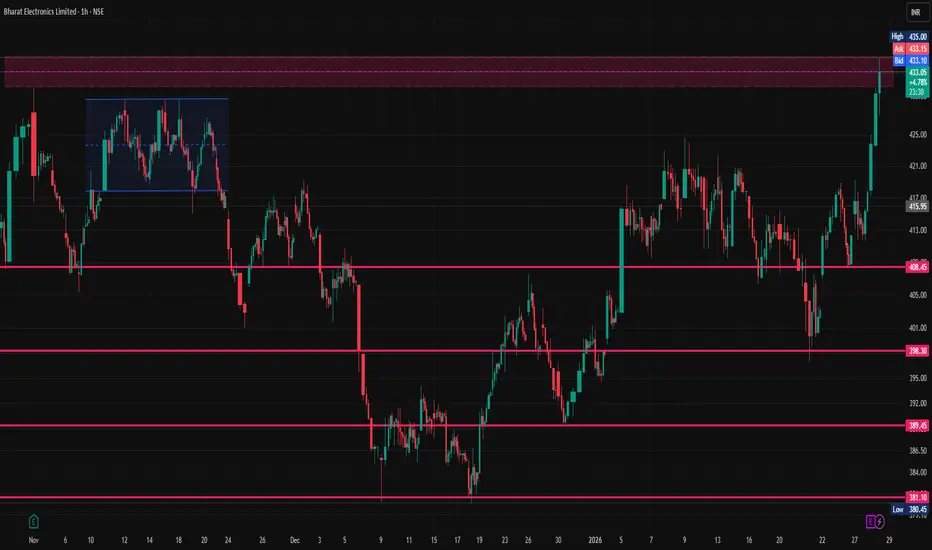
BEL 1 Hour Frame 📊 BEL Intraday 1‑Hour Levels (Approx) Current Price Range (Indicative): ~₹415–₹433 on the NSE (recent live data) 🟩 Support Levels S1 (First Support): ~₹412–₹411.9 S2 (Second Support): ~₹408–₹407.9 S3 (Third Support): ~₹404–₹403.9 (Below these, deeper support can emerge closer to ~₹395 area on broader intraday) 📈 Pivot / Reference Pivot Point: ~₹415–₹416 area — often used as the intraday “balance” level. If price stays above pivot → bullish bias; below → bearish bias intraday. 🟥 Resistance Levels R1 (First Resistance): ~₹419–₹420 R2 (Second Resistance): ~₹423–₹424 R3 (Third Resistance): ~₹427–₹428+ (Above these, further strength can aim toward recent highs close to ₹430+) 📌 How to Use These Levels Bounce trades: Buy near support zones (S1/S2) with tight stops if price shows rejection candles around those levels. Breakout trades: Upside break above R1/R2 levels with volume can signal continuation. Pivot strategy: Price above the pivot suggests short‑term positive bias; below it suggests caution/tactical selling. (Note: intraday pivots are most effective with volume + confirmation from candles) ⚠️ Important Reminders Intraday levels change fast — these are approximate estimates based on recent pivot and support/resistance calculations (not real‑time live quotes). Use alongside indicators like RSI, MACD, VWAP, and moving averages for confirmation. Always have a stop‑loss based on your risk tolerance before trading.Longby GlobalWolfStreet4
#GBP/USD Sell Trade Scenario.Here’s an up-to-date GBP/USD Sell trade outlook (technical + fundamental) to help you assess whether positioning for a Downside makes sense right now. Thank You...... Shortby Target_FX_2O2
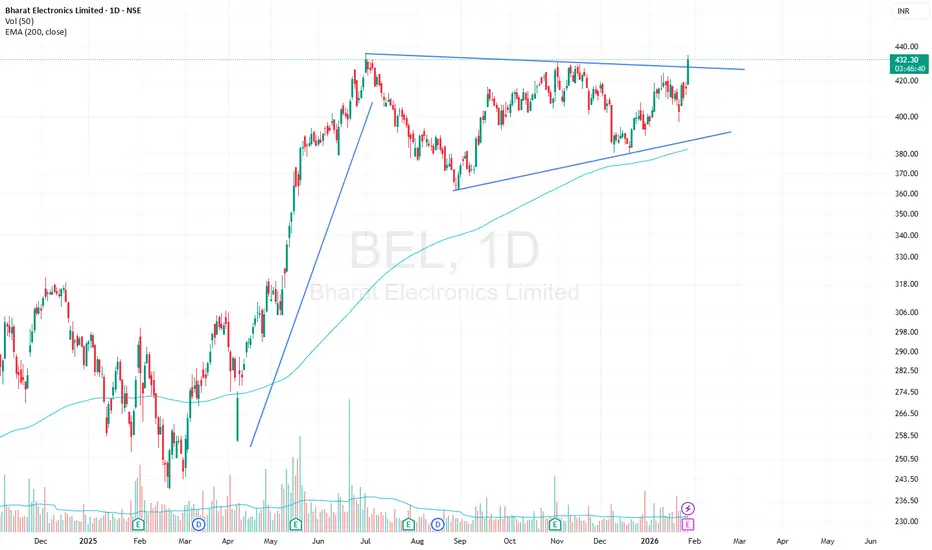
BEL Triangle & Flag BreakoutBEL is attempting breakout from Triangle and Bull Flag Pattern on 1D timeframe. Watch for closing at End of the Day. Watch for Earnings because this stock carries earnings risk.Longby Khwaish4
JINDALSTEL Cup & Handle pattern trading set up1. Set up - Cup & Handle breakout 2. Trend - Bullish 3. Price Trading at 52 weeks high 4. Over all structure bullish Longby KamalKJoshi1
Small Cap vs. Large Cap – Visualizing Risk Cycles & Rotation PoiWhat the Lines Tell Us: 1. Small Caps (Blue): Steeper rallies in bullish phases, sharper falls in corrections. Higher beta, higher reward, higher pain. 2. Large Caps (Red): More stable, smoother trends. Acts as a defensive harbor during market stress. Now: The gap is wide again. Historically, this signals rising risk in small caps. Correlation with the Ratio-Based Strategy: - The Small-Cap / Large-Cap Ratio from my earlier post is essentially the vertical distance between these two lines. - When the blue line runs far above the red (wide gap) → Ratio is high (>1.6) → Time to rotate to large caps. - When the lines converge (gap narrows) → Ratio is low (<1.6) → Time to enter small caps. Current Implication: The gap is historically wide (similar to 2008, 2018 highs). This aligns with the ratio signal, reinforcing the move toward large-cap ETFs/index funds for capital preservation. Small caps will again shine—after the gap closes. Takeaway: You don’t need complex indicators. Sometimes, just watching these two lines and their separation tells you when to rotate—capture small-cap upside, hide in large-cap safety.Educationby tanmay_agrawal2
Beating Nifty with One Ratio: The Small-Cap / Large-Cap SwitchWe all know small-cap outperforms in bull runs, but we forget to remember that it also crash harder in downturns. On the other hand, large-caps give just moderate returns But what if you could systematically increase your returns—using the same index funds? The Core Idea Track the "Small-Cap to Large-Cap Ratio" (BSE Small-Cap Index ÷ Nifty 50). This ratio shows when small-caps are overextended vs. large-caps. The Simple Rule (Backtested 2006-2024) 1. Go Small-Cap when ratio < 1.6 2. Switch to Large-Cap when ratio > 1.6 Why It Works It’s not market timing—it’s risk timing. The ratio peaks (1.8–2.2) near market tops and bottoms near 1.0. Switching at 1.6 avoids the worst drawdowns while staying invested. Backtested Results 1. Nifty Buy & Hold: ~12.1% CAGR (₹10L → ~₹70L) 2. Small-Cap Buy & Hold: ~12.3% CAGR (₹10L → ~₹75L) 3. Switch Strategy (Pre-tax): ~18.6% CAGR (₹10L → ~₹2.3Cr) How to Implement 1. Use ETFs: Nifty Bees for large-cap, a Small-Cap ETF for small-cap. 2. Check ratio monthly; switches occur ~every 2 years. 3. For SIPs, direct new money per the current signal.Educationby tanmay_agrawal2
NIFTY KEY LEVELS FOR 28.01.2026NIFTY KEY LEVELS FOR 28.01.2026 Timeframe: 3 Minutes If the candle stays above the pivot point, it is considered a bullish bias; if it remains below, it indicates a bearish bias. Price may reverse near Resistance 1 or Support 1. If it moves further, the next potential reversal zone is near Resistance 2 or Support 2. If these levels are also broken, we can expect the trend. When a support or resistance level is broken, it often reverses its role; a broken resistance becomes the new support, and a broken support becomes the new resistance. If the range(R2-S2) is narrow, the market may become volatile or trend strongly. If the range is wide, the market is more likely to remain sideways please like and share my idea if you find it helpful 📢 Disclaimer I am not a SEBI-registered financial adviser. The information, views, and ideas shared here are purely for educational and informational purposes only. They are not intended as investment advice or a recommendation to buy, sell, or hold any financial instruments. Please consult with your SEBI-registered financial advisor before making any trading or investment decisions. Trading and investing in the stock market involves risk, and you should do your own research and analysis. You are solely responsible for any decisions made based on this research.by AATHIE3312
BUY TODAY SELL TOMORROW for 5%DON’T HAVE TIME TO MANAGE YOUR TRADES? - Take BTST trades at 3:25 pm every day - Try to exit by taking 4-7% profit of each trade - SL can also be maintained as closing below the low of the breakout candle Now, why do I prefer BTST over swing trades? The primary reason is that I have observed that 90% of the stocks give most of the movement in just 1-2 days and the rest of the time they either consolidate or fall Trendline Breakout in BEL BUY TODAY SELL TOMORROW for 5%by Kapil-Mittal224
Gold at ATH before FOMC shakeout first or straight breakout?🧭 Macro Snapshot Donald Trump maintains a hardline stance, increasing military presence in the Middle East → geopolitical risk remains elevated. Tonight’s key focus: Federal Reserve Political pressure and questions around Fed independence. DXY continues to weaken, retesting major historical support (2020–2022) → supportive for gold. 👉 Conclusion: Geopolitics + a weaker USD set the bullish bias, while the Fed determines short-term volatility. 📊 Intraday Range to Watch Upper range: 5,280 – 5,305 Lower range: 5,190 – 5,160 → High probability of range trading and liquidity absorption ahead of the Fed decision. 🟢 Support 5,220–5,225 | 5,150–5,165 | 5,080–5,085 | 5,050–5,060 🔴 Resistance 5,280–5,294 | 5,300 | 5,315 | 5,380–5,385 ⚠️ Strategy Notes Expect possible fake moves / stop hunts within the range. Avoid chasing highs or catching tops without confirmation. Focus on price reaction at key levels and stay disciplined. Summary: Gold is fundamentally supported, but today the key is how price reacts within 5,160–5,305. Be patient — wait for confirmation — trade the reaction.Longby Chum_trades114
Nifty Intraday Analysis for 28th January 2026NSE:NIFTY Index has resistance near 25375 – 25425 range and if index crosses and sustains above this level then may reach near 25625 – 26675 range. Nifty has immediate support near 24975 – 24925 range and if this support is broken then index may tank near 24725 – 24675 range. Index is expected to open positive because of the conducive outcome of India EU FTA along with Security and Defense Partnership and low February’26 F&O Contract carry forward. Trend in the short term shall be decided as per formation of F&O contracts in February’26 Month by FIIs, DIIs and Retails. by RKMAURYAUpdated 1