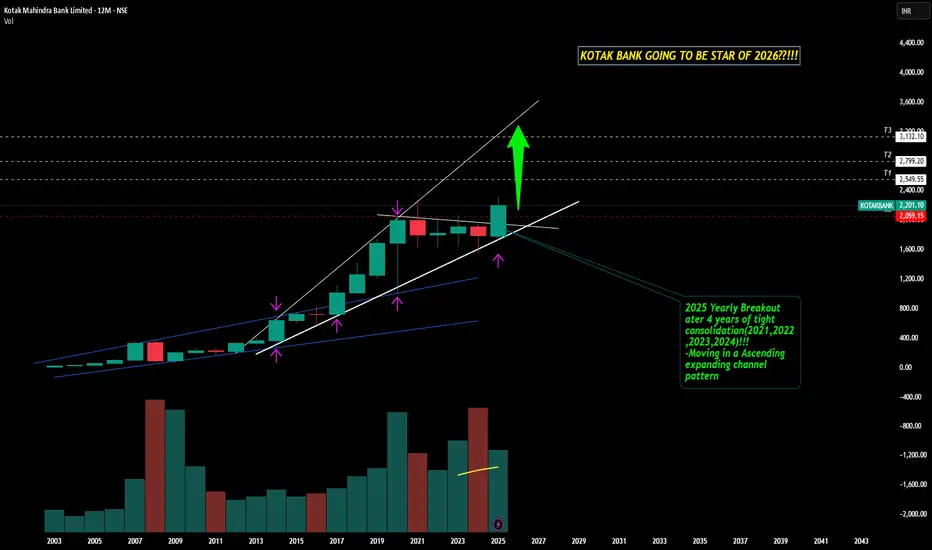
Kotak Mahindra Bank - Bulls Wish Happy 2026 Ahead!!!Kotak Mahindra Bank after 4 years of tight consolidation , has given a Beautiful 2025 Yearly Breakout!!!
It is trading inside a expanding ascending channel pattern from 2014 till now ....taking support and resistance at respective channel lines( shown below- 6month timeframe chart )
Chances are less for a down move after this clean yearly breakout... .Breaking 2059.2 will be a warning sign and possibly delay the upmove...(not for long term investors....)
Monthly time frame chart view below-
For Long term Investors , Monthly breakdown out of the channel with good volume support would make the SL.
Target levels mentioned for long term ones.
With the Stock split on Jan 14, 2026, Kotak bank will see high retail participation and higher volumes!!!
Anyway , Charts indicating a bulls eye on Kotak Mahindra Bank in 2026 and future!!!
Just Sharing my View...not a tip nor advice!!!
Wishing you all a very HAPPY & Prosperous NEWYEAR 2026!!!!
Thank you,
mmjimm!!
Privatebank
Which Bank Offers Better Returns – Public or Private?Quick Take (TL;DR)
Depositors (savings accounts & fixed deposits): Private banks often advertise higher headline savings rates at certain balance slabs and run frequent FD specials for short tenors. But public sector banks can be competitive on standard FD slabs and usually have lower charges that protect your net return—especially for low or moderate balances.
All-in net return for everyday customers: If you maintain small-to-mid balances and value minimal fees, PSBs can deliver higher net effective returns after costs. If you maintain large balances, use digital tools, and chase promotional rates, private banks may deliver higher effective yields.
For long-term wealth growth (mutual funds, SIPs, bonds via the bank channel): Returns depend on the product, not the bank’s ownership. Choose based on product selection, fees, and advice quality, not whether the bank is public or private.
For bank shareholders (investing in bank stocks): Historically, private banks have often delivered higher shareholder returns thanks to faster loan growth and higher ROE, but this comes with valuation risk and cyclicality. Several PSBs have improved profitability lately; stock selection matters more than the category label.
What Do We Mean by “Returns” From a Bank?
“Returns” can mean different things depending on your relationship with the bank:
Depositor returns – Interest and benefits you earn on savings accounts, current accounts (indirect through perks), fixed deposits (FDs), recurring deposits (RDs), and sometimes special deposit schemes.
Net effective return – Your interest earned minus fees, penalties, and opportunity costs. This is the real-world number that matters.
Ecosystem returns – Value from cashback, rewards, lounges, insurance benefits, and digital features like auto-sweep or goal-based savings that nudge you to earn more.
Investment returns via the bank – Mutual funds, bonds, SGBs, NPS, and PMS that you buy through the bank’s platform or RM. The bank is a distributor, not the manufacturer; returns depend on the underlying product.
Shareholder returns – If you buy the bank’s equity shares or AT1 bonds, you’re seeking capital gains, dividends, and coupon income. This is a separate lens from being a customer.
We’ll analyze each lens for public vs private.
Savings Accounts: Headline Rates vs Reality
Headline Savings Interest
Private banks often publish tiered, higher savings rates for balances above certain slabs (say ₹1 lakh, ₹5 lakh, or ₹10 lakh+), or during promotional windows, to attract deposits.
Public sector banks usually offer more uniform savings rates across slabs, updated less frequently, with fewer short-term promotions.
But beware of tiers: A higher “up to X%” rate might apply only above a certain balance; the rest earns a lower rate. Also, rates can adjust quickly.
Fees and Minimum Balance
Private banks tend to have higher non-maintenance charges for failing to keep a minimum average balance, plus bundled fees (debit card annual fees, SMS alerts, cash transaction limits).
PSBs generally keep lower minimum balances and lower penalties, especially for basic savings accounts and rural/semi-urban branches.
Net effect: For small-to-mid balance savers who occasionally miss minimum balance targets, PSBs can deliver a higher net return after avoiding private-bank penalties.
Digital & Auto-Sweep Features
Many private banks lead on auto-sweep (surplus from savings sweeps into higher-yield term deposits and back when needed) and goal-based saving.
Several PSBs also offer sweep-in FDs and improving mobile apps, but private players typically push these more aggressively.
If you use auto-sweep well, your effective savings yield can edge higher in a private bank. If you prefer simpler banking with no surprises, a PSB can be more predictable.
Verdict on Savings Accounts:
Low/irregular balances + fee sensitivity → PSB likely better net return.
High balances + savvy use of sweep & promos → Private can win.
Fixed Deposits (FDs) & Recurring Deposits (RDs)
FD Rate Levels and Promos
Private banks frequently run “special FD” campaigns (e.g., odd tenors like 444 days, 555 days) at attractive rates.
PSBs set rates with stability in mind; during rate up-cycles, some PSBs are equally competitive on standard tenors, especially for senior citizens.
Premature Withdrawal & Breakage
Both segments charge penalties for premature withdrawal, but policy transparency and consistency varies by bank rather than ownership. Always read the fine print.
Senior Citizen Rates
Both PSBs and private banks add 50–80 bps (varies by bank) for senior citizens. PSBs often market guaranteed feel + branch support, which many retirees value. Private banks sometimes add targeted senior specials too.
Safety Considerations
All scheduled banks are regulated by the RBI; deposits are insured by DICGC up to ₹5 lakh per depositor per bank. Above that, spread across banks if safety is a concern.
Sovereign perception: Many depositors trust PSBs more in tail-risk scenarios thanks to implicit state backing. Private banks are safe overall, but perceived risk can affect depositor comfort.
Verdict on FDs/RDs:
Rate-chasers may find private bank specials occasionally superior.
Standard tenors and senior citizen slabs can be equally competitive, and PSBs sometimes match or top at peak cycles.
For very conservative savers, PSBs can feel safer (perception), though insurance norms are the same across banks up to ₹5 lakh.
The Hidden Variable: Fees, Penalties, and Friction
Even a 0.5% higher FD rate can be neutralized if you regularly incur account fees, cash handling charges, cheque book charges, or debit card annual fees.
PSBs: Lower fee schedules for basic services; branch-based processes can be slower, which is a “time cost” rather than cash, but matters less for pure deposit returns.
Private banks: Sleek apps, instant processing, and better digital experiences—time saved is a value. However, fee vigilance is crucial.
Rule of thumb:
If you’re organized and keep balances above required thresholds, private banks can edge out on total experience + slightly better yield.
If you’re hands-off and sometimes drop below minimums, PSBs may deliver higher net returns simply by not eroding them with charges.
Value-Adds: Rewards, Cashbacks, and “In-Kind” Returns
Credit Cards & Rewards
Private banks dominate the premium and super-premium credit card space with strong reward earn rates, co-brands (airlines, fuel, e-commerce), and accelerated categories.
PSBs have improved, but private banks still lead on breadth and redemption ecosystems.
If you optimize credit card rewards, a private bank ecosystem can substantially raise your effective annual return (cashback, miles, vouchers). If you don’t optimize, the benefit narrows.
Salary Accounts and Offers
Private banks often bundle salary accounts with fee waivers, lounge access, and exclusive FD rates, improving the net benefit.
PSBs sometimes have government/PSU tie-ups with steady perks but fewer flashy promotions.
Insurance & Add-ons
Complimentary accident cover, lost card liability, and travel insurance exist across both types. The fine print (caps, conditions) matters more than ownership.
Verdict on value-adds: Private banks typically offer richer, more gamified rewards ecosystems. If you’re an optimizer, this tilts returns in their favor. If not, the gap is small.
Cross-Sold Investments: Do Private Banks Deliver Higher Returns?
When you buy mutual funds, SGBs, NPS, corporate FDs, or bonds through a bank, you are using the bank as a distributor. Your product return depends on:
The specific fund/asset, not the bank’s ownership.
Expense ratios/loads, which may differ by share class or channel.
Advisor quality and suitability—are you being sold high-commission products or the right fit?
Key point: Don’t assume “private bank = higher returns” on MF SIPs or bonds. The alpha is in fund selection, asset allocation, costs, and discipline, not in whether the distributor is public or private. Many PSBs also distribute leading fund houses.
Best practice:
Choose direct plans where you can and if you are comfortable DIY (lower expense ratio).
If you need advice, judge the RM quality, ask about commissions, and insist on suitability (risk profiling, goals, horizon).
Wealth Management & RM Quality
Private banks often staff relationship managers with sales targets, broader product shelves, and premium experiences (priority banking, lounges, white-glove service).
PSBs provide improving wealth desks but tend to be process-centric rather than sales-heavy.
Returns impact: A good RM who keeps you allocated correctly, rebalances, and avoids behavior mistakes can add more value than a 50–75 bps difference in deposit rates. Conversely, frequent churning into high-commission products can erode returns.
Business Banking: Working Capital & Treasury Returns
For SMEs and self-employed professionals, “returns” include the cost of funds and cash management:
Private banks excel at digital collections, virtual accounts, payment gateways, sweeps, cash concentration, and API banking, enabling better float management and interest optimization on idle cash.
PSBs are improving, with competitive cash credit rates, strong PSU tie-ups, and reach in semi-urban/rural markets. Documentation can be heavier, but rates and collateral norms can be favorable for certain government-linked schemes.
Net effect: If you can leverage digital treasury tools well, private banks might help you earn more on idle balances and lower leakage. If you value schematic lending and broad branch access, PSBs can be advantageous.
Safety, Stability, and the “Peace-of-Mind” Return
The probability of a regulated Indian bank failing is low, but depositor comfort matters:
PSBs carry sovereign majority ownership, which many interpret as an additional comfort layer in extreme stress scenarios.
Private banks are closely supervised; India has a track record of swift regulatory action to protect depositors.
Behavioral return: If you sleep better keeping large sums in a PSB, that peace-of-mind is part of your personal utility—a legitimate aspect of “return.”
For Shareholders: Which Side Delivers Better Equity Returns?
If you’re buying bank stocks (public or private), your return depends on:
Growth (loan growth, deposit franchise strength, fee income).
Profitability (NIMs, cost-to-income, ROA/ROE).
Asset quality (GNPA/NNPA, provisioning discipline).
Valuation (P/BV, P/E) at your entry point.
Cycle timing (credit growth wave, interest rate cycle).
Private banks historically often posted higher ROE, better CASA mix, and premium valuations, leading to stronger long-run shareholder returns. However:
Starting valuations can be rich, which caps upside.
Some PSBs have undergone transformations, cleaning up NPAs, improving technology, and enhancing profitability—delivering strong catch-up returns in certain phases.
Investor takeaway: Don’t generalize. Analyze bank-specific metrics, leadership, strategy (retail vs corporate mix), and valuation. Category labels are too broad for equity selection.
Practical Framework: Maximize Your Net Returns
Use this 7-step checklist to decide where you get better returns:
Profile your balances
Average monthly savings balance? Range of surplus cash?
If < ₹50,000 or balances fluctuate: PSB likely better net return due to lower fees.
If > ₹2–5 lakh stable balances and you’ll use sweep: Private can edge out via features & promos.
Account fees reality check
List minimum balance, debit card annual fee, cash transaction charges, branch visit limits, cheque book fees, NEFT/IMPS/UPI costs (often free, but check).
Subtract this from your annual interest to compute net effective return.
Use auto-sweep wisely
If your bank offers sweep, set a threshold slightly above your monthly cash flow needs.
Ensure the breakage penalty or minimum tenor doesn’t negate the benefit.
Shop FD tenors strategically
Look for odd-tenor specials if available.
Ladder multiple FDs (e.g., 3–4 different maturities) to manage liquidity and rate risk.
Senior citizens: optimize the slab
Compare senior add-ons across both bank types; pick the tenor with the best add-on.
Consider monthly/quarterly interest payout if you need income; otherwise cumulative for compounding.
Rewards and ecosystem
If you fly, shop online, or fuel frequently and pay in full monthly, private-bank credit card ecosystems can materially add to returns via rewards.
If you revolve credit, interest costs dwarf rewards—don’t chase points; a simple low-fee PSB setup may be better.
Investments via bank: separate the decision
Choose products on merit (costs, track record, fit with goals), not because a bank RM pitched them.
Consider direct platforms for MFs if comfortable; if not, demand transparent advice from either bank type.
Example Scenarios (How Net Returns Shift)
Scenario A: Young professional with ₹25,000–₹40,000 monthly balance, irregular cash flows
A private bank may impose non-maintenance fees or debit card charges that eat a big chunk of the small interest you earn.
A PSB basic savings account with low fees could deliver higher net return even if the headline rate is slightly lower.
Scenario B: Household maintaining ₹6–10 lakh average balance, comfortable with apps
Private bank with auto-sweep + occasional FD specials + credit card rewards can outperform PSB net returns by a meaningful margin—assuming fees are waived for that balance tier.
Scenario C: Retired couple seeking income, prioritizing safety and branch support
A PSB offering competitive senior FD rates, predictable processes, and low fees may deliver a better risk-adjusted and behaviorally comfortable return.
If a private bank offers a special senior FD at a meaningfully higher rate and you’re comfortable digitally, it can be worth splitting deposits.
Scenario D: SME with volatile cash cycles
A private bank with strong cash management and sweep can reduce idle cash and earn more on surplus; overall treasury return likely higher.
For credit lines under government schemes, a PSB may offer advantageous terms; mixing relationships can maximize outcomes.
Common Myths, Debunked
“Private banks always pay more.” Not always. They often advertise higher slabs and promos, but fees and conditions matter.
“PSBs don’t have competitive rates.” In many cycles and tenors, PSBs do—especially for senior citizens and standard FD slabs.
“Investment returns will be higher if I buy through a private bank.” Returns depend on the product; evaluate costs and suitability, not the distributor’s ownership.
Risk Management & Diversification
Diversify deposits above ₹5 lakh per bank if you are highly conservative, regardless of bank type.
Consider holding two relationships:
A PSB for stable savings, lower fees, and comfort.
A private bank for sweep features, promos, and rewards optimization.
Revisit your setup every 6–12 months as interest rates and fee schedules change.
The Bottom Line
There is no universal winner.
If your balances are small to moderate and you don’t want to obsess over fees and thresholds, a public sector bank often delivers better net returns—because what you don’t lose to charges frequently beats a small interest advantage elsewhere.
If you maintain larger balances, make full use of auto-sweep, chase FD specials, and actively optimize rewards, a private bank can deliver higher effective returns and superior day-to-day convenience.
For investments, focus on the product quality and costs, not the bank’s ownership.
For shareholders, historical market leadership has often favored private banks, but valuation and cycle timing dominate; several PSBs have also delivered strong phases—stock-pick selectively.
Actionable takeaway:
Map your average balances, fee sensitivity, digital comfort, and risk preference.
Use the 7-step checklist to compute your net effective return from each bank you’re considering.
If you want a simple rule of thumb:
Hands-off, fee-averse, small balances → PSB.
Hands-on, balance-rich, feature-optimizer → Private.
Safety-first or large sums → Split across both.
RBL BANK FOR 300% UPSIDEtechnically RBL bank is a buy call for upside seen more than 300% to it's lifetime high and is retraced even 45% from its 52 week high.
This Private bank major is below RSI and generating a buy signal on the charts.
Fundamentals are looking good for long term.
Note: Having a notable holding in the entity at various price levels.
Tech-Finance Synergy Could Boost Nifty This Week!Nifty It NSE:CNXIT
The IT index has been in a consolidation phase for an extended duration and developed a Cup & Handle pattern.
After breaking out, the index has effectively retested the breakout level and is now on an upward trajectory.
In the past week, the index gained approximately 3% and is showing robust strength, with expectations for further upward movement.
Nifty Private Bank NSE:NIFTYPVTBANK
The Private Bank index is currently experiencing a positive upward trend.
It previously established a Cup & Handle pattern, and following a breakout, the index saw substantial gains, consistently recording higher highs and lows.
After hitting an all-time high near the 26,650 level, the Private Bank index retraced to its immediate support zone and is now rising once more.
With a significant increase of almost 2.7% last week, the index seems to be in a bullish phase at present.
#RBLBANK, 2.5X Opportunity, 2 Patterns supporting thisSmall Sized Private Bank,
Available at Rs. 216
Face Value: Rs.10
Equity Capital: Rs. 600 crores
Previous High: Rs. 687
Inverted Head and Shoulder Pattern, Price currently available at bottom of shoulder.
High Chances of Reversal to complete the pattern that will open the doors for 500+ Price according to the pattern.
images.app.goo.gl
I did a similar research on #INDIANBANK in November 2022 when it was trading at Rs. 198 and currently trading at 560 and charging for 700+ in times to come.
HDFC Bank | Inverse H&S in formation | 35% upsideNSE:HDFCBANK
Inverse Head & Shoulder under formation whose BO neckline is at 1510
Triple Bottom on Weekly Chart made on multi-year support line
CMP @1450 is bouncing from Short Term EMAs. Upside from CMP ~35%
Based on Fibonacci Next Tgts : 1558 - 1720 - 1980
SL : 1260
Time Frame : 3 to 12 Months
For Learning Purpose
Chaukhambha_Charts
ICICI Bank| Rounding & Triple Bottom | Life High |27% UpsideNSE:ICICIBANK
CMP 925 is at Lifetime High
Rounding Bottom, Triple Bottom Breakout.
Price Bouncing above Short Term EMAs which are acting as support in the uptrend
RSI in Bullish Zone in all time frames
Targets : 1020 - 1137 - 1209
Upside : 27%
SL : 810
Time Frame : 3 - 6 Months
10/11/2021 Research Report For BandhanDisclaimer:
I am not SEBI registered person and this is not an investment advice and also please note this is only for education purpose. Also note we can use this research in my own portfolios. So don't influence yourself by this research. Please note before investing according to this educational research, please do own research and also do take advice from your financial adviser. Your any profits and loss are totally your liability. No one is liable for that. Also, please note we will not never compensate your any loss. So before investing any single rupee, please do your own research according to your risk taking capacity and after that do invest and book profits on right time.
Buy at C.M.P (Current Market Price) to Maximum 308
Target 1:- 310
Target 2:- 312
Target 3:- 319
18/10/2021 Resarch Report For RBLBANKDisclaimer:
I am not SEBI registered person and this is not an investment advice and also please note this is only for education purpose. Also note we can use this research in my own portfolios. So don't influence yourself from this research. Please note before investing according to this educational research, please do own research and also do take advice from your financial adviser. Your any profits and loss are totally your liability. No one is liable for that. Also, please note we will not never compensate your any loss. So before investing any single ruppe, please do your own rerearch according to your risk taking capacity and after that do invest and book profits on right time.
Buy Only if RBLBANK will goto below on 165 or 164.5
Target 1: 200
Target 2: 210
Target 3: 214
Target 4: 218 or 219
Target 5: 230
27/10/2021 Research Report For CSBBANK Disclaimer:
I am not SEBI registered person and this is not an investment advice and also please note this is only for education purpose. Also note we can use this research in my own portfolios. So don't influence yourself by this research. Please note before investing according to this educational research, please do own research and also do take advice from your financial adviser. Your any profits and loss are totally your liability. No one is liable for that. Also, please note we will not never compensate your any loss. So before investing any single rupee, please do your own research according to your risk taking capacity and after that do invest and book profits on right time.
Buy at 290
Target 1: 297
18/10/2021 Research Report For ICICIBANKDisclaimer:
I am not SEBI registered person and this is not an investment advice and also please note this is only for education purpose. Also note we can use this research in my own portfolios. So don't influence yourself by this research. Please note before investing according to this educational research, please do own research and also do take advice from your financial adviser. Your any profits and loss are totally your liability. No one is liable for that. Also, please note we will not never compensate your any loss. So before investing any single rupee, please do your own research according to your risk taking capacity and after that do invest and book profits on right time.
Buy Below 730
Target 1: 740
Target 2: 760
18/10/2021 Research Report For AXISBANKDisclaimer:
I am not SEBI registered person and this is not an investment advice and also please note this is only for education purpose. Also note we can use this research in my own portfolios. So don't influence yourself from this research. Please note before investing according to this educational research, please do own research and also do take advice from your financial adviser. Your any profits and loss are totally your liability. No one is liable for that. Also, please note we will not never compensate your any loss. So before investing any single ruppe, please do your own rerearch according to your risk taking capacity and after that do invest and book profits on right time.
Buy Below 802 or Maximum 811
Target 1: 820