Stock Market Trading (Equities)Introduction
Stock market trading, often referred to as equity trading, is the buying and selling of shares of publicly listed companies through a regulated marketplace known as a stock exchange. Equities represent ownership in a company, and shareholders are entitled to a portion of the company's profits in the form of dividends and capital gains. Stock trading serves as a fundamental component of financial markets, providing liquidity, capital formation, and investment opportunities for individuals, institutions, and corporations alike.
The stock market is often perceived as a barometer of the economy, reflecting investor sentiment, corporate performance, and broader macroeconomic trends. Trading in equities is both an art and a science, combining analytical rigor, strategy, and psychological discipline.
Key Participants in Stock Market Trading
Retail Investors: Individual traders who buy and sell stocks for personal investment or short-term trading profits. Retail investors account for a significant portion of trading volume in major stock exchanges.
Institutional Investors: Entities such as mutual funds, hedge funds, insurance companies, and pension funds that invest large sums of money in equities. Their trades can significantly impact stock prices due to the size of their transactions.
Market Makers & Brokers: Market makers provide liquidity by quoting both buy and sell prices, facilitating smoother trading. Brokers act as intermediaries between investors and the exchange, executing orders on behalf of clients.
Regulators: Regulatory authorities like the Securities and Exchange Board of India (SEBI) in India or the U.S. Securities and Exchange Commission (SEC) ensure fair practices, transparency, and protection for investors.
Types of Equity Trading
Equity trading can broadly be categorized into long-term investing and short-term trading, each with distinct objectives and strategies.
Long-Term Investing:
Investors hold stocks for an extended period, usually years, aiming to benefit from dividends and capital appreciation. This strategy is based on fundamental analysis, which evaluates a company's financial health, growth potential, and market position. Long-term investors are less concerned with short-term price fluctuations and focus on the company's intrinsic value.
Short-Term Trading:
Traders aim to profit from price volatility within short periods, ranging from seconds (high-frequency trading) to days or weeks. This category includes:
Day Trading: Buying and selling stocks within the same trading session.
Swing Trading: Holding stocks for several days or weeks to capture intermediate-term trends.
Scalping: Executing multiple trades in a day to profit from small price movements.
Fundamental Analysis
Fundamental analysis involves evaluating a company's underlying financial health and growth potential to estimate its intrinsic value. Key aspects include:
Financial Statements:
Income Statement: Evaluates profitability through revenue, expenses, and net profit.
Balance Sheet: Assesses the company's assets, liabilities, and equity.
Cash Flow Statement: Analyzes liquidity and operational efficiency.
Ratios & Metrics:
Price-to-Earnings (P/E) Ratio: Measures stock valuation relative to earnings.
Return on Equity (ROE): Indicates profitability for shareholders.
Debt-to-Equity Ratio: Shows financial leverage and risk.
Macro & Industry Analysis:
Economic indicators like GDP growth, interest rates, and inflation impact stock performance.
Industry trends, competitive landscape, and regulatory policies influence individual company prospects.
Fundamental analysis is particularly favored by long-term investors seeking stable returns based on sound business fundamentals.
Technical Analysis
Technical analysis focuses on stock price movements and trading volume to predict future price trends. Traders use historical data and chart patterns to identify entry and exit points. Key tools include:
Charts: Line charts, candlestick charts, and bar charts provide visual representations of price movements.
Indicators:
Moving Averages: Identify trends by smoothing out price fluctuations.
Relative Strength Index (RSI): Measures overbought or oversold conditions.
MACD (Moving Average Convergence Divergence): Helps detect trend reversals.
Patterns: Head-and-shoulders, double tops/bottoms, and trendlines are common patterns used to anticipate price behavior.
Technical analysis is commonly applied by short-term traders and those seeking to exploit market psychology and price momentum.
Stock Market Orders
Traders and investors execute trades through different types of orders:
Market Order: Executes immediately at the current market price.
Limit Order: Executes only at a specified price or better.
Stop-Loss Order: Automatically sells a stock when it reaches a predetermined price to limit losses.
Stop-Limit Order: Combines stop-loss and limit orders for controlled execution.
Choosing the right type of order is crucial for managing risk and optimizing profits.
Risk Management in Equity Trading
Equity trading carries inherent risks, including market risk, company-specific risk, and liquidity risk. Effective risk management strategies include:
Diversification: Spreading investments across sectors, industries, and asset classes to reduce exposure to a single stock.
Position Sizing: Allocating a fixed portion of capital to each trade based on risk tolerance.
Stop-Loss Strategies: Limiting losses by setting predefined exit points.
Hedging: Using derivatives like options and futures to protect against adverse price movements.
Risk management is essential to survive in volatile markets and preserve capital.
Stock Market Strategies
Traders and investors employ various strategies depending on their objectives:
Value Investing: Buying undervalued stocks with strong fundamentals, aiming for long-term growth.
Growth Investing: Focusing on companies with high growth potential, even if currently overvalued.
Momentum Trading: Capitalizing on strong trends, buying rising stocks and selling before a reversal.
Dividend Investing: Targeting stocks that provide regular income through dividends.
Algorithmic Trading: Using automated systems and algorithms to execute trades at high speed and efficiency.
Behavioral Aspects of Trading
Psychology plays a crucial role in stock trading. Emotional biases such as fear, greed, overconfidence, and herd mentality can impact decision-making. Successful traders cultivate discipline, patience, and emotional control to make rational decisions.
Regulation and Compliance
Stock markets operate under strict regulations to ensure transparency and investor protection. Key regulatory practices include:
Listing Requirements: Companies must meet financial and disclosure standards to be listed on exchanges.
Insider Trading Regulations: Prevent individuals with non-public information from exploiting unfair advantages.
Market Surveillance: Exchanges monitor trading activity to detect manipulation and fraud.
Disclosure Norms: Companies must regularly disclose financial results, material events, and corporate governance practices.
In India, SEBI oversees the functioning of stock exchanges, brokers, and listed companies to maintain a fair and efficient market.
Technological Impact
Modern equity trading is heavily technology-driven. Online trading platforms, mobile apps, and algorithmic trading systems have democratized access, enabling retail investors to participate with ease. Artificial intelligence, machine learning, and data analytics are increasingly used to identify patterns, forecast trends, and automate trading strategies.
Conclusion
Stock market trading in equities is a dynamic and multifaceted activity, offering opportunities for wealth creation and capital growth. Success in trading requires a blend of analytical skills, strategic planning, risk management, and psychological discipline. Understanding fundamental and technical factors, along with macroeconomic and behavioral elements, equips traders and investors to navigate market volatility effectively.
While trading involves risks, disciplined approaches, continuous learning, and adherence to regulatory norms can significantly enhance the probability of long-term success. Whether one aims for long-term investment growth or short-term trading profits, equities remain a cornerstone of financial markets, providing avenues for participation in the wealth generated by companies and economies.
In essence, stock market trading is not merely about buying low and selling high; it is an intricate process of research, analysis, timing, and emotional control, offering immense learning opportunities and financial rewards for those who approach it with knowledge, patience, and strategy.
Stockstrading
Understanding Stock Market TradingBasics of Stock Trading
At its core, stock trading involves purchasing a company’s equity, known as a share, with the expectation that its value will increase over time, providing capital gains or dividend income. Shares represent ownership in a company, giving shareholders certain rights, such as voting at annual general meetings and receiving dividends. The stock market operates under the principles of supply and demand. When demand for a stock increases, its price rises; when supply exceeds demand, the price falls.
There are two main types of stock market participants: retail investors (individuals) and institutional investors (mutual funds, banks, hedge funds, etc.). Retail investors often trade in smaller volumes and rely on personal research or brokerage platforms, whereas institutional investors handle large volumes of trades and have significant market influence.
Stock Exchanges and Trading Platforms
Trading occurs on stock exchanges—centralized platforms where buyers and sellers meet. Globally, major exchanges include the New York Stock Exchange (NYSE), NASDAQ, London Stock Exchange (LSE), and India’s National Stock Exchange (NSE) and Bombay Stock Exchange (BSE). These exchanges enforce strict regulations to ensure transparency, fair pricing, and investor protection.
In addition to traditional exchanges, trading has evolved through online brokerage platforms and mobile apps, which provide real-time market data, charts, and research tools. These platforms allow investors to place different types of orders, such as market orders, limit orders, and stop-loss orders, enabling greater control over trading strategies.
Types of Stock Market Trading
Stock trading is broadly categorized based on the time horizon and strategy:
Day Trading:
Day traders buy and sell stocks within the same trading day, aiming to profit from short-term price fluctuations. They rely heavily on technical analysis, charts, and real-time data. This type of trading is high-risk and requires quick decision-making and strict risk management.
Swing Trading:
Swing traders hold stocks for a few days to weeks, attempting to capture price movements during trends. This approach balances the intensity of day trading with a longer-term perspective and often uses a combination of technical and fundamental analysis.
Position Trading:
Position traders adopt a long-term approach, holding stocks for months or years. Their focus is on the underlying fundamentals of companies, economic trends, and growth potential rather than short-term market fluctuations.
Scalping:
Scalping is a high-frequency trading strategy where traders make numerous trades within minutes or seconds to capture small price differentials. It demands high precision, speed, and low transaction costs.
Fundamental and Technical Analysis
Successful stock trading relies on analysis, which can be divided into fundamental and technical approaches:
Fundamental Analysis:
This involves evaluating a company’s financial health, management, industry position, and growth prospects. Key metrics include earnings per share (EPS), price-to-earnings (P/E) ratio, revenue growth, profit margins, and debt levels. Macroeconomic factors like interest rates, inflation, and GDP growth also influence fundamental analysis. Investors using this method aim to identify undervalued stocks that are likely to grow over time.
Technical Analysis:
Technical analysis studies historical price movements and trading volumes to forecast future trends. Traders use charts, patterns, and indicators such as moving averages, Relative Strength Index (RSI), and Bollinger Bands. This method is widely used in short-term trading strategies like day trading and swing trading.
Many traders combine both methods to maximize insights. For instance, a swing trader may use fundamental analysis to select stocks and technical analysis to determine entry and exit points.
Derivatives and Advanced Trading
Beyond buying and selling stocks, traders can use derivatives such as options, futures, and contracts for difference (CFDs) to hedge risks or speculate.
Options give the right, but not the obligation, to buy or sell a stock at a predetermined price.
Futures are contracts to buy or sell an asset at a future date at a fixed price.
CFDs allow traders to speculate on price movements without owning the underlying asset.
These instruments amplify both potential profits and risks, requiring thorough understanding and careful risk management.
Risk Management and Psychology
Trading involves risk, as prices can fluctuate due to market volatility, economic events, or unexpected company performance. Effective risk management strategies include:
Setting stop-loss orders to limit potential losses
Diversifying across sectors and asset classes
Using position sizing to prevent excessive exposure
Equally important is trading psychology. Emotional control is critical, as fear and greed can drive impulsive decisions. Successful traders cultivate discipline, patience, and the ability to stick to their trading plans even under market stress.
Regulation and Compliance
Stock markets are heavily regulated to protect investors and maintain fair trading. Regulatory bodies, such as the Securities and Exchange Commission (SEC) in the U.S. and the Securities and Exchange Board of India (SEBI), enforce rules on transparency, insider trading, market manipulation, and reporting. Compliance ensures investor confidence and smooth functioning of markets.
Trends and Technology in Trading
Modern stock trading has been transformed by technology. Algorithmic trading and high-frequency trading leverage computers to execute trades at extremely high speeds based on predefined rules. Artificial intelligence and machine learning are increasingly used to analyze market data, detect patterns, and optimize trading strategies. Moreover, mobile trading apps and robo-advisors have democratized access, allowing even small investors to participate actively in markets.
Sustainability and ESG (Environmental, Social, and Governance) investing are also emerging trends, where traders consider non-financial factors while making investment decisions.
Conclusion
Stock market trading is both an art and a science. It provides opportunities for wealth creation, liquidity, and portfolio diversification, but it is not without risks. Success depends on a combination of knowledge, strategy, discipline, and emotional resilience. Whether you are a long-term investor focusing on fundamentals or a short-term trader analyzing technical charts, understanding market dynamics, regulatory frameworks, and risk management principles is essential.
The stock market reflects the broader economy and human behavior, making it a fascinating yet challenging domain. With the right approach, education, and patience, trading can be a rewarding avenue for financial growth and personal development.
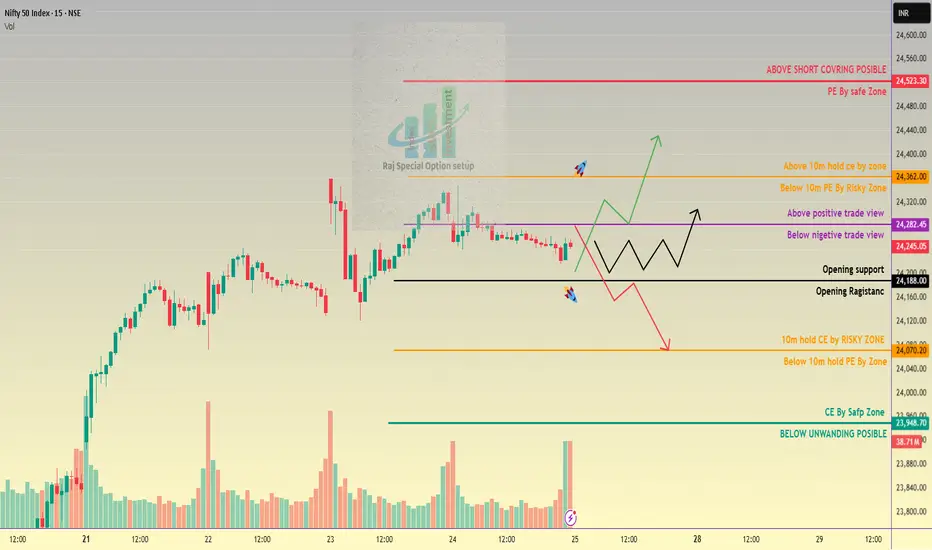
25 April Nifty Trade zone#Nifty50 #option trading
99% working trading plan
👉Gap up open 24282 above & 15m hold after positive trade target 24362, 24520
👉Gap up open 24282 below 15 m not break upside after nigetive trade target 24188 , 24070
👉Gap down open 24188 above 15m hold after positive trade target 24282 , 24362
👉Gap down open 24188 below 15 m not break upside after nigetive trade target 24072, 24948
💫big gapdown open 24072 above hold 1st positive trade view
💫big Gapup opening 24362 below nigetive trade view
Trade plan for education purpose I'm not responsible your trade
More education follow & support me
📌 koi bhi trade leval se 20 point ke sl ke bhina karan nahi hi
📌 koi trade app activate tabhi karana hota hi level pe 2 candle uper ya niche closing aati hai to
📌 leval par Ane pe turant trade plan na kare ...
📌 Full risk apaki hi hi meri nah
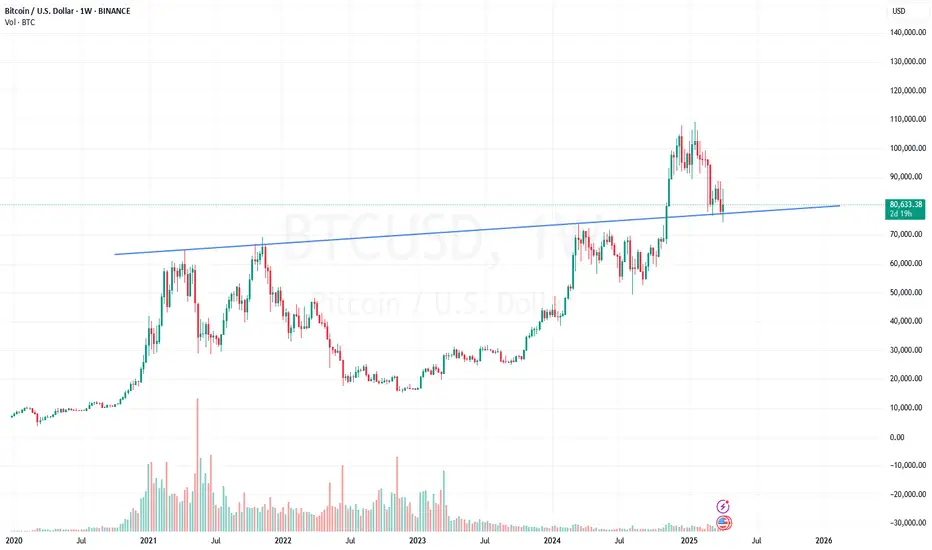
BITCOIN , BTCUSD
Bitcoin is currently finding support at the trend-line. Let's see whether it moves up from this support or breaks down. We should wait for the candle close this week for a clearer indication.
The stock market is unpredictable and can be influenced by large players. In recent years, we've seen significant struggles, like the COVID-19 pandemic and the Russia-Ukraine war, along with political events like Trump's actions. Although the market tends to recover quickly after crashes, it can also drop suddenly, as Newton's law suggests: what goes up fast can come down fast.
After the pandemic, many people wanted to invest in stocks, which attracted big investors and social media influencers promoting specific stocks that they wanted to sell. Many investors believe it's always good to buy the dip, but how much you invest matters. It's wise not to put all your money into the market; instead, diversify your investments across at least three different areas.
Don’t invest blindly just because the market is down. Additionally, governments often regulate the stock market in ways that benefit large investors while imposing higher taxes on ordinary people. I don’t blame the wealthy or those in power, as they were once normal people too; it's how we change with more money that can lead to different behaviors.
RHIM Swing Long Trade Signal- RHIM is currently trading at 596
- RHIM is building up a very tight base followed by a Higher low higher low structure
- The last candle was a huge imbalance and that will soon get filled based on that we can see a rebalance of price up to 620-640
- Accumulation Zones: 585-595
- Stop Loss - 567
- Chase - 10%
GRINDWELL next moveGRINDWELL started sell trend and also making trend line liquidity forbreak upside
if break above 2440 we can expect uptrend up to 2810
if breaks bellow 2320 we can expect 1980
Hit the like button to Rock !! Show some energy !!
Note :
⨻ Check the live market updates and analysis yourself before buy or sell.
⨺ Am not giving any advisory or signals its just my idea for upgrade my knowledge in trading for myself
⨹ This is my pre and post market analysis and my trading journey. Not a suggestion to buy or sell.
⫸ You are responsible for your trading not me ⫷
happy trading 🥰
Bankex - Sep 23current market braked the structure and
we can see 5min ob at the point of trend line
if it breaks the trend line we can expect a sell
otherwise be on buy side
Hit the like button to Rock !! Show some energy !!
Note :
⨻ Check the live market updates and analysis yourself before buy or sell.
⨺ Am not giving any advisory or signals its just my idea for upgrade my knowledge in trading for myself
⨹ This is my pre and post market analysis and my trading journey. Not a suggestion to buy or sell.
⫸ You are responsible for your trading not me ⫷
happy trading 🥰
Bullish Flag pattern in SANGHVI MOVERSA Weekly Bullish Flag and Pole pattern is visible on the charts of
Flag and Pole pattern is a bullish continuation pattern and it is visible in charts after a meaningful appreciation in the NSE:SANGHVIMOV
MACD gave Positive crossover on Daily chart , Monthly chart and on weekly chart, it is on verge of giving positive breakout So, expecting the momentum to continue.
One can look to create a fresh position in the scrip near Rs. 740-760 levels with the stoploss of Rs. 620.55 on weekly closing basis. The 1st target will be 840.10 , 2nd target will be 928.10, 3rd target will be 1008.20, 4th target will be 1096.65 and fifth target will be 1184.55.
Jubilant Ingrevia (Trendline Breakout Seen On W Chart)Jubilant Ingrevia (CMP: 555) has given a trendline breakout on the weekly chart. The stock has the possibility to head towards 600, 630, and 700 in the coming few months. View invalid below 483 (Weekly Closing basis). Also, good volumes can be seen on the weekly chart.
Disclaimer: I am not a SEBI registered analyst. All the stocks are for educational purposes. Investors must consult a financial advisor before making any investment. It is not a buy or sell recommendation.
Bullish Cup & Handle BO in Tata ElexiA Weekly Bullish Cup & Handle pattern is visible on the charts of NSE:TATAELXSI
Cup & Handle pattern is a bullish pattern and it is visible on the charts after a meaningful consolidation in the weekly charts of NSE:TATAELXSI
MACD gave positive crossover on daily and weekly and monthly time frame it is on verge of giving breakout.
One can look to create a fresh position in the scrip near Rs. 8000-8050 levels with the stoploss of Rs. 7400.50 on weekly closing basis. The 1st target will be 8540 , 2nd target will be 9035.65, 3rd target will be 9515.35 and 4th target will be 1015.65
And finally this study is for educational purpose only.