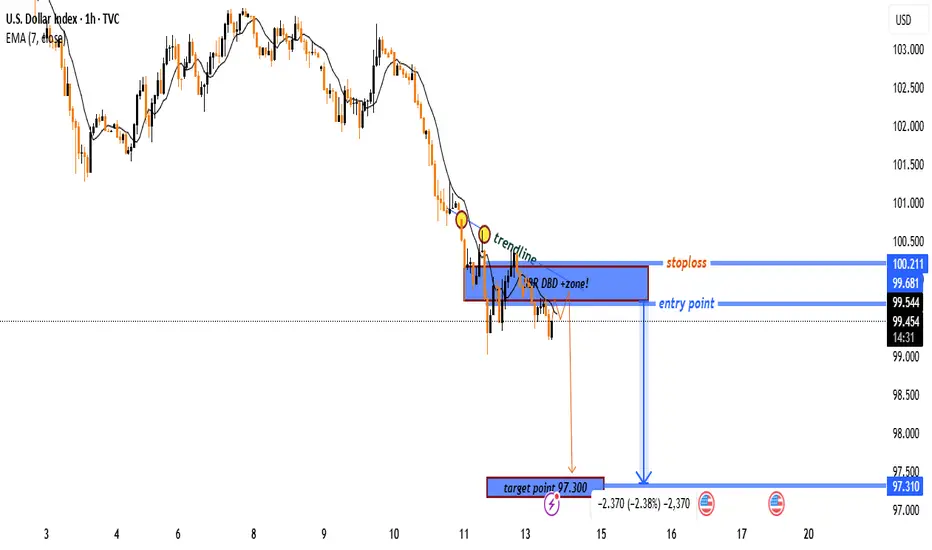
"USD Index Short Setup – Bearish Rejection from Supply Zone (DBD📉 Downtrend confirmed
➖ Lower highs and lower lows
➖ EMA (7) is sloping downward and acting as resistance
➖ Bearish momentum continues
Key Zones & Levels
🔵 Supply Zone (DBD)
🔹 Zone: 99.540 – 99.681
🔹 Label: “Drop-Base-Drop”
🔹 This is where sellers stepped in before – price is retesting it
🔹 Expecting a rejection from this area.
Trade Setup
📍 Entry Point:
🔹 Enter short around 99.540 – 99.681
❌ Stop Loss:
🔺 Set above the zone at 100.211
🚫 Protects against fakeouts
🎯 Target Point:
🔻 Target at 97.300
💰 Risk-Reward: 1:2.4 (Good!)
Visual Summary
📍 Entry: 99.540
❌ Stop Loss: 100.211
🎯 Target: 97.300
📉 Overall Bias: Bearish
✅ Strong RR setup with trend confirmation
Technicalindicators
"Bitcoin Bearish Reversal Setup: Supply Zone Short Strategy"🔵 SUPPLY ZONE (Resistance Area)
💥 Strong selling area around 85,800 - 87,800 USD
Historically, price got rejected here
Expect sellers to step in again
✍️ ENTRY POINT
📍 Just below the supply zone (~85,889.89)
Ideal for short position setup
Watch for bearish candlestick patterns for confirmation
🛑 STOP LOSS
❌ Placed above the supply zone at 87,796.97
Keeps risk under control if breakout happens
🎯 TARGET POINT (Support Area)
📉 Around 78,000 USD
Marked by previous support and structure
Great Risk-to-Reward ratio
📐 PATTERN WATCH
Looks like a harmonic pattern (maybe Gartley or Bat) 🦇
Suggests reversal from point D
Also resembles a rising wedge, which is bearish
📊 EMA (9-period)
🧭 Price hovering above the 9 EMA (84,704)
A break below it = bearish confirmation
Summary
🔻 Bearish bias
🛒 Short near supply zone
❌ SL above 87,800
🎯 TP around 78,000
Explanation of RSIRSI is a tool that aids traders in capturing market momentum by measuring the fluctuation in prices. Traders rely on RSI to spot oversold and overbought markets and determine the right time to enter a trade. RSI helps traders identify whether a stock is either overbought or oversold.
Option Chain TradingAn option chain is a comprehensive listing of all available option contracts for a specific underlying asset, typically organized by expiration date and strike price. It provides a detailed view of call and put options, their premiums, and other relevant information like bid/ask prices, volume, and open interest. This tool is crucial for options traders to analyze market conditions, identify potential trading opportunities, and choose the right options contracts based on their investment strategy.
Meaning of Management and psychologyManagement is the process of planning, organizing, leading, and controlling resources to achieve organizational goals, while psychology is the scientific study of behavior and mental processes. Management psychology, also known as managerial psychology, applies psychological principles to understand and improve managerial practices and organizational behavior.
Basic to Advance in Trading1. Open and fund your live account.
2. After careful analysis of the market, select your opportunity.
3. 'Buy' if you think that market's price will rise, or 'sell' if you think it'll fall.
4. Select your deal size, ie the number of CFD contracts.
5. Take steps to manage your risk.
Candlestick PatternsThe best way to learn to read candlestick patterns is to practise entering and exiting trades from the signals they give. You can develop your skills in a risk-free environment by opening an IG demo account, or if you feel confident enough to start trading, you can open a live account today.
Option traderOptions trading is a type of financial trading that allows investors to buy or sell the right to purchase or sell an underlying asset at a fixed price, at a future date. Options trading operates on the basis that the buyer has the option to exercise the contract but is not under any obligation to do so.
XAG/USD (Silver) 4H Trading Analysis📍 Current Price: 33.0990 (Near Entry Zone)
🔹 Trading Setup:
🟢 Entry Zone: 32.97654
🔴 Stop-Loss (SL): 32.48368 ❌
🔵 Take-Profit (TP) Levels:
TP1: 33.30512 🎯
TP2: 33.62431 🎯🎯
Final Target: 34.19599 🚀
📊 Price Action Insights:
✅ Bounce from Demand Zone (Gray Box) 📈
✅ Potential Bullish Move if price holds above entry 🚀
⚠️ Risk if SL is hit (Red Box) ❌
XAU/USD (Gold) Bullish Trade Setup – Key Levels & Targets📊 XAU/USD (Gold vs. USD) - 1H Chart Analysis
🔹 Entry & Risk-Reward Setup
🟢 Buy Zone: $3,015 - $3,017 ✅
🛑 Stop Loss: $3,003.14 ❌ (Protects against downside risk)
🎯 Target Point: $3,045.40 🚀
🔹 Take Profit Levels (TP)
🟡 TP1: $3,021.01 🥇 (First checkpoint)
🟡 TP2: $3,029.73 🥈 (Second target, stronger resistance)
🔵 Final Target: $3,045.40 🏆 (Major resistance level)
🔹 Market Structure & Price Action
📉 Recent Drop: Found support near $3,003 📌
📈 Potential Upside: Price attempting a bullish reversal 📊
⚠️ Watch for breakout at $3,021+ for confirmation! 🚀📊
"XAU/USD Price Action Analysis: Targeting $3,063 or Reversal to Alright! Let's break down the chart analysis. 📊
🔹 Chart Overview:
Pair: XAU/USD (Gold vs. US Dollar)
Timeframe: 1-hour (H1)
Price Level: Current price at $3,030.44
Target Point: $3,063.97
🔥 Key Observations:
Supply and Demand Zones:
The highlighted blue zones suggest resistance (supply) where price was rejected twice (blue arrows).
The larger gray zones below indicate potential demand/support.
Double Top Formation:
The double blue arrows point to a possible double-top pattern, hinting at a bearish reversal. However, the price hasn't strongly broken below the neckline yet.
Scenario Analysis:
Bullish Scenario: If the price holds the current demand zone and breaks above the immediate resistance, we could see a rally towards the target of $3,063.97. 💹🚀
Bearish Scenario: If it fails to hold the support zone, it may drop to the lower demand area around $3,000. 🔻
📉 Conclusion:
Entry Idea: Long above the supply zone break with a target of $3,063.97.
Stop Loss: Below the current demand zone at around $3,020.
Risk Management: Watch for strong price action before entering.
what is adx and how does it works ?**SkyTradingZone** is your go-to source for educational content on trading, covering market insights, strategies, and in-depth analysis. Our goal is to empower traders with knowledge to navigate the markets effectively.
---
# **What is ADX (Average Directional Index) and How Does It Work?**
## **1️⃣ What is ADX?**
The **Average Directional Index (ADX)** is a **trend strength indicator** developed by J. Welles Wilder. It helps traders measure the **strength of a trend** and determine whether the market is trending or consolidating.
📌 **ADX Components:**
- **ADX Line** → Measures trend strength (values from 0 to 100).
- **+DI (Positive Directional Indicator)** → Measures **bullish** strength.
- **-DI (Negative Directional Indicator)** → Measures **bearish** strength.
### **Formula for ADX Calculation**
1️⃣ Calculate **Directional Movement (DM)**
- **+DM** = Current High - Previous High (if positive)
- **-DM** = Previous Low - Current Low (if positive)
2️⃣ Calculate **True Range (TR)**
- TR = Highest of (Current High - Current Low, |Current High - Previous Close|, |Current Low - Previous Close|)
3️⃣ Calculate **Smoothed Moving Average of DM & TR**
4️⃣ Compute **DI+ and DI-**
- **+DI = (Smoothed +DM / Smoothed TR) × 100**
- **-DI = (Smoothed -DM / Smoothed TR) × 100**
5️⃣ Compute ADX using the difference between +DI and -DI.
---
## **2️⃣ How to Interpret ADX?**
📌 **ADX Trend Strength Scale:**
| **ADX Value** | **Trend Strength** |
|-------------|------------------|
| **0-20** | Weak or No Trend (Sideways Market) |
| **20-40** | Moderate Trend (Growing Momentum) |
| **40-60** | Strong Trend (Trending Market) |
| **60-100** | Extremely Strong Trend (Overheated Market) |
🔹 **Rising ADX** → **Trend is strengthening** (bullish or bearish).
🔹 **Falling ADX** → **Trend is weakening** (possible consolidation or reversal).
🔹 **ADX below 20** → **Sideways market, no clear trend**.
📌 **+DI vs. -DI Interpretation**
- If **+DI is above -DI**, the market is in an **uptrend**.
- If **-DI is above +DI**, the market is in a **downtrend**.
- If **ADX is below 20**, the market is in a **choppy range** → Avoid trend-based trades.
---
## **3️⃣ How to Use ADX in Trading?**
### 🔹 **1. Identifying Strong Trend Opportunities**
✅ **ADX Above 25** → Indicates a strong trend, traders can enter a trade in the trend’s direction.
✅ **ADX Below 20** → Market is ranging, avoid trend-based strategies.
📌 **Example:** If **ADX rises from 20 to 40**, it confirms an **ongoing strong trend** (either bullish or bearish).
### 🔹 **2. Trend Confirmation Strategy**
**Buy Setup:**
✅ **+DI crosses above -DI** → Bullish trend signal.
✅ **ADX above 20** → Confirms strength.
✅ Enter a **long position** when ADX rises above 25.
**Sell Setup:**
✅ **-DI crosses above +DI** → Bearish trend signal.
✅ **ADX above 20** → Confirms downtrend.
✅ Enter a **short position** when ADX rises above 25.
📌 **Example:** If **+DI crosses above -DI & ADX > 25**, enter a long trade.
### 🔹 **3. Combining ADX with Other Indicators**
📌 **Strategy 1: ADX + Moving Averages**
✅ Use **ADX > 25** to confirm a **moving average crossover signal**.
✅ **If ADX is below 20**, avoid moving average-based signals.
📌 **Strategy 2: ADX + RSI (Relative Strength Index)**
✅ **ADX above 25 & RSI above 50** → Strong uptrend (buy signal).
✅ **ADX above 25 & RSI below 50** → Strong downtrend (sell signal).
📌 **Strategy 3: ADX + Support & Resistance**
✅ If **ADX is rising near a breakout level**, it confirms a **trend continuation**.
✅ If **ADX is falling near support/resistance**, it signals **a possible reversal**.
---
## **4️⃣ Example: ADX Trading in Nifty 50**
| **Date** | **ADX Value** | **+DI** | **-DI** | **Market Condition** |
|---------|------------|------|------|----------------|
| Feb 15 | 18 | 23 | 21 | No Trend (Range-bound) |
| Feb 16 | 30 | 28 | 15 | Strong Uptrend (Buy Signal) |
| Feb 17 | 42 | 32 | 10 | Very Strong Uptrend |
| Feb 18 | 50 | 35 | 8 | Extremely Strong Trend (Watch for Reversal) |
📌 **Observation:**
- ADX **rising above 25** confirms a **strong bullish trend**.
- If ADX **peaks at 50+**, trend exhaustion may occur → **Reversal possible**.
---
## **5️⃣ Common Mistakes When Using ADX**
⚠️ **Misinterpreting Low ADX as a Bearish Signal** – Low ADX means **no trend**, not necessarily bearish.
⚠️ **Ignoring DI Crossovers** – ADX alone doesn’t indicate direction; **DI crossovers confirm bullish/bearish trends**.
⚠️ **Trading Every ADX Move** – ADX should be used **with trend-following indicators** like RSI or Moving Averages.
---
## **Conclusion**
The **ADX Indicator** is a **powerful tool** to measure **trend strength and confirm market direction**. By combining **ADX with DI crossovers and support/resistance levels**, traders can improve their accuracy in **trend-following strategies**.
In future lessons, we will cover:
✅ **Live Chart Examples of ADX Trading**
✅ **How to Combine ADX with Moving Averages for Stronger Entries**
✅ **Building a Trend-Following Strategy Using ADX**
Stay tuned for more insights!
---
🔹 **Disclaimer**: This content is for educational purposes only. *SkyTradingZone* is not SEBI registered, and we do not provide financial or investment advice. Please conduct your own research before making any trading decisions.
Reliance Industries Ltd.**Reliance Industries Ltd. (RELIANCE) Stock Analysis**
**Company Overview:**
Reliance Industries Ltd. is one of India's largest conglomerates, with operations spanning across several sectors including petrochemicals, refining, oil and gas exploration, retail, and telecommunications. It holds a dominant position in the Indian market with its diversified businesses, and the company is known for its significant impact on India's economic development, particularly in the telecom and retail industries through its Jio and retail businesses.
**Fundamental Analysis:**
- **Market Capitalization:** Approximately ₹16.61 trillion.
- **Price-to-Earnings (P/E) Ratio:** The stock trades at a P/E ratio of 24.01, which is above the industry average, indicating that the stock is priced at a premium in anticipation of future growth.
- **Earnings Per Share (EPS):** ₹51.13, showing the company's strong profitability in terms of earnings generated per share.
- **Return on Equity (ROE):** 8.29%, suggesting moderate efficiency in generating profits from shareholders' equity.
- **Debt-to-Equity Ratio:** 0.44, indicating that Reliance maintains a balanced approach to using debt in its capital structure, with a moderate reliance on borrowing.
- **Dividend Yield:** 0.41%, which is on the lower side, reflecting a conservative dividend payout policy.
**Technical Analysis:**
- **Current Price:** ₹1,227.70.
- **52-Week Range:** The stock has traded between ₹978.15 and ₹1,608.95 during the past year, displaying significant price volatility.
- **Support Levels:**
- First Support: ₹1,200.00
- Second Support: ₹1,150.00
- **Resistance Levels:**
- First Resistance: ₹1,300.00
- Second Resistance: ₹1,350.00
- **Breakout Point:** A sustained move above ₹1,300.00 could signal the start of a bullish trend, potentially bringing more investors into the stock.
- **Retest Levels:** If the stock breaks above ₹1,300.00, a retest of this level would confirm it as a new support level, solidifying a stronger trend.
**Recent Performance:**
- **1 Week:** The stock has increased by 0.75%.
- **1 Month:** The stock has decreased by 3.92%, reflecting a period of downward pressure.
- **6 Months:** The stock has decreased by 16.35%, underperforming compared to broader market indices.
**Analyst Ratings:**
- **Morgan Stanley:** Maintains an 'Overweight' rating with a target price of ₹1,606, suggesting a 31% upside from the current market price.
- **JP Morgan:** Holds an 'Overweight' rating, with a potential upside of up to 25% from current levels.
**Conclusion:**
Reliance Industries Ltd. continues to be a key player in the Indian market, with strong fundamentals and diversified business operations. Despite its elevated P/E ratio and some short-term underperformance, it remains a long-term growth candidate due to its dominant position in sectors like telecom and retail. Traders should watch key support levels at ₹1,200.00 and ₹1,150.00, and be alert for potential breakout opportunities above ₹1,300.00 for further upside momentum.
*Please note that stock market investments carry inherent risks. It is advisable to conduct thorough research or consult with a financial advisor before making investment decisions.*
what is divergence based trading ?**Divergence-based trading** is a strategy that focuses on identifying potential price reversals by analyzing the relationship between the price of an asset and an **oscillator** or indicator, such as the **Relative Strength Index (RSI)**, **Moving Average Convergence Divergence (MACD)**, or **Stochastic Oscillator**. Divergence occurs when the price of an asset and the indicator do not move in the same direction or exhibit opposite trends. This could signal that the prevailing trend is weakening, and a reversal may be imminent.
### Types of Divergence:
1. **Bullish Divergence**:
- **Bullish Divergence** occurs when the price is making **lower lows**, but the indicator (e.g., RSI, MACD) is making **higher lows**.
- This indicates that although the price is still falling, the momentum behind the downward movement is weakening, which can signal a potential **upward reversal**.
- **Example**: A stock price may be making new lows, but the RSI is making higher lows, suggesting that selling pressure is weakening, and a buying opportunity could be coming.
2. **Bearish Divergence**:
- **Bearish Divergence** happens when the price is making **higher highs**, but the indicator is making **lower highs**.
- This suggests that while the price is rising, the momentum behind the price movement is fading, which can indicate a **downward reversal**.
- **Example**: A stock price is making new highs, but the MACD is making lower highs, signaling a potential weakening of the uptrend and a possible price decline.
### **How to Use Divergence in Trading**
1. **Confirming Reversals**:
- Divergence often signals potential **trend reversals** or shifts in momentum, but it is essential to wait for confirmation. A reversal is not guaranteed just because divergence appears.
- Traders often wait for additional signals, such as **candlestick patterns** (like engulfing candles, doji patterns) or a **break of key support/resistance levels**, to confirm the reversal.
2. **Combining with Other Indicators**:
- Divergence can be more reliable when combined with other technical indicators or chart patterns. For example, combining divergence with **moving averages** or **support and resistance levels** provides additional confirmation that the trend is about to change.
- For instance, if a bearish divergence is spotted on the RSI, and the price breaks below a support level, this strengthens the signal that the price may reverse to the downside.
3. **Using Multiple Time Frames**:
- Traders often check divergence on multiple time frames to increase the accuracy of their predictions. For example, a bullish divergence on a **daily chart** and a corresponding **hourly chart** could provide a stronger confirmation of a potential trend reversal.
4. **Risk Management**:
- Like any other trading strategy, divergence-based trading requires **proper risk management**. Traders should use **stop-loss orders** to protect themselves from unexpected market movements. Since divergence doesn't always result in a reversal, having a stop-loss in place is crucial for limiting potential losses.
### **Example of Divergence-Based Trading**
Let’s consider an example of **bearish divergence**:
- A trader notices that the **price of stock XYZ** is making higher highs, but the **RSI** is forming lower highs. This signals **bearish divergence**, meaning the buying momentum is weakening despite the price increase. The trader may wait for a confirmation of a reversal by watching for price to break below the **previous support level** or other technical signals (such as a **bearish candlestick pattern**).
- After confirmation, the trader may enter a **short position** (betting on the price going down) and set a stop-loss to manage risk.
### **Advantages of Divergence-Based Trading**:
- **Identifying Potential Trend Reversals**: Divergence can help spot when a trend may be losing momentum and is potentially ready to reverse.
- **Market Timing**: Divergence helps traders anticipate entry points, which could lead to favorable trades if used effectively.
- **Useful Across Multiple Markets**: Divergence-based trading can be applied across various financial markets, such as stocks, forex, commodities, or cryptocurrencies.
### **Limitations of Divergence-Based Trading**:
- **False Signals**: Divergence doesn’t always lead to a reversal. The price could continue in the same direction despite the divergence.
- **Timing Issues**: Divergence often appears before a reversal happens, and it can take time for the market to confirm the change in trend. Therefore, it requires patience and may result in missed opportunities.
- **Needs Confirmation**: Divergence alone isn’t a strong enough signal to make a trade. Traders should wait for confirmation through other technical indicators, chart patterns, or trend breaks.
### **Conclusion**:
Divergence-based trading is a useful strategy for identifying potential trend reversals by comparing price action with momentum indicators. However, it’s important to use it as part of a broader trading plan that incorporates proper risk management and confirmation from other indicators. By doing so, traders can increase the likelihood of successful trades and better manage the inherent risks of divergence-based signals.