Geopolitics & Energy TradingIntroduction
Energy is the lifeblood of modern economies. The global energy market encompasses oil, natural gas, coal, nuclear, and increasingly, renewable energy sources. Trading in these commodities is not just a commercial activity; it is deeply intertwined with international politics, national security, and global diplomacy. Geopolitical events—ranging from wars, sanctions, and territorial disputes to alliances, trade agreements, and regulatory changes—have the power to cause sharp fluctuations in energy prices and disrupt supply chains worldwide.
Understanding the connection between geopolitics and energy trading is crucial for policymakers, investors, and businesses. Energy trading markets are not purely governed by supply-demand fundamentals; political decisions, international relations, and strategic considerations often shape market dynamics, creating both risks and opportunities for traders.
Historical Perspective
Historically, energy trading has been shaped by geopolitical considerations. The oil crises of the 1970s are classic examples: the 1973 Arab Oil Embargo and the 1979 Iranian Revolution caused severe disruptions in oil supplies, triggering global economic shocks. Prices quadrupled within months, highlighting the vulnerability of economies reliant on imported energy.
Similarly, the Gulf Wars of the 1990s and early 2000s demonstrated how military conflicts in key oil-producing regions directly impacted energy markets. Traders learned that political stability in regions like the Middle East, North Africa, and parts of Asia is as critical as technical supply-demand forecasts.
Geopolitics as a Driver of Energy Prices
Energy prices are highly sensitive to geopolitical developments. There are several mechanisms through which politics affects trading:
Supply Disruptions: Conflicts, civil wars, and sanctions can cut off production in major energy-producing countries. For example, sanctions against Iran and Russia restricted oil and gas exports, creating supply shortages that pushed prices higher.
Transport & Transit Risks: Many energy supplies depend on transit routes, pipelines, and chokepoints such as the Strait of Hormuz or the Suez Canal. Geopolitical tensions near these routes can increase shipping insurance costs, reduce flow, and spike energy prices.
Resource Nationalism: Governments may control energy resources to advance political agendas. Nationalization of oil fields or preferential export policies can reduce global supply and disrupt markets. Venezuela’s oil policies in the past decades exemplify this phenomenon.
Strategic Alliances & Trade Agreements: Energy-exporting nations often form alliances like OPEC (Organization of the Petroleum Exporting Countries) to coordinate output and stabilize prices. Political alignment among members can dictate production quotas, influencing global trading dynamics.
Regulatory & Policy Changes: Geopolitical considerations often influence domestic energy policies. For instance, the U.S. decision to reduce dependence on Middle Eastern oil by boosting shale production reshaped global oil trading patterns and affected OPEC strategies.
Regional Geopolitics & Energy Markets
Middle East
The Middle East remains central to global energy trading. Countries like Saudi Arabia, Iraq, Iran, and the UAE hold substantial reserves of crude oil and natural gas. Political instability in the region often triggers price volatility. For instance, the U.S.-Iran tensions have repeatedly caused spikes in Brent crude prices, even without an actual disruption in supply. Traders closely monitor developments in the region, including diplomatic negotiations, internal unrest, and proxy conflicts, as these can have immediate market implications.
Russia & Europe
Russia is a dominant player in global energy markets, especially natural gas and oil. European reliance on Russian gas has made the region vulnerable to geopolitical conflicts. The Russia-Ukraine war in 2022 caused unprecedented disruptions in European energy markets. Gas prices surged, alternative energy sourcing became urgent, and European nations accelerated energy diversification strategies. Energy traders had to account not only for price risks but also for policy-driven changes like sanctions and supply restrictions.
Asia-Pacific
Asia’s energy market is characterized by high demand growth, particularly in China and India. These nations rely heavily on imported oil and liquefied natural gas (LNG). Geopolitical tensions in the South China Sea or with energy suppliers such as the Middle East or Australia can influence trading patterns. Furthermore, regional energy diplomacy, including agreements between China, Russia, and Central Asian nations, has implications for LNG and crude oil flows.
Africa & Latin America
African and Latin American nations are increasingly significant in energy markets. Political instability, regulatory uncertainty, and infrastructure challenges in countries like Nigeria, Angola, and Venezuela often lead to supply disruptions. Traders must account for both the risks and the potential arbitrage opportunities created by these geopolitical factors.
Geopolitical Risks and Energy Trading Strategies
Energy trading is inherently risky due to geopolitical uncertainty. Traders and investors employ various strategies to manage this risk:
Hedging: Futures contracts, options, and swaps allow traders to lock in prices and reduce exposure to geopolitical volatility. For example, airlines often hedge fuel costs to protect against sudden price spikes due to Middle East tensions.
Diversification of Supply: Energy importers diversify their sources to reduce dependence on politically unstable regions. Japan and South Korea, for instance, import LNG from multiple countries to mitigate supply risks.
Speculation & Arbitrage: Geopolitical events create short-term volatility, which can be exploited by speculative traders. For instance, a news report about potential conflict in the Strait of Hormuz can trigger immediate buying or selling of oil futures.
Long-Term Contracts & Strategic Reserves: Countries and corporations often enter long-term supply contracts or maintain strategic reserves to mitigate supply risks associated with geopolitical uncertainties.
The Role of International Organizations
Global energy trading is influenced by international institutions that seek to balance political and economic interests:
OPEC and OPEC+ coordinate production policies among member nations, using geopolitical leverage to influence global prices. OPEC decisions are often influenced by the political interests of its members, blending market economics with diplomacy.
International Energy Agency (IEA) helps coordinate energy security policies among developed nations, ensuring preparedness against geopolitical shocks. For example, IEA member countries maintain strategic oil reserves to stabilize markets in case of sudden supply disruptions.
United Nations & WTO frameworks affect trade policies and sanctions. Trade restrictions or embargoes imposed for political reasons can dramatically affect energy flows, influencing trading strategies globally.
Emerging Trends
The intersection of geopolitics and energy trading is evolving due to technological and structural changes:
Transition to Renewable Energy: As nations diversify toward solar, wind, and hydrogen, the geopolitical influence of traditional fossil fuel exporters may decline. However, new geopolitical dependencies could emerge around critical minerals for renewable technologies.
Energy Storage & LNG Flexibility: Advances in storage technology and liquefied natural gas transport reduce vulnerability to short-term supply disruptions. This mitigates some geopolitical risk for traders but also introduces complex market dynamics.
Cybersecurity Threats: Energy infrastructure is increasingly digital, making it susceptible to cyber-attacks that have geopolitical implications. A hack on a pipeline or electricity grid can disrupt markets instantly, adding a new dimension to energy trading risk.
Geoeconomic Competition: Countries are increasingly using energy as a strategic tool, influencing markets through tariffs, subsidies, or state-backed investments in foreign energy infrastructure. China's Belt and Road Initiative, including energy projects, exemplifies this trend.
Case Studies
1. Russia-Ukraine Conflict (2022–Present)
The war demonstrated how energy markets respond to sudden geopolitical crises. European nations scrambled for alternative gas supplies as pipelines from Russia were restricted. Energy trading became highly volatile, with natural gas prices in Europe reaching record highs. Traders had to incorporate political risk assessments, sanctions updates, and alternative sourcing strategies into their decision-making process.
2. Iran Sanctions & Oil Markets
U.S. sanctions on Iran over its nuclear program restricted its oil exports, reducing global supply and increasing crude prices. The uncertainty surrounding sanctions enforcement created trading opportunities for speculative investors while increasing costs for import-dependent nations.
3. Gulf Tensions and Strait of Hormuz
The Strait of Hormuz, a vital chokepoint for global oil flows, has been a geopolitical flashpoint. Military incidents and political posturing in the Gulf region cause immediate spikes in oil futures prices, demonstrating the tight coupling between geopolitics and energy trading.
Conclusion
Geopolitics and energy trading are inextricably linked. The energy market is not only a reflection of supply and demand but also a mirror of global political tensions, alliances, and conflicts. Traders and policymakers must constantly monitor international developments, anticipate risks, and employ strategies to mitigate the effects of geopolitical uncertainty.
The future of energy trading will be shaped by the interplay between traditional fossil fuel geopolitics and emerging trends like renewable energy, energy storage, and cyber threats. While diversification, hedging, and strategic planning can reduce exposure, the market’s inherently political nature ensures that energy trading will remain a high-stakes arena where economics and geopolitics converge.
Understanding this nexus is essential for anyone involved in energy markets, from traders and investors to policymakers and energy companies. In a world where a single geopolitical event can ripple through global supply chains and markets, staying informed and agile is not just advantageous—it is imperative.
Tradingidea
Options Greeks & Advanced Hedging Strategies1. Introduction to Options
Options are derivative instruments that provide the right, but not the obligation, to buy or sell an underlying asset at a predetermined price before or on a specified expiry date. There are two main types:
Call Options – Give the holder the right to buy the underlying asset.
Put Options – Give the holder the right to sell the underlying asset.
Unlike equities, options are inherently more complex because their value is influenced by multiple variables such as underlying price, strike price, time to expiration, volatility, interest rates, and dividends. This multidimensionality is captured by the Greeks, which form the backbone of options risk management.
2. Understanding Options Greeks
The Greeks quantify the sensitivity of an option’s price to various market factors. They are indispensable for assessing risk and structuring trades. The primary Greeks are Delta, Gamma, Theta, Vega, and Rho, each serving a specific purpose.
2.1 Delta (Δ) – Price Sensitivity
Delta measures the rate of change of an option's price with respect to the price movement of the underlying asset.
Call Delta ranges from 0 to 1.
Put Delta ranges from -1 to 0.
Interpretation:
A delta of 0.6 for a call option indicates that if the underlying asset moves up by ₹1, the call option price will increase by ₹0.60.
Traders use delta to gauge the directional exposure of their portfolio, often referred to as delta exposure.
Delta Hedging:
Delta hedging is a strategy where traders neutralize the delta of a position by taking an offsetting position in the underlying asset. For example, if you hold a call option with a delta of 0.6 on 100 shares, you can short 60 shares of the underlying to make the position delta-neutral.
2.2 Gamma (Γ) – Rate of Change of Delta
Gamma measures the rate of change of delta with respect to changes in the underlying asset price.
High Gamma indicates that delta changes rapidly with underlying price movement.
Low Gamma implies delta is stable.
Importance of Gamma:
Gamma is crucial for understanding convexity risk, especially near the option’s expiry or at-the-money options.
Traders use gamma to anticipate how delta hedges will change as the market moves.
Gamma Hedging:
Gamma hedging involves balancing a portfolio such that it remains neutral to delta changes. Typically, it requires frequent adjustments because gamma fluctuates as underlying prices move.
2.3 Theta (Θ) – Time Decay
Theta represents the rate at which an option loses value as time passes, holding other factors constant.
Options are decaying assets, losing value every day due to time erosion.
Call and put options experience negative theta for holders (long positions) and positive theta for writers (short positions).
Applications:
Long options traders must account for theta decay, especially in volatile markets.
Strategies like calendar spreads or selling options exploit theta decay to generate income.
2.4 Vega (ν) – Volatility Sensitivity
Vega measures an option’s sensitivity to changes in implied volatility of the underlying asset.
Options prices increase with higher volatility (for both calls and puts).
Vega is higher for at-the-money options and long-dated options.
Volatility Trading:
Traders can take positions purely on expected volatility changes without relying on directional movement.
Long Vega positions profit from volatility spikes, while short Vega strategies benefit from declining volatility.
2.5 Rho (ρ) – Interest Rate Sensitivity
Rho measures sensitivity to changes in the risk-free interest rate.
More significant for long-term options.
A call option’s price rises with increasing interest rates, while put options decline.
Practical Relevance:
Rho is relatively minor compared to delta or vega but becomes crucial in macroeconomic shifts, especially for options with long maturities.
3. Combining Greeks for Portfolio Management
While each Greek provides specific insights, professional traders consider multiple Greeks simultaneously to manage comprehensive risk. This multidimensional approach allows traders to:
Maintain delta neutrality – minimize directional risk.
Control gamma exposure – manage rapid changes in delta.
Optimize theta decay – benefit from time erosion.
Manage vega risk – protect against volatility shocks.
Monitor rho impact – for long-term interest-sensitive trades.
Example:
A trader holding a long call may delta-hedge by shorting the underlying. If gamma is high, the hedge needs frequent adjustments. Additionally, they must consider theta decay, particularly if the position is near expiry.
4. Advanced Hedging Strategies
Hedging with options is a way to protect portfolios from adverse movements while retaining profit potential. Advanced hedging strategies involve using combinations of options, futures, and the underlying asset.
4.1 Delta Neutral Hedging
Objective: Make a portfolio insensitive to small price movements.
Method: Offset delta of options with underlying asset or other derivatives.
Example: Long call delta of 0.6 → Short 60 shares of the underlying.
Advantages:
Reduces directional risk.
Can be dynamically adjusted to changing deltas.
Limitations:
Frequent rebalancing is required due to gamma exposure.
4.2 Gamma Scalping
Objective: Profit from price swings in the underlying asset while remaining delta neutral.
Method: Buy options with high gamma. As underlying moves, delta changes are hedged dynamically, locking in profits from volatility.
Applications: Used by market makers and professional traders to extract profit from intraday volatility.
4.3 Vega Hedging
Objective: Neutralize exposure to volatility changes.
Method: Offset vega by taking positions in options with opposite volatility sensitivity (e.g., long a call and short a call with different strike prices or maturities).
Applications: Useful during earnings announcements, geopolitical events, or expected market turbulence.
4.4 Calendar and Diagonal Spreads
Calendar Spread: Buy a long-dated option and sell a short-dated option of the same strike.
Diagonal Spread: Combine different strikes and expiries.
Purpose: Exploit theta decay and volatility differences while limiting directional risk.
Example: A trader expecting stable markets but rising volatility may buy a long-term call and sell a near-term call.
4.5 Protective Puts & Collars
Protective Put: Buying a put option to safeguard a long stock position.
Collar: Combining a protective put with a covered call to limit downside while capping upside.
Applications: Hedging large equity positions during uncertain markets.
4.6 Ratio & Backspread Strategies
Ratio Spread: Buy/sell unequal number of options to balance cost and risk.
Backspread: Sell a small number of near-term options and buy a larger number of far-term options.
Use Case: Profitable in high volatility expectations, providing leveraged exposure with hedged downside.
5. Greeks-Based Risk Management
A sophisticated options trader actively monitors Greeks to:
Adjust positions dynamically – react to price, time, and volatility changes.
Measure risk-reward tradeoffs – understand potential loss in extreme scenarios.
Stress-test portfolios – simulate scenarios like sharp price jumps or volatility spikes.
Optimize hedging costs – reduce capital expenditure while maintaining protection.
Conclusion
Options Greeks are the foundation for advanced options trading and risk management. Understanding delta, gamma, theta, vega, and rho enables traders to quantify risk, structure trades, and implement sophisticated hedging strategies. By combining these metrics with advanced approaches like delta neutral hedging, gamma scalping, vega hedging, spreads, and collars, traders can protect portfolios against adverse movements while seizing opportunities in volatile markets.
For Indian traders, these strategies are highly relevant in indices like Nifty, Bank Nifty, and sectoral options, as well as in individual stocks. Mastery of Greeks and hedging not only enhances risk management but also opens avenues for strategic income generation, volatility trading, and portfolio optimization.
In an increasingly complex and volatile market environment, leveraging Options Greeks and advanced hedging strategies is no longer optional—it is essential for any serious options trader aiming for consistent, risk-adjusted returns.
Swing & Positional Trading in India1. Introduction
Trading in India has evolved dramatically over the last few decades. With the liberalization of the economy, the growth of the Indian Stock Market, and the advent of online trading platforms, Indian traders now have unprecedented access to domestic and global financial markets. Among the different trading styles, Swing Trading and Positional Trading have emerged as popular strategies for retail and professional traders alike. These approaches allow traders to capture medium- to long-term price movements without the need to constantly monitor intraday charts.
While intraday trading focuses on short-term price fluctuations within a single trading session, swing and positional trading capitalize on trends that develop over days, weeks, or even months. This approach suits traders who have limited time but want to participate in the market meaningfully. Understanding these trading strategies and their applicability to the Indian markets can significantly improve a trader’s probability of success.
2. Understanding Swing Trading
2.1 Definition
Swing trading is a medium-term trading strategy that aims to capture price movements, or “swings,” over several days to weeks. Traders look for short- to medium-term trends and take positions accordingly, often based on technical analysis, momentum indicators, and market sentiment.
2.2 Key Principles
Trend Following: Swing traders usually identify the prevailing trend (uptrend, downtrend, or sideways) and make trades in the direction of the trend.
Support and Resistance: Traders rely on technical levels to identify entry and exit points. Buying near support and selling near resistance is common practice.
Risk Management: Swing traders typically use stop-loss orders to protect against sudden market reversals.
Trade Duration: Positions are generally held from 2 to 10 days, depending on the strength of the trend and market volatility.
2.3 Tools and Techniques
Technical Indicators: Moving Averages (SMA, EMA), Relative Strength Index (RSI), MACD, Bollinger Bands.
Chart Patterns: Head and Shoulders, Double Top/Bottom, Flags, Pennants.
Candlestick Patterns: Doji, Hammer, Engulfing Patterns.
Volume Analysis: Helps confirm the strength of a trend.
2.4 Advantages of Swing Trading
Time Efficiency: Requires less monitoring compared to intraday trading.
Profit Potential: Captures larger price movements than day trading.
Flexibility: Can be applied to stocks, indices, commodities, and currencies.
2.5 Challenges in India
Market Volatility: Indian markets, particularly mid-cap and small-cap stocks, can be highly volatile.
Gap Risk: Overnight events or global cues can cause price gaps against positions.
Liquidity Constraints: Certain stocks may not have sufficient liquidity, making entry and exit difficult.
3. Understanding Positional Trading
3.1 Definition
Positional trading is a longer-term trading strategy, where traders hold positions for weeks, months, or even years. It is based on identifying fundamental and technical trends that suggest sustained price movement.
3.2 Key Principles
Long-Term Trend Analysis: Positional traders often rely on both fundamental analysis (company performance, macroeconomic indicators) and technical analysis to select stocks.
Patience: Since positions are held longer, traders need the patience to withstand short-term market fluctuations.
Risk Management: Stop-losses are wider than swing trading to account for natural market volatility over time.
Trade Duration: Positions are typically held from several weeks to months, and sometimes years.
3.3 Tools and Techniques
Technical Indicators: Long-term moving averages (50-day, 200-day), trendlines, Fibonacci retracements.
Fundamental Analysis: Earnings growth, P/E ratio, debt-to-equity ratio, macroeconomic trends.
Market Sentiment: Tracking global markets, FII and DII activity, RBI policies, and geopolitical events.
3.4 Advantages of Positional Trading
Lower Stress: Traders are not required to monitor markets constantly.
Reduced Transaction Costs: Fewer trades mean lower brokerage and taxes.
Captures Major Trends: Potential for larger gains by riding long-term market trends.
3.5 Challenges in India
Policy & Regulatory Risk: Changes in government policy, taxation, or SEBI rules can impact long-term positions.
Corporate Governance Issues: Fraud, mismanagement, or delayed disclosures can harm stock value.
Capital Lock-In: Funds remain invested longer, reducing liquidity for other opportunities.
4. Swing vs Positional Trading: Key Differences
Feature Swing Trading Positional Trading
Duration 2-10 days Weeks to months
Analysis Focus Technical Technical + Fundamental
Risk Exposure Moderate Moderate to Low (if diversified)
Capital Requirement Moderate Higher (for long-term gains)
Stress Level Medium Low
Suitable For Active traders with some time Investors seeking long-term gains
While both styles aim to profit from trends, swing trading suits more active, hands-on traders, whereas positional trading is suitable for those with a longer investment horizon and patience.
5. Indian Market Context
5.1 Stock Exchanges
NSE (National Stock Exchange): Provides access to liquid stocks, derivatives, and indices like Nifty 50.
BSE (Bombay Stock Exchange): Known for a wide range of listed companies, including small and mid-caps.
Both exchanges support advanced trading platforms, live data feeds, and charting tools crucial for swing and positional trading.
5.2 Key Sectors for Trading
Banking & Finance: Highly liquid, reacts to RBI policy.
IT & Technology: Influenced by global tech trends and export demand.
Pharmaceuticals & Healthcare: Stable and defensive, often suitable for positional trades.
Energy & Commodities: Sensitive to global crude, metals, and government policies.
5.3 Role of Retail & Institutional Traders
Retail Traders: Increasingly active in swing trading due to technology and social media-driven stock tips.
Institutional Investors: Often drive positional trends through large buy/sell orders, especially in FII-heavy stocks.
6. Strategy Formulation in India
6.1 Swing Trading Strategy Example
Identify a stock with a clear uptrend using moving averages.
Confirm momentum using RSI (e.g., RSI above 50).
Look for a retracement near support levels for entry.
Set stop-loss just below support.
Target previous resistance levels or Fibonacci extension levels for exit.
Example:
Stock: Infosys
Trend: Uptrend (50-day MA > 200-day MA)
Entry: On a pullback to ₹1,800
Stop-loss: ₹1,770
Target: ₹1,860-₹1,900
6.2 Positional Trading Strategy Example
Conduct fundamental analysis of the company.
Check macroeconomic factors affecting the sector.
Identify long-term trend on weekly/monthly charts.
Enter position with a wider stop-loss.
Hold position for several months to capture full trend.
Example:
Stock: HDFC Bank
Fundamental Strength: Consistent earnings growth, strong balance sheet
Technical Entry: Breakout above ₹1,700 weekly resistance
Stop-loss: ₹1,600
Target: ₹2,000+ over 6-12 months
7. Risk Management & Psychology
7.1 Position Sizing
Swing traders often risk 1-2% of capital per trade.
Positional traders may take slightly larger positions due to longer-term confidence in fundamentals but diversify across sectors.
7.2 Stop-Loss and Take-Profit
Crucial for both styles.
Swing traders use tighter stops to protect against short-term reversals.
Positional traders use wider stops due to normal market volatility over weeks or months.
7.3 Trading Psychology
Avoid overtrading: Common among swing traders who react to minor fluctuations.
Avoid panic selling: Critical for positional traders facing temporary market dips.
Maintain discipline: Stick to strategy and avoid emotional decision-making.
8. Technology & Tools in India
Trading Platforms: Zerodha Kite, Upstox Pro, Angel Broking, Sharekhan.
Charting Tools: TradingView, MetaTrader, Amibroker.
Data Feeds: NSE India, BSE India, moneycontrol.com.
AI & Algo Trading: Increasingly used for swing strategies in liquid stocks.
Technology has made it easier for both swing and positional traders to backtest strategies, monitor trends, and execute trades efficiently.
Conclusion
Swing and positional trading are two distinct but complementary strategies suited for the Indian markets. Swing trading provides opportunities to capitalize on short- to medium-term market movements, requiring active monitoring and technical analysis skills. Positional trading focuses on long-term trends driven by fundamentals, offering stability and lower stress levels.
In India, the proliferation of online trading platforms, real-time data, and educational resources has empowered traders to adopt these strategies effectively. However, market volatility, regulatory changes, and behavioral biases necessitate disciplined risk management, proper research, and emotional control.
By understanding market trends, mastering technical tools, and integrating fundamental analysis where necessary, traders can harness the potential of swing and positional trading to achieve consistent returns. For many, combining these strategies—balancing short-term gains with long-term growth—offers the most pragmatic path to success in the Indian stock market.
Blockchain & Tokenized Assets in Trading1. Understanding Blockchain in Trading
1.1 Blockchain Fundamentals
Blockchain is a decentralized ledger that records transactions across multiple computers, ensuring that records cannot be altered retroactively. Key characteristics include:
Decentralization: No single entity controls the network, reducing the risk of centralized failures or manipulation.
Immutability: Once recorded, transactions cannot be altered, enhancing transparency and trust.
Consensus Mechanisms: Networks use methods like Proof of Work (PoW) or Proof of Stake (PoS) to validate transactions.
Smart Contracts: Self-executing contracts with rules encoded directly on the blockchain automate processes, reducing human intervention.
In trading, these features eliminate many traditional inefficiencies, such as delayed settlement, dependency on intermediaries, and manual record-keeping.
1.2 Blockchain vs Traditional Trading Systems
Traditional trading systems, such as stock exchanges and commodity markets, are centralized and rely heavily on brokers, clearinghouses, and custodians. These systems often involve:
Settlement delays: Trades typically settle in T+2 or T+3 days.
Limited accessibility: Small investors may face restrictions due to high entry barriers.
Manual reconciliation: Back-office operations are labor-intensive and prone to errors.
Blockchain addresses these issues by providing:
Real-time settlement: Transactions can be settled almost instantly using digital tokens.
Global accessibility: Anyone with an internet connection can participate in tokenized markets.
Reduced costs: Automation through smart contracts lowers administrative and operational expenses.
2. Tokenized Assets: Definition and Scope
2.1 What Are Tokenized Assets?
Tokenized assets are digital tokens issued on a blockchain that represent ownership rights to real-world assets. These tokens can be broadly categorized into:
Security Tokens: Represent traditional securities like stocks, bonds, or real estate shares. They are often regulated and provide legal rights to holders, including dividends or interest payments.
Utility Tokens: Provide access to a service or platform rather than ownership of an asset. For example, tokens used in decentralized exchanges for transaction fees.
Commodity Tokens: Represent tangible assets like gold, oil, or other commodities.
NFTs as Assets: While traditionally linked to art and collectibles, NFTs can represent ownership of unique financial contracts or intellectual property.
2.2 Benefits of Tokenization
Fractional Ownership: High-value assets, like real estate or rare art, can be divided into smaller tokens, allowing retail investors to participate.
Liquidity: Tokenization enables trading of illiquid assets in secondary markets, improving asset liquidity.
Transparency and Security: Ownership and transaction history are recorded immutably on the blockchain.
Global Market Access: Investors worldwide can buy and sell tokenized assets without geographic restrictions.
Programmability: Smart contracts automate payouts, compliance, and corporate actions.
3. Blockchain-Powered Trading Platforms
3.1 Decentralized Exchanges (DEXs)
Decentralized exchanges allow peer-to-peer trading without intermediaries. Examples include Uniswap, Sushiswap, and PancakeSwap. Key advantages:
Users retain custody of their assets.
Automated Market Makers (AMMs) provide liquidity using smart contracts.
Cross-border and 24/7 trading is possible.
3.2 Security Token Exchanges
Security token exchanges, like tZERO and OpenFinance, cater to regulated security tokens. Features include:
Compliance with KYC/AML regulations.
Integration with traditional financial systems.
Fractional trading of securities like real estate, bonds, or shares.
3.3 Hybrid Trading Platforms
Hybrid platforms combine centralized and decentralized elements to provide regulatory compliance, liquidity, and efficient execution. Examples include Binance and FTX (prior to its collapse). They often provide:
Custody services.
Access to tokenized securities.
Integration with fiat onramps.
4. Applications of Tokenized Assets in Trading
4.1 Equity Tokenization
Companies can issue shares as digital tokens, making fundraising faster and accessible globally. Benefits include:
Reduced costs of IPOs and share issuance.
Increased liquidity for traditionally illiquid stocks.
Fractional ownership for small investors.
4.2 Bond Tokenization
Tokenized bonds offer programmable interest payouts and shorter settlement cycles. This reduces operational costs and increases market efficiency.
4.3 Commodity Tokenization
Gold, silver, and oil can be tokenized, allowing traders to buy small fractions of physical commodities. Advantages:
Reduced storage and transport costs.
Global access to commodities markets.
Instant settlement and 24/7 trading.
4.4 Real Estate Tokenization
Tokenizing real estate allows multiple investors to co-own properties without traditional paperwork. Benefits:
Liquidity in traditionally illiquid markets.
Diversification across geographies and asset types.
Automated rental income distribution via smart contracts.
4.5 Derivatives and Synthetic Assets
Blockchain enables tokenized derivatives and synthetic assets that mirror the price movements of traditional assets. Traders can gain exposure to equities, commodities, or currencies without holding the underlying asset.
5. Advantages of Blockchain and Tokenization in Trading
Efficiency and Speed: Trade settlement occurs almost instantly compared to traditional T+2/T+3 systems.
Reduced Counterparty Risk: Smart contracts automate settlement, reducing reliance on third parties.
Cost Reduction: Fewer intermediaries and automation lower transaction and operational costs.
Transparency: All transactions are recorded on a public ledger, reducing fraud risk.
Global Access: Investors across the world can participate without geographical restrictions.
Programmable Assets: Smart contracts allow automation of dividends, interest, or royalties.
6. Challenges and Risks
While the benefits are significant, blockchain and tokenized assets face several challenges:
6.1 Regulatory Challenges
Regulatory frameworks for tokenized assets are still evolving worldwide.
Different countries have varying rules for securities, taxation, and investor protection.
Compliance with anti-money laundering (AML) and know-your-customer (KYC) standards is mandatory but complicated in decentralized systems.
6.2 Security Concerns
Smart contract vulnerabilities can lead to hacks and loss of assets.
Private key management is critical; loss of keys results in irreversible loss.
6.3 Market Liquidity
Tokenized asset markets are still emerging; liquidity may not always match traditional markets.
Low liquidity can lead to price volatility and market manipulation.
6.4 Technological Risks
Blockchain scalability and transaction speed are ongoing challenges, especially during periods of high demand.
Interoperability between different blockchain networks is limited.
9. Conclusion
Blockchain technology and tokenized assets are reshaping the landscape of trading. By combining decentralization, transparency, and programmability, they address the inefficiencies of traditional financial markets. Investors can now access fractional ownership of assets, trade globally, and benefit from faster settlement cycles.
However, challenges remain—regulation, security, liquidity, and technological limitations need resolution for mainstream adoption. Despite these hurdles, the trajectory is clear: tokenized trading is moving from niche innovation to an integral part of global financial markets. The future may see fully decentralized exchanges for stocks, bonds, commodities, and real estate, offering unprecedented access, efficiency, and democratization of financial markets.
Blockchain and tokenized assets do not merely represent a new way to trade—they signal a paradigm shift in how value is represented, transferred, and monetized in the digital era. For traders, investors, and institutions, embracing this evolution is no longer optional; it is essential for staying ahead in the rapidly changing financial landscape.
The Rise of Retail Traders and the Influence of Social MediaIntroduction
The landscape of financial markets has undergone a profound transformation in recent years, driven by the convergence of technological advancements and the democratization of information. Central to this evolution is the rise of retail traders—individual investors who engage in trading activities traditionally dominated by institutional players. This shift has been significantly influenced by the pervasive reach of social media platforms, which have become pivotal in shaping investment behaviors, disseminating financial information, and fostering online trading communities.
The Emergence of Retail Traders
Historically, access to financial markets was primarily the domain of institutional investors, hedge funds, and high-net-worth individuals. However, the advent of online trading platforms, coupled with the proliferation of mobile technology, has lowered the barriers to entry for individual investors. Platforms like Robinhood, Zerodha, and Upstox have democratized access to trading by offering commission-free trades, user-friendly interfaces, and educational resources. This accessibility has led to a surge in retail trading activity, with platforms reporting significant increases in user sign-ups and trading volumes.
For instance, Robinhood reported that nearly 40% of 25-year-olds used investment accounts in 2024, a sharp rise from 6% in 2015
Investopedia
. Similarly, in India, the number of retail investors has seen exponential growth, with millions participating in equity markets for the first time.
Social Media: The New Financial Frontier
Social media platforms have emerged as influential channels for financial discourse, information dissemination, and community building. Platforms such as Reddit, Twitter (now X), TikTok, and YouTube have become hubs where financial news, investment strategies, and market analyses are shared in real-time. The accessibility and immediacy of these platforms have empowered retail traders to make informed decisions, often in collaboration with like-minded individuals.
A notable example is Reddit's r/WallStreetBets community, where members engage in discussions about high-risk trading strategies, share investment insights, and collectively influence market movements. The GameStop short squeeze in early 2021 exemplified the power of social media in mobilizing retail traders to challenge institutional investors, leading to unprecedented volatility in the stock's price
TIME
.
The Role of Financial Influencers (Finfluencers)
The rise of social media has also given birth to a new class of financial content creators known as "finfluencers." These individuals leverage their online presence to share investment tips, market analyses, and trading strategies with their followers. While some finfluencers provide valuable insights, others may promote high-risk investments or products without adequate disclosures, raising concerns about the quality and reliability of financial advice available online
Financial Times
.
The influence of finfluencers is amplified by their ability to reach large audiences quickly and the trust that followers place in their recommendations. This dynamic has led to instances where retail traders, influenced by social media content, make investment decisions that may not align with traditional financial principles, potentially exposing them to increased risks.
Behavioral Implications and Market Dynamics
The integration of social media into trading practices has introduced new behavioral dynamics among retail traders. The constant flow of information, coupled with the desire for quick financial gains, can lead to impulsive decision-making and herd behavior. Retail traders may be swayed by trending stocks or viral content, often disregarding fundamental analyses.
Studies have shown that social media discussions can significantly influence investor sentiment and trading volumes. For example, the volume of comments and discussions on platforms like Reddit has been correlated with subsequent stock price movements, indicating that collective online sentiment can impact market dynamics
arXiv
.
Moreover, the phenomenon of "upward social comparison"—where individuals compare their financial achievements with those of others—can lead to increased risk-taking and trading activity. Investors exposed to peers' successes may feel compelled to emulate similar strategies, sometimes without fully understanding the associated risks
Nature
.
Regulatory Challenges and Misinformation
The rapid growth of retail trading and the pervasive influence of social media have posed significant challenges for regulators. The decentralized nature of information dissemination on social platforms makes it difficult to monitor and control the spread of misinformation, fraudulent schemes, and manipulative practices.
Regulatory bodies in various countries have begun to address these challenges by implementing measures to enhance transparency and protect investors. For instance, the UK's Financial Conduct Authority has introduced regulations under the Financial Promotions Regime to combat misleading financial content and has prosecuted violators
Financial Times
.
In India, the Securities and Exchange Board of India (SEBI) has issued advisories cautioning investors about the risks associated with financial influencers and the potential for deepfake videos to mislead investors
Reuters
. These efforts highlight the need for a balanced approach that fosters innovation while safeguarding investor interests.
The Future of Retail Trading and Social Media
Looking ahead, the intersection of retail trading and social media is poised to continue evolving. Advancements in artificial intelligence, machine learning, and data analytics are expected to further personalize trading experiences, offering tailored recommendations and predictive insights to individual investors.
Simultaneously, the role of social media in shaping market trends will likely intensify, with platforms developing more sophisticated tools to facilitate trading and investment discussions. The integration of social features into trading platforms, such as Robinhood's "Robinhood Social," exemplifies this trend by allowing users to follow and emulate successful traders in real-time
Investopedia
.
However, as the influence of social media grows, so too does the responsibility of platforms, influencers, and regulators to ensure that retail traders have access to accurate, reliable, and ethical financial information. The future of retail trading will depend on striking a balance between innovation, education, and regulation to create a sustainable and equitable financial ecosystem.
Conclusion
The rise of retail traders, fueled by the pervasive influence of social media, has transformed the financial landscape, democratizing access to trading and investment opportunities. While this shift has empowered individual investors, it has also introduced new challenges related to information reliability, behavioral biases, and regulatory oversight.
As the financial ecosystem continues to evolve, it is imperative for stakeholders—including investors, influencers, platforms, and regulators—to collaborate in fostering an environment that promotes informed decision-making, ethical practices, and financial literacy. By doing so, the potential of retail traders can be harnessed to contribute positively to the broader financial markets, ensuring that the benefits of this transformation are realized in a responsible and sustainable manner.
Divergence SecretsLong Straddle
Setup: Buy 1 Call + Buy 1 Put (same strike & expiry).
When to Use: Expect huge volatility but uncertain direction.
Logic: Profit if stock makes big move either way.
Example: Stock at ₹100. Buy Call 100 for ₹4 + Put 100 for ₹4 (total ₹8). If stock goes to ₹115, Call worth ₹15 (profit ₹7). If stock goes to ₹85, Put worth ₹15 (profit ₹7). Loss if stock stays near ₹100.
Long Strangle
Setup: Buy Out-of-the-Money Call + Buy Out-of-the-Money Put.
When to Use: Expect big move but cheaper than Straddle.
Logic: Profitable in strong moves but needs bigger movement than Straddle.
Example: Stock at ₹100. Buy Call 105 for ₹3 + Put 95 for ₹3. Total cost ₹6. Profit only if stock moves above 111 or below 89.
Bull Call Spread
Setup: Buy Call at lower strike + Sell Call at higher strike.
When to Use: Moderately bullish.
Logic: Reduces cost compared to naked Call.
Example: Stock ₹100. Buy Call 100 for ₹5, Sell Call 110 for ₹2. Net cost ₹3. Max profit = ₹7 (if stock > ₹110).
Bear Put Spread
Setup: Buy Put at higher strike + Sell Put at lower strike.
When to Use: Moderately bearish.
Logic: Cheaper than long Put.
Example: Stock ₹100. Buy Put 100 for ₹5, Sell Put 90 for ₹2. Net cost ₹3. Max profit = ₹7 (if stock < ₹90).
Iron Condor
Setup: Sell Out-of-the-Money Call Spread + Sell Out-of-the-Money Put Spread.
When to Use: Expect sideways movement with low volatility.
Logic: Earn premium as long as stock stays in range.
Example: Stock ₹100. Sell 90 Put, Buy 85 Put, Sell 110 Call, Buy 115 Call. Net premium collected ₹4. Profit if stock stays between 90–110.
Butterfly Spread
Setup: Buy 1 Call (low strike) + Sell 2 Calls (middle strike) + Buy 1 Call (high strike).
When to Use: Expect very low volatility, price near middle strike.
Logic: Profits if stock stays near center strike.
Example: Stock ₹100. Buy Call 95 for ₹7, Sell 2 Calls 100 for ₹4 each, Buy Call 105 for ₹2. Net cost = ₹1. Max profit at ₹100 = ₹4.
Collar Strategy
Setup: Buy stock + Buy Put + Sell Call.
When to Use: Want to protect downside while capping upside.
Logic: Provides range-bound protection.
Example: Stock ₹100. Buy Put 95 for ₹3, Sell Call 110 for ₹3. Net zero cost. Loss limited below ₹95, profit capped above ₹110.
Calendar Spread
Setup: Sell short-term option + Buy long-term option (same strike).
When to Use: Expect stock to remain stable short-term but move long-term.
Logic: Benefit from time decay in near-term option.
Example: Stock ₹100. Sell 1-month Call 100 for ₹3, Buy 3-month Call 100 for ₹6. Net cost ₹3.
Part 2 Support and Resistance Advantages of Options Trading
Leverage: Control a large position with limited capital.
Hedging: Protect stock holdings from adverse movements.
Flexibility: Multiple strategies for different market conditions.
Income Generation: Sell options for premium income.
Speculation: Profit from both rising and falling markets.
Market Dynamics and Participants
Options markets involve diverse participants:
Retail Traders – Individual investors trading for speculation or hedging.
Institutional Traders – Hedge funds, mutual funds, and banks use options for portfolio strategies.
Market Makers – Ensure liquidity by continuously quoting bid-ask prices.
Regulators – SEBI in India, SEC in the US, maintain fair and transparent trading practices.
Options trading occurs in exchanges like NSE, BSE, CBOE, offering standardized contracts. Indian markets primarily trade in equity options and index options.
Practical Tips for Options Trading
Start Small – Begin with limited capital while learning strategies.
Understand Greeks – They help manage risk and strategy adjustments.
Focus on Liquid Options – Avoid thinly traded contracts for better execution.
Use Stop Loss and Risk Management – Limit losses in volatile markets.
Monitor Time Decay – Be aware of how options lose value as expiration nears.
Combine Strategies – Mix calls, puts, and spreads for hedging or speculation.
Stay Updated on Market News – Earnings, policy changes, and global events impact volatility.
Part 2 Candle Stick Pattern Types of Options
There are two primary types of options:
a) Call Options
Gives the holder the right to buy an underlying asset at a specified strike price.
Investors buy calls when they expect the underlying asset price to rise.
Example: If stock ABC is trading at ₹100 and you buy a call with a strike price of ₹110, you profit if ABC rises above ₹110 plus the premium paid.
b) Put Options
Gives the holder the right to sell an underlying asset at a specified strike price.
Investors buy puts when they expect the underlying asset price to fall.
Example: If stock XYZ is trading at ₹200 and you buy a put with a strike price of ₹190, you profit if XYZ falls below ₹190 minus the premium paid.
Option Pricing and Valuation
Option pricing is crucial in determining potential profits and risks. Two main components influence the price of an option:
a) Intrinsic Value
For a call option: Current Price – Strike Price
For a put option: Strike Price – Current Price
Intrinsic value is zero if the option is out-of-the-money.
b) Time Value
Time value depends on:
Time to Expiry: Longer time increases the premium.
Volatility: Higher volatility increases the likelihood of profitable movements.
Interest Rates: Small effect on option premiums.
Dividends: Impact options on dividend-paying stocks.
c) Black-Scholes Model
Widely used for European-style options pricing.
Formula incorporates current stock price, strike price, time to expiration, volatility, and risk-free rate.
d) Greeks
Measures the sensitivity of option prices to various factors:
Delta: Sensitivity to the underlying asset price.
Gamma: Rate of change of delta.
Theta: Time decay effect.
Vega: Sensitivity to volatility.
Rho: Sensitivity to interest rate changes.
Part 1 Candle Stick Pattern Introduction
Options trading is one of the most versatile and powerful instruments in the financial markets. Unlike traditional stock trading, options allow traders and investors to gain exposure to an asset's price movements without actually owning the asset. Options belong to the derivatives family because their value derives from an underlying asset, such as stocks, indices, commodities, currencies, or ETFs.
Options trading has become increasingly popular in India, the United States, and global markets due to its flexibility, potential for leveraged profits, and ability to hedge risks. Investors use options for speculation, income generation, and risk management, making it a crucial tool in modern portfolio strategies.
Basics of Options
An option is a contract that gives the holder the right, but not the obligation, to buy or sell an underlying asset at a predetermined price on or before a specific date. This differentiates options from futures, where both parties are obligated to execute the contract.
Key terms in options trading:
Underlying Asset: The stock, index, commodity, or currency on which the option is based.
Strike Price: The price at which the option holder can buy (call) or sell (put) the underlying asset.
Expiry Date: The date on which the option contract expires.
Premium: The cost of buying an option, paid by the buyer to the seller.
Intrinsic Value: The difference between the current price of the underlying and the strike price, if favorable to the option holder.
Time Value: The extra value based on the time remaining until expiration and expected volatility.
In-the-Money (ITM), At-the-Money (ATM), Out-of-the-Money (OTM): Terms used to describe an option’s profitability status.
Options provide flexibility, allowing investors to profit from rising, falling, or sideways markets, depending on the chosen strategy.
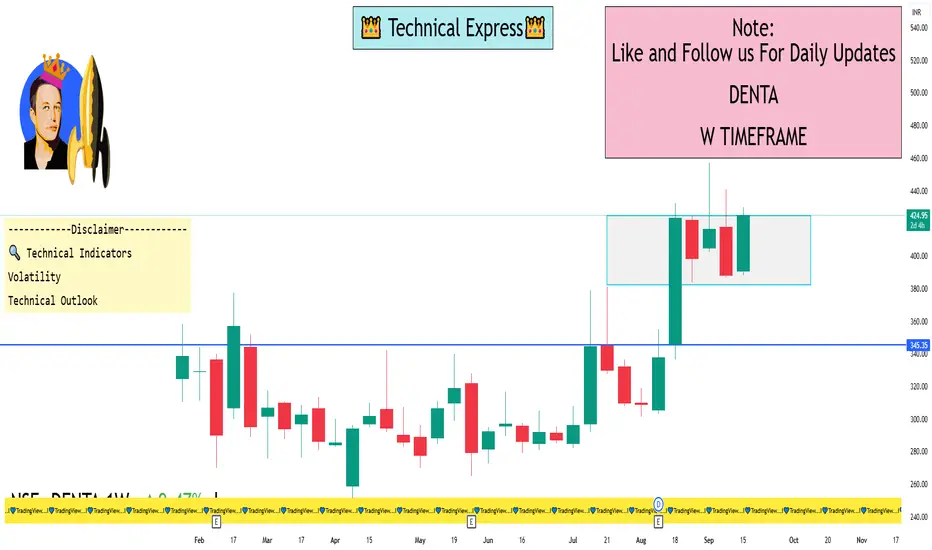
DENTA 1 Week View📈 1-Week Performance Snapshot
Current Price: ₹426.65
Week’s High/Low: ₹429.70 / ₹409.65
Weekly Change: Approximately −6.12%
📊 1-Month and 3-Month Trends
1-Month Change: +24.43%
3-Month Change: +41.61%
📉 1-Year Overview
52-Week High: ₹457.00
52-Week Low: ₹251.25
Current Price: ₹426.65
1-Year Return: Approximately +70%
🔍 Technical Indicators
Volatility: Weekly volatility stands at 8%, higher than 75% of Indian stocks, indicating relatively higher price fluctuations
Technical Outlook: Based on moving averages and other indicators, the daily buy/sell signal is currently a Strong Buy
💡 Summary
Despite a slight dip over the past week, Denta Water and Infra Solutions Ltd continues to exhibit strong growth, with significant gains over the past month and year. The stock's higher volatility suggests active trading interest, and the positive technical indicators may appeal to investors looking for momentum opportunities.
Currency Derivatives & INR VolatilityPart 1: Understanding Currency Derivatives
1.1 What are Currency Derivatives?
Currency derivatives are financial contracts whose value is derived from the exchange rate of one currency against another. They allow market participants to lock in, hedge, or speculate on future currency movements.
For example:
An Indian importer of crude oil may use a USD/INR futures contract to protect themselves from the risk of a weakening rupee.
A trader may buy options on USD/INR expecting volatility around an RBI policy announcement.
1.2 Types of Currency Derivatives
1.2.1 Currency Forwards
A forward contract is a customized agreement between two parties to exchange a certain amount of currency at a future date at a fixed exchange rate. In India, forwards are widely used by corporates with genuine foreign exchange exposure.
1.2.2 Currency Futures
Futures are standardized contracts traded on exchanges like NSE or BSE. For example, USD/INR futures allow participants to buy or sell US Dollars at a future date at a predetermined price. Futures provide transparency, liquidity, and are regulated by SEBI.
1.2.3 Currency Options
Options give the buyer the right (but not the obligation) to buy or sell currency at a predetermined rate before a specific date. They are powerful tools for hedging uncertain outcomes. For instance, an exporter expecting USD payments may buy a put option to safeguard against INR appreciation.
1.2.4 Currency Swaps
Swaps involve exchanging principal and interest payments in different currencies. They are often used by companies or governments borrowing abroad to manage currency and interest rate risks.
Part 2: The Dynamics of INR Volatility
2.1 What is INR Volatility?
INR volatility refers to fluctuations in the value of the Indian Rupee against other currencies. It can be measured using indicators like standard deviation of returns, implied volatility from options, or volatility indices.
For example:
If USD/INR moves from 83.20 to 84.10 within a week, that 90-paisa move reflects volatility.
2.2 Causes of INR Volatility
2.2.1 Trade Deficit & Balance of Payments
India imports more than it exports, especially crude oil. A rising trade deficit often puts downward pressure on INR.
2.2.2 Capital Flows (FII/FPI Investments)
Large inflows of foreign capital strengthen INR, while sudden outflows (like during global risk-off events) weaken it.
2.2.3 Interest Rate Differentials
If US interest rates rise while Indian rates remain steady, investors may prefer USD assets, leading to INR depreciation.
2.2.4 Global Commodity Prices
A surge in oil prices increases India’s import bill, weakening INR. Conversely, stable or falling prices support INR.
2.2.5 Geopolitical Tensions & Global Uncertainty
Events like wars, sanctions, or global financial crises drive investors to safe-haven assets like the USD, increasing INR volatility.
2.2.6 Domestic Policies & RBI Intervention
The Reserve Bank of India (RBI) frequently intervenes in the forex market to prevent sharp swings. However, such interventions cannot fully eliminate volatility.
2.3 Measuring INR Volatility
Historical Volatility (HV): Based on past exchange rate movements.
Implied Volatility (IV): Derived from option prices, showing expected future volatility.
Rupee Volatility Index (INR VIX): Similar to equity VIX, a market measure of expected volatility in INR.
Part 3: The Role of Currency Derivatives in Managing INR Volatility
3.1 Hedging Through Derivatives
Currency derivatives help corporates, banks, and individuals manage the risks of adverse INR movements.
Importers: Hedge against INR depreciation (higher cost of imports).
Exporters: Hedge against INR appreciation (reduced export earnings).
Investors: Hedge foreign equity/debt portfolio risks.
3.2 Speculation & Arbitrage
Apart from hedging, derivatives also attract traders who speculate on short-term INR movements. Arbitrageurs exploit price differences between spot, futures, and options markets.
3.3 Corporate Case Example
Suppose an Indian IT company expects $100 million in revenue in 3 months. If INR strengthens from 83 to 81, revenue in INR terms falls by ₹200 crore. By using a USD/INR forward contract, the company can lock in the rate and secure predictable cash flows.
3.4 Risk Management in Banks
Banks are major participants in currency derivative markets. They manage client exposure while also using derivatives to balance their own positions. RBI regulations ensure banks don’t take excessive speculative risk.
Part 4: Regulatory Framework in India
4.1 Role of RBI & SEBI
RBI: Regulates over-the-counter (OTC) forex derivatives.
SEBI: Regulates exchange-traded derivatives (ETDs).
4.2 Exchange-Traded Currency Derivatives in India
Launched in 2008, currency futures and options on exchanges like NSE, BSE, and MCX-SX have grown rapidly. Contracts are available in USD/INR, EUR/INR, GBP/INR, JPY/INR, and cross-currency pairs.
4.3 RBI’s Intervention Policy
RBI often uses its reserves to prevent extreme INR volatility, but avoids pegging INR to a fixed rate. This “managed float” system balances stability and flexibility.
Part 5: Impact of INR Volatility
5.1 On Businesses
Importers: Weaker INR increases costs of raw materials.
Exporters: Stronger INR reduces competitiveness abroad.
SMEs: Smaller firms often lack hedging mechanisms, making them more vulnerable.
5.2 On Investors
Equity Investors: INR depreciation hurts foreign investors’ returns, leading to outflows.
Debt Investors: Currency risk affects bond investments, especially government securities.
5.3 On the Economy
Inflation: Weaker INR makes imports expensive, adding to inflation.
Growth: Currency instability affects trade, investment, and financial confidence.
Forex Reserves: RBI may need to use reserves to stabilize INR, impacting balance sheet strength.
Part 6: Opportunities & Challenges
6.1 Opportunities
Deepening of Currency Markets: Growing participation increases liquidity and efficiency.
New Instruments: Cross-currency derivatives (e.g., EUR/USD in India) expand opportunities.
Retail Participation: Rising awareness allows individuals to hedge or invest.
6.2 Challenges
Speculative Excesses: Over-leverage by traders can cause instability.
Regulatory Restrictions: Limited participation compared to global FX markets.
Information Asymmetry: SMEs and retail participants lack knowledge on hedging tools.
Conclusion
Currency derivatives and INR volatility are two sides of the same coin in India’s financial landscape. The rupee, being influenced by domestic and international factors, will always experience fluctuations. These fluctuations, if unmanaged, can disrupt businesses, trade, and investment.
Currency derivatives provide a structured way to manage risks, offering corporates, banks, and investors tools to hedge exposure while also opening avenues for speculation and arbitrage. However, their effectiveness depends on proper usage, regulatory oversight, and awareness among participants.
In the long run, as India’s economy expands, INR’s role in global finance will increase. With it, the need for efficient currency derivative markets will only grow. Proper risk management, coupled with regulatory prudence, can turn volatility from a threat into an opportunity, ensuring stability and growth in India’s financial ecosystem.
Algo & Quant Trading in IndiaIntroduction
The Indian financial markets have witnessed a remarkable transformation over the past two decades. From open outcry systems in regional stock exchanges to fully automated electronic trading platforms, India’s capital markets have evolved into one of the fastest-growing ecosystems in the world. Among the most significant developments in recent years is the rise of algorithmic trading (algo trading) and quantitative trading (quant trading).
In simple terms:
Algorithmic trading uses pre-programmed computer instructions (algorithms) to execute trades in financial markets.
Quantitative trading relies on mathematical and statistical models to identify trading opportunities.
Together, they form the backbone of modern high-speed and data-driven trading strategies. In India, the adoption of algo and quant trading has grown rapidly, supported by advances in technology, regulatory approval, and the increasing sophistication of market participants.
This article provides a comprehensive 3000-word description of algo and quant trading in India, including its evolution, functioning, strategies, regulatory landscape, challenges, and the future ahead.
Evolution of Algo & Quant Trading in India
Early 2000s: The Seeds of Automation
The National Stock Exchange (NSE) introduced electronic trading systems in the 1990s, replacing traditional open outcry methods. This laid the foundation for automated order placement. However, at that time, trading was still manual — brokers placed buy and sell orders directly.
The first signs of algorithmic trading emerged in the early 2000s, when institutional investors started experimenting with Direct Market Access (DMA). This allowed traders to place orders directly into the exchange’s trading system without manual intervention by brokers.
2008: SEBI’s Green Signal
In 2008, the Securities and Exchange Board of India (SEBI) formally allowed algorithmic trading in India. This was a landmark event. Initially, adoption was slow due to high costs, lack of awareness, and limited technological infrastructure.
2010s: Rapid Growth
The next decade saw exponential growth in algo trading:
The NSE introduced co-location facilities (where traders could place their servers near exchange servers to reduce latency).
Institutional investors, hedge funds, and proprietary trading firms increasingly adopted algorithmic and quantitative strategies.
Retail participation remained limited, but brokers began offering algo-based tools to their clients.
By 2019, about 50% of trading volume on Indian exchanges was driven by algorithms, mostly by large institutions.
2020s: Democratization of Algo Trading
With the rise of fintech, APIs, and discount brokers, algo and quant trading started reaching retail traders. Platforms like Zerodha Streak, Upstox API, and others began offering plug-and-play strategies for small investors.
Today, algo trading is not just the playground of hedge funds and foreign investors — even retail traders in India are experimenting with coding their own strategies.
What is Algo Trading?
Algo trading refers to computerized trading where pre-programmed rules determine the execution of trades. These rules can include price, timing, volume, and mathematical models.
For example, instead of manually watching charts and entering trades, a trader can program:
“If Nifty 50 rises above its 50-day moving average and volume increases by 20%, buy 100 shares of HDFC Bank.”
The computer will then execute this trade instantly and without emotions.
Benefits of Algo Trading
Speed: Orders are executed in milliseconds.
Accuracy: Eliminates manual entry errors.
Emotion-Free: No fear, greed, or panic.
Backtesting: Traders can test strategies on historical data.
Cost Efficiency: Reduces market impact and transaction costs.
What is Quant Trading?
Quantitative (quant) trading is a step deeper than algo trading. It uses advanced mathematical, statistical, and computational models to identify profitable patterns in markets.
For example, a quant trader might use machine learning models to analyze correlations between global interest rates, currency fluctuations, and Indian equity prices to predict short-term opportunities.
Key Features of Quant Trading
Data-Driven: Relies heavily on historical and real-time data.
Models and Predictions: Uses regression, probability, and AI/ML algorithms.
Risk Management: Emphasizes hedging and portfolio optimization.
Scalability: Models can be applied across multiple assets and markets.
In short, all quant trading is algorithmic, but not all algorithmic trading is quantitative. Algo can be simple rule-based, while quant involves complex mathematical logic.
Popular Algo & Quant Strategies in India
Indian traders and institutions use a wide variety of algo and quant strategies, depending on their goals, risk appetite, and access to data. Some of the most popular include:
1. Trend-Following Strategies
Based on moving averages, momentum indicators, and breakouts.
Example: Buy Nifty futures when the price crosses above 200-day EMA with high volume.
2. Arbitrage Strategies
Exploit price differences across instruments.
Types include:
Cash-Futures Arbitrage: Buying stock in the cash market and selling futures when prices differ.
Index Arbitrage: Exploiting mispricing between index futures and constituent stocks.
3. Statistical Arbitrage (Pairs Trading)
Identify two historically correlated stocks (e.g., HDFC Bank and ICICI Bank).
If correlation breaks temporarily, long one and short the other, expecting mean reversion.
4. High-Frequency Trading (HFT)
Involves ultra-fast order execution using co-location servers.
Firms place thousands of trades within seconds to capture tiny price inefficiencies.
5. Options-Based Algo Strategies
Automated execution of straddles, strangles, iron condors, etc.
Dynamic hedging using the Greeks (delta, gamma, theta).
6. Market Making Algorithms
Providing liquidity by continuously quoting buy/sell prices.
Profits earned from bid-ask spreads.
7. Quantitative Models
Factor investing (value, momentum, quality).
Machine learning predictions (random forest, neural networks).
Sentiment analysis using news and social media.
Regulatory Landscape in India
Algo and quant trading in India are tightly regulated by SEBI to ensure fairness and reduce systemic risks.
Key Regulations
Approval Requirement: Brokers offering algo services must get approval from exchanges.
Risk Controls: Mandatory circuit breakers, order limits, and risk checks before execution.
Co-Location Services: Exchanges offer equal access to minimize unfair advantages.
Audit Trails: Brokers must maintain complete records of all algo trades.
Retail Algo Regulations (2022): SEBI proposed stricter oversight on retail algo platforms to prevent misuse and scams.
Concerns for Regulators
Market manipulation through spoofing and layering.
Flash crashes caused by runaway algorithms.
Unequal playing field between institutions and small traders.
Despite these challenges, SEBI has been proactive in encouraging innovation while maintaining safety.
Technology Infrastructure
Algo and quant trading in India require robust technology:
Low Latency Networks: Millisecond execution is crucial.
Co-Location Facilities: Placing servers near exchanges.
APIs and Algo Platforms: Brokers like Zerodha, Upstox, and Interactive Brokers provide APIs.
Programming Languages: Python, R, C++, and Java are widely used.
Data Feeds: Real-time tick data from NSE/BSE is critical.
Conclusion
Algo and quant trading are reshaping India’s capital markets. What began as an institutional experiment in 2008 has now become mainstream, driving nearly half of all exchange volumes. While challenges remain in terms of regulation, infrastructure, and retail education, the future looks promising.
India’s unique mix of high market participation, growing fintech innovation, and regulatory oversight positions it as a global hub for algorithmic and quantitative trading.
In the coming years, the line between human and machine-driven decisions will blur further. Traders who adapt to this new paradigm — whether retail or institutional — will be better placed to thrive in the fast-paced world of Indian financial markets.
Sectoral Rotation & India’s Growth StoriesIntroduction
India is one of the fastest-growing economies in the world, standing at the intersection of tradition and innovation. From being an agrarian economy to becoming a services-driven powerhouse and now steadily rising as a manufacturing hub, India’s growth story has been shaped by shifting macroeconomic cycles, government reforms, global trade patterns, and evolving consumer demand.
One of the most powerful ways to understand and capture this growth is through sectoral rotation – the process by which capital moves from one industry to another, depending on the stage of the economic cycle. For investors, traders, policymakers, and business leaders, analyzing sectoral rotation is not just an exercise in market timing—it is a way to understand how India’s story unfolds across different industries.
In this essay, we will dive deep into:
The concept of sectoral rotation.
How sectoral rotation plays out in the Indian economy.
India’s key growth stories and emerging sectors.
Case studies of sectoral transitions in the past two decades.
How investors and businesses can benefit from sectoral rotation.
Understanding Sectoral Rotation
Sectoral rotation refers to the systematic movement of investments across different sectors of the economy, depending on which industries are expected to outperform at a given point in the business or economic cycle.
In early expansion phases, cyclical sectors like banking, automobiles, infrastructure, and capital goods tend to outperform as demand revives and investments pick up.
In the mid-cycle, consumer durables, IT, and manufacturing-driven sectors show strength as income rises and companies expand.
In the late cycle or slowdown phases, defensive sectors like FMCG, healthcare, and utilities gain momentum since they provide stable returns even in uncertain times.
Globally, sectoral rotation is a well-documented strategy, but in India, it carries a unique flavor due to:
Strong government policy interventions.
Rapid demographic shifts.
Dependence on monsoons and agriculture in rural demand.
The interplay of global commodity cycles with domestic growth.
India’s Sectoral Journey Over Time
1. The 1990s – Liberalization & IT Boom
India opened its economy in 1991.
The IT sector became the flagbearer of India’s growth, driven by outsourcing, Y2K needs, and global cost arbitrage.
Banking reforms, private sector entry, and telecom deregulation created the foundation for future sectoral shifts.
2. The 2000s – Infrastructure & Real Estate Wave
A decade of strong growth (8–9% GDP).
Infrastructure, real estate, and capital goods were the stars, benefiting from urbanization and foreign capital inflows.
Power and steel sectors also thrived on global commodity booms.
3. The 2010s – Consumer & Financials Lead
After the global financial crisis, India saw stable growth.
FMCG, pharmaceuticals, IT services, and private banks became market leaders.
Real estate and infra cooled due to high debt and policy bottlenecks.
Digital adoption fueled e-commerce and fintech’s rise.
4. The 2020s – Manufacturing, Green Energy & Digital India
Post-pandemic, India has entered a new rotation cycle.
Manufacturing (PLI schemes, “Make in India”), renewable energy, semiconductors, and defense are emerging as sunrise sectors.
BFSI (Banking, Financial Services, Insurance) continues as a backbone.
Tech is shifting from services to product-based ecosystems (AI, SaaS, fintech).
Key Growth Stories Driving India
1. Banking & Financial Services (BFSI)
BFSI has been the single most consistent performer over the last two decades.
Private sector banks like HDFC Bank, ICICI Bank, and Kotak Mahindra Bank revolutionized lending, retail banking, and digital financial services.
NBFCs and microfinance institutions expanded financial inclusion.
Insurance and asset management gained prominence as savings moved from gold/land to financial assets.
Future Drivers:
Digital lending.
Unified Payments Interface (UPI) and fintech partnerships.
Rising credit penetration in semi-urban and rural India.
2. Information Technology (IT) & Digital India
The IT sector turned India into a global outsourcing hub.
TCS, Infosys, Wipro, and HCL became world-class giants.
Now, the focus is shifting from low-cost outsourcing to high-value areas: AI, blockchain, cloud services, SaaS exports.
Future Drivers:
Artificial Intelligence adoption globally.
India as a global innovation hub.
Growth of domestic tech startups and unicorns.
3. Manufacturing & PLI Push
India wants to become a global manufacturing hub like China.
The Production Linked Incentive (PLI) scheme is attracting investments in electronics, semiconductors, EVs, and pharma.
Automobile exports, mobile phone production, and defense manufacturing are picking up.
Future Drivers:
“China+1” strategy of global supply chains.
EVs and battery storage.
Defense exports and indigenous production.
4. Renewable Energy & Sustainability
India has committed to net-zero by 2070.
Solar, wind, and green hydrogen are becoming sunrise industries.
Adani Green, Tata Power Renewables, and ReNew Power are expanding capacity rapidly.
Future Drivers:
Rising energy demand.
Policy incentives for clean energy.
Global investors’ push for ESG-compliant investments.
5. Healthcare & Pharmaceuticals
India is the “pharmacy of the world.”
Generic drug manufacturing and vaccine production are key strengths.
Medical tourism is growing, making India a healthcare destination.
Future Drivers:
Biotechnology and R&D investment.
Digital health and telemedicine.
Preventive healthcare and wellness sector.
6. Consumer Story – FMCG, Retail & E-Commerce
Rising middle class and urbanization continue to boost demand.
FMCG players like HUL, Nestle, and Dabur thrive on rural consumption.
E-commerce platforms like Flipkart, Amazon, and Reliance Retail are reshaping retail.
Future Drivers:
Tier-2 and Tier-3 consumption.
Digital marketplaces and ONDC.
Premiumization trends (from basic needs to aspirational products).
7. Infrastructure & Real Estate Revival
Post-2015 slowdown, the real estate sector is rebounding.
Affordable housing, commercial spaces, and warehousing (e-commerce logistics) are growing.
Smart cities and highway construction are boosting infra.
Future Drivers:
Urbanization wave.
REITs offering investment access.
Logistics demand from digital economy.
Case Studies of Sectoral Rotation in India
1. IT vs. Infrastructure (2000s)
In the early 2000s, IT was dominant.
Mid-2000s saw infra/real estate outperform IT as global liquidity boosted construction.
Post-2008, infra crashed, IT regained leadership.
2. Private Banks vs. PSU Banks (2010s)
PSU banks struggled with NPAs.
Private banks gained market share, becoming market leaders.
The sectoral rotation within BFSI favored private institutions.
3. Renewables vs. Traditional Energy (2020s)
Earlier, coal and oil companies dominated India’s energy story.
Now, renewables and green hydrogen are attracting huge investments, showing sectoral shift toward sustainability.
GIFT Nifty & Its Global Impact1. Introduction
In the dynamic world of global finance, financial instruments, and trading platforms play a crucial role in connecting economies, investors, and businesses. Among these, stock index futures have emerged as one of the most powerful vehicles for global investors seeking exposure to key economies.
One such instrument that has been gaining international attention is GIFT Nifty, the rebranded version of the Singapore-traded Nifty futures, now hosted at GIFT City (Gujarat International Finance Tec-City) in India. This shift is more than just a geographical move; it reflects India’s ambition to emerge as a leading global financial hub and the world’s growing interest in the Indian growth story.
This article takes a deep dive into the origin, structure, functioning, and global implications of GIFT Nifty, while analyzing how this move impacts India, foreign investors, and the wider global financial markets.
2. Understanding GIFT Nifty
2.1 What is GIFT Nifty?
GIFT Nifty refers to the futures contracts on the Nifty 50 index, now traded on the NSE International Exchange (NSE IX), based at GIFT City in Gandhinagar, Gujarat. Earlier, these contracts were traded on the Singapore Exchange (SGX) under the name “SGX Nifty.”
In July 2023, a historic shift occurred: all open interest and positions in SGX Nifty were migrated to NSE IX in India, giving rise to GIFT Nifty.
2.2 Why was the shift made?
The migration was the outcome of a 2018 agreement between NSE and SGX after disputes over licensing rights. India wanted to consolidate trading volumes within its jurisdiction and make GIFT City a hub for international investors.
Key reasons for the move:
To boost India’s onshore derivatives market.
To increase liquidity in GIFT City.
To give foreign investors direct access to Indian markets within a globally recognized framework.
2.3 Core features of GIFT Nifty
Trading Hours: Almost 21 hours a day, from 4:30 am to 2:00 am IST. This allows overlap with Asian, European, and U.S. trading sessions.
Contracts: Nifty 50 futures, Nifty Bank futures, Nifty Financial Services futures, and Nifty IT futures.
Currency: Settled in USD, making it easier for foreign investors.
Tax Benefits: Investors trading from GIFT City enjoy tax neutrality, similar to international jurisdictions.
3. GIFT City: India’s Financial Gateway
To fully appreciate the impact of GIFT Nifty, one must understand GIFT City, the ecosystem hosting it.
Concept: Launched by the Government of India, GIFT City is India’s first International Financial Services Centre (IFSC), designed to compete with hubs like Singapore, Hong Kong, and Dubai.
Offerings: It provides financial institutions with liberal regulations, tax benefits, and international-standard infrastructure.
Regulator: The International Financial Services Centres Authority (IFSCA) governs activities within GIFT City.
Vision: To make India a global capital of financial services, reducing reliance on foreign hubs.
GIFT Nifty is one of the flagship products driving international investor participation in GIFT City.
4. Why GIFT Nifty Matters
4.1 For India
Enhances India’s image as a credible financial market hub.
Boosts liquidity and market depth in domestic indices.
Keeps derivatives trading revenue within India.
Attracts global financial institutions to set up operations in GIFT City.
4.2 For Global Investors
Provides direct exposure to Indian equity markets without having to set up local accounts in India.
Extended trading hours enable hedging opportunities across global time zones.
Tax-neutral environment makes it cost-efficient compared to onshore trading.
4.3 For Global Markets
Adds to the integration of Indian markets with global capital flows.
Creates arbitrage opportunities between different time zones.
Makes India a larger part of the global derivatives ecosystem.
5. The Evolution from SGX Nifty to GIFT Nifty
5.1 SGX Nifty’s Popularity
For years, SGX Nifty futures in Singapore served as a proxy for Indian markets for global investors.
They helped international traders gauge market sentiment before Indian markets opened.
Huge foreign institutional participation made SGX Nifty a global benchmark.
5.2 Why India Pulled It Back
NSE wanted to control data licensing and fee revenues.
SGX Nifty volumes were massive, but India was losing out on revenue and liquidity.
Strengthening GIFT City required high-profile products — SGX Nifty was the perfect candidate.
5.3 The Transition
In July 2023, all positions were shifted from SGX to NSE IX seamlessly.
The migration symbolized a major win for India’s financial diplomacy.
6. Global Impact of GIFT Nifty
6.1 Strengthening India’s Position in Global Finance
India is the fifth-largest economy and one of the fastest-growing markets.
GIFT Nifty ensures India’s financial markets are directly accessible to global capital.
By retaining liquidity at home, India reduces dependence on offshore hubs.
6.2 Impact on Global Investors
Earlier, investors preferred Singapore due to its global reputation and neutrality.
Now, they must adapt to trading within India’s jurisdiction at GIFT City.
Long trading hours offer better alignment with global market events, making Indian exposure more convenient.
6.3 Impact on Singapore
Singapore lost a key product that attracted billions in trading volume.
However, it remains a strong financial hub with diversified offerings.
6.4 Impact on Indian Stock Market
With higher liquidity, Indian indices get better price discovery.
Domestic derivatives market becomes more competitive.
FII (Foreign Institutional Investor) flows become more transparent.
6.5 Arbitrage & Hedging
GIFT Nifty enables traders to hedge Indian positions across global hours.
It creates arbitrage opportunities between GIFT Nifty, Nifty futures on NSE India, and ETFs in global markets.
Conclusion
GIFT Nifty represents far more than a migration of futures contracts from Singapore to India. It embodies India’s aspiration to become a leading global financial hub, a move to consolidate liquidity within its borders, and an opportunity to integrate deeply with global capital flows.
For investors, GIFT Nifty provides long trading hours, tax neutrality, and direct access to the Indian growth story. For India, it strengthens financial sovereignty, boosts GIFT City’s credibility, and positions the country as a rising force in international finance.
Globally, it changes the way investors engage with India, creating new arbitrage and hedging opportunities while redistributing financial influence away from Singapore.
The global impact of GIFT Nifty will continue to unfold in the coming years. But one thing is certain: India has planted its flag firmly on the map of international finance, and GIFT Nifty is leading the charge.
Part 8 Trading master ClassWhy Trade Options?
Options are popular because of their flexibility. They can serve multiple purposes:
Hedging (Insurance)
Just like insurance, options protect against downside risk.
Example: Buying a put option to protect your stock holdings.
Speculation (Profit from Price Movements)
Traders use options to bet on direction, volatility, or even stability of prices.
Income Generation
Selling covered calls or cash-secured puts generates steady premium income.
Leverage
Options allow large exposure with smaller capital compared to stocks.
How Options Work: Pricing
Option pricing is complex, but two main values exist:
Intrinsic Value → Difference between stock price and strike (if favorable).
Time Value → Extra value based on time left till expiry and expected volatility.
Example:
Stock = ₹1,000
Call strike = ₹950, Premium = ₹70
Intrinsic = ₹1,000 – ₹950 = ₹50
Time Value = ₹20
Options Market Structure
The options market involves:
Buyers of Options – Limited risk (premium), unlimited potential reward.
Sellers (Writers) of Options – Limited reward (premium), potentially high risk.
Exchanges (like NSE in India, CBOE in US) – Standardized contracts.
Clearing Corporations – Ensure smooth settlement, reduce counterparty risk.
Part 6 Institutional TradingStrategies in Option Trading
Basic Strategies
Buying Calls: Profiting from price increases.
Buying Puts: Profiting from price decreases.
Covered Calls and Protective Puts
Covered Call: Holding a stock and selling a call to earn premium.
Protective Put: Buying a put to hedge potential losses in a stock position.
Spreads
Bull Call Spread: Buy a call at a lower strike, sell at a higher strike.
Bear Put Spread: Buy a put at a higher strike, sell at a lower strike.
Calendar Spreads: Different expiration dates for long and short options.
Advanced Strategies
Straddles: Buying a call and put at the same strike, betting on volatility.
Strangles: Buying out-of-the-money calls and puts.
Iron Condors & Butterflies: Limited-risk strategies combining multiple options for steady income.
Real-World Examples
Apple Stock Call: Investor buys 100 Apple call options at ₹150. Stock rises to ₹180; profit realized by exercising or selling the call.
Hedging a Portfolio: Investor holds ₹10 lakh in shares, buys put options to limit losses during market decline.
Income Generation: Investor sells covered calls on a stock they own to earn premium income.
Part 4 Institutional TradingOption Styles
Options come in different styles, which dictate when they can be exercised:
American Options
Can be exercised anytime before expiration.
European Options
Can be exercised only on the expiration date.
How Option Trading Works
Buying vs Selling Options
Buying an option: You pay the premium for the right to buy/sell.
Selling an option (writing an option): You collect the premium but take the obligation if the buyer exercises it.
Exercising Options
Exercising is when the holder uses their right to buy or sell at the strike price.
Options in the Secondary Market
Options can also be traded without exercising. Traders can buy and sell options in the market to profit from changes in premiums.
Hedging and Speculation with Options
Options are used both for hedging (reducing risk) and speculation (betting on price movement). For example:
Hedging: Buying put options to protect a stock portfolio.
Speculation: Buying call options to profit from anticipated upward movement.
Part 2 Ride The Big MovesIntroduction to Options
Option trading is a sophisticated financial strategy that allows investors to hedge, speculate, or generate income in financial markets. Unlike buying a stock or a commodity directly, trading options gives you the right, but not the obligation, to buy or sell an underlying asset at a predetermined price within a specific time period.
The concept of options is not new. Options have been used for centuries to hedge risks and manage investments. In modern financial markets, options are widely used by retail investors, institutional investors, and professional traders because they provide flexibility, leverage, and strategic opportunities that are not available in traditional stock trading.
An option derives its value from the underlying asset, which can be a stock, commodity, index, currency, or ETF. Because options have time-limited value, they are classified as derivatives, meaning their price depends on the price movement of the underlying asset.
Key Terminology
Understanding option trading requires familiarity with basic terms:
Underlying Asset: The security or instrument on which the option is based. For example, Apple stock for an Apple options contract.
Strike Price: The predetermined price at which the option can be exercised.
Expiration Date: The date when the option contract expires. After this date, the option is worthless if not exercised.
Premium: The price paid to buy the option. Think of it as the cost of the “insurance” provided by the option.
In-the-Money (ITM): A call option is ITM when the stock price is above the strike price; a put option is ITM when the stock price is below the strike price.
Out-of-the-Money (OTM): Opposite of ITM. Call options are OTM when the stock price is below the strike price, and put options are OTM when the stock price is above the strike price.
At-the-Money (ATM): When the stock price equals the strike price.
Part ! Ride The Big MovesWhat is an Option?
An option is a financial derivative that gives the holder the right, but not the obligation, to buy or sell an underlying asset at a predetermined price (strike price) on or before a specified date (expiration date).
Underlying Asset: This can be a stock, index, commodity, currency, or ETF.
Strike Price: The price at which the asset can be bought or sold.
Expiration Date: The date on which the option contract expires.
Premium: The price paid to purchase the option.
There are two main types of options:
Call Option: Gives the holder the right to buy the underlying asset at the strike price.
Put Option: Gives the holder the right to sell the underlying asset at the strike price.
Call Options Explained
A call option becomes profitable when the price of the underlying asset rises above the strike price plus the premium paid.
Example:
Stock price: ₹1,000
Strike price: ₹1,050
Premium: ₹20
If the stock rises to ₹1,100:
Profit = (Stock Price – Strike Price – Premium) = 1,100 – 1,050 – 20 = ₹30
If the stock remains below ₹1,050, the option expires worthless, and the loss is the premium paid.
Technical Analysis (TA) and Fundamental Analysis (FA) in Trading1. Introduction to Market Analysis
Financial markets, whether stocks, forex, commodities, or cryptocurrencies, are highly dynamic. Prices fluctuate due to supply and demand, investor sentiment, macroeconomic factors, corporate performance, and global events. To navigate this volatility, traders and investors use analysis methods to predict future price movements and identify profitable opportunities.
The two main methods are:
Fundamental Analysis (FA): Focuses on the intrinsic value of an asset by evaluating economic, financial, and qualitative factors.
Technical Analysis (TA): Focuses on historical price and volume data to predict future price movements using charts and technical indicators.
While both have their strengths and weaknesses, many successful traders use a combination of both to make informed decisions.
2. Fundamental Analysis (FA)
2.1 Definition
Fundamental Analysis is the study of a company’s financial health, economic conditions, and other external factors to determine the intrinsic value of a stock or asset. The goal is to identify whether an asset is overvalued, undervalued, or fairly priced in the market.
2.2 Key Principles
Intrinsic Value: The true worth of a company or asset based on fundamentals, not just the market price.
Long-Term Perspective: FA is generally used by investors looking for long-term investments rather than short-term trading.
Economic Influence: Macroeconomic factors, industry trends, and geopolitical events influence the value of assets.
2.3 Components of Fundamental Analysis
Fundamental Analysis involves two main components:
2.3.1 Quantitative Analysis
This involves analyzing measurable data from financial statements and economic reports. Key metrics include:
Revenue and Earnings: Revenue indicates the total income generated, while earnings reflect the net profit.
Earnings Per Share (EPS): Shows profitability on a per-share basis.
Price-to-Earnings (P/E) Ratio: Compares the stock price to its earnings. A high P/E may indicate overvaluation.
Debt-to-Equity Ratio (D/E): Measures financial leverage and risk.
Return on Equity (ROE): Indicates how effectively a company uses shareholders’ equity to generate profit.
Cash Flow Analysis: Evaluates liquidity and the ability to meet obligations.
2.3.2 Qualitative Analysis
This involves assessing non-numerical factors that affect a company’s long-term performance, including:
Business Model: Understanding how a company makes money and its competitive advantage.
Management Quality: Leadership effectiveness impacts growth and profitability.
Industry Trends: Assessing the growth potential and competitive landscape.
Brand Strength and Market Position: Strong brands often command pricing power.
Regulatory Environment: Government policies can affect operations and profitability.
2.4 Steps in Fundamental Analysis
Macro Analysis: Examine global and national economic conditions.
Industry Analysis: Evaluate the sector or industry trends and competitors.
Company Analysis: Analyze financial statements, management, and business strategies.
Valuation: Use models like Discounted Cash Flow (DCF), Price-to-Earnings (P/E), or Price-to-Book (P/B) to estimate intrinsic value.
Decision Making: Compare intrinsic value to current market price to determine buy, hold, or sell.
2.5 Advantages of Fundamental Analysis
Provides a long-term perspective.
Helps investors make informed decisions based on real company performance.
Can identify undervalued opportunities for significant gains.
2.6 Limitations of Fundamental Analysis
Time-consuming and requires detailed research.
Market prices can remain irrational for extended periods.
Not suitable for short-term trading due to market volatility.
3. Technical Analysis (TA)
3.1 Definition
Technical Analysis is the study of past market data—primarily price and volume—to forecast future price movements. Unlike FA, it does not focus on a company’s intrinsic value but on market behavior and trends.
3.2 Key Principles
Technical Analysis is based on three core assumptions:
Price Discounts Everything: All available information (fundamentals, sentiment, news) is already reflected in the market price.
Prices Move in Trends: Markets follow trends (uptrend, downtrend, or sideways), and these trends can be identified and traded.
History Tends to Repeat Itself: Price patterns and market psychology often repeat due to human behavior.
3.3 Tools of Technical Analysis
Technical Analysis relies on charts, indicators, and patterns:
3.3.1 Price Charts
Line Chart: Connects closing prices over time.
Bar Chart: Shows open, high, low, and close prices (OHLC).
Candlestick Chart: Visual representation of OHLC with patterns indicating market sentiment.
3.3.2 Technical Indicators
Indicators are mathematical calculations based on price and volume to identify trends, momentum, and reversals.
Common Indicators:
Moving Averages (MA): Smooth out price data to identify trends.
Relative Strength Index (RSI): Measures overbought or oversold conditions.
Moving Average Convergence Divergence (MACD): Detects momentum and trend changes.
Bollinger Bands: Identify volatility and potential reversal points.
Volume Indicators (OBV, VWAP): Confirm price movements with volume activity.
3.3.3 Chart Patterns
Patterns indicate potential market movements:
Trend Continuation Patterns: Flags, pennants, and triangles suggest ongoing trends.
Reversal Patterns: Head and shoulders, double tops/bottoms signal trend changes.
Candlestick Patterns: Doji, hammer, engulfing, shooting star indicate short-term reversals.
3.3.4 Support and Resistance
Support: Price level where demand is strong enough to prevent further decline.
Resistance: Price level where selling pressure prevents price from rising.
Identifying these levels helps traders set entry, exit, and stop-loss points.
3.4 Steps in Technical Analysis
Select the Asset and Timeframe: Choose the market and timeframe (intraday, daily, weekly, monthly).
Analyze Trend: Determine if the market is in an uptrend, downtrend, or sideways.
Identify Key Levels: Locate support, resistance, and breakout zones.
Apply Indicators: Use momentum, volume, and trend indicators to confirm signals.
Plan Entry and Exit: Decide when to enter or exit trades based on risk management.
3.5 Advantages of Technical Analysis
Works in any market with historical data.
Suitable for short-term and intraday trading.
Helps identify precise entry and exit points.
Can be automated using algorithmic trading.
3.6 Limitations of Technical Analysis
Ignores underlying fundamentals.
Requires discipline and practice to interpret correctly.
May produce false signals in volatile markets.
4. Integrating FA and TA
Many successful market participants combine both methods to maximize profits:
FA to Choose the Asset: Identify fundamentally strong stocks for long-term investment.
TA to Time the Market: Use technical signals to decide when to buy or sell.
For example:
A stock may be fundamentally undervalued (FA).
TA can identify the right entry point when the price hits a key support level.
Similarly, FA can help avoid fundamentally weak stocks that may temporarily rise due to technical momentum.
5. Practical Tips for Traders and Investors
Know Your Style: Long-term investors benefit more from FA, while short-term traders rely on TA.
Risk Management: Always set stop-loss levels and manage trade size.
Stay Updated: Monitor economic news, earnings reports, and global events.
Combine Analysis: Using FA and TA together can reduce risk and improve accuracy.
Continuous Learning: Markets evolve, so stay updated on new tools and strategies.
6. Conclusion
Both Fundamental Analysis (FA) and Technical Analysis (TA) are essential tools for navigating financial markets. FA provides the foundation for understanding the true value of assets, while TA offers insights into price trends, momentum, and market psychology. While FA is best suited for long-term investments, TA is invaluable for timing trades and short-term opportunities. By understanding and integrating both approaches, traders and investors can make informed decisions, minimize risk, and increase their chances of consistent success in the dynamic world of financial markets.
Spot vs. Futures: Choosing the Right Path in Crypto Trading1. Understanding the Basics
1.1 What is Spot Trading?
Spot trading is the simplest form of trading in crypto. Here, you directly buy or sell a cryptocurrency at its current market price—also known as the “spot price.”
Example: If Bitcoin is trading at $50,000, and you buy 1 BTC, you now own that Bitcoin in your wallet.
If the price rises to $55,000, you can sell and make a $5,000 profit.
It’s direct, transparent, and ownership-based—you actually hold the asset.
1.2 What is Futures Trading?
Futures trading is more advanced. Instead of buying the asset, you trade contracts that represent the future price of a cryptocurrency.
Example: You enter a futures contract to buy Bitcoin at $50,000. If the price rises to $55,000, you profit, even without owning BTC.
Futures allow long (buy) and short (sell) positions, meaning you can profit whether the market goes up or down.
They often involve leverage, meaning you can trade with borrowed funds to magnify profits (and risks).
2. Key Differences Between Spot and Futures
Feature Spot Trading Futures Trading
Ownership You own the crypto asset You trade contracts, no ownership
Leverage Rarely used Common, often 10x–100x
Direction Profits only when price rises Profits from rising (long) or falling (short) markets
Complexity Beginner-friendly Advanced, requires experience
Risk Limited to your investment High, due to leverage & volatility
Settlement Immediate ownership Settles at contract expiry (or perpetual funding in perpetual futures)
3. Advantages of Spot Trading
Simplicity
Buy low, sell high. No complex mechanics. Perfect for beginners.
Actual Ownership
You hold the crypto in your wallet, which you can use for payments, staking, or DeFi.
Lower Risk
No leverage, so you can’t lose more than what you invest.
Good for Long-Term Investors
Spot trading is ideal for HODLers who believe in the future of crypto.
4. Disadvantages of Spot Trading
One-Directional Profit
You only profit when the market goes up. In a bear market, you either hold or sell at a loss.
Capital Heavy
To make big profits, you need significant capital. For example, buying 1 BTC requires tens of thousands of dollars.
Slow Growth
Returns are usually slower compared to leveraged trading.
5. Advantages of Futures Trading
Leverage
With leverage, you can control a large position with a small investment. Example: With 10x leverage, $1,000 can control $10,000 worth of BTC.
Profit in Both Directions
Go long in bull markets, go short in bear markets. You’re never “stuck” waiting.
Capital Efficiency
You don’t need to buy the full asset—contracts allow you to trade with smaller capital.
Hedging Tool
Investors can hedge their spot holdings using futures. For example, if you own BTC but fear a crash, you can short futures to offset losses.
6. Disadvantages of Futures Trading
High Risk
Leverage can amplify losses. A 10% move against you with 10x leverage wipes out your capital.
Complex Mechanics
Concepts like funding rates, margin, liquidation, and expiry dates are tricky for beginners.
Psychological Pressure
Futures trading is fast-paced. Losses happen quickly, leading to stress and emotional mistakes.
Not for Long-Term Holding
Futures are better for short-term speculation, not for holding assets long term.
7. Spot Trading Strategies
Buy and Hold (HODL)
Buy a crypto you believe in and hold it for years. Works best with BTC, ETH, or strong projects.
Dollar-Cost Averaging (DCA)
Invest fixed amounts at regular intervals (weekly/monthly), regardless of price. Smooths volatility.
Swing Trading
Buy low and sell high based on technical analysis, but without leverage.
Arbitrage
Buying on one exchange and selling on another at a higher price.
8. Futures Trading Strategies
Leverage Trading
Use 2x–10x leverage for bigger exposure. Risky but can be rewarding.
Scalping
Making multiple small trades daily to capture tiny price movements.
Hedging
Protect your spot portfolio by taking the opposite position in futures.
Funding Rate Arbitrage
Exploiting funding rates in perpetual futures to earn passive returns.
9. Risks in Spot vs. Futures
Spot Risks:
Market crashes can reduce your portfolio value.
Poor project selection can lead to losses.
Hacks if you store assets on exchanges instead of secure wallets.
Futures Risks:
Liquidation wipes out your margin if the market moves against you.
Over-leveraging causes rapid losses.
Emotional stress leads to revenge trading.
10. Which One Should You Choose?
Spot is better if:
You’re a beginner.
You believe in the long-term value of crypto.
You prefer holding assets safely.
You want lower risk and peace of mind.
Futures are better if:
You are an experienced trader.
You understand risk management.
You want to profit in both bull and bear markets.
You’re disciplined enough to handle leverage.
Conclusion
Spot and futures trading are like two different roads leading to the same destination—profits from crypto markets.
Spot trading is safer, ownership-based, and beginner-friendly, ideal for long-term believers in crypto.
Futures trading is advanced, risky, and highly rewarding if used wisely, ideal for traders who want to profit in all market conditions.
The right choice depends on your personality, goals, and risk tolerance. Some traders thrive in the adrenaline of futures, while others prefer the calm patience of spot. The smartest traders often use a balanced mix of both.
How to Build Multiple Income Streams in Trading1. Why Multiple Income Streams Matter in Trading
1.1 Protection Against Market Cycles
No trading strategy works in every market condition. For instance, trend-following strategies thrive in strong trends but fail in sideways markets. By diversifying income streams (e.g., options selling, intraday scalping, swing trading), traders ensure they’re not left idle during unfavorable conditions.
1.2 Reducing Dependence on a Single Strategy
If you rely only on intraday trading, one bad month can severely impact your finances. Having multiple sources—such as long-term investing, dividend income, or mentoring—can balance the risk.
1.3 Building Wealth Alongside Active Trading
Trading provides cash flow, but wealth is built by reinvesting profits. Multiple income streams allow traders to accumulate wealth while still maintaining liquidity.
1.4 Peace of Mind and Financial Freedom
When you know you have more than one stream of income, trading pressure reduces. You can focus on quality trades instead of overtrading out of desperation.
2. Core Trading Income Streams
These are the direct ways traders generate income through market participation.
2.1 Intraday Trading (Active Cash Flow)
Description: Buying and selling securities within the same day to capture small price moves.
Pros: Daily income, highly liquid, opportunities almost every day.
Cons: Requires skill, discipline, and constant screen time.
Role in multiple streams: Provides quick cash flow but should be balanced with slower strategies.
2.2 Swing Trading (Medium-Term Profits)
Description: Holding trades for days to weeks to capture short-term price swings.
Pros: Less stressful than intraday, fits part-time traders, fewer trades but higher reward-to-risk.
Cons: Exposure to overnight risks, requires patience.
Role: Acts as a bridge between intraday and long-term investments.
2.3 Positional / Trend Trading
Description: Capturing major price moves by holding positions for weeks or months.
Pros: High potential returns, less screen time.
Cons: Requires strong conviction, risk of large drawdowns.
Role: Generates lump-sum profits in trending markets.
2.4 Options Trading
Strategies to Create Income Streams:
Options Selling (Covered Calls, Credit Spreads): Generates steady premium income.
Options Buying (Speculation): High-risk but can deliver explosive returns.
Why it’s powerful: Options allow both hedging and income generation, making them a versatile addition to income streams.
2.5 Futures Trading
Description: Speculating or hedging using futures contracts in equities, commodities, or currencies.
Pros: Leverage, exposure to global assets, hedging benefits.
Cons: High risk due to leverage, requires strict money management.
Role: Can be used to hedge other trading streams.
2.6 Long-Term Investing
Description: Building a portfolio of stocks, ETFs, bonds, or commodities for years.
Pros: Wealth creation, passive dividend income.
Cons: Requires patience, not always liquid.
Role: Complements trading income with long-term wealth building.
3. Supplementary Trading-Related Income Streams
Beyond direct trading, many professionals create secondary income sources by leveraging their knowledge.
3.1 Mentorship & Training
Conduct workshops, webinars, or one-on-one mentorships.
Example: Charging fees for teaching beginners how to read charts or manage risk.
Stream Type: Active but highly rewarding once you establish credibility.
3.2 Writing & Content Creation
Blogging, YouTube channels, newsletters.
Why it works: Traders can monetize content via ads, sponsorships, or premium subscriptions.
Stream Type: Semi-passive over time.
3.3 Trading Systems & Algorithm Sales
If you develop profitable strategies, you can license or sell them.
Example: Creating a TradingView indicator and charging for access.
3.4 Prop Trading
Trade firm capital and share profits.
Stream Type: Directly tied to performance, but scales bigger with firm capital.
4. Passive Income Streams for Traders
4.1 Dividend Stocks & ETFs
Building a portfolio that pays regular dividends ensures cash flow without active trading.
4.2 Bonds & Fixed Income Instruments
While not glamorous, they provide stability and consistent passive returns.
4.3 Real Estate Investment (REITs)
Traders often allocate part of their profits into REITs for passive rental-like income.
4.4 Copy Trading / Signal Services
Traders can allow others to copy their trades (via broker platforms) and earn commissions.
4.5 Automated Bots & Algorithms
Once developed, bots can run with minimal supervision, creating income across multiple markets.
5. Building a Diversified Trading Ecosystem
5.1 Example of Multiple Streams
A professional trader may combine:
Intraday trading (daily income)
Options selling (weekly/monthly income)
Dividend investing (quarterly passive income)
Training/YouTube (content income)
Algorithm licensing (scalable income)
5.2 The Key is Balance
Not all income streams should demand full-time attention. A healthy mix includes active, semi-passive, and passive streams.
6. Risk Management and Sustainability
6.1 Don’t Over-Diversify
Too many income streams can dilute focus. Start with 2–3 and expand gradually.
6.2 Position Sizing
Allocate capital carefully:
50% trading strategies (intraday, swing, options)
30% long-term investing
20% passive or external ventures
6.3 Psychological Stability
More income streams reduce emotional stress and trading pressure.
6.4 Compounding Profits
Reinvest profits from one stream into another (e.g., use trading profits to build a dividend stock portfolio).
7. Step-by-Step Plan to Build Multiple Trading Income Streams
Step 1 – Master One Trading Stream First
Don’t try everything at once. Build expertise in one area (say intraday).
Step 2 – Add Complementary Streams
If you start with intraday, add swing trading or options selling next.
Step 3 – Create Passive Foundations
Use part of profits to invest in dividend stocks or ETFs.
Step 4 – Monetize Your Knowledge
Start a blog, YouTube channel, or mentorship program.
Step 5 – Scale & Automate
Explore prop trading, algorithmic systems, or copy trading for scalable income.
8. Real-Life Examples
Trader A: Makes daily income via scalping, builds wealth with long-term stocks, and earns extra through prop trading.
Trader B: Focuses on swing trading, sells covered calls for income, and runs a YouTube channel teaching beginners.
Trader C: Trades futures, invests in REITs for passive income, and licenses trading bots.
Conclusion
Building multiple income streams in trading is about resilience, balance, and sustainability. Active trading provides immediate cash flow, but supplementary and passive streams ensure long-term stability. The best traders treat trading like a business with diversified revenue, reducing risks from market cycles and creating lasting financial freedom.
By starting small, mastering one stream, and gradually adding more, traders can build a powerful ecosystem where money works in different ways—whether markets are trending, sideways, or volatile. Ultimately, multiple income streams in trading are not just about making more money, but about building financial security, independence, and peace of mind.
Part 2 Trading Master ClassTypes of Options: Calls and Puts
There are only two fundamental types of options:
Call Option – Gives the right to buy the underlying asset at the strike price.
Example: Nifty is at 20,000. You buy a call option with a strike of 20,100. If Nifty rises to 20,400, you can buy at 20,100 and profit.
Put Option – Gives the right to sell the underlying asset at the strike price.
Example: Infosys is at ₹1,500. You buy a put option with a strike of ₹1,480. If Infosys falls to ₹1,400, you can sell at ₹1,480 and profit.
So, calls = bullish bets; puts = bearish bets.
Key Terminologies in Option Trading
To understand options, you must master the vocabulary:
Strike Price → Pre-decided price where option can be exercised.
Premium → Price paid by the option buyer to the seller.
Expiry Date → Last day the option can be exercised.
In-the-Money (ITM) → Option already has intrinsic value.
At-the-Money (ATM) → Strike price is equal to current market price.
Out-of-the-Money (OTM) → Option has no intrinsic value.
Lot Size → Options are traded in lots, not single shares. For example, Nifty lot = 50 units.