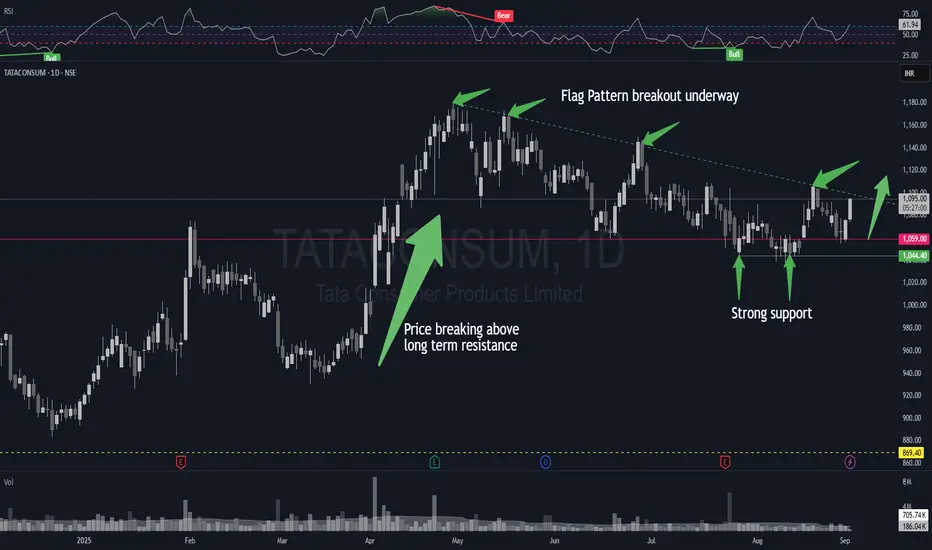
NSE:TATACONSUM - Flag Pattern breakout on cardsAfter breaking above a long-term resistance level near 1050 in April, the price consolidated above 1050 and formed a Flag Pattern. Bouncing from the support, showing positive momentum on RSI, and a bullish trend on MACD confirms the bullish view. After the breakout is complete, any pullback towards 9EMA or 21EMA may be used for entry, while keeping SL at 1030 on a daily closing basis.
Disclaimer: This idea is for educational and learning purposes only and not to be construed as a suggestion/advice to buy or sell any instrument. Please consult your investment advisor before making an investment. All the investments are subject to market risks.
Tradingpatterns
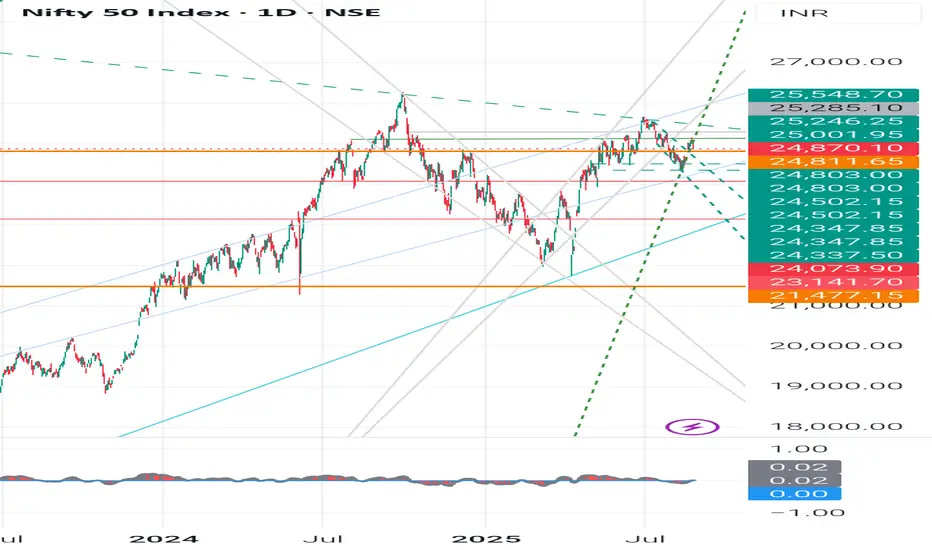
Nifty 50 - Technical Chart Pattern Analysis, With LevelsNifty 50 - Technical Chart Analysis (as per Daily chart)
Current Price (CMP): 25,070
Trend: Sideways consolidation between 24,500 - 25,500 levels.
Chart Pattern:
Multiple tests of 25,500 - strong resistance.
Multiple supports around 24,500 - 24,800 - strong demand zone.
The broad pattern looks like a Rectangle / Range-bound movement.
Swing Analysis:
Higher swing lows visible after 24,000 - bullish undertone.
Lower swing highs at 25,500 - supply pressure.
Key Levels
- Immediate Resistance: 25,250 - 25,550 - 26,000
- Immediate Support: 24,800 - 24,500 - 24,073
Major Support: 23,141 - 21,477 (long-term trend support)
👉Candlestick Learnings (Recent Pattern)
Recent candles show long wicks both sides - market indecision (buyers & sellers fighting).
A strong green bullish engulfing candle near 24,500 support - sign of buyers stepping in.
Current candles forming inside bars - breakout move expected soon (either above 25,500 or below 24,500).
✍️Student Learning Point:
When candles show long wicks near support - it signals accumulation.
When candles cluster near resistance - expect breakout/reversal.
Always confirm with volume before taking position.
Fundamental Comparison - Nifty Competitors (Index Peers)
Since Nifty 50 is an index, let’s compare with other global indices (macro investing perspective):
Index P/E Ratio Dividend Yield 5Y CAGR Returns Volatility
Nifty 50 -22-23 -1.2% -13% Moderate
Sensex -24 -1.1% -12% Moderate
Dow Jones -21 -1.7% -9% Lower
Nasdaq 100 -28 -0.9% -15% High
Shanghai Comp -17 -2.0% -5% Moderate
Learnings:
Nifty has a healthy P/E (not cheap, not too expensive).
Growth rate is higher than global averages - India is attractive long-term.
Volatility is moderate, making Nifty good for SIP investors & long-term compounding.
Investment Learnings for Students
1. Candlestick Patterns: Learn basics like Doji, Engulfing, Hammer, Shooting Star - they often show reversal/continuation.
2. Swing Analysis: Markets move in swings (higher highs/lows in uptrend, lower highs/lows in downtrend). Recognizing them helps in entry/exit.
3. Support & Resistance: Always mark key levels before trading/investing.
4. Fundamentals: Don’t just look at charts - check P/E, dividend yield, EPS growth, sector weightage.
5. Risk Management: Use stop-loss in trading. For investing, use SIP & diversify.
⚠️ Disclaimer
This analysis is for educational purposes only. Not a SEBI-registered advisory. Students & investors should do their own research or consult a financial advisor before making decisions.
#Nifty50 #StockMarketIndia #TechnicalAnalysis #InvestingForBeginners #CandlestickPatterns #SwingTrading #SupportAndResistance #StockMarketEducation #MarketLearning
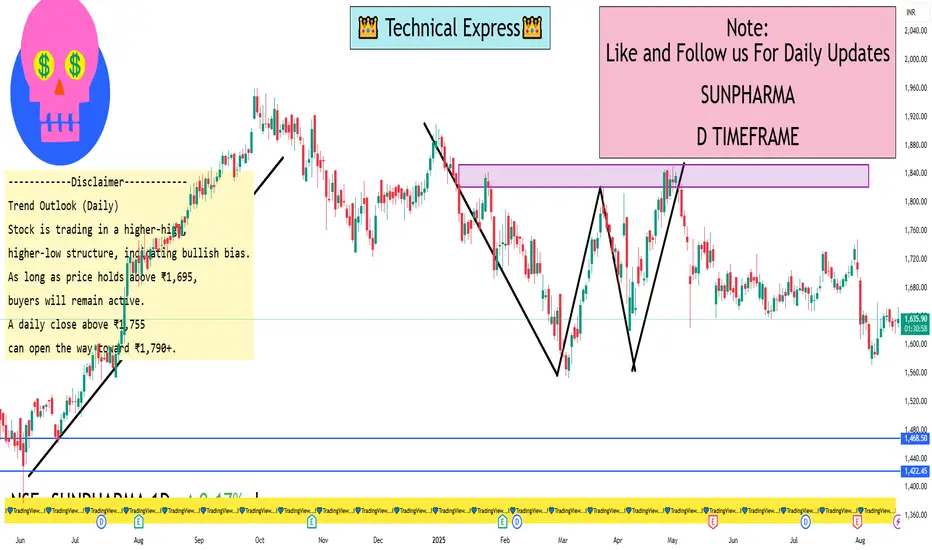
Sunpharma 1 day ViewSun Pharma – Daily Chart Levels
Immediate Resistance: ₹1,745 – ₹1,755
Major Resistance Zone: ₹1,790 – ₹1,810 (breakout zone for further rally)
Immediate Support: ₹1,705 – ₹1,695
Strong Support Zone: ₹1,660 – ₹1,650
Trend Outlook (Daily)
Stock is trading in a higher-high, higher-low structure, indicating bullish bias.
As long as price holds above ₹1,695, buyers will remain active.
A daily close above ₹1,755 can open the way toward ₹1,790+.
A break below ₹1,695 may bring downside toward ₹1,660.
Trading Discipline with Biofeedback1. Introduction: Why Trading Discipline is Hard
In the world of financial markets, traders are constantly balancing analysis with emotion. Charts and data may look purely rational, but the human brain does not operate like a spreadsheet. Instead, traders face fear, greed, overconfidence, hesitation, and impulse — all in rapid cycles during market hours.
Trading discipline is the ability to execute a trading plan consistently, without being swayed by emotional impulses or external noise. It’s what separates a professional who survives years in the market from someone who burns out after a few months.
The challenge? Even the best-prepared trader can watch their discipline crumble in moments of market stress. This is where biofeedback comes in — a method for measuring and controlling physiological responses to improve self-control and decision-making under pressure.
2. What is Biofeedback in the Context of Trading?
Biofeedback is a technique where you use electronic monitoring devices to measure physiological functions — like heart rate, breathing rate, muscle tension, skin conductance, and brainwave activity — and then use that real-time data to learn how to control them.
In trading, biofeedback can help you:
Recognize early signs of stress before they impact your judgment.
Maintain an optimal arousal level for peak performance.
Train your nervous system to remain calm in volatile situations.
Develop habits that strengthen mental resilience over time.
Example:
A trader using a heart rate variability (HRV) monitor might notice their HRV drops significantly before a losing trade — a sign of rising stress. With practice, they can use breathing techniques to restore calm and prevent impulsive decisions.
3. The Science Behind Biofeedback for Traders
3.1. The Stress-Performance Curve
This is based on the Yerkes–Dodson Law, which shows that performance improves with physiological arousal — but only up to a point. Too little arousal (low alertness) leads to sluggish reactions; too much (high anxiety) causes poor judgment.
Biofeedback helps traders stay in the optimal performance zone — alert but calm.
3.2. Physiological Markers in Trading
When you place a trade or watch a volatile market, your body activates the sympathetic nervous system ("fight-or-flight" mode):
Heart rate increases → decision-making becomes reactive.
Breathing shortens → oxygen supply to the brain decreases.
Skin conductance rises → higher sweat response from stress.
Muscle tension increases → physical discomfort, fatigue.
Brainwaves shift → from alpha/theta (calm focus) to high beta (stress).
This physiological shift can override logic. Biofeedback helps you detect these changes before they hijack your behavior.
3.3. Neuroplasticity and Habit Formation
Biofeedback training taps into neuroplasticity — the brain’s ability to rewire itself through repeated experience. By pairing specific mental states (calm focus) with trading activities, you strengthen neural pathways that make discipline more automatic.
4. Why Discipline Breaks in Trading
Even with a perfect trading plan, discipline often fails because:
Emotional Hijacking — The amygdala overrides rational thought under stress.
Overtrading — Dopamine-driven urge to "chase" trades after wins or losses.
Loss Aversion — The tendency to avoid losses at all costs, leading to holding losers too long.
Confirmation Bias — Seeking only information that supports your existing trade.
Fatigue — Poor sleep or extended screen time reduces impulse control.
Biofeedback directly addresses points 1 and 5, and indirectly helps with the rest by improving awareness and emotional regulation.
5. Types of Biofeedback Tools for Traders
5.1. Heart Rate Variability (HRV) Monitors
Function: Measures beat-to-beat variations in heart rate.
Why it’s useful: Higher HRV = greater resilience and adaptability to stress.
Popular devices: Polar H10, Whoop, Elite HRV, Oura Ring.
5.2. Electroencephalography (EEG) Headsets
Function: Measures brainwave activity (alpha, beta, theta, gamma).
Why it’s useful: Identifies mental states — e.g., focus, relaxation, distraction.
Popular devices: Muse, Emotiv Insight.
5.3. Skin Conductance Sensors
Function: Measures electrical conductance of skin (linked to sweat response).
Why it’s useful: Early indicator of stress before conscious awareness.
Popular devices: Empatica E4, GSR2.
5.4. Breathing Feedback Devices
Function: Tracks breathing rate and depth.
Why it’s useful: Calm, diaphragmatic breathing maintains optimal arousal levels.
Popular devices: Spire Stone, Breathbelt.
5.5. Multi-Sensor Platforms
Combine HRV, skin conductance, temperature, movement, and EEG for a full picture.
Often integrated with mobile apps that guide breathing, meditation, or cognitive training.
6. The Biofeedback-Discipline Loop for Traders
Here’s how biofeedback fits into a trader’s workflow:
Baseline Measurement
Monitor your physiological state during calm, non-trading hours.
Establish "normal" HRV, heart rate, and brainwave patterns.
Stress Mapping
Record your physiological data during live trading.
Identify patterns before, during, and after trades — especially losing streaks.
Intervention Training
Use breathing, mindfulness, or focus exercises to restore optimal state.
Repeat until the intervention becomes automatic.
Real-Time Application
Wear biofeedback devices during trading.
Take action the moment stress markers exceed thresholds.
Review and Adjust
Analyze post-trade logs for emotional triggers and physiological patterns.
Update your discipline strategy accordingly.
7. Biofeedback Training Protocol for Traders
Phase 1: Awareness (2–3 Weeks)
Goal: Understand your physiological reactions to market events.
Action Steps:
Wear HRV and skin conductance sensors during trading.
Log market conditions and emotional states alongside data.
Identify recurring "stress spikes" and the situations causing them.
Phase 2: Regulation (3–4 Weeks)
Goal: Learn to control physiological stress responses.
Techniques:
Coherent Breathing: Inhale for 5.5 seconds, exhale for 5.5 seconds.
Progressive Muscle Relaxation: Tense and release muscles from head to toe.
Alpha Wave Training: Use EEG feedback to enter calm, focused states.
Phase 3: Integration (Ongoing)
Goal: Make emotional regulation part of your trading routine.
Action Steps:
Pre-market: 5 minutes of HRV breathing.
During trading: Monitor stress markers, take breaks if needed.
Post-market: Review biofeedback logs and trade journal together.
8. Case Studies
Case Study 1: The Impulsive Scalper
Problem: A day trader entered trades too quickly after losses, leading to overtrading.
Biofeedback Insight: HRV dropped sharply after losing trades; breathing became shallow.
Solution: Implemented 3-minute breathing reset after each loss. Over 6 weeks, reduced revenge trades by 70%.
Case Study 2: The Swing Trader with Exit Anxiety
Problem: Took profits too early due to fear of reversals.
Biofeedback Insight: EEG showed increased beta waves when price approached target.
Solution: Practiced alpha-wave breathing before exit decisions. Result: Average holding time increased by 15%, boosting profits.
Case Study 3: The New Trader with Market Open Stress
Problem: Felt overwhelmed at the opening bell, making erratic trades.
Biofeedback Insight: Skin conductance spiked dramatically at market open.
Solution: Added 10 minutes of pre-market meditation and HRV training. Result: 40% fewer impulsive trades in the first 30 minutes.
9. Advantages of Biofeedback for Trading Discipline
Objective self-awareness: Replaces guesswork with measurable data.
Prevents emotional spirals: Stops small mistakes from snowballing.
Speeds up learning: Accelerates habit formation for calm decision-making.
Customizable: Can be adapted to each trader’s unique stress patterns.
Integrates with trading journal: Creates a full picture of both mental and market performance.
10. Limitations and Considerations
Cost: High-quality devices can be expensive.
Learning curve: Requires time to interpret data and apply techniques.
Over-reliance: Biofeedback should enhance, not replace, psychological skill-building.
Privacy: Data storage should be secure, especially with cloud-based apps.
Conclusion
Trading discipline is not just a mental skill — it’s a mind-body skill. Biofeedback bridges the gap between the psychological and physiological sides of trading performance. By learning to recognize and control your body’s stress responses, you can keep your decision-making sharp, your execution consistent, and your emotions balanced even in high-pressure market environments.
Over time, biofeedback training rewires your nervous system for resilience, turning discipline from a constant battle into a natural, automatic state. And in the competitive world of trading, that could be the difference between long-term success and early burnout.
RALLIS - Ready for Momentum BurstNSE:RALLIS
Technical Analysis
⦿ Its moving in a good uptrend with stair pattern in a Wide channel.
⦿ On 15th of July company posted good results but since than - the stock is just consolidating now its been 1 month, Now it will be time to capitalize on that good earning.
⦿ The current base is clean and a static resistance is formed @386
⦿ Price is Approaching for 3rd time and from last 3 days upmove volume has surged.
⦿ Planning a trade above resistance and keeping a simple 2% stoploss to capture 10% Move.
🟢Entry - 386
♦️Stop - 375
🎯Tgt - 400,425+
The above information is for educational purposes only.
Before acting on any investment idea please do your own analysis and follow proper risk-to-reward, position sizing rules
⦿ If you found this idea Useful, please like and comment 👍💬
Keep Learning,
Happy Trading 🤞**
Part3 learn Institutional Trading Options Trading in India
In India, options are primarily traded on the National Stock Exchange (NSE). Some key features:
Lot Size: Options are traded in fixed lot sizes (e.g., Nifty = 50 units).
Settlement: Cash-settled (no delivery of underlying).
Expiry: Weekly (Thursday) and Monthly (last Thursday).
Margins: Sellers must maintain margin with their broker.
Popular contracts include:
Nifty 50 Options
Bank Nifty Options
Fin Nifty Options
Stock Options (e.g., Reliance, HDFC, TCS)
Tools & Platforms
Successful options trading often relies on good tools:
Broker Platforms: Zerodha, Upstox, Angel One, ICICI Direct.
Charting Tools: TradingView, ChartInk, Fyers.
Option Analysis Tools:
Sensibull
Opstra DefineEdge
QuantsApp
NSE Option Chain
These tools help visualize OI (Open Interest), build strategies, and simulate outcomes.
AT&T Inc BREAKOUTAT&T Inc Share has broken its previous pattern after a strong bullish move. It increased by 100% in two years, from 14 to 27, and now it’s breaking out with a big bullish monthly candle. Due to this strong upward momentum over the past few years, the stock might consolidate for a while before moving higher. This means the upward move could take some time or even a year, so we should keep that in mind when swing trading or investing.
The target and stoploss levels depend on each person’s risk appetite. A minimum risk-reward ratio of 1:1 is always good for swing trades. For example, if our target is around 32 or 33, we could set the stoploss below 25, like at 24.5. This would give a risk-reward ratio of approximately 1.77.
This is just an analysis based on the chart pattern. We can't always expect the share to move exactly as we want. That's why we always put a stoploss. Because many different people are trading based on their own thoughts and decisions. So, never feel bad if a share doesn’t move the way you expect. There’s always an opportunity somewhere else to grab.
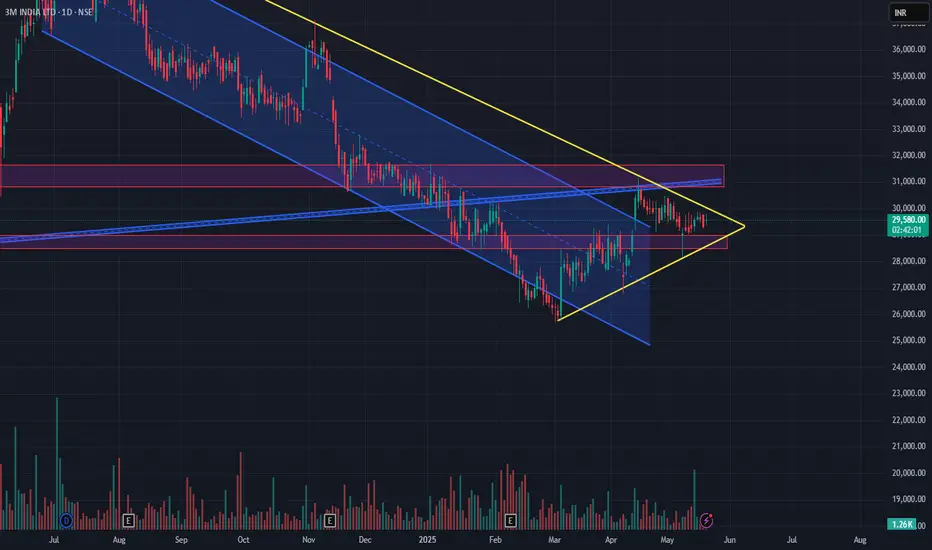
3MINDIA at Breakout Crossroads📅 Chart Type: Daily
📉 Structure Observed: Downtrend Channel → Breakout Attempt → Symmetrical Triangle
📌 Current Price: ₹29,620
🔍 Chart Analysis Summary:
3M India has been under a prolonged downtrend since mid-2023, clearly respecting the falling channel (highlighted in blue). However, since March 2025, a base seems to be forming, and price action has converged into a symmetrical triangle pattern (yellow lines), signaling a potential breakout.
💥 Trade Ideas
✅ Long Trade (High Risk, High Reward):
If price decisively breaks out above the triangle resistance (~₹30,000+), it could be the first real sign of trend reversal after months of weakness. Potential targets could be:
₹31,200 (resistance zone)
₹33,500+ (previous swing highs)
Stop-loss: Below ₹28,800 (lower triangle boundary)
Risk: Moderate-High (False breakout possibility due to low volume)
⚠️ Risky Trade:
Given the triangle formation at the end of a downtrend, this could also be a bearish continuation pattern. A fake breakout followed by rejection could trap bulls.
💡 Avoid trading until confirmation (volume spike + close above resistance or breakdown)
📉 Short Trade:
If price breaks below ₹28,800 with volume, the stock could revisit:
₹27,000 (March support)
₹25,000 (channel support retest)
Stop-loss: ₹30,100 (triangle resistance)
Risk: Medium
Reward: High if channel resumes downward
🔁 Swing Trade Perspective:
This setup is ideal for swing traders who thrive on breakouts or breakdowns from tight consolidations.
📈 Breakout Swing: Enter above ₹30,000 with target ₹33,500
📉 Breakdown Swing: Enter below ₹28,800 with target ₹25,000
🧠 Wait for confirmation candle (daily close + volume) before entry.
📌 Key Zones to Watch:
Resistance: ₹30,000 – ₹31,200
Support: ₹28,800, ₹27,000
Volume Spike: Needed to confirm move direction
🧠 Final Thoughts:
This is a make-or-break level for 3M India. Traders should be cautious but alert. Whether you're bullish or bearish, this consolidation is unlikely to last much longer — and a sharp move is imminent.
"In the market, the biggest profits often come from waiting for the right setup. This might be one."
📉💰 Trade responsibly. Always manage your risk.
USD/JPY 15-Minute Chart AnalysisKey Observations:
1. Trendline Break:
- A potential break below the upward trendline indicates bearish momentum.
2. Supply Zone:
- The price is trading within a highlighted supply zone.
3. Short Trade Setup:
- A short position will be active after breakdown, with the following targets and stop-loss:
- Stop-Loss: Above 157.440
- Target 1: 156.76
- Target 2: 156.493
- Target 3: 156.100
---
Trading Scenarios:
1. Bearish Continuation:
- If the price sustains below 157.030, bearish momentum is likely to accelerate toward 156.100.
2. Invalidation of Bearish Setup:
- A move above 157.6 would invalidate this bearish setup, signaling a potential bullish reversal.
---
Trading Plan:
- Entry (Sell): Below 157.030, targeting 156.810, 156.500, and 156.090.
- **Stop-Loss**: Above **157.436**.
---
This trade setup is in line with bearish market structure, but closely monitor price action around support levels and trailing stop-loss adjustments as the trade progresses.
Disclaimer:
This analysis is for informational purposes only and does not constitute financial advice. Trading involves substantial risk, and past performance is not indicative of future results. Always conduct your own research and consult a financial advisor before making investment decisions. Trade responsibly.
Expleo SolutionsTechnical Analysis of Expleo Solutions:
Expleo Solutions' price has been range-bound for over two years, specifically 847 days. The peak it reached between May 2023 and August 2023 is considered an outlier, as the stock has since reverted to its prior trading range.
Despite this, the stock has experienced a notable 55% increase in trading volume, from 6.2 million shares to 9.6 million over the last 470 days. This increase is significant when compared to the previous 470-day period. The MACD also suggests a decline in seller interest, indicating potential shifts in momentum that could lead to a more positive outlook.
Two key support and resistance levels have been identified, which will be pivotal in determining future price movements.
Potential Risk:
The primary risk to the stock's upward trajectory is the possibility of a broader market correction, particularly influenced by uncertainty in the Index and geopolitical tensions.
Disclaimer:
This analysis is intended for educational purposes and is not a purchase recommendation. It is important to learn how to recognize and understand patterns in stock movements.
Exide Inverted HnS plus double bottomA bullish trade on Exide in daily TF
Entry Range- 462-464
Sl- 450
Target- 480, 490
Pattern- Inverted HnS in Daily TF and A double bottom.
Note- Entry to be made on retracement at the given Entry level. Very good Risk Reward Trade.
Disclaimer-This trade is just for educational purpose. Please take advice from your financial advisor before taking any trade.
NIFTY... KEEP INVESTING...Guys... I am sharing my view on the Elliot waves in Nifty.
The bullish pattern is intact.
We are currently in the 3rd primary wave. Of the five intermediate waves in the primary wave 3, nifty is right now in wave (4) correction.
A quick and rapid wave (5) is likely to start at the end of wave 4. Though Nifty is at 200 EMA right now, I feel the strong support zone is around 22700 levels.
I won't be surprised if Nifty can fall around 800 points from here.
Keep investing in parts and add more when Nifty goes below 23000.
The market is always right..! Trade with appropriate stop-loss.
Silver Futures: Navigating the Bullish Breakout
The Silver Futures chart presents a compelling picture, but as we know, navigating the market demands more than just technical analysis. Let's break down what we see:
Bullish Signals: The decisive breakout above the VWAP, coupled with the series of green Heikin Ashi candles, paints a bullish picture. The recent breach of the Base Camp level further strengthens this positive outlook.
VWAP as a Guide: The VWAP is now acting as dynamic support, offering potential buying opportunities on dips. However, remember that even in a bullish scenario, the market can be unpredictable.
Beyond the Chart: While technicals are promising, external factors can sway silver prices. Keep an eye on global economic indicators, geopolitical tensions, and any news that might impact precious metals.
Applying the Wisdom:
Don't Get Complacent: Even with a bullish setup, risk management is paramount. Set stop-losses to protect your capital in case of unexpected reversals.
Stay Informed: Technical analysis is valuable, but it's only one piece of the puzzle. Stay updated on fundamental factors that can influence silver's price trajectory.
Avoid Blind Faith in Tips: This bullish setup might attract stock tips, but remember, no one can predict the market with certainty. Do your own research and make informed decisions.
In Conclusion:
The Silver Futures chart is signaling a potential bullish trend. However, successful trading involves more than just following signals. Combine technical analysis with a keen understanding of market dynamics, risk management, and a healthy dose of skepticism towards "hot tips." This approach will increase your chances of navigating the market successfully, even when faced with its inherent unpredictability.
Disclaimer: This is an analysis, not financial advice. Trading involves risk; conduct your own research and consider your risk tolerance before making any investment decisions
RCF - Forming Bullish Head and Shoulder Chart PatternRCF is forming bullish head and shoulder chart pattern, waiting for upside breakout!
Once breakout given we will update how to trade Head and Shoulder chart pattern and most of you know how to trade.
Thank You
Arvind Yadav, Cfa
Arvind Share Academy
NIFTY... ELLIOT WAVE COUNTING... BULL TREND STILL INTACT!The 5th primary Elliott Wave, which began after the decline following the election results, is continuing its upward movement towards the 26,000 mark. The secondary waves 1 to 4 (within the primary wave 5) have already been completed, and wave 5 is expected to resume its upward trend soon.
This progression can be clearly seen in the chart. I am optimistic about seeing the Nifty reach 26,000 this year.
Remember, the market is supreme, so trade cautiously.
Nifty50 Chart Analysis - 20-08-24 TuesdayNSE:NIFTY
Timeframe- 30 min chart
Validity - Current Week
➖ Boring /Dull Move in Last Session, Totally range bound after gapup open.
👉PCR -1.0
👉INDIAVIX - 14.31 (Normal)
🏦 Cash activity
FII- Net SELL (-2667) Cr
DII- Net BUY 1803 Cr
🌐US Markets Last day movement.
DJI:- Bullish by 336+ point.
Nasdaq: Bullish up by 357+points.
#GIFTNIFTY - 40 points up.’
👉NiftySupport 24460,24220,24080.
👉NiftyResistance 24640,24850.
🔹(Same as yesterday )Verdict:- 2 scenarios.
1. Breakout of the channel if the 30-minute candle is above - 24640 then only long side momentum will build up.
2. Reversal from the channel. 24550 range.
Use Appropriate stops to avoid big drawdowns.
Not a buy/sell just for educational purposes.
Keep learning,
Happy trading.
CAMPUS LONG (313 OR 297-303)| INVERSE H&S + RESISTENCE BREAKOUTDisclaimer: I am not SEBI certified and these are my personal views. Please do your research before making any investment decisions.
Bought CAMPUS at 313 , Will add more at 297-303
- Completed Inverse Head & Shoulder formation
- Resistance zone breakout(done) and
retest(pending)
- RSI is not overbought
- Trading above 50,100,200 EMA (bullish sign)
- Short term target-348
- Long term target-393
- Views invalidated if breakdown uptrend support line
Short term target: 348
Long term target: 393
Finished Trades (2/2)
JUBLINGREA - Target hit in 4 sessions (check out it in ideas section)
CAPLIPOINT - Target hit in 4 sessions (check out it in ideas section)