ULTRACEMCO 1 Day View 📊 Current Price (approx)
• ULTRACEMCO is trading around ₹12,620–₹12,770 on NSE in today’s session based on multiple live price feeds.
📈 Daily Support & Resistance Levels – NSE (Pivot-based)
📌 Daily Pivot & Range (classic pivot levels):
Resistance 3 (R3): ~ ₹13,101
Resistance 2 (R2): ~ ₹12,963
Resistance 1 (R1): ~ ₹12,776
Pivot Point (PP): ~ ₹12,638
Support 1 (S1): ~ ₹12,451
Support 2 (S2): ~ ₹12,313
Support 3 (S3): ~ ₹12,126
👉 Key intraday reference:
• If price holds above Pivot ~₹12,638, bulls may target the R1–R3 zone.
• A break below S1/S2 could open downside to ₹12,313–₹12,126 S3.
🔁 Alternate Daily Support / Resistance (Pivot Speed)
• R1: ~ ₹12,521
• R2: ~ ₹12,673
• R3: ~ ₹12,792
• Support 1: ~ ₹12,250
(Different pivot provider with slightly variation — good as corroborative levels)
📊 Short-Term Support & Resistance (Alternative)
• Daily Support (Munafasutra): ~ ₹12,264–₹12,265
• Daily Resistance: ~ ₹12,499–₹12,500
(These can be useful for tighter intraday stops)
📌 What This Means for 1D Trading
Bullish above:
• ₹12,638 Pivot — key to stay above for bullish bias today.
• Above ₹12,776–₹12,963 — adds confidence for breakout toward ₹13,101 R3.
Bearish below:
• Below ₹12,451 S1 — risk to ₹12,313–₹12,126 S3.
• Sustained close below Pivot may signal short-term pressure.
Trendbreak
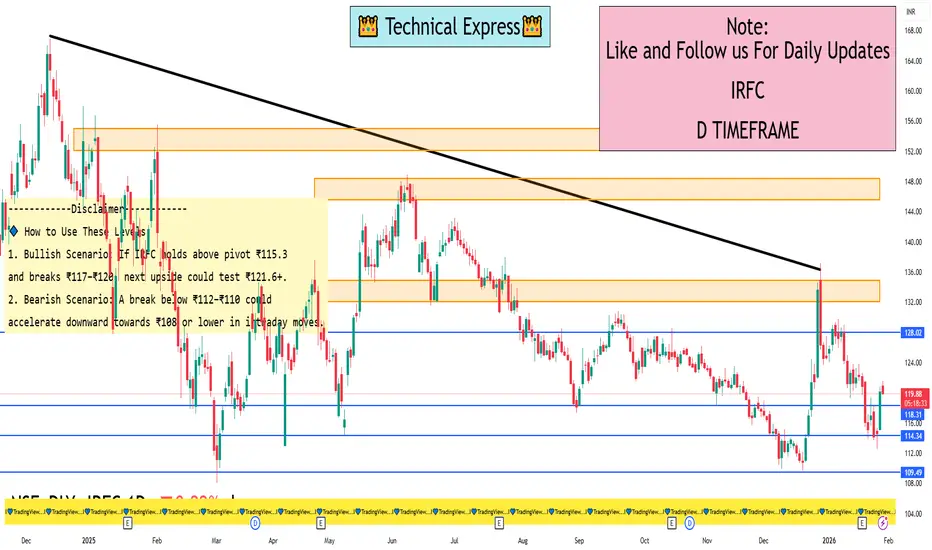
IRFC 1 Day View 📊 Daily Pivot Levels (1-Day TF)
Pivot (daily equilibrium): ~ ₹115.3 – bias above this = short-term bullish; below = bearish.
📈 Resistance Levels (Upside)
R1: ~ ₹117.0–₹117.1 — first daily resistance.
R2: ~ ₹119.9–₹120.0 — secondary resistance zone.
R3: ~ ₹121.6–₹122.0+ — stronger upside barrier.
📉 Support Levels (Downside)
S1: ~ ₹112.5–₹112.6 — first support around recent lows.
S2: ~ ₹110.8–₹111.0 — next support zone below.
S3: ~ ₹107.9–₹108.0 — deeper support zone from pivot analysis.
🔁 Technical Bias Notes (Daily Timeframe)
Current daily RSI and momentum indicators show bearish to neutral bias, with price often trading below short-term moving averages — sellers have slight edge unless price clears key resistances.
Stochastic and oscillators have shown oversold pressures at times, so short-term bounce near support zones (₹110–₹112) is possible if momentum shifts.
Part 5 Advance Option Trading Option Buyers vs. Sellers
Option Buyer
Limited risk (premium paid)
Unlimited profit potential
Theta works against them
Need strong directional move
Option Seller
Unlimited risk but high probability
Earn from premium decay
High margin requirement
Best when market stays in range
Institutions prefer selling due to deep pockets, while retail often leans towards buying due to lower capital requirements.
Part 5 Advance Option Trading How Option Trading Works – Step-by-Step
You choose a strike price based on your directional view.
You decide whether to buy the option or sell it, depending on your risk appetite.
If you expect strong movement, you typically buy.
If you expect sideways movement, you typically sell.
When market moves in your direction, premium increases.
When market moves against you, premium decreases.
Premium also falls automatically due to theta decay, especially near expiry.
Option chain helps identify support and resistance based on OI built-up.
Volume profile shows where big institutions executed trades.
Market structure tells you whether to buy CE, PE, or sell options.
Part 4 Technical Analysis VS. Institutional Option TradingOption Trading in Trending vs. Range-Bound Markets
1. Trending Market
Buyers → High reward
Sellers → Increased risk
Look for:
Market structure break
Volume surge
Imbalance zones
Clearing of option OI levels
2. Range-Bound Market
Sellers → Consistent profits
Buyers → Theta decay damage
Indicators:
High HVN
OI build-up on both sides
Low IV environment
Part 2 Technical Analysis VS. Institutional Option Trading Why Do Traders Use Options?
Options are used for:
✔ Speculation
Predicting whether the price will move up or down.
✔ Hedging
Insurance for your portfolio or positional trades.
✔ Income Generation
Through option selling strategies.
✔ Risk Management
You can cap losses while maintaining unlimited upside potential.
✔ Leverage
Small premium → big exposure.
✔ Flexibility
You can design strategies for all market conditions:
Uptrend
Downtrend
Range-bound
High volatility
Low volatility
APTPACK 1 Week View 📊 Short-Term (1-Week) Price Snapshot
Recent trading range (indicative): ~₹98 – ₹105+.
Current / recent price levels are near ₹100–103 on BSE.
Over the last week, price has shown small fluctuations around this zone.
Note: Actual real-time intra-week chart data isn’t available here, so these bands are inferred from resistance/support indicators and quoted prices.
📈 Key Technical Levels (Short-Term)
🔹 Resistance Levels
Resistance zones are price points where selling pressure could emerge:
R1: ~₹106.00
R2: ~₹110.85
R3: ~₹113.70
These are common pivot-based resistance bandings seen on short-term technical references.
👉 A close above these areas with volume could indicate bullish momentum.
🔻 Support Levels
Support marks areas where buyers might defend price:
S1: ~₹98.30
S2: ~₹95.45
S3: ~₹90.60
These are derived from short-term support pivots around the ₹100 region.
👉 Breaks below these levels on strong volume could signal further weakness.
📉 Short-Term Trend Cues
Moving Averages (Short Window): 20-day EMA/SMA are around ~₹101–102, near current price — indicating consolidation in the near term.
Volatility: Given relatively modest moves week-to-week, the stock seems range-bound unless it breaks key resistances (~106+) or supports (~98−).
🧠 What This Means for 1-Week Trading
Bullish Scenario:
Price holds above ₹100–101 (near short EMA/SMA cross)
Break above ₹106 could open room for short squeeze toward ₹110–113 range
Bearish Scenario:
Weakness under ₹98 might see a slide toward ₹95–90 support cluster
Risk increases on lower delivery/volume and lack of strong buying
Neutral/Range:
With price stuck near pivot zone and short moving averages overlapping, this looks like a range-bound stock for the week until significant catalyst or volume confirms breakouts.
Intraday Institutiona TradingWhat Is an Option?
An option is a derivative contract whose value is derived from an underlying asset such as a stock, index, commodity, or currency.
Each option contract gives:
The buyer the right (not obligation)
The seller (writer) the obligation
to transact the underlying asset at a fixed price (strike price) on or before a specified date (expiry).
Key Types of Options
Call Option
Put Option
Part 4 Institutional Trading Vs. Technical AnalysisOption Buyer (Long Option)
Advantages:
Limited risk
Unlimited profit potential (for calls)
High leverage
Clear risk-reward structure
Disadvantages:
Time decay works against buyer
Requires strong directional or volatility move
High probability of small losses
Part 5 Advace Option Trading Selling Options – Explained in Points
Benefits of Selling Options
High probability trading (65–80% win rate for many strategies).
Premium decay works in your favour.
Suitable for sideways markets.
Big institutions prefer selling options.
Income-generating approach for experienced traders.
Risks of Selling Options
Unlimited loss potential.
Requires high margin.
Big trending days can cause huge losses.
Not suitable for beginners.
When to Sell Options
When market is range-bound.
IV is high (premiums inflated).
OI built-up shows strong resistance/support.
During consolidation around value areas (Volume Profile).
On weekly expiries where theta decay is fastest.
Part 3 Techical Analysis Vs. Institutional Option TradingHow Option Trading Works – Step-by-Step
You choose a strike price based on your directional view.
You decide whether to buy the option or sell it, depending on your risk appetite.
If you expect strong movement, you typically buy.
If you expect sideways movement, you typically sell.
When market moves in your direction, premium increases.
When market moves against you, premium decreases.
Premium also falls automatically due to theta decay, especially near expiry.
Option chain helps identify support and resistance based on OI built-up.
Volume profile shows where big institutions executed trades.
Market structure tells you whether to buy CE, PE, or sell options.
Part 2 Techical Analysis Vs. Institutional Option Trading Key Terminologies in Option Trading
Strike Price – The pre-decided price at which you get the right to buy or sell.
Premium – Amount you pay to buy an option.
Spot Price – Current market price of the underlying.
Intrinsic Value – Actual value of an option if exercised now.
Time Value – Extra premium due to time left until expiry.
OTM (Out of The Money) – No intrinsic value; cheaper premiums.
ATM (At The Money) – Strike closest to current market price.
ITM (In The Money) – Has intrinsic value; expensive premiums.
Expiry – Last date on which the option is valid.
Lot Size – Minimum number of units per option contract.
Part 2 Support and Resistance What Is an Option? – Simple Explanation
An option is a financial contract that gives you a right, but not an obligation.
You pay a small price (called premium) to get this right.
There are two types of options: Call Option (CE) and Put Option (PE).
Call Option gives you the right to BUY the asset at a fixed price before expiry.
Put Option gives you the right to SELL the asset at a fixed price before expiry.
If you are a buyer, your risk is limited to the premium you paid.
If you are a seller, your profits are limited but your risks can be unlimited.
Options are available for multiple expiries: weekly, monthly, and quarterly.
Premium changes based on market demand, volatility, and time remaining for expiry.
Option trading requires understanding of how price reacts at key levels like demand/supply zones, volume clusters, and option chain levels.
HINDCOPPER 1 Day Time Frame 📈 Current/Last Traded Price (Daily):
• ₹535.90 — Last traded price on the NSE, showing a positive move on the day.
• Change on day: approx +0.7% to +0.72% from previous close.
📊 Intraday Price Action:
• Open: ₹544.00
• Previous Close: ₹532.05
• High (today): ~₹555.95
• Low (today): ~₹532.50
• VWAP (average traded price): ~₹546.34
📉 1‑Day Movement Summary:
Today’s price action suggests a mild bullish bias, with price bouncing off the previous close and holding above ₹530 intraday, but also showing some resistance near the mid‑550s range.
📌 Key Levels to Watch Today:
• Support: ~₹532–₹535 (intraday low/previous close area)
• Resistance: ~₹555–₹560 (intraday high zone)
📊 Other Notes:
• Price remains well above recent 52‑week lows (~₹184) and closer to recent highs (~₹576), indicating strong positive momentum over the past few months.
MCX Crude Oil Futures 1 Month time frame level📊 Current Price Snapshot (Indicative)
MCX Crude Oil futures (Feb/near‑month) recently around ₹5,600–₹5,620 range.
📈 Key Technical Levels — 1‑Month Time Frame
(Levels are approximate and from aggregated chart analyses; actual quotes can vary minute‑by‑minute)
🎯 Resistance Levels
1. ₹5,780–₹5,800 – Upper resistance zone from short‑term breakout projections.
2. ₹5,700–₹5,750 – Near‑term Resistance (sell/stop zone).
3. ₹5,730–₹5,842 – Broader resistance cluster seen in chart studies.
🛑 Support Levels
1. ₹5,430–₹5,450 – Key near‑term demand zone (retracement support).
2. ₹5,300 – Major short‑term structural support. Break below suggests bearish risk.
3. ₹5,245–₹5,350 – Additional support band seen on chart levels.
📅 What to Watch
✔ Breakout above 5,780‑5,800 – Signals strong continuation.
✔ Close below 5,300 – Increases bearish risk.
✔ Option Chain PCR & OI changes – Can help gauge near‑term sentiment (MCX data).
How AI Predicts Market Moves1. Data: The Foundation of AI Market Prediction
AI does not “guess” market direction. It learns from data.
Types of Data Used
Price data: Open, high, low, close (OHLC), volume
Order-book data: Bid–ask spreads, depth, liquidity shifts
Technical indicators: RSI, MACD, moving averages, volatility
Fundamental data: Earnings, balance sheets, macro indicators
Alternative data: News, social media sentiment, Google trends
Cross-asset data: Bonds, commodities, currencies, crypto
AI models look at how these datasets interact across timeframes. For example, a sudden rise in bond yields combined with declining liquidity may historically precede equity sell-offs.
2. Pattern Recognition Beyond Human Ability
Traditional technical analysis relies on visual patterns like head-and-shoulders or support and resistance. AI goes much deeper.
What AI Finds
Micro-patterns invisible to the naked eye
Non-linear relationships (A affects B only when C is present)
Regime changes (bull, bear, sideways markets)
Probabilistic outcomes, not certainties
For example, AI might learn that when volatility compresses for 14–18 sessions and volume drops below a threshold, the probability of a sharp breakout increases by 62%.
3. Machine Learning Models Used in Markets
Different AI models specialize in different tasks.
a) Supervised Learning
Used when historical outcomes are known.
Predict next-day return
Classify market as bullish/bearish
Forecast volatility or drawdown risk
Common models:
Linear & Logistic Regression
Random Forests
Gradient Boosting (XGBoost, LightGBM)
These models are popular in swing trading and factor investing.
b) Unsupervised Learning
Used when patterns are unknown.
Market regime detection
Asset clustering
Correlation breakdown analysis
Examples:
K-Means Clustering
Principal Component Analysis (PCA)
This helps funds rotate strategies when market behavior changes.
c) Deep Learning
Used for complex, sequential data.
LSTM / GRU networks: Learn long-term price memory
CNNs: Treat charts like images
Transformers: Capture multi-timeframe dependencies
Deep learning excels in high-frequency trading and multi-asset forecasting.
d) Reinforcement Learning
AI learns by trial and error, similar to how a trader adapts.
Chooses actions: buy, sell, hold
Receives rewards or penalties
Optimizes trading policy over time
This is widely used in algorithmic execution and portfolio allocation.
4. Sentiment Analysis: Reading Market Psychology
Markets are driven by emotion as much as fundamentals.
AI processes:
News headlines
Earnings call transcripts
Social media posts
Analyst reports
Using Natural Language Processing (NLP), AI converts text into numerical sentiment scores:
Positive
Neutral
Negative
Fear vs greed intensity
For example, if sentiment turns sharply negative while prices hold support, AI may detect a potential contrarian bounce.
5. Timeframe Intelligence
AI does not rely on a single timeframe.
Short-term: milliseconds to minutes (HFT)
Medium-term: days to weeks (swing trading)
Long-term: months to years (asset allocation)
By stacking timeframes, AI avoids false signals. A short-term sell signal may be ignored if the long-term trend remains strongly positive.
6. Probability-Based Forecasting (Not Certainty)
AI does not predict exact prices. It predicts probabilities.
Example output:
65% probability market closes higher tomorrow
20% probability of range-bound movement
15% probability of sharp downside move
Professional traders use this to:
Size positions
Adjust stop-losses
Hedge tail risk
This probabilistic thinking is why AI performs better during volatile markets.
7. Risk Management and Drawdown Control
AI models focus as much on risk as on returns.
They monitor:
Volatility expansion
Correlation spikes
Liquidity stress
Tail-risk events
When risk rises, AI may:
Reduce exposure
Shift to defensive assets
Increase cash allocation
Trigger hedging strategies
This is a key reason AI funds often survive crashes better than discretionary traders.
8. Continuous Learning and Adaptation
Markets evolve. Strategies decay.
AI systems:
Retrain on new data
Detect performance degradation
Retire failing models
Combine multiple models into ensembles
This adaptability is crucial because patterns that worked last year may fail today.
9. Why AI Still Fails Sometimes
AI is powerful—but not magical.
Limitations include:
Black swan events (wars, pandemics)
Data bias or overfitting
Sudden regulatory changes
Market manipulation
That’s why the best systems combine AI + human oversight.
10. The Future of AI in Market Prediction
AI is moving toward:
Real-time macro interpretation
Cross-market reflexivity models
AI-driven portfolio construction
Personalized trading assistants
In the future, AI won’t just predict markets—it will design strategies dynamically based on each investor’s risk profile.
Conclusion
AI predicts market moves by learning from massive datasets, recognizing complex patterns, analyzing sentiment, and adapting to changing conditions. It does not replace human judgment but enhances it by removing emotion, bias, and speed limitations. In modern markets, AI is no longer optional—it is becoming the core engine behind trading, investing, and risk management.
Algorithmic Strategies for Cross-Asset Futures1. Concept of Cross-Asset Futures Trading
Cross-asset futures trading involves taking positions in two or more futures contracts from different asset classes based on statistical, macroeconomic, or structural relationships. Instead of predicting absolute price direction, these strategies often focus on relative value, correlation, or transmission of information across markets.
For example:
Bond yields rising may negatively impact equity index futures.
Crude oil futures may influence inflation expectations and currency futures.
Gold futures may react to movements in real yields and USD futures.
Algorithms systematically quantify and trade these relationships at scale.
2. Asset Classes Commonly Used
Cross-asset futures strategies typically span:
Equity Index Futures (S&P 500, Nifty 50, Nasdaq, DAX)
Interest Rate Futures (Treasury futures, Gilt futures)
Commodity Futures (Crude oil, gold, copper, agricultural products)
Currency Futures (USD, EUR, JPY, INR)
Volatility Futures (VIX)
The diversity of instruments improves portfolio robustness and diversification.
3. Core Types of Cross-Asset Algorithmic Strategies
A. Inter-Market Spread Trading
Inter-market spread strategies exploit pricing relationships between futures in different asset classes.
Examples:
Long equity index futures and short bond futures during reflationary phases.
Long copper futures and short gold futures to express a “risk-on” view.
Algorithms monitor historical spreads, z-scores, and cointegration metrics to identify deviations from equilibrium and execute trades when spreads are statistically stretched.
Key tools:
Cointegration analysis
Z-score normalization
Kalman filters for dynamic spreads
B. Macro-Driven Regime Strategies
These algorithms classify the macro environment into regimes such as:
Growth acceleration
Inflation shock
Deflation risk
Risk-off crisis
Each regime has predefined cross-asset positioning rules.
Example:
Inflationary regime: Long commodities, short bonds, selective equity exposure.
Risk-off regime: Long bond futures, long gold futures, short equity futures.
Machine learning classifiers or rule-based macro indicators (PMI, CPI, yield curve slope) are often used for regime detection.
C. Correlation and Breakdown Strategies
Cross-asset correlations are not static. Algorithms monitor rolling correlations between assets and trade correlation breakdowns.
Example:
If equities and bonds suddenly turn positively correlated during stress, the model adjusts hedges or exploits the shift.
These strategies are especially effective during crisis periods when traditional correlations fail.
Common methods:
Rolling correlation matrices
Principal Component Analysis (PCA)
Dynamic Conditional Correlation (DCC-GARCH)
D. Lead-Lag Strategies
Some markets react faster to new information than others. Algorithms identify leading assets and trade lagging ones.
Examples:
Currency futures reacting before equity futures to rate expectations.
Energy futures leading inflation-sensitive bond futures.
High-frequency or medium-frequency data is used to detect causality using:
Granger causality tests
Transfer entropy
Time-shifted regressions
E. Risk Parity and Volatility Targeting
Cross-asset futures portfolios often use risk parity, where capital allocation is based on volatility rather than notional value.
Key characteristics:
Lower allocation to volatile assets like equities
Higher allocation to stable assets like bonds
Continuous rebalancing based on realized volatility
Algorithms dynamically adjust exposure so that each asset class contributes equally to portfolio risk.
F. Statistical Arbitrage Across Asset Classes
These strategies treat futures contracts as components of a statistical system rather than economic instruments.
Examples:
Mean-reversion between commodity indices and equity indices
Cross-sectional ranking of futures returns across asset classes
Models may include:
Multivariate regression
Factor models
Machine learning clustering techniques
4. Data and Infrastructure Requirements
Cross-asset futures strategies are data-intensive.
Required data:
Futures price data (continuous contracts)
Macro data (rates, inflation, growth indicators)
Volatility indices
Correlation and covariance matrices
Infrastructure:
Low-latency execution for intraday strategies
Robust backtesting engines
Risk management and margin optimization systems
Institutional-grade systems are preferred due to the complexity of managing multiple asset classes.
5. Risk Management in Cross-Asset Algorithms
Risk management is central to cross-asset futures trading.
Key risks:
Correlation breakdown risk
Leverage and margin risk
Liquidity risk during stress events
Model overfitting
Risk controls:
Portfolio-level drawdown limits
Volatility scaling
Stop-loss at spread and portfolio level
Stress testing across historical crises
Many strategies cap risk at the portfolio level rather than individual trades, reflecting the interconnected nature of assets.
6. Advantages of Cross-Asset Futures Strategies
Diversification across asset classes
Ability to profit in both trending and sideways markets
Reduced reliance on single-market direction
Strong performance during macro regime shifts
Capital efficiency due to futures leverage
These advantages make cross-asset strategies attractive for institutional portfolios.
7. Limitations and Challenges
Despite their strengths, these strategies face challenges:
Changing macro relationships
Data quality issues across asset classes
High complexity and maintenance cost
Regulatory and margin changes affecting futures trading
Models must be continuously monitored and adapted.
8. Future Trends
The future of cross-asset futures algorithms includes:
AI-driven regime detection
Alternative data integration (shipping, satellite, flows)
Real-time macro nowcasting
Improved tail-risk hedging models
As global markets become more interconnected, cross-asset algorithms will become even more relevant.
Conclusion
Algorithmic strategies for cross-asset futures represent one of the most sophisticated forms of systematic trading. By exploiting relationships across equities, bonds, commodities, currencies, and volatility, these strategies move beyond single-market forecasting toward a holistic view of global financial systems. When combined with robust risk management, disciplined execution, and adaptive models, cross-asset futures algorithms can deliver consistent, diversified performance across market cycles.
SEBI Trading Regulations and Derivatives Curbs (F&O Clampdowns)1. Introduction: What Is SEBI and Why Regulate Derivatives?
The Securities and Exchange Board of India (SEBI) is India’s capital markets regulator. It’s tasked with protecting investors’ interests, developing markets, and regulating securities trading—including equities, bonds, and derivatives (futures and options). Derivatives are financial contracts whose value is linked to an underlying asset (e.g., stocks, indices). They offer benefits like risk management, price discovery, and market liquidity. But because these instruments involve leverage, they can also amplify risks and attract speculative trading that may destabilize markets, particularly when retail participation surges.
In recent years, the rapid growth of derivatives trading in India—especially retail participation in Futures & Options (F&O)—has prompted SEBI to tighten regulations. Regulators have expressed concerns about excessive speculation, high loss rates among individual traders, volatile expiry days, and possible manipulation by sophisticated players. The steps SEBI has taken are designed to balance market efficiency with investor protection and financial stability.
2. Scope of SEBI’s Regulatory Framework
SEBI’s derivatives regulations cover the entire lifecycle of F&O trading, including:
Contract design and eligibility (what can be traded, and under what conditions)
Position limits and surveillance (how much exposure any participant can hold)
Margin and risk management frameworks
Monitoring and enforcement protocols
These rules apply to all market participants—retail investors, brokers, proprietary traders, foreign portfolio investors (FPIs), and exchanges.
3. Key Derivatives Curbs (“F&O Clampdowns”)
Below are the major regulatory reforms SEBI has introduced since late 2024 and through 2025 to control excessive speculation and safeguard the markets:
3.1 Increase in Contract Size
One of SEBI’s most significant changes was to raise the minimum contract size of index derivatives. Previously, most index futures and options contracts had values between ₹5–10 lakh. SEBI increased this to at least ₹15 lakh, with lot sizes adjusted so that the contract value on review falls between ₹15–20 lakh. This applies when new contracts are introduced.
Why? Larger contract sizes mean traders must commit more capital to participate. This raises the entry barrier for highly leveraged retail speculation and encourages more responsible positioning.
3.2 Upfront Collection of Option Premiums
Under earlier practices, brokers could offer credit or allow traders to pay part of the premium or margins later. SEBI mandated that for options trading, premiums must be collected upfront from buyers by trading or clearing members.
Impact: This reduces unrealistic leverage and ensures traders can cover potential losses. It protects both individual traders and the broader clearing ecosystem from defaults.
3.3 Removal of Calendar Spread Benefits
Calendar spreads involve holding positions in two different expiry months and benefit from regulatory margin offsets. SEBI eliminated these benefits on the day a contract expires.
Purpose: This curbs complex strategies often used for speculative gains during volatile expiry periods and simplifies risk calculations. It also prevents traders from taking disproportionate positions near expiry.
3.4 Rationalisation of Weekly Expiry Contracts
Weekly expiry options—contracts that expire every week—were increasingly popular among retail traders due to frequent rollover opportunities. SEBI limited each exchange to offering weekly derivatives on only one benchmark index.
The regulator also later mandated that all equity derivatives must expire only on Tuesdays or Thursdays to reduce “hyperactivity” and speculating across multiple days.
Goal: Reducing speculative volume spikes and concentrating trading activity to manageable expiries eases operational risk and volatility.
3.5 Intraday Monitoring of Position Limits
Historically, position limits were checked only at the end of the trading day. SEBI changed this by requiring stock exchanges to take multiple random intraday snapshots (typically at least four during the trading session) to monitor open interest and cap positions.
In 2025, SEBI also introduced specific entity-level intraday limits for index derivatives—for example, capping net exposure at ₹5,000 crore and gross exposure at ₹10,000 crore per entity, with monitoring across the day and penalties for breaches.
Effect: Real-time monitoring prevents traders from building up excessive positions unnoticed and enhances market discipline and risk control.
3.6 Revised Market Wide Position Limits (MWPL)
SEBI revised how Market Wide Position Limits (MWPL) are calculated by using more realistic measures such as delta-adjusted open interest (FutEq OI), which accounts for actual risk exposure rather than nominal contract volumes. It also tied limits more closely to cash market liquidity and free float data.
Result: Position limits now reflect true market risk, reducing the likelihood of manipulation and sudden bans on derivative trading in individual stocks.
3.7 Rules During Ban Periods
Under the revised ban framework, if a stock reaches a high proportion (e.g., 95%) of its MWPL, it enters a ban period. In such cases, traders cannot increase net positions and must reduce exposure periodically. This prevents “flipping” or speculative attacks designed to influence prices.
4. Broader Surveillance and Enforcement
SEBI has also strengthened surveillance norms in the derivatives markets, including:
Heightened scrutiny of price and volume anomalies
Greater transparency from brokers and exchanges
Penalties for breaches of limits and non-compliance
Actions against manipulation (e.g., banning firms for manipulative practices)
These actions signal SEBI’s intent not only to set rules but enforce them rigorously.
5. Objectives Behind F&O Clampdowns
SEBI’s reforms aim to address multiple structural issues:
5.1 Protect Retail Investors
Data show that a large majority of individual traders in derivatives incur losses, often due to leverage and speculation without adequate risk management. SEBI’s rules seek to protect such traders from unsustainable risk exposure.
5.2 Enhance Market Stability
By curbing speculative excesses—especially around expiry days when volumes can spike—SEBI wants to reduce extreme volatility that can undermine confidence in the markets.
5.3 Improve Risk Monitoring and Transparency
Real-time monitoring and more accurate measurement of exposure provide better risk oversight across market participants, protecting the clearing ecosystem and broader financial system.
6. Criticisms and Responses
Some market participants argue that SEBI’s “clampdowns” may reduce liquidity, discourage legitimate trading strategies, and make markets less attractive, especially for smaller participants or algorithmic traders. SEBI’s chairperson has emphasized the need to strike a balance between regulation and innovation, warning against overly restrictive, threshold-based approaches that might stifle market activity.
7. Conclusion: The Future of Derivatives in India
SEBI’s trading regulations and derivatives curbs reflect a broader trend of tightening oversight in financial markets globally. India’s experience shows a regulator adjusting rules in response to market behavior, risk trends, and investor outcomes. While these measures may dampen speculative frenzy and protect vulnerable investors, they also require market participants to adapt through better risk management, informed strategy, and compliance diligence.
In essence, SEBI’s approach balances market development with investor protection and stability, steering the derivatives ecosystem toward more sustainable growth.
Impact of Union Budget & Policy Reforms on Financial Markets1. Union Budget as a Market-Moving Event
The Union Budget is one of the most anticipated annual events for financial markets. Traders, investors, corporates, and foreign institutions analyze budget proposals to assess how fiscal decisions will influence economic growth and profitability. Announcements related to taxation, government spending, subsidies, fiscal deficit targets, and reforms often lead to sharp short-term volatility in markets.
A growth-oriented budget generally boosts market sentiment, while a fiscally conservative or populist budget may have mixed reactions. Markets tend to reward budgets that balance growth with fiscal discipline, as this indicates macroeconomic stability and sustainability.
2. Impact on Equity Markets
a) Corporate Earnings and Profitability
Budget proposals directly influence corporate earnings through changes in corporate tax rates, input costs, incentives, and subsidies. Tax cuts or production-linked incentive (PLI) schemes improve profitability and attract investments, which is positive for equities. Conversely, higher taxes or withdrawal of incentives can pressure margins and stock prices.
b) Sector-Specific Impact
Different sectors react differently to budget announcements:
Infrastructure & Capital Goods benefit from higher government capital expenditure.
Banking & Financial Services respond to recapitalization plans, credit growth measures, and regulatory reforms.
FMCG & Consumption stocks gain from tax relief for individuals and rural spending.
Healthcare, Defense, Renewable Energy, and Manufacturing benefit from targeted policy support.
As a result, the Union Budget often leads to sectoral rotation within equity markets.
c) Investor Sentiment
Clear reforms, transparency, and pro-growth measures enhance investor confidence. Equity markets favor predictable policies and long-term reform commitments, as these reduce uncertainty and improve valuation multiples.
3. Impact on Bond and Debt Markets
The bond market reacts sharply to budget announcements related to fiscal deficit, borrowing plans, and inflation expectations.
Fiscal Deficit Targets: A lower-than-expected fiscal deficit reassures investors about government finances and supports bond prices (lower yields).
Borrowing Program: Higher government borrowing can push bond yields up due to increased supply.
Inflation Control Measures: Policies aimed at controlling inflation support bond markets, as inflation erodes real returns.
Policy reforms related to monetary-fiscal coordination and financial market deepening also enhance the stability and attractiveness of the debt market.
4. Impact on Currency Markets
The Indian rupee is influenced indirectly by the Union Budget and policy reforms through capital flows, trade balance, and investor confidence.
A reform-oriented budget attracts foreign direct investment (FDI) and foreign institutional investment (FII), supporting the currency.
Fiscal discipline and growth-enhancing reforms improve macroeconomic fundamentals, strengthening the rupee.
Excessive fiscal expansion without revenue support can increase inflation and current account pressures, weakening the currency.
Thus, currency markets interpret the budget as a signal of economic credibility.
5. Role of Structural Policy Reforms
Beyond the annual budget, structural policy reforms have a lasting impact on markets. Reforms such as Goods and Services Tax (GST), Insolvency and Bankruptcy Code (IBC), labor law reforms, banking sector reforms, and digitalization initiatives have transformed the Indian economic landscape.
a) Improving Ease of Doing Business
Structural reforms simplify regulations, reduce compliance burden, and improve transparency. This enhances business efficiency and attracts long-term investments, which is positive for equity and debt markets.
b) Financial Sector Reforms
Reforms in banking, NBFCs, capital markets, and insurance sectors strengthen financial stability. Measures such as bank recapitalization, asset quality resolution, and market-linked borrowing improve credit flow and reduce systemic risk, which markets view favorably.
c) Privatization and Disinvestment
Policy reforms promoting privatization and strategic disinvestment improve efficiency, reduce fiscal burden, and unlock value. Markets often react positively to credible disinvestment roadmaps, as they signal reform commitment.
6. Impact on Foreign Investment
Foreign investors closely evaluate the Union Budget and policy reforms before allocating capital.
Stable tax policies and avoidance of retrospective taxation improve investor trust.
Liberalization of FDI norms expands investment opportunities.
Capital market reforms enhance liquidity, transparency, and accessibility.
Consistent reforms increase India’s attractiveness as an emerging market destination, leading to sustained capital inflows and market depth.
7. Short-Term Volatility vs Long-Term Impact
While the Union Budget may cause short-term market volatility, its true impact unfolds over the medium to long term. Markets may initially react negatively to reform-heavy budgets due to implementation costs or transitional challenges. However, over time, structural reforms tend to improve productivity, competitiveness, and earnings growth, resulting in sustainable market gains.
Investors who focus on long-term fundamentals often use budget-related volatility as an opportunity to accumulate quality stocks aligned with policy direction.
8. Impact on Retail Investors and Market Participation
Policy reforms promoting financial inclusion, digital payments, and capital market access have increased retail participation in markets. Measures such as tax incentives for savings, pension reforms, and investor protection frameworks enhance confidence among retail investors.
The growing role of domestic investors has also reduced market dependence on foreign flows, contributing to greater stability.
9. Risks and Market Concerns
Markets also remain cautious about certain risks:
Overly populist budgets may strain fiscal health.
Policy uncertainty or frequent regulatory changes can unsettle investors.
Delays in reform implementation may reduce credibility.
Therefore, markets continuously assess not just announcements but also execution capability.
10. Conclusion
The Union Budget and policy reforms are powerful drivers of financial markets. While the budget sets the short-term tone, structural reforms shape long-term market trajectories. Growth-oriented spending, fiscal discipline, transparent taxation, and consistent reform policies enhance investor confidence and support sustainable market growth. Equity, bond, and currency markets respond dynamically to these signals, reflecting expectations about economic stability and future earnings.
In the long run, markets reward governments that prioritize reforms, productivity, and inclusive growth over short-term populism. For investors, understanding the interplay between the Union Budget, policy reforms, and market behavior is essential for making informed and strategic investment decisions.