PROTECTED SOURCE SCRIPT
Currency Strength Meter (8 Majors) — invincible3
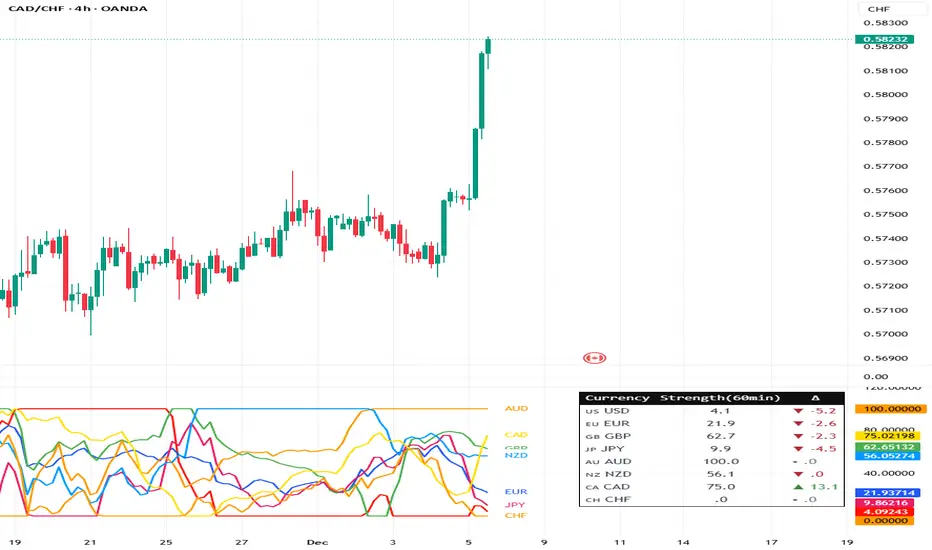
📊 Currency Strength Meter (8 Majors) — Description
The Currency Strength Meter (8 Majors) calculates the relative performance of the major global currencies — USD, EUR, GBP, JPY, AUD, NZD, CAD, CHF — using aggregated logarithmic returns across all major FX pairs. Strength values are normalized on every bar, allowing users to quickly identify the strongest and weakest currencies at any moment in time.
Each currency’s strength is computed from a basket of 7 related currency pairs, smoothed with EMA, converted into z-scores, and finally normalized to a 0–100 scale for easy comparison.
A built-in table displays the real-time strength for all currencies, along with bar-to-bar delta and directional arrows.
🔶 SETTINGS
General
- Broker Prefix
Select the broker symbol prefix used for pair requests (e.g., OANDA:, FX_IDC:). - Calculation Timeframe
Timeframe used to calculate the log returns of currency pairs.
Higher timeframes reduce noise, lower timeframes increase sensitivity. - Lookback Bars
Number of bars (on the calculation timeframe) used to measure logarithmic performance. - Smoothing (EMA)
Smooths currency strength with an EMA of selectable length. - Plot Lines
Option to display the normalized strength of each currency (0–100) directly on the chart.
🔹 Strength Meter Table
Show Table
Enables the on-chart strength meter table.
Show ▲▼ Delta Arrows
Displays directional arrows indicating bar-over-bar momentum:
▲ increasing strength
▼ decreasing strength
• neutral
Size
Controls the table text size (Tiny → Huge).
Layout
Shows:
- Currency name & flag
- Strength (0–100)
- Delta (current – previous bar)
🔶 USAGE
This indicator helps traders quickly determine which currencies are strong and which are weak, and how that strength evolves over time.
Because currencies are evaluated relative to one another, trend strength becomes easier to identify across FX pairs.
Use cases include:
- Finding strong vs. weak currency pair combinations
- Confirming trend continuation or exhaustion
- Identifying momentum shifts through the delta column
- Spotting early reversals when strength begins to diverge
- Comparing currency performance over multiple timeframes
📈 Example Interpretation
If the USD shows:
- Strength = 82
- Delta = +3 (▲)
…USD is not only strong, but also getting stronger relative to the previous bar.
If AUD shows:
- Strength = 22
- Delta = -5 (▼)
…AUD is weak and weakening further.
This makes strong/weak pairing intuitive:
- Prefer strong vs weak pairs (e.g., USD/AUD if USD strong & AUD weak)
- Avoid neutral or mixed-strength pairs
🔶 DETAILS
Currency Strength Calculation
- For each currency pair, the indicator calculates the log-return over the selected lookback window.
- Each currency aggregates 7 major related pairs to form a composite strength value.
- The aggregated value is smoothed using EMA.
- All 8 currencies are converted into z-scores, then normalized to a 0–100 scale for cross-sectional comparison.
- A bar-to-bar delta is computed to reveal strengthening or weakening momentum.
This structure ensures the indicator remains stable, consistent, and highly responsive for intraday and higher-timeframe trading.
Protected script
This script is published as closed-source. However, you can use it freely and without any limitations – learn more here.

Disclaimer
The information and publications are not meant to be, and do not constitute, financial, investment, trading, or other types of advice or recommendations supplied or endorsed by TradingView. Read more in the Terms of Use.
Protected script
This script is published as closed-source. However, you can use it freely and without any limitations – learn more here.
Disclaimer
The information and publications are not meant to be, and do not constitute, financial, investment, trading, or other types of advice or recommendations supplied or endorsed by TradingView. Read more in the Terms of Use.