Harmonic Pulse Tracker [JOAT]Harmonic Pulse Tracker
Introduction
The Harmonic Pulse Tracker is an open-source institutional-grade wave and rhythm analysis system that combines Elliott Wave principles, Fibonacci harmonic analysis, WaveTrend oscillator mechanics, and cycle detection into a unified oscillator. This sophisticated system integrates multiple proven methodologies to identify high-probability reversal zones where harmonic patterns, wave cycles, and momentum indicators converge.
The indicator is designed for traders who understand that market movements follow natural harmonic patterns and cyclical rhythms. By synthesizing detrended price oscillation, Fibonacci retracement levels, WaveTrend momentum analysis, money flow dynamics, and volume confirmation, this tool helps identify structural market turning points with mathematical precision.
Why This Integration Exists
This indicator combines six distinct analytical frameworks that complement each other:
Harmonic Wave Analysis: Uses detrended price oscillation combined with Ehlers cycle detection to identify natural market rhythms
Fibonacci Harmonic Levels: Calculates dynamic Fibonacci retracements and extensions based on wave swing points
WaveTrend Oscillator: Implements LazyBear's WaveTrend algorithm for momentum and overbought/oversold detection
Money Flow Integration: Tracks institutional buying and selling pressure through Money Flow Index analysis
Volume Analysis: Confirms wave movements with volume spikes and directional volume pressure
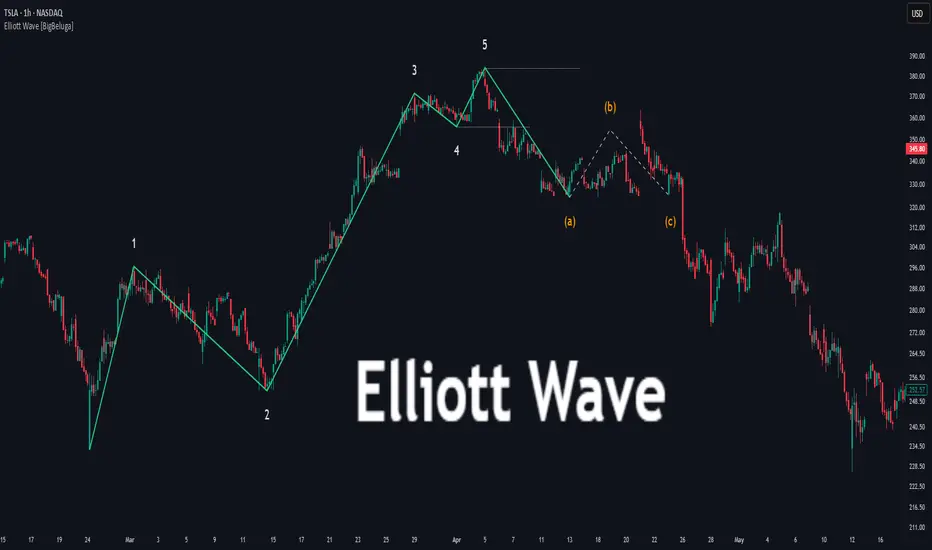
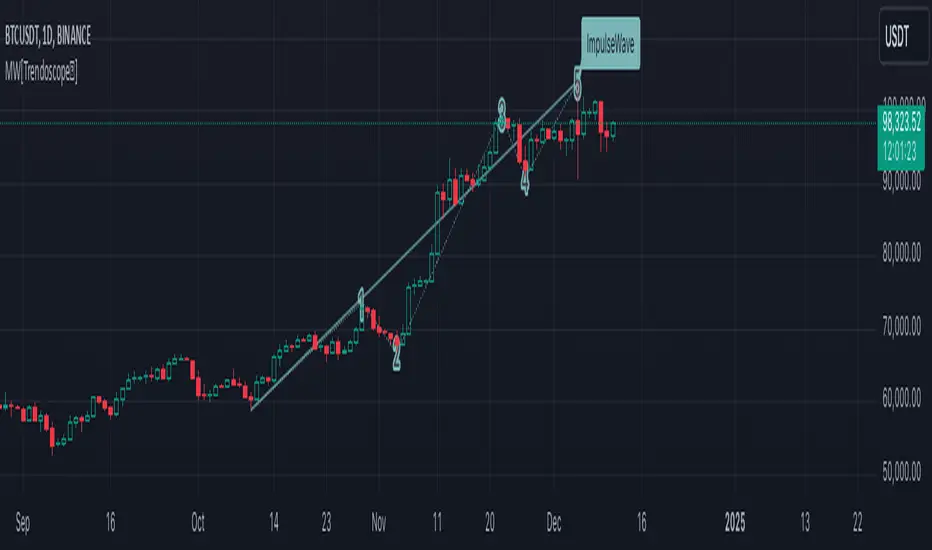
Elliott Wave Counting: Simplified wave counting system to identify impulse and corrective wave phases
Each component addresses different aspects of market rhythm and harmony. The harmonic wave engine identifies natural price cycles, Fibonacci levels provide mathematical support/resistance, WaveTrend shows momentum extremes, money flow reveals institutional activity, volume confirms genuine moves, and Elliott Wave counting provides structural context. Together, they create a multi-dimensional view of market harmony and discord.
Core Components Explained
1. Harmonic Wave Engine
The core wave calculation combines two advanced techniques:
DPO (Detrended Price Oscillator) = close - sma(close, length/2 + 1)
Ehlers Cycle Component = High-pass filtered price with cycle smoothing
Harmonic Wave = Smoothed DPO + (Cycle Component * 0.5)
This creates a wave that removes trend bias while preserving cyclical components, revealing the natural harmonic rhythm of price movement.
Wave Derivatives:
- Wave Momentum: Rate of change in harmonic wave
- Wave Acceleration: Rate of change in momentum
- Wave Velocity: Percentage rate of change over 5 periods
These derivatives help identify wave phase transitions and momentum shifts before they become obvious in price.
2. Fibonacci Harmonic Level System
The indicator calculates dynamic Fibonacci levels based on harmonic wave swing points:
Standard Retracements:
- 23.6%, 38.2%, 50.0%, 61.8%, 78.6% of wave range
Extensions:
- 127.2%, 161.8%, 261.8% beyond wave high
Golden Pocket Zone:
The critical 61.8% to 78.6% retracement zone where most harmonic reversals occur. This zone represents the mathematical sweet spot where Fibonacci ratios converge with natural market rhythm.
Harmonic Resonance Detection:
The system identifies when price is within 5% of key Fibonacci levels and calculates confluence scores when multiple levels align.
3. WaveTrend Oscillator Integration
Implements the proven WaveTrend algorithm:
ESA = ema(hlc3, channel_length)
D = ema(abs(hlc3 - ESA), channel_length)
CI = (hlc3 - ESA) / (0.015 * D)
WT1 = ema(CI, average_length)
WT2 = sma(WT1, 4)
WaveTrend Signals:
- Crossovers in oversold zone (< -50): Bullish reversal signals
- Crossunders in overbought zone (> 50): Bearish reversal signals
- Regular crossovers: Momentum shift confirmation
4. Money Flow Analysis
Tracks institutional buying and selling pressure:
MFI = Money Flow Index over specified period
MFI Centered = (MFI - 50) * multiplier
- Positive MFI: Institutional buying pressure
- Negative MFI: Institutional selling pressure
- Strong MFI: Absolute value > 25 indicates significant institutional activity
5. Volume Analysis Engine
Comprehensive volume analysis including:
Volume Spikes: Volume > Average Volume * Threshold
Volume Ratio: Current volume / Average volume
Volume Strength: Normalized volume intensity (0-100)
Directional Volume:
- Bullish Volume Spike: High volume + green candle
- Bearish Volume Spike: High volume + red candle
6. Elliott Wave Phase Detection
Simplified wave analysis to identify market structure:
Impulse Waves:
- Impulse Up: Positive momentum + acceleration + velocity
- Impulse Down: Negative momentum + acceleration + velocity
Corrective Waves:
- Mixed momentum and acceleration signals indicating consolidation
Wave Counting:
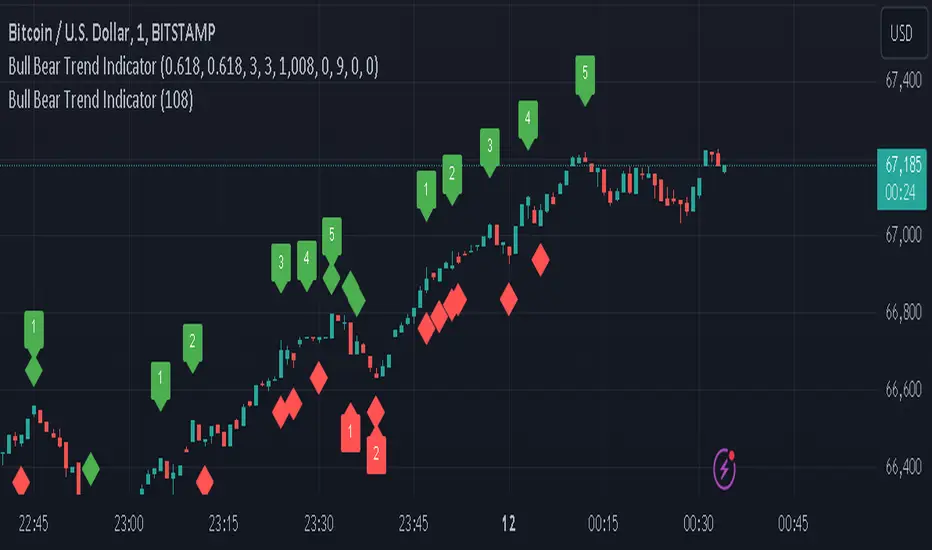
Basic 5-wave count system that resets after wave 5 completion, helping identify potential reversal zones.
Multi-Factor Confluence Scoring System
The indicator calculates a real-time confluence score (0-100) by weighting each component:
Confluence Score Components:
- Fibonacci Zone: Up to 20 points (Golden Pocket = 20, other Fib levels = 4 each)
- Wave Strength: Up to 20 points (based on wave momentum intensity)
- WaveTrend: Up to 20 points (extreme zone crossovers = 20, regular = 15)
- Money Flow: Up to 20 points (strong institutional activity = 20)
- Volume: Up to 20 points (volume spikes = 20, elevated = 15)
Scores above 80 indicate exceptional confluence for potential trades. The dashboard displays individual component scores for transparency.
Perfect Harmonic Alignment Detection
The system identifies rare "Perfect Harmonic" setups when:
- Price is in Golden Pocket zone
- Impulse wave phase is active
- Wave strength > 70
- WaveTrend crossover in extreme zone
- Positive money flow (for bullish) or negative (for bearish)
- Volume spike confirmation
These setups represent the highest probability reversal opportunities.
Visual Elements
Harmonic Wave: Main oscillator with gradient coloring based on wave position
Wave Momentum: Histogram showing rate of change in wave movement
Fibonacci Levels: Key retracement and extension levels (38.2%, 50%, 61.8%, 78.6%, 161.8%)
Golden Pocket Zone: Highlighted area between 61.8% and 78.6% levels
WaveTrend Lines: WT1 and WT2 with overbought/oversold zones
Money Flow Columns: Institutional buying/selling pressure visualization
Volume Strength: Volume intensity histogram
Signal Markers: Perfect Harmonic signals and strong confluence alerts
Background Zones: Golden Pocket and Perfect Signal highlighting
Dashboard: Real-time display of all component values and confluence score
How Components Work Together
The integration creates a harmonic analysis approach:
Layer 1 - Wave Rhythm: Harmonic wave identifies natural market cycles and turning points
Layer 2 - Mathematical Levels: Fibonacci ratios provide precise support/resistance zones
Layer 3 - Momentum Context: WaveTrend shows overbought/oversold extremes
Layer 4 - Institutional Flow: Money flow reveals smart money positioning
Layer 5 - Volume Confirmation: Volume analysis validates genuine moves vs noise
Layer 6 - Wave Structure: Elliott Wave context provides structural framework
Example scenario: Harmonic wave reaches Golden Pocket zone (Layer 1 + 2) during WaveTrend oversold crossover (Layer 3) with positive money flow (Layer 4) and volume spike (Layer 5) in corrective wave phase (Layer 6). This confluence suggests exceptional reversal probability.
Input Parameters
Wave Settings:
Wave Length: Period for harmonic wave calculation (default: 34)
Smoothing Period: Wave smoothing factor (default: 5)
WaveTrend Settings:
Show WaveTrend: Toggle WaveTrend display
WT Channel Length: Channel calculation period (default: 9)
WT Average Length: Smoothing period (default: 12)
WT Overbought: Overbought threshold (default: 50)
WT Oversold: Oversold threshold (default: -50)
Money Flow Settings:
Show Money Flow: Toggle money flow display
MFI Length: Money Flow Index period (default: 14)
MFI Multiplier: Sensitivity adjustment (default: 1.5)
Volume Settings:
Show Volume Analysis: Toggle volume indicators
Volume Spike Threshold: Multiplier for spike detection (default: 1.5)
Fibonacci Settings:
Show Fibonacci Levels: Toggle Fibonacci level display
Fibonacci Lookback: Period for swing point calculation (default: 100)
Cycle Settings:
Cycle Period: Ehlers cycle detection period (default: 20)
Cycle Smoothing: Cycle component smoothing (default: 3)
How to Use This Indicator
Step 1: Identify Wave Phase
Check the dashboard for current wave phase (Impulse Up/Down, Corrective, Neutral) and Elliott Wave count.
Step 2: Locate Fibonacci Zones
Look for price approaching key Fibonacci levels, especially the Golden Pocket zone (61.8%-78.6%).
Step 3: Check WaveTrend Position
Identify if WaveTrend is in extreme zones and watch for crossovers in oversold/overbought areas.
Step 4: Analyze Money Flow
Confirm institutional positioning through Money Flow Index - positive for bullish setups, negative for bearish.
Step 5: Verify Volume Confirmation
Ensure volume supports the move - look for volume spikes in the direction of the expected reversal.
Step 6: Review Confluence Score
Check the dashboard confluence score. Scores above 80 indicate high-probability setups.
Step 7: Wait for Perfect Harmonic Signals
The highest probability trades occur when "PERFECT" signals appear, indicating all factors are aligned.
Best Practices
Use on 15-minute to 4-hour timeframes for optimal harmonic detection
Focus on Golden Pocket zone entries - this is where most harmonic reversals occur
Wait for WaveTrend crossovers in extreme zones for best risk:reward
Confirm with money flow direction - institutional flow should support the trade direction
Volume spikes add significant confirmation to harmonic setups
Perfect Harmonic signals are rare but offer exceptional probability
Wave 5 completions often coincide with major reversal opportunities
Use confluence scores above 80 as primary filter for trade selection
Indicator Limitations
Harmonic patterns can extend beyond expected Fibonacci levels
Perfect Harmonic signals are rare - patience is required for best setups
Wave counting is simplified and may not match complex Elliott Wave analysis
Fibonacci levels are dynamic and may adjust as new swing points form
Money flow can remain extreme longer than expected during strong trends
Volume confirmation may be less reliable in low-liquidity markets
Confluence scoring is mathematical, not predictive of future performance
Requires understanding of harmonic analysis principles for effective use
Technical Implementation
Built with Pine Script v6 using:
Advanced detrended price oscillation with Ehlers cycle detection
Dynamic Fibonacci calculation based on swing point analysis
LazyBear WaveTrend algorithm implementation
Real-time Money Flow Index with institutional bias detection
Volume analysis with spike detection and directional confirmation
Simplified Elliott Wave counting with phase detection
Multi-factor confluence scoring system with component weighting
Anti-overlap signal filtering to prevent signal clustering
The code is fully open-source and can be modified to suit individual trading styles and preferences.
Originality Statement
This indicator is original in its harmonic integration approach. While individual components (DPO, Fibonacci, WaveTrend, MFI, volume analysis, Elliott Wave) are established concepts, this integration is justified because:
It synthesizes six distinct methodologies that address different aspects of market harmony
The harmonic wave engine combines detrended oscillation with cycle detection for superior rhythm analysis
Dynamic Fibonacci levels adjust to current wave structure rather than using static retracements
Golden Pocket zone identification provides mathematical precision for reversal timing
Multi-factor confluence scoring quantifies setup quality across all components
Perfect Harmonic detection identifies rare, high-probability reversal opportunities
Each component contributes unique harmonic information: wave analysis reveals natural cycles, Fibonacci provides mathematical levels, WaveTrend shows momentum extremes, money flow indicates institutional positioning, volume confirms genuine moves, and Elliott Wave provides structural context. The integration's value lies in identifying moments when all these harmonic factors align simultaneously.
Disclaimer
This indicator is provided for educational and informational purposes only. It is not financial advice or a recommendation to buy or sell any financial instrument. Trading involves substantial risk of loss and is not suitable for all investors.
Harmonic analysis and Fibonacci levels are mathematical concepts that do not guarantee future price movement. Past performance and backtested results do not guarantee future results. Market conditions change, and harmonic patterns that worked historically may not work in the future.
Always use proper risk management, including stop losses and position sizing appropriate for your account size and risk tolerance. Never risk more than you can afford to lose. Consider consulting with a qualified financial advisor before making investment decisions.
The author is not responsible for any losses incurred from using this indicator. Users assume full responsibility for all trading decisions made using this tool.
-Made with passion by officialjackofalltrades
Pine Script® indicator