10>20,p>50 DEMARenders daily EMA, 10, 20 and 50 on any timeframe below 1D 30m timeframe works well. Use trend of 10 > 20 + price > 50 for long and 10 < 20 + price < 50 for shorts or exits.Pine Script® strategyby frank_quebecUpdated 3369
EURUSD | Yield Curve Flip Strategy (2s10s State Flips)Strategy Core (Concept) The strategy trades EURUSD exclusively when the US yield curve regime (2Y/10Y) flips into a new, clearly bullish or bearish regime. The core assumption is that re-pricing in the US yield curve (rather than individual data points) is a robust driver of USD strength or weakness and can act as a structural trigger for trend changes. ⸻ Data Basis • Uses US 2Y Yield (TVC:US02Y) and US 10Y Yield (TVC:US10Y). • The 2s10s curve is calculated as: curveUS = US10Y – US2Y • Regime assessment is based on the N-day change (default: 5 days), calculated on true rates bars (not intraday noise). ⸻ Regime Detection (Correct Bond Logic) First, the strategy checks whether the curve has significantly steepened or flattened over the lookback period: • Steepener if Δ(2s10s) > thrCurve (default: +0.10 percentage points = 10 bp) • Flattener if Δ(2s10s) < −thrCurve Next, a leg confirmation determines the specific type of steepener/flattener (default thrLeg = 5 bp): Bull Steepener • Curve steepens because yields fall, with the 2Y falling more (risk-off / rate-cut pricing) Bear Steepener • Curve steepens because yields rise, with the 10Y rising more (reflation / term-premium move) Bull Flattener • Curve flattens because yields fall, with the 10Y falling more (growth shock / long-end rally) Bear Flattener • Curve flattens because yields rise, with the 2Y rising more (hawkish repricing / front-end up) Important: By default, a Bear Steepener is not treated as a bearish signal, unless allowBearSteepForShort is enabled. ⸻ State Machine (Memory + Flip Triggers) The strategy maintains a persistent state variable curveState: • +1 = bullish • −1 = bearish • 0 = neutral The state is updated only on a new rates bar (daily rates when tfRates = "D"), avoiding intraday noise. A trade is generated only on a true regime flip: • flipToBull: new state turns bullish and the previous state was bearish (or neutral, if allowed) • flipToBear: new state turns bearish and the previous state was bullish (or neutral, if allowed) The option enterFromNeutral controls whether the first clear regime emerging from neutral is traded. The option onlyOnNewRatesBar ensures signals occur only when a new rates bar is printed, providing clean timing. ⸻ Trading Rules (Entry / Exit) There are no stops, targets, or trailing mechanisms. The strategy is a pure regime-switching / reversal system: • On flipToBull • Close short (“S”) • Open long (“L”) • On flipToBear • Close long (“L”) • Open short (“S”) Positions are therefore held until the next regime flip. ⸻ Parameter Interpretation • N: Smoothing / inertia. Smaller = faster but noisier; larger = more stable but later. • thrCurve: Minimum curve move required to define a regime. • thrLeg: Minimum move of the confirming leg (2Y or 10Y) to reduce misclassification. • allowBearSteepForShort: Makes the system more aggressive (more bearish signals), but represents a different macro case. • enterFromNeutral: Increases trade frequency by trading the first regime impulse. ⸻ What You See on the Chart • Background shading: • Green for bullish state • Red for bearish state • The curve and Δ-curve are plotted but hidden (display=none), mainly for debugging and analysis.Pine Script® strategyby Deepray8
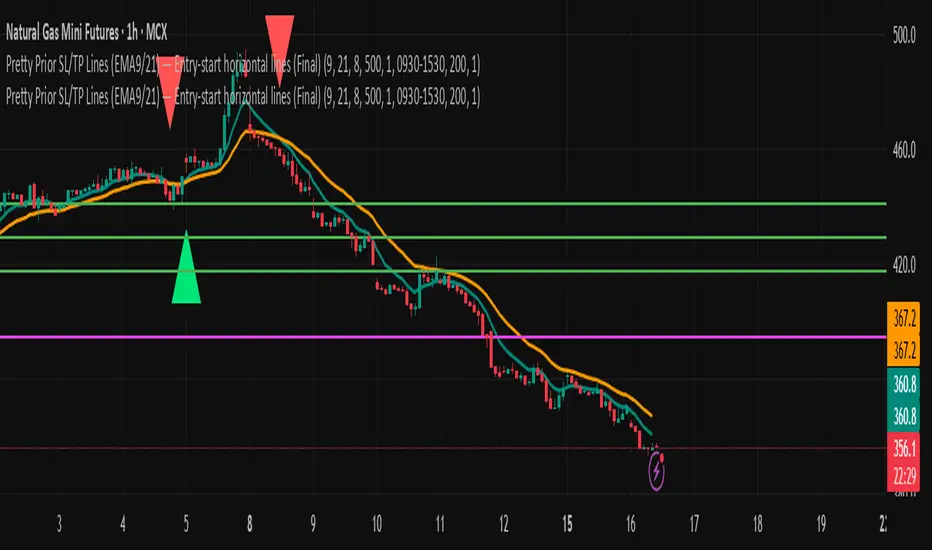
algonova(EMA9/21)algonova(EMA9/21) is a moving average stratergy for good trade Pine Script® strategyby thealgonova13277
225 SMA CrossoverWell-known strategy from Zahlengraf from the Mauerstrassenwetten subreddit for you to test yourself. You can change the length of the SMA and whether to trade long, short or both directions. Pine Script® strategyby MeinnameaufXYZ13
Buy the dips StrategyThis strategy getting in long position only after the price drop- Buy the dips The % of the drop is Determined by SMA for the first trade The inputs of SMA and % of the drop can be adjust from the User After that Strategy start taking safe trades if not take profit from the first trade The safe trades are Determined by step down deviation % and by quantity There is no Stop loss is not for one with small tolerance to getting under if any question askPine Script® strategyby fullmax44102
Trend Core Strategy v1.0 - GUMROADLog Regression Channel Pro Strategy This is a trend-following pullback strategy built for TradingView (Pine Script v6). It uses logarithmic regression channels to define the market’s primary trend, and looks for low-risk pullback entries within strong trending conditions. Momentum and trend strength filters are applied to avoid ranging or weak markets. This strategy is designed to be used when the market is clearly trending, not during choppy or sideways price action. Best Used When Strong uptrend or downtrend is present Price is pulling back toward the regression channel Volatility is sufficient (ADX confirms trend strength) Suitable for 1H / 4H timeframes Commonly used on BTC, ETH, and major crypto pairs Key Characteristics Non-repainting logic Volatility-based risk management (ATR) Designed for realistic backtesting No martingale, no grid, no over-optimization Gumroad Disclaimer (3 Lines) This strategy is provided for educational purposes only and is not financial advice. Trading involves risk, and losses may occur. You are fully responsible for your own trading decisions.Pine Script® strategyby kahsang95111
Deviation Burn + Pivots + Advanced stop + Midpoint CancelA session-based range strategy that places buy and sell orders at the session high and low, expecting price reactions from these levels. Additional filters help avoid low-probability trades.Pine Script® strategyby dotan2
Improved Candle Strategy (without daily squared)# Candle Pattern Trading Strategy ## Core Logic Analyzes the last 5 candlesticks to identify "close at high" and "close at low" patterns, generating long/short signals. ## Trading Conditions - **Long**: ≥2 bars closed at high in past 5 bars + current bar closes at high → Open long - **Short**: ≥2 bars closed at low in past 5 bars + current bar closes at low → Open short - **Filter**: If ≥3 doji patterns detected, skip trading ## Risk Management - Stop Loss: Based on entry bar's high/low - Take Profit: Risk × 2x multiplier - Cooldown: No trading for 2 bars after entry - Session Filter: No trading for first 5 bars after market open ## Configurable Parameters - Lookback period, doji threshold, close proximity ratio, TP/SL ratio, cooldown bars, etc. **Use Cases**: 1-minute and higher timeframes on stocks/futuresPine Script® strategyby masteraux10116
Ace Algo [Anson5129]🏆 Exclusive Indicator: Ace Algo 📈 Works for stocks, forex, crypto, indices 📈 Easy to use, real-time alerts, no repaint 📈 No grid, no martingale, no hedging 📈 One position at a time ---------------------------------------------------------------------------------------- Ace Algo A trend-following TradingView strategy using a confluence of technical indicators and time-based rules for structured long/short entries and exits: ---------------------------------------------------------------------------------------- Parameters Explanation Moving Average Length Indicates the number of historical data points used for the average price calculation. Shorter = volatile (short-term trends); longer = smoother (long-term trends, less noise). Default: 20 Entry delay in bars After a trade is closed, delay the next entry in bars. The lower the number, the more trades you will get. Default: 4 Take Profit delay in bars After a trade is opened, delay the take profit in bars. The lower the number, the more trades you will get. Default: 3 Enable ADX Filter No order will be placed when ADX < 20 Default: Uncheck Block Period Set a block period during which no trading will take place. ---------------------------------------------------------------------------------------- Entry Condition: Only Long when the price is above the moving average (Orange line). Only Short when the price is below the moving average (Orange line). * Also, with some hidden parameter that I set in the backend. Exit Condition: When getting profit: Trailing Stop Activates after a position has been open for a set number of bars (to avoid premature exits). When losing money: In a long position, when the price falls below the moving average, and the conditions for a short position are met, the long position will be closed, and the short position will be opened. In a short position, when the price rises above the moving average, and the conditions for a long position are met, the short position will be closed, and the long position will be opened. ---------------------------------------------------------------------------------------- How to get access to the strategy Read the author's instructions on the right to learn how to get access to the strategy.Pine Script® strategyby anson5129Updated 112
Estrategia Momentum Seguro (EMS) Entry and exit signals, this indicator helps or suggests where to enter, exit, or place a stop loss.Pine Script® strategyby cabosycom10
Tailwind.(BTC)Imagine the price of Bitcoin is like a person climbing a staircase. The Steps (Grid): Instead of watching every single price movement, the strategy divides the market into fixed steps. In your configuration, each step measures **3,000 points**. (Examples: 60,000, 63,000, 66,000...). The Signal: We buy only when the price climbs a full step decisively. The "Expensive Price" Filter: If the price jumps the step but lands too far away (the candle closes too high), we do not buy. It is like trying to board a train that has already started moving too fast; the risk is too high. Rigid Exits: The Take Profit (TP) and Stop Loss (SL) are calculated from the edge of the step, not from the specific price where you managed to buy. This preserves the geometric structure of the market. The Code Logic (Step-by-Step) A. The Math of the Grid (`math.floor`) pinescript level_base = math.floor(close / step_size) * step_size This is the most important line. What does it do? It rounds the price down to the nearest multiple of 3,000. Example: If BTC is at 64,500 and the step size is 3,000: 1. Divide: $64,500 / 3,000 = 21.5$ 2. `math.floor` (Floor): Removes the decimals $\rightarrow$ remains $21$. 3. Multiply: $21 * 3,000 = 63,000$. Result: The code knows that the current "floor" is **63,000**, regardless of whether the price is at 63,001 or 65,999. B. The Strict Breakout (`strict_cross`) pinescript strict_cross = (open < level_base) and (close > level_base) Most strategies only check if `close > level`. We do things slightly differently: `open < level_base`: Requires the candle to have "born" *below* the line (e.g., opened at 62,900). `close > level_base`: Requires the candle to have *finished* above the line (e.g., closed at 63,200). Why? This avoids entering on gaps (price jumps where the market opens already very high) and confirms that there was real buying power crossing the line. C. The "Expensive Price" Filter (`max_dist_pct`) pinescript limit_price_entry = level_base + (step_size * (max_dist_pct / 100.0)) price_is_valid = close <= limit_price_entry Here you apply the percentage rule: -If the level is 63,000 and the next is 66,000 (a difference of 3,000). -If `max_dist_pct` is **60%**, the limit is $63,000 + (60\% \text{ of } 3,000) = 64,800$. -If the breakout candle closes at **65,000**, the variable `price_is_valid` will be **false** and it will not enter the trade. This avoids buying at the ceiling. D. TP and SL Calculation (Anchored to the Level) pinescript take_profit = level_base + (step_size * tp_mult) stop_loss = level_base - (step_size * sl_mult) Note that we use `level_base` and not `close`. -If you entered because the price broke 63,000, your SL is calculated starting from 63,000. -If your SL is 1.0x, your stop will be exactly at 60,000. This is crucial: If you bought "expensive" (e.g., at 63,500), your real stop is wider (3,500 points) than if you bought cheap (63,100). Because you filter out expensive entries, you protect your Risk/Reward ratio. E. Visual Management (`var line`) The code uses `var` variables to remember the TP and SL lines and the `line.set_x2` function to stretch them to the right while the operation remains open, providing that visual reference on the chart until the trade ends. Workflow Summary Strategy Parameters: Total Capital: $20,000 We will use 10% of total capital per trade. Commissions: 0.1% per trade. TP: 1.4 SL: 1 Step Size (Grid): 3,000 We use the 200 EMA as a trend filter. Feel free to experiment with the parameters to your liking. Cheers.Pine Script® strategyby OldWave961119
Session Sweep Strategy V3Johannes Spezial FVG Indikator :-) zur erkennung von FVG zu definierbaren Sessionzeiten.Pine Script® strategyby johannesf_singerUpdated 1
Daily Dynamic Grid StrategyHi everyone, This strategy is built around a dynamic daily grid concept, using an upper and lower daily range that is automatically divided into multiple grid levels. The idea is to take advantage of daily volatility by executing DCA entries on specific grid levels, based on predefined conditions. Key points of the strategy & feature: I recommend using 1H or 2H timeframe for this strategy Take profit by grid When DCA is active (>1 entry), the exit condition switches to close above the average price A hard stop loss is applied Includes an optional Trailing TP / SL to help maximize profit during strong moves Like most DCA-based strategies, it tends to have a high win rate, but during strong market dumps, losses can become relatively large Can also be used for backtest on Forex markets such as Gold, where using the trailing option is generally more effective And still trial for the webhook, may continue to improve and update this strategy in future versions.Pine Script® strategyby begrilUpdated 9
Kairos Bands [v1.1]Overview The Kairos Bands Strategy is a highly modular trading system designed to identify high probability entry points based on volatility exhaustion and momentum shifts... It is built with a proprietary core algorithm that detects when price has extended too far from its mean, but it is wrapped in a Confluence Cloud that allows the user to filter these signals through nine different secondary indicators... This is not just a static strategy... It is a framework that allows you to build your own edge by toggling specific filters on and off to match current market conditions... 1... The Chameleon Feature (Trend or Reversal) One of the most powerful features of Kairos Bands is the Inverse Trades logic... Reversal Mode (Default): By default, the strategy looks for price exhaustion... It buys when the market is oversold and sells when the market is overbought... This is ideal for ranging markets or catching tops and bottoms... Trend Following Mode (Inversed): By checking the Inverse Trades box in the settings, the logic flips completely... A Buy signal becomes a Sell and vice versa... This transforms the strategy into a breakout or trend following system, entering trades in the direction of the momentum rather than against it... 2... The Confluence Cloud While the core trigger is based on proprietary volatility calculations, the user has full control over how strictly those trades are filtered... You can toggle any of the following 9 momentum filters independently for both Long and Short setups... RSI (Relative Strength Index) Stochastic Oscillator CCI (Commodity Channel Index) Williams %R MFI (Money Flow Index) CMO (Chande Momentum Oscillator) Fisher Transform Ultimate Oscillator ROC (Rate of Change) For example, you can require RSI and MFI to agree with the main signal for Longs, but only require Stochastic for Shorts... This allows for granular tuning... 3... Trend Bias & Time Management To further refine entries, the strategy includes: EMA Trend Filter: An optional dual EMA system (Fast vs Slow) that forces the strategy to only trade in the direction of the dominant trend... Precision Time Filtering: You can define exact start and end times (down to the minute) for entries... No Trade Zone (NTZ): A specific time window where the strategy is forbidden from holding positions... If a trade is open when the NTZ begins, it is immediately force closed to avoid volatility events or market closes... 4... Risk Management The strategy moves away from vague percentage based stops and uses precision point based targeting... Fixed Points: Set your Take Profit and Stop Loss in exact price points... Signal Skipping: An optional feature to cool down the strategy after a trade closes, forcing it to skip a set number of subsequent signals to avoid over trading... 5... Professional Analytics Dashboard The visual overlay provides a detailed Heads Up Display (HUD) containing institutional grade metrics... Strategy Grade: An automatic A through F grading system based on the Win Rate Differential (how much better the strategy performs compared to a breakeven coin flip)... Streak Analysis: Tracks the maximum and average consecutive wins and losses to help you understand the psychological drawdown risk... Rolling PnL: A secondary dashboard tracks your hypothetical Net PnL over the last 7 trading days and the last 12 months, giving you a clear view of short term and long term performance...Pine Script® strategyby kingdomcitizendavid12
Daily High/Low Breakout Strategy v2Long and Short trade signal strategy, connects via API key to any exchange, can be used as an indicator. Based on the break of maximum and minimum levels. preferred timeframe 5 minutes.Pine Script® strategyby KriptoBotik118
CRYPTO HELPERThis works on most large crypto currencies and beats a buy a hold strategy for the most part it can work for some volatile stocks as well. Try it out and adjust but 1 day seems to work best for time framesPine Script® strategyby jonhenrysaucedo3
S&P 500: 300-Day Trend FollowerSIMPLE STRAT FOR MACRO ETFs The 300-day Moving Average is a very slow, long-term filter. Pros: It keeps you in the market during massive bull runs (like 2013-2019) without shaking you out on minor dips. Cons: It is slow to react. If the market crashes fast (like COVID in 2020), price might drop 15-20% before it crosses the line and tells you to sell.Pine Script® strategyby jonhenrysaucedo2
Hybrid Trend-Following Inside Bar BreakoutHybrid Trend-Following Inside Bar Breakout Strategy The Hybrid Trend-Following Inside Bar Breakout Strategy is a rule-based trading system designed to capture strong directional moves while controlling risk during uncertain market conditions. It combines trend-following, price action, and volatility-based risk management into a single robust framework. Core Concept The strategy trades inside bar breakouts only in the direction of the dominant market trend. Inside bars represent periods of consolidation, and when price breaks out of this consolidation in a trending market, it often leads to impulsive moves with favorable risk–reward characteristics. Key Components 1. Trend Filter Uses 50 EMA and 200 EMA to define the market trend. Bullish bias: 50 EMA above 200 EMA Bearish bias: 50 EMA below 200 EMA This filter prevents counter-trend trades and improves trade quality. 2. Volatility Filter Compares fast ATR (14) with slow ATR (50). Trades are taken only when volatility is expanding or above a minimum threshold. This avoids low-volatility, choppy market conditions. 3. Inside Bar Breakout An inside bar forms when the current candle’s high is lower than the previous candle’s high and the low is higher than the previous candle’s low. A trade is triggered only when price breaks above or below the inside bar range in the direction of the trend. 4. Candle Quality Filter Requires a minimum body-to-range ratio, ensuring that the breakout candle has strong momentum and is not driven by weak wicks. Risk Management & Trade Management Stop Loss (SL) Placed using ATR-based dynamic stops, adapting to current market volatility. Prevents tight stops in volatile conditions and wide stops in calm markets. Partial Profit Taking 50% of the position is exited at 1.5R, locking in profits early. This reduces psychological pressure and improves equity stability. Trailing Stop After partial profit is taken, the remaining position is managed with an ATR-based trailing stop. Allows the strategy to capture large trend moves while protecting gains. Cooldown Mechanism After a losing trade, the system enters a cooldown period and skips a fixed number of bars. This helps avoid revenge trading and overtrading during unfavorable market phases. Why This Strategy Works Trades only high-probability breakouts in trending markets Adapts automatically to changing volatility Combines price action precision with systematic risk control Designed for consistent performance over long historical periodsPine Script® strategyby JeET3695
EMA 5/9 Angle + Candle Strength (SL=Open, TP=RR)EMA 5 / EMA 9 cross Cross must have ~30° angle (approximated using slope → atan) Entry candle must be bullish/bearish and also be Normal / 2nd Most / Most based on body-size percentile Entry = close of signal candle SL = open of signal candle TP = 1:2 RR (editable input)Pine Script® strategyby prajwalaradhya1113
BRT Support MA [STRATEGY] v2BRT Support MA Strategy v2 - Dynamic Support Line Strategy 📊 Strategy Description BRT Support MA Strategy v2 is an automated trading strategy based on the analysis of dynamic support and resistance levels using volatility calculations on higher timeframes. The strategy is designed to identify key trend reversal moments and enter positions with optimal risk-to-reward ratios. 🎯 Key Features Unique strategy characteristics: 1. Multi-Timeframe Volatility Analysis - indicators are calculated on a user-selected timeframe, which allows filtering market noise and obtaining more reliable signals 2. Adaptive Hedging System - a unique algorithm for dynamic position volume calculation during reversals, which accounts for current drawdown and automatically adjusts order size for optimal risk management 3. Visual Trend Indication - dynamic color change of the main line (green = uptrend, red = downtrend) for quick assessment of current market conditions 4. Automatic Signal Markers - the strategy marks trend change moments on the chart with arrows for convenient analysis 5. Limit Orders - entries into positions occur via limit orders at key levels, ensuring better price execution ⚙️ Strategy Settings Support MA Length - calculation period for the main support/resistance line Support MA Timeframe - timeframe for indicator calculations (can be set higher than current for noise filtering) TP (%) - take profit percentage from entry point SL (%) - stop loss percentage from entry point Hedge Multiplier - volume multiplier for hedging positions during reversals 📈 Operating Logic The strategy analyzes the relationship between two dynamic levels calculated based on market volatility. When price breaks through the main support level in the direction of the trend: Long positions are opened when the main indicator is in an uptrend and price breaks above it Short positions are opened when the main indicator is in a downtrend and price breaks below it When there is an open position and an opposite signal forms, the strategy automatically calculates the optimal volume for a hedging position based on the percentage price movement and the set take profit. 🎨 Visual Elements Blue/Green/Red line - main dynamic support/resistance level (color changes depending on current trend) Green arrows down ▼ - uptrend reversal signals Red arrows up ▲ - downtrend reversal signals TP and SL - displayed in data window for current open position 💡 Usage Recommendations Test the strategy on historical data of different instruments before use Optimize parameters for the specific trading instrument and timeframe Configure TP/SL parameters according to your trading system and risk tolerance Hedge Multiplier controls hedging system aggressiveness - start with conservative values ⚠️ DISCLAIMER IMPORTANT! PLEASE READ BEFORE USE: This script is provided for educational and research purposes only . It is intended for testing on historical data and studying algorithmic trading approaches. The author is NOT responsible for: Any financial losses incurred as a result of using this strategy Trading results in real-time or on demo accounts Losses arising from incorrect parameter configuration Technical failures, slippage, and other market conditions Trading involves a high level of risk and is not suitable for all investors. You can lose all of your invested capital. Do not invest money you cannot afford to lose. Before starting real trading: Conduct thorough testing on historical data Ensure you fully understand the strategy's operating logic Consult with a financial advisor Consider broker commissions and slippage Start with minimum volumes Past performance does not guarantee future profitability. Use of the strategy is at your own risk. © MaxBRFZCO | Version 2.0 | Pine Script v5 For questions and suggestions, please use comments under the publicationPine Script® strategyby MaxBRFZCO31
Monthly DI+ & RSI StrategyOverview This strategy is designed to capture significant trend reversals and continuations on the Monthly timeframe. It combines the trend-following capability of the Directional Movement Index (DMI) with the fast momentum detection of RSI (Period 6). Core Logic The strategy triggers a long position based on a dual-confirmation system. It looks for a specific "handshake" between Trend (DI) and Momentum (RSI). Entry Conditions (OR Logic) A Buy signal is generated if EITHER of the following occurs: Trend Trigger: DI+ crosses over DI- (while RSI is already bullish, trading above its SMA). Momentum Trigger: RSI(6) crosses over RSI SMA(14) (while the trend is already bullish, with DI+ > DI-). Exit Condition (Stop Loss) Trend Reversal: The position is closed immediately if DI- crosses over DI+, indicating the bullish trend has been invalidated. Default Settings Timeframe: Optimized for 1M (Monthly) charts. RSI: Length 6 RSI SMA: Length 14 DMI: Length 14 / Smoothing 14 Risk Warning This script is for educational purposes only. Past performance does not guarantee future results. Always backtest on your specific asset classes before trading.Pine Script® strategyby Ganamurthy9
Daily High Breakout Strategy v2Long trade signal strategy, connects via API key to any exchange, can be used as an indicator. Based on breakout, rebound from daily highs.Pine Script® strategyby KriptoBotik115
[Backtest Crypto] Cross MAThis script is designed for testing the moving average crossover strategy. Script settings: Select testing range Indicator settings: Select moving average type (EMA, SMA, WMA, SMMA, HMA) and period Trade management: Select risk-to-reward ratio, stop-loss defined as min/max for a certain number of candles (you can set a desired number), option to partially lock in a position by moving the stop-loss to breakeven, trailing stop, or close a position on an opposite signal. Option to limit the stop-loss by ATR to prevent it from becoming too large during volatile movements. =============================================================== Скрипт предназначен для тестирования стратегии пересечение скользящих средних. Настройки скрипта: Выбор диапазона тестирования Настройки индикатора: выбор типа скользящей (EMA, SMA, WMA, SMMA, HMA) и периода Сопровождение сделки: выбор соотношения риска к прибыли, стоп-лосс определяется как мин/мах за определенное количество свечей (можно устанавливать желаемое количество), возможность частичной фиксации позиции с переносом стоп-лосса в безубыток, трейлинг-стоп, или закрытие позиции по противоположному сигналу. Возможность ограничения стоп-лосса по ATR, чтобы при волатильных движениях он не был слишком большим.Pine Script® strategyby Backtest_Crypto2