MTF EMAs: 200 EMA (1hr & 15m), 8 EMA (5m)Using the 200 ema on 1hr and 15 min timeframe to ID entry points for scalping.Pine Script® indicatorby ejkotewa1
Price Log Regression (by Currency)1. Introduction This indicator draws a logarithmic regression line directly on top of the price candles, showing the long‑term “average” growth path of any asset in the currency you select (for example USD). It is inspired by popular log‑regression studies used on assets like Bitcoin, where price is transformed to a log scale and a straight regression line is used to visualize macro trends and diminishing returns over time. 2. Key Features - Currency‑aware trend line : Before calculating the regression, the script converts the asset’s price into the chosen currency, so the line represents the trend of “price in USD”, not just the original quote on the chart. - Logarithmic regression : The script takes the logarithm (base 10) of the converted price, applies a linear regression to that log series, and then converts the result back to normal price; this produces a smooth line that follows the exponential character of many long‑term price moves. - On‑chart overlay : Only the regression line is plotted and `overlay` is enabled, so the line appears directly over your existing candles, keeping the chart clean and making it easy to compare current price versus its long‑term log‑trend in the selected currency. 3. How to Use - Add the script to any symbol and timeframe, then choose the Currency input (for example set it to “USD” if you want to see the trend of that asset measured in Dolars). - Adjust the Regression length input: longer lengths give a slower, smoother macro line, while shorter lengths react more to recent price action; use what best matches the horizon you are analysing. - Read the line as an analytical tool, not as guaranteed support or resistance: if price is far above the line, it may indicate an extended move relative to its long‑term path in that currency; if it is far below, it may indicate a cheaper zone relative to that same path, always remembering that this is educational analysis and not financial advice. Note: This indicator focuses on long‑term logarithmic trends rather than short‑term noise, it is best suited for longer‑horizon approaches such as swing trading and position trading, rather than intraday scalping.Pine Script® indicatorby destrobr06855
HMA 9/50 Crossover + RSI 50 Filter1. The Core Indicators HMA 9 (Fast): Acts as the primary trigger line. Its unique calculation minimizes lag compared to standard moving averages, allowing for faster entries. HMA 50 (Slow): Defines the medium-term trend direction and acts as the "anchor" for crossover signals. RSI 14: Serves as a "momentum gate." Instead of traditional overbought/oversold levels, we use the 50 midline to confirm that the directional strength supports the crossover. 2. Entry Conditions Long Entry: Triggered when the HMA 9 crosses above the HMA 50 AND the RSI is greater than 50. Short Entry: Triggered when the HMA 9 crosses below the HMA 50 AND the RSI is less than 50. 3. Execution & Reversal This strategy is currently configured as an Always-in-the-Market system. A "Long" position is automatically closed when a "Short" signal is triggered. To prevent "pyramiding" (buying multiple positions in one direction), the script checks the current position_size before opening new entries. How to Use Timeframe: Optimized for 3-minute (3m) candles but can be tuned for 1m to 15m scalping. Settings: Use the Inputs panel to adjust HMA lengths based on the volatility of your specific asset (e.g., shorter for stable stocks, longer for volatile crypto). Visuals: Aqua Line: HMA 9 Orange Line: HMA 50 Green Background: Bullish RSI Momentum (> 50) Red Background: Bearish RSI Momentum (< 50) Risk Disclosure Whipsaws: This strategy is likely to underperform in sideways markets. Backtesting: Past performance does not guarantee future results. Always test this strategy in the Strategy Tester with appropriate commission and slippage settings before live use.Pine Script® strategyby justincheong0621
CryptoFlux Dynamo [JOAT]CryptoFlux Dynamo: Velocity Scalping Strategy WHAT THIS STRATEGY IS CryptoFlux Dynamo is an open-source Pine Script v6 strategy designed for momentum-based scalping on cryptocurrency perpetual futures. It combines multiple technical analysis methods into a unified system that adapts its behavior based on current market volatility conditions. This script is published open-source so you can read, understand, and modify the complete logic. The description below explains everything the strategy does so that traders who cannot read Pine Script can fully understand how it works before using it. HOW THIS STRATEGY IS ORIGINAL AND WHY THE INDICATORS ARE COMBINED This strategy uses well-known indicators (MACD, EMA, RSI, MFI, Bollinger Bands, Keltner Channels, ATR). The originality is not in the individual indicators themselves, but in the specific way they are integrated into a regime-adaptive system. Here is the detailed justification for why these components are combined and how they work together: The Problem Being Solved: Standard indicator-based strategies use fixed thresholds. For example, a typical MACD strategy might enter when the histogram crosses above zero. However, in cryptocurrency markets, volatility changes dramatically throughout the day and week. A MACD crossover during a low-volatility consolidation period has very different implications than the same crossover during a high-volatility trending period. Using the same entry thresholds and stop distances in both conditions leads to either: Too many false signals during consolidation (if thresholds are loose) Missing valid opportunities during expansion (if thresholds are tight) Stops that are too tight during volatility spikes (causing premature exits) Stops that are too wide during compression (giving back profits) The Solution Approach: This strategy first classifies the current volatility regime using normalized ATR (ATR as a percentage of price), then dynamically adjusts ALL other parameters based on that classification. This creates a context-aware system rather than a static threshold comparison. How Each Component Contributes to the System: ATR-Based Regime Classification (The Foundation) The strategy calculates ATR over 21 periods, smooths it with a 13-period EMA to reduce noise from wicks, then divides by price to get a normalized percentage. This ATR% is classified into three regimes: - Compression (ATR% < 0.8%): Market is consolidating, breakouts are more likely but false signals are common - Expansion (ATR% 0.8% - 1.6%): Normal trending conditions - Velocity (ATR% > 1.6%): High volatility, larger moves but also larger adverse excursions This regime classification then controls stop distances, profit targets, trailing stop offsets, and signal strength requirements. The regime acts as a "meta-parameter" that tunes the entire system. EMA Ribbon (8/21/34) - Trend Structure Detection The three EMAs establish trend direction and structure. When EMA 8 > EMA 21 > EMA 34, the trend structure is bullish. The slope of the middle EMA (21) is calculated over 8 bars and converted to degrees using arctangent. This slope measurement quantifies trend strength, not just direction. Why these specific periods? The 8/21/34 sequence follows Fibonacci-like spacing and provides good separation on 5-minute cryptocurrency charts. The fast EMA (8) responds to immediate price action, the mid EMA (21) represents the short-term trend, and the slow EMA (34) acts as a trend filter. The EMA ribbon works with the regime classification: during compression regimes, the strategy requires stronger ribbon alignment before entry because false breakouts are more common. MACD (8/21/5) - Momentum Measurement The MACD uses faster parameters (8/21/5) than the standard (12/26/9) because cryptocurrency markets move faster than traditional markets. The histogram is smoothed with a 5-period EMA to reduce noise. The key innovation is the adaptive histogram baseline. Instead of using a fixed threshold, the strategy calculates a rolling baseline from the smoothed absolute histogram value, then multiplies by a sensitivity factor (1.15). This means the threshold for "significant momentum" automatically adjusts based on recent momentum levels. The MACD works with the regime classification: during velocity regimes, the histogram baseline is effectively higher because recent momentum has been stronger, preventing entries on relatively weak momentum. RSI (21 period) and MFI (21 period) - Independent Momentum Confirmation RSI measures momentum using price changes only. MFI (Money Flow Index) measures momentum using price AND volume. By requiring both to confirm, the strategy filters out price moves that lack volume support. The 21-period length is longer than typical (14) to reduce noise on 5-minute charts. The trigger threshold (55 for longs, 45 for shorts) is slightly offset from 50 to require momentum in the trade direction, not just neutral readings. These indicators work together: a signal requires RSI > 55 AND MFI > 55 for longs. This dual confirmation reduces false signals from price manipulation or low-volume moves. Bollinger Bands (1.5 mult) and Keltner Channels (1.8 mult) - Squeeze Detection When Bollinger Bands contract inside Keltner Channels, volatility is compressing and a breakout is likely. This is the "squeeze" condition. When the bands expand back outside the channels, the squeeze "releases." The strategy uses a 1.5 multiplier for Bollinger Bands (tighter than standard 2.0) and 1.8 for Keltner Channels. These values were chosen to identify meaningful squeezes on 5-minute cryptocurrency charts without triggering too frequently. The squeeze detection works with the regime classification: squeeze releases during compression regimes receive additional signal strength points because breakouts from consolidation are more significant. Volume Impulse Detection - Institutional Participation Filter The strategy calculates a volume baseline (34-period SMA) and standard deviation. A "volume impulse" is detected when current volume exceeds the baseline by 1.15x OR when the volume z-score exceeds 0.5. This filter ensures entries occur when there is meaningful market participation, not during low-volume periods where price moves are less reliable. Volume impulse is required for all entries and adds points to the composite signal strength score. Cycle Oscillator - Trend Alignment Filter The strategy calculates a 55-period EMA as a cycle basis, then measures price deviation from this basis as a percentage. When price is more than 0.15% above the cycle basis, the cycle is bullish. When more than 0.15% below, the cycle is bearish. This filter prevents counter-trend entries. Long signals require bullish cycle alignment; short signals require bearish cycle alignment. BTC Dominance Filter (Optional) - Market Regime Filter The strategy can optionally use BTC.D (Bitcoin Dominance) as a market regime filter. When BTC dominance is rising (slope > 0.12), the market is in "risk-off" mode and long entries on altcoins are filtered. When dominance is falling (slope < -0.12), short entries are filtered. This filter is optional because the BTC.D data feed may lag during low-liquidity periods. How The Components Work Together (The Mashup Justification): The strategy uses a composite scoring system where each signal pathway contributes points: Trend Break pathway (30 points): Requires EMA ribbon alignment + positive slope + price breaks above recent structure high Momentum Surge pathway (30 points): Requires MACD histogram > adaptive baseline + MACD line > signal + RSI > 55 + MFI > 55 + volume impulse Squeeze Release pathway (25 points): Requires BB inside KC (squeeze) then release + momentum bias + histogram confirmation Micro Pullback pathway (15 points): Requires shallow retracement to fast EMA within established trend + histogram confirmation + volume impulse Additional modifiers: +5 points if volume impulse is present, -5 if absent +5 points in velocity regime, -2 in compression regime +5 points if cycle is aligned, -5 if counter-trend A trade only executes when the composite score reaches the minimum threshold (default 55) AND all filters agree (session, cycle bias, BTC dominance if enabled). This scoring system is the core innovation: instead of requiring ALL conditions to be true (which would generate very few signals) or ANY condition to be true (which would generate too many false signals), the strategy requires ENOUGH conditions to be true, with different conditions contributing different weights based on their reliability. HOW THE STRATEGY CALCULATES ENTRIES AND EXITS Entry Logic: 1. Calculate current volatility regime from ATR% 2. Calculate all indicator values (MACD, EMA, RSI, MFI, squeeze, volume) 3. Evaluate each signal pathway and sum points 4. Check all filters (session, cycle, dominance, kill switch) 5. If composite score >= 55 AND all filters pass, generate entry signal 6. Calculate position size based on risk per trade and regime-adjusted stop distance 7. Execute entry with regime name as comment Position Sizing Formula: RiskCapital = Equity * (0.65 / 100) StopDistance = ATR * StopMultiplier(regime) RawQuantity = RiskCapital / StopDistance MaxQuantity = Equity * (12 / 100) / Price Quantity = min(RawQuantity, MaxQuantity) Quantity = round(Quantity / 0.001) * 0.001 This ensures each trade risks approximately 0.65% of equity regardless of volatility, while capping total exposure at 12% of equity. Stop Loss Calculation: Stop distance is ATR multiplied by a regime-specific multiplier: Compression regime: 1.05x ATR (tighter stops because moves are smaller) Expansion regime: 1.55x ATR (standard stops) Velocity regime: 2.1x ATR (wider stops to avoid premature exits during volatility) Take Profit Calculation: Target distance is ATR multiplied by regime-specific multiplier and base risk/reward: Compression regime: 1.6x ATR * 1.8 base R:R * 0.9 regime bonus = approximately 2.6x ATR Expansion regime: 2.05x ATR * 1.8 base R:R * 1.0 regime bonus = approximately 3.7x ATR Velocity regime: 2.8x ATR * 1.8 base R:R * 1.15 regime bonus = approximately 5.8x ATR Trailing Stop Logic: When adaptive trailing is enabled, the strategy calculates a trailing offset based on ATR and regime: Compression regime: 1.1x base offset (looser trailing to avoid noise) Expansion regime: 1.0x base offset (standard) Velocity regime: 0.8x base offset (tighter trailing to lock in profits during fast moves) The trailing stop only activates when it would be tighter than the initial stop. Momentum Fail-Safe Exits: The strategy closes positions early if momentum reverses: Long positions close if MACD histogram turns negative OR EMA ribbon structure breaks (fast EMA crosses below mid EMA) Short positions close if MACD histogram turns positive OR EMA ribbon structure breaks This prevents holding through momentum reversals even if stop loss hasn't been hit. Kill Switch: If maximum drawdown exceeds 6.5%, the strategy disables new entries until manually reset. This prevents continued trading during adverse conditions. HOW TO USE THIS STRATEGY Step 1: Apply to Chart Use a 5-minute chart of a high-liquidity cryptocurrency perpetual (BTC/USDT, ETH/USDT recommended) Ensure at least 200 bars of history are loaded for indicator stabilization Use standard candlestick charts only (not Heikin Ashi, Renko, or other non-standard types) Step 2: Understand the Visual Elements EMA Ribbon: Three lines (8/21/34 periods) showing trend structure. Bullish when stacked upward, bearish when stacked downward. Background Color: Shows current volatility regime - Indigo/dark blue = Compression (low volatility) - Purple = Expansion (normal volatility) - Magenta/pink = Velocity (high volatility) Bar Colors: Reflect signal strength divergence. Brighter colors indicate stronger directional bias. Triangle Markers: Entry signals. Up triangles below bars = long entry. Down triangles above bars = short entry. Dashboard (top-right): Real-time display of regime, ATR%, signal strengths, position status, stops, targets, and risk metrics. Step 3: Interpret the Dashboard Regime: Current volatility classification (Compression/Expansion/Velocity) ATR%: Normalized volatility as percentage of price Long/Short Strength: Current composite signal scores (0-100) Cycle Osc: Price deviation from 55-period EMA as percentage Dominance: BTC.D slope and filter status Position: Current position direction or "Flat" Stop/Target: Current stop loss and take profit levels Kill Switch: Status of drawdown protection Volume Z: Current volume z-score Impulse: Whether volume impulse condition is met Step 4: Adjust Parameters for Your Needs For more conservative trading: Increase "Minimum Composite Signal Strength" to 65 or higher For more aggressive trading: Decrease to 50 (but expect more false signals) For higher timeframes (15m+): Increase "Structure Break Window" to 12-15, increase "RSI Momentum Trigger" to 58 For lower liquidity pairs: Increase "Volume Impulse Multiplier" to 1.3, increase slippage in strategy properties To disable short selling: Uncheck "Enable Short Structure" To disable BTC dominance filter: Uncheck "BTC Dominance Confirmation" STRATEGY PROPERTIES (BACKTEST SETTINGS) These are the exact settings used in the strategy's Properties dialog box. You must use these same settings when evaluating the backtest results shown in the publication: Initial Capital: $100,000 Justification: This amount is higher than typical retail accounts. I chose this value to demonstrate percentage-based returns that scale proportionally. The strategy uses percentage-based position sizing (0.65% risk per trade), so a $10,000 account would see the same percentage returns with 10x smaller position sizes. The absolute dollar amounts in the backtest should be interpreted as percentages of capital. Commission: 0.04% (commission_value = 0.04) Justification: This reflects typical perpetual futures exchange fees. Major exchanges charge between 0.02% (maker) and 0.075% (taker). The 0.04% value is a reasonable middle estimate. If your exchange charges different fees, adjust this value accordingly. Higher fees will reduce net profitability. Slippage: 1 tick Justification: This is conservative for liquid pairs like BTC/USDT on major exchanges during normal conditions. For less liquid altcoins or during high volatility, actual slippage may be higher. If you trade less liquid pairs, increase this value to 2-3 ticks for more realistic results. Pyramiding: 1 Justification: No position stacking. The strategy holds only one position at a time. This simplifies risk management and prevents overexposure. calc_on_every_tick: true Justification: The strategy evaluates on every price update, not just bar close. This is necessary for scalping timeframes where waiting for bar close would miss opportunities. Note that this setting means backtest results may differ slightly from bar-close-only evaluation. calc_on_order_fills: true Justification: The strategy recalculates immediately after order fills for faster response to position changes. RISK PER TRADE JUSTIFICATION The default risk per trade is 0.65% of equity. This is well within the TradingView guideline that "risking more than 5-10% on a trade is not typically considered viable." With the 12% maximum exposure cap, even if the strategy takes multiple consecutive losses, the total risk remains manageable. The kill switch at 6.5% drawdown provides additional protection by halting new entries during adverse conditions. The position sizing formula ensures that stop distance (which varies by regime) is accounted for, so actual risk per trade remains approximately 0.65% regardless of volatility conditions. SAMPLE SIZE CONSIDERATIONS For statistically meaningful backtest results, you should select a dataset that generates at least 100 trades. On 5-minute BTC/USDT charts, this typically requires: 2-3 months of data during normal market conditions 1-2 months during high-volatility periods 3-4 months during low-volatility consolidation periods The strategy's selectivity (requiring 55+ composite score plus all filters) means it generates fewer signals than less filtered approaches. If your backtest shows fewer than 100 trades, extend the date range or reduce the minimum signal strength threshold. Fewer than 100 trades produces statistically unreliable results. Win rate, profit factor, and other metrics can vary significantly with small sample sizes. STRATEGY DESIGN COMPROMISES AND LIMITATIONS Every strategy involves trade-offs. Here are the compromises made in this design and the limitations you should understand: Selectivity vs. Opportunity Trade-off The 55-point minimum threshold filters many potential trades. This reduces false signals but also misses valid setups that don't meet all criteria. Lowering the threshold increases trade frequency but decreases win rate. There is no "correct" threshold; it depends on your preference for fewer higher-quality signals vs. more signals with lower individual quality. Regime Classification Lag The ATR-based regime detection uses historical data (21 periods + 13-period smoothing). It cannot predict sudden volatility spikes. During flash crashes or black swan events, the strategy may be classified in the wrong regime for several bars before the classification updates. This is an inherent limitation of any lagging indicator. Indicator Parameter Sensitivity The default parameters (MACD 8/21/5, EMA 8/21/34, RSI 21, etc.) are tuned for BTC/ETH perpetuals on 5-minute charts during 2024 market conditions. Different assets, timeframes, or market regimes may require different parameters. There is no guarantee that parameters optimized on historical data will perform similarly in the future. BTC Dominance Filter Limitations The CRYPTOCAP:BTC.D data feed may lag during low-liquidity periods or weekends. The dominance slope calculation uses a 5-bar SMA, adding additional delay. If you notice the filter behaving unexpectedly, consider disabling it. Backtest vs. Live Execution Differences TradingView backtesting does not replicate actual broker execution. Key differences: Backtests assume perfect fills at calculated prices; real execution involves order book depth, latency, and partial fills The calc_on_every_tick setting improves backtest realism but still cannot capture sub-bar price action or order book dynamics Commission and slippage settings are estimates; actual costs vary by exchange, time of day, and market conditions Funding rates on perpetual futures are not modeled in backtests and can significantly impact profitability over time Exchange-specific limitations (position limits, liquidation mechanics, order types) are not modeled Market Condition Dependencies This strategy is designed for trending and breakout conditions. During extended sideways consolidation with no clear direction, the strategy may generate few signals or experience whipsaws. No strategy performs well in all market conditions. Cryptocurrency-Specific Risks Cryptocurrency markets operate 24/7 without session boundaries. This means: No natural "overnight" risk reduction Volatility can spike at any time Liquidity varies significantly by time of day Exchange outages or issues can occur at any time WHAT THIS STRATEGY DOES NOT DO To be straightforward about limitations: This strategy does not guarantee profits. Past backtest performance does not indicate future results. This strategy does not predict the future. It reacts to current conditions based on historical patterns. This strategy does not account for funding rates, which can significantly impact perpetual futures profitability. This strategy does not model exchange-specific execution issues (partial fills, requotes, outages). This strategy does not adapt to fundamental news events or black swan scenarios. This strategy is not optimized for all market conditions. It may underperform during extended consolidation. IMPORTANT RISK WARNINGS Past performance does not guarantee future results. The backtest results shown reflect specific historical market conditions and parameter settings. Markets change constantly, and strategies that performed well historically may underperform or lose money in the future. A single backtest run does not constitute proof of future profitability. Trading involves substantial risk of loss. Cryptocurrency derivatives are highly volatile instruments. You can lose your entire investment. Only trade with capital you can afford to lose completely. This is not financial advice. This strategy is provided for educational and informational purposes only. It does not constitute investment advice, trading recommendations, or any form of financial guidance. The author is not a licensed financial advisor. You are responsible for your own decisions. Before using this strategy with real capital: Thoroughly understand the code and logic by reading the open-source implementation Forward test with paper trading or very small positions for an extended period Verify that commission, slippage, and execution assumptions match your actual trading environment Understand that live results will differ from backtest results Consider consulting with a qualified financial advisor No guarantees or warranties. This strategy is provided "as is" without any guarantees of profitability, accuracy, or suitability for any purpose. The author is not responsible for any losses incurred from using this strategy. OPEN-SOURCE CODE STRUCTURE The strategy code is organized into these sections for readability: Configuration Architecture: Input parameters organized into logical groups (Core Controls, Optimization Constants, Regime Intelligence, Signal Pathways, Risk Architecture, Visualization) Helper Functions: calcQty() for position sizing, clamp01() and normalize() for value normalization, calcMFI() for Money Flow Index calculation Core Indicator Engine: EMA ribbon, ATR and regime classification, MACD with adaptive baseline, RSI, MFI, volume analytics, cycle oscillator, BTC dominance filter, squeeze detection Signal Pathway Logic: Trend break, momentum surge, squeeze release, micro pullback pathways with composite scoring Entry/Exit Orchestration: Signal filtering, position sizing, entry execution, stop/target calculation, trailing stop logic, momentum fail-safe exits Visualization Layer: EMA plots, regime background, bar coloring, signal labels, dashboard table You can read and modify any part of the code. Understanding the logic before deployment is strongly recommended. - Made with passion by officialjackofalltrades Pine Script® strategyby officialjackofalltrades32
Order Blocks & Breaker BlocksOrder Blocks & Breaker Blocks Enhance your trading with this advanced indicator that highlights Bullish and Bearish Order Blocks (OBs) and Breaker Blocks on any chart. It is designed to help traders quickly identify key supply and demand zones and potential reversal points with clear visual cues. Key Features Automatically highlights Bullish and Bearish OBs. Detects Breaker Blocks when OB levels are violated, signaling potential trend shifts. Fully customizable visuals: Box and Breaker Box transparency Line transparency, width, and style (Solid, Dashed, Dotted) Option to calculate OBs using candle body or high/low. Adjustable number of recent OBs displayed. Recommended Settings by Timeframe Timeframe Swing Lookback Show OBs Notes 5 min 10 3 For fast intraday trading and scalping. 15 min 12 3 For intraday trend analysis 1H 15 3 Ideal for intraday support/resistance and breakout detection. 4H 22 3 Captures stronger OBs for swing trades. Daily 22 3 Highlights major supply and demand zones for trend trading. Weekly 30 2 Focuses on long-term OBs for strategic analysis. These values provide a good balance of accuracy and chart clarity across all timeframes. Why Use This Indicator Quickly visualize key supply and demand zones. Identify potential reversals and breakout points. Improve trade timing and risk management with enhanced visual clarity. Works across all major timeframes, making it suitable for intraday, swing, and long-term traders. Pine Script® indicatorby WorldMarket618F79
Box Theory [Interactive Zones] PyraTimeThis script combines Nicholas Darvas’s "Box Theory" with modern Supply and Demand (Premium/Discount) concepts. It automatically identifies the most recent Swing High and Swing Low to delineate the current trading range. The purpose of this tool is to visualize market structure and help traders identify when price is relatively expensive (Premium) or cheap (Discount) within a defined range. Visual Guide: What You Are Seeing The Box: Represents the active trading range defined by the most recent significant Swing High and Swing Low. Red Zone (Premium): The top 25% of the range. Mathematically, prices here are considered "expensive" relative to the current structure. Green Zone (Discount): The bottom 25% of the range. Prices here are considered "cheap" relative to the current structure. Grey Zone (Equilibrium): The middle 50% of the range. This is the area of fair value where price often consolidates. Dashed Line (EQ): The exact 50% midpoint of the range. Tutorial: How to Trade Using This Indicator Method 1: Mean Reversion (Range Trading) This method applies when the market is moving sideways. Identify Structure: Wait for a box to form. Wait for Extremes: Do not trade when price is in the middle (Grey/White area). Wait for price to enter the Red or Green zones. Entry Trigger: Shorts: When price enters the Red Zone, look for a rejection (wicks leaving the zone) or a lower timeframe breakdown. Target the EQ (Midline) as your first take profit. Longs: When price enters the Green Zone, look for support formation. Target the EQ (Midline) as your first take profit. Method 2: Trend Continuation (Breakouts) This method applies when the market is trending strongly. Breakout: Monitor the alerts. A close outside the box indicates a potential shift in market structure. Retest: After a breakout up, the old "Red Zone" (Resistance) often flips to become new Support. Wait for price to pull back to the top of the old box before entering. Configuration Guide (Settings) Pivot Left/Right Bars (Sensitivity): Default (20/20): Best for Swing Trading. It filters out market noise and only draws boxes based on major structural points. Lower (5/5): Best for Scalping. It will create smaller, more frequent boxes but increases the risk of false signals. Zone Percentage: Default (25%): Standard deviation for Supply/Demand zones. Alternative (15%): Use this for "sniping" entries at the absolute extremes of the range. Multi-Timeframe (MTF): Enable "Use Higher Timeframe" to see Daily or Weekly ranges while trading on lower timeframes (like the 15m or 1H). This helps keep your intraday trades aligned with the major trend. Technical Note on "Lag" This indicator uses Pivots to draw the box. A pivot is only confirmed after a certain number of bars have passed (the "Pivot Right Bars" setting). Example: If "Pivot Right Bars" is set to 20, the box will update 20 bars after the actual high or low occurred. This is necessary to confirm that the point was indeed a Swing High/Low. Do not treat the box lines as predictive; they are reactive to confirmed structure.Pine Script® indicatorby PyraTime11576
Multi-Fractal Trading Plan [Gemini] v22Multi-Fractal Trading Plan The Multi-Fractal Trading Plan is a quantitative market structure engine designed to filter noise and generate actionable daily strategies. Unlike standard auto-trendline indicators that clutter charts with irrelevant data, this system utilizes Fractal Geometry to categorize market liquidity into three institutional layers: Minor (Intraday), Medium (Swing), and Major (Institutional). This tool functions as a Strategic Advisor, not just a drawing tool. It calculates the delta between price and structural pivots in real-time, alerting you when price enters high-probability "Hot Zones" and generating a live trading plan on your dashboard. Core Features 1. Three-Tier Fractal Engine The algorithm tracks 15 distinct fractal lengths simultaneously, aggregating them into a clean hierarchy: Minor Structure (Thin Lines): Captures high-frequency volatility for scalping. Medium Structure (Medium Lines): Identifies significant swing points and intermediate targets. Major Structure (Thick Lines): Maps the "Institutional" defense lines where trend reversals and major breakouts occur. 2. The Strategic Dashboard A dynamic data panel in the bottom-right eliminates analysis paralysis: Floor & Ceiling Targets: Displays the precise price levels of the nearest Support and Resistance. AI Logic Output: The script analyzes market conditions to generate a specific command, such as "WATCH FOR BREAKOUT", "Near Lows (Look Long?)", or "WAIT (No Setup)". 3. "Hot Zone" Detection Never miss a critical test of structure. Dynamic Alerting: When price trades within 1% (adjustable) of a Major Trend Line, the indicator’s labels turn Bright Yellow and flash a warning (e.g., "⚠️ WATCH: MAJOR RES"). Focus: This visual cue highlights the exact moment execution is required, reducing screen fatigue. 4. The Quant Web & Markers Pivot Validation: Deep blue fractal markers (▲/▼) identify the exact candles responsible for the structure. Inter-Timeframe Web: Faint dotted lines connect Minor pivots directly to Major pivots, visualizing the "hidden" elasticity between short-term noise and long-term trend anchors. 5. Enterprise Stability Engine Engineered to solve the "Vertical Line" and "1970 Epoch" glitches common in Pine Script trend indicators. This engine is optimized for Futures (NQ/ES), Forex, and Crypto, ensuring stability across all timeframes (including gaps on ETH/RTH charts). Operational Guide Consult the Dashboard: Before executing, check the "Strategy" output. If it says "WAIT", the market is in chop. If it says "WATCH FOR BOUNCE", prepare your entry criteria. Monitor Hot Zones: A Yellow Label indicates price is testing a major liquidity level. This is your signal to watch for a rejection wick or a high-volume breakout. Utilize the Web: Use the faint web lines to find "confluence" where a short-term pullback aligns with a long-term trend line. Configuration Show History: Toggles "Ghost Lines" (Blue) to display historical structure and broken trends. Fractal Points: Toggles the geometric pivot markers. Hot Zone %: Adjusts the sensitivity of the Yellow Warning system (Default: 1%). Max Line Length: A noise filter that removes stale or "spiderweb" lines that are no longer statistically relevant. Pine Script® indicatorby CustomQuantLabsUpdated 2294
BALANCED Strategy: Intraday Pro + Smart DashboardWelcome to the BALANCED Strategy: Intraday Pro. This all-in-one indicator is designed for Intraday traders looking to capture trend movements while effectively filtering out sideways market noise. It combines the power of Supertrend for direction, EMA 100 for the baseline trend, and rigorous validation via RSI and ADX. The script also integrates a complete Risk Management system with targets based on the Golden Ratio (Fibonacci) and a real-time Dashboard. ⏳ Recommended Timeframes This algorithm is optimized for Intraday volatility: M5 (5 Minutes) ⭐️: Ideal for quick Scalping. The ADX filter is crucial here to avoid false signals. M15 (15 Minutes) 🏆: The "Sweet Spot." It offers the best balance between signal frequency and trend reliability. M30 / H1: For a "Swing Intraday" approach—calmer, fewer signals, but higher precision. Not recommended for M1 (1 Minute) with default settings (too much noise). 🚀 How It Works The algorithm follows a strict 3-step logic to generate high-quality signals: 1. Trend Identification (The Engine) Supertrend: Determines the immediate direction. EMA 100: Acts as a background trend filter. We only buy above and sell below the EMA. 2. Noise Filtering (Safety) ADX (Average Directional Index): The signal is only validated if there is sufficient volatility (Configurable threshold, default 12) to avoid "chop markets" (flat markets). RSI (Relative Strength Index): Strict momentum filter. Buy only if RSI > 50, Sell if RSI < 50. 3. Entry Confirmation (The Trigger) The script doesn't just rely on a crossover. It waits for "Price Action" confirmation: the candle must close higher than the previous one (for Long) or lower (for Short) to validate the entry. 🛡️ Risk Management (Money Management) This is the core strength of this tool. Upon signal validation, the script automatically calculates and plots: Stop Loss (SL): Based on volatility (ATR). It places the stop at the recent Low/High with a safety padding. Take Profit (TP): Two modes available: Fibonacci Mode (Default): Targets the 1.618 extension (Golden Ratio) of the risk taken. Fixed Ratio Mode: Targets a manual Risk/Reward ratio (e.g., 2.0). 📊 The Dashboard Located at the bottom right, the smart dashboard provides vital info at a glance: Signal Time: To check if the alert is fresh. Type (LONG/SHORT): Color-coded (Green/Pink). Tech Data: RSI and ADX values at the moment of the signal. Exact Prices: Entry Level, Target (TP), and Stop Loss (SL). ⚙️ Configurable Settings Sensitivity: Adjust the Supertrend factor (Default 2.0). Filters: Toggle the RSI filter ON/OFF or adjust the ADX threshold. Execution: Choose between Fibonacci Target (1.618) or a Manual Ratio. ⚠️ Disclaimer: This tool is a technical decision aid and does not constitute financial investment advice. Always use prudent risk management and backtest the indicator on your preferred assets before live use.Pine Script® indicatorby manolodes116
Hyper Insight MA Strategy [Universal]Hyper Insight MA Strategy ** is a comprehensive trend-following engine designed for traders who require precision and flexibility. Unlike standard indicators that lock you into a single calculation method, this strategy serves as a "Universal Adapter," allowing you to **Mix & Match 13 different Moving Average types** for both the Fast and Slow trend lines independently. Whether you need the smoothness of T3, the responsiveness of HMA, or the classic reliability of SMA, this script enables you to backtest thousands of combinations to find the perfect edge for your specific asset class. --- 🔬 Deep Dive: Calculation Logic of Included MAs This strategy includes 13 distinct calculation methods. Understanding the math behind them will help you choose the right tool for your specific market conditions. #### 1. Standard Averages * **SMA (Simple Moving Average):** The unweighted mean of the previous $n$ data points. * *Logic:* Treats every price point in the period with equal importance. Good for identifying long-term macro trends but reacts slowly to recent volatility. * **WMA (Weighted Moving Average):** A linear weighted average. * *Logic:* Assigns heavier weight to current data linearly (e.g., $1, 2, 3... n$). It reacts faster than SMA but is still relatively smooth. * **SWMA (Symmetrically Weighted Moving Average):** * *Logic:* Uses a fixed-length window (usually 4 bars) with symmetrical weights $ $. It prioritizes the center of the recent data window. #### 2. Exponential & Lag-Reducing Averages * **EMA (Exponential Moving Average):** * *Logic:* Applies an exponential decay weighting factor. Recent prices have significantly more impact on the average than older prices, reducing lag compared to SMA. * **RMA (Running Moving Average):** Also known as Wilder's Smoothing (used in RSI). * *Logic:* It is essentially an EMA but with a slower alpha weight of $1/length$. It provides a very smooth, stable line that filters out noise effectively. * **DEMA (Double Exponential Moving Average):** * *Logic:* Calculated as $2 \times EMA - EMA(EMA)$. By subtracting the "lag" (the smoothed EMA) from the original EMA, DEMA provides a much faster reaction to price changes with less noise than a standard EMA. * **TEMA (Triple Exponential Moving Average):** * *Logic:* Calculated as $3 \times EMA - 3 \times EMA(EMA) + EMA(EMA(EMA))$. This effectively eliminates the lag inherent in single and double EMAs, making it an extremely fast-tracking indicator for scalping. #### 3. Advanced & Adaptive Averages * **HMA (Hull Moving Average):** * *Logic:* A composite formula involving Weighted Moving Averages: ASX:WMA (2 \times Integer(n/2)) - WMA(n)$. The result is then smoothed by a $\sqrt{n}$ WMA. * *Effect:* It eliminates lag almost entirely while managing to improve curve smoothness, solving the traditional trade-off between speed and noise. * **ZLEMA (Zero Lag Exponential Moving Average):** * *Logic:* This calculation attempts to remove lag by modifying the data source before smoothing. It calculates a "lag" value $(length-1)/2$ and applies an EMA to the data: $Source + (Source - Source )$. This creates a projection effect that tracks price tightly. * **T3 (Tillson T3 Moving Average):** * *Logic:* A complex smoothing technique that runs an EMA through a filter multiple times using a "Volume Factor" (set to 0.7 in this script). * *Effect:* It produces a curve that is incredibly smooth and free of "overshoot," making it excellent for filtering out market chop. * **ALMA (Arnaud Legoux Moving Average):** * *Logic:* Uses a Gaussian distribution (bell curve) to assign weights. It allows the user to offset the moving average (moving the peak of the weight) to align it perfectly with the price, balancing smoothness and responsiveness. * **LSMA (Least Squares Moving Average):** * *Logic:* Calculates the endpoint of a Linear Regression line for the lookback period. It essentially guesses where the price "should" be based on the best-fit line of the recent trend. * **VWMA (Volume Weighted Moving Average):** * *Logic:* Weights the closing price by the volume of that bar. * *Effect:* Prices on high volume days pull the MA harder than prices on low volume days. This is excellent for validating true trend strength (i.e., a breakout on high volume will move the VWMA significantly). --- ### 🛠 Features & Settings * **Universal Switching:** Change the `Fast MA` and `Slow MA` types instantly via the settings menu. * **Trend Cloud:** A dynamic background fill (Green/Red) highlights the crossover zone for immediate visual trend identification. * **Strategy Mode:** Built-in Backtesting logic triggers `LONG` entries when Fast MA crosses over Slow MA, and `EXIT` when Fast MA crosses under. ### ⚠️ Disclaimer This script is intended for educational and research purposes. The wide variety of MA combinations can produce vastly different results. Past performance is not indicative of future results. Please use proper risk management.Pine Script® strategyby waranyutrkm20
Bayesian Liquidity Pain & Gain [Instit. Vol Weighted]Bayesian Liquidity Pain & Gain Indicator Stop guessing where support and resistance are. The Bayesian Liquidity Pain & Gain indicator moves beyond arbitrary lines and raw price action. It quantifies Institutional Intent by calculating the exact price levels where large volume has been accumulated and visualizes the "Pain" (stress) those participants feel when the market moves against them. The Logic: Quantified Institutional Stress Institutions don't trade single candles; they accumulate positions over time. This indicator tracks their Volume-Weighted Average Cost Basis to answer two critical questions: Where did they enter? (The Cost Basis Lines) Are they underwater? (The Pain Clouds) By normalizing price distance using volatility (ATR) and statistical deviation (Z-Score), we filter out noise and only highlight zones where "Smart Money" is statistically forced to defend their positions or capitulate. How to Read the Chart 1. The Cost Basis Lines (Anchors) • 🟢 Green Line (Buyer Cost Basis): The average price where institutions accumulated long positions. This acts as dynamic Support. • 🔴 Red Line (Seller Cost Basis): The average price where institutions accumulated short positions. This acts as dynamic Resistance. 2. The Pain Clouds (Signals) When price moves significantly away from the cost basis (Z-Score > 2.0), "Clouds" appear to visualize the PnL status of the participants: • 🔴 Red Cloud (Buyer Pain): Price is below the buyer's entry. Buyers are losing money (in the red). This creates a "Discount" zone where they may defend support. • 🟢 Green Cloud (Seller Pain): Price is above the seller's entry. Sellers are losing money (shorts are squeezed). This indicates strong bullish momentum. 3. The Multi-Timeframe Dashboard A real-time HUD showing the Z-Score status across 4 timeframes (1m, 5m, 15m, 1h): • 🟢 Green: Profitable/Neutral (Trend Continuation) • 🟠 Orange: Warning (Pressure Building) • 🔴 Red: Critical Pain (High Probability Reversal) Trading Strategies Setup 1: The Defensive Bounce (Long) • Context: Price drops into a 🔴 Red Cloud (Buyer Pain). • Trigger: Price touches the 🟢 Green Line (Buyer Cost Basis) and shows a rejection wick. • Logic: Institutional buyers defend their cost basis to avoid realizing losses. Setup 2: The Short Squeeze (Momentum) • Context: Price rallies into a 🟢 Green Cloud (Seller Pain). • Trigger: Price holds above the 🔴 Red Line (Seller Cost Basis). • Logic: Short sellers are trapped and forced to buy back (cover), fueling the rally. Fractal Alignment: For high-conviction trades, wait for the Dashboard to show "Pain" signals on both the 1h (Anchor) and 5m (Trigger) timeframes simultaneously. Settings • Memory Length (Default 144): The lookback period for the institutional cost basis. Increase for swing trading, decrease for scalping. • Sigma Threshold (Default 2.0): The statistical confidence level for "Pain". Higher values = fewer, stronger signals. • Volume Amp: When enabled, high volume amplifies the pain signal, giving more weight to institutional footprints. Pine Script® indicatorby nnfuzzy19
3-bar Swing Liquidity Grab📊 3-BAR SWING LIQUIDITY GRAB WHAT IT DOES Automatically detects 3-bar swing highs/lows and alerts you to liquidity grab moments — when price breaks structural levels to trigger stop-losses, then reverses. SIGNALS AT A GLANCE Signal What It Means Trade Idea SH 🟠▼ Swing High (Resistance) Reference level SL 🔵▲ Swing Low (Support) Reference level LQH 🔴❌ Fake break ABOVE resistance SHORT ⬇️ LQL 🟢❌ Fake break BELOW support LONG ⬆️ HOW TO TRADE IT Spot the trend — Is price going up or down? Wait for signal — LQL (green) in uptrend, LQH (red) in downtrend Enter on signal — Place order on that bar Stop Loss — Just outside the swing level Take Profit — At the next swing level SETTINGS EXPLAINED Swing length: 1 = 3-bar swing, 2 = 5-bar swing (use 1 for scalp, 2 for larger TF) Lookback bars: Time window to find liquidity grabs (10-20 for scalp, 50+ for position) Toggles: Show/hide swing markers and signals BEST ON THESE TIMEFRAMES TF Type Settings M5-M15 Scalp SL: 1, LB: 10-15 M15-H1 Intraday SL: 1, LB: 15-20 H1-H4 Swing SL: 1-2, LB: 20-50 D+ Position SL: 2, LB: 50+ KEY RULES ✅ DO: Trade signals aligned with major trend Always use stop loss Use 2-5% risk per trade Confirm with price action ❌ DON'T: Trade choppy/sideways markets Ignore the trend Chase signals Overtrade REAL EXAMPLE LONG Trade (LQL Signal): text Uptrend → Swing Low forms at 1.0950 → Price dips to 1.0930 (below SL) → Closes at 1.0955 (above SL) = GREEN ❌ (LQL) → BUY at 1.0960 → Stop Loss: 1.0920 → Take Profit: 1.1050 (previous Swing High) WORKS ON ✅ Crypto (Bitcoin, Ethereum, Altcoins) ✅ Forex (EUR/USD, GBP/USD, etc.) ✅ Stocks & Indices ✅ Commodities (Gold, Oil, etc.) Any asset, any timeframe, any market. DISCLAIMER This is a technical analysis tool, not financial advice. Past performance does not guarantee future results. Always use proper risk management and test on a demo account first.Pine Script® indicatorby arsenkam_22
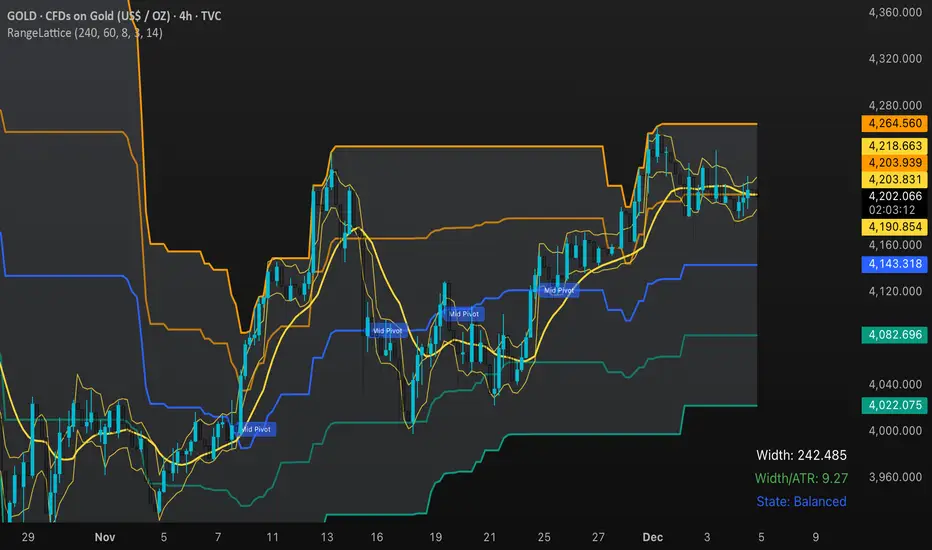
Range Lattice## RangeLattice RangeLattice constructs a higher-timeframe scaffolding on any intraday chart, locking in structural highs/lows, mid/quarter grids, VWAP confluence, and live acceptance/break analytics. It provides a non-repainting overlay that turns range management into a disciplined process. HOW IT WORKS Structure Harvesting – Using request.security() , the script samples highs/lows from a user-selected timeframe (default 240 minutes) over a configurable lookback to establish the dominant range. Grid Construction – Midpoint and quarter levels are derived mathematically, mirroring how institutional traders map distribution/accumulation zones. Acceptance Detection – Consecutive closes inside the range flip an acceptance flag and darken the cloud, signaling balanced auction conditions. Break Confirmation – Multi-bar closes outside the structure raise break labels and alerts, filtering the countless fake-outs that plague breakout traders. VWAP Fan Overlay – Session VWAP plus ATR-based bands provide a live measure of flow centering relative to the lattice. HOW TO USE IT Range Plays : Fade taps of the outer rails only when acceptance is active and VWAP sits inside the grid—this is where mean-reversion works best. Breakout Plays : Wait for confirmed break labels before entering expansion trades; the dashboard's Width/ATR metric tells you if the expansion has enough fuel. Market Prep : Carry the same lattice from pre-market into regular trading hours by keeping the structure timeframe fixed; alerts keep you notified even when managing multiple tickers. VISUAL FEATURES Range Tap and Mid Pivot markers provide a tape-reading breadcrumb trail for journaling. Cloud fill opacity tightens when acceptance persists, visually signaling balance compressions ready to break. Dashboard displays absolute width, ATR-normalized width, and current state (Balanced vs Transitional) so you can glance across charts quickly. Acceptance Flag toggle: Keep the repeated acceptance squares hidden until you need to audit balance. PARAMETERS Structure Timeframe (default: 240): Choose the timeframe whose ranges matter most (4H for indices, Daily for stocks). Structure Lookback (default: 60): Bars sampled on the structure timeframe. Acceptance Bars (default: 8): How many consecutive bars inside the range confirm balance. Break Confirmation Bars (default: 3): Bars required outside the range to validate a breakout. ATR Reference (default: 14): ATR period for width normalization. Show Midpoint Grid (default: enabled): Display the midpoint and quarter levels. Show Adaptive VWAP Fan (default: enabled): Toggle the VWAP channel for assets where volume distribution matters most. Show Acceptance Flags (default: disabled): Turn the acceptance markers on/off for maximum visual control. Show Range Dashboard (default: enabled): Disable if screen space is limited, re-enable during prep sessions. ALERTS The indicator includes five alert conditions: Range High Tap: Price interacted with the RangeLattice high Range Low Tap: Price interacted with the RangeLattice low Range Mid Tap: Price interacted with the RangeLattice mid Range Break Up: Confirmed upside breakout Range Break Down: Confirmed downside breakout Where it works best This indicator works best on liquid instruments with clear structural levels. On very low timeframes (1-minute and below), the structure may update too frequently to be useful. The acceptance/break confirmation system requires patience—faster traders may find the multi-bar confirmation too slow for scalping. The VWAP fan is session-based and resets daily, which may not suit all trading styles. Pine Script® indicatorby officialjackofalltrades17
FluxPulse Beacon## FluxPulse Beacon FluxPulse Beacon applies a microstructure lens to every bar, combining directional thrust, realized volatility, and multi-timeframe liquidity checks to decide whether the tape is being pushed by real sponsorship or just noise. The oscillator's color-coded columns and adaptive burst thresholds transform complex flow dynamics into a single actionable flux score for futures and equities traders. HOW IT WORKS Momentum Extraction – Price differentials over a configurable pulse distance are smoothed using exponential moving averages to isolate directional thrust without reacting to single prints. Volatility + Liquidity Normalization – The momentum stream is divided by realized volatility and multiplied by both local and higher-timeframe EMA volume ratios, ensuring pulses only appear when volatility and liquidity align. Adaptive Thresholding – A volatility-derived standard deviation of flux is blended with the base threshold so bursts scale automatically between low-volatility and high-volatility market conditions. Divergence Engine – Linear regression slopes compare price vs. flux to tag bullish/bearish divergences, highlighting stealth accumulation or distribution zones. HOW TO USE IT Continuation Entries : Go with the trend when histogram bars stay above the adaptive threshold, the signal line confirms, and trend bias agrees—this is where liquidity-backed follow-through lives. Fade Plays : Watch for divergence alerts and shrinking compression values; when flux prints below zero yet price grinds higher, hidden selling pressure often precedes rollovers. Session Filter : Compression percentage in the diagnostics table instantly tells you whether to trade thin overnight sessions—low compression means stand down. VISUAL FEATURES Dynamic background heat maps flux magnitude, while threshold lines provide a quick read on whether a pulse is statistically significant. Diagnostics table displays live flux, signal, adaptive threshold, and compression for quick reference. Alert-first workflow: The surface is intentionally clean—bursts and divergences are delivered via alerts instead of on-chart clutter. PARAMETERS Trend EMA Length (default: 34): Defines the macro bias anchor; increase for higher-timeframe confirmation. Pulse Distance (default: 8): Controls how sensitive momentum extraction becomes. Volatility Window (default: 21): Sample window for realized volatility normalization. Liquidity Window (default: 55): Volume smoothing window that proxies liquidity expansion. Liquidity Reference TF (default: 60): Select a higher timeframe to cross-check whether current volume matches institutional flows. Adaptive Threshold (default: enabled): Disable for fixed thresholds on slower markets; enable for high-volatility assets. Base Burst Threshold (default: 1.25): Minimum flux magnitude that qualifies as an actionable pulse. ALERTS The indicator includes four alert conditions: Bull Burst: Detects upside liquidity pulses Bear Burst: Detects downside liquidity pulses Bull Divergence: Flags bullish delta divergence Bear Divergence: Flags bearish delta divergence LIMITATIONS This indicator is designed for liquid futures and equity markets. Performance may degrade in low-volume or highly illiquid instruments. The adaptive threshold system works best on timeframes where sufficient volatility history exists (typically 15-minute charts and above). Divergence signals are probabilistic and should be confirmed with price action. INSERT_CHART_SNAPSHOT_URL_HERE --- ## RangeLattice Mapper RangeLattice Mapper constructs a higher-timeframe scaffolding on any intraday chart, locking in structural highs/lows, mid/quarter grids, VWAP confluence, and live acceptance/break analytics. It provides a non-repainting overlay that turns range management into a disciplined process. HOW IT WORKS Structure Harvesting – Using request.security() , the script samples highs/lows from a user-selected timeframe (default 240 minutes) over a configurable lookback to establish the dominant range. Grid Construction – Midpoint and quarter levels are derived mathematically, mirroring how institutional traders map distribution/accumulation zones. Acceptance Detection – Consecutive closes inside the range flip an acceptance flag and darken the cloud, signaling balanced auction conditions. Break Confirmation – Multi-bar closes outside the structure raise break labels and alerts, filtering the countless fake-outs that plague breakout traders. VWAP Fan Overlay – Session VWAP plus ATR-based bands provide a live measure of flow centering relative to the lattice. HOW TO USE IT Range Plays : Fade taps of the outer rails only when acceptance is active and VWAP sits inside the grid—this is where mean-reversion works best. Breakout Plays : Wait for confirmed break labels before entering expansion trades; the dashboard's Width/ATR metric tells you if the expansion has enough fuel. Market Prep : Carry the same lattice from pre-market into regular trading hours by keeping the structure timeframe fixed; alerts keep you notified even when managing multiple tickers. VISUAL FEATURES Range Tap and Mid Pivot markers provide a tape-reading breadcrumb trail for journaling. Cloud fill opacity tightens when acceptance persists, visually signaling balance compressions ready to break. Dashboard displays absolute width, ATR-normalized width, and current state (Balanced vs Transitional) so you can glance across charts quickly. Acceptance Flag toggle: Keep the repeated acceptance squares hidden until you need to audit balance. PARAMETERS Structure Timeframe (default: 240): Choose the timeframe whose ranges matter most (4H for indices, Daily for stocks). Structure Lookback (default: 60): Bars sampled on the structure timeframe. Acceptance Bars (default: 8): How many consecutive bars inside the range confirm balance. Break Confirmation Bars (default: 3): Bars required outside the range to validate a breakout. ATR Reference (default: 14): ATR period for width normalization. Show Midpoint Grid (default: enabled): Display the midpoint and quarter levels. Show Adaptive VWAP Fan (default: enabled): Toggle the VWAP channel for assets where volume distribution matters most. Show Acceptance Flags (default: disabled): Turn the acceptance markers on/off for maximum visual control. Show Range Dashboard (default: enabled): Disable if screen space is limited, re-enable during prep sessions. ALERTS The indicator includes five alert conditions: Range High Tap: Price interacted with the RangeLattice high Range Low Tap: Price interacted with the RangeLattice low Range Mid Tap: Price interacted with the RangeLattice mid Range Break Up: Confirmed upside breakout Range Break Down: Confirmed downside breakout LIMITATIONS This indicator works best on liquid instruments with clear structural levels. On very low timeframes (1-minute and below), the structure may update too frequently to be useful. The acceptance/break confirmation system requires patience—faster traders may find the multi-bar confirmation too slow for scalping. The VWAP fan is session-based and resets daily, which may not suit all trading styles. ---Pine Script® indicatorby officialjackofalltrades23
Bollinger Bands Delta Matrix Analytics [BDMA] Bollinger Bands Delta Matrix Analytics (BDMA) v7.0 Deep Kinetic Engine – 5x8 Volatility & Delta Decision Matrix 1. Introduction & Concept Bollinger Bands Delta Matrix Analytics (BDMA) v7.0 is an analytical framework that merges: - Spatial analysis via Bollinger Bands (%B location), - with a 4-factor Deep Kinetic Engine based on: • Total Volume • Buy Volume • Sell Volume • Delta (Buy – Sell) Z-Scores and converts them into an expanded 5×8 decision matrix that continuously tracks where price is trading and how the underlying orderflow is behaving. BDMA is not a trading system or strategy. It does not generate entry/exit signals. Instead, it provides a structured contextual map of volatility, volume, and delta so traders can: - identify climactic extensions vs. fakeouts, - distinguish strong initiative moves vs. passive absorption, - and detect squeezes, traps, and liquidity voids with a unified visual dashboard. 2. Spatial Engine – Bollinger S-States (S1–S5) The spatial dimension of BDMA comes from classic Bollinger Bands. Price location is expressed as Percent B (%B) and mapped into 5 spatial states (S-States): S1 – Hyper Extension (Above Upper Band) Price has pushed beyond the upper Bollinger Band. Often associated with parabolic or blow-off behavior, late-stage momentum, and elevated reversal risk. S2 – Resistance Test (Upper Zone) Price trades in the upper Bollinger region but remains inside the bands. Represents a sustained test of resistance, typically within an established or emerging uptrend. S3 – Neutral Zone (Middle) Price hovers around the mid-band. This is the mean reversion gravity field where the market often consolidates or transitions between regimes. S4 – Support Test (Lower Zone) Price trades in the lower Bollinger region but inside the bands. Represents a sustained test of support within range or downtrend structures. S5 – Hyper Drop (Below Lower Band) Price extends below the lower Bollinger Band. Often aligned with panic, forced liquidations, or capitulation-type behavior, with increased snap-back risk. These 5 S-States define the vertical axis (rows) of the BDMA matrix. 3. Deep Kinetic Engine – 4-Factor Z-Score & D-States (D1–D8) The Deep Kinetic Engine transforms raw volume and delta into standardized Z-Scores to measure how abnormal current activity is relative to its recent history. For each bar: - Raw Buy Volume is estimated from the candle’s position within its range - Raw Sell Volume is complementary to buy volume - Raw Delta = Buy Volume – Sell Volume - Total Volume = Buy Volume + Sell Volume These 4 series are then normalized using a unified Z-Score lookback to produce: 1. Z_Vol_Total – overall activity and liquidity intensity 2. Z_Vol_Buy – aggression from buyers (attack) 3. Z_Vol_Sell – aggression from sellers (defense or attack) 4. Z_Delta – net victory of one side over the other Thresholds for Extreme, Significant, and Neutral Z-Score levels are fully configurable, allowing you to tune the sensitivity of the kinetic states. Using Z_Vol_Total and Z_Delta (plus threshold logic), BDMA assigns one of 8 Deep Kinetic states (D-States): D1 – Climax Buy Extreme Total Volume + Extreme Positive Delta → Buying climax or blow-off behavior. D2 – Strong Buy High Volume + High Positive Delta → Confirmed bullish initiative activity. D3 – Weak Buy / Fakeout Low Volume + High Positive Delta → Bullish delta without commitment, low-liquidity breakout risk. D4 – Absorption / Conflict High Volume + Neutral Delta → Aggressive two-way trade, strong absorption, war zone behavior. D5 – Neutral Low Volume + Neutral Delta → Low-energy environment with low conviction. D6 – Weak Sell / Fakeout Low Volume + High Negative Delta → Bearish delta without commitment, low-liquidity breakdown risk. D7 – Strong Sell High Volume + High Negative Delta → Confirmed bearish initiative activity. D8 – Capitulation Extreme Volume + Extreme Negative Delta → Panic selling or capitulation regime. These 8 D-States define the horizontal axis (columns) of the BDMA matrix. 4. The 5×8 BDMA Decision Matrix The core of BDMA is a 5×8 matrix where: - Rows (1–5) = Spatial S-States (S1…S5) - Columns (1–8) = Kinetic D-States (D1…D8) Each of the 40 possible combinations (SxDy) is pre-computed and mapped to: - a Status or Regime Title (for example: Climax Breakout, Bear Trap Spring, Capitulation Breakdown), - a Bias (Climactic Bull, Neutral, Strong Bear, Conflict or Reversal Risk, and similar labels), - and a Strategic Signal or Consideration (for example: High reversal risk, Wait for confirmation, Low probability zone – avoid). Internally, BDMA resolves all 40 regimes so the current state can be displayed on the dashboard without performance overhead. 5. Key Regime Families (How to Read the Matrix) 5.1. Breakouts and Breakdowns Climax Breakout (Top-side) Spatial S1 with Kinetic D1 or D2 Bias: Explosive or Extreme Bull Signal: - Strong or climactic upside extension with abnormal bullish orderflow. - Trend continuation is possible, but reversal risk is extremely high after blow-off phases. Low-Conviction Breakout (Fakeout Risk) S1 with D3 (Weak Buy, low liquidity) Bias: Weak Bull – Caution Signal: - Breakout not supported by volume. - Elevated risk of failed auction or bull trap. Capitulation Breakdown (Bottom-side) Spatial S5 with Kinetic D8 Bias: Climactic Bear (panic) Signal: - Capitulation-type selling or forced liquidations. - Trend can still proceed, but snap-back or violent short-covering risk is high. Initiative Breakdown vs. Weak Breakdown - Strong, high-volume breakdown typically corresponds to D7 (Strong Sell). - Low-volume breakdown often corresponds to D6 (Weak Sell or Fakeout) with potential for failure. 5.2. Absorption, Traps and Springs Absorption at Resistance (Top-side conflict) S1 or S2 with D4 (Absorption or Conflict) Bias: Conflict – Extreme Tension Signal: - Heavy two-way trade near resistance. - Potential distribution or reversal if sellers begin to dominate. Bull Trap or Failed Auction Typically S1 with D6 (Weak Sell breakdown behavior after a top-side attempt) Indicates a breakout attempt that fails and reverses, often after poor liquidity structure. Absorption at Support and Bear Trap (Spring) S4 or S5 with D4 or D3 Bias: Conflict or Weak Bear – Reversal Risk Signal: - Aggressive buying into lows (spring or shakeout behavior). - Potential bear trap if price reclaims lost territory. 5.3. Trend Phases Strong Uptrend Phases Typically seen when S2–S3 combine with strong bullish kinetic behavior. Bias: Strong or Extreme Bull Signal: - Pullbacks into S3 or S4 with supportive kinetic states often act as trend continuation zones. Strong Downtrend Phases Typically seen when S3–S4 combine with strong bearish kinetic behavior. Bias: Strong or Extreme Bear Signal: - Rallies into resistance with strong bearish kinetic backing may act as continuation sell zones. 5.4. Neutral, Exhaustion and Squeeze Exhaustion or Liquidity Void S1 or S5 with D5 (Neutral kinetics) Bias: Neutral or Exhaustion Signal: - Spatial extremes without kinetic confirmation. - Often marks the end of a move, with poor follow-through. Choppy, Low-Activity Range S3 with D5 Bias: Neutral Signal: - Low volume, low conviction market. - Typically a low-probability environment where standing aside can be logical. Squeeze or High-Tension Zone S3 with D4 or tightly clustered kinetic values Bias: Conflict or High Tension Signal: - Hidden battle inside a volatility contraction. - Often precedes large directionally-biased moves. 6. Dashboard Layout & Reading Guide When Show Dashboard is enabled, BDMA displays: 1. Title and Status Line Name of the current regime (for example: Climax Breakout, Bear Trap Spring, Mean Reversion). 2. Bias Line Plain-language summary of directional context such as Climactic Bull, Strong Bear, Neutral, or Conflict and Reversal Risk. 3. Signal or Strategic Notes Concise guidance focused on risk and context, not entries. For example: - High reversal risk – aggressive traders only - Wait for confirmation (break or rejection) - Low probability zone – avoid taking new positions 4. Kinetic Profile (4-Factor Z-Score) Shows the current Z-Scores for Total Volume (Activity), Buy Volume (Attack), Sell Volume (Defense), and Delta (Net Result). 5. Matrix Heatmap (5×8) Visual representation of S-State vs. D-State with color coding: - Bullish clusters in a green spectrum - Bearish clusters in a red spectrum - Conflict or exhaustion zones in yellow, amber, or neutral tones The dashboard can be repositioned (top right, middle right, or bottom right) and its size can be adjusted (Tiny, Small, Normal, or Large) to fit different layouts. 7. Inputs & Customization 7.1. Core Parameters (Bollinger and Z-Score) - Bollinger Length and Standard Deviation define the spatial engine. - Z-Score Lookback (All Factors) defines how many bars are used to normalize volume and delta. 7.2. Deep Kinetic Thresholds - Extreme Threshold defines what is considered climactic (D1 or D8). - Significant Threshold distinguishes strong initiative vs. weak or fakeout behavior. - Neutral Threshold is the band within which delta is treated as neutral. These thresholds allow you to tune the sensitivity of the kinetic classification to fit different timeframes or instruments. 7.3. Calculation Method (Volume Delta) Geometry (Approx) - Fast, non-repainting approach based on candle geometry. - Suitable for most users and real-time decision-making. Intrabar (Precise) - Uses lower-timeframe data for more precise volume delta estimation. - Intrabar mode can repaint and requires compatible data and plan support on the platform. - Best used for post-analysis or research, not blind automation. 7.4. Visuals and Interface - Toggle Bollinger Bands visibility on or off. - Switch between Dark and Light color themes. - Configure dashboard visibility, matrix heatmap display, position, and size. 8. Multi-Language Semantic Engine (Asia and Middle East Focus) BDMA v7.0 includes a fully integrated multi-language layer, targeting a wide geographic user base. Supported Languages: English, Türkçe, Русский, 简体中文, हिन्दी, العربية, فارسی, עברית All dashboard labels, regime titles, bias descriptions, and signal texts are dynamically translated via an internal dictionary, while semantic meaning is kept consistent across languages. This makes BDMA suitable for multi-language communities, study groups, and educational content across different regions. However, due to the heavy computational load of the Deep Kinetic Engine and TradingView’s strict Pine Script execution limits, it was not possible to expand support to additional languages. Adding more translation layers would significantly increase memory usage and exceed runtime constraints. For this reason, the current language set represents the maximum optimized configuration achievable without compromising performance or stability. 9. Practical Usage Notes BDMA is most powerful when used as a contextual overlay on top of market structure (HH, HL, LH, LL), higher-timeframe trend, key levels, and your own execution framework. Recommended usage: - Identify the current regime (Status and Bias). - Check whether price location (S-State) and kinetic behavior (D-State) agree with your trade idea. - Be especially cautious in climactic and absorption or conflict zones, where volatility and risk can be elevated. Avoid treating BDMA as an automatic green equals buy, red equals sell tool. The real edge comes from understanding where you are in the volatility or kinetic spectrum, not from forcing signals out of the matrix. 10. Limitations & Important Warnings BDMA does not predict the future. It organizes current and recent data into a structured context. Volume data quality depends on the underlying symbol, exchange, and broker feed. Forex, crypto, indices, and stocks may all behave differently. Intrabar mode can repaint and is sensitive to lower-timeframe data availability and your plan type. Use it with extra caution and primarily for research. No indicator can remove the need for clear trading rules, disciplined risk management, and psychological control. 11. Disclaimer This script is provided strictly for educational and analytical purposes. It is not a trading system, signal service, financial product, or investment advice. Nothing in this indicator or its description should be interpreted as a recommendation to buy or sell any asset. Past behavior of any indicator or market pattern does not guarantee future results. Trading and investing involve significant risk, including the risk of losing more than your initial capital in leveraged products. You are solely responsible for your own decisions, risk management, and results. By using this script, you acknowledge that you understand these risks and agree that the author or authors and publisher or publishers are not liable for any loss or damage arising from its use.Pine Script® indicatorby ata_sabanci2296
Moving VWAP-KAMA CloudMoving VWAP-KAMA Cloud Overview The Moving VWAP-KAMA Cloud is a high-conviction trend filter designed to solve a major problem with standard indicators: Noise. By combining a smoothed Volume Weighted Average Price (MVWAP) with Kaufman’s Adaptive Moving Average (KAMA), this indicator creates a "Value Zone" that identifies the true structural trend while ignoring choppy price action. Unlike brittle lines that break constantly, this cloud is "slow" by design—making it exceptionally powerful for spotting genuine trend reversals and filtering out fakeouts. How It Works This script uses a unique "Double Smoothing" architecture: The Anchor (MVWAP): We take the standard VWAP and smooth it with a 30-period EMA. This represents the "Fair Value" baseline where volume has supported price over time. The Filter (KAMA): We apply Kaufman's Adaptive Moving Average to the already smoothed MVWAP. KAMA is unique because it flattens out during low-volatility (choppy) periods and speeds up during high-momentum trends. The Cloud: Green/Teal Cloud: Bullish Structure (MVWAP > KAMA) Purple Cloud: Bearish Structure (MVWAP < KAMA) 🔥 The "Reversal Slingshot" Strategy Backtests reveal a powerful behavior during major trend changes, particularly after long bear markets: The Resistance Phase: During a long-term downtrend, price will repeatedly rally into the Purple Cloud and get rejected. The flattened KAMA line acts as a "concrete ceiling," keeping the bearish trend intact. The Breakout & Flip: When price finally breaks above the cloud with conviction, and the cloud flips Green, it signals a structural regime change. The "Slingshot" Retest: Often, immediately after this flip, price will drop back into the top of the cloud. This is the "Slingshot" moment. The old resistance becomes new, hardened support. The Rally: From this support bounce, stocks often launch into a sustained, multi-month bull run. This setup has been observed repeatedly at the bottom of major corrections. How to Use This Indicator 1. Dynamic Support & Resistance The KAMA Wall: When price retraces into the cloud, the KAMA line often flattens out, acting as a hard "floor" or "wall." A break of this wall usually signals a genuine trend change, not just a stop hunt. 2. Trend Confirmation (Regime Filter) Bullish Regime: If price is holding above the cloud, only look for Long setups. Bearish Regime: If price is holding below the cloud, only look for Short setups. No-Trade Zone: If price is stuck inside the cloud, the market is traversing fair value. Stand aside until a clear winner emerges. 3. Multi-Timeframe Versatility While designed for trend confirmation on higher timeframes (4H, Daily), this indicator adapts beautifully to lower timeframes (5m, 15m) for intraday scalping. On Lower Timeframes: The cloud reacts much faster, acting as a dynamic "VWAP Band" that helps intraday traders stay on the right side of momentum during the session. Settings Moving VWAP Period (30): The lookback period for the base VWAP smoothing. KAMA Settings (10, 10, 30): Controls the sensitivity of the adaptive filter. Cloud Transparency: Adjust to keep your chart clean. Alerts Included Price Cross Over/Under MVWAP Price Cross Over/Under KAMA Cloud Flip (Bullish/Bearish Trend Change) Tip for Traders This is not a signal entry indicator. It is a Trend Conviction tool. Use it to filter your entries from faster indicators (like RSI or MACD). If your fast indicator signals "Buy" but the cloud is Purple, the probability is low. Wait for the Cloud FlipPine Script® indicatorby SovereignCharts259
Simple Line📌 Understanding the Basic Concept The trend reverses only when the price moves up or down by a fixed filter size. It ignores normal volatility and noise, recognizing a trend change only when price moves beyond a specified threshold. Trend direction is visually intuitive through line colors (green: uptrend, red: downtrend). ⚙️ Explanation of Settings Auto Brick Size: Automatically determines the brick/filter size. Fixed Brick Size: Manually set the size (e.g., 15, 30, 50, 100, etc.). Volatility Length: The lookback period used for calculations (default: 14). 📈 Example of Identifying Buy Timing When the line changes from gray or red to green, it signals the start of an uptrend. This indicates that the price has moved upward by more than the required threshold. 📉 Example of Identifying Sell Timing When the line changes from green to red, it suggests a possible downtrend reversal. At this point, consider closing long positions or evaluating short entries. 🧪 Recommended Use Cases Use as a trend filter to enhance the accuracy of existing strategies. Can be used alone as a clean directional indicator without complex oscillators. Works synergistically with trend-following strategies, breakout strategies, and more. 🔒 Notes & Cautions More suitable for medium- to long-term trend trading than for fast scalping. If the brick size is too small, the indicator may react to noise. Sensitivity varies greatly depending on the selected brick size, so backtesting is essential to determine optimal values. ❗ The Trend Simple Line focuses solely on direction—remove the noise and focus purely on the trend. 초대 전용 스크립트 이 스크립트에 대한 접근이 제한되어 있습니다. 사용자는 즐겨찾기에 추가할 수 있지만 사용하려면 사용자의 권한이 필요합니다. 연락처 정보를 포함하여 액세스 요청에 대한 명확한 지침을 제공해 주세요. 이 비공개 초대 전용 스크립트는 스크립트 모더레이터의 검토를 거치지 않았으며, 하우스 룰 준수 여부는 확인되지 않았습니다. 트레이딩뷰는 스크립트의 작동 방식을 충분히 이해하고 작성자를 완전히 신뢰하지 않는 이상, 해당 스크립트에 비용을 지불하거나 사용하는 것을 권장하지 않습니다. 커뮤니티 스크립트에서 무료 오픈소스 대안을 찾아보실 수도 있습니다. 작성자 지시 사항 . c9indicator 면책사항 해당 정보와 게시물은 금융, 투자, 트레이딩 또는 기타 유형의 조언이나 권장 사항으로 간주되지 않으며, 트레이딩뷰에서 제공하거나 보증하는 것이 아닙니Pine Script® indicatorby c9indicator29