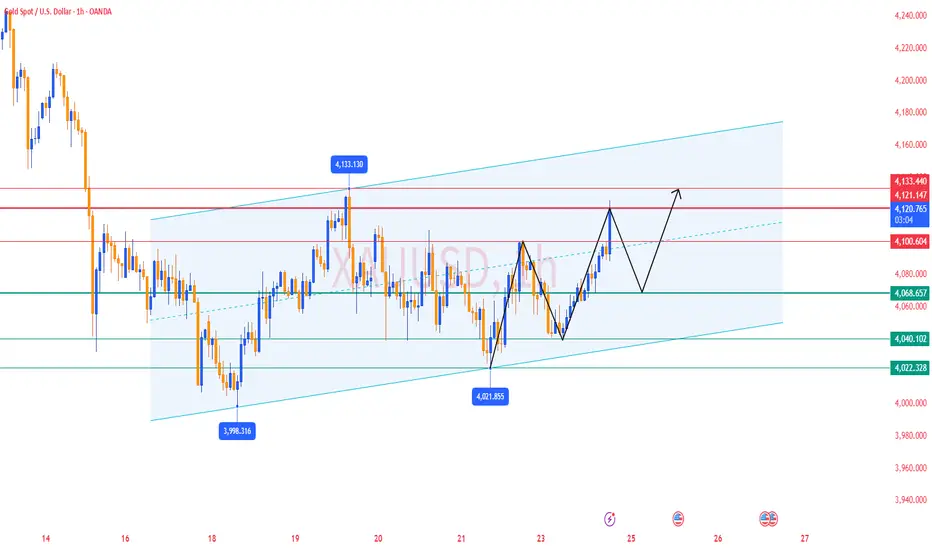
XAU/USD (gold) has achieved the TARGET. As we analyzed before gold was in a Sideways Zone consolidation and upside liquidity was pending to hunt. And also is was trending at the support as well. by ironman271
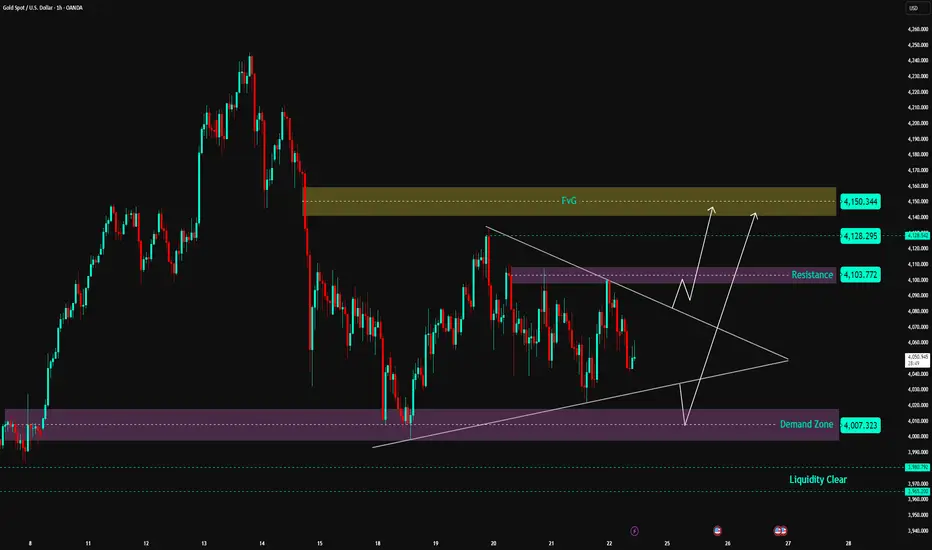
Gold Set to Explode from Triangle Pattern—Act Now!📊 Market Structure Gold is entering a tight accumulation phase within a Symmetrical Triangle pattern – indicating compression before a strong breakout. On the downside, the price is still supported by the Demand Zone 4,007 – 4,020 USD , which is the main support area for the medium-term uptrend structure. On the upside, the Resistance Zone 4,103 – 4,110 USD continuously exerts pressure, causing price rejection. Currently, gold is trading right in the middle of the compression triangle → the market is preparing to choose a direction. Looking at the wave structure, the trend slightly leans towards a break up to sweep liquidity in the high area. 💎 Key Technical Zones • ⭐ FVG Supply Zone: 4,128 – 4,150 USD → expected strong reaction area if price breaks up • 🟣 Resistance Zone: 4,103 – 4,110 USD → decisive area for direction • 🟪 Demand Zone: 4,007 – 4,020 USD → strong base maintaining structure • 🟦 Liquidity Clear: 3,980 USD → risk area if price collapses the triangle 🎯 Trading Plan – Two Possible Scenarios 1️⃣ BUY – Wait for Breakout from Triangle (priority scenario) If the price breaks the resistance zone 4,103 – 4,110 with a strong H1 closing candle: • Entry: 4,112 – 4,115 • SL: 4,095 • TP1: 4,128 • TP2: 4,145 • TP3: 4,150 (reach FVG) → This is a trend-following setup, with a high probability of sweeping liquidity above after the break. 2️⃣ BUY – Retest Demand Zone 4,007 – 4,020 If the price continues to follow the triangle pattern and falls to the trendline + demand zone: • Entry: 4,010 – 4,017 • SL: 3,990 • TP1: 4,103 • TP2: 4,128 • TP3: 4,150 → This is a very strong confluence area between Demand Zone + Trendline + pattern base. ❌ SELL? When is it valid? Currently, selling is not prioritized, as the price is still above the Demand Zone and the larger structure still favors an uptrend. Selling is only valid if the price: • Breaks strongly below 4,007 USD → At this point, the market turns bearish, with a distant target of 3,980 USD. 🧠 Vincent’s View Gold is under strong compression. When the triangle pattern is broken, the move will be extremely fast and decisive. The current trend leans towards breaking up and heading straight into the FVG area 4,128 – 4,150 USD. Just be patient and wait for the confirmation candle — don’t predict, react to the market. ⚡ “Breakout is born from pressure — patience profits.” ⏰ Timeframe: 1H 📅 Update: 24/11/2025 ✍️ Analysis by: Captain VincentLongby CaptainVincentUpdated 0
XauusdXauusd is most of idea is bullish flag pattern if it broken down the flag pattern it may short position by sragavendra270
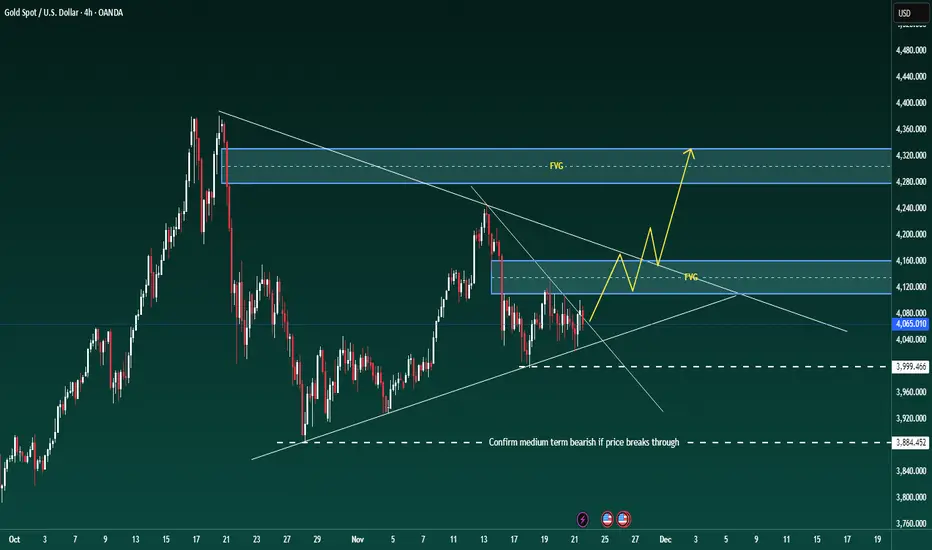
XAU Long Trade idea for 25/11/2025It can't get simpler than this, we have a H4 fvg. We'll wait for price to tag in there and wait for an smt, it could happen in London or NY, we'll wait. Once it happens we're gonna ride this baby for a 2R Victory ⚔️⚔️🗡️🛡️ Keep Winning 👊👊👊👊👊Longby Ksha3ya_99220
Gold Analysis and Trading Strategy | November 24-25✅ 4-Hour Chart Analysis (H4) 1️⃣ Market Structure: Weak rebound, strong resistance above Gold is currently trading around 4095, standing above MA5, MA10, and MA20. This shows that the short-term rebound is still valid. However, the moving averages have not formed a bullish expansion, meaning the market is still in a corrective rebound after a decline, not a strong uptrend. Price is approaching the key resistance at 4100–4103 (First Resistance). Above this level lies the Bollinger upper band near 4114, where selling pressure will increase significantly. ➡️ The upward space is limited; the rebound is entering its later stage. 2️⃣ Bollinger Bands: Above mid-band, approaching upper-band Mid-band ≈ 4070 Price has broken above the mid-band → rebound confirmed But upper-band at 4113–4115 → strong Resistance ➡️ Gold is in the later phase of the rebound, chasing long positions here has higher risk. 3️⃣ Key Levels 🔴Resistance: 4103 / 4113–4120 🟢Support: 4068 / 4050 As long as price stays above 4068–4070, the rebound structure remains intact. ✅ 1-Hour Chart Analysis (H1) 1️⃣ Price rejected at 4101 resistance, momentum weakening From the 1H chart: Price touched 4101–4103 and immediately pulled back Bollinger upper band near 4105 Bullish momentum is slowing down This is a typical structure: ➡️ Short-term rebound → hit resistance → pullback 2️⃣ Moving averages remain bullish, but market entering high-level consolidation MA5 and MA10 are still rising, but strong rejection at resistance indicates high-level consolidation, not strong continuation. If price drops below MA10 (≈4085), short-term pullback may begin. 3️⃣ Key Levels 🔴Resistance: 4101–4105 / 4110-4115 🟢Support: 4080–4085 (minor support) / 4063 (pivot support) ✅ Trading Strategy 🔰 Primary Plan: Sell on Rebounds 📍 4110-4115 resistance zone If price retests this zone but fails to break through, consider short entries. Targets: 4085 / 4070 Stop loss: Above 4120 🔰 Secondary Plan: Buy on Pullbacks 📍 4068–4072 support zone If price pulls back and stabilizes, small-lot long positions can be considered. Targets: 4095 / 4100 Stop loss: Below 4058 🔹Gold is currently near strong resistance around 4100, short-term bullish momentum is weakening, and the market favors selling the rebound rather than chasing longs. 🔹After rebounding from 4050 to the 4100 region, gold has reached a heavy resistance zone (previous highs + Bollinger upper band). The probability of continued upward movement decreases. 🔥Trading Reminder: Trading strategies are time-sensitive, and market conditions can change rapidly. Please adjust your trading plan based on real-time market conditions. by GoldTradingPro1
XAUUSD – Reading the Market’s Secret IntentionsH1 Outlook – 24 November 2025 🌐 MARKET CONTEXT Gold enters the new week with a controlled, slow-paced volatility environment, as the market continues to balance between inflation expectations, shifting USD flows, and cautious positioning ahead of major U.S. data. Recently, price has shown repeated rejection from premium zones, forming a mild bearish intraday bias across the H1 structure. The market is still operating inside a liquidity-rich environment where institutions are engineering both upside and downside sweeps before choosing a clear direction. Recent Drivers USD holds moderate strength after last week’s hawkish Fed commentary Market remains in “wait-and-watch” mode ahead of mid-week data No strong risk-off sentiment → gold lacks solid fundamental support Session Expectations London: Early liquidity sweeps above premium levels expected New York: Higher probability of real trend expansion Bias: Mild bearish unless deep discount zones trigger CHoCH on H1 Price is currently mid-range → only extreme liquidity areas provide safe, high-probability setups. 📉 TECHNICAL ANALYSIS (SMC + LIQUIDITY) Market Structure H1 structure forming: Lower Highs → Lower Lows Equilibrium zone: 4070–4090 Strong inducement layers above 4146 and 4071 Liquidity Map Buy-side Liquidity (BSL): Above 4146, 4071 Sell-side Liquidity (SSL): Below 4030 and 3994 Market forming engineered wicks at both ends → ideal for SMC traders Imbalance Zones Bearish FVG: 4146–4148 → prime area for premium sells Minor Imbalance: 4068–4071 → intraday scalp reversal potential Discount Imbalances: 4032 and 3996 → clean reaction zones for buys 🔑 KEY PRICE ZONES (Clear explanations linked directly to your entries) 4148–4146 ▶️ Premium Sell Zone – High Manipulation Area Unmitigated supply zone + major BSL buildup. Smart money usually induces breakout buyers here before reversing sharply. 4068–4071 ▶️ Secondary Premium Pool – Scalp Rejection A mini-liquidity pocket above equilibrium. Perfect for quick stop-hunt sweeps during London session. 4032–4030 ▶️ Discount Reaction Zone – Strong Scalping Demand A small OB + SSL cluster. Expect fast, technical bounces with low drawdown. 3996–3994 ▶️ Deep Discount Zone – High-Value Reversal Highly reactive zone where institutions accumulate long positions. A strong candidate for structural shifts if tapped. ⚙️ TRADE SETUPS (SMC-Driven Execution) ✔️ SELL SETUP 1 – Premium Rejection Entry: 4148–4146 Stoploss: 4154 TP1: 4135 TP2: 4120 TP3: 4090 Logic: Sweep of BSL + FVG fill → high confidence bearish rejection. ✔️ SELL SETUP 2 – Intraday Scalp Sell Entry: 4068–4071 Stoploss: 4077 TP1: 4055 TP2: 4043 TP3: 4032 Logic: Engineered liquidity sweep above mid-range → fast downside move. ✔️ BUY SETUP 1 – Scalping Rebound Entry: 4032–4030 Stoploss: 4024 TP1: 4048 TP2: 4068 Logic: SSL sweep → immediate bounce expected from discount zone. ✔️ BUY SETUP 2 – Deep Discount Buy Entry: 3996–3994 Stoploss: 3988 TP1: 4010 TP2: 4035 TP3: 4068 Logic: A strong institutional accumulation area → ideal for reversal setups. 🧠 SESSION PLAN & NOTES Do not trade inside the mid-range Stick strictly to liquidity extremes for precision entries Expect London fake-outs → wait for confirmation NY session more likely to deliver the real move Use M5/M15 CHoCH + displacement for entry confirmation 🏁 CONCLUSION XAUUSD is currently holding a mild bearish structure on H1, with premium zones at 4146 and 4071 offering the best sell opportunities. Discount areas at 4030 and 3994 remain the highest-probability zones for intraday reversals or continuation buys. Trade with patience. Let the liquidity traps form—then strike with precision.Shortby Alicee_TraderUpdated 1
Short on gold Hoping for a down side movement in gold It's to consolidate hear and may be a quick 100 pips downside is possible Shortby mohit248760
GOLD (XAUUSD): FINAL SQUEEZE! TRADE ZONES READY!Timeframe: 1H | Gold is tightly consolidated between 4,040 - 4,085 (Symmetrical Triangle). 1. ⚙️ TECHNICAL ANALYSIS (TA) & ACTIONABLE ZONES The market is coiled like a spring. We have identified specific zones for high-probability setups. 🔥 BUY ZONE (Reversal Play): Entry: 4,044 - 4,046 Stop Loss (SL): 4,038 Strategy: This is our Strong Support confluence area. A golden opportunity for a bounce play. ⚠️ SELL Scalp (Intra-range): Entry: 4,071 - 4,073 Stop Loss (SL): 4,077 Strategy: Near-term resistance. Quick profit booking expected here. 🚨 SELL ZONE (Strong Resistance): Entry: 4,097 - 4,099 Stop Loss (SL): 4,107 Strategy: A major supply zone. Excellent spot to short if the initial Long move fizzles out. ⚡ MEGA BREAKOUT SCENARIO LONG Breakout: Above 4,085 to TP: 4,110 to 4,130. SHORT Breakout: Below 4,040 to TP: 4,020 to 4,000. 2. 📰 FUNDAMENTAL ANALYSIS (FA) The market is waiting for Major US Data (Jobs report, PCE Inflation) and Fed sentiment. This data will be the ultimate catalyst for the breakout Weak Data: Supports Gold (Long) due to a weaker USD. Strong Data: Pressurizes Gold (Short) due to a stronger USD. 💡 THE GOLDEN STRATEGY Patience is key! Do not jump the gun inside the triangle. Set strict SLs for all trades. Act only on a confirmed technical breakout backed by the Fundamental news flow. #Gold #XAUUSD #ForexIndia #IndianTraders #TechnicalAnalysis #Intraday #BreakoutTrade #GoldAnalysis #TradingSetupLongby Jeremy_NPC0
XAUUSD – Potential Distribution Phase Signaling Deeper Bearish TAnalysis of the Chart Your chart shows a full market cycle structure based on Wyckoff + Smart Money Concepts (SMC). Here’s a clean breakdown: 1️⃣ Previous Accumulation Phase (Left Side) Multiple BOS (Break of Structure) labels confirming bullish intent. CHoCH followed by accumulation zones. Price gradually builds liquidity (SSL / price points). Strong bullish impulsive leg begins after accumulation. 2️⃣ Strong Bullish Trend Continuation Successive BOS levels show continuation of bullish strength. Several mitigation blocks / filled imbalances visible. Price aggressively pushes toward the premium ceiling zone. 3️⃣ Entry Into Distribution Phase (Top Right) Market reaches Premium Ceiling Zone. Signs of exhaustion appear: Lower high formations Reversal zone highlighted Shift in character from expansion → distribution 4️⃣ Bearish Reversal Structure Forming The chart shows: A potential descending structure Expectation of liquidity sweeps followed by deeper decline First bearish target (Target One) around 3,902 Second bearish target (Target Two) around 3,700 These levels align with prior imbalances and discount pricing. 5️⃣ Market Psychology According to the Chart Bulls losing momentum after premium pricing reached Smart money distributing positions Expecting a retracement toward major discount areas Possible sweep of liquidity before continuation downwardShortby DrForexPhd0
Gold Analysis for upside movement. Gold trading in a sideways zone. buyer's liquidity has already been grabbed. targeting for sell side pending liquidity. Longby ironman272
MARKET CONTEXT – XAUUSD (1H)Gold is currently trading right below the intersection of the short-term descending trendline and the long-term ascending trendline, creating a compression zone. This is the type of structure that often leads to a strong breakout. 1. Volume Profile Structure VAH zone (Value Area High) around 4080–4085, indicating a strong previous selling area where buying pressure weakens and profit-taking increases. POC zone (4067–4072): The most traded area—where buyers and sellers are balanced. Price keeps getting rejected here, showing the market is not yet ready for a strong bullish push. VAL zone (4051–4055): Price is moving right at VAL, showing the market is testing the lower boundary of value. 2. Market Structure Price remains within a short-term downtrend channel and has not broken the descending trendline yet. However, the recent lows continue to be defended around 4050–4047, showing buyers are still protecting this level. If price breaks above the descending trendline and closes above the POC, the market may retrace toward: 4058 4067 4080 3. Key Levels Major Support: 4047–4044 (previous low + lower VAL boundary) Big Demand Zone: 4035–4028 → if tapped, it may generate a strong rebound. Strong Resistance: 4065–4072 (POC), then 4080–4085 (VAH) 4. Current Signals Price is sitting at the edge of VAL → a common area for small reversals. No clear reversal structure yet, but buying pressure is still holding the lows firmly.by Mark_Melanie_Gold_Stragegy1
Gold Trading Strategy for 500 Pips!Hey traders, As we roll into a brand-new week, gold is showing some impressive stability. XAUUSD is hanging right around the 4,050-dollar mark, and despite the quiet price action, there’s a lot happening beneath the surface that’s worth paying attention to. The market right now is in “wait-and-see” mode as everyone watches the Federal Reserve’s next moves. Over the past few days, expectations have started to shift—more traders believe the Fed may slowly pivot toward a softer stance and potentially move closer to cutting rates by the end of the year. Because of that, bond yields have been drifting lower, the dollar is losing some of its strength, and demand for safe-haven assets like gold is starting to rise again. All of these elements together create a strong backdrop for potential upside in the short term. On the technical side, XAUUSD is tightening inside a clean triangle structure, and for those who follow price action closely, you know what that usually means: the market is building pressure. When price consolidates this way, it often sets the stage for a strong breakout. If buyers can push through the upper boundary of this triangle, the next logical target sits up near the 4,500-dollar zone — right in line with the momentum we saw during the last bullish move. How about you? What’s your take on this setup? Are you leaning toward another leg up, or do you think the market is prepping for a pullback first? Wishing you a great week of trading—focused, confident, and full of solid opportunities.Longby Luiss_MiguelUpdated 1
Gold Fluctuates in Support Range; Accumulation Signals Rise⏰ Timeframe: 30m 📅 Update: 24/11/2025 🔍 Market Context After a corrective decline from the 4,104 USD area, gold is moving within a range-bound structure with strong support at the 4,003–4,023 USD area. The market is in a short-term re-accumulation phase, as consecutive CHoCH movements appear around the bottom area — reflecting the buying side's effort to absorb liquidity. The selling side temporarily controls, but balancing signals are becoming clearer as the price continuously rejects breaking deeply below the Demand Zone. 📊 Technical Structure Resistance Zone (4,090–4,104 USD): main supply area, confluence with Fibo 1.0, where profit-taking reactions are likely if the price rebounds. Support Zone (4,023 USD): intermediate support, playing a key role in the current sideways structure. Demand Zone (4,003 USD): potential demand area, confluence with previous liquidity bottom – main BUY Zone area. Structure Bias: still inclined towards accumulation – recovery, as long as the price maintains above 4,003 USD. 🎯 Market Outlook 1️⃣ Priority Scenario (Buy setup): • The price may continue to retest the Demand Zone (4,003–4,023 USD). • When a clear reaction signal appears, expect a recovery to the Fibo 0.618 → 1.0 area, corresponding to 4,075–4,104 USD. 2️⃣ Secondary Scenario (Breakdown): • If the price breaks below 4,003 USD, the recovery structure will be invalidated, bringing gold back to the lower liquidity area around 3,985 USD. 💎 Key Zones BUY Zone: 4,003 – 4,023 USD SELL Zone: 4,090 – 4,104 USD 🧠 Analyst’s View Gold is currently in a liquidity re-accumulation phase, as both sides are testing the lower boundary of the main support area. The buying side needs confirmation with a break above 4,075 USD, while the selling side still holds the advantage if the price cannot maintain above the balance area. In the current context, price behavior leans towards the “Sweep – Retest – Expansion” model, with the potential for forming a short-term technical recovery wave. 🛡️ Risk Note The market is in a low volatility area – avoid emotional actions without clear structural confirmation.Longby Goldscale-Capital0
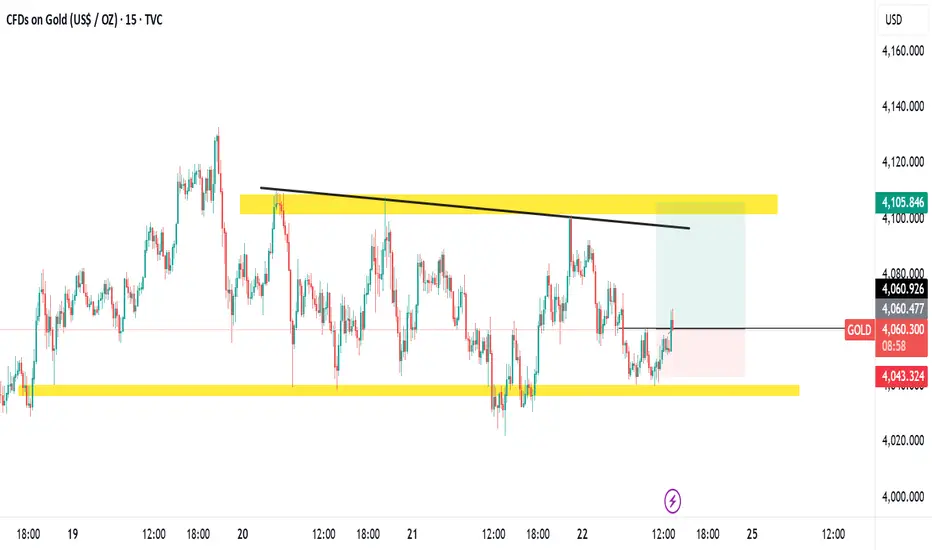
Gold breakout loading🔹 Price respecting a clean falling wedge on 15M ⏳ 🔹 Strong support zone holding firmly 🛡️ 🔹 Buyers showing early signs of reversal momentum 📊 🔹 A breakout above the wedge trendline may trigger a sharp upside rally 🚀 🔹 Targets aligning toward the 4100+ zone 🎯 🔹 Watching for a pullback + bounce entry for safer confirmation ✔️ 💛 Gold gearing up for a potential bullish reversal! #Gold #XAUUSD #PriceAction #Breakout #TradingSetup #ChartAnalysis 📈🔥Longby Arunsam101
Elliott Wave Analysis XAUUSD – November W4, 2025 1. Momentum W1 – Weekly timeframe Weekly momentum is showing early signs of a reversal. If next week forms a confirmed bullish weekly candle, the market may enter 4–5 consecutive bullish weeks, pushing weekly momentum into the overbought zone. D1 – Daily timeframe Daily momentum continues to rise, suggesting the market may experience 1–2 more days of upward movement before reaching the overbought region. H4 – 4-hour timeframe H4 momentum remains bullish, indicating that Monday is likely to show a continuation of upward movement or sideways consolidation. ________________________________________ 2. Elliott Wave Structure Weekly Structure (W1) The last three weekly candles are bullish, but not strongly decisive: • Two candles have short bodies • One is a bullish candle with an upper wick This behavior suggests the market is completing wave X (purple). Therefore, the main expectation is a continued decline to complete wave Y (purple) toward the lower target zones. Once wave Y finishes and weekly momentum confirms reversal, a new major bullish trend is likely to begin. ________________________________________ Daily Structure (D1) • Wave X (purple) is likely complete. • Price is now progressing within wave Y (purple). Inside wave Y: • Wave 1 (red) appears to have finished. • Price is currently in wave 2 (red) or has already started the early phase of wave 3 (red). 🔸 Key confirmation level: A break below 4001 would confirm that the market has entered wave 3 (red), leading to a sharp and decisive decline. 🔸 Alternative scenario: Because D1 momentum is still rising, wave 2 (red) may be forming a WXY corrective pattern (green zigzag), meaning the market may still produce a final upward swing before the next strong decline. ________________________________________ 3. H4 Wave Structure At the moment, there are two scenarios in line with the D1 structure: • The market may already be in the early phase of wave 3 (red). • Or price is completing the final leg of the WXY correction of wave 2 (red) (indicated by the green zigzag). The zone around 4081 currently acts as the balance area, also the region with the highest traded volume (green POC line). • If price stays below 4081 during Monday, the probability favors wave 3 (red), meaning strong support zones 4020 and 3958 are likely to break. • If price stays above 4081, upside targets at 4145 and 4184 become ideal levels for completing wave 2 (red). ________________________________________ 4. Trading Plan 📌 Preferred Limit Sell Zones: • 4145 • 4184 📌 Direct Sell Zone: • 4020 → only valid if a strong H4 candle closes below 4020, followed by a retest. A more detailed trading plan will be updated on Monday, once fresh market data becomes available.Shortby WavePoint_FXUpdated 0
Gold plan B clean breakdown below the minor consolidation area signals a TVC:GOLD continuation toward the liquidity pocket near 4000–3985, which aligns with the next demand block.Shortby Wall_Street_Jr0
Gold buy setupThe structure indicates that sellers are losing momentum while buyers are building pressure from the demand zone. entered @4063 placing SL below the deepest liquidity grab Trailing till 4092 TVC:GOLD Longby Wall_Street_Jr0
Gold Nonfarm: Buy OB 4030, Target Break 4111🔍 Market Context – November 20, 2025 Gold initially dropped nearly 70 pips at the start of the day but quickly rebounded sharply from the 4030–4032 zone, demonstrating strong buying pressure and a refusal to decline further. The market structure on the H1–H2 timeframe is forming a classic, well-defined Inverse Head & Shoulders pattern—a quintessential bullish reversal pattern—signaling a potential upward expansion if the neckline is successfully broken. 📅 Key News Events Today: 🇺🇸 Non-Farm Payrolls (NFP) 📉 US Unemployment Rate 🏛 FOMC Meeting Minutes 🗣 Speeches by Trump, Barkin, Williams 🧾 Initial Jobless Claims ⚠️ These events could trigger sharp volatility and will determine the confirmation or rejection of the reversal pattern. 📊 Technical Analysis 🛒 BUY SETUP – Primary Priority ✅ Entry: 4030 – 4032 🛡 Stop Loss (SL): 4027 🎯 Take Profit (TP): TP1: 4039 TP2: 4047 TP3: 4059 💡 Rationale: Price bounced strongly at the OB + SSS zone. This is a crucial technical support area and the base of the Inverse H&S pattern. The objective is to break the neckline to trigger the uptrend. 🔻 SELL SETUP – Short-Term Strategy 📍 Entry: 4093 – 4095 🛡 SL: 4098 🎯 TP: TP1: 4088 TP2: 4077 TP3: 4060 TP4: 4033 💡 Rationale: This strategy is only applicable if the price forms a false breakout of the BSL zone and reverses. This is an ideal entry point for quick scalping if the market reacts negatively to the news. 🔑 Key Price Zones Buy Zone (OB + SSS): 4030 – 4032 → Strong demand zone, the base of the Inverse Head & Shoulders pattern, confirming the reversal signal if held. Breakout Neckline Zone: 4101 – 4111 → The neckline of the Inverse H&S pattern. Breaking this zone will open up opportunities for a sharp rise. Final Resistance Zone: 4133 – 4140 → The final target if the breakout is successful and the bullish pattern is confirmed. ✅ Strategy Conclusion 🎯 Main Strategy: Priority is to BUY in the OB zone 4030–4032. 🩸 SELL is only for short-term scalping if there is a signal of rejection at the BSL zone. 🕓 Caution: Be careful entering trades near the Nonfarm news release time—wait for price action to confirm the direction.Longby Linda_OneShotTraderUpdated 2
BULLISH MOVE on gold for the next trading season. who's ready ?BULLISH MOVE on gold for the next trading season. who's ready ? I'M TRYING TO CAPTURE 1:6 risk to reward. Let's see what's gonna happen./ GIVE ME YOUR IDEA AS WELL. Longby gurdassingh131
XAUUSD – ACCUMULATION TRIANGLE ON D1💛 XAUUSD – ACCUMULATION TRIANGLE ON D1, AWAITING A NEW BREAKOUT THIS WEEK 🎯 🌤 Overview of the New Week Hello everyone, Lana here 💬 Gold, after a very strong rise from the 3,500 region to above 4,400, is entering a "resting" phase on the D1 frame: the price continuously tests the upward trendline but has not yet broken it to confirm a downtrend. The market is clearly waiting for a real breakout before forming a new medium-term wave. Next week, we have CPI and PPI – important inflation data that could act as a catalyst to push gold out of the current accumulation zone. 💹 Technical Analysis (Daily Triangle) On the D1 frame, when connecting the descending peaks and ascending bottoms, gold is in a narrowing triangle pattern. The upward trendline below is still maintained, indicating that the medium-term trend has not reversed. Below are important zones: ≈ 3,890: if the price closes below this area, it could confirm medium-term weakening. Fibonacci & psychological resistance zone 3,800–3,900: strong support, confluence with old price structure. POC Volume Profile around 3,650: if a deep decline scenario occurs, this will be the next price attraction zone. Above, the old peak zone around 4,300–4,400 remains a large liquidity zone, a natural target if gold breaks the upper edge of the triangle. In summary: the more compressed the triangle, the stronger the breakout – the direction will depend heavily on CPI/PPI data & Fed expectations. 🎯 Reference Trading Plan (Medium-Term) 💖 Scenario 1 – Maintain Uptrend (priority when the trendline is not broken) Observe the reaction at the D1 upward trendline (area around 4,000). If the price continuously bounces from the trendline and stays above the 3,890 area, you can: Prioritize buying according to the trend at support retests on H4–H1. Medium-term targets: 4,150 → 4,250 → 4,300–4,400 if the triangle breaks upwards. 💢 Scenario 2 – Triangle Breaks, Shifts to Medium-Term Decline If D1 closes below 3,890: Consider this a signal confirming medium-term weakening. Prioritize selling at newly formed resistance zones. Step-by-step targets: 3,800 → 3,700 (POC) → 3,500 (strong previous support). In both scenarios, specific entry points should be refined on smaller frames (H4, H1) based on price action/OB/FVG. ⚠️ Note News & Risk Management Next week's CPI & PPI could be the "final blow," pushing gold out of the triangle – volatility can be wide and fast, spreads may widen. Last week's NFP news hardly created big waves for gold after the US government shutdown, indicating the market is holding strength waiting for more important data. 🌷 Conclusion & Interaction with LanaM2 Gold on D1 is in the final stage of the accumulation triangle – this is a time where patient observation is as important as a beautiful entry point 💛 Next week, I will continue to update daily details on smaller frames so everyone can have more specific entry points.Longby Lana_M20
Public Sector Banks in the Trading Market1. What Are Public Sector Banks? Public Sector Banks are commercial banks where the Government of India holds majority ownership, usually above 51%. These banks operate under government oversight and play a vital role in: Mobilizing public savings Lending to priority sectors Executing government welfare schemes Providing financial inclusion Supporting economic stability Some major PSBs include: State Bank of India (SBI) – India’s largest bank Bank of Baroda (BoB) Punjab National Bank (PNB) Canara Bank Union Bank of India Indian Bank Bank of India (BoI) UCO Bank, Bank of Maharashtra, Central Bank of India, etc. These banks collectively hold nearly two-thirds of India’s banking assets, giving them huge influence in stock market behaviour. 2. Importance of PSBs in the Trading Market a) High Liquidity and Trading Volumes PSB stocks like SBI, BoB, and PNB consistently appear in the NSE’s most-traded list, making them attractive for: Intraday traders Swing traders Options traders Institutional investors Liquidity ensures narrower spreads, faster order execution, and stable price discovery. b) Macro Indicators PSBs reflect the health of: Credit growth in the economy Corporate borrowing trends Housing and retail loan demand Government capital expenditure Stress in sectors like MSME or agriculture Thus, traders use PSB performance to gauge broader market trends. c) Interest Rate Impact Bank profitability is heavily dependent on the interest rate cycle. Rising rates → higher net interest margin (NIM) → PSBs rally Falling rates → lower margins → PSBs correct Therefore, PSB stocks move quickly after: RBI monetary policy Inflation data Government bond yield changes This makes them ideal for event-based trading. 3. How Public Sector Bank Stocks Behave PSB stocks often show cyclical behaviour related to the broader economy. a) Credit Demand Cycle When corporate and retail loan demand is strong: Bank lending grows NIMs improve Profitability increases Stocks rally During slowdowns, lending slows and PSBs weaken. b) NPA (Non-Performing Assets) Influence A major factor that affects PSB valuations is bad loans. High NPAs = weak valuations Lower NPAs = strong re-rating and investor confidence Whenever PSBs report declining NPAs, stocks usually see multi-month rallies. c) Government Recapitalization PSBs sometimes require government capital infusion to strengthen balance sheets. Announcements of recapitalization often cause: Short-term volatility Long-term stability Such events attract traders seeking momentum. 4. Key Factors Traders Track in PSBs 1. RBI Monetary Policy Interest rate hikes usually have a positive impact on PSBs initially but may impact loan growth later. The reverse is true for rate cuts. 2. Credit Growth Data Higher loan growth = bullish sentiment. 3. NPA Trends Quarterly results showing reduced NPAs cause strong buying. 4. Provisioning Coverage Ratio Higher provisioning means lower future risk. 5. Government Policies Schemes like: Jan Dhan Yojana Mudra loans PM Kisan Affordable housing subsidies impact PSB balance sheets as these banks execute most government programs. 6. Bond Yield Movements Bond yields impact treasury income. PSBs hold large government bond portfolios, so: Falling yields → appreciate bond prices → higher profits Rising yields → mark-to-market losses This directly affects stock movements. 7. Global Market Sentiment PSBs often move in line with: US interest rate trends Crude oil prices Global risk appetite Because they reflect India’s financial stability. 5. Why Traders Prefer PSB Stocks ✔ Volatility and Momentum PSBs offer clear trending phases and sharp breakouts during periods of: Economic expansion NPA reduction Privatization rumours Monetary policy shifts Their volatility works well for both intraday and swing trading. ✔ High Options Activity PSBs like SBI and PNB have: Liquid options Tight premiums Wide strike selections This helps option sellers and buyers trade with confidence. ✔ Low Valuation Base PSBs often trade at low price-to-book (P/B) ratios compared to private banks. So when re-rating happens, rallies are stronger and sustained. ✔ Strong Institutional Participation FIIs and DIIs frequently invest in PSBs during bullish economic cycles. Their buying creates long uptrends. 6. Risks in Trading Public Sector Banks PSBs carry unique risks that traders must consider. 1. High Exposure to Government Schemes While beneficial for society, these schemes sometimes: Reduce profitability Increase operational costs Lead to higher NPAs in certain sectors 2. Slow Decision-Making Compared to private banks, PSBs may be slower to adapt to: Digital banking Fintech competition Modern risk assessment systems This can limit valuation expansion. 3. Vulnerability to Economic Stress PSBs are more exposed to: MSME distress Agriculture stress Infrastructure lending defaults These risks cause periodic corrections. 7. Trading Strategies for Public Sector Banks 1. Event-Based Trading Best events for trading PSBs: RBI monetary policy Union Budget Quarterly results NPA announcements Government recapitalization news Privatization rumours Traders often take positions before or after these events. 2. Trend Following Strategies PSBs tend to show long, clean trends. Traders use: 20/50/200 EMA crossovers RSI breakout levels Price-volume surge patterns Trendline breakouts Trending phases provide multi-week or multi-month opportunities. 3. Options Strategies Popular strategies: Bull call spread (during NPA improvement cycles) Short straddle/strangle (during consolidation phases) Protective put (around volatile policy announcements) 4. Pair Trading Traders sometimes pair: SBI vs Bank of Baroda PNB vs Union Bank Canara Bank vs Indian Bank Based on relative strength comparisons. 8. Long-Term View of PSB Stocks Historically, PSBs have delivered inconsistent long-term returns, but cycles of reform — such as: Bank mergers Digital transformation NPA resolution Government capital infusion Interest rate cycles have created powerful rally phases. Investors who entered during undervalued periods often gained significantly over the long term. Conclusion Public Sector Banks are foundational pillars of India’s financial ecosystem. For traders, they offer a rare combination of: High liquidity Strong correlation with macroeconomic trends Event-driven volatility Clear trend opportunities Attractive options trading potential However, trading PSBs also requires careful monitoring of: NPAs RBI policies Government decisions Bond yields Sector-wise economic health Understanding these factors helps traders navigate PSB stocks effectively in both short-term and long-term market environments.Educationby TechnicalExpress1
Gold is compressed; next week’s US data will pick a side.Gold is being compressed, the upcoming US data week will determine which side is squeezed. Good evening everyone, Brian here with a view on XAUUSD on the H2 and H4 frames for the upcoming week. Fundamental Analysis – a "tailor-made" week for the USD Next week is packed with US data, meaning gold will react more to numbers than narratives: Core PPI, PPI, and Retail Sales Initial Unemployment Claims Prelim GDP q/q Core PCE Price Index m/m – the Fed's preferred inflation measure If inflation and growth come out weak, the market will lean more towards the slow growth / easing policy narrative. This usually puts pressure on the USD and supports gold, especially when real yields gradually decrease. Conversely, stronger-than-expected data will strengthen the USD, increase yields, and create short-term downward pressure on gold. In such a context, price and liquidity areas around news release times will be more important than usual – typically, fading emotional spikes back to structural areas is safer than chasing the initial move. Technical Analysis – triangle, FVG, and key support areas On the H4 frame, gold is still trading within a broad triangle structure. The previous decline has stalled, with prices continuously reacting at the upward support line and around 4,000, but there has yet to be a clear breakout from the pattern. When zooming into H1–H2: The price has broken a short-term downtrend line and closed strongly above – this is an early signal that selling pressure in this move is weakening. The nearest support is around 4050–4040, deeper is the 4000–3998 support band (marked on the chart as important support). As long as it holds above 4,000, the structure remains positive. Above, we have a very important confluence area around 4135–4160 including: Fibo 0.382 of the most recent main decline An old fair value gap (FVG) and resistance block Chart note: "Gold will go strong if it passes this price range" – aligns with my view: if the price accepts above this area, the potential for a stronger upward move will open up. Around 4100 is an area prone to "large liquidity response" – expect strong profit-taking and position restructuring if the price returns to this area. Currently, I consider the market to be accumulating above 4,000 in a corrective pattern, with a slight upward bias as long as 4,000 is maintained. Key Price Areas Resistance: 4100 – first liquidity area 4135–4160 – Fibo 0.382 + FVG + strong resistance Support: 4050–4040 – nearest intraday support 4000–3998 – large frame support; if broken, the picture changes 3940 area – stronger support if 4k is breached Trading Scenarios for Next Week (All are for reference only, not investment advice.) Scenario 1 – Buy when price corrects above 4,000 (foundation for the next upward wave) Idea: follow the forming upward bias as the price respects the triangle support and the 4,000 mark. Entry area: 4050–4040 or any clean retest of the broken downtrend line on smaller frames Cautious position addition area: 4025–4005 if there is a deep sweep to 4,000 with a strong bounce reaction Stop loss: below 3990–3988 depending on risk appetite Targets: First: 4100 (liquidity area) Second: 4135–4140 (lower edge of FVG/resistance) Extended: 4155–4160 if a strong continuation move appears Signals to wait for: wick rejections from support, bullish engulfing candles, or clear intraday structural phase shifts to higher highs and lows. Scenario 2 – Break & Retest Long above 4135–4140 If the price doesn't give a deep correction and runs straight up: Condition: H2/H4 candle closes clearly above 4135–4140 and holds on retest Entry: when price pulls back in a controlled manner to the 4135–4140 area, turning this area from resistance to support SL: below 4120 TP: 4180 → 4200+ depending on momentum strength This is the "gold goes strong" scenario as noted on the chart – viewing the FVG/0.382 area as a launchpad for a larger impulsive upward wave. Scenario 3 – Bearish scenario if 4,000 is broken If fundamentals and flows turn against gold, decisively pushing the price below 4,000, the bullish view needs to be set aside. Condition: daily candle closes clearly below 4000–3998 Plan: wait for the price to retrace up to retest 4000–4020 from below Entry: short when rejection signals appear at that retest area TP: 3960 → 3940, then reassess the structure When below 4,000, the triangle will break down, and the market is likely to hunt deeper liquidity areas before potentially forming a new medium-term upward wave. In summary: as long as 4,000 holds, I prioritize the buy scenario on corrections, respecting the upward potential to 4135–4160 and beyond. If there is a decisive break below 4,000, the picture will reverse – then retracements up will be opportunities to look for shorts. Trade according to what the structure shows, not what I hope for. Manage risk tightly around next week's data points and let the major price areas "do the heavy lifting." If this perspective helps you plan better, don't forget to follow Brian for weekly gold analysis and share your scenarios in the comments to compare.Longby BrianLionCapital0
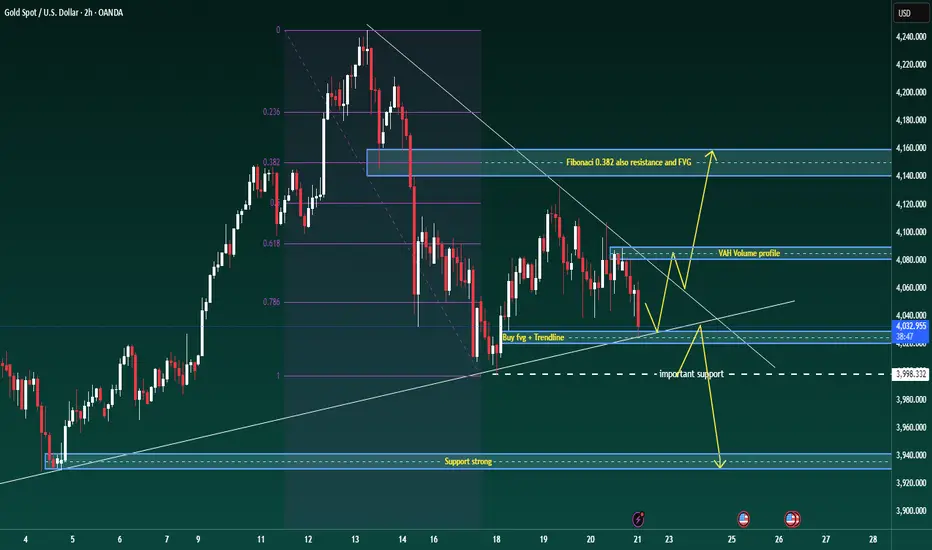
Gold is stuck in a wide range, ready for a decisive break.Good evening traders, Brian here with a fresh look at gold on the 2-hour chart. Price is compressing in a broad sideways range, building energy for the next leg – the break from this structure will set the tone for the coming sessions. Fundamental analysis The core driver remains the Fed’s December decision. The market is effectively split on whether we see a cut or a delay: A camp of institutions argues that rising unemployment and softer data could still justify a 25-basis-point cut in December, keeping pressure on the dollar and supporting gold on dips. Others point out that the Fed is short of clean, up-to-date data and may prefer to wait until next year before committing to an easing cycle. As a result, pricing for a December cut is roughly “fifty–fifty” and highly sensitive to the next run of labour-market and activity data. In short: the macro backdrop is undecided, so intraday direction will be driven mainly by levels and liquidity until the next data catalyst hits. Technical analysis On the H2 chart, gold is in a broad consolidation after the recent sell-off: Price is trading inside a descending structure, repeatedly respecting the short-term trendline from the recent high. The Fibonacci retracement of the latest impulse shows the 0.382 level lining up with a prior fair-value gap and horizontal resistance – this forms a key rejection zone overhead. Below price, there is a confluence of support where the rising trendline meets a small bullish FVG around 4027–4029, followed by a more important horizontal support band near 3998. The volume profile highlights a Value Area High (VAH) around 4075–4080, which is likely to act as a reaction zone if price rotates back into it. Until we break convincingly out of this structure, I treat it as a large accumulation range with a slight downside bias: sellers are still defending lower highs, but buyers are stepping in aggressively at trendline support. Key levels Resistance zones: 4080–4085 (VAH / short-term supply) 4135–4145 (Fibonacci 0.382 + FVG + structural resistance) Support zones: 4027–4029 (trendline + FVG confluence buy area) 3995–4000 (important horizontal support) 3940 region (deeper support if the range finally breaks down) Trade scenarios 1. Primary long – buy the trendline/FVG confluence Entry: 4027–4029 Stop: 4023 Targets: 4035 – 4050 – 4068 – 4080 Idea: look for price to react at the rising trendline where it overlaps with the small FVG. A clean rejection candle or shift in intraday order flow from that zone sets up a rotation back towards the VAH and potentially the upper boundary of the range. 2. Break-and-retest short – if the trendline fails Trigger: clear H1/H2 close below the rising trendline and the 4027 area Plan: wait for price to retest the underside of the broken trendline / prior support Entry: on rejection of that retest Initial targets: 4000, then 3940 if momentum accelerates This scenario treats any breakdown as a structural shift, using the retest as a lower-risk point to join the move rather than chasing the first leg. 3. Intraday scalp zones These are discretionary, short-term opportunities for active traders: Reaction sells: around 4085, and higher up if we spike into the 4135–4145 resistance band. Look for exhaustion or rejection patterns back into the range (potential targets 4060 then 4033). Reaction buys: into 3998–4000 if we see a liquidity sweep below the current range, with tight stops and quick profit-taking back towards the mid-range.Longby BrianLionCapitalUpdated 0