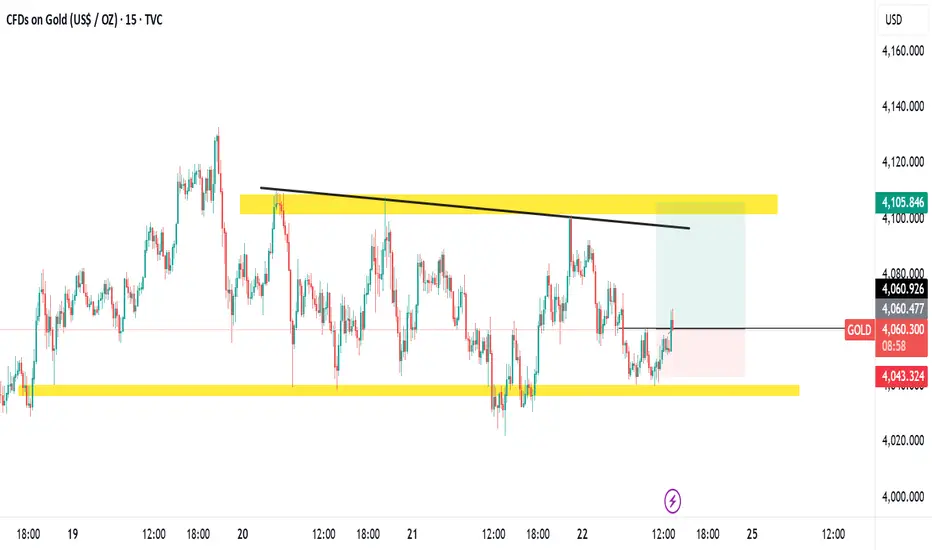
Gold Analysis for upside movement. Gold trading in a sideways zone. buyer's liquidity has already been grabbed. targeting for sell side pending liquidity. Longby ironman272
Gold (XAU/USD) 2H Chart Analysis – Sell Setup from High ProbabilBased on the chart you provided, Gold is currently reacting near a High Probability POI (supply zone) after a corrective bullish move. The structure still shows: Lower highs and lower lows → Bearish market structure Price is approaching a supply zone where sellers previously dominated Liquidity has been taken above internal highs (marked as "$$$"), indicating a liquidity grab This supports a short position idea from the supply zone. 🔍 Key Technical Levels Zone / Level Meaning 4,125 – 4,150 USD High Probability POI / Supply (Sell area) 4,080 – 4,100 USD Entry region (price is currently here) 4,040 – 4,025 USD First reaction / partial take zone (50% area) 3,990 – 4,000 USD Main Target (previous demand + equal lows) 🎯 Suggested Target Primary Target: $4,000 (Exactly aligning with your chart’s marked “TARGET” zone where liquidity sits) If momentum continues and structure breaks more aggressively: Extended Target: $3,975 – $3,960 (deeper sweep into demand) 🛑 Risk Management Detail Level Stop Loss Above 4,155 USD (beyond POI + liquidity) R:R Potential Approx. 1:3 to 1:4 📌 Summary Price has retraced into a key supply zone Liquidity was taken → seller confirmation likely Expectation is continuation downward towards the liquidity pool below 📊 Title Recommendation: “Gold Retests Supply Zone – Bearish Continuation Toward $4,000 Expected”Shortby Pipshunter27Updated 1
MARKET CONTEXT – XAUUSD (1H)Gold is currently trading right below the intersection of the short-term descending trendline and the long-term ascending trendline, creating a compression zone. This is the type of structure that often leads to a strong breakout. 1. Volume Profile Structure VAH zone (Value Area High) around 4080–4085, indicating a strong previous selling area where buying pressure weakens and profit-taking increases. POC zone (4067–4072): The most traded area—where buyers and sellers are balanced. Price keeps getting rejected here, showing the market is not yet ready for a strong bullish push. VAL zone (4051–4055): Price is moving right at VAL, showing the market is testing the lower boundary of value. 2. Market Structure Price remains within a short-term downtrend channel and has not broken the descending trendline yet. However, the recent lows continue to be defended around 4050–4047, showing buyers are still protecting this level. If price breaks above the descending trendline and closes above the POC, the market may retrace toward: 4058 4067 4080 3. Key Levels Major Support: 4047–4044 (previous low + lower VAL boundary) Big Demand Zone: 4035–4028 → if tapped, it may generate a strong rebound. Strong Resistance: 4065–4072 (POC), then 4080–4085 (VAH) 4. Current Signals Price is sitting at the edge of VAL → a common area for small reversals. No clear reversal structure yet, but buying pressure is still holding the lows firmly.by Mark_Melanie_Gold_Stragegy1
LiamTrading – XAUUSD H1 | Monday SetupLiamTrading – XAUUSD H1 | Monday Setup Wait for gold to retest the upper trendline before choosing a direction Quick Overview On the H1 timeframe, gold is still moving inside a triangle pattern with a descending upper trendline and a gradually rising lower trendline. In my view, price still needs a bullish swing to retest the upper trendline – which aligns with the FVG zone + Volume Profile POC – before deciding a new trend (either a breakout to the upside or a reversal downward). Regarding the USD, many Fed officials have begun signaling that rate cuts may happen, but they remain very cautious. UBS and Barclays both lean towards the scenario that the Fed could cut rates in December if upcoming data continues to weaken. This limits the USD’s ability to strengthen too much, giving gold room for a technical pullback into resistance zones. H1 Technical Analysis Current structure: price is consolidating sideways, with lower highs along the descending trendline and higher lows supported by the lower trendline. Zone 4079–4081: FVG + Volume Profile POC. This area aligns with the upper trendline → a strong confluence resistance zone, suitable for a reaction-based short setup. Nearest support zone: around 4040–4035; if this level breaks, price may likely head back to retest 4010–4000. A clear bullish reversal signal only forms if an uptrend structure returns, at least when price breaks and holds above 4061, then continues through the descending trendline. Trading Scenarios (Reference Only) Sell at FVG + POC + Trendline (Priority setup) Entry: 4079–4081 SL: 4086 TP: 4060 → 4045 → 4010 Logic: Price is expected to move up to fill the FVG and touch the POC/trendline before sellers step back in. This zone has strong confluence, offering a better win rate than shorting inside the sideway range. Buy when bullish structure is confirmed Conditions: Price must break above 4061, close an H1 candle holding above this level, and break out of the descending trendline. Entry (reference): 4061–4068 (retest of breakout zone) SL: 4050 TP: 4095 → 4130 → 4150 In this case, the triangle pattern breaks upward, Dow Theory bullish structure returns, and the priority is buying with the new trend rather than trying to short the top. Trading Notes Possible scalp levels: 4060, 4040, 4010, 4130 – always wait for clear candle reactions on M5–M15 before entering. Risk per trade: 0.5–1% of account size; once the trade reaches around 1R, move SL to breakeven to protect your capital. If you have a different scenario for XAUUSD H1 today, leave a comment and follow LiamTrading for daily gold strategies on TradingView.Longby LiamTradingFX13
XAU/USD – Gold Under Heavy Pressure, 4,000$ Break Looks ImminentGold continues to slide as the US Dollar strengthens, fueled by resilient US data. With markets waiting for the final week of November and the upcoming FOMC decision, safe-haven flows remain weak—making XAU/USD extremely vulnerable to further downside. 📊 Technical Outlook – H1/H30 The short-term structure remains clearly bearish: 1️⃣ Trend Bias: Bearish Price keeps rejecting the descending trendline. Every pullback is shallow and absorbed quickly by intraday supply zones. 2️⃣ Key Technical Levels Resistance / Supply Zones: 4,078 – 4,089 4,104 (major confluence: Fibo + H1 supply) Support / Liquidity Targets: 4,023 – 4,013 3,989 – 3,975 → major liquidity zone (high reaction probability) 3️⃣ Scenarios to Watch 🔻 Scenario 1 — Continuation Drop (Primary Bias) Break below 4,044 → targets 4,023, then the liquidity sweep at 3,99x – 3,97x. 🔄 Scenario 2 — Pullback Before Drop Retracement to 4,054 – 4,078 → rejection → continuation lower. 🔺 Scenario 3 — Deeper Recovery (Low Probability) Only valid if price closes above 4,104, unlocking a move toward 4,13x – 4,15x. 🎯 MMF Trading Plan SELL – Trend-Following (Primary) Sell Zone 1: 4,054 – 4,078 SL: 4,105 TP: 4,023 → 4,013 → 3,99x Sell Zone 2: 4,089 – 4,104 SL: 4,112 TP: 4,054 → 4,023 BUY – Only as a Reaction Trade (Liquidity Sweep) Buy Zone: 3,99x – 3,97x SL: 3,955 TP: 4,023 → 4,054 ⚠️ Buy setups are counter-trend and require strong confirmation. Primary bias remains SELL as long as price stays below 4,104. ⚜️ MMFLOW TRADING View Gold is being pushed toward the psychological 4,000$ support. A clean break could trigger a broader bearish expansion into 3,98x – 3,95x. With month-end positioning, FOMC expectations, and shifting Fed sentiment, volatility is likely to increase sharply. Stay with the trend—SELL the rallies. BUY only at deep liquidity zones with confirmation.Longby MMFlowTrading1
Gold Trading Strategy for 500 Pips!Hey traders, As we roll into a brand-new week, gold is showing some impressive stability. XAUUSD is hanging right around the 4,050-dollar mark, and despite the quiet price action, there’s a lot happening beneath the surface that’s worth paying attention to. The market right now is in “wait-and-see” mode as everyone watches the Federal Reserve’s next moves. Over the past few days, expectations have started to shift—more traders believe the Fed may slowly pivot toward a softer stance and potentially move closer to cutting rates by the end of the year. Because of that, bond yields have been drifting lower, the dollar is losing some of its strength, and demand for safe-haven assets like gold is starting to rise again. All of these elements together create a strong backdrop for potential upside in the short term. On the technical side, XAUUSD is tightening inside a clean triangle structure, and for those who follow price action closely, you know what that usually means: the market is building pressure. When price consolidates this way, it often sets the stage for a strong breakout. If buyers can push through the upper boundary of this triangle, the next logical target sits up near the 4,500-dollar zone — right in line with the momentum we saw during the last bullish move. How about you? What’s your take on this setup? Are you leaning toward another leg up, or do you think the market is prepping for a pullback first? Wishing you a great week of trading—focused, confident, and full of solid opportunities.Longby Luiss_MiguelUpdated 1
xauusd has seeped swing lowprice has seeped swing low, although structure on 15m if bearish but price has seeped low and give us engulfing candle+fvg, so entering here is good idea, sl woud be at $4040.080 and tp would be at $4069.500. price can face resistance at 4058.300, but if it breaks this zone and manages to close above $4069.300, it can blast upside. OANDA:XAUUSD Longby arnnav_tv115
Gold Fluctuates in Support Range; Accumulation Signals Rise⏰ Timeframe: 30m 📅 Update: 24/11/2025 🔍 Market Context After a corrective decline from the 4,104 USD area, gold is moving within a range-bound structure with strong support at the 4,003–4,023 USD area. The market is in a short-term re-accumulation phase, as consecutive CHoCH movements appear around the bottom area — reflecting the buying side's effort to absorb liquidity. The selling side temporarily controls, but balancing signals are becoming clearer as the price continuously rejects breaking deeply below the Demand Zone. 📊 Technical Structure Resistance Zone (4,090–4,104 USD): main supply area, confluence with Fibo 1.0, where profit-taking reactions are likely if the price rebounds. Support Zone (4,023 USD): intermediate support, playing a key role in the current sideways structure. Demand Zone (4,003 USD): potential demand area, confluence with previous liquidity bottom – main BUY Zone area. Structure Bias: still inclined towards accumulation – recovery, as long as the price maintains above 4,003 USD. 🎯 Market Outlook 1️⃣ Priority Scenario (Buy setup): • The price may continue to retest the Demand Zone (4,003–4,023 USD). • When a clear reaction signal appears, expect a recovery to the Fibo 0.618 → 1.0 area, corresponding to 4,075–4,104 USD. 2️⃣ Secondary Scenario (Breakdown): • If the price breaks below 4,003 USD, the recovery structure will be invalidated, bringing gold back to the lower liquidity area around 3,985 USD. 💎 Key Zones BUY Zone: 4,003 – 4,023 USD SELL Zone: 4,090 – 4,104 USD 🧠 Analyst’s View Gold is currently in a liquidity re-accumulation phase, as both sides are testing the lower boundary of the main support area. The buying side needs confirmation with a break above 4,075 USD, while the selling side still holds the advantage if the price cannot maintain above the balance area. In the current context, price behavior leans towards the “Sweep – Retest – Expansion” model, with the potential for forming a short-term technical recovery wave. 🛡️ Risk Note The market is in a low volatility area – avoid emotional actions without clear structural confirmation.Longby Goldscale-Capital0
XAUUSD/GOLD 1H BUY PROJECTION 24.11.25(XAUUSD/GOLD 1H BUY PROJECTION – 24.11.25). 🔍 What the Chart Shows Your chart displays a buy setup on the 1-hour timeframe with the following key elements: 🟦 1. Support Zone (S1) Price is reacting from the horizontal support zone. This zone aligns with the 1H uptrend line, adding confluence. Good demand area. 📉 2. Trendline Support (1H Uptrend) The price is touching the ascending trendline, indicating continuation of the uptrend. 🔦 3. Hammer Candle Confirmation A bullish hammer candle is highlighted (yellow box). This indicates seller exhaustion and possible reversal to upside. This candle gives confidence for a buy entry. 🎯 4. Entry, SL, TP Entry: At the hammer candle close near 4043–4045 zone. Stop Loss: Below support zone and trendline (~4020–4025 zone). Target: Back to Resistance R2, around 4100+ zone. Risk/Reward: 1:4 shown — good reward potential. 🟪 5. Resistance Levels Resistance R1: Mid chart area. Resistance R2: Strong resistance zone near 4100+. 📌 Overall Summary Your setup is logically structured with: Support + Trendline confluence Hammer reversal confirmation Clean R:R Uptrend continuation expectation This is a valid 1H buy setup based on price action and structure.Longby kripsonfx976
Gold breakout loading🔹 Price respecting a clean falling wedge on 15M ⏳ 🔹 Strong support zone holding firmly 🛡️ 🔹 Buyers showing early signs of reversal momentum 📊 🔹 A breakout above the wedge trendline may trigger a sharp upside rally 🚀 🔹 Targets aligning toward the 4100+ zone 🎯 🔹 Watching for a pullback + bounce entry for safer confirmation ✔️ 💛 Gold gearing up for a potential bullish reversal! #Gold #XAUUSD #PriceAction #Breakout #TradingSetup #ChartAnalysis 📈🔥Longby Arunsam101
Gold Stuck Between 4050-4100. Now What?Gold price is currently trading in classic range-bound behavior on the daily timeframe, with price action consolidating between the 4050-4100 area (On closing basis ) as marked by the rectangle on the chart. Based on the current technical setup, I'm anticipating continued consolidation for approximately 6-7 weeks from this point. However, this isn't likely to be a simple sideways move the consolidation is expected to carry a bearish undertone, meaning we may see more pressure toward the lower end of the range during this period. after mid-January, conditions appear favorable for a fresh buying rally to develop. This consolidation phase may simply be the market gathering momentum for the next leg higher, allowing for profit-taking and position adjustments before the next bullish impulse. While range trading can be tempting during consolidation phases,., buying on dips remains the more favorable approach.by TheGoldenCircle1
Elliott Wave Analysis XAUUSD – November W4, 2025 1. Momentum W1 – Weekly timeframe Weekly momentum is showing early signs of a reversal. If next week forms a confirmed bullish weekly candle, the market may enter 4–5 consecutive bullish weeks, pushing weekly momentum into the overbought zone. D1 – Daily timeframe Daily momentum continues to rise, suggesting the market may experience 1–2 more days of upward movement before reaching the overbought region. H4 – 4-hour timeframe H4 momentum remains bullish, indicating that Monday is likely to show a continuation of upward movement or sideways consolidation. ________________________________________ 2. Elliott Wave Structure Weekly Structure (W1) The last three weekly candles are bullish, but not strongly decisive: • Two candles have short bodies • One is a bullish candle with an upper wick This behavior suggests the market is completing wave X (purple). Therefore, the main expectation is a continued decline to complete wave Y (purple) toward the lower target zones. Once wave Y finishes and weekly momentum confirms reversal, a new major bullish trend is likely to begin. ________________________________________ Daily Structure (D1) • Wave X (purple) is likely complete. • Price is now progressing within wave Y (purple). Inside wave Y: • Wave 1 (red) appears to have finished. • Price is currently in wave 2 (red) or has already started the early phase of wave 3 (red). 🔸 Key confirmation level: A break below 4001 would confirm that the market has entered wave 3 (red), leading to a sharp and decisive decline. 🔸 Alternative scenario: Because D1 momentum is still rising, wave 2 (red) may be forming a WXY corrective pattern (green zigzag), meaning the market may still produce a final upward swing before the next strong decline. ________________________________________ 3. H4 Wave Structure At the moment, there are two scenarios in line with the D1 structure: • The market may already be in the early phase of wave 3 (red). • Or price is completing the final leg of the WXY correction of wave 2 (red) (indicated by the green zigzag). The zone around 4081 currently acts as the balance area, also the region with the highest traded volume (green POC line). • If price stays below 4081 during Monday, the probability favors wave 3 (red), meaning strong support zones 4020 and 3958 are likely to break. • If price stays above 4081, upside targets at 4145 and 4184 become ideal levels for completing wave 2 (red). ________________________________________ 4. Trading Plan 📌 Preferred Limit Sell Zones: • 4145 • 4184 📌 Direct Sell Zone: • 4020 → only valid if a strong H4 candle closes below 4020, followed by a retest. A more detailed trading plan will be updated on Monday, once fresh market data becomes available.Shortby WavePoint_FXUpdated 0
Gold Trading Strategy for 24th November 2025✨ GOLD Trading Plan – Breakout Strategy (30-Min Candle) 🟢 BUY Setup (Long Trade) Trigger: Enter only if the price closes above the high of the 30-minute candle at 4086. Entry: Buy above 4086 after a confirmed candle close. Targets: 🎯 Target 1: 4100 🎯 Target 2: 4115 🎯 Target 3: 4128 Stop-Loss Suggestion: Below the breakout candle low or below 4058–4062 zone (adjust per risk tolerance). Logic: A close above 4086 signals bullish strength and a possible continuation toward intraday resistance levels. Momentum confirmation is essential before entering. 🔴 SELL Setup (Short Trade) Trigger: Enter only if the price closes below the low of the 30-minute candle at 4042. Entry: Sell below 4042 after a confirmed candle close. Targets: 🎯 Target 1: 4034 🎯 Target 2: 4024 🎯 Target 3: 4010 Stop-Loss Suggestion: Above the breakdown candle high or above 4060–4065 zone. Logic: A close below 4042 shows bearish momentum that can push price toward the next support zones. 📌 Extra Notes for Better Execution ⏳ Wait for a confirmed 30-minute candle close before entering — avoid wick traps. 📉 Place stop-loss strictly; gold is highly volatile. ⚙️ Risk–reward should be at least 1:2 or better. 📊 Monitor global cues: USD strength, yields, economic data, and geopolitical news. ⚠️ Disclaimer This analysis is for educational and informational purposes only. It is not investment or trading advice. Financial markets involve risk, and you should conduct your own research or consult a certified financial advisor before making any trading decisions. You are fully responsible for your trades.by ramkkyy11
Gold plan B clean breakdown below the minor consolidation area signals a TVC:GOLD continuation toward the liquidity pocket near 4000–3985, which aligns with the next demand block.Shortby Wall_Street_Jr0
Gold buy setupThe structure indicates that sellers are losing momentum while buyers are building pressure from the demand zone. entered @4063 placing SL below the deepest liquidity grab Trailing till 4092 TVC:GOLD Longby Wall_Street_Jr0
Gold Analysis and Trading Strategies | Monday✅ Technical Outlook (4-Hour Structure) ● After reaching the historical high of 4381, gold entered a corrective phase, forming a segmented structure of “decline → bottoming → rebound.” Each segment has lasted for roughly one week. Currently, after touching 4245, gold has entered the second corrective wave, and from a cycle perspective, this adjustment is not fully completed yet. ● Over the past two days, gold has repeatedly found support around the 4000 psychological level, showing signs of rebound. This indicates that buyers are actively defending this area and that short-term bullish interest remains. ● Short-term moving averages (MA5, MA10, MA20) are currently clustered around the 4080–4100 region, forming strong pressure and signaling that the short-term trend remains bearish. However, the long-term moving averages are slowly turning upward, suggesting that downside support remains valid and that deeper declines may be limited. ● The Bollinger Bands continue to narrow, indicating a range-bound and repetitive price structure. The lower band is gradually aligning with previous lows, which together limit the downside space for further price declines. ✅ Daily Chart Structure ● Gold remains in a consolidation phase, with the overall Bollinger Bands displaying a gradual narrowing pattern, suggesting that a one-directional move is unlikely in the near term. ● The lower band is steadily rising and aligning with prior lows → limiting further downside risk. ● The upper band remains near 4100–4130, serving as the main short-term resistance zone for rebounds. 🔴 Resistance Levels: 4100–4130 🟢 Support Levels: 4005–4000 🎯 Trading Strategy Reference 🔰 Strategy 1 (Sell on Rebound) ● Short around 4100–4105 in batches Targets: 4050–4020 Breakdown target: 4000 🔰 Strategy 2 (Buy on Pullback) ● Buy around 4000–4005 in batches Targets: 4020–4030 Breakout target: 4050 📌 Outlook for Next Week Overall, gold remains in a structure of weak consolidation — supported but with limited rebound strength. The price is expected to continue oscillating within the 4000–4100 USD range next week. ● If Federal Reserve officials sound more “hawkish”: Rate-cut expectations decline → USD strengthens → Gold may retest the 4000 support. ● If Fed officials turn more “dovish”: Rate-cut expectations rise → Gold may retest the 4100 resistance zone. ● If geopolitical tensions escalate: Safe-haven demand may push gold to break above the upper boundary of the range. Next Monday’s short-term focus remains the 4000–4100 range. Wait for a breakout, then follow the direction accordingly.by GoldTradingPro14
Gold Reaches Exhaustion Zone — Sell Momentum LoadingGold Reaches Exhaustion Zone — Sell Momentum Loading Gold is showing signs of upside exhaustion, with price repeatedly failing to gain momentum as it approaches the mid-range premium zone near the 4,245 area. The recent structure reflects a market transitioning from short-term recovery into renewed weakness, with each bullish attempt losing strength faster than the previous one. Order flow remains dominated by distribution behaviour, and the chart signals a potential liquidity sweep followed by a bearish continuation. The projected rejection zone suggests that buyers are running into an area of heavy supply, where institutional activity has previously triggered aggressive downside extensions. Volume distribution across the range also highlights diminishing demand at higher prices, reinforcing the likelihood of a downward rotation. As the market continues to respect its broader range ceiling, the probability increases for price to revisit deeper value regions. With momentum fading and the current leg showing hesitation, gold is positioned for a potential sell-side move toward lower mean-reversion levels.Shortby XAU_EMPIREUpdated 2
Strong news chain could push gold to retest 4300🟡 XAU/USD – Weekly Trading Plan (Nov 23–29) SMC – FVG – Supply/Demand – High-Impact News Week 1. Market Context Gold is sideways in the H4 accumulation structure, forming higher lows along the trendline. Above are 3 important supply layers: OLD FVG 1 OLD FVG 2 Large FVG 4220–4300 the price needs to sweep liquidity & hit the supply zone before creating a new direction. 2. Strong News Schedule for the Week This week has a lot of USD news directly affecting gold: Tuesday (Nov 25) Core PPI – Retail Sales – PPI (4 consecutive red news) → strong volatility. Wednesday (Nov 26) Unemployment Claims Durable Goods → Core Durable Goods GDP q/q – GDP Price Index Core PCE (most important inflation news of the week) ➡️ This is the decisive day for the trend for the rest of the week. Friday (Nov 28) German CPI (affects EUR → USD indirectly) 🎯 News Conclusion: → Gold likely to fake move – sweep liquidity before running correctly. → Thin SL zones will be continuously hunted. 3. Key Levels (from the chart you sent) 🔻 SELL Zone (Supply – FVG) 4189 – 4191 (Main Sell) SL: 4195 This is a strong reaction zone for the week. 4132 – 4134 (Sell scalp) SL: 4138 🔵 BUY Zone (Demand – Trendline – SMC) 4906 – 4904 (main BUY scalp zone in the chart) SL: 3999 → This is the only zone clearly marked as BUY in the chart. Psychological level: 4000 – 3985 If the price falls → strong reaction to form the weekly low. 4. Weekly Trading Scenarios 🅰️ Scenario 1 – Price retraces to supply zone before dropping (most likely) Price is forecasted to retest 4132–4134 → 4189–4191 After hitting 4190 ± → potential appearance of: Bearish BOS H1/H4 Strong reversal to 4050 – 4000 🔻 SELL Plan Sell 4132–4134 (scalp) SL 4138 Main Sell 4189–4191 SL 4195 TP targets: TP1: 4090 TP2: 4050 TP3: 4000 🅱️ Scenario 2 – Price dips before news then surges (kill liquidity) If gold is pushed down before PPI/GDP news: Best BUY zone: 4000 – 3985 Form a low → surge back up to test supply. 🔵 BUY Plan BUY 4000–3985 SL: 3975 TP: 4050 4100 4130 🅾️ Scenario 3 – If 4200 breaks If 4200 is broken by a large-bodied H4 candle: ➡️ High probability gold will move up to test large FVG 4250–4300 → At that point, only look for BUY pullbacks, no more SELL.Longby Linda_OneShotTrader1
Gold Nonfarm: Buy OB 4030, Target Break 4111🔍 Market Context – November 20, 2025 Gold initially dropped nearly 70 pips at the start of the day but quickly rebounded sharply from the 4030–4032 zone, demonstrating strong buying pressure and a refusal to decline further. The market structure on the H1–H2 timeframe is forming a classic, well-defined Inverse Head & Shoulders pattern—a quintessential bullish reversal pattern—signaling a potential upward expansion if the neckline is successfully broken. 📅 Key News Events Today: 🇺🇸 Non-Farm Payrolls (NFP) 📉 US Unemployment Rate 🏛 FOMC Meeting Minutes 🗣 Speeches by Trump, Barkin, Williams 🧾 Initial Jobless Claims ⚠️ These events could trigger sharp volatility and will determine the confirmation or rejection of the reversal pattern. 📊 Technical Analysis 🛒 BUY SETUP – Primary Priority ✅ Entry: 4030 – 4032 🛡 Stop Loss (SL): 4027 🎯 Take Profit (TP): TP1: 4039 TP2: 4047 TP3: 4059 💡 Rationale: Price bounced strongly at the OB + SSS zone. This is a crucial technical support area and the base of the Inverse H&S pattern. The objective is to break the neckline to trigger the uptrend. 🔻 SELL SETUP – Short-Term Strategy 📍 Entry: 4093 – 4095 🛡 SL: 4098 🎯 TP: TP1: 4088 TP2: 4077 TP3: 4060 TP4: 4033 💡 Rationale: This strategy is only applicable if the price forms a false breakout of the BSL zone and reverses. This is an ideal entry point for quick scalping if the market reacts negatively to the news. 🔑 Key Price Zones Buy Zone (OB + SSS): 4030 – 4032 → Strong demand zone, the base of the Inverse Head & Shoulders pattern, confirming the reversal signal if held. Breakout Neckline Zone: 4101 – 4111 → The neckline of the Inverse H&S pattern. Breaking this zone will open up opportunities for a sharp rise. Final Resistance Zone: 4133 – 4140 → The final target if the breakout is successful and the bullish pattern is confirmed. ✅ Strategy Conclusion 🎯 Main Strategy: Priority is to BUY in the OB zone 4030–4032. 🩸 SELL is only for short-term scalping if there is a signal of rejection at the BSL zone. 🕓 Caution: Be careful entering trades near the Nonfarm news release time—wait for price action to confirm the direction.Longby Linda_OneShotTraderUpdated 2
BULLISH MOVE on gold for the next trading season. who's ready ?BULLISH MOVE on gold for the next trading season. who's ready ? I'M TRYING TO CAPTURE 1:6 risk to reward. Let's see what's gonna happen./ GIVE ME YOUR IDEA AS WELL. Longby gurdassingh131
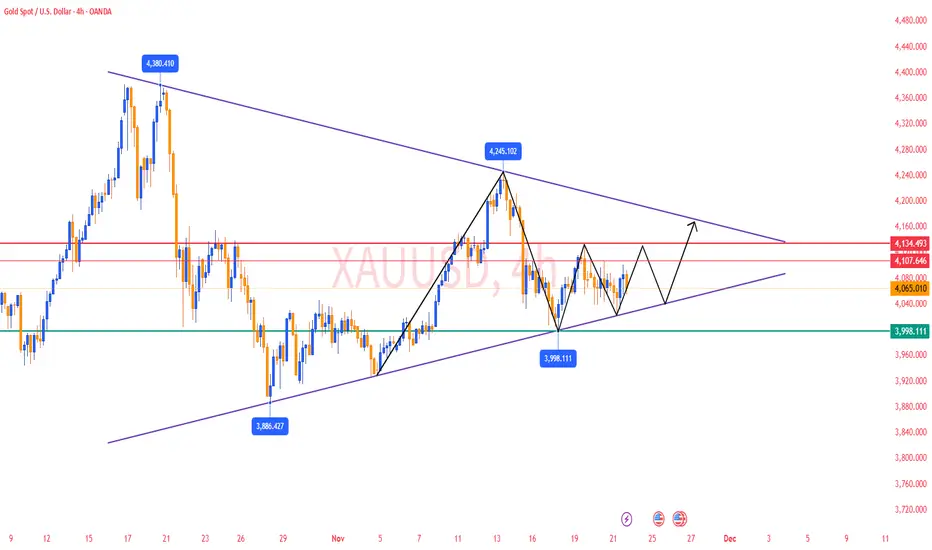
LiamTrading – XAUUSD H4 | Gold accumulates on the trendlineLiamTrading – XAUUSD H4 | Gold accumulates on the trendline, waiting to break the structure for a breakout After testing the upward trendline twice, gold bounced up and then moved sideways around the 4065 area. On H4, this price zone has accumulated for almost a week – indicating that the selling force is not liquid enough to push the price down deeply, while there is still plenty of price gap above according to Fibonacci. My preferred scenario: gold continues to "compress" within the triangle, then breaks out to create a new wave. Macro – Fed context Fed member Collins emphasized that there is still reason to be cautious about cutting rates in the December meeting. She stated: This is a complex phase, and it's not unusual for internal disagreements within the Fed. The Fed must balance between the two goals of employment and inflation, which are moving in opposite directions. This makes it difficult for the market to clearly price the interest rate scenario, so gold continues to choose to accumulate around important technical zones instead of breaking out in one direction. Technical Analysis – Trendline, Fibonacci, Volume Profile The current H4 structure is a triangle model with: A downward sloping trendline from the old peak 42xx. An upward sloping trendline from the late October low, acting as dynamic support. Zone 4060–4070: the "balance" price zone last week – where the price moved sideways the longest, serving as a reference point for the short-term trend. Key levels: 4132: near resistance, coinciding with the VAH area of the current Volume Profile. 4171: higher resistance, near the Fibonacci 1.0 area of the recovery wave. 4242: Fibonacci extension confluence zone (1.618) + historical resistance – where strong profit-taking is likely. 4347: 2.618 expansion zone – reference target if the peak is successfully broken. 4022 and 3997: important support close to the lower trendline – main buy zone if there is a liquidity sweep. When the price decisively breaks out of one of the trendlines, the new trend on H4 will be clearer; the trading plan will follow this breakout direction. Risk management and invalidation H4 closes below 3997: the triangle structure is broken downward, fully prioritizing sell orders to lower zones – at that point, medium-term buy orders should not be held. H4 closes above 4245 with good volume: considered a successful triangle peak breakout, discard all sell orders in this area and focus on buying according to the new trend. Which scenario are you leaning towards for next week: breaking up to test 4242–4347 or sweeping down to 4022–3997 before bouncing back? Leave a comment and follow the LiamTrading channel on TradingView for daily XAUUSD updates.Longby LiamTradingFX10
XAUUSD – ACCUMULATION TRIANGLE ON D1💛 XAUUSD – ACCUMULATION TRIANGLE ON D1, AWAITING A NEW BREAKOUT THIS WEEK 🎯 🌤 Overview of the New Week Hello everyone, Lana here 💬 Gold, after a very strong rise from the 3,500 region to above 4,400, is entering a "resting" phase on the D1 frame: the price continuously tests the upward trendline but has not yet broken it to confirm a downtrend. The market is clearly waiting for a real breakout before forming a new medium-term wave. Next week, we have CPI and PPI – important inflation data that could act as a catalyst to push gold out of the current accumulation zone. 💹 Technical Analysis (Daily Triangle) On the D1 frame, when connecting the descending peaks and ascending bottoms, gold is in a narrowing triangle pattern. The upward trendline below is still maintained, indicating that the medium-term trend has not reversed. Below are important zones: ≈ 3,890: if the price closes below this area, it could confirm medium-term weakening. Fibonacci & psychological resistance zone 3,800–3,900: strong support, confluence with old price structure. POC Volume Profile around 3,650: if a deep decline scenario occurs, this will be the next price attraction zone. Above, the old peak zone around 4,300–4,400 remains a large liquidity zone, a natural target if gold breaks the upper edge of the triangle. In summary: the more compressed the triangle, the stronger the breakout – the direction will depend heavily on CPI/PPI data & Fed expectations. 🎯 Reference Trading Plan (Medium-Term) 💖 Scenario 1 – Maintain Uptrend (priority when the trendline is not broken) Observe the reaction at the D1 upward trendline (area around 4,000). If the price continuously bounces from the trendline and stays above the 3,890 area, you can: Prioritize buying according to the trend at support retests on H4–H1. Medium-term targets: 4,150 → 4,250 → 4,300–4,400 if the triangle breaks upwards. 💢 Scenario 2 – Triangle Breaks, Shifts to Medium-Term Decline If D1 closes below 3,890: Consider this a signal confirming medium-term weakening. Prioritize selling at newly formed resistance zones. Step-by-step targets: 3,800 → 3,700 (POC) → 3,500 (strong previous support). In both scenarios, specific entry points should be refined on smaller frames (H4, H1) based on price action/OB/FVG. ⚠️ Note News & Risk Management Next week's CPI & PPI could be the "final blow," pushing gold out of the triangle – volatility can be wide and fast, spreads may widen. Last week's NFP news hardly created big waves for gold after the US government shutdown, indicating the market is holding strength waiting for more important data. 🌷 Conclusion & Interaction with LanaM2 Gold on D1 is in the final stage of the accumulation triangle – this is a time where patient observation is as important as a beautiful entry point 💛 Next week, I will continue to update daily details on smaller frames so everyone can have more specific entry points.Longby Lana_M20
Public Sector Banks in the Trading Market1. What Are Public Sector Banks? Public Sector Banks are commercial banks where the Government of India holds majority ownership, usually above 51%. These banks operate under government oversight and play a vital role in: Mobilizing public savings Lending to priority sectors Executing government welfare schemes Providing financial inclusion Supporting economic stability Some major PSBs include: State Bank of India (SBI) – India’s largest bank Bank of Baroda (BoB) Punjab National Bank (PNB) Canara Bank Union Bank of India Indian Bank Bank of India (BoI) UCO Bank, Bank of Maharashtra, Central Bank of India, etc. These banks collectively hold nearly two-thirds of India’s banking assets, giving them huge influence in stock market behaviour. 2. Importance of PSBs in the Trading Market a) High Liquidity and Trading Volumes PSB stocks like SBI, BoB, and PNB consistently appear in the NSE’s most-traded list, making them attractive for: Intraday traders Swing traders Options traders Institutional investors Liquidity ensures narrower spreads, faster order execution, and stable price discovery. b) Macro Indicators PSBs reflect the health of: Credit growth in the economy Corporate borrowing trends Housing and retail loan demand Government capital expenditure Stress in sectors like MSME or agriculture Thus, traders use PSB performance to gauge broader market trends. c) Interest Rate Impact Bank profitability is heavily dependent on the interest rate cycle. Rising rates → higher net interest margin (NIM) → PSBs rally Falling rates → lower margins → PSBs correct Therefore, PSB stocks move quickly after: RBI monetary policy Inflation data Government bond yield changes This makes them ideal for event-based trading. 3. How Public Sector Bank Stocks Behave PSB stocks often show cyclical behaviour related to the broader economy. a) Credit Demand Cycle When corporate and retail loan demand is strong: Bank lending grows NIMs improve Profitability increases Stocks rally During slowdowns, lending slows and PSBs weaken. b) NPA (Non-Performing Assets) Influence A major factor that affects PSB valuations is bad loans. High NPAs = weak valuations Lower NPAs = strong re-rating and investor confidence Whenever PSBs report declining NPAs, stocks usually see multi-month rallies. c) Government Recapitalization PSBs sometimes require government capital infusion to strengthen balance sheets. Announcements of recapitalization often cause: Short-term volatility Long-term stability Such events attract traders seeking momentum. 4. Key Factors Traders Track in PSBs 1. RBI Monetary Policy Interest rate hikes usually have a positive impact on PSBs initially but may impact loan growth later. The reverse is true for rate cuts. 2. Credit Growth Data Higher loan growth = bullish sentiment. 3. NPA Trends Quarterly results showing reduced NPAs cause strong buying. 4. Provisioning Coverage Ratio Higher provisioning means lower future risk. 5. Government Policies Schemes like: Jan Dhan Yojana Mudra loans PM Kisan Affordable housing subsidies impact PSB balance sheets as these banks execute most government programs. 6. Bond Yield Movements Bond yields impact treasury income. PSBs hold large government bond portfolios, so: Falling yields → appreciate bond prices → higher profits Rising yields → mark-to-market losses This directly affects stock movements. 7. Global Market Sentiment PSBs often move in line with: US interest rate trends Crude oil prices Global risk appetite Because they reflect India’s financial stability. 5. Why Traders Prefer PSB Stocks ✔ Volatility and Momentum PSBs offer clear trending phases and sharp breakouts during periods of: Economic expansion NPA reduction Privatization rumours Monetary policy shifts Their volatility works well for both intraday and swing trading. ✔ High Options Activity PSBs like SBI and PNB have: Liquid options Tight premiums Wide strike selections This helps option sellers and buyers trade with confidence. ✔ Low Valuation Base PSBs often trade at low price-to-book (P/B) ratios compared to private banks. So when re-rating happens, rallies are stronger and sustained. ✔ Strong Institutional Participation FIIs and DIIs frequently invest in PSBs during bullish economic cycles. Their buying creates long uptrends. 6. Risks in Trading Public Sector Banks PSBs carry unique risks that traders must consider. 1. High Exposure to Government Schemes While beneficial for society, these schemes sometimes: Reduce profitability Increase operational costs Lead to higher NPAs in certain sectors 2. Slow Decision-Making Compared to private banks, PSBs may be slower to adapt to: Digital banking Fintech competition Modern risk assessment systems This can limit valuation expansion. 3. Vulnerability to Economic Stress PSBs are more exposed to: MSME distress Agriculture stress Infrastructure lending defaults These risks cause periodic corrections. 7. Trading Strategies for Public Sector Banks 1. Event-Based Trading Best events for trading PSBs: RBI monetary policy Union Budget Quarterly results NPA announcements Government recapitalization news Privatization rumours Traders often take positions before or after these events. 2. Trend Following Strategies PSBs tend to show long, clean trends. Traders use: 20/50/200 EMA crossovers RSI breakout levels Price-volume surge patterns Trendline breakouts Trending phases provide multi-week or multi-month opportunities. 3. Options Strategies Popular strategies: Bull call spread (during NPA improvement cycles) Short straddle/strangle (during consolidation phases) Protective put (around volatile policy announcements) 4. Pair Trading Traders sometimes pair: SBI vs Bank of Baroda PNB vs Union Bank Canara Bank vs Indian Bank Based on relative strength comparisons. 8. Long-Term View of PSB Stocks Historically, PSBs have delivered inconsistent long-term returns, but cycles of reform — such as: Bank mergers Digital transformation NPA resolution Government capital infusion Interest rate cycles have created powerful rally phases. Investors who entered during undervalued periods often gained significantly over the long term. Conclusion Public Sector Banks are foundational pillars of India’s financial ecosystem. For traders, they offer a rare combination of: High liquidity Strong correlation with macroeconomic trends Event-driven volatility Clear trend opportunities Attractive options trading potential However, trading PSBs also requires careful monitoring of: NPAs RBI policies Government decisions Bond yields Sector-wise economic health Understanding these factors helps traders navigate PSB stocks effectively in both short-term and long-term market environments.Educationby TechnicalExpress1