
Introduction
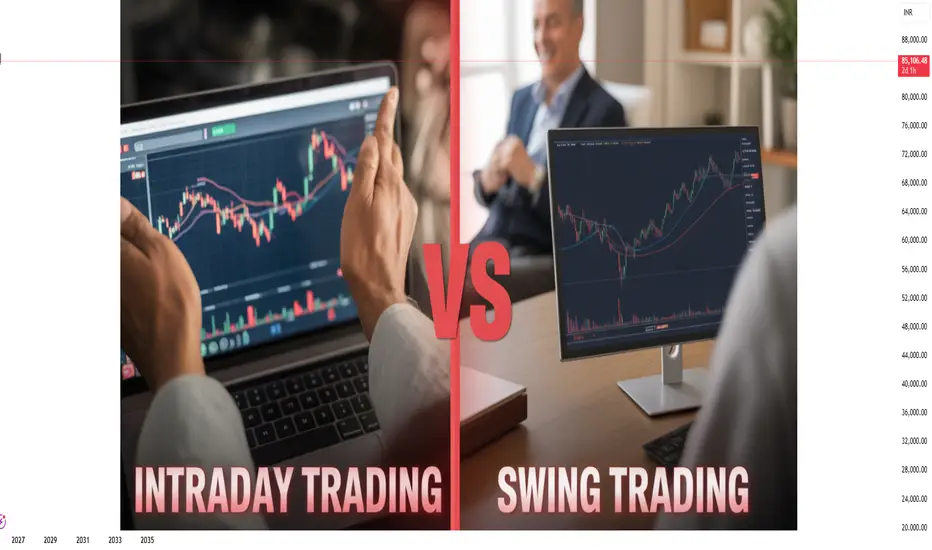
Trading in financial markets can be broadly classified based on the holding period of positions. Among the most popular approaches are Intraday Trading and Swing Trading. Both strategies aim to profit from price movements in stocks, commodities, currencies, or derivatives, but they differ significantly in execution, time horizon, risk exposure, and required skill sets. Understanding these differences is crucial for traders to align their style with personal risk tolerance, market knowledge, and lifestyle.
Intraday Trading
Definition:
Intraday trading, often called day trading, involves buying and selling financial instruments within the same trading day. Positions are opened and closed before the market closes, ensuring no overnight exposure. The primary objective is to capitalize on small price fluctuations within the day.
Key Characteristics:
Time Horizon:
Trades last minutes to hours; rarely extend beyond one trading session. Traders monitor charts constantly, looking for quick opportunities.
Leverage:
Intraday traders often use leverage to amplify gains. While this can increase profits, it also magnifies potential losses.
Technical Analysis:
Decision-making heavily relies on technical indicators, charts, patterns, and volume analysis. Fundamental factors are less significant for short-term moves.
Liquidity:
High liquidity stocks are preferred to ensure positions can be entered and exited quickly without affecting price significantly.
Common Strategies:
Scalping: Making numerous trades to capture small price gaps.
Momentum Trading: Identifying strong trends and riding them for quick profits.
Breakout Trading: Buying/selling when price breaks key support/resistance levels.
Advantages:
Quick realization of profits.
No overnight risk due to market gaps.
High number of trading opportunities daily.
Risks and Challenges:
Requires constant attention and quick decision-making.
High transaction costs due to frequent trades.
Emotionally taxing; can lead to impulsive decisions.
Small errors can lead to significant losses due to leverage.
Ideal Trader Profile:
Intraday trading suits disciplined, experienced traders with access to advanced trading tools, strong risk management, and the ability to handle stress.
Swing Trading
Definition:
Swing trading involves holding positions for several days to weeks, aiming to capture medium-term price movements. Unlike intraday trading, swing traders accept overnight exposure and aim to profit from market swings rather than minute-to-minute volatility.
Key Characteristics:
Time Horizon:
Trades are held from a few days to several weeks. Swing traders monitor trends and patterns over longer time frames, such as daily or weekly charts.
Market Analysis:
Both technical and fundamental analysis play roles. Swing traders use chart patterns, trend lines, moving averages, and sometimes news events to guide trades.
Risk Exposure:
Positions are exposed to overnight market risks, such as news events or economic announcements that can cause gaps.
Position Sizing:
Typically, swing traders use moderate leverage or none, reducing risk of large losses.
Common Strategies:
Trend Following: Entering trades along the direction of a prevailing trend.
Counter-Trend Trading: Taking positions against short-term extremes in a larger trend.
Breakout and Pullback Trading: Capturing price movements after breaking support/resistance or after a retracement.
Advantages:
Less time-intensive than intraday trading.
Opportunities to profit from larger price moves.
Reduced stress compared to day trading.
More room for analysis and planning trades.
Risks and Challenges:
Exposure to overnight or weekend gaps.
Patience required; trades may take days to materialize.
Market reversals can erode profits.
Requires solid risk management to handle potential drawdowns.
Ideal Trader Profile:
Swing trading is suitable for part-time traders or those unable to monitor markets continuously. It requires patience, analytical skills, and emotional control to ride trends over days or weeks.
Key Differences Between Intraday and Swing Trading
Aspect Intraday Trading Swing Trading
Time Horizon Minutes to hours Days to weeks
Overnight Exposure No Yes
Focus Short-term price fluctuations Medium-term price trends
Leverage Often high Moderate or low
Analysis Mainly technical Technical + fundamental
Risk High due to leverage Moderate; exposure to overnight gaps
Profit Potential Small per trade; requires high frequency Larger per trade; fewer trades
Emotional Demand Very high Moderate
Tools Needed Real-time charts, fast execution platforms Charting software, research tools
Transaction Costs High due to frequent trades Lower due to fewer trades
Choosing Between Intraday and Swing Trading
Selecting the right trading style depends on several factors:
Time Commitment:
Intraday trading demands full-time monitoring. Swing trading can fit around a regular job.
Risk Appetite:
Traders seeking quick gains with tolerance for high risk may prefer intraday trading. Conservative traders or beginners may favor swing trading.
Capital Requirements:
Intraday trading may require more capital to maintain margin requirements. Swing trading generally needs less margin.
Personality:
Traders who enjoy fast-paced environments, quick decisions, and intense focus lean towards intraday trading. Those preferring research, patience, and a slower pace find swing trading more comfortable.
Market Conditions:
Highly volatile markets favor intraday trading, while stable trending markets are more suitable for swing trading.
Combining Both Approaches
Some traders combine intraday and swing trading strategies to balance risk and opportunity. For instance:
Intraday for quick profits: Exploiting short-term volatility.
Swing for medium-term positions: Capturing larger moves without daily stress.
This hybrid approach requires discipline, strong risk management, and clear rules for position sizing.
Risk Management Considerations
Regardless of style, risk management is critical:
Stop-Loss Orders:
Limit losses on each trade. Intraday traders may set tight stops; swing traders allow wider stops to account for volatility.
Position Sizing:
Avoid risking too much capital on a single trade. The common guideline is 1–2% of capital per trade.
Diversification:
Spread trades across multiple instruments to mitigate sector or stock-specific risks.
Emotional Control:
Emotional discipline is essential. Both styles demand strict adherence to trading plans and avoidance of impulsive decisions.
Conclusion
Both intraday trading and swing trading offer opportunities to profit in financial markets but cater to different trader profiles, time commitments, and risk tolerances. Intraday trading focuses on rapid, short-term gains requiring intense monitoring and quick execution, whereas swing trading emphasizes medium-term trends, patience, and less stressful decision-making.
Choosing between these styles requires honest self-assessment of skills, capital, emotional resilience, and available time. Many successful traders blend both approaches strategically, capturing short-term moves while holding selected positions over days for larger trends. Ultimately, success depends not just on style, but on disciplined execution, strong risk management, and continuous learning in ever-changing markets.
Trading in financial markets can be broadly classified based on the holding period of positions. Among the most popular approaches are Intraday Trading and Swing Trading. Both strategies aim to profit from price movements in stocks, commodities, currencies, or derivatives, but they differ significantly in execution, time horizon, risk exposure, and required skill sets. Understanding these differences is crucial for traders to align their style with personal risk tolerance, market knowledge, and lifestyle.
Intraday Trading
Definition:
Intraday trading, often called day trading, involves buying and selling financial instruments within the same trading day. Positions are opened and closed before the market closes, ensuring no overnight exposure. The primary objective is to capitalize on small price fluctuations within the day.
Key Characteristics:
Time Horizon:
Trades last minutes to hours; rarely extend beyond one trading session. Traders monitor charts constantly, looking for quick opportunities.
Leverage:
Intraday traders often use leverage to amplify gains. While this can increase profits, it also magnifies potential losses.
Technical Analysis:
Decision-making heavily relies on technical indicators, charts, patterns, and volume analysis. Fundamental factors are less significant for short-term moves.
Liquidity:
High liquidity stocks are preferred to ensure positions can be entered and exited quickly without affecting price significantly.
Common Strategies:
Scalping: Making numerous trades to capture small price gaps.
Momentum Trading: Identifying strong trends and riding them for quick profits.
Breakout Trading: Buying/selling when price breaks key support/resistance levels.
Advantages:
Quick realization of profits.
No overnight risk due to market gaps.
High number of trading opportunities daily.
Risks and Challenges:
Requires constant attention and quick decision-making.
High transaction costs due to frequent trades.
Emotionally taxing; can lead to impulsive decisions.
Small errors can lead to significant losses due to leverage.
Ideal Trader Profile:
Intraday trading suits disciplined, experienced traders with access to advanced trading tools, strong risk management, and the ability to handle stress.
Swing Trading
Definition:
Swing trading involves holding positions for several days to weeks, aiming to capture medium-term price movements. Unlike intraday trading, swing traders accept overnight exposure and aim to profit from market swings rather than minute-to-minute volatility.
Key Characteristics:
Time Horizon:
Trades are held from a few days to several weeks. Swing traders monitor trends and patterns over longer time frames, such as daily or weekly charts.
Market Analysis:
Both technical and fundamental analysis play roles. Swing traders use chart patterns, trend lines, moving averages, and sometimes news events to guide trades.
Risk Exposure:
Positions are exposed to overnight market risks, such as news events or economic announcements that can cause gaps.
Position Sizing:
Typically, swing traders use moderate leverage or none, reducing risk of large losses.
Common Strategies:
Trend Following: Entering trades along the direction of a prevailing trend.
Counter-Trend Trading: Taking positions against short-term extremes in a larger trend.
Breakout and Pullback Trading: Capturing price movements after breaking support/resistance or after a retracement.
Advantages:
Less time-intensive than intraday trading.
Opportunities to profit from larger price moves.
Reduced stress compared to day trading.
More room for analysis and planning trades.
Risks and Challenges:
Exposure to overnight or weekend gaps.
Patience required; trades may take days to materialize.
Market reversals can erode profits.
Requires solid risk management to handle potential drawdowns.
Ideal Trader Profile:
Swing trading is suitable for part-time traders or those unable to monitor markets continuously. It requires patience, analytical skills, and emotional control to ride trends over days or weeks.
Key Differences Between Intraday and Swing Trading
Aspect Intraday Trading Swing Trading
Time Horizon Minutes to hours Days to weeks
Overnight Exposure No Yes
Focus Short-term price fluctuations Medium-term price trends
Leverage Often high Moderate or low
Analysis Mainly technical Technical + fundamental
Risk High due to leverage Moderate; exposure to overnight gaps
Profit Potential Small per trade; requires high frequency Larger per trade; fewer trades
Emotional Demand Very high Moderate
Tools Needed Real-time charts, fast execution platforms Charting software, research tools
Transaction Costs High due to frequent trades Lower due to fewer trades
Choosing Between Intraday and Swing Trading
Selecting the right trading style depends on several factors:
Time Commitment:
Intraday trading demands full-time monitoring. Swing trading can fit around a regular job.
Risk Appetite:
Traders seeking quick gains with tolerance for high risk may prefer intraday trading. Conservative traders or beginners may favor swing trading.
Capital Requirements:
Intraday trading may require more capital to maintain margin requirements. Swing trading generally needs less margin.
Personality:
Traders who enjoy fast-paced environments, quick decisions, and intense focus lean towards intraday trading. Those preferring research, patience, and a slower pace find swing trading more comfortable.
Market Conditions:
Highly volatile markets favor intraday trading, while stable trending markets are more suitable for swing trading.
Combining Both Approaches
Some traders combine intraday and swing trading strategies to balance risk and opportunity. For instance:
Intraday for quick profits: Exploiting short-term volatility.
Swing for medium-term positions: Capturing larger moves without daily stress.
This hybrid approach requires discipline, strong risk management, and clear rules for position sizing.
Risk Management Considerations
Regardless of style, risk management is critical:
Stop-Loss Orders:
Limit losses on each trade. Intraday traders may set tight stops; swing traders allow wider stops to account for volatility.
Position Sizing:
Avoid risking too much capital on a single trade. The common guideline is 1–2% of capital per trade.
Diversification:
Spread trades across multiple instruments to mitigate sector or stock-specific risks.
Emotional Control:
Emotional discipline is essential. Both styles demand strict adherence to trading plans and avoidance of impulsive decisions.
Conclusion
Both intraday trading and swing trading offer opportunities to profit in financial markets but cater to different trader profiles, time commitments, and risk tolerances. Intraday trading focuses on rapid, short-term gains requiring intense monitoring and quick execution, whereas swing trading emphasizes medium-term trends, patience, and less stressful decision-making.
Choosing between these styles requires honest self-assessment of skills, capital, emotional resilience, and available time. Many successful traders blend both approaches strategically, capturing short-term moves while holding selected positions over days for larger trends. Ultimately, success depends not just on style, but on disciplined execution, strong risk management, and continuous learning in ever-changing markets.

I built a Buy & Sell Signal Indicator with 85% accuracy.
📈 Get access via DM or
WhatsApp: wa.link/d997q0
Contact - +91 76782 40962
| Email: techncialexpress@gmail.com
| Script Coder | Trader | Investor | From India
📈 Get access via DM or
WhatsApp: wa.link/d997q0
Contact - +91 76782 40962
| Email: techncialexpress@gmail.com
| Script Coder | Trader | Investor | From India
Related publications
Disclaimer
The information and publications are not meant to be, and do not constitute, financial, investment, trading, or other types of advice or recommendations supplied or endorsed by TradingView. Read more in the Terms of Use.
I built a Buy & Sell Signal Indicator with 85% accuracy.
📈 Get access via DM or
WhatsApp: wa.link/d997q0
Contact - +91 76782 40962
| Email: techncialexpress@gmail.com
| Script Coder | Trader | Investor | From India
📈 Get access via DM or
WhatsApp: wa.link/d997q0
Contact - +91 76782 40962
| Email: techncialexpress@gmail.com
| Script Coder | Trader | Investor | From India
Related publications
Disclaimer
The information and publications are not meant to be, and do not constitute, financial, investment, trading, or other types of advice or recommendations supplied or endorsed by TradingView. Read more in the Terms of Use.