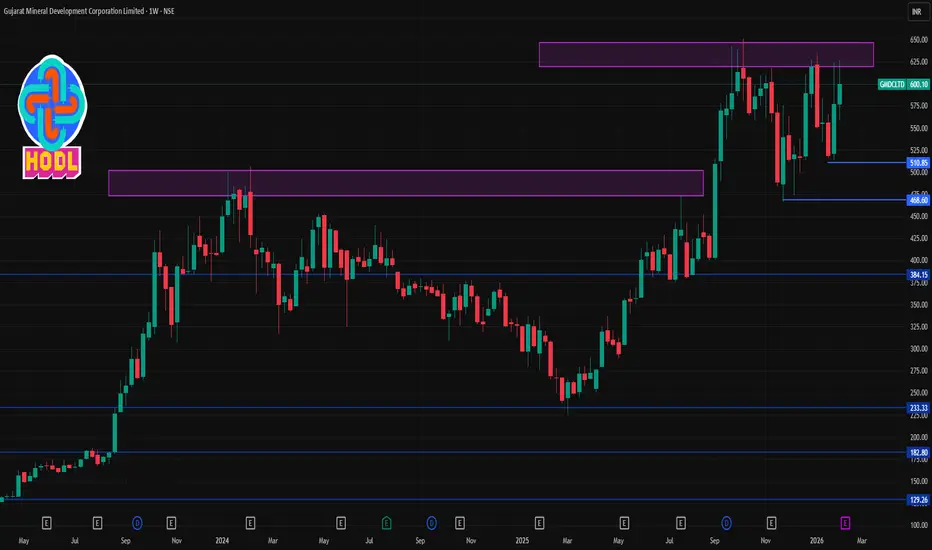
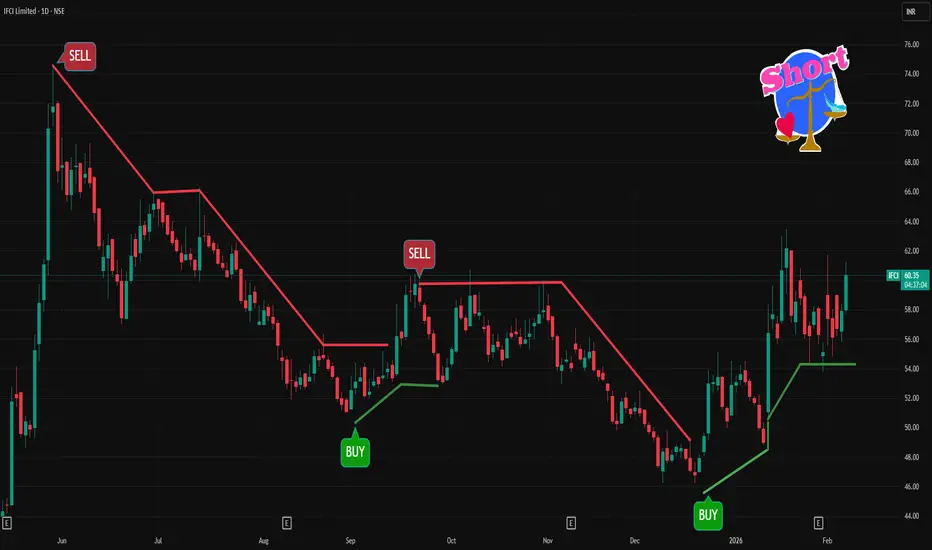
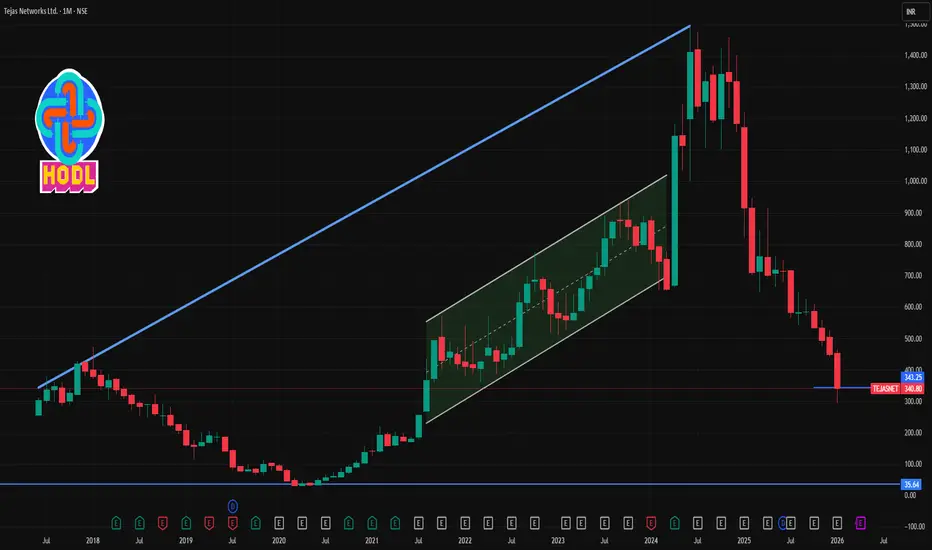
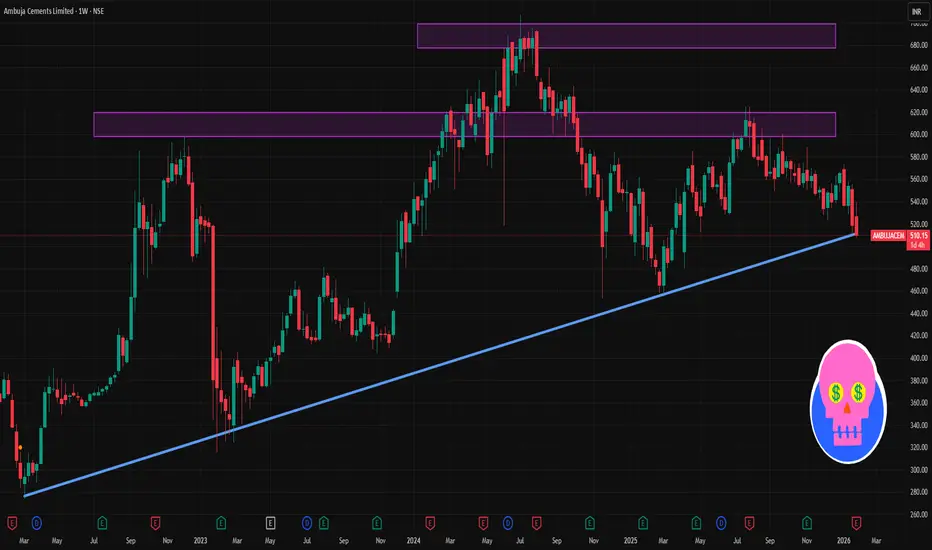
Chart Patterns (Macro Structure + Psychology + Trading)Chart patterns arise over larger timeframes from the interaction of supply and demand. They help identify continuation or reversal of trends.
⭐ Advantages of Chart Patterns
Helps predict market direction – Shows whether price may continue or reverse.
Easy to understand visually – Patterns are simple shapes (triangles, flags, head & shoulders).
Gives clear entry and exit points – Breakouts and breakdowns guide trading decisions.
Works on all timeframes – Useful for intraday, swing, and long-term trading.
Useful for trend analysis – Helps identify strong or weak trends.
Improves accuracy when combined with volume – Volume confirms true breakouts.
Chartanalysis
UPL 1 Week Time Frame 📌 Current Price Snapshot
Approx Current Price (NSE): ₹770–₹780 range (varies slightly by source and time) — ~₹774 area recently quoted.
52‑week High: ~₹786.30
📊 Weekly Support & Resistance (Accurate Levels)
🔥 Key Weekly Pivot (Bias Level)
Weekly Pivot: ~₹770.8–₹773.8 — central reference zone for weekly trend.
Above = bullish bias
Below = bearish/weak bias
🟢 Support Levels (Weekly Frame)
1️⃣ Immediate Support: ~₹769–₹770
2️⃣ Next Support: ~₹764–₹765
3️⃣ Lower Support: ~₹758–₹760
4️⃣ Stronger Lower Zone: ~₹736–₹721 (secondary structurals)
🔴 Resistance Levels (Weekly Frame)
1️⃣ Immediate Resistance: ~₹779–₹780
2️⃣ Next Zone: ~₹785–₹790
3️⃣ Higher Weekly Resistances: ~₹805–₹824+ (if breakout happens)
🧩 Summary Table — Weekly Levels
Level Category Approx Level (₹)
Weekly Pivot 770–774
Support 1 769–770
Support 2 764–765
Support 3 758–760
Resistance 1 779–780
Resistance 2 785–790
Higher Resistance ~805–~824
Note: These reflect technical pivot & Fibonacci zones on the weekly frame.
📌 How to Use These Levels
✅ Above Pivot (~771–774) → Weekly bias tends bullish.
✅ Sustain above ~780–785 → Breakout zone — next leg could aim towards ~800+.
✅ Break below ~764 → Weakness may extend toward lower supports.
JSL 1 Day Time Frame 🔑 Daily Levels (1‑Day Time Frame)
Level Price (₹) Description
R3 ~₹820 Major resistance zone
R2 ~₹812 Secondary resistance
R1 ~₹805 Immediate resistance (near recent highs)
Pivot Point (PP) ~₹796‑₹797 Daily pivot reference
S1 ~₹786 First support zone
S2 ~₹780 Second support (near recent lows)
S3 ~₹773‑₹774 Strong downside support
🔎 Additional short‑term support/resistance context:
• Short‑term support around ₹772 and resistance near ~₹813 on daily charts/intraday pivot models.
📌 How To Use These Levels Today (1‑Day Strategy)
Bullish continuation
✔ Above ₹805–₹810 — next upside target towards ₹812–₹820.
✔ Break and hold above ₹820 signals strong bullish momentum.
Range / Neutral zone
↔ Between ₹786 – ₹805 — likely range‑bound unless heavy volumes break one side.
Bearish scenario
✘ Below ₹780 — opening further downside toward ₹773‑₹770 levels.
📈 Technical Sentiment Snapshot (Daily)
• Some daily indicators lean bullish (strong buy signals on technicals as per some platforms) but momentum oscillators like RSI/MACD show mixed short‑term signals.
GOLD/SILVER RatioChart is self explanatory. The price of the TVC:GOLD/TVC:SILVER ratio (XAU/XAG) as of January 1, 2026, is approximately 60.71. This indicates that one ounce of gold is worth roughly 60.71 ounces of silver. Over the past year, the ratio has seen a significant change, trading within a 52-week range of 54.19 to 107.27.
Recent trends
* Market Sentiment and Economic Conditions: When economic uncertainty is high, investors typically flock to gold as a safe-haven asset, which widens the ratio (increases the number).
* Industrial Demand for Silver: Silver has significant industrial applications (electronics, solar panels), so its price often correlates with economic growth and industrial demand, which can narrow the ratio.
* Relative Volatility: Silver is generally more volatile than gold ("high-beta" version of gold); in a bull market for precious metals, silver prices tend to rise faster, lowering the ratio, while in a bear market, gold prices tend to hold up better, increasing the ratio.
Key Insights
* Ratio Fluctuation: The gold-silver ratio is highly volatile. Historically, the all-time high was 125:1 in April 2020.
* Recent Volatility: Both gold and silver have experienced significant price movements in 2025, driven by factors such as interest rate expectations, geopolitical tensions, and industrial demand for silver.
* Price Influences: Domestic gold and silver prices in India are influenced by international market trends, currency exchange rates, local demand, taxes, and import duties.
Gold-Silver Ratio and Future Price Predictions
The gold-silver ratio (calculated by dividing the gold price by the silver price) indicates which metal may be undervalued or overvalued compared to the other and helps anticipate potential out performance.
* High Ratio (e.g., above 80:1 or 90:1): Historically suggests that silver is undervalued relative to gold. This often signals a potential buying opportunity for silver, with expectations that silver's price may rise faster than gold's, causing the ratio to decrease (revert to its mean). A high ratio can also indicate economic uncertainty or a flight to gold's safe-haven appeal.
* Low Ratio (e.g., below 50:1 or 60:1): Historically suggests that silver is overvalued relative to gold. This may signal a potential buying opportunity for gold, with expectations that gold may outperform silver, causing the ratio to increase. A low ratio often coincides with periods of economic optimism and stronger industrial demand for silver.
Current Market Insights
As of late December 2025/early January 2026, the gold-silver ratio has recently fluctuated, with reports placing it around 60.53 to 64:1, down from highs earlier in 2025 that exceeded 100:1. The sharp drop in the ratio during 2025 signaled a strong out performance by silver.
* Silver Out performance Expected: Many analysts believe silver is still cheap relative to its long-term historical average ratio (around 40-60:1 or 60-80:1) and could continue to outperform gold.
* Key Drivers: Silver's strong industrial demand (especially in solar panels and electronics), coupled with persistent supply deficits, provides fundamental support for its price to potentially reach higher levels like $85-$100 per ounce in the medium to long term.
* Volatility and Risk: Silver is generally more volatile than gold, which means it has the potential for higher percentage gains but also larger pullbacks. Investors use the ratio as one of several tools to balance their portfolios, rather than relying on it as a sole predictor.
Disclaimer: This is for demonstration and educational purpose only. This is not buying or selling recommendations. I am not SEBI registered. Please consult your financial advisor before taking any trade.
[INTRADAY] #BANKNIFTY PE & CE Levels(30/12/2025)A flat opening is expected in Bank Nifty, with the index trading near the 59,000 zone, which continues to act as a short-term balance area. Price action over the last few sessions shows sustained selling pressure from higher levels, followed by a mild pullback and sideways movement. This indicates that the market is still in a consolidation-to-weak structure, where buyers are attempting to defend lower supports while sellers remain active near resistance.
On the upside, the 59,050–59,100 zone is the immediate resistance and a crucial trigger for bullish momentum. If Bank Nifty manages to hold above this zone, buying opportunities in buying can be considered, with upside targets at 59,250, 59,350, and 59,450+. A sustained move above this resistance may lead to short covering and a recovery toward higher levels.
On the downside, failure to hold the 58,950–58,900 zone can invite renewed selling pressure. In such a scenario, selling positions may be considered with downside targets at 58,750, 58,650, and 58,550-, where stronger demand is expected to emerge. Until a clear breakout or breakdown occurs, traders should continue to trade range to range, avoid aggressive positions, and strictly follow risk management in this consolidation-driven setup.
INFY 1 Day Tim Frame 📌 Current Live Price Snapshot
Current trading price: ~₹1,644 – ₹1,658 range (approx real‑time)
Today’s High/Low: ~₹1,673 / ₹1,645 (intraday)
52‑Week Range: ₹1,307 – ₹1,982 approx
📊 Daily Pivot Points & Levels (Standard Pivot)
(Source: Pivot analysis data)
Pivot (Daily): ₹1,658.87
Resistance Levels:
R1: ₹1,666.0
R2: ₹1,675.97
R3: ₹1,683.13
Support Levels:
S1: ₹1,648.93
S2: ₹1,641.77
S3: ₹1,631.83
Central Pivot Range (CPR): ~₹1,657–₹1,660
📌 Price above pivot/CPR → bullish bias; below CPR → bearish / consolidation zone.
🔹 Intraday Bias
Bullish above: ₹1,658 – ₹1,666 (break above this zone can attract upside)
Bearish/Weak if below: ₹1,648 – ₹1,642 (break below may open deeper support)
📊 Strategy Notes
✅ Bullish if closes above pivot & R1 (~₹1,666) with volume.
⚠️ Neutral day if it stays between S1 & R1.
❌ Bearish if breaks and sustains below S2/S3 (~₹1,642/₹1,632).
Breakout in Silver (Ag)...Chart is self explanatory. Levels of breakout, possible up-moves (where silver may find resistances) and support (close below which, setup will be invalidated) are clearly defined.
Disclaimer: This is for demonstration and educational purpose only. This is not buying or selling recommendations. I am not SEBI registered. Please consult your financial advisor before taking any trade.
ASIANTILES 1 Day Time Frame 📊 Current Price Context
Asian Granito India is trading around ₹72–73 on the NSE in today’s session.
📈 1‑Day Key Levels (based on recent pivot/technical data)
🔹 Pivot Point (daily reference): ~ ₹73 (central level)
📌 Resistance Levels:
R1: ~ ₹75 – Immediate upside hurdle (recent 52‑week high area)
R2: ~ ₹77 – Secondary resistance if price breaks above R1
R3: ~ ₹79 – Extended resistance zone
📉 Support Levels:
S1: ~ ₹72 – Nearest support below the pivot
S2: ~ ₹70 – Short‑term support zone
S3: ~ ₹68 – Deeper support if market weakens
🛠️ How to Use These Levels
Bullish entry: Above the daily pivot (~₹73) with volume confirmation.
Stop loss: Below ₹70–₹68 if long.
Profit targets: ₹75 → ₹77 → ₹79 on sustained upside.
Chart Patterns CHART PATTERNS
Chart patterns represent big-picture market structures formed over dozens or hundreds of candles. They reveal accumulation, distribution, reversal, and continuation phases.
Patterns are grouped into:
A. Reversal Chart Patterns
B. Continuation Chart Patterns
C. Bilateral / Indecisive Patterns
Chart Patterns
Larger structures for strong trades
Indicate trend continuation or reversal
Higher reliability when combined with candles
Help set clear targets & stop-loss levels
Real Knowledge of Chart Patterns CHART PATTERNS (Market Structure Patterns)
Chart patterns are formed by price movements over a longer period and help traders understand the bigger picture. They indicate whether the trend is likely to continue, reverse, or break out after consolidation. These patterns can be grouped into three major categories:
1. Continuation Patterns
These suggest that the existing trend (uptrend or downtrend) will likely continue after a temporary pause.
2. Reversal Patterns
These indicate a possible change in trend direction.
3. Bilateral Patterns
These can break either up or down, signaling indecision.
Let’s study them in detail.
MCX 1 Day Time Frame 📌 MCX Latest Daily Price Snapshot
Approx. Last Traded Price: ~₹10,172 – ₹10,307 range (recent sessions)
Today’s Intraday Range: ~₹10,181 – ₹10,365 (approx)
52‑Week High: ~₹10,847 and 52‑Week Low ~₹4,408
📊 Daily Time‑Frame Levels (1D)
🔹 Pivot Point
Daily Pivot: ~₹10,386 – ₹10,442 zone (central reference)
🔸 Resistance Levels
R1: ~₹10,519 – ₹10,600
R2: ~₹10,596 – ₹10,650
R3: ~₹10,729 – ₹10,800
These levels act as potential upside barriers on daily closes. A sustained breakout above R1/R2 suggests strength into the next resistance zone.
🔻 Support Levels
S1: ~₹10,309 – ₹10,300
S2: ~₹10,176 – ₹10,170
S3: ~₹10,020 – ₹9,993
If price breaks below S1/S2 on daily close, deeper support may be tested near S3.
📈 Trend & Technical Tone
Technical indicators on daily charts signal a bullish bias / strong buy on daily based on moving averages and buy signals vs. sell signals.
📊 How to Use These Levels (1‑Day)
Bullish View
Long/buy setups near S1‑S2 with targets around R1‑R
A breakout above R2 could extend toward R3
Bearish/Correction View
Failure at R1/R2 with reversal momentum could target S1/S2
JSWENERGY 1 Day Time Frame📌 Live Price (Approx Latest)
Current price: ~ ₹478.2 – ₹478.3 per share (latest close/near real‑time) on the NSE.
Today’s range: Low ~ ₹468.3 | High ~ ₹479.9 (intraday range).
📊 Daily Key Levels (1‑Day Time Frame)
🔹 Pivot (Daily Reference)
Pivot Point: ~ ₹475.5 – central reference for daily trend.
📈 Resistance Levels
R1: ~ ₹482.7
R2: ~ ₹487.1
R3: ~ ₹494.3
(Higher resistances mark potential upside targets if the price moves up today.)
📉 Support Levels
S1: ~ ₹471.1
S2: ~ ₹463.9
S3: ~ ₹459.5
(Below these, risk of deeper pullbacks increases.)
📌 What These Levels Mean Today
✅ Bullish scenario:
A sustained trade above ₹482–₹487 could push toward ₹494+ resistance zones.
❌ Bearish scenario:
A break below ₹471 may open the path to ₹464–₹459 support.
📊 Pivot reference:
Trading above the pivot ~₹475–₹476 suggests positive short‑term bias; below it leans bearish.
PFC 1 Day Time Frame 📊 Daily Pivot Levels
Pivot Point (Daily): ~₹343.00–₹343.30
Central Pivot (CPR):
• Top: ₹343.60
• Mid: ₹343.00
• Bottom: ₹342.40
📈 Resistance Levels (Daily)
R1: ~₹344–₹346
R2: ~₹347–₹348
R3: ~₹350–₹351
📉 Support Levels (Daily)
S1: ~₹338–₹341 (minor support)
S2: ~₹335–₹337
S3: ~₹332–₹334
🔍 Intraday Range to Watch
Near‑term range: ₹337–₹354, with crucial rejection/resume zones at ~₹337 (support) and ~₹352–₹354 (upper resistance).
📌 How to Use These Levels
Bullish breakout: Sustained close above the pivot ~₹343 with volume could target R1 → R2 (~₹347–₹350).
Bearish continuation: Failure below S1 (~₹338–₹341) increases odds of a drop toward S2/S3 (~₹335 / ₹332).
Pivot flips: Pivot pivots often act as support if price stays above, and as resistance if below.
RIL 1 Day Time Frame 📊 Current Price Context (approx):
RIL is trading near ₹1,540 – ₹1,550 intraday range today.
📈 1‑Day Resistance Levels
These are levels where the stock may face selling pressure or pause on the upside:
Intraday Daily Resistances (Pivots & Speed Levels):
R1: ~₹1,549 – ₹1,550
R2: ~₹1,557 – ₹1,557
R3: ~₹1,562 – ₹1,563
(above current price)
Extended intraday pivot R4 (if breakout):
~₹1,570+ (from broader pivot series)
📉 1‑Day Support Levels
Key levels where buyers may step in on dips:
Intraday Daily Supports:
S1: ~₹1,536 – ₹1,537
S2: ~₹1,531 – ₹1,532
S3: ~₹1,523 – ₹1,524
(below current price)
Weekly pivot support band (if selling accelerates):
Around ₹1,531 – ₹1,505+ (broader support zone)
IOC 1 Month Time Frame 📊 Current Context
IOC is trading around the ₹166–₹168 range as of mid‑December 2025.
Over the last month, the stock has seen a slight decline (~‑2.7% to ‑3.6% depending on source).
🟢 Key 1‑Month Support Levels
These are levels where the price may find buying interest if the stock pulls back:
✅ Primary Support: ~₹164–₹162
➡️ Near recent lows and pivot zone where short‑term buyers could step in.
✅ Lower Support: ~₹160–₹158
➡️ Broader support band from slight chart congestion.
⚠️ Deep Support: ~₹138–₹135
➡️ A deeper correction zone identified by longer‑term indicators — likely only relevant if broader markets turn very weak.
🔴 Key 1‑Month Resistance Levels
These are price points that may cap upside near‑term:
🚧 Immediate Resistance: ~₹170–₹171
➡️ Short‑term hurdle around recent highs.
🚧 Next Resistance: ~₹172–₹173
➡️ Slightly stronger resistance if stock breaks above ₹171.
🚧 Higher Resistance: ~₹176–₹177+
➡️ Breakout zone toward the upper end of the near‑term range.
IRFC 1 Day Time Frame 📊 Current Price Context
Recent IRFC price ~ ₹112–₹114 (NSE) as of mid-Dec 2025.
📉 Daily Support & Resistance Levels
🔹 Daily Pivot Levels
These are typical daily pivot points used by traders:
Support
S1 ~ ₹112.6–₹113.0
S2 ~ ₹112.0–₹112.6
S3 ~ ₹111.4–₹112.0
(Support zones where price may find buying interest)
Pivot / Median
Pivot ~ ₹113.5–₹116.6
(If price stays above pivot – short-term bullish bias; below pivot – bearish bias)
Resistance
R1 ~ ₹113.7–₹114.0
R2 ~ ₹115–₹117
R3 ~ ₹118–₹119+
(Levels where selling pressure may emerge)
📌 How to Use These Levels
Bullish scenario (short trades):
Break above ₹116–₹118 may open resistance at ₹120+
Bearish scenario:
A break below ₹112 → ₹111 opens the path toward lower support ~ ₹108–₹110 (near recent swing lows).
INFOBEANINFOBEAN gave breakout of the resistance, there was gap up, then price retraced and tapped at the support-20ema.
Now price is contracting near 620 zone, a breakout from here may give a good upside move.
Keep it in your watchlist for paper trading.
✅ If you like my analysis, please follow me here as a token of appreciation :)
in.tradingview.com/u/SatpalS/
📌 For learning and educational purposes only, not a recommendation. Please consult your financial advisor before investing.
Clean Trendline Respect on Weekly Chart – 500 DaysPattern Context
Price has been respecting a well-defined descending trendline on the weekly timeframe, with each rally stalling below the previous swing high and reinforcing the broader lower‑high, lower‑low sequence.
Candlestick Behavior
Showing how supply continues to respond at the same diagonal zone. This reaction visually confirms how aggressively the market has been defending the pattern’s upper boundary without implying what comes next, keeping the focus strictly on how price has behaved historically around this line.
Observational Takeaway
This chart serves as a clear example of how a simple, clean trendline can organize price behavior over multiple months and frame where participation repeatedly shifts. The emphasis here is on observing how consistently the structure has been respected and how each touch has shaped the ongoing sequence, allowing traders to study price interaction with a dominant trend rather than anticipate future outcomes.
Disclaimer
This post is for educational and informational purposes only and is not investment advice, stock tips, or a recommendation to buy or sell any security. Readers should do their own research, consider their personal risk tolerance, and consult a registered financial professional if needed before making any trading or investment decisions.
Chart Patterns Financial markets speak a language of price. Every movement on a chart represents the collective psychology of millions of participants—institutions, traders, investors, algorithms, and speculators. Chart patterns and candlestick patterns are the visual translation of this psychology. They do not predict the future with certainty, but they provide probabilistic insights into market behavior, trend continuation, reversals, and momentum shifts. Mastering them allows traders to read price action with clarity, discipline, and confidence.
ICICIBANK 1 Day Time Frame 📊 Current Live Price (approx): ₹1,364–1,365 on NSE as of this session.
🟢 Daily Pivot & Intraday Levels
(from pivot analysis)
Pivot Points (Standard / Daily):
Pivot: ~1363.8
Resistance 1 (R1): ~1371
Resistance 2 (R2): ~1377
Resistance 3 (R3): ~1385
Support Levels:
Support 1 (S1): ~1357
Support 2 (S2): ~1350
Support 3 (S3): ~1343
👉 Price staying above pivot ~1364 suggests slight short‑term strength; a break above R1 ~1371 could see extension toward ~1378–1385. Sustained breaks below S1/S2 may trigger momentum toward ~1350 or lower.
BAJAJ-AUTO 1 Month Time Frame 📊 Current Position
Last price: ~₹8,940 – ₹9,000 range.
52-week range: ₹7,089 – ₹9,490.
🔁 Near-Term Levels (1-Month Time Frame)
📈 Upside / Resistance Levels
These are prices where the stock may face selling pressure or pauses in a rally:
1. Immediate Resistance: ~₹9,100 – ₹9,150
2. Stronger Resistance: ~₹9,200 – ₹9,250
3. Positive Breakout Zone: Above ~₹9,250 – ₹9,300
Closing above these zones in sequence suggests short-term bullish momentum.
📉 Downside / Support Levels
These are key areas where the stock may find buying support if price dips:
1. Immediate Support: ~₹8,850 – ₹8,890
2. Next Support: ~₹8,750 – ₹8,780
3. Deeper Support: ~₹8,600 – ₹8,650
A breakdown below ₹8,850 could see retest of lower supports.
📊 Likely 1-Month Trading Range (Technical View)
Based on current trend and volatility, traders often expect the stock to fluctuate roughly between:
≈ ₹8,750 – ₹9,300 over a 4–6 week horizon, unless strong breakout/breakdown occurs.
This aligns with recent short-term forecast ranges from chart-based models.
ADANIPOWER 1 Week Time Frame 📊 Current price context
• Share price is around ₹144–₹146 per share (as of latest session).
📈 Resistance Levels (Upside)
These are prices where the stock may face selling pressure or pause before further upmove:
1. ~₹147–₹149 — near short-term resistance cluster.
2. ~₹150–₹153 — pivot/fib resistance from short-term charts.
3. ~₹160–₹165/₹170 — higher target zone if bullish momentum strengthens.
➡️ If the price breaks above ₹150–₹153 with good volume, next upside could test ₹160+ over the week.
📉 Support Levels (Downside)
These are price zones that might act as demand zones if declines occur:
1. ~₹142–₹143 — immediate support from recent pivot levels.
2. ~₹140–₹139 — deeper support if weakness persists.
3. ₹135–₹134 (Lower) — secondary support seen in broader fib/pivot analysis.
➡️ A close below ₹142–₹140 could open the path toward ₹135+ on short-term weakness.