NIFTY KEY LEVELS FOR 21.10.2025NIFTY KEY LEVELS FOR 21.10.2025
Timeframe: 3 Minutes
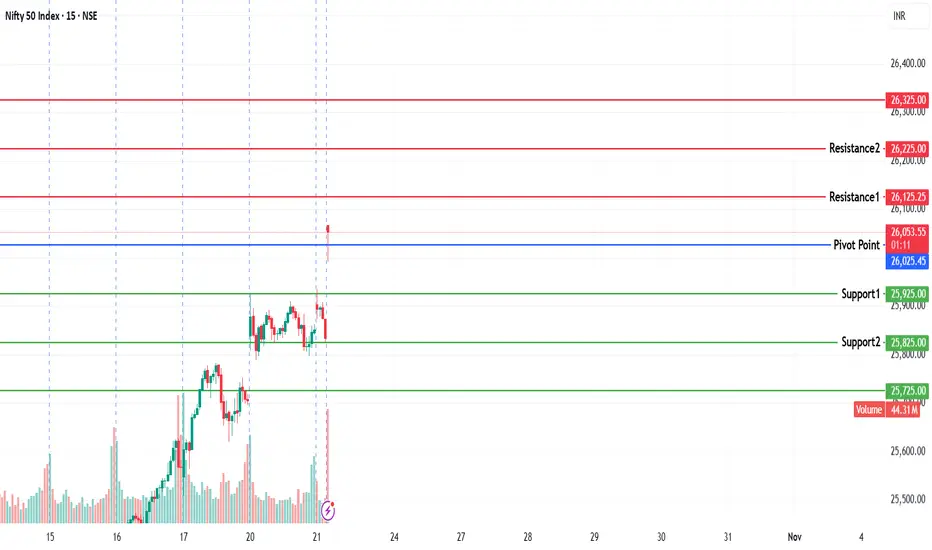
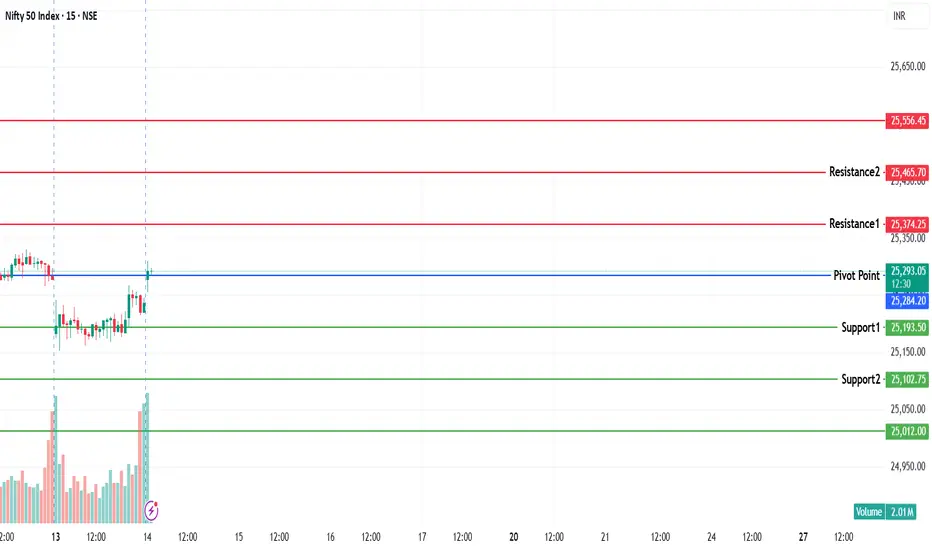
If the candle stays above the pivot point, it is considered a bullish bias; if it remains below, it indicates a bearish bias. Price may reverse near Resistance 1 or Support 1. If it moves further, the next potential reversal zone is near Resistance 2 or Support 2. If these levels are also broken, we can expect the trend.
When a support or resistance level is broken, it often reverses its role; a broken resistance becomes the new support, and a broken support becomes the new resistance.
If the range(R2-S2) is narrow, the market may become volatile or trend strongly. If the range is wide, the market is more likely to remain sideways
please like and share my idea if you find it helpful
📢 Disclaimer
I am not a SEBI-registered financial adviser.
The information, views, and ideas shared here are purely for educational and informational purposes only. They are not intended as investment advice or a recommendation to buy, sell, or hold any financial instruments.
Please consult with your SEBI-registered financial advisor before making any trading or investment decisions.
Trading and investing in the stock market involves risk, and you should do your own research and analysis. You are solely responsible for any decisions made based on this research.
Niftyoutlook
NIFTY KEY LEVELS FOR 20.10.2025NIFTY KEY LEVELS FOR 20.10.2025
Timeframe: 3 Minutes
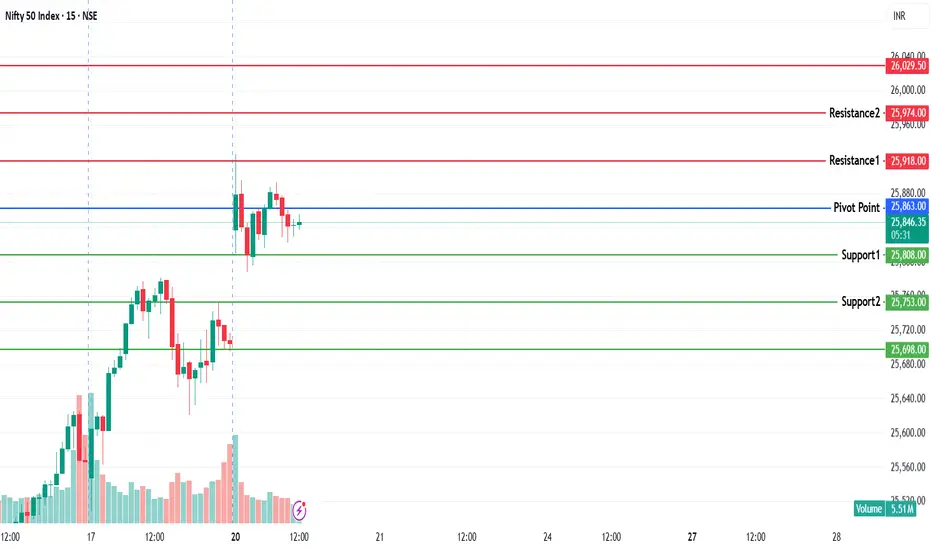
If the candle stays above the pivot point, it is considered a bullish bias; if it remains below, it indicates a bearish bias. Price may reverse near Resistance 1 or Support 1. If it moves further, the next potential reversal zone is near Resistance 2 or Support 2. If these levels are also broken, we can expect the trend.
When a support or resistance level is broken, it often reverses its role; a broken resistance becomes the new support, and a broken support becomes the new resistance.
If the range(R2-S2) is narrow, the market may become volatile or trend strongly. If the range is wide, the market is more likely to remain sideways
please like and share my idea if you find it helpful
📢 Disclaimer
I am not a SEBI-registered financial adviser.
The information, views, and ideas shared here are purely for educational and informational purposes only. They are not intended as investment advice or a recommendation to buy, sell, or hold any financial instruments.
Please consult with your SEBI-registered financial advisor before making any trading or investment decisions.
Trading and investing in the stock market involves risk, and you should do your own research and analysis. You are solely responsible for any decisions made based on this research.
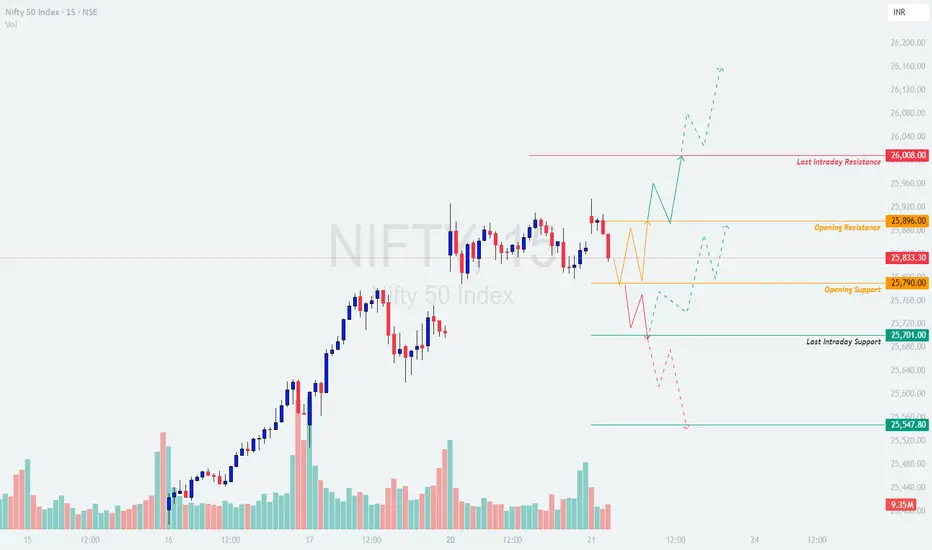
NIFTY – Professional Trading Plan for 20-Oct-2025 (educationaMarket context and key levels
Reference from your map: Opening/last intraday resistance 25,815; “No‑Trade Zone” 25,698–25,744; Opening Support Zone 25,581–25,597; Last Intraday Support 25,503; Profit‑booking zone near 26,007. The plan focuses on trading acceptance or rejection around these zones and avoiding low‑edge chop inside the No‑Trade box. 🚦
GAP UP OPEN (≥ +100 pts)
Educational logic: Positive gaps can trap shorts; the edge is to wait for acceptance above resistance, not the first spike. 📈
If open prints around 25,780–25,820 and first 5–15 minutes hold above VWAP/first high, consider a momentum long toward 25,860–25,900; partials there, then trail for 25,950–26,007 (profit‑booking zone). Stop below the retest low of 25,770–25,780.
If open jumps near 25,950–26,007, avoid chasing into supply. Prefer a pullback to 25,880–25,840; go long only on a higher low and reclaim of 25,900 with a tight stop under pullback low; targets 25,960 → 26,007.
Failure short: Rejection wicks from 25,880–26,007 followed by a 15‑min close back below 25,820. Take a tactical short to 25,744 then 25,698; cover if 25,860 is reclaimed decisively.
FLAT OPEN (±0–50 pts)
Educational logic: Neutral opens favor range trades around nearby pivots until a breakout with time + volume occurs. ⚖️
Avoid initiating inside the No‑Trade Zone 25,698–25,744 unless playing quick scalps; wait for a break and retest.
Breakout long: A 15‑min close and successful retest above 25,744 opens 25,780 → 25,815; if breadth strengthens, extend toward 25,860–25,900.
Breakdown short: Acceptance below 25,698 on retest targets 25,640–25,600, then 25,597–25,581 (Opening Support). Consider partials into 25,581 and trail for 25,503 if momentum persists.
GAP DOWN OPEN (≤ −100 pts)
Educational logic: Negative gaps near support can either trend down (“gap‑and‑go”) or reverse sharply if buyers defend key zones. 📉
Gap‑and‑go short: Open around 25,610–25,590 and failure to reclaim 25,597–25,581 on retest → short to 25,540–25,520; extend to 25,503 if sellers maintain control. Book partials into 25,503 and trail with lower highs.
Reversal long: Strong rejection from 25,503 with bullish engulfing/hammer and pickup in volume → long back to 25,560 then 25,597–25,598; shift stop to breakeven once 25,597 holds.
Bias flip: If price re-enters above 25,698 and sustains, abandon shorts and prepare for rotation through 25,744→25,780; don’t fight a reclaim day.
Execution checklist
Predefine the scenario, trigger (acceptance or clean retest), invalidation (where the idea is wrong), and first target.
Respect the No‑Trade Zone 25,698–25,744 to reduce whipsaw risk; act only after a clear break and retest.
Use structure-based stops beyond the far side of the zone; scale out at each next pivot and trail to protect gains.
Options risk management tips
Define risk : Prefer debit spreads near decision areas (bull call above 25,744/25,815; bear put below 25,698/25,581) to cap tail risk.
Size by volatility: Wider expected range → smaller position; avoid oversizing because premiums “look cheap.”
Liquidity first: Use near‑ATM, current‑week Nifty options with tight spreads; avoid illiquid deep OTMs that decay fast in chop.
Confirm before entry: Wait for 5–15 min acceptance or a clean retest hold; be cautious in the first 1–3 minutes unless trading a planned opening drive.
Manage winners: Take partials at the next pivot and trail; if IV expands, consider converting naked options into verticals to lock risk while keeping upside.
Avoid overlap: If structure flips (e.g., reclaim above 25,698 after a breakdown), exit losers decisively rather than hedging passively.
Summary
Core map: 25,698–25,744 is a No‑Trade chop box; 25,815 is resistance to beat; 25,581–25,597 is opening support; 25,503 is last intraday support; 26,007 is profit‑booking supply. Upside unlocks on acceptance above 25,744/25,815 toward 25,900–26,007, while downside strengthens below 25,698/25,581 toward 25,503. 🙂
Conclusion
Prepare three plays: continuation long above 25,744/25,815, responsive range trades around 25,698–25,744 only with clear edges, and momentum shorts below 25,698/25,581 aiming 25,503. Execute with strict invalidations, scale responsibly, and adapt quickly if pivots are reclaimed. 📊
Disclaimer: This is an educational plan, not investment advice or a trade recommendation; I am not a SEBI registered analyst .
17 Oct 2025 – 869pts profits and counting on Nifty + PostMortemNifty Stance Bullish 🐂
The last crossover signal for long was on 3rd Oct 2025, and since then, Nifty has gone up a whopping 869pts. After April 2025, this is the longest long-only streak by Nifty this year.
Surprisingly, Nifty almost crossed over on 14th October at 15.23. If the market were open for the next 32 minutes, we would have gone short. In fact, I was looking at the open on 15th, wherein we gapped up and then rallied. If the markets had fallen in the opening 16mts, we would have gone short as well, reducing our profits. This time, the long only stance had a bit of luck as well.
From the 15th Oct, the next three days also saw a one-sided upmove, almost magical. What is more surprising is that the actual portfolio's upmove is not even half of what Nifty was moving. I was checking my portfolio from the 3rd to the 17th, and it is not even up 1.7% versus Nifty, which went up 3.5%.
The last known resistance was 25681, and we are above that, meaning Nifty can directly aim at the all-time highs of 26277. If you look at the daily chart, Nifty had reconquered these levels on 30th June, but we started falling badly thereafter. For the current uptrend to continue, we must stay above 25681 on Monday.
---
If you liked this article, consider sharing it with someone who could benefit from this.
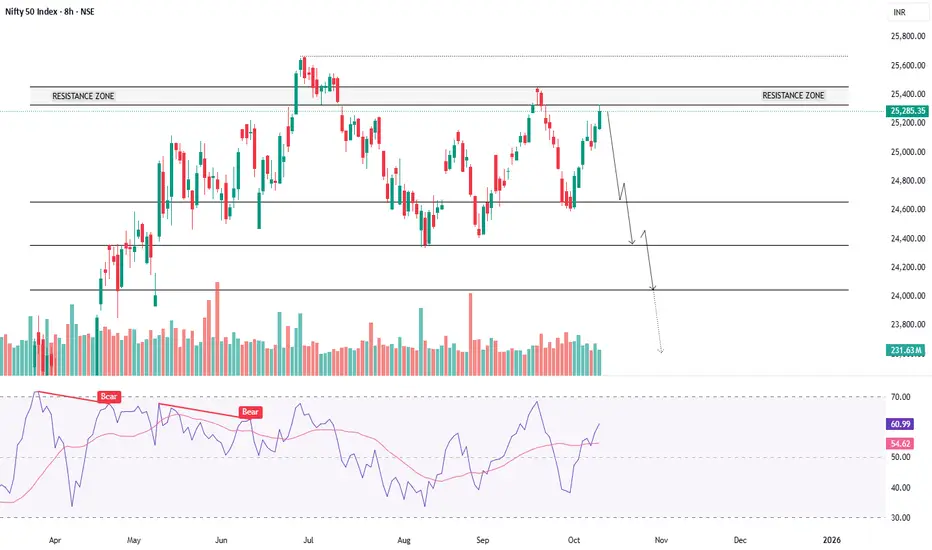
Nifty 50 Technical Analysis (October 19 To 24 , 2025)The Nifty 50 index closed at 25,709.85 INR, marking a gain of +124.55 points or +0.49% for the day.
Based on the latest data, the overall technical outlook is Strong Buy, driven by bullish signals from moving averages and technical indicators.
Key Support Levels (Aggregated):Immediate: 25,500–25,300
Strong: 24,850–25,613.58
Deep: 23,530–23,400
Key Resistance Levels (Aggregated):Immediate: 25,760
Next: –26,370.
Next Immediate Target : 26,300
Monthly Target - 28,000 - 28,500
Overall Outlook
The Nifty 50 shows robust bullish momentum in the short to medium term, with the index well above its 200-day moving average and supported by strong indicator readings. However, overbought conditions in momentum oscillators suggest possible minor pullbacks—watch for support around 25,500 - 25,300. Traders might consider buying on dips For Targets 26,300 - 28,000 - 28,500 . Always combine with risk management and fundamental factors.
Disclaimer
High Risk Investment
Trading or investing in assets like crypto, equity, or commodities carries high risk and may not suit all investors.
Analysis on this channel uses recent technical data and market sentiment from web sources for informational and educational purposes only, not financial advice. Trading involves high risks, and past performance does not guarantee future results. Always conduct your own research or consult a SEBI-registered advisor before investing or trading.
This channel, Render With Me, is not responsible for any financial loss arising directly or indirectly from using or relying on this information.
NIFTY KEY LEVELS FOR 17.10.2025NIFTY KEY LEVELS FOR 17.10.2025
Timeframe: 3 Minutes
If the candle stays above the pivot point, it is considered a bullish bias; if it remains below, it indicates a bearish bias. Price may reverse near Resistance 1 or Support 1. If it moves further, the next potential reversal zone is near Resistance 2 or Support 2. If these levels are also broken, we can expect the trend.
When a support or resistance level is broken, it often reverses its role; a broken resistance becomes the new support, and a broken support becomes the new resistance.
If the range(R2-S2) is narrow, the market may become volatile or trend strongly. If the range is wide, the market is more likely to remain sideways
please like and share my idea if you find it helpful
📢 Disclaimer
I am not a SEBI-registered financial adviser.
The information, views, and ideas shared here are purely for educational and informational purposes only. They are not intended as investment advice or a recommendation to buy, sell, or hold any financial instruments.
Please consult with your SEBI-registered financial advisor before making any trading or investment decisions.
Trading and investing in the stock market involves risk, and you should do your own research and analysis. You are solely responsible for any decisions made based on this research.
NIFTY – Professional Trading Plan for 17-Oct-2025NIFTY – Professional Trading Plan for 17-Oct-2025 (educational)
Market context and key levels
Reference from your map: Opening/last intraday resistance 25,659–25,674, strong resistance zone 25,720–25,740, opening pivot 25,549, last intraday supports 25,426 and 25,363. Momentum remains constructive while above 25,549; sustained acceptance above 25,674 is needed for continuation. 🚦
GAP UP OPEN (≥ +100 pts)
Educational logic: Positive gaps can trap late shorts; edge comes from waiting for acceptance above resistance (time + volume) and then riding continuation rather than chasing the first spike. 📈
If open lands around or just above 25,659–25,674 and the first 5–15 minutes hold above VWAP/first high, consider a momentum long toward 25,700–25,720; scale partials, then trail for 25,740. Stop below the retest low of 25,650 zone.
If open jumps near 25,720–25,740, avoid impulsive buys into strong resistance. Prefer a pullback to 25,680–25,660; go long only on a higher low plus reclaim of 25,700 with stop under pullback low; targets 25,720–25,740 and possible extension if breadth expands.
Failure short: Rejection wicks from 25,720–25,740 followed by a 15‑min close back below 25,680. Take a tactical short toward 25,659 → 25,600–25,549; exit if 25,700 is reclaimed decisively.
FLAT OPEN (±0–50 pts)
Educational logic: Neutral opens favor range trades around nearby pivots until a breakout confirms with acceptance. ⚖️
Range buy: Look for reversal signals near 25,560–25,549 with risk below the session swing; targets 25,620 → 25,659–25,674.
Breakout buy: A 15‑min close and successful retest above 25,674 opens 25,700–25,720; scale out into 25,740 if momentum broadens.
Breakdown short: Acceptance below 25,549 on retest targets 25,500–25,426; if sellers maintain control, extend to 25,380–25,363. Trail using successive lower highs.
GAP DOWN OPEN (≤ −100 pts)
Educational logic: Negative gaps near support often lead to “gap‑and‑go” trend days if acceptance stays below, or sharp reversals if buyers defend key zones. 📉
Gap‑and‑go short: Open around 25,470–25,450 and failure to reclaim 25,549 on retest → short to 25,426; book partials, then trail for 25,380–25,363.
Reversal long: Strong rejection from 25,426–25,363 (long lower wicks/engulfing) → long back to 25,500 then 25,549; move stop to breakeven once 25,549 holds.
Bias flip: If price re-enters above 25,659 after a weak open and sustains, abandon shorts and prepare for rotation to 25,700–25,720; don’t fight a reclaim day.
Execution checklist
Predefine scenario, trigger (acceptance/retest), invalidation (where the idea is wrong), and first target.
Key decision areas: 25,549 support/pivot, 25,659–25,674 resistance, and 25,720–25,740 strong resistance; 25,426/25,363 supports. Trade the reaction to zones, not the exact number.
Use structure-based stops beyond the far side of the zone; scale out at the next pivot and trail to protect gains.
Options risk management tips
Define risk : Prefer debit spreads near zones (bull call above 25,674; bear put below 25,549) to cap tail risk on volatile gap opens.
Size by volatility: Wider expected range → smaller position; avoid oversizing because options look “cheap.”
Liquidity first: Use near‑ATM, current‑week Nifty options with tight spreads; avoid illiquid deep OTMs that decay fast if rangebound.
Confirm before entry: Use 5–15 min acceptance or clean retest holds to avoid false breaks; be cautious in the first 1–3 minutes unless trading a planned opening drive.
Manage winners: Take partials at first pivot; if IV expands, consider converting naked calls/puts into verticals to lock risk while keeping upside.
Avoid overlap: If structure flips (e.g., reclaim of 25,659 after breakdown), exit losers decisively instead of hedging passively.
Summary
Primary map: 25,549 is the intraday pivot; 25,659–25,674 is the gate to continuation; 25,720–25,740 is strong resistance. Upside opens on acceptance above 25,674 toward 25,720–25,740; downside strengthens below 25,549 toward 25,426 and 25,363. 🙂
Conclusion
Prepare three plays: continuation long above 25,674, responsive range trades around 25,549/25,659, and momentum shorts below 25,549 aiming 25,426–25,363. Execute with clear invalidations, scale responsibly, and adapt quickly if pivots are reclaimed. 📊
Disclaimer: This is an educational plan, not investment advice or a trade recommendation; I am not a SEBI registered analyst .
NIFTY The Nifty has moved up nicely after opening strong above the trend line. The first resistance is at 25,650, and the second is near the all-time high. Let's see what happens tomorrow, as it's Friday. Hopefully, Donald Trump isn't upset or planning any actions that could turn the market bearish.
NIFTY KEY LEVELS FOR 16.10.2025NIFTY KEY LEVELS FOR 16.10.2025
Timeframe: 3 Minutes
If the candle stays above the pivot point, it is considered a bullish bias; if it remains below, it indicates a bearish bias. Price may reverse near Resistance 1 or Support 1. If it moves further, the next potential reversal zone is near Resistance 2 or Support 2. If these levels are also broken, we can expect the trend.
When a support or resistance level is broken, it often reverses its role; a broken resistance becomes the new support, and a broken support becomes the new resistance.
If the range(R2-S2) is narrow, the market may become volatile or trend strongly. If the range is wide, the market is more likely to remain sideways
please like and share my idea if you find it helpful
📢 Disclaimer
I am not a SEBI-registered financial adviser.
The information, views, and ideas shared here are purely for educational and informational purposes only. They are not intended as investment advice or a recommendation to buy, sell, or hold any financial instruments.
Please consult with your SEBI-registered financial advisor before making any trading or investment decisions.
Trading and investing in the stock market involves risk, and you should do your own research and analysis. You are solely responsible for any decisions made based on this research.
NIFTY – Professional Trading Plan for 16-Oct-2025NIFTY 50 – Professional Trading Plan for 16-Oct-2025 (educational)
Market context and key levels
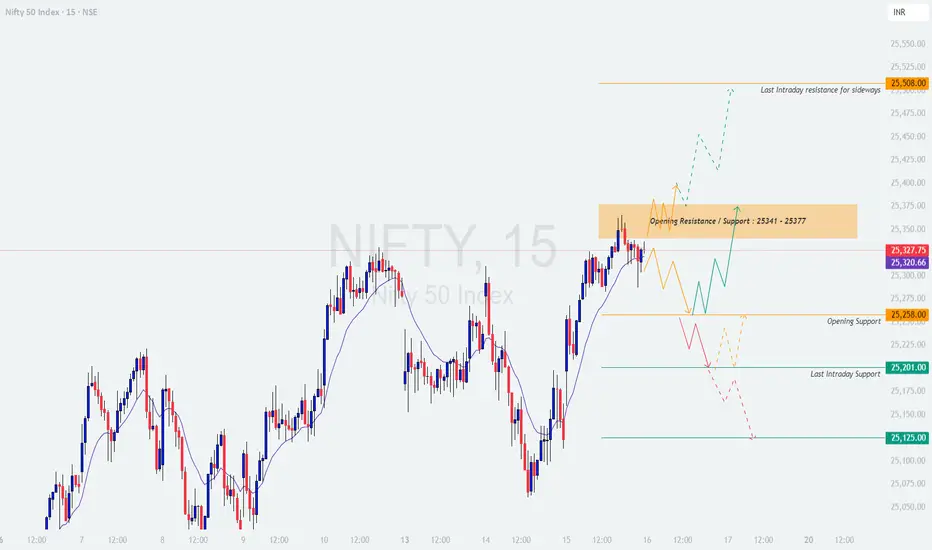
Reference map from 15‑Oct close: price is hovering around 25,320 with an opening resistance/support band at 25,341–25,377; immediate supports at 25,258 (opening support) and 25,201 (last intraday support), with a deeper line in the sand near 25,125. Trend bias is constructive above 25,258 and momentum unlocks only on acceptance above 25,377; sustained loss of 25,201–25,125 flips control to bears. 🚦
GAP UP OPEN (≥ +100 pts)
Educational logic: A strong positive gap often traps shorts from the prior day. The edge is to wait for “acceptance” (time + volume) above resistance rather than chasing a spike.
If open is inside or just above 25,341–25,377 and the first 5–15 minutes hold above VWAP, consider a momentum long toward 25,420–25,450; partial profit inside the band, then trail for 25,508 (prior sideways resistance marker). Stop below the retest low of the zone.
If open is directly near 25,480–25,520, avoid chasing into resistance. Prefer a pullback to 25,377/25,360. Go long only on a higher low plus reclaim of 25,400 with a tight stop under the pullback low; targets 25,480 → 25,508.
Failure short: Rejection wicks from 25,400–25,480 followed by a 15‑min close back below 25,360. Take a tactical short to 25,341 → 25,300–25,258. Exit if price reclaims 25,377 with strength.
FLAT OPEN (±0–50 pts)
Educational logic: Neutral open favors range trading between nearby pivots until the market shows acceptance beyond the range. ⚖️
Range buy: Look for reversal candles near 25,280–25,258 with risk below the session swing; targets 25,341–25,360, then 25,377 if acceptance builds.
Breakout buy: A 15‑min close and retest hold above 25,377 opens 25,400–25,450; scale out on the way to 25,508 if momentum broadens.
Breakdown short: Acceptance below 25,258 on retest aims 25,220–25,201; if sellers keep control, extend to 25,150–25,125. Manage risk by moving stops above the last lower high.
GAP DOWN OPEN (≤ −100 pts)
Educational logic: Negative gaps near support can lead to “gap‑and‑go” trend days or sharp reversals if responsive buyers defend key zones. 📉
Gap‑and‑go short: Open near 25,210–25,201 and failure to reclaim 25,201 on retest → short to 25,150, then 25,125. Take partials at each target; trail using 5–15 min lower highs.
Reversal long: Strong rejection from 25,125 (long lower wicks/engulfing) → long back to 25,201 then 25,258; shift stop to breakeven once 25,201 is accepted.
Bias flip: If price re-enters above 25,258 and sustains, abandon shorts and prepare for rotation to 25,341–25,377. Avoid fighting a reclaim day—trade with the acceptance, not the open.
Execution checklist
Predefine scenario, entry trigger (acceptance/retest), invalidation (where the idea is wrong), and first target.
Treat 25,258, 25,341–25,377, and 25,508 as decision areas. Trade the reaction to these levels rather than the level itself.
Use structure-based stops: beyond the last swing or the far side of the zone. Scale out at the next pivot and trail to protect gains.
Options risk management tips
Define risk : Prefer debit spreads over naked options at key zones (bull call above 25,377; bear put below 25,258) to cap tail risk on volatile opens.
Size by volatility: Wider expected ranges require smaller position size; don’t oversize because premiums look “cheap.”
Liquidity first: Stick to near‑ATM, current‑week options with tight spreads; avoid far OTM contracts that decay rapidly if the market ranges.
Enter on confirmation: Use a 15‑min acceptance or a clean retest hold to avoid false breakouts; avoid entries during the first 1–3 minutes unless trading a planned opening drive.
Manage winners: Take partials at the first pivot; if IV expands in your favor, consider converting naked calls/puts into verticals to lock risk while keeping upside.
Event awareness: Watch for midday global cues; if structure flips (e.g., reclaim of 25,258 after a breakdown), exit losers decisively instead of hedging passively.
Summary
Primary range: 25,258 support to 25,377 resistance. Upside continuation requires acceptance above 25,377 to target 25,400–25,450 and potentially 25,508. Downside momentum strengthens on acceptance below 25,258 toward 25,201 and 25,125. Trade level‑to‑level, let acceptance guide direction, and prioritize defined risk. 😊
Conclusion
Prepare three plays: continuation long above 25,377, responsive range trades around 25,258/25,341, and momentum shorts below 25,258 with extensions to 25,201–25,125. Execute with clear invalidations, scale responsibly, and adapt quickly if key pivots are reclaimed. 📊
Disclaimer: This is an educational plan, not investment advice or a trade recommendation; I am not a SEBI registered analyst .
NIFTY KEY LEVELS FOR 15.10.2025NIFTY KEY LEVELS FOR 15.10.2025
Timeframe: 3 Minutes
If the candle stays above the pivot point, it is considered a bullish bias; if it remains below, it indicates a bearish bias. Price may reverse near Resistance 1 or Support 1. If it moves further, the next potential reversal zone is near Resistance 2 or Support 2. If these levels are also broken, we can expect the trend.
When a support or resistance level is broken, it often reverses its role; a broken resistance becomes the new support, and a broken support becomes the new resistance.
If the range(R2-S2) is narrow, the market may become volatile or trend strongly. If the range is wide, the market is more likely to remain sideways
please like and share my idea if you find it helpful
📢 Disclaimer
I am not a SEBI-registered financial adviser.
The information, views, and ideas shared here are purely for educational and informational purposes only. They are not intended as investment advice or a recommendation to buy, sell, or hold any financial instruments.
Please consult with your SEBI-registered financial advisor before making any trading or investment decisions.
Trading and investing in the stock market involves risk, and you should do your own research and analysis. You are solely responsible for any decisions made based on this research.
NIFTY Analysis 15 october 2025 ,Daily Morning update at 9 amNifty spot is in overbought zone in chart
Market is consolidating to create space for next move
For last 3 sessions, Nifty is moving sideways
Indicates accumulation and range formation
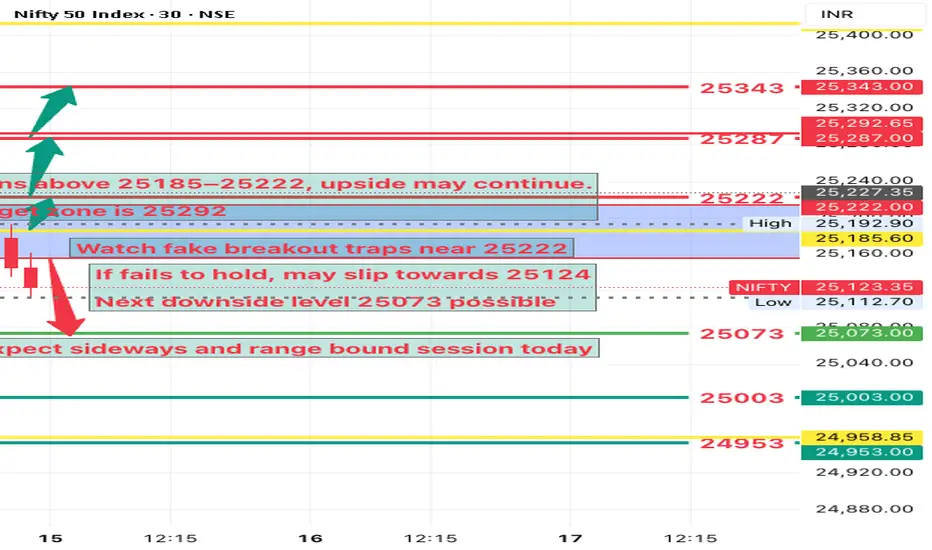
Expected open around 25185
If sustains above 25185–25222, upside may continue
Next target zone is 25292
Watch for sustainability above 25182 level.
If fails to hold, may slip towards 25125
Next downside level 25073 possible
Expect sideways and range bound session today
Support levels 25073, 25003, 24953.
Resistance levels 25222, 25287, 25343
Watch false breakout traps near 25222
Confirm direction using 1H candle close. and use your mind
NIFTY : Trading levels and Plan for 15-Oct-2025NIFTY 50 – Professional Trading Plan for 15-Oct-2025 (educational)
Market context and key levels
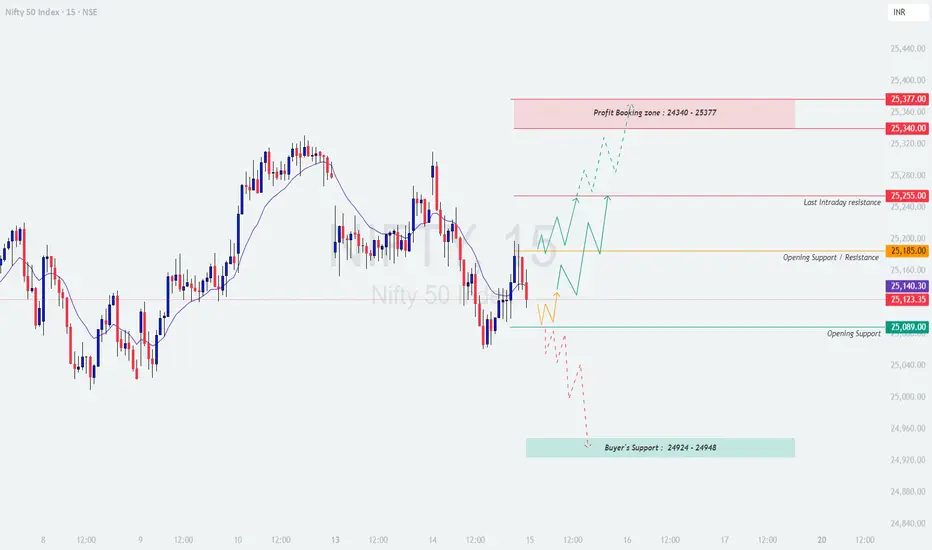
Nifty closed near 25,145 on 14-Oct after a mild decline, with immediate supports at 25,089/25,060 and deeper demand around 24,950–24,924. Sentiment is balanced; expect two-way moves early. 🙂
Overhead resistances are 25,185 (opening pivot), 25,255–25,268 (last intraday barrier), 25,326, and the supply/profit zone at 25,340–25,450.
Bias roadmap: Momentum unlocks only on acceptance beyond 25,326; bearish momentum strengthens below 25,060 toward 24,950 and 24,924–24,948.
GAP UP OPEN (≥ +100 pts)
Educational logic: Gaps higher can trap shorts; wait for acceptance above resistance rather than chasing the first spike.
If open ≥ 25,245–25,260 and first 5–15 min high holds above VWAP, plan a momentum buy toward 25,300 → 25,326, scale partials into 25,340–25,360; trail for 25,422 if strength persists.
If open directly inside 25,340–25,450 supply, avoid chasing; wait for a pullback to 25,300–25,326. Go long only on a higher low plus reclaim of 25,340 with stop below the retest low.
Failure short: Bearish rejection wicks in 25,340–25,450 followed by a 15‑min close back below 25,300. Short to 25,255/25,268 and 25,200–25,185; exit if 25,326 is reclaimed with strength.
FLAT OPEN (±0–50 pts)
Educational logic: Neutral opens favor range trading around nearby pivots until a confirmed breakout with volume. ⚖️
Range buy: Look for reversal signals near 25,100–25,150 aiming for 25,255 then 25,268/25,326; keep stops tight under the reversal low.
Breakout buy: Sustained 15‑min close above 25,326 with rising volume/market breadth opens 25,340–25,450; scale out inside that zone, trail below last swing low.
Breakdown short: Loss of 25,060 with acceptance below on retest targets 24,950; extension possible to 24,924–24,948 buyer zone. Cover partials into these supports and trail.
GAP DOWN OPEN (≤ −100 pts)
Educational logic: Negative gaps near support can either trend down (“gap-and-go”) or reverse sharply if buyers defend key zones. 📉
Gap-and-go short: Open around 25,030–25,060 and failure to reclaim 25,060 on retest → short toward 24,950; manage risk by trailing as price approaches 24,924–24,948.
Reversal long: Strong rejection from 24,924–24,948 (bullish engulfing/inside-bar break) → long back to 25,060 then 25,185; move stop to breakeven once 25,060 is accepted.
Bias flip: If price re-enters and sustains above 25,185 intraday, switch to long bias for 25,255/25,268 → 25,326; avoid fighting a reclaim day.
Execution checklist
Plan the open : Define your initial scenario, invalidation level, and first target before the bell.
Map accept/reject: Treat 25,060, 25,185, 25,255–25,268, 25,326, and 25,340–25,450 as decision points; act only on acceptance or rejection, not touches.
Use structure: Place stops beyond the structure that invalidates your idea (last swing or the other side of the zone).
Scale management: Take partials at the next pivot; trail stops bar-by-bar or below/above last swing to lock gains.
Options risk management tips
Define risk upfront : Prefer debit spreads (bull call above 25,326, bear put below 25,060) to cap tail risk on volatile opens.
Size by volatility: Wider stops need smaller size; don’t oversize just because options look “cheap.”
Choose liquidity: Trade near-ATM, same-week options for intraday; avoid illiquid deep OTMs that decay fast in ranges.
Time entries: Enter after acceptance (15‑min close or retest hold) to reduce false breaks.
Manage winners: Scale at first target; convert naked options into spreads if IV expands in your favor.
Event watch: Stay alert to midday global cues; if structure flips (e.g., reclaim of 25,185), exit losers decisively instead of hedging passively.
Summary
Inside day plan favors responsive trades between 25,060–25,326. Upside expansion requires acceptance above 25,326 toward 25,340–25,450; downside momentum strengthens below 25,060 toward 24,950 and 24,924–24,948.
Trade level-to-level, let acceptance guide direction, and prioritize defined-risk option structures with disciplined scaling. 🚦
Conclusion
Prepare three plays: momentum continuation above 25,326, range trades around 25,185/25,255, and breakdowns below 25,060. Respect invalidations, scale responsibly, and adapt if the market reclaims key pivots. 📊
Disclaimer: This is an educational plan, not investment advice or a trade recommendation; I am not a SEBI registered analyst .
NIFTY KEY LEVELS FOR 14.10.2025NIFTY KEY LEVELS FOR 14.10.2025
Timeframe: 3 Minutes
If the candle stays above the pivot point, it is considered a bullish bias; if it remains below, it indicates a bearish bias. Price may reverse near Resistance 1 or Support 1. If it moves further, the next potential reversal zone is near Resistance 2 or Support 2. If these levels are also broken, we can expect the trend.
When a support or resistance level is broken, it often reverses its role; a broken resistance becomes the new support, and a broken support becomes the new resistance.
If the range(R2-S2) is narrow, the market may become volatile or trend strongly. If the range is wide, the market is more likely to remain sideways
please like and share my idea if you find it helpful
📢 Disclaimer
I am not a SEBI-registered financial adviser.
The information, views, and ideas shared here are purely for educational and informational purposes only. They are not intended as investment advice or a recommendation to buy, sell, or hold any financial instruments.
Please consult with your SEBI-registered financial advisor before making any trading or investment decisions.
Trading and investing in the stock market involves risk, and you should do your own research and analysis. You are solely responsible for any decisions made based on this research.
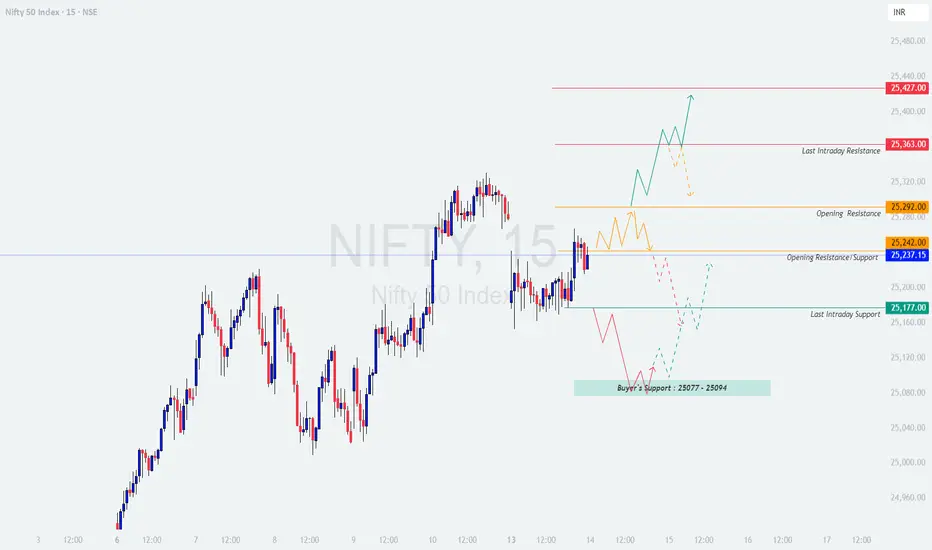
NIFTY : Trading levels and plan for 14-Oct-2025NIFTY TRADING PLAN – 14-Oct-2025
📈 Chart Timeframe: 15-Min | Analysis by LiveTradingBox
🔹 Key Zones:
🟥 Last Intraday Resistance: 25,363 – 25,427
🟧 Opening Resistance: 25,292
🟨 Opening Resistance/Support: 25,242
🟩 Last Intraday Support: 25,177
🟦 Buyer’s Support Zone: 25,077 – 25,094
🚀 Scenario 1: Gap-Up Opening (100+ Points Above Previous Close)
If Nifty opens around or above the 25,292 – 25,363 resistance zone, traders should stay cautious initially. A gap-up above this area without immediate follow-through often attracts profit booking.
Allow the first 30 minutes for price stability and observe whether the index sustains above 25,363.
A strong candle close above 25,363 with rising volume could trigger a momentum move toward 25,427 and possibly 25,480 intraday.
However, if the index fails to hold above 25,292, expect a retest towards 25,242 where intraday buying opportunities could emerge again.
Aggressive traders can look for quick call scalps only after confirmation above 25,363 with a defined stop loss just below 25,300.
🟢 Educational Note: In gap-up scenarios, overextended prices often face supply pressure. Patience during the first retracement gives a safer entry aligned with trend continuation.
⚖️ Scenario 2: Flat Opening Near 25,230 – 25,250
A flat opening around the Opening Resistance/Support Zone (25,242) indicates an indecisive sentiment. This level is a critical pivot that may dictate intraday direction.
If Nifty sustains above 25,242, bulls may gradually push toward 25,292, where resistance might emerge.
A clean breakout above 25,292 can open the path to 25,363, followed by 25,427 if momentum persists.
Conversely, a break below 25,177 could invite short-term selling toward the Buyer’s Support Zone (25,077 – 25,094).
Avoid trading inside the narrow 25,177–25,242 range; instead, wait for breakout confirmation in either direction.
🟠 Educational Tip: During flat openings, the market often traps both sides. Let the first direction be confirmed before taking a position, and avoid chasing initial candles.
🔻 Scenario 3: Gap-Down Opening (100+ Points Below Previous Close)
If Nifty opens below 25,120, it enters the Buyer’s Support Zone (25,077 – 25,094). This area is where dip-buyers may become active.
Watch for bullish reversal candles or a higher low structure forming around 25,080 to consider call entries.
A rebound from this support could push the index toward 25,177 first, and if sustained, 25,242.
However, if the index fails to hold above 25,077, further downside pressure may test 25,020–25,000 zones.
Maintain strict stop losses below 25,070 on long positions to manage risk effectively.
🔴 Educational Note: Gap-downs often trigger panic selling, but experienced traders know that strong support zones are ideal for mean-reversion setups with limited downside exposure.
💡 Risk Management Tips for Options Traders
Always define your maximum risk per trade (1–2% of capital).
Avoid trading both CE & PE simultaneously unless hedging.
Prefer trading after initial volatility cools (post 9:45 AM).
Use trailing stop losses once in profit to lock gains.
Do not average losing positions; focus on quality setups only.
Consider weekly options only for momentum confirmation setups.
🧩 Summary & Conclusion
Nifty remains in a neutral-to-bullish tone as long as 25,177 holds. The 25,292–25,363 zone will decide whether the next move extends higher or reverses lower. Any dip toward the 25,077–25,094 area could attract strong buyers if the broader trend stays intact.
Traders should stay disciplined, respect intraday levels, and trade with confirmation rather than anticipation. Remember: Consistency comes from control, not prediction.
⚠️ Disclaimer:
I am not a SEBI-registered analyst. The above analysis is for educational purposes only. Please do your own research or consult a certified financial advisor before making any trading decisions.
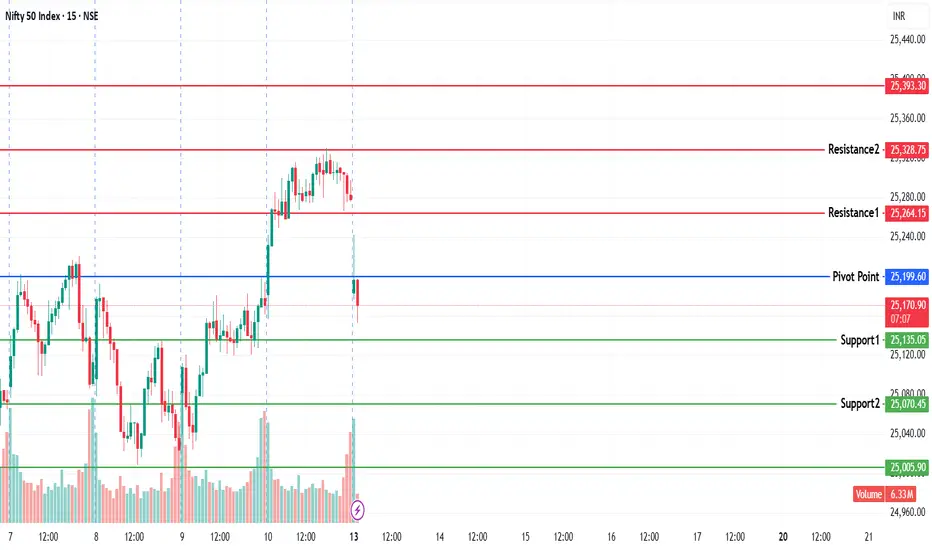
NIFTY KEY LEVELS FOR 13.10.2025NIFTY KEY LEVELS FOR 13.10.2025
Timeframe: 3 Minutes
If the candle stays above the pivot point, it is considered a bullish bias; if it remains below, it indicates a bearish bias. Price may reverse near Resistance 1 or Support 1. If it moves further, the next potential reversal zone is near Resistance 2 or Support 2. If these levels are also broken, we can expect the trend.
When a support or resistance level is broken, it often reverses its role; a broken resistance becomes the new support, and a broken support becomes the new resistance.
If the range(R2-S2) is narrow, the market may become volatile or trend strongly. If the range is wide, the market is more likely to remain sideways
please like and share my idea if you find it helpful
📢 Disclaimer
I am not a SEBI-registered financial adviser.
The information, views, and ideas shared here are purely for educational and informational purposes only. They are not intended as investment advice or a recommendation to buy, sell, or hold any financial instruments.
Please consult with your SEBI-registered financial advisor before making any trading or investment decisions.
Trading and investing in the stock market involves risk, and you should do your own research and analysis. You are solely responsible for any decisions made based on this research.
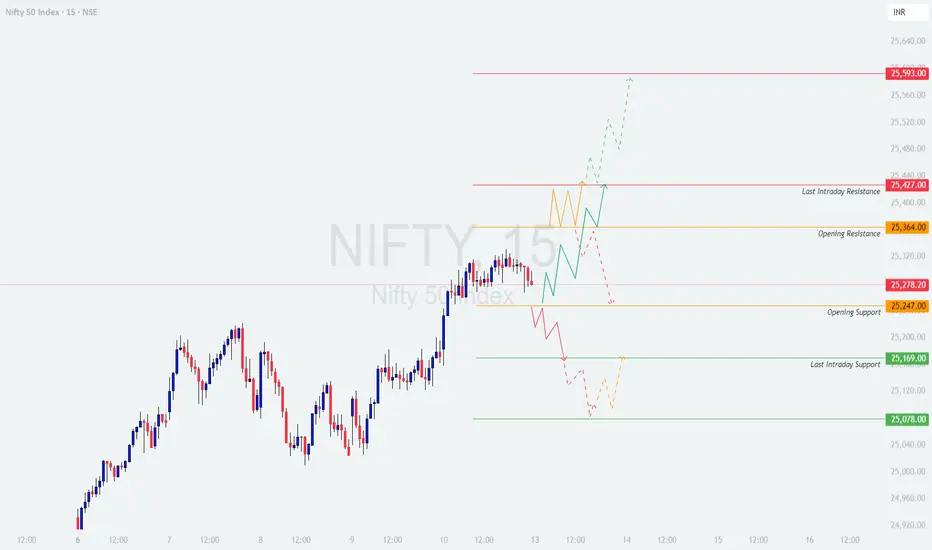
NIFTY : Trading levels and Plan for 13-Oct-2025NIFTY TRADING PLAN – 13-Oct-2025
📊 Chart Timeframe: 15-Minutes
📍 Last Close: 25,278.20 | 🔽 -6.00 pts (-0.02%)
📅 Analysis Type: Psychological + Technical Levels-Based
🔍 Key Technical Levels to Watch
🟥 Last Intraday Resistance: 25,427
🟧 Opening Resistance: 25,364
🟠 Opening Support: 25,247
🟩 Last Intraday Support: 25,169
🟢 Major Support Zone: 25,078
🚀 Scenario 1 – Gap Up Opening (100+ pts above 25,380)
If Nifty opens above 25,380, it will enter a near-resistance zone between 25,364 – 25,427, making the early session crucial for direction confirmation.
In case the index sustains above 25,427 for 15–30 minutes with supportive volume, it could trigger a momentum rally toward 25,520–25,593 levels.
Avoid aggressive long entries immediately at open — instead, wait for a controlled pullback or retest near 25,364–25,400, which can offer a low-risk long entry zone.
If rejection candles appear near 25,427, it may indicate short-term profit booking. In that case, downside retracement toward 25,247 can occur.
A sustained failure to hold above 25,364 post-gap-up could turn the session choppy, so trade with confirmation.]
💡 Educational Insight:
Gap-up openings near resistance zones often invite emotional buying. Wait for the market to confirm strength through structure — not just price. Watch volume and candle behavior closely before acting.
⚖️ Scenario 2 – Flat Opening (Around 25,250 ± 50 pts)
A flat opening around the previous close keeps Nifty within the decision zone between 25,247 – 25,364.
If Nifty sustains above 25,364, bulls may regain control with upside potential toward 25,427 and then 25,593.
Failure to hold above 25,247 can trigger mild profit booking, dragging prices toward 25,169 — the last intraday support.
A bounce from 25,169 can act as a low-risk buy setup with strict stop loss below 25,078.
If a 15-min candle closes below 25,078, it confirms short-term weakness; sellers can then aim for 25,000–24,950 zones.]
🧠 Educational Tip:
Flat openings give the best opportunity to follow structure-based breakouts. Don’t predict — let price action dictate direction. Wait for a clear breakout above 25,364 or breakdown below 25,169 for a decisive trade setup.
📉 Scenario 3 – Gap Down Opening (100+ pts below 25,180)
If Nifty opens below 25,180, sentiment will lean negative, but watch how it reacts near the 25,078 major support zone.
A bounce from 25,078 can offer a relief rally toward 25,169–25,247, especially if short covering kicks in.
However, a breakdown and 15-min close below 25,078 may extend weakness toward 24,950–24,900.
Avoid chasing shorts aggressively at open — instead, wait for a pullback toward resistance near 25,169–25,200 to re-enter with better risk-reward.
The key here is patience — let the initial volatility settle before entering positions.]
💬 Educational Note:
Gap-down openings near major support often create traps. Let confirmation come through a strong close — don’t rely solely on the first few minutes of panic or excitement.
🛡️ Risk Management Tips for Options Traders
Limit your risk to 2%–3% of total trading capital per trade.
Use 15-min or hourly candle close to confirm breakouts and stop losses.
Trade ATM or slightly ITM options to minimize time decay.
Avoid over-leveraging during high-volatility gap openings.
Consider using spreads (Bull Call / Bear Put) to hedge against rapid time decay.
Book partial profits once your trade achieves a 1:1 risk/reward to protect gains.
Avoid holding options beyond 2:45 PM, as theta decay intensifies in the final hour. ⏳]
📊 Summary & Conclusion
Nifty continues to hover in a tight consolidation range, with key resistance at 25,427 and support at 25,078.
A breakout above 25,427 can trigger fresh bullish momentum toward 25,593, while a breakdown below 25,078 may open the path for 24,950.
Patience, disciplined execution, and confirmation-based entries are essential — avoid emotional trading during gap openings.
Remember: The best trades are those backed by both structure and timing, not prediction.]
🎯 Focus Zones for 13-Oct-2025:
🟩 Buyers’ Zone: 25,169 → 25,078
🟥 Sellers’ Zone: 25,364 → 25,427
📢 Disclaimer:
I am not a SEBI-registered analyst . This analysis is meant purely for educational and informational purposes. Traders are advised to perform their own research or consult a certified financial advisor before making trading decisions.
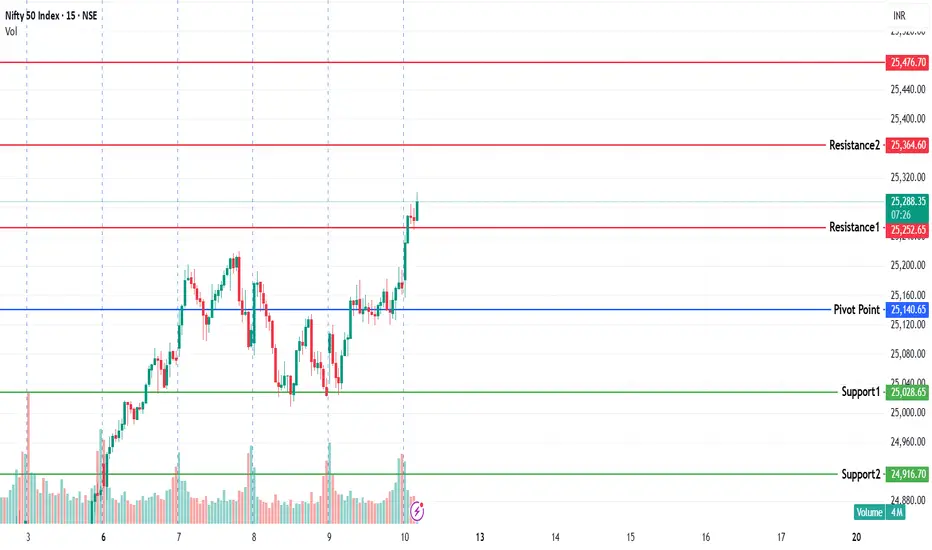
NIFTY KEY LEVELS FOR 10.10.2025NIFTY KEY LEVELS FOR 10.10.2025
Timeframe: 3 Minutes
If the candle stays above the pivot point, it is considered a bullish bias; if it remains below, it indicates a bearish bias. Price may reverse near Resistance 1 or Support 1. If it moves further, the next potential reversal zone is near Resistance 2 or Support 2. If these levels are also broken, we can expect the trend.
When a support or resistance level is broken, it often reverses its role; a broken resistance becomes the new support, and a broken support becomes the new resistance.
If the range(R2-S2) is narrow, the market may become volatile or trend strongly. If the range is wide, the market is more likely to remain sideways
please like and share my idea if you find it helpful
📢 Disclaimer
I am not a SEBI-registered financial adviser.
The information, views, and ideas shared here are purely for educational and informational purposes only. They are not intended as investment advice or a recommendation to buy, sell, or hold any financial instruments.
Please consult with your SEBI-registered financial advisor before making any trading or investment decisions.
Trading and investing in the stock market involves risk, and you should do your own research and analysis. You are solely responsible for any decisions made based on this research.
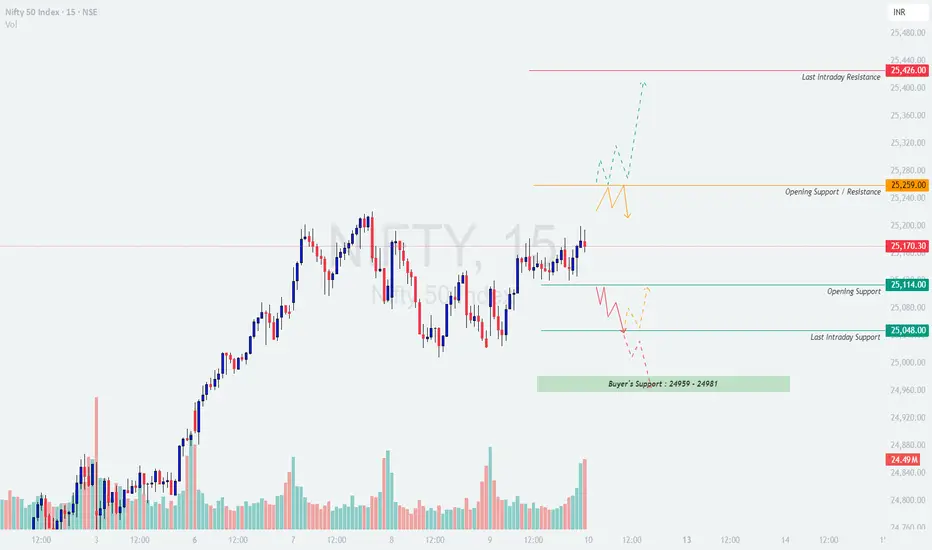
NIFTY : Trading levels and plan for 10-10-2025💼 NIFTY TRADING PLAN – 10-Oct-2025
📊 Chart Timeframe: 15-min
📍 Last Close: 25,170.30 | 🔻 Change: -7.40 pts (-0.03%)
📅 Analysis Based on Psychological & Technical Levels
🔍 Key Technical Zones
🟧 Opening Support / Resistance: 25,259
🟥 Last Intraday Resistance: 25,426
🟩 Opening Support: 25,114
🟢 Last Intraday Support: 25,048
💚 Buyer’s Support Zone: 24,959 – 24,981
🚀 Scenario 1 – Gap Up Opening (100+ pts above 25,270)
If Nifty opens near or above 25,270, it will directly approach the opening resistance zone.
A sustained move above 25,259 with strong green candles could trigger momentum buying toward 25,426, which is the last intraday resistance.
Avoid chasing the first 15 minutes — wait for a minor pullback to 25,259–25,280 and look for support confirmation before going long.
If Nifty fails to sustain above 25,259, expect short-term profit booking that can drag prices toward 25,170 or even 25,114.
Fresh shorts should be avoided until there’s a confirmed reversal candle near 25,400–25,426, as this area may trigger volatility and fake breakouts.]
🧠 Educational Insight:
Gap-up openings near resistance often create a “trap zone.” Patience is key — let the price test and confirm breakout strength before entering directional trades.
⚖️ Scenario 2 – Flat Opening (Around 25,150 ± 50 pts)
A flat start indicates market indecision and provides both long and short opportunities based on level reactions.
If the index sustains above 25,170–25,200, buyers may attempt to push prices toward 25,259 → 25,426. Watch for volume expansion to confirm momentum.
If Nifty rejects 25,259, expect a dip toward 25,114–25,048, which will act as short-term intraday supports.
Buyers can look for reversal confirmation from 25,048–25,114 zone for potential bounce trades.
A decisive hourly close below 25,048 may shift intraday trend bearish toward 24,981–24,959 (Buyer’s Support Zone).]
💡 Educational Note:
Flat openings favor disciplined traders who react to confirmation rather than prediction. Combining 15-min chart patterns with volume clues gives higher probability entries.
📉 Scenario 3 – Gap Down Opening (100+ pts below 25,060)
If Nifty opens around or below 25,060, it enters the support testing zone.
Monitor early reactions near 25,048–25,020. A quick recovery from this area can lead to a short-covering rally back toward 25,114–25,170.
If the index sustains below 25,020, expect a gradual slide toward the Buyer’s Support Zone (24,959–24,981) — a critical area where bulls might attempt to defend.
Failure to hold 24,959 could invite further downside toward 24,880–24,840, so avoid catching a falling knife without confirmation.
Intraday traders should prefer trading only on sustained 15-min candle closes below key levels to avoid whipsaws.]
🧠 Educational Insight:
Gap-down openings can trigger emotional decisions — let the first 30 minutes unfold before entering trades. Reversal setups are only valid with clear rejection wicks or bullish engulfing candles near key supports.
🛡️ Risk Management Tips for Options Traders
Limit trade exposure to 2–3% of total capital per trade.
Always use a stop loss based on 15-min candle close to avoid fake breakouts.
Prefer ATM or slightly ITM options for better delta and reduced time decay.
Avoid holding losing positions after 2:45 PM, as premium decay accelerates.
When volatility rises, use spreads (Bull Call / Bear Put) to manage theta and vega risk.
Never average losing trades — protect capital before chasing profit. 💎
📊 Summary & Conclusion
Nifty remains in a neutral-to-bullish structure, as long as it sustains above 25,048.
Upside momentum may resume only above 25,259, targeting 25,426.
A breakdown below 25,048 could shift control to sellers, pulling prices toward 24,981–24,959.
Traders should watch 15-min closing confirmations and volume expansion before taking directional positions.]
🎯 Focus Zone for 10-Oct-2025:
🟩 25,048 → 24,959 (Buyers’ Defensive Zone)
🟥 25,259 → 25,426 (Sellers’ Dominance Zone)
📢 Disclaimer:
I am not a SEBI-registered analyst . This analysis is purely for educational and informational purposes. Traders should perform their own due diligence or consult with a financial advisor before making trading decisions.
NIFTY KEY LEVELS FOR 09.10.2025NIFTY KEY LEVELS FOR 09.10.2025
Timeframe: 3 Minutes
If the candle stays above the pivot point, it is considered a bullish bias; if it remains below, it indicates a bearish bias. Price may reverse near Resistance 1 or Support 1. If it moves further, the next potential reversal zone is near Resistance 2 or Support 2. If these levels are also broken, we can expect the trend.
When a support or resistance level is broken, it often reverses its role; a broken resistance becomes the new support, and a broken support becomes the new resistance.
If the range(R2-S2) is narrow, the market may become volatile or trend strongly. If the range is wide, the market is more likely to remain sideways
please like and share my idea if you find it helpful
📢 Disclaimer
I am not a SEBI-registered financial adviser.
The information, views, and ideas shared here are purely for educational and informational purposes only. They are not intended as investment advice or a recommendation to buy, sell, or hold any financial instruments.
Please consult with your SEBI-registered financial advisor before making any trading or investment decisions.
Trading and investing in the stock market involves risk, and you should do your own research and analysis. You are solely responsible for any decisions made based on this research.
NIFTY : Trading levels and Plan for 09-Oct-2025💼 NIFTY TRADING PLAN – 09-Oct-2025
📊 Chart Reference: 15-min Timeframe
📍 Last Close: 25,023.80 | 🔻 Change: -12.60 pts (-0.05%)
📅 Analysis Based on Psychological and Technical Levels
🔍 Key Technical Zones
🟧 Opening Resistance: 25,113
🟧 Last Intraday Resistance: 25,160
🟥 Major Resistance: 25,260
🟩 Buyer’s Try Zone: 25,094 – 24,935
🟢 Next Support: 24,721
📈 Scenario 1 – Gap Up Opening (100+ pts above 25,123)
If Nifty opens around or above the 25,150–25,180 zone, it will enter near the last intraday resistance area.
Initial candles should be observed for supply reaction. If prices sustain above 25,160 for 15–30 minutes, momentum traders may expect a rally toward 25,260 — the next psychological resistance.
However, if price shows rejection at 25,160 and fails to close above it on a 15-min basis, expect a pullback toward 25,050–25,014.
Fresh buying should only be considered after a breakout and retest above 25,160, confirming strength.
Aggressive short traders can consider small risk entries near 25,250–25,260 only if reversal candles appear.
🧠 Educational Note:
A gap-up opening near resistance zones often triggers early profit booking. Let the market reveal its true direction before acting. Avoid emotional entries in the first 15 minutes.
⚖️ Scenario 2 – Flat Opening (Around 25,000 ± 50 pts)
A flat start indicates indecision and offers balanced opportunities.
If Nifty holds 25,014–25,040 and rebounds, a short-term long trade can be considered with targets near 25,113 → 25,160.
A sustained move above 25,160 could extend gains to 25,260, but watch volume confirmation.
If the index slips below 25,014, sellers might test the Buyer’s Try Zone (25,094–24,935) where a strong reversal can occur.
Any hourly candle close below 24,935 may open the gate for deeper correction toward 24,721.
💡 Educational Note:
Flat openings work best when traders plan both sides. Use 15-min candle confirmations and align with broader trend direction from hourly charts.
📉 Scenario 3 – Gap Down Opening (100+ pts below 24,930)
A gap down would place Nifty straight into or below the Buyer’s Try Zone.
Observe price behavior near 24,935–24,900. If buyers defend this zone with strong green candles, expect a sharp intraday pullback toward 25,014 → 25,113.
Failure to sustain above 24,900 may accelerate decline toward 24,721, a crucial swing support.
Avoid shorting aggressively at open — wait for a 15-min candle close below 24,900 for confirmation.
Reversal traders can build long exposure gradually with tight stops below 24,720 if support holds.
🧠 Educational Note:
Gap-down opens often induce panic. The key is not to chase moves. Let the market test support and confirm reversal before committing capital.
🛡️ Risk Management Tips for Options Traders
Keep position size within 2–3% of total capital for each trade.
Always define a stop loss based on candle close, not just intraday wicks.
Avoid trading OTM options during volatile sessions; use near ATM strikes for better delta control.
If volatility spikes, consider switching to spreads (bull call / bear put) to limit theta decay.
Respect time decay — avoid holding positions beyond 2:30 PM unless trend is very clear.
Never revenge trade after a stop-loss hit; remember, risk control = long-term survival. 🔒
📊 Summary & Conclusion
Nifty remains in a short-term corrective phase, with 25,160 acting as a crucial breakout level.
A move above 25,160 could lift prices toward 25,260, while rejection may invite selling pressure.
Support sits near 25,014 and deeper at 24,935–24,721.
Traders should focus on confirmation rather than prediction — patience and discipline will decide profitability.
🎯 Focus Zone for 09-Oct-2025:
🟩 25,014 → 24,935 (Buyer’s Control)
🟥 25,160 → 25,260 (Seller’s Control)
📢 Disclaimer:
I am not a SEBI-registered analyst . The above analysis is for educational and informational purposes only. Traders should conduct their own research or consult a financial advisor before making any investment decisions.
Nifty 50 Is Showing Sign of ReversalIn previous chart, Expected upsurge accomplished:
Nifty has reached the optimal supply zone and is expected to decline, at least up to 24,584 . The retracement of wave A (0.786) could act as a strong resistance for a reversal. The lower boundary lies at 24,120 , while 24,377 marks the low of wave (W). It’s better to consider the lower boundary as the potential maximum downside level.
Once the reversal level is identified, we will proceed toward the bullish path.
Stay tuned!
@Money_Dictators
Thanks :)
NIFTY KEY LEVELS FOR 08.10.2025NIFTY KEY LEVELS FOR 08.10.2025
RTF: 3 Minutes
If the candle stays above the pivot point, it is considered a bullish bias; if it remains below, it indicates a bearish bias. Price may reverse near Resistance 1 or Support 1. If it moves further, the next potential reversal zone is near Resistance 2 or Support 2. If these levels are also broken, we can expect the trend.
When a support or resistance level is broken, it often reverses its role; a broken resistance becomes the new support, and a broken support becomes the new resistance.
If the range(R2-S2) is narrow, the market may become volatile or trend strongly. If the range is wide, the market is more likely to remain sideways
please like and share my idea if you find it helpful
📢 Disclaimer
I am not a SEBI-registered financial adviser.
The information, views, and ideas shared here are purely for educational and informational purposes only. They are not intended as investment advice or a recommendation to buy, sell, or hold any financial instruments.
Please consult with your SEBI-registered financial advisor before making any trading or investment decisions.
Trading and investing in the stock market involves risk, and you should do your own research and analysis. You are solely responsible for any decisions made based on this research.