Chapter 3: Funded Traders Lose on Rules, Not ReadsChapter 3: Funded Traders Lose on Rules, Not Reads
(Education only. Not financial advice. No automation. No signals.)
Why this chapter matters
Many funded traders read bias correctly… and still fail.
Not because their analysis is wrong — but because evaluation rules punish emotional execution:
Daily loss limit
Max drawdown (static / trailing)
Consistency expectations
Overtrading + revenge trades under pressure
Funded accounts don’t die on “direction.” They die on “discipline.”
The Funded Failure Chain (what really breaks evaluations)
This pattern repeats across almost every blown challenge:
One normal loss happens
Trader feels “time pressure” to recover
Size increases (or standards drop)
Another loss hits → daily loss limit pressure starts
Forced entries + late entries + FOMO
Slippage/spread + panic exits
Rule breach → evaluation ends
The market didn’t eliminate you. The rulebook did.
The 7 core mistakes (and the solution for each)
1) Trading P&L instead of trading setup quality
Symptom: “I need to make it back today.”
Solution: Your KPI becomes A/A+ setups only, not profit.
MARAL touch: If your board says WAIT / WEAK, you do nothing — even if you “feel” it.
2) Oversizing (the silent killer)
Symptom: “Just one bigger trade to recover.”
Solution: Fixed risk per trade. No exceptions.
MARAL touch: Risk is not emotional — it’s pre-defined. If “Risk State” is HIGH, size must reduce or skip.
3) Revenge trading after a loss
Symptom: Immediate re-entry without re-validation.
Solution: A forced cooldown + re-qualification rule.
MARAL touch: After a loss, you must return to Qualification Board. If Entry Permission is not clean → WAIT.
4) Holding losers because “it will come back”
Symptom: Stop becomes negotiable.
Solution: Stop-loss is a rule, not a suggestion.
MARAL touch: If structure flips or “Exit Pressure” appears → manage or exit. No hope trades.
5) Moving SL wider (“avoid stop hunt”)
Symptom: Turning a controlled loss into drawdown damage.
Solution: If SL hit → accept → reassess. Never widen.
MARAL touch: SL is tied to logic + invalidation, not emotion.
6) Overtrading during low-quality liquidity
Symptom: Trading chop / thin liquidity / late-stage moves.
Solution: Only trade when market is “cooperative.”
MARAL touch: If Liquidity is LOW or Momentum Health is weak → avoid. Funded trading is selective, not active.
7) No exit plan (winners turn into losers)
Symptom: Good entry, bad management.
Solution: Predefine TP1 / reduce-risk / exit triggers.
MARAL touch: Management Board tells you when to hold / reduce / exit based on real-time conditions.
The MARAL Funded Survival Protocol (solution system)
A) 3 Kill-Switch Rules (non-negotiable)
Daily Drawdown Guard: If you hit your daily loss threshold → STOP (no “one more trade”).
Quality Guard: If your setup isn’t A/A+ → NO TRADE.
State Guard: If board says WAIT / RISKY / WEAK → NO TRADE.
Funded traders pass by not dying on bad days.
B) MARAL 3-Board Workflow (Funded Mode)
1) Context Board (Before any trade)
Trend / structure alignment
Volatility context (is the market stable or wild?)
“Obstacle ahead” check (near HTF levels/liquidity zones)
If Context is mixed → WAIT.
2) Qualification Board (Permission to trade)
You only trade when these are aligned:
Setup state = VALID
Entry permission = YES (clean confirmation)
Liquidity not “LOW” (avoid thin/dirty zones)
Risk awareness = acceptable (no “high-risk squeeze zone”)
If any gate fails → WAIT.
3) Management Board (After entry)
Funded traders fail here. MARAL solves this by structuring decisions:
Reduce risk when trade stabilizes (protect drawdown)
Exit when structure changes / exit pressure rises
Hold only when conditions remain valid
Goal: protect equity + protect evaluation eligibility.
Practical Rule Set
Risk (simple & safe)
Risk per trade: 0.25% – 0.50% max
Trades per day: 2–3 max
After 1 loss: 1 cooldown candle + re-qualify
After 2 losses: STOP for the day (funded mode)
Execution (quality first)
Only trade when MARAL gates say VALID + Permission
No entries inside chop
No “late entries” after the move already expanded
Stop-loss never widened
If conditions degrade → reduce risk or exit
Psychology (the funded mindset)
Passing is not about big wins
Passing is about zero rule breaks
Consistency > hero trades
One clean trade is enough
What this chart is showing (how to study it)
Even in a strong move, funded traders often fail during:
pullbacks
consolidation
late-session impulse entries
emotional overconfidence after 1–2 wins
Your job is not to predict. Your job is to execute inside rules.
That’s the funded edge.
Closing
Chapter 3 is the reality check:
Funded traders lose on rules, not reads.
Build a rule-safe execution system, and your “good analysis” finally gets paid.
Educational content only. Manual discretionary trading. No automation. No guarantees.
Chapter 4 (Coming Soon): Intuition vs Execution Permission
Intuition isn’t the enemy.
Unfiltered intuition is.
Next chapter breaks down why “gut feeling” fails funded traders—and how intuition must pass execution permission, risk awareness, and context checks to become tradable.
#trading #riskmanagement #propfirm #fundedtrader #tradingpsychology #execution #discipline
Riskreward
XAUUSD (Gold) Technical Outlook - 18/12/2025📊 XAU/USD Quick Outlook
Gold is trading near 4,326, showing short-term weakness, but the overall trend is still bullish on higher timeframes.
🔑 Key Levels
• Support: 4,320 – 4,300
• Resistance: 4,335 – 4,345
🟢 Bullish: Above 4,320 → targets 4,345 → 4,370+
🔴 Bearish: Below 4,320 → targets 4,300 → 4,260
📌 Intraday Tip:
Sell near resistance, buy near support only after confirmation.
⚠️ Expect volatility during USD news.
⚠️ Disclaimer: This analysis is for educational purposes only. Markets are volatile—trade with proper risk management and at your own risk.
XAUUSD – Continuation Update | Buy Trade Progressing as PlannedAfter the earlier move and corrective phase, Gold once again respected the previous high → support zone, confirming that buyers were still defending structure.
🔹 Buy Trade Recap:
Entry taken after structure held above support
Price dipped close to SL, but never broke structure
Liquidity was grabbed, weak hands shaken out
Market respected demand and expanded upward
🎯 TP1 hit successfully
Partial profits secured as planned.
🔹 Current Status:
Buy position still active
Targeting TP2
SL protected and trade managed
This trade is a reminder:
Markets don’t reward impatience.
They reward those who trust their analysis and manage risk.
Almost stopped out, yes — but structure stayed intact.
And that’s all that matters.
Patience is not passive.
It’s a position.
#XAUUSD #Gold #TradeManagement #SmartMoney #TradingView #ValhallaCore
Engineers India Price Analysis for Dec 2025 to Mar 2026Stock has shown support in 166-175 region during Mar - Apr 2025 period. It went on to reach a high of 250 by mid-july 2025.
It is likely to take support as the uptrend trendline and support area are likely to converge again anytime during the period Dec 2025 to Mar 2026. As shown in the chart.
Entry, SL and 3 likely Targets are projected on the charts.
Please check with your financial adviser before investing.
Happy Investing!
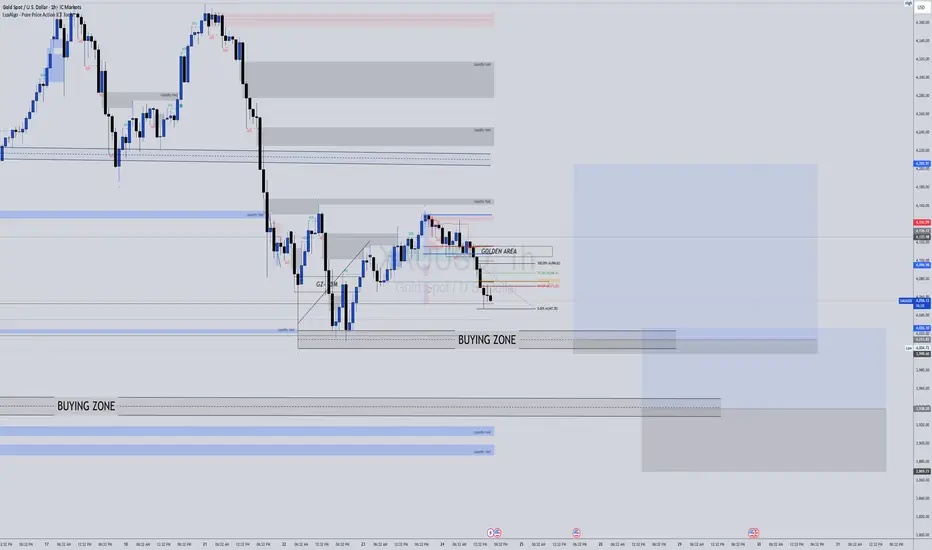
XAUUSD BUY TRADE PLAN🔱 VALHALLA CORE — XAUUSD (1H) TRADE PLAN
Date: 24 Oct 2025
🧭 Market Outlook:
Gold dropped hard from the 4,150 area after rejecting the Golden Zone (50–61.8% retracement).
Now heading toward our main BUYING ZONE at 4,012–4,004 where we’ll look for a bullish setup.
📉 If Price Pulls Back Up:
Sell zone: 4,092–4,150 (Golden Area / Supply zone)
SL: Above 4,165
TP1: 4,035
TP2: 4,010 (Buying Zone)
📈 If Price Drops to Buying Zone:
Buy zone: 4,012–4,004
SL: Below 3,995
TP1: 4,092
TP2: 4,120–4,150
💡 Plan Summary:
Short from the Golden Area = continuation trade.
Buy from the Buying Zone = reversal setup.
Wait for 1H confirmation before entry (strong candle or rejection wick).
Always move SL to BE after TP1 hits.
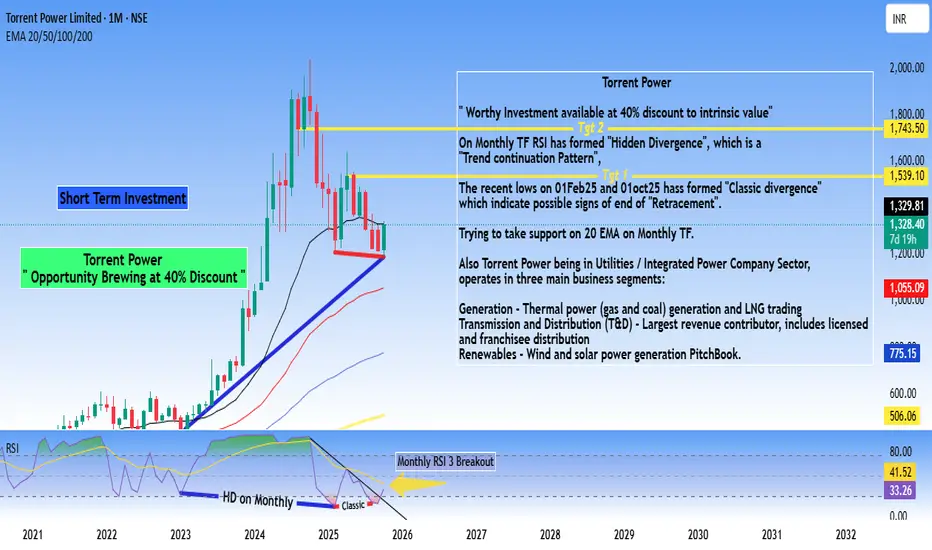
Torrent Power - Short Term Investment IdeasTorrent Power Limited - Technical Analysis Report
Current Market Price: 1,328.40
Opportunity: The Stock is Trading at 40% discount to intrinsic value, presenting a potential value investment in the #Integrated #powersector.
Technical Setup: Stock testing critical 20 #EMA support on monthly timeframe after forming #HiddenDivergence #pattern. Recent decline suggests caution but oversold conditions emerging.
Technical Snapshot
Trend: Monthly chart shows trend continuation pattern with classic divergence forming between February and October 2025 lows. Currently attempting support at 20 EMA (1,329).
RSI: Monthly RSI at 33.26 (oversold territory) with RSI 3 breakout indicating significant selling pressure but potential bounce setup.
Support Levels: 1328, 1200, 1055
Resistance Levels: 1539, 1743 (recent high)
Business Overview (Fundamentals)
Torrent Power operates across three segments: thermal power generation and LNG trading, transmission and distribution (largest revenue contributor), and renewable energy through wind and solar projects.
Trading Strategy
Aggressive Buyers: Accumulate at current levels with stop loss below 1,280. Risk-reward favorable given 40% discount.
Conservative Buyers: Wait for weekly close above 1,350 confirming support hold before entry.
Target:1,539 (short-term), 1,743+ (medium-term)
Full Replay Breakdown! From Planning to Execution of a TradeWatch as I use the Bar Replay feature to walk you through the planning, execution, and post-trade phases of a real swing trade. Don’t miss these actionable insights, mindsets, and mistakes from start to finish for smarter trading decisions!
Chart used is older than 3 months for explanation
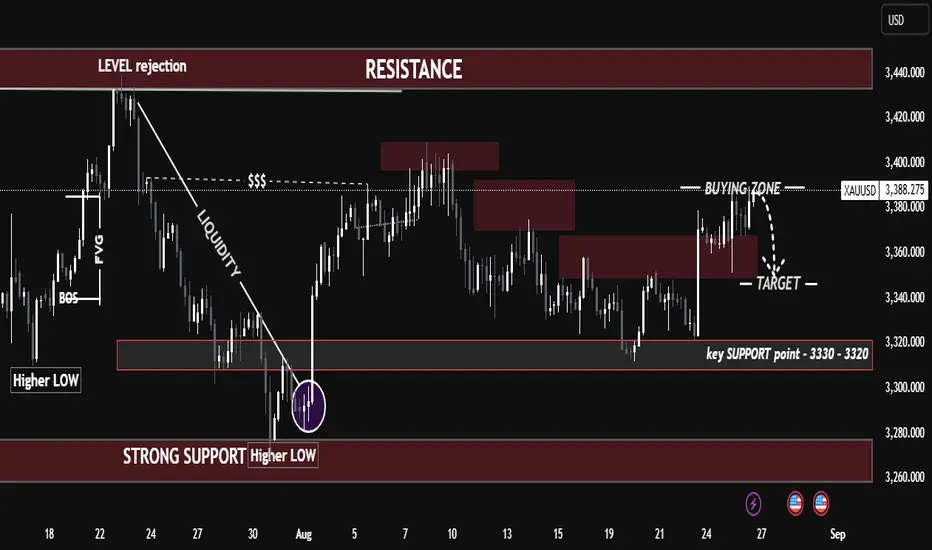
"Gold Setup: Buying Zone Rejection or Breakout Ahead?""Gold Setup: Buying Zone Rejection or Breakout Ahead?"
Gold is currently trading inside a buying zone (3380 – 3400) but facing rejection. Market structure is still holding higher lows, which keeps the bigger trend bullish, but short-term price action suggests a possible retracement move.
Resistance Zone: 3420 – 3440 (strong supply, previous rejection)
Key Support: 3330 – 3320 (major demand, higher low base)
Immediate Target: 3340 – 3360 (if rejection continues)
📉 Short-term bias: bearish correction toward 3340 – 3360
📈 Swing bias: bullish as long as 3330 – 3320 holds
🔑 My View:
I’ll be watching how price reacts around 3330 – 3320. Holding this level could trigger the next bullish leg toward 3420 – 3440. Losing it opens the door for deeper downside into 3280.
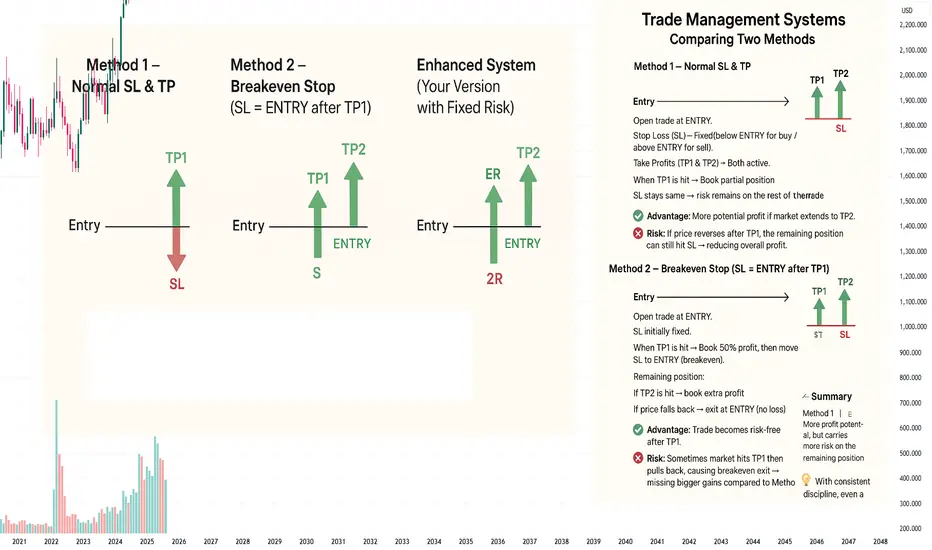
Trade Management Systems: Comparing Two Methods
📌 Method 1 – Normal SL & TP
Entry → Open trade at ENTRY.
Stop Loss (SL) → Fixed (below ENTRY for buy / above ENTRY for sell).
Take Profits (TP1 & TP2) → Both active.
When TP1 is hit → Book partial position.
SL stays the same → risk remains on the rest of the trade.
✅ Advantage:
More potential profit if market extends to TP2.
❌ Risk:
If price reverses after TP1, the remaining position can still hit SL → reducing overall profit.
📌 Method 2 – Breakeven Stop (SL = ENTRY after TP1)
Entry → Open trade at ENTRY.
SL initially fixed.
When TP1 is hit → Book 50% profit, then move SL to ENTRY (breakeven).
Remaining position:
If TP2 is hit → book extra profit.
If price falls back → exit at ENTRY (no loss).
✅ Advantage:
Trade becomes risk-free after TP1.
❌ Risk:
Sometimes market hits TP1 then pulls back, causing breakeven exit → missing bigger gains compared to Method 1.
📌 Enhanced System (Your Version with Fixed Risk)
Initial SL → Always set at 2R.
TP1 → When reached, book 50% profit (+1R on half).
Then move SL to ENTRY (breakeven) for the remaining 50%.
📊 Possible Outcomes:
Scenario Result
Price hits SL (before TP1) –2R loss
Price hits TP1, then reverses to ENTRY +0.5R profit
Price hits TP1, then TP2 +2R total profit
⚖️ Summary
Method 1 (Normal SL & TP) → More profit potential, but carries more risk on the remaining position.
Method 2 (SL = ENTRY after TP1) → Safer, risk-free after TP1, but sometimes cuts off bigger gains.
Your Enhanced Version → A defensive system:
Losers are limited (–2R).
Small winners (+0.5R) happen often.
Big winners (+2R) balance out losses.
💡 With consistent discipline, even a 40–45% win rate can make this system profitable.
When to Exit a Trade: Exit Plan for Every Trading Style!Hello Traders!
Every trade type needs a different kind of exit plan — but most traders use one-size-fits-all. That’s why they either exit too soon or too late.
Today, I’ll break down how to plan your exits based on trade type and intention .
A smart exit plan fits the nature of the trade — not just your emotion in the moment.
Exit Plan for Swing Trades
Target Based: Pre-decide 1:2 or 1:3 risk-reward levels.
Trailing SL (Candle Based): Move SL below each higher low in uptrend.
Exit on Structure Break: If price breaks key swing low, exit immediately.
Exit Plan for Positional Trades
Weekly Chart View: Exit only if weekly trend changes or closes below trendline.
Partial Booking: Book some profits at resistance zones, hold rest for trend continuation.
News/Events SL: Avoid holding through uncertain events unless strategy-backed.
Exit Plan for Long-Term Trades (Investment Trades)
Fundamental Exit: Exit only if company fundamentals weaken or story changes.
Valuation-Based Exit: Exit when valuations are stretched beyond long-term average.
Exit in Phases: Don’t exit fully — scale out in parts across 10-20% intervals.
Exit Plan for Breakout Trades
Multi-Year Breakout: Hold till price holds above breakout zone on weekly chart.
2-Week Breakout: Use previous resistance as SL. Exit if it fails to sustain above it.
Volume Confirmation: Exit if breakout happens on weak volume and fails to follow through.
Exit Plan for Options Trades
Defined SL in Premium: Keep strict SL (e.g., ₹30 loss on ₹100 premium).
Time-Based Exit: Exit if expected move doesn’t come by your time window.
Theta Decay Watch: Exit early if holding beyond 2–3 days and premium drops without move.
Momentum Exit: Trail SL tightly once premiums start shooting.
Rahul’s Tip
Don’t treat every trade the same. Swing, positional, long-term — each needs its own exit discipline.
Your plan should depend on chart timeframe, reason for entry, and trade type — not just emotions.
Conclusion
Your exit strategy should match your trade type, not just your mood.
Once you start using the right exit logic for the right trade, your results will become more consistent, more powerful, and way less stressful.
Thanks for reading!
If this helped bring clarity, do like, share and follow for more trading insights made simple.
Dixon Technologies Bullish Bias 10% upsideThe Stock has been consolidating for a while
As visible from the RSI the stock has given a nice breakout from the range
The stock price was also falling and took support near 200day EMA zone
The price has reversed from the selling zone
3 days constant increase in the price and reversal with a W Breakout pattern
The overall sentiment looks really bullish for the counter
Also, the tariff pause shall be helping the business for a short term
Looks really bullish to me.
Caution: Trade as per your risk appetite.
The Psychology Behind Holding Option Trades to the Targets!Hello Traders!
Entering a trade is easy, but holding it with conviction till the target hits — that’s where 90% of traders fail. Most of the time, we exit early out of fear, impatience, or seeing quick profits vanish. Today, let’s understand the psychology behind holding option trades and how to set yourself up for patience and discipline .
Why We Exit Too Early?
Fear of Losing Unrealized Profits: The moment your trade shows green, the mind screams “book now!” even when the setup is still valid.
Overtrading Mentality: You want to book fast and re-enter again, leading to emotional and scattered trades.
Lack of a Clear Plan: If you don’t have a defined target, SL, and reason to hold , you’ll exit at the first sign of volatility.
How to Develop the Patience to Hold Trades
Visualize Your Trade Before Entering: Ask yourself — “What will I do if price pulls back after entry?” Plan your SL, target, and trailing logic beforehand.
Use Alert Zones, Not Constant Monitoring: Watching every tick increases anxiety. Instead, set alerts at key levels and focus on the logic, not emotions.
Risk What You’re Comfortable With: If your position size is too big, you’ll panic during small reversals. Right sizing = calm holding.
Follow Structure Over Emotion: Hold as long as price is above VWAP/Trendline/Support (for longs). Only exit if structure breaks.
Rahul’s Tip
“The market rewards patience more than perfection.” If your analysis was right, trust it. Let the trade breathe. Stop treating every green candle as your exit point.
Conclusion
The biggest wins in options trading come when you hold with discipline . Build a setup where your entry has logic, your exit has structure, and your mind stays calm in between. That’s how you train yourself for consistency — not by chasing, but by mastering patience .
How long do you usually hold your option trades? Let’s talk about it in the comments below!
The Most Powerful Gap Fill Strategy You've Never Used!Hello Traders!
Today, let’s dive into one of the most reliable and underrated trading setups – the Gap Fill Strategy on the Daily Chart . This strategy works like magic when traded with patience and proper confirmation. If you’re a swing trader looking for high-probability setups, this is a goldmine for catching reversals and trend continuation moves .
When a stock or index leaves a price gap and then returns to fill that area, it often provides a clear entry point with well-defined risk and reward .
What is a Gap Fill?
Gap Up or Gap Down: A gap is formed when the price opens significantly higher or lower than the previous day’s close.
Gap Fill: A gap fill happens when price retraces and returns to cover the gap zone fully or partially.
Why It Works: Gaps often represent emotional moves or news-based reactions. When that emotion fades, price tends to come back to “fill the gap,” offering a great opportunity.
How to Trade the Gap Fill Strategy
Chart Timeframe: Focus on the Daily Timeframe for more reliable swing setups.
Identify Clear Gaps: Look for recent gap ups or downs with strong candles and volume.
Confirmation: Wait for reversal candlestick patterns (like bullish engulfing, hammer, or doji) near the gap zone.
Entry: Enter once price enters the gap zone and shows signs of reversal.
Stop Loss: Place SL below the gap zone (for longs) or above it (for shorts).
Target: First target is the top/bottom of the gap; second target based on previous support/resistance.
When Is It Most Effective?
After News-Driven Gaps (like earnings, macro events)
At Key Support/Resistance Zones
In Range-Bound or Reversal Markets
Rahul’s Tip
Gaps get filled not always — but often! Combine this setup with volume analysis and candle patterns, and it turns into a powerful swing weapon. Trust the structure, and wait for confirmation.
Conclusion
The Gap Fill Strategy on the Daily Chart offers a simple yet effective way to catch swing trades with clean entries and exits. It’s perfect for those who can wait for the right moment rather than chase every candle.
Have you used the gap fill setup in your trading? Share your experience below and let’s grow together!
When to Book Profits? Smart Exit Signs Every Trader Must Know!Hello Traders!
We all love the feeling of seeing profits on our screen, but the real challenge is knowing when to book them . Exiting too early means missing the big move. Exiting too late? You give back most of your gains. So today, let’s break down how to identify the perfect moment to book profits —whether you're trading intraday, swing, or positional.
Top Signs You Should Book Profits
Price Hits Key Resistance or Target Zone:
When your price hits a pre-defined target, Fibonacci level, or a strong resistance, it's a clear signal to book partial or full profits.
Momentum is Fading:
Look for weakening RSI, MACD crossovers, or decreasing volume. These are signs that buying strength is drying up.
Reversal Candlesticks Near Resistance:
Patterns like Bearish Engulfing, Shooting Star, or Evening Star near key levels indicate a possible reversal.
News/Event Risk Ahead:
If there's a major earnings release, policy decision, or macroeconomic event ahead, it’s safer to secure some profits.
Risk-Reward Becomes Unfavorable:
If the remaining upside is less than the downside risk, reduce your position and protect gains.
Trailing Stop Loss Triggered:
Using trailing stops helps you ride the trend while locking in profits. If it hits, exit without regret.
Rahul’s Tip
You don’t need to catch the exact top. Profit booked is better than profit on paper. Focus on consistency and discipline. Let the markets reward your process, not just your predictions.
Conclusion
Booking profits is an art backed by rules. Follow your strategy, monitor price action, and trust your system. That’s how you grow and protect your trading capital in the long run.
How do you decide when to exit your trades? Share your strategy in the comments below!
Time-Tested Tips for Better Risk Management in Trading
📝 Develop a Trading Plan
• Start with a Plan: Avoid jumping into trades without preparation. A solid trading plan is
your blueprint for success.
• Key Components: Define your entry points, stop-loss levels (to limit losses), and target
profit levels in advance.
• Why It Matters: A structured plan provides clarity during stressful trading situations and
ensures consistency with your risk tolerance.
________________________________________
🧘♂️ Understand Your Risk Tolerance
• Self-Reflection: Assess your emotional and psychological response to risk.
Know your comfort level with losses, market fluctuations, and stress.
• Financial Awareness: Factor in your income, savings, debts, and expenses to
gauge how much risk you can afford.
• Personalization is Key: There’s no one-size-fits-all strategy.
Tailor your risk management approach to your account size, goals,
and unique circumstances.
________________________________________
📚 Follow Your Trading System
• Have a Clear System: Establish rules for entering and exiting trades to maintain discipline
and avoid impulsive decisions.
• Backtest and Research: Test your system against historical data and simulate performance
in different market conditions.
• Stick to It: If your system has a proven edge, trust it. Jumping between strategies after
losses often leads to bigger losses.
________________________________________
🚨 Use a Stop-Loss
• What is a Stop-Loss? A predefined price level where you exit a trade to
limit potential losses.
• Why It’s Important: Prevents emotional decision-making and ensures you
quantify your risk before entering a trade.
________________________________________
✂️ Manage Your Position Size
• Avoid Overexposure: Adjust your position size to manage risk effectively and
avoid putting too much capital into one trade.
• Diversify: Don’t put all your eggs in one basket unless you fully understand and
accept the risks.
Risk-Reward Ratios: Quick Reference
1:2 Risk-Reward
• Risking $1 to make $2
• Win 33% of the time to break even.
• Common for day and swing traders aiming for moderate profits.
• Example: Stop-loss at 10 pips, target profit at 20 pips.
________________________________________
1:3 Risk-Reward
• Risking $1 to make $3
• Win 25% of the time to break even.
• Ideal for trades with a high-probability setup and larger moves.
• Example: Stop-loss at $50, target profit at $150.
________________________________________
1:5 Risk-Reward
• Risking $1 to make $5
• Win 17% of the time to break even.
• Suitable for trend-following strategies or breakout trades with significant momentum.
• Example: Stop-loss at 5% of capital, target profit at 25%.
________________________________________
❌ Don’t Overtrade or Revenge Trade
• Control Impulses: Avoid the urge to overtrade or recover losses through high-risk trades.
• Stay Rational: Emotional trading can lead to poor decisions and bigger losses.
Trade with a clear head and logic.
________________________________________
📔 Maintain a Trading Journal
• Track Your Trades: Document your trades to identify patterns, mistakes, and
areas for improvement.
• Enhance Strategies: Regular reviews help refine your approach,
improve risk management, and evolve as a trader.
• Accountability: A journal instils discipline and serves as a learning tool for future trades.
________________________________________
✅ Final Reminders
• Trade with discipline, not emotions.
• Always align your strategies with your risk tolerance and financial situation.
• Remember, trading is a marathon, not a sprint—stay consistent and patient.
________________________________________
Note- The Magic Formula for Lot Size Calculation (1% Risk)
Formula = 1% of Capital/Stop Loss in Pips/10
Example Scenarios:
Capital = $5,000 | Stop Loss = 30 pips: in XAUUSD
1% of capital = 50$
Lot size = 1% of Capital/Stop Loss in Pips/10 = 50/30/10 = 0.16
🚀 Thanks for reading!
Drop your thoughts or additional tips in the comments below. Let’s grow and trade smarter together! Cheers! 🌟
Abans Holdings Ltd - AHLLast Resistance now Working as Support.
Tested base multiple time.
Spent good time near Support.
Good R:R For Longs.