NIFTY // 4hour Support and Resistance Index Name: NIFTY 50
Exchange: NSE | Benchmark index of the Indian equity market
Constituents: 50 large-cap companies across 13 sectors
🧾 Overview:
The NIFTY 50 represents India’s top-performing blue-chip companies and acts as a barometer of the overall market health. It covers sectors like financials, IT, FMCG, energy, and auto.
💼 Key Sector Weights:
Financial Services – ~35%
IT – ~13%
Oil & Gas – ~12%
Consumer Goods – ~9%
Auto – ~6%
📊 Current Trend Insight (as of 4H chart):
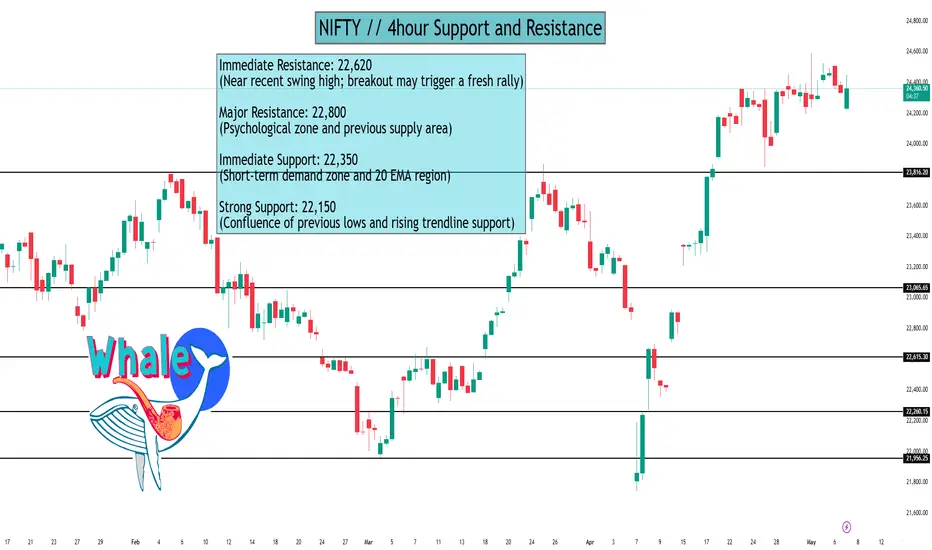
Index near resistance at 22,620
Holding support at 22,350 indicates buying strength
Sustained breakout above 22,620 could lead to a move toward 22,800+
NIFTY 50 Index – 4-Hour Chart Support & Resistance
Support and Resistance Levels (4H Timeframe):
c
Trend Insight:
NIFTY is forming higher lows, indicating bullish strength. Consolidation above 22,350 strengthens the case for a breakout. Watch 22,620 for momentum entry confirmation.
Technical
Technical TradingTechnical trading is a broader style that is not necessarily limited to trading. Generally, a technician uses historical patterns of trading data to predict what might happen to stocks in the future. This is the same method practiced by economists and meteorologists: looking to the past for insight into the future.
MACD (Moving Average Convergence/Divergence )The Moving Average Convergence/Divergence (MACD) is a technical analysis indicator used to analyze price trends and momentum. It's calculated by subtracting a longer-term exponential moving average (EMA) from a shorter-term EMA. The resulting MACD line, along with a signal line (an EMA of the MACD line) and a histogram (the difference between the MACD and signal lines), helps traders identify potential buy and sell signals, as well as changes in the strength and direction of a trend.
Option TradingOptions trading may seem overwhelming at first, but it’s easy to understand if you know a few key points. Investor portfolios are usually constructed with several asset classes. These may be stocks, bonds, exchange-traded funds (ETFs), and mutual funds. Options are another asset class, and when used correctly, they offer many advantages that trading stocks and ETFs alone cannot.
Institution Trading prt 5Institutional trading refers to the buying and selling of financial assets by large organizations, like financial institutions, on behalf of their clients or members. These institutions manage large pools of capital and can significantly impact market prices and trends due to their size and trading volume. Unlike retail traders, institutional traders often have access to a wider range of investment opportunities and strategies.
Candlesticks Pattern part 1Candlestick patterns are visual representations of price movements within a specific timeframe, used in technical analysis to identify potential future price movements. Each candlestick represents a period's opening, high, low, and closing prices, and their combinations form patterns that can signal trend changes or potential continuations.
Institution Trading part 4Institutional trading consists of the purchase and sale of financial assets by institutions through their traders. This definition of institutional trading applies to institutional equity trading, institutional stock trading, institutional options trading - any subcategory.
Institutional TradingInstitutional trade refers to the buying and selling of financial assets by large financial institutions, such as hedge funds, mutual funds, and pension funds. These institutions often manage significant amounts of capital and make trades on behalf of their clients or members. They typically engage in large-scale transactions and require specialized tools and services.
Gold Surges Amid War Tensions Is This the Start of a New Bull 🟡 Gold Surges Amid War Tensions – Is This the Start of a New Bull Run?
📈 XAU/USD Weekly Outlook – May 6, 2025
Gold made a strong comeback this morning, jumping over 600 PIPS as investor demand surged in response to escalating geopolitical risks and massive physical demand in Asia — particularly from China and Japan. The current breakout momentum suggests a high probability of new ATHs if macro and political tensions continue.
🔥 Why is Gold Rising Again?
1️⃣ Geopolitical Flashpoint:
19+ Ukrainian UAVs struck Moscow overnight.
The attack came just ahead of Russia's Victory Day (May 9) — a symbolic blow that rattled global markets.
2️⃣ China Ramping Up Gold Imports:
Reports show China has been quietly stockpiling gold at aggressive levels.
Institutional and retail demand has returned strongly to the Asian bullion market.
3️⃣ Fear and FOMO in the Market:
Asian investors are driving early-session buying frenzies.
Technical retracements are being ignored as price accelerates without respecting classic resistance zones.
📊 Technical Outlook – H4 + D1 Focus
Gold has successfully defended the 3312 zone and surged past resistance zones with ease. Current MA13/MA34/MA89 crossovers on higher timeframes confirm a trend reversal and sustained bullish momentum.
🔑 Key Technical Zones to Watch:
🔻 Support Levels:
3355
3335
3313
🔺 Resistance Levels:
3380
3405
3443
3470
🎯 Trade Plan for May 6 – BUY Bias Dominant
🚫 Avoid SELL positions unless confirmed exhaustion appears — momentum is extremely bullish and politically driven.
🔵 BUY ZONE #1:
Entry: 3314 – 3312
SL: 3308
TP: 3318 → 3322 → 3326 → 3330 → 3340 → 3350 → ???
🔵 BUY ZONE #2:
Entry: 3335 – 3332
SL: 3329
TP: 3340 → 3344 → 3348 → 3352 → 3356 → 3360
🔴 SELL ZONE (High Risk):
Entry: 3343 – 3345
SL: 3359
TP: 3339 → 3335 → 3330 → 3326 → 3320
🧭 Final Thoughts
Gold is currently in hyper bullish mode. Key level 3313 is now confirmed as a volume-based support (VPOC + FIBO 0.5) and will likely be the base for the next wave. As global headlines point to uncertainty, investors are shifting capital back into gold, supported by physical buying from China.
💬 Patience and proper entry are key. Avoid early sell traps. Focus on the Asia-led FOMO rallies and align your strategy with safe-haven flows.
Advanced Trading part 2In business, "trade advance" or "trade credit" generally refers to a short-term, interest-free loan provided by a supplier to a business, allowing the buyer to defer payment for goods or services. It's essentially an arrangement where a supplier allows a buyer to purchase goods on credit, with payment due at a later date, typically within 30 to 90 days.
Institution Trading StrategiesThis strategy involves taking advantage of price discrepancies between two or more markets or instruments. For example, an institution may buy a stock on one exchange where it is undervalued and simultaneously sell it on another exchange where it is overvalued, profiting from the difference.
Support and Resistance part 2Support occurs at the point where a downtrend is expected to pause due to a concentration of demand. Resistance occurs at the point where an uptrend is expected to pause due to a concentration of supply. Support and resistance areas can be identified on charts using trendlines and moving averages.
INDUSIND Bank // 1month Support and ResistanceAs of May 5, 2025, here are the key 1-Month Support and Resistance levels for IndusInd Bank Ltd. (NSE: INDUSINDBK) based on recent technical analyses:
📊 Monthly Support and Resistance Levels
Level Value (₹)
S3 809.77
S2 888.08
S1 941.97
Pivot 1,015.58
R1 1,074.17
R2 1,152.48
R3 1,206.37
These levels are derived from the previous month's price range and are commonly used to identify potential reversal points in the market.
📈 Technical Indicators
Relative Strength Index (RSI): 44 (Neutral)
Moving Average Convergence Divergence (MACD): 5.16 (Sell)
Average Directional Index (ADX): 25.44 (Weak Trend)
Commodity Channel Index (CCI): -61.09 (Downtrend)
Money Flow Index (MFI): 26.16 (Strong Downtrend)
These indicators suggest a neutral to slightly bearish momentum, indicating potential downward movement if selling pressure increases.
📌 Summary
Immediate Support: ₹809.77
Immediate Resistance: ₹1,074.17
Medium-Term Outlook: Neutral to slightly bearish, with mixed signals from moving averages and momentum indicators.
Please note that technical analysis is subject to change based on market conditions. It's advisable to monitor these levels regularly and consider consulting with a financial advisor for personalized investment advice.
HDFC Bank ltd // 3hour Support and ResistanceAs of May 5, 2025, here are the key support and resistance levels for HDFC Bank Ltd. (NSE: HDFCBANK) based on the 3-hour chart:
📊 3-Hour Pivot Points
Level Value (₹)
S3 1,689.18
S2 1,701.12
S1 1,714.03
Pivot 1,725.97
R1 1,738.88
R2 1,750.82
R3 1,763.73
These levels are calculated based on the previous day's high, low, and close prices and are used to identify potential support and resistance zones.
📈 Technical Indicators
Relative Strength Index (RSI): 72.46 (Strong Uptrend)
Stochastic RSI: 0.92 (Strong Uptrend)
Commodity Channel Index (CCI): 130.18 (Strong Uptrend)
Money Flow Index (MFI): 86.61 (Strong Uptrend)
These indicators suggest a strong bullish momentum, indicating potential upward movement if buying interest continues.
📌 Summary
Immediate Support: ₹1,689.18
Immediate Resistance: ₹1,738.88
Medium-Term Outlook: Bullish, with strong momentum indicators and positive moving averages.
Please note that technical analysis is subject to change based on market conditions. It's advisable to monitor these levels regularly and consider consulting with a financial advisor for personalized investment advice.
RR KABEL LTDAs of May 5, 2025, here are the key support and resistance levels for R R Kabel Ltd. (NSE: RRKABEL) based on recent technical analyses:
📊 Classic Pivot Points (1-Day View)
Support Levels:
S3: ₹880.40
S2: ₹901.70
S1: ₹924.85
Resistance Levels:
R1: ₹969.30
R2: ₹990.60
R3: ₹1,013.75
Pivot Point: ₹946.15
These levels are derived from the price range of the previous trading day and are commonly used to identify potential reversal points in the market.
📈 Moving Averages & Indicators
Simple Moving Averages (SMA):
5-Day: ₹915.44 (Buy)
10-Day: ₹911.38 (Buy)
20-Day: ₹907.79 (Buy)
50-Day: ₹891.27 (Buy)
100-Day: ₹896.50 (Buy)
200-Day: ₹1,012.39 (Sell)
Exponential Moving Averages (EMA):
5-Day: ₹918.88 (Buy)
10-Day: ₹913.53 (Buy)
20-Day: ₹906.36 (Buy)
50-Day: ₹898.08 (Buy)
100-Day: ₹928.24 (Sell)
200-Day: ₹1,003.36 (Sell)
The alignment of these averages suggests a bullish short-term to medium-term outlook, with some indicators signaling bearish trends in the long term.
📉 RSI & Momentum Indicators
Relative Strength Index (RSI): 65.27 (Buy)
Stochastic RSI: 68.79 (Buy)
MACD: 7.38 (Buy)
Average Directional Index (ADX): 35.19 (Buy)
These indicators suggest a strong bullish momentum, indicating potential upward movement if buying interest continues.
📌 Summary
Immediate Support: ₹880.40
Immediate Resistance: ₹969.30
Medium-Term Outlook: Bullish, with strong momentum indicators and positive moving averages.