Tradinglatino
Event-Driven Earnings Trading: A Complete ExplanationWhy Earnings Are Market-Moving Events
Every publicly listed company reports earnings quarterly. These reports include:
Revenue
Profit (net income, EPS)
Operating margins
Forward guidance
Management commentary
Markets are forward-looking. Prices already discount expectations well before earnings are released. When actual results differ from expectations, the stock must quickly reprice—sometimes violently.
That repricing creates opportunity.
Expectations vs Reality: The Real Driver
A common mistake beginners make is assuming:
“Good earnings = stock goes up”
“Bad earnings = stock goes down”
In reality:
Good earnings can crash a stock
Bad earnings can rally a stock
Why? Because the market reacts to the difference between expectations and outcomes, not the outcome alone.
Example:
Expected EPS: ₹10
Actual EPS: ₹9.80
Even though the company is profitable, missing expectations can trigger selling.
On the other hand:
Expected EPS: ₹5
Actual EPS: ₹6
Even weak companies can rally if they outperform expectations.
Types of Event-Driven Earnings Trading Strategies
1. Pre-Earnings Positioning
This strategy involves taking positions before earnings based on:
Technical structure
Institutional positioning
Options data (implied volatility, open interest)
Past earnings behavior
Common pre-earnings approaches:
Volatility expansion trades
Range breakout anticipation
Trend continuation into earnings
Risk here is high because earnings outcomes are uncertain. Many professional traders reduce size or hedge risk using options.
2. Earnings Volatility Trading
Earnings bring a volatility spike. Option premiums rise sharply before the event due to uncertainty.
Traders exploit this by:
Buying volatility if they expect a large move
Selling volatility if they expect muted reaction
Key concept: Implied Volatility (IV)
IV rises before earnings
IV collapses immediately after earnings (IV crush)
Understanding IV behavior is crucial for earnings traders.
3. Post-Earnings Reaction Trading
This is one of the most popular and safer approaches.
Instead of predicting earnings, traders react to:
Price gaps
Volume expansion
Trend confirmation or failure
Post-earnings trading focuses on:
Gap-and-go setups
Gap fill trades
Trend reversals
Momentum continuation
This approach lets the market reveal direction first, reducing guesswork.
Earnings Gaps and Market Psychology
Earnings often cause price gaps, where a stock opens significantly above or below the previous close.
There are different types of gaps:
Breakaway gaps – start of a new trend
Continuation gaps – confirm an existing trend
Exhaustion gaps – signal trend reversal
Understanding the context is more important than the gap size.
For example:
A gap up after a long rally may fail
A gap up after consolidation may lead to strong continuation
Role of Institutional Investors
Institutions dominate earnings reactions because:
They control large capital
They model earnings far in advance
They trade based on guidance and long-term outlook
Key signs of institutional behavior:
Heavy volume after earnings
Sustained price movement beyond the first hour
Failure or success of VWAP levels
Retail traders often lose money by reacting emotionally, while institutions trade systematically.
Options and Earnings Trading
Options are deeply linked to earnings events.
Key concepts:
Implied Volatility (IV) rises before earnings
IV Crush happens immediately after
Directional move must exceed implied move for profit
Popular earnings option strategies:
Straddles and strangles
Iron condors
Call/put spreads
Options allow traders to:
Limit risk
Trade volatility instead of direction
Hedge equity positions
However, options require precise understanding. Without IV knowledge, earnings options trading can be costly.
Risks in Earnings Trading
Earnings trading is not easy money. Major risks include:
Overnight Gap Risk
Prices can move sharply outside trading hours.
False Breakouts
Initial moves can reverse quickly.
Liquidity Traps
Wide bid-ask spreads post-earnings.
Emotional Trading
Fast moves trigger fear and greed.
Risk management is non-negotiable:
Smaller position size
Predefined stop-loss
Accepting uncertainty
Combining Technicals with Earnings
The best earnings traders don’t rely only on fundamentals.
They combine:
Support and resistance
Trend structure
Volume analysis
Market sentiment
Broader index behavior
A strong earnings report in a weak market may still fail. Context always matters.
Earnings Season and Market Cycles
Earnings seasons create:
Sector-specific volatility
Index-level moves
Rotation between industries
Smart traders:
Track sector leaders
Watch correlated stocks
Avoid overtrading every earnings event
Not every earnings report is tradable. Selectivity is a key edge.
Who Should Trade Earnings?
Earnings trading suits:
Disciplined traders
Those comfortable with volatility
Traders who can react quickly
Options traders with IV knowledge
It is not ideal for:
Emotional traders
Over-leveraged accounts
Beginners without risk control
Final Thoughts
Event-driven earnings trading is not about predicting numbers—it’s about understanding expectations, volatility, and crowd behavior. Earnings are moments when uncertainty collapses into clarity, and price adjusts rapidly.
The real edge comes from:
Preparation over prediction
Risk management over excitement
Reaction over opinion
When done correctly, earnings trading can be one of the most powerful tools in a trader’s playbook—but only for those who respect its speed, risk, and complexity.
Domestic Equity Market Trends: A Comprehensive Overview1. Structural Shift in the Domestic Equity Market
One of the most prominent trends in recent years has been the structural strengthening of the equity market. India has moved from being a savings-driven economy dominated by physical assets (gold and real estate) to an increasingly financialized economy.
Key drivers of this shift include:
Expansion of mutual funds and SIP culture
Digital trading platforms and mobile apps
Regulatory reforms by SEBI
Greater financial literacy and awareness
This structural transformation has made equity markets deeper, more liquid, and more resilient to shocks.
2. Rise of Retail and Domestic Institutional Investors
A defining trend in the domestic equity market is the surge in retail participation. Millions of new demat accounts have been added over the last few years, particularly after 2020.
Retail Investors
Retail investors are no longer short-term speculators alone. A growing segment participates through:
Systematic Investment Plans (SIPs)
Direct equity investments
ETFs and index funds
This has created steady domestic inflows, reducing dependence on volatile foreign capital.
Domestic Institutional Investors (DIIs)
Domestic institutions such as:
Mutual funds
Insurance companies
Pension funds
have emerged as market stabilizers, often counterbalancing Foreign Institutional Investor (FII) selling during global risk-off periods.
3. Sectoral Rotation and Thematic Trends
Domestic equity markets are increasingly characterized by sectoral rotation, where leadership shifts based on economic cycles, policy support, and earnings visibility.
Cyclical Sectors
Banking and financial services
Capital goods
Infrastructure
Metals and energy
These sectors tend to outperform during economic expansion, government capex cycles, and credit growth phases.
Defensive Sectors
FMCG
Pharmaceuticals
IT services
These sectors attract capital during periods of uncertainty, inflationary pressure, or global slowdown.
Emerging Themes
Recent domestic equity trends show growing interest in:
Manufacturing and “Make in India”
Defense and railways
Renewable energy and EV ecosystem
Digital platforms and fintech
4. Banking and Financial Services as Market Leaders
The banking and financial sector remains the backbone of the domestic equity market. Strong balance sheets, improving asset quality, and robust credit growth have made banks market leaders.
Key trends include:
Declining NPAs and improved capital adequacy
Strong performance by private sector banks
Gradual recovery in PSU banks
Expansion of NBFCs and fintech collaboration
Because financials hold significant index weight, their performance largely determines broader market direction.
5. Earnings Growth and Corporate Profitability
A sustainable equity market trend depends on earnings growth, not just valuation expansion. In recent years, Indian corporates have shown:
Improved operating margins
Better cost efficiency
Lower debt levels
Strong cash flows
Sectors aligned with domestic consumption and infrastructure spending have reported consistent earnings growth, reinforcing long-term investor confidence.
6. Valuation Expansion and Market Maturity
India’s domestic equity market often trades at a premium valuation compared to other emerging markets. This trend is supported by:
Political stability
Predictable policy framework
Strong demographic dividend
Long-term GDP growth prospects
However, high valuations also mean:
Increased sensitivity to earnings disappointments
Selective stock picking becomes crucial
Midcap and small-cap segments face sharper corrections during risk-off phases
7. Midcap and Small-Cap Market Dynamics
The midcap and small-cap segments have become key areas of interest in domestic equity markets.
Trends Observed:
Higher volatility compared to large caps
Strong participation from retail investors
Periodic sharp rallies followed by corrections
Growing scrutiny on corporate governance and balance sheet quality
While these segments offer higher growth potential, they demand disciplined risk management.
8. Influence of Macroeconomic Factors
Domestic equity market trends are closely linked to macroeconomic variables such as:
Inflation and interest rates
RBI monetary policy stance
Fiscal deficit and government spending
Currency movements
A stable inflation environment and supportive monetary policy typically boost equity valuations, while tightening cycles introduce volatility.
9. Impact of Global Factors on Domestic Markets
Although domestic equity markets are increasingly self-reliant, global factors still play a role:
US Federal Reserve policy
Global liquidity conditions
Geopolitical tensions
Commodity price movements
However, strong domestic flows have reduced the shock impact of FII outflows, making Indian markets relatively resilient compared to the past.
10. Regulatory and Policy Support
SEBI reforms have enhanced transparency, investor protection, and market efficiency. Measures such as:
T+1 settlement
Enhanced disclosure norms
Stronger corporate governance rules
have boosted confidence in domestic equity markets and encouraged long-term participation.
11. Technology and Market Accessibility
Technology has transformed equity market participation:
Algorithmic and quantitative trading
Online research and analytics
Low-cost brokerage models
Real-time data access
This has democratized investing but also increased short-term volatility due to faster information flow.
12. Long-Term Outlook of Domestic Equity Markets
The long-term trend of the domestic equity market remains structurally bullish, supported by:
Rising household financial savings
Expanding middle class and consumption
Infrastructure-led growth
Manufacturing revival
Digital and technological adoption
Short-term corrections are a natural part of market cycles, but the underlying growth story remains intact.
Conclusion
Domestic equity market trends reflect a powerful transformation—from liquidity-driven rallies to earnings-backed, structurally supported growth. The rise of domestic investors, sectoral diversification, strong regulatory oversight, and improving corporate fundamentals have made the market more mature and resilient.
For investors, the key lies in understanding these trends, aligning strategies with economic cycles, and maintaining a long-term perspective. While volatility is inevitable, the domestic equity market continues to offer compelling opportunities for wealth creation in a growing economy like India.
Part 2 Support and ResistanceMoneyness of Options
Options are classified based on their relationship with the underlying price:
In-the-Money (ITM)
Call: Spot > Strike
Put: Spot < Strike
At-the-Money (ATM)
Spot ≈ Strike
Out-of-the-Money (OTM)
Call: Spot < Strike
Put: Spot > Strike
Moneyness affects premium value, probability of profit, and risk.
How One Quant Giant Quietly Reshaped Global MarketsJane Street Impact
Jane Street is not a household name like Goldman Sachs or JPMorgan, yet its impact on modern financial markets is enormous. Founded in 2000, Jane Street is a quantitative trading firm and liquidity provider that operates across equities, ETFs, bonds, options, and cryptocurrencies in markets around the world. Its influence is subtle but powerful: tighter spreads, faster markets, changing trading strategies, and a new reality for both institutions and retail traders.
1. Market Liquidity: Making Markets “Always On”
One of Jane Street’s biggest contributions is liquidity provision. The firm acts as a market maker, constantly posting buy and sell quotes. This ensures that traders can enter or exit positions quickly without massive price slippage.
Before firms like Jane Street dominated market making:
Spreads were wider
Liquidity was inconsistent
Large trades caused sharp price moves
Jane Street changed this by using sophisticated algorithms that continuously adjust prices based on real-time supply, demand, and risk. The result is:
Narrower bid–ask spreads
Deeper order books
More stable short-term pricing
For investors, this reduces transaction costs. For traders, it means faster fills—but also tougher competition.
2. ETFs and Price Efficiency
Jane Street is one of the largest ETF market makers in the world. ETFs rely on a mechanism where prices stay close to their underlying assets through arbitrage. Jane Street plays a key role in this process.
Their impact includes:
Keeping ETF prices aligned with net asset value (NAV)
Enabling massive ETF growth globally
Making passive investing cheaper and more reliable
Without firms like Jane Street, ETFs would trade with larger discounts or premiums, reducing trust in the product. Their efficiency helped fuel the explosion of ETFs across equities, commodities, bonds, and thematic strategies.
3. Volatility: Reduced on Average, Sharper in Extremes
Jane Street’s presence generally reduces everyday volatility. Constant liquidity smooths price movement during normal conditions. However, in extreme events, the picture changes.
During market stress:
Algorithms widen spreads
Liquidity can temporarily vanish
Prices can move suddenly and violently
This doesn’t mean Jane Street causes crashes, but it highlights a new reality: modern markets are stable—until they aren’t. When risk models flip to “defensive,” liquidity providers step back simultaneously, amplifying sudden moves.
4. Speed and the Rise of Microstructure Trading
Jane Street operates at ultra-high speed, reacting to market signals in microseconds. This reshaped market microstructure in several ways:
Price discovery happens faster
Arbitrage opportunities disappear quickly
Traditional discretionary trading edges shrink
For slower participants, this creates frustration. Patterns that once worked for minutes now work for seconds—or not at all. This is why many retail traders feel markets have become “harder” or “unfair,” even though they are technically more efficient.
5. Impact on Retail Traders
Jane Street doesn’t trade against retail traders directly in a predatory sense, but its presence changes the game:
Positive impacts
Lower spreads
Better execution prices
Easier entry and exit
Negative impacts
Fake breakouts due to liquidity probing
Stops hunted in low-liquidity zones
Retail strategies losing edge faster
Many retail traders unknowingly trade against sophisticated liquidity models. This is why modern trading education increasingly emphasizes:
Market structure
Liquidity zones
Institutional footprints
6. Institutional Trading and Strategy Evolution
Jane Street forced traditional institutions to evolve. Old-school floor trading and manual arbitrage could not compete with algorithmic precision.
As a result:
Banks adopted quant desks
Hedge funds invested heavily in data science
Trading shifted from intuition to probability models
Risk management also improved. Jane Street is known for strict risk controls, scenario testing, and disciplined capital allocation. This professionalized trading across the industry.
7. Cultural Impact: Redefining What a Trader Is
Jane Street changed the identity of a “trader.” Today, traders are often:
Mathematicians
Engineers
Physicists
Data scientists
The firm’s culture emphasizes:
Collaboration over ego
Continuous learning
Intellectual honesty
This influenced the broader finance world, making quantitative skills more valuable than aggressive personalities or gut instinct.
8. Regulatory and Ethical Implications
Jane Street operates within regulations, but its scale raises questions:
Should ultra-fast firms have speed advantages?
Is liquidity real if it disappears during crises?
Do algorithms create unequal access?
Regulators worldwide now focus more on:
Market fairness
Order-to-trade ratios
Algorithmic risk controls
Jane Street’s success indirectly pushed regulators to modernize frameworks designed for a pre-algorithm era.
9. Global Impact, Including Emerging Markets
Jane Street trades globally, including emerging markets through derivatives, ETFs, and arbitrage links. This has several effects:
Faster price transmission from global cues
Increased correlation across markets
Reduced inefficiencies
For countries like India, this means domestic markets respond more quickly to global flows. While this increases efficiency, it also reduces insulation from global shocks.
10. The Bigger Picture: Markets as Machines
Jane Street symbolizes a broader shift: markets are no longer human-driven arenas—they are machine ecosystems. Prices move not because of stories alone, but because of models reacting to probabilities, correlations, and risk constraints.
This doesn’t eliminate opportunity—it changes it. Traders who understand liquidity, structure, and behavior thrive. Those relying only on indicators struggle.
Conclusion
Jane Street’s impact on financial markets is profound yet understated. It improved liquidity, tightened spreads, enhanced ETF efficiency, and pushed trading into a new quantitative era. At the same time, it raised the bar for participation, forcing traders and institutions alike to adapt.
Jane Street did not “break” the markets—it rewired them. Understanding its role helps explain why modern price action behaves the way it does: fast, efficient, occasionally ruthless, and deeply structural.
In today’s world, trading is no longer about beating the market emotionally—it’s about understanding the systems that move it. Jane Street is one of the architects of that system.
Derivatives Explained in Detail (Imply & Describe)Introduction to Derivatives
Derivatives are financial instruments whose value is derived from an underlying asset. That underlying asset can be anything that has a measurable price—stocks, stock indices, commodities, currencies, interest rates, bonds, or even weather and volatility. The derivative itself has no independent value; its worth implies and reflects movements in the price of the underlying asset.
In simple terms:
If the underlying asset moves, the derivative moves.
Derivatives are widely used in modern financial markets for risk management (hedging), price discovery, speculation, and arbitrage. They are essential tools for institutions, traders, corporations, and even governments.
Meaning and Implication of Derivatives
The word derivative comes from the idea that the instrument “derives” its value from something else. For example, a futures contract on crude oil derives its price from the spot price of crude oil. If crude oil prices rise, the value of that futures contract generally rises as well.
The implied meaning of derivatives is forward-looking. Unlike spot market transactions, derivatives often represent expectations about future prices. When traders buy or sell derivatives, they are expressing a view—bullish, bearish, or neutral—on how the underlying asset will behave in the future.
Thus, derivatives markets often act as a mirror of market sentiment, reflecting expectations, fear, confidence, volatility, and institutional positioning.
Key Characteristics of Derivatives
No Physical Ownership
Most derivatives do not involve ownership of the underlying asset. You can trade derivatives on gold without owning gold, or on stocks without owning shares.
Leverage
Derivatives allow traders to control a large value of assets with relatively small capital. This magnifies both profits and losses.
Contract-Based
Derivatives are legal contracts that specify terms such as price, quantity, expiration date, and settlement method.
Time-Bound
Most derivatives have an expiry date. Their value decays or changes as time passes, especially in options.
Risk Transfer
Derivatives shift risk from one party to another. Hedgers transfer risk; speculators absorb it for potential profit.
Types of Derivatives
1. Futures Contracts
A futures contract is an agreement to buy or sell an asset at a predetermined price on a future date.
Traded on exchanges (NSE, BSE, CME)
Standardized contracts
Daily mark-to-market settlement
Widely used in commodities, indices, and currencies
Implication:
Futures reflect collective expectations of future prices and institutional positioning.
2. Options Contracts
An option gives the buyer the right but not the obligation to buy or sell an underlying asset at a fixed price before or on expiry.
Call Option: Right to buy
Put Option: Right to sell
Options involve a premium, which is the cost of the contract.
Implication:
Options imply market expectations of volatility, not just direction. Concepts like implied volatility are derived directly from option prices.
3. Forwards Contracts
Forwards are private, customized agreements between two parties to trade an asset at a future date.
Not traded on exchanges
High counterparty risk
Common in corporate hedging (FX, interest rates)
Implication:
Forwards reflect negotiated future price expectations between specific parties.
4. Swaps
Swaps involve the exchange of cash flows between two parties.
Interest rate swaps
Currency swaps
Commodity swaps
Implication:
Swaps help institutions manage long-term financial risks and funding costs.
Why Derivatives Exist
1. Hedging Risk
Producers, exporters, investors, and institutions use derivatives to protect against adverse price movements.
Example:
A farmer hedges crop prices using futures
An airline hedges fuel costs
An exporter hedges currency risk
Here, derivatives imply risk insurance rather than speculation.
2. Speculation
Traders use derivatives to profit from price movements without owning the asset.
Lower capital required
Faster returns (and losses)
High risk, high reward
Implication:
Speculation adds liquidity but increases volatility if unmanaged.
3. Arbitrage
Arbitrageurs exploit price differences between markets.
Example:
Spot vs futures mispricing
Index vs constituent stocks
Derivatives help enforce price efficiency in financial markets.
Role of Derivatives in Price Discovery
Derivatives markets often react faster than cash markets because:
Lower transaction costs
Higher leverage
Institutional dominance
As a result, futures and options prices often lead spot prices. This makes derivatives a crucial tool for understanding:
Market trend direction
Institutional activity
Volatility expectations
In this sense, derivatives imply where “smart money” is positioned.
Risks Associated with Derivatives
Leverage Risk – Small moves can cause large losses
Liquidity Risk – Wide spreads during volatile periods
Time Decay – Especially harmful for option buyers
Complexity Risk – Misunderstanding contract behavior
Counterparty Risk – In OTC derivatives
Derivatives are powerful tools, but misuse can lead to catastrophic losses, as seen in multiple global financial crises.
Derivatives in the Indian Market
In India, derivatives are actively traded on NSE and BSE, mainly in:
Index derivatives (NIFTY, BANK NIFTY)
Stock futures and options
Currency derivatives
India’s derivatives market often has higher volumes than the cash market, highlighting its importance in price discovery and institutional trading.
Economic Importance of Derivatives
From a macroeconomic perspective, derivatives:
Improve market efficiency
Allow better risk distribution
Enhance capital allocation
Support global trade and investment
However, excessive speculative use can amplify systemic risk, making regulation essential.
Conclusion
Derivatives are not merely trading instruments; they are the backbone of modern financial markets. Their value is implied by the movement of underlying assets, expectations of future prices, and market psychology. When used responsibly, derivatives provide stability, efficiency, and risk management. When misused, they can magnify losses and destabilize entire economies.
Understanding derivatives is crucial for anyone involved in finance, trading, economics, or investment strategy. They are neither good nor bad by nature—their impact depends entirely on how intelligently they are used.
Sub-Broker in India: Role, Regulation, Business Model, FutureMeaning of a Sub-Broker
A sub-broker is an individual or entity that acts as an agent of a SEBI-registered stockbroker. The sub-broker assists clients in trading securities such as equities, derivatives, commodities, and currencies through the trading infrastructure of the main broker. Importantly, a sub-broker cannot trade independently on stock exchanges; all transactions must be routed through the principal broker.
In simple terms, if a stockbroker is the backbone of trading operations, the sub-broker is the business development arm, responsible for client acquisition, relationship management, and localized market presence.
Regulatory Framework in India
Earlier, sub-brokers were registered directly with SEBI (Securities and Exchange Board of India). However, after regulatory changes introduced around 2018, SEBI discontinued fresh sub-broker registrations. Instead, individuals now operate as Authorized Persons (APs) of stockbrokers. Despite this change in terminology, the core functions remain largely similar.
Key regulatory points include:
Sub-brokers/APs must be affiliated with a SEBI-registered broker.
They must comply with KYC norms, Anti-Money Laundering (AML) guidelines, and investor protection rules.
All client funds and securities are held by the main broker, not the sub-broker.
Misconduct by a sub-broker can attract penalties for both the sub-broker and the principal broker.
This regulatory structure ensures investor safety while allowing brokers to scale efficiently.
Role and Responsibilities of a Sub-Broker
The primary role of a sub-broker is client servicing and business expansion. Their responsibilities include:
Client Acquisition
Sub-brokers identify potential investors, explain trading products, and onboard clients by completing KYC documentation.
Market Guidance and Support
While they cannot provide unauthorized investment advice, sub-brokers often guide clients on market processes, trading platforms, and basic strategies.
Relationship Management
Maintaining long-term relationships with clients is a key strength of sub-brokers, especially in regions where trust and personal interaction matter.
Order Assistance
Some clients, particularly traditional investors, rely on sub-brokers for placing trades or resolving order-related issues.
Education and Awareness
Conducting seminars, workshops, and one-to-one sessions to educate investors about stock markets is an important value addition.
Business Model and Revenue Structure
The income of a sub-broker comes from commission sharing with the main broker. This commission is a percentage of the brokerage generated by the clients introduced by the sub-broker.
Common revenue models include:
Revenue Sharing Model: The sub-broker earns 30%–70% of the brokerage charged to clients.
Hybrid Model: Fixed income plus variable incentives based on volume or client activity.
Performance-Linked Model: Higher revenue share for achieving targets such as active clients or turnover.
Sub-brokers dealing with full-service brokers generally earn higher commissions, while those tied to discount brokers rely on volume rather than per-trade revenue.
Capital and Infrastructure Requirements
One of the major advantages of becoming a sub-broker is the low entry barrier. Unlike stockbrokers, sub-brokers do not need exchange memberships or large capital investments.
Basic requirements include:
Office space (physical or virtual)
Internet connectivity and computer systems
Sales and support staff (optional but helpful)
Initial security deposit payable to the broker (varies by broker)
This makes sub-broking an attractive entrepreneurial opportunity for finance professionals, relationship managers, and local business owners.
Advantages of Becoming a Sub-Broker
Low Risk Business
Since trading infrastructure, compliance, and settlement are handled by the main broker, operational risk is minimal.
Scalable Income
Earnings grow with the client base and trading volume, offering long-term passive income potential.
Local Market Trust
Sub-brokers leverage personal relationships and regional familiarity, which large brokers often lack.
Brand Support
Association with a reputed broker provides credibility, research support, and advanced trading platforms.
Challenges Faced by Sub-Brokers
Despite its benefits, sub-broking also comes with challenges:
Margin Pressure: Discount brokers offer very low brokerage, reducing commission income.
Regulatory Compliance: Continuous adherence to SEBI and broker guidelines is mandatory.
Client Expectations: Investors increasingly demand real-time service, advanced tools, and market insights.
Technology Shift: Online platforms and DIY trading apps have reduced dependency on intermediaries.
To survive, modern sub-brokers must adapt by offering value-added services rather than just trade execution.
Sub-Broker vs Stockbroker
Aspect Sub-Broker Stockbroker
Exchange Membership No Yes
SEBI Registration Through Broker Direct
Capital Requirement Low High
Client Funds Handling No Yes
Risk Exposure Low High
This comparison highlights why sub-broking is suitable for individuals seeking market participation without heavy compliance burden.
Future of Sub-Brokers in India
The future of sub-brokers in India is transformational rather than extinct. While traditional commission-based models are under pressure, new opportunities are emerging in:
Financial literacy and advisory support
Regional investor onboarding
HNI relationship management
Hybrid online-offline service models
Sub-brokers who embrace technology, build trust, and focus on long-term client value will continue to play a vital role in India’s expanding capital markets.
Conclusion
A sub-broker in India serves as a vital link between investors and stockbrokers, enabling market access, education, and personalized service. Though regulatory frameworks and technology have reshaped the role, sub-broking remains a powerful business model when approached with professionalism and adaptability. In a country like India—where financial inclusion is still growing—sub-brokers will continue to be an important pillar of the securities ecosystem.
Nifty & Bank Nifty Options: Smart Trading StrategiesIntroduction
Nifty 50 and Bank Nifty options are the most actively traded derivatives in India, offering high liquidity, tight bid-ask spreads, and multiple weekly expiries. These characteristics make them attractive to traders—but also dangerous for those without a structured approach. Smart options trading is not about predicting the market every day; it’s about probability, risk control, and discipline.
This guide explains smart, repeatable strategies used by professional and experienced retail traders across different market conditions—ranging from intraday momentum to non-directional income setups.
Understanding Nifty vs Bank Nifty Behavior
Before strategies, it’s critical to understand how these indices behave.
Nifty 50
Broader market representation
Lower volatility compared to Bank Nifty
Better for positional options selling, spreads, and calm intraday trades
Moves smoothly and respects technical levels
Bank Nifty
Highly volatile and momentum-driven
Sensitive to RBI policy, bond yields, and banking stocks
Ideal for intraday option buying, scalping, and fast spreads
Requires strict risk management due to sharp swings
Smart traders choose the index based on market conditions, not habit.
Core Principles of Smart Options Trading
1. Trade Probability, Not Prediction
Most professional options traders focus on high-probability setups (60–80%) instead of directional certainty.
2. Risk Defined First
Every trade must have:
Fixed maximum loss
Pre-decided exit
Position size based on capital, not confidence
3. Time Decay Is a Weapon
Theta (time decay) works against buyers and for sellers, especially in weekly options.
Smart Intraday Strategies
1. Opening Range Breakout (ORB) – Option Buying
Best for: Bank Nifty & Nifty (high volatility days)
Setup
Mark high and low of first 15 minutes
Buy Call if price breaks above range
Buy Put if price breaks below range
Choose ATM or slightly ITM options
Why it works
Institutions establish direction early
Volatility expansion favors buyers
Risk management
Stop-loss: 30–40% premium
Partial profit booking recommended
2. VWAP Trend Following
Best for: Trending intraday markets
Rules
Price above VWAP → buy Calls on pullbacks
Price below VWAP → buy Puts on pullbacks
Avoid counter-trend trades
Smart tip
Trade only when VWAP is sloping clearly—flat VWAP = no trade.
Smart Positional Strategies
3. Bull Call Spread / Bear Put Spread
Best for: Directional view with limited risk
Example (Bull Call Spread)
Buy ATM Call
Sell OTM Call (same expiry)
Advantages
Lower cost than naked buying
Reduced time decay impact
Defined risk and reward
Ideal for
Breakouts
News-based positional trades
Budget day, RBI policy days
4. Calendar Spread
Best for: Low volatility → expected volatility expansion
Setup
Sell near-expiry option
Buy same strike next-expiry option
Why it’s smart
Takes advantage of faster decay in weekly options
Lower directional risk
Used by
Experienced traders before events like RBI policy or CPI data.
Smart Non-Directional Strategies (Option Selling)
5. Short Strangle
Best for: Sideways markets, low VIX
Setup
Sell OTM Call
Sell OTM Put
Same expiry
Profit source
Time decay
Range-bound price action
Risk control
Always hedge with far OTM options
Exit if spot breaches sold strike
Works best
In Nifty more than Bank Nifty
When India VIX < 14–15
6. Iron Condor (Hedged Income Strategy)
Best for: Consistent weekly income
Structure
Sell OTM Call + Buy higher Call
Sell OTM Put + Buy lower Put
Advantages
Defined maximum loss
Lower margin requirement
Stress-free compared to naked selling
Professional insight
Iron Condors outperform aggressive selling over long periods.
Expiry Day Smart Strategies
7. Intraday Short Straddle (Advanced)
Best for: Weekly expiry, post 1 PM
Logic
Volatility collapses rapidly on expiry
ATM options lose value quickly
Rules
Only when index is range-bound
Strict stop-loss on combined premium
Not for beginners
8. Directional Expiry Scalping
Best for: Bank Nifty expiry
Setup
Trade ATM options
Quick 5–15 point moves
High frequency, low holding time
Golden rule
One bad trade can wipe 5 good ones—size small.
Risk Management: The Real Edge
Capital Allocation
Risk max 1–2% of capital per trade
Never deploy full margin on one idea
Stop-Loss Discipline
Pre-defined SL beats mental SL
Exit without emotion
Avoid Overtrading
No trade is also a trade
Most losses happen due to boredom trades
Common Mistakes to Avoid
Buying weekly OTM options without momentum
Holding losing positions hoping for reversal
Trading during low-volume midday hours
Ignoring India VIX
Trading every expiry aggressively
Smart Trader’s Checklist (Before Every Trade)
Is the market trending or sideways?
What is India VIX doing?
Am I a buyer or seller today?
Is my risk predefined?
Is this trade worth taking?
If any answer is unclear—skip the trade.
Conclusion
Smart Nifty and Bank Nifty options trading is not about high returns every day, but about survival, consistency, and compounding. The market rewards patience, structure, and risk control far more than excitement.
Successful traders:
Adapt strategies to volatility
Prefer probability over prediction
Protect capital first, profits second
Part 4 Institutional Option Trading Vs. Techncal AnalysisLot Size
Options trade in lots, not single units.
Lot size varies by instrument.
Why Are Options Popular?
Low upfront premium.
Leverage.
Sophisticated hedging.
High liquidity.
European vs American Options
Indian index options are European — can only be exercised on expiry.
Stock options are American — can be exercised any time (but rarely done).
Behavioral Finance & Trading Psychology1. Traditional Finance vs Behavioral Finance
Traditional finance theory assumes that investors are rational, markets are efficient, and prices always reflect all available information. In reality, markets frequently experience bubbles, crashes, overreactions, and panic selling—events that cannot be fully explained by logic alone.
Behavioral finance challenges this assumption by recognizing that:
Investors are emotionally driven
Decisions are influenced by cognitive biases
Market prices can deviate from intrinsic value for long periods
Understanding behavioral finance helps traders identify why mistakes happen and how to reduce their impact.
2. Core Psychological Forces in Trading
a) Fear
Fear is one of the strongest emotions in trading. It appears in different forms:
Fear of losing money
Fear of missing out (FOMO)
Fear of being wrong
Fear often causes traders to:
Exit profitable trades too early
Avoid valid setups
Panic sell during market corrections
b) Greed
Greed pushes traders to:
Overtrade
Take oversized positions
Ignore stop-losses
Hold losing trades hoping for reversal
Greed usually appears after a series of winning trades, leading to overconfidence and risk mismanagement.
c) Hope
Hope is dangerous in trading. Traders often hold losing positions hoping the market will turn in their favor. Hope replaces discipline and prevents logical decision-making.
d) Regret
Regret arises after missed trades or losses. It often leads to revenge trading—entering poor trades to “recover” losses quickly.
3. Common Cognitive Biases in Trading
a) Loss Aversion
People feel the pain of losses more strongly than the pleasure of gains. Traders may:
Hold losing trades too long
Cut winning trades too quickly
This leads to an unfavorable risk-reward ratio.
b) Overconfidence Bias
After a few successful trades, traders may believe they have “figured out” the market. This often results in:
Ignoring rules
Increasing position size
Taking low-quality setups
Overconfidence is one of the biggest reasons for sudden account drawdowns.
c) Confirmation Bias
Traders tend to seek information that supports their existing view and ignore opposing signals. For example, a bullish trader may ignore bearish indicators and news.
d) Anchoring Bias
Anchoring occurs when traders fixate on a specific price (buy price, previous high, or analyst target) and make decisions based on it rather than current market conditions.
e) Herd Mentality
Many traders follow the crowd instead of independent analysis. This leads to buying at tops and selling at bottoms—classic bubble behavior.
4. Emotional Cycle of a Trader
Most traders experience a repeated emotional cycle:
Optimism – Confidence after a few wins
Excitement – Increasing trade size
Euphoria – Peak confidence, maximum risk
Anxiety – First loss appears
Denial – Ignoring signals
Fear – Losses increase
Panic – Emotional exits
Despair – Loss of confidence
Hope – Waiting for recovery
Relief – Small recovery, cycle restarts
Successful traders learn to break this cycle through discipline and systems.
5. Trading Psychology and Performance
Trading psychology directly affects:
Entry timing
Exit discipline
Position sizing
Consistency
Two traders using the same strategy can have very different results due to psychological differences. Discipline, patience, and emotional control matter more than finding a “perfect” strategy.
6. Importance of Self-Awareness
Every trader has a unique psychological profile. Some are risk-averse, others are aggressive. Understanding personal tendencies helps in:
Selecting the right trading style (intraday, swing, positional)
Choosing appropriate risk levels
Designing realistic trading rules
Self-awareness turns weaknesses into controlled variables.
7. Developing a Strong Trading Mindset
a) Accepting Uncertainty
Markets are probabilistic. No trade is guaranteed. Successful traders accept losses as a cost of doing business rather than personal failure.
b) Process Over Profits
Focusing on execution quality instead of daily profits reduces emotional pressure. Profits become a by-product of consistency.
c) Discipline and Routine
A disciplined routine includes:
Pre-market planning
Defined entry and exit rules
Fixed risk per trade
Post-market review
Routine reduces impulsive decisions.
d) Risk Management as Psychological Protection
Proper risk management lowers emotional stress. When losses are controlled, fear and panic reduce significantly.
8. Role of Trading Journal
A trading journal is one of the most powerful psychological tools. It helps:
Identify emotional mistakes
Track behavioral patterns
Improve discipline
Build confidence based on data
Journaling transforms subjective feelings into objective analysis.
9. Behavioral Finance in Market Movements
Market phenomena explained by behavioral finance include:
Bubbles (excessive optimism and herd behavior)
Crashes (panic selling and fear)
Overreaction to news
Underreaction to fundamentals
Smart traders use these behavioral inefficiencies to their advantage.
10. Long-Term Psychological Edge
The real edge in trading is not speed, indicators, or predictions—it is emotional stability and consistency. Over time:
Strategies change
Markets evolve
Psychology remains constant
Traders who master their emotions outperform those who constantly search for new systems.
Conclusion
Behavioral finance and trading psychology reveal a critical truth: markets move because people make emotional decisions. Fear, greed, bias, and overconfidence influence not only individual traders but the entire market structure. While technical and fundamental analysis tell you what the market is doing, psychology explains why traders fail or succeed.
Mastering trading psychology requires self-awareness, discipline, and acceptance of uncertainty. Traders who control their behavior can survive market volatility, maintain consistency, and achieve long-term success. In trading, the biggest battle is not against the market—it is against one’s own mind.
AMBUJACEM 1 Month View 📈 1-Month Price Range (Most Recent Data)
📊 Last Traded Price:
• Around ₹510.15 – ₹510.20 as of 30 Jan 2026 close.
🔥 1-Month Highest Price:
• ₹573.10 – observed in early January 2026.
❄️ 1-Month Lowest Price:
• ₹507.90 – recent intra-month low.
➡️ Typical Trading Range Over Last Month:
• High: ~₹573
• Low: ~₹508
• Average: ~₹545 area (approx).
📊 Current Daily Range (Latest Session)
As of the latest session:
• Day’s High: ~₹536.05
• Day’s Low: ~₹507.90
• Close / Last Price: ~₹510.15.
📌 Key Takeaways
Ambuja Cements’ share price traded between ~₹508 and ₹573 over the past 1 month.
The latest closing levels are near the lower end of that range (~₹510 area), reflecting recent downward movement.
This gives you a clear 1-month context of where support (near ~₹508) and resistance (near ~₹570+) have been.
SWIGGY 1 Day View 📊 SWIGGY – 1-Day Time Frame Key Levels (Daily Technical View)
📍 Latest Price Context (Approx)
Current/Live price range (recent session): ~₹305–₹315 (trading range today)
🔑 Daily Support Levels
These are price zones where buying interest could emerge if the stock dips:
📌 S1 (Immediate Support): ~₹313–₹315
📌 S2: ~₹307–₹310
📌 S3 (Deeper support): ~₹295–₹300
(levels help define where the stock may stabilize on a pullback)
📈 Daily Resistance Levels
These are zones where price may face selling pressure:
🔹 R1: ~₹329–₹330
🔹 R2: ~₹335–₹336
🔹 R3: ~₹345–₹346
(above these, the stock needs strong momentum to continue higher)
📊 Daily Pivot Levels
Pivot levels often act as reference for thematic direction:
📍 Pivot (Central daily level): ~₹326–₹327
(Above this = mildly bullish bias for the day; below this = bearish bias)
📌 Based on Technical Indicators
Short-term indicators show mixed to bearish bias in daily trend, with several oscillators and moving average signals leaning sell/oversold — reflecting current selling pressure in the market.
DIXON 1 Week Time Frame 📊 Current Price Context
Current share price is roughly around ₹10,150–₹10,300 on NSE/BSE.
📅 1‑Week Time‑Frame Key Levels
📌 Major Weekly Support Levels
These act as zones where buyers may step in if price dips:
Support 1 (S1): ~₹10,040–₹10,050 – first defensive zone this week.
Support 2 (S2): ~₹9,720–₹9,730 – deeper weekly support if S1 breaks.
Support 3 (S3): ~₹9,170–₹9,180 – wide range lower support in extended sell‑off.
👉 A close firmly below ~₹10,040 could accelerate downside momentum for the week.
📌 Weekly Resistance Levels
These are upside caps for the short‑term:
Resistance 1 (R1): ~₹10,900–₹10,910 – immediate upside hurdle.
Resistance 2 (R2): ~₹11,460–₹11,470 – secondary resistance if R1 breaks.
Resistance 3 (R3): ~₹11,780–₹11,790 – higher weekly target zone.
👉 A weekly close above ₹10,900–₹11,000 improves short‑term bullish bias.
📉 Short Summary — 1W Levels
Bullish breakout zone:
↗️ Close above ~₹10,900 → next target ₹11,460 / ₹11,780
Range‑bound / neutral:
↔️ ₹10,040 – ₹10,900
Bearish breakdown zone:
↘️ Close below ~₹10,040 → deeper support at ₹9,720 → ₹9,170
Part 1 Technical Analysis Vs Institution Option Trading What Are Options?
Options are contracts, not shares.
They give you a right (not an obligation) to buy or sell an underlying asset—usually a stock or index—at a predetermined price.
You do not own the stock, you only trade the contract.
Options derive their value from something else → an index (Nifty, Bank Nifty), stock (Reliance, TCS), or commodities (gold).
Therefore, they are called “derivatives.”
Two basic types:
Call Option (CE) → Right to buy
Put Option (PE) → Right to sell
You can either Buy or Sell (Write) both types.
Option trading allows profits in up, down, and sideways markets.
BTC/USD 1 Month Time Frame 📈 Real‑Time BTC/USD Snapshot
Bitcoin live price (BTC → USD):
≈ $89,200 – $89,300 USD based on recent aggregated market data.
Over the past month, Bitcoin’s price has fluctuated between:
High ≈ $97,759
Low ≈ $86,181
with a net mild upside in the 30‑day range.
📊 Key 1‑Month Support & Resistance Levels
🚧 Resistance Levels
These are ceilings where price has historically struggled to rise above:
$95,800 – $97,800 — upper resistance band near recent 1‑month highs.
$100,000 psychological level — big round‑number resistance, important if price approaches it again.
$103,500+ — longer technical resistance above $100K (higher timeframe).
Short‑term focus: a close above $96K–$97K could signal short‑term bullish momentum.
🛟 Support Levels
These are floors where price finds buying interest:
$88,900 – $89,000 — current intermediate support around today’s price band.
$86,000 – $87,000 — stronger support range near recent lows.
$84,000 – $84,200 — volatility support zone (lower boundary).
Bearish risk: if price drops below $86K, the next deeper support is near $84K–$83K.
🧠 How to Use These Levels
Traders: Use $88,000, $86,000 as potential swing supports; $95,000 and above as breakout targets.
Long‑term holders: These levels help understand volatility zones, but long‑term trends require larger time frame analysis.
Bank Nifty 1 Week Time Frame 📊 Current Approx Level
Bank Nifty (NSEBANK): ~59,595 on 28 Jan 2026.
📈 Weekly Resistance Levels
1. Near-term resistance: ~₹59,600–59,700
– This zone has acted as a supply/resistance band on weekly charts.
2. Immediate overhead resistances: ~₹59,800–60,000
– Breaking and closing above this would signal stronger weekly bullish momentum.
3. Higher resistance cluster: ~₹60,000+
– Psychological/all‑time high areas — strong supply if price approaches.
📉 Weekly Support Levels
1. Key support band: ~₹58,300–58,100
– A critical weekly support zone aligned with trendlines/EMA zones.
2. Secondary support: ~₹57,000–57,500
– Important weekly structure support on pullbacks.
3. Deeper support zone: ~₹56,000 – major structure support
– Very strong demand area if broader correction deepens.
📌 Weekly Pivot Zones (Technical Reference)
From pivot analysis (classic/Fibonacci levels):
Support (S1): ~₹57,124–57,970 (depending on method)
Pivot middle: ~₹58,953
Resistance (R1−R3): ~₹59,627 – 60,780+
These can be used as reference points within the broader weekly structure.
🧠 Summary – Weekly Context
Bullish above: ~₹59,800–60,000 — breakout signals strength.
Neutral/consolidation range: ~₹57,500–59,600 — sideways trend.
Bearish below key support: <₹58,100 — risk of deeper pullback.
Nifty 50 1 Week Time Frame 📊 Current Level (approx)
Nifty 50 ~ 25,200–25,350 area as of the last trading sessions (January 27–28, 2026).
📈 Key Weekly Levels to Watch
🔹 Immediate Resistance
1. ~25,300–25,350 — short‑term upside barrier (recent highs around these levels).
2. ~25,500–25,700+ — next major resistance zone (from prior weekly technical analysis, a breakout above ~26,100 historically signalled stronger bullish control).
🔻 Support Zones
1. ~24,900–25,000 — key short‑term support defended in recent sessions and noted by traders as a pivot area.
2. ~24,500–24,700 — broader weekly support zone (buffer from intermediate trend lines / moving averages).
3. ~24,200–24,300 — deeper weekly support; breach here could imply stronger correction risk.
📌 Weekly Trading Range (Probable)
Based on recent technical ranges and previous weekly outlooks:
➡️ Bullish bias above ~25,000 with resistance towards 25,500–25,700+.
➡️ Bearish/mixed bias if breaks below ~24,900, with support down to 24,500 and 24,200 zones.
⚠️ Important Notes
These levels are technical references used by traders — not investment advice.
Weekly support/resistance can shift quickly with strong market moves or macro events (especially around global policy news or earnings).
Always use stop losses and proper risk management if trading off these levels.
HINDZINC 1 Month View 📊 Current Price Context (as of late Jan 28, 2026)
Stock is trading near its recent highs around ₹720–₹730 on NSE.
📈 1-Month Key Levels (Support & Resistance)
🔁 Major Resistance Levels
1. ~₹730–₹735 — Immediate resistance around recent highs/upper range of the month (where price struggled on breakout)
2. ~₹750 — Psychological resistance zone above current levels (weekly/medium term trend)
3. ~₹770–₹780+ — Extended upside if breakout sustains (higher supply zone)
(Break above ~₹735 with strong volume can open room toward these higher targets.)
🔽 Immediate Support Levels
1. ~₹695–₹700 — First support pivot zone (near recent consolidation low)
2. ~₹675–₹680 — Next technical support from pivot and short-term averages
3. ~₹650–₹660 — Stronger 1-month base support if the stock pulls back further
4. ~₹620–₹630 — Major support zone if broader weakness emerges (coincides with longer moving averages)
📊 Moving Average Context
The 20/50/100/200-day SMAs/EMAs are generally positioned below the current price, showing positive slope — often interpreted as bullish momentum on the medium-term charts.
📌 Interpretation / Range Estimate (1-Month)
Based on recent trading dynamics and pivot analysis, a reasonable 1-month trading range could be approximately:
Bullish Scenario: ₹735 → ₹770+
Bearish / Pullback Range: ₹700 → ₹650
This gives a sense of where the stock may find near-term resistance and support around the current price action.
Part 5 Advance Option Trading How Option Trading Works – Step-by-Step
You choose a strike price based on your directional view.
You decide whether to buy the option or sell it, depending on your risk appetite.
If you expect strong movement, you typically buy.
If you expect sideways movement, you typically sell.
When market moves in your direction, premium increases.
When market moves against you, premium decreases.
Premium also falls automatically due to theta decay, especially near expiry.
Option chain helps identify support and resistance based on OI built-up.
Volume profile shows where big institutions executed trades.
Market structure tells you whether to buy CE, PE, or sell options.
BIKAJI 1 Week View 📌 Current Price Snapshot (Weekly Context)
Current trading price: ~₹645 – ₹651 (NSE) — price has been trending lower recently.
1‑week return: down ~6–7% (indicating short‑term bearish momentum).
📊 Weekly Support & Resistance Levels (Key Zones)
🔹 Resistance (Upside)
These are levels where price may face selling pressure if it tries to rebound:
R1: ~₹680 – ₹686
R2: ~₹695 – ₹700
R3: ~₹710 – ₹722
(these are key weekly/week pivot‑type resistance zones)
🔸 Current Pivot / Short‑Term Reference
Pivot zone: ~₹668 – ₹670 (central bias level)
This is useful for gauging bullish vs bearish bias for the week.
🔻 Support (Downside)
These are levels where buyers could step in on weakness:
S1: ~₹650 – ₹642
S2: ~₹635 – ₹630
S3: ~₹620 – ₹619
(weekly support zones below current price)
📈 How to Interpret These Levels (1‑Week Lens)
🎯 Bearish scenario
If price closes below ~₹640–₹635 on weekly candles → next support around ₹620 becomes important. Continuous closes below that could see deeper pullbacks.
📈 Bullish/Recovery scenario
For a bullish shift at this 1‑week timeframe:
Break above ₹680–₹690 zone convincingly → next upside toward ₹700+
Weekly close above ₹700–₹710 strengthens the reversal thesis.
🟡 Neutral/Range scenario
Between approx ₹650–₹690, expect sideways movement / consolidation with likely choppy action.
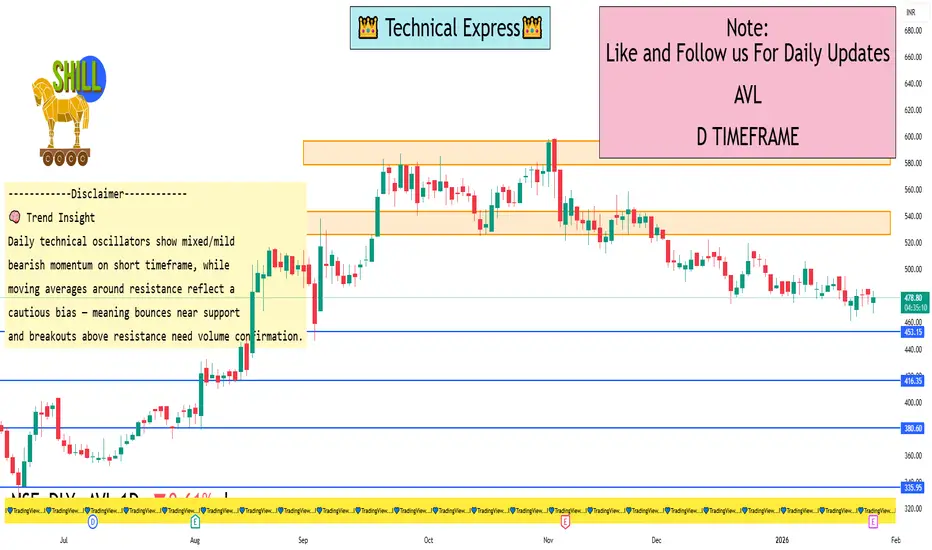
AVL 1 Day View📅 Daily (1‑Day) Technical Levels – Aditya Vision Ltd
📌 Current Approx Price (Latest)
~₹474–₹483 range around current trading session (today’s intraday range seen) — price fluctuates in this band.
📊 Pivot / Reference
Pivot ~ ₹479–₹484 (central reference for bias — above = bullish, below = bearish).
🟩 Resistance Levels (Upside)
R1: ~ ₹484–₹485 – first upside barrier.
R2: ~ ₹489–₹492 – next target if momentum improves.
R3: ~ ₹495–₹500+ – higher resistance zone.
🔻 Support Levels (Downside)
S1: ~ ₹474–₹476 – immediate support.
S2: ~ ₹468–₹470 – intermediate support if S1 breaks.
S3: ~ ₹460–₹463 – deeper support zone.
📈 Interpretation (1‑Day View)
Bullish scenario:
✔️ Price holding above pivot ~₹480 strengthens short‑term bullish bias.
✔️ A break above ~₹490–₹492 can open up ~₹495–₹500+ region.
Bearish scenario:
❌ If price decisively drops below ~₹474–₹476, next supports ~₹468 and ~₹463 may be tested.
Part 4 Techical Analysis Vs. Institutional Option TradingBuying Options – Explained in Points
Benefits of Buying Options
Limited risk, unlimited reward.
Small premium, large exposure.
Suitable for trending markets.
Ideal for news-driven moves (budget, RBI meetings, earnings, US data).
Great for breakout trading.
Risks of Buying Options
Time decay eats premium quickly.
Market can trap buyers in fake breakouts.
High volatility inflates premium (overpriced).
Reversal or sideways movement leads to loss.
When to Buy Options
Strong trend confirmed by price action.
Big volume breakout from key levels.
Market structure showing BOS (Break of Structure).
Low IV environment (premiums cheaper).
When a catalyst event can trigger trending movement.


