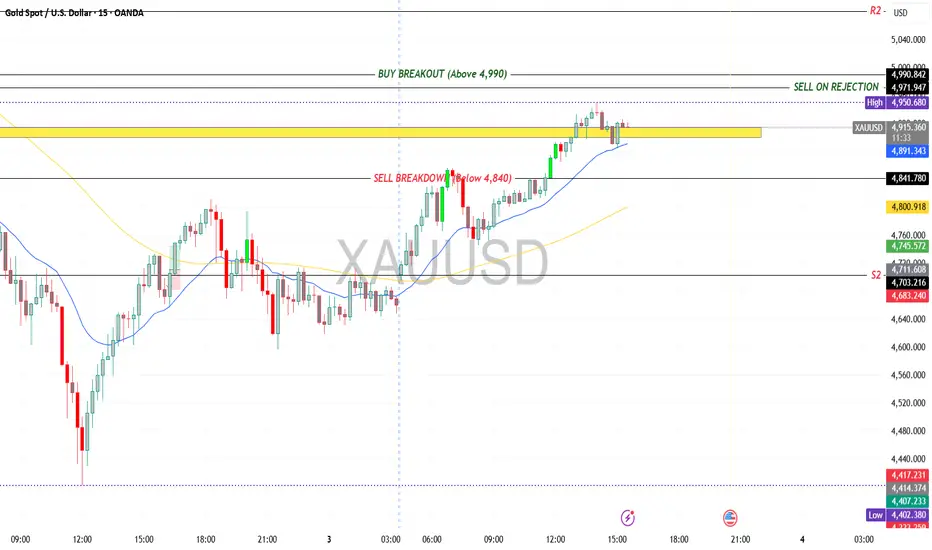
XAUUSD (Gold) | TECAHNICAL LEVEL | 3rd FEB'2026Gold trades near 4,930, up +5.8%, with higher timeframes maintaining a bullish structure. Price is holding above the 100 & 200 EMA, while elevated volatility keeps intraday moves sharp. The 4,940–5,000 zone remains a key decision area.
Key Levels
Resistance: 4,990 | 5,080
Support: 4,840 | 4,700
Volatility Zones: Above 4,990 (expansion) | Below 4,840 (pressure)
USD data, Fed commentary, and bond yields remain the primary drivers today.
⚠️ Disclaimer: Educational content only. Markets are risky—manage risk wisely.
Tradingsetup
Part 3 Institutional Option Trading Vs. Techncal AnalysisOption Buyer vs Option Seller
Buyer pays premium, limited risk, unlimited profit.
Seller collects premium, limited profit, unlimited risk.
In real market volume, 80–90% of time sellers (institutions) dominate.
Expiry
Every option has a deadline (weekly, monthly).
On expiry day, option either:
ITM: Has value.
OTM: Becomes zero.
XAUUSD (Gold) | BULLISH VS BEARISH LEVEL | 4th Feb'2026Gold remains bullish above 5,015–4,995, which is the major demand zone and key trend support. Intraday pullbacks toward 5,030–5,050 can offer buy-on-dips opportunities as long as price holds above this base.
On the upside, 5,090–5,100 is the immediate supply zone. A sustained breakout above 5,100 can accelerate momentum toward 5,125–5,160 and further to 5,200. Only a decisive hourly close below 4,995 would weaken the bullish structure and open downside toward 4,960–4,920.
Market Bias: Bullish above 5,015 | Neutral 5,015–5,050 | Bearish below 4,995
Algorithmic & Quantitative Trading – Basics Explained1. What is Algorithmic Trading?
Algorithmic Trading (Algo Trading) refers to using computer algorithms to automatically place trades based on predefined rules. These rules can be based on:
Price
Time
Volume
Technical indicators
Mathematical models
Once the algorithm is deployed, it can monitor markets, generate signals, and execute trades without human intervention.
Simple Example
An algorithm may be programmed as:
“Buy 100 shares of a stock when its 20-day moving average crosses above the 50-day moving average, and sell when the reverse happens.”
The computer continuously checks this condition and executes trades instantly when criteria are met.
2. What is Quantitative Trading?
Quantitative Trading (Quant Trading) is a broader concept that focuses on using statistical, mathematical, and probabilistic models to identify patterns in market data.
While algorithmic trading focuses on execution automation, quantitative trading focuses on:
Strategy design
Data analysis
Model building
Risk optimization
Most quantitative strategies are eventually implemented through algorithms, but not all algorithms are deeply quantitative.
3. Key Differences: Algo vs Quant Trading
Aspect Algorithmic Trading Quantitative Trading
Focus Automated execution Strategy development using math
Complexity Can be simple Often highly complex
Tools Rule-based logic Statistics, probability, ML
Human role Minimal after deployment High during research phase
Objective Speed & discipline Edge discovery & optimization
In practice, modern trading combines both.
4. Core Components of Algo & Quant Trading
1. Data
Data is the foundation. Common types include:
Price data (OHLC)
Volume data
Order book data
Corporate actions
Macroeconomic indicators
Data quality directly impacts strategy performance.
2. Strategy Logic
This defines when to buy, sell, or hold. Strategies can be:
Trend-following
Mean-reversion
Momentum-based
Arbitrage-based
Statistical models
Clear logic ensures consistency and removes emotional bias.
3. Backtesting
Backtesting evaluates how a strategy would have performed using historical data.
Key metrics include:
Net profit
Drawdown
Win rate
Sharpe ratio
Risk-reward ratio
Backtesting helps identify flaws before risking real capital.
4. Risk Management
Risk control is crucial. Common rules:
Fixed percentage risk per trade
Stop-loss and take-profit
Maximum drawdown limits
Position sizing models
A profitable strategy without risk control will eventually fail.
5. Execution System
Execution algorithms ensure:
Minimal slippage
Optimal order placement
Reduced market impact
Examples:
VWAP (Volume Weighted Average Price)
TWAP (Time Weighted Average Price)
5. Common Algorithmic Trading Strategies
1. Trend-Following Strategies
These aim to capture sustained price movement using:
Moving averages
Breakouts
Channel systems
Popular among beginners due to simplicity.
2. Mean Reversion Strategies
Based on the idea that prices revert to an average over time.
Examples:
RSI oversold/overbought systems
Bollinger Band reversals
Works well in range-bound markets.
3. Arbitrage Strategies
Exploits price differences between:
Cash and futures
Two exchanges
Related instruments
Requires high speed and low transaction costs.
4. Statistical Arbitrage
Uses correlations and probabilities between assets.
Example:
Pair trading (e.g., Reliance vs ONGC)
Relies heavily on quantitative analysis.
5. Market Making
Continuously places buy and sell orders to profit from bid-ask spread.
Mostly used by institutions due to infrastructure requirements.
6. Quantitative Models Used in Trading
1. Statistical Models
Regression analysis
Correlation & covariance
Z-score models
Used for identifying relationships between assets.
2. Probability & Risk Models
Normal distribution
Value at Risk (VaR)
Monte Carlo simulations
Used for risk estimation and stress testing.
3. Machine Learning Models
Advanced quants use:
Linear regression
Decision trees
Random forests
Neural networks
These models detect hidden patterns but require careful validation.
7. Benefits of Algorithmic & Quant Trading
Eliminates emotional decision-making
Faster execution than manual trading
Consistent application of rules
Ability to test strategies objectively
Scalability across multiple instruments
8. Risks and Challenges
Despite advantages, there are risks:
Overfitting historical data
Strategy failure in changing markets
Technology glitches
Data errors
Regulatory constraints
Successful traders focus on robustness, not perfection.
9. Algo & Quant Trading in Indian Markets
In India, algo trading is widely used in:
Index futures & options
Liquid stocks
Arbitrage strategies
SEBI regulations require:
Broker-approved algorithms
Risk checks
Order limits
Audit trails
Retail traders usually access algo trading through:
Broker APIs
Semi-automated platforms
Strategy builders
10. Skills Required to Learn Algo & Quant Trading
Basic statistics & probability
Market microstructure knowledge
Programming (Python preferred)
Understanding of trading psychology
Risk management principles
You don’t need to be a mathematician initially, but logic and discipline are essential.
11. Conclusion
Algorithmic and Quantitative Trading represent the evolution of trading from intuition-based decisions to systematic, data-driven processes. While institutions dominate advanced quantitative strategies, retail traders can still benefit from simpler rule-based algorithms.
Success in this field comes not from complexity, but from:
Well-tested logic
Strong risk management
Continuous learning
Adaptability to market conditions
When used correctly, algorithmic and quantitative trading can transform trading from speculation into a structured business.
Derivatives Trading Strategies – A Complete GuideDerivatives are financial instruments whose value is derived from an underlying asset such as stocks, indices, commodities, currencies, or interest rates. The most common derivatives used by traders are Futures and Options. Derivatives trading allows participants to hedge risk, speculate on price movements, and generate income with relatively lower capital compared to the cash market. However, derivatives are complex and require disciplined strategies and strong risk management.
Derivatives trading strategies can broadly be classified into futures-based strategies, options buying strategies, options selling strategies, hedging strategies, and advanced multi-leg strategies.
1. Futures Trading Strategies
Futures contracts are agreements to buy or sell an asset at a predetermined price on a future date. They are linear instruments, meaning profit or loss moves directly with price.
a) Trend Following Strategy
This is one of the most popular futures strategies. Traders identify strong trends using indicators like Moving Averages, ADX, or trendlines.
Buy futures in an uptrend
Sell futures in a downtrend
This strategy works best in trending markets and requires strict stop-losses to manage risk.
b) Breakout Strategy
Traders enter trades when price breaks above resistance or below support with strong volume.
Buy on resistance breakout
Sell on support breakdown
This strategy captures sharp moves but may suffer from false breakouts in sideways markets.
c) Pullback Strategy
Instead of chasing price, traders enter during minor retracements within a trend.
Buy near support in an uptrend
Sell near resistance in a downtrend
This provides better risk-reward compared to chasing breakouts.
d) Calendar Spread (Futures)
This involves buying one expiry and selling another expiry of the same contract.
Profits from changes in spread rather than price direction
Lower risk compared to naked futures positions
2. Option Buying Strategies
Option buying involves purchasing Call or Put options with limited risk but high reward potential. Timing is crucial.
a) Long Call Strategy
Used when the trader is bullish.
Buy Call option
Limited risk (premium paid)
Unlimited profit potential
Works best when price moves fast and volatility increases.
b) Long Put Strategy
Used in bearish conditions.
Buy Put option
Limited risk
Profits from falling prices
Effective during strong downtrends or market crashes.
c) Directional Option Buying with Indicators
Traders combine options with indicators like RSI, MACD, or VWAP to time entries. This helps reduce time decay losses.
d) Event-Based Option Buying
Traders buy options before events such as results, budgets, or global news expecting big moves. High risk due to volatility crush after the event.
3. Option Selling Strategies (Income Strategies)
Option selling focuses on earning premium and benefits from time decay (Theta). These strategies require margin and strong risk control.
a) Covered Call
Hold stock + sell Call option
Generates regular income
Limited upside but safer than naked selling
b) Cash Secured Put
Sell Put option with sufficient cash
Suitable for acquiring stocks at lower prices
Generates income in sideways markets
c) Short Straddle
Sell Call and Put at same strike
Profits when market remains range-bound
High risk if market moves sharply
d) Short Strangle
Sell out-of-the-money Call and Put
Lower risk than straddle
Suitable for low-volatility markets
4. Non-Directional Option Strategies
These strategies do not require predicting market direction but depend on volatility.
a) Iron Condor
Combination of Call and Put spreads
Profits in sideways markets
Limited risk and limited reward
Very popular among professional traders.
b) Butterfly Spread
Buy one ITM option, sell two ATM options, buy one OTM option
Low cost strategy
Profits when price stays near middle strike
c) Calendar Spread (Options)
Sell near-term option, buy far-term option
Profits from time decay difference
Lower risk compared to naked selling
5. Volatility-Based Strategies
Volatility plays a major role in options pricing.
a) Long Straddle
Buy Call + Put at same strike
Profits from big moves in either direction
Requires strong volatility expansion
b) Long Strangle
Buy OTM Call and Put
Cheaper than straddle
Needs large price movement
c) Vega Trading
Professional traders buy options when volatility is low and sell when volatility is high.
6. Hedging Strategies Using Derivatives
Derivatives are widely used for risk protection.
a) Portfolio Hedging
Buy Index Puts against stock portfolio
Protects against market crashes
b) Futures Hedging
Short index futures to hedge long equity holdings
Effective during uncertain market conditions
c) Protective Put
Buy Put option against stock holding
Acts like insurance
7. Risk Management in Derivatives Trading
Risk management is more important than strategy selection.
Always use stop-loss
Avoid over-leveraging
Risk only 1–2% of capital per trade
Understand Greeks (Delta, Theta, Vega, Gamma)
Avoid emotional trading
Conclusion
Derivatives trading strategies offer immense opportunities for profit, flexibility, and risk management. Futures strategies suit traders who prefer direct price movement, while options strategies provide multiple ways to trade direction, volatility, and time decay. However, derivatives amplify both profits and losses. Success in derivatives trading depends on discipline, risk control, strategy selection, and continuous learning.
For beginners, it is advisable to start with simple strategies like covered calls, cash-secured puts, or directional option buying before moving to advanced multi-leg strategies. With the right approach, derivatives can become a powerful tool in a trader’s arsenal.
XAUUSD (Gold) | Bull vs Bear Scenerio | 28th Jan'2026XAUUSD (Gold) | Technical Outlook | 28 Jan 2026
Gold (XAU/USD) is trading near 5,291, maintaining a strong bullish trend across intraday, daily, and higher timeframes. Price is holding firmly above all major moving averages (MA5–MA200), confirming trend strength. Momentum indicators (MACD, ADX, ROC, Bull/Bear Power) support further upside, while oscillators (RSI, Stoch RSI, CCI, Williams %R) remain overbought, indicating strong momentum with chances of short-term pullbacks. Volatility remains high (ATR ~59), so key levels are crucial.
Key Levels
Support: 5,232 | 5,198 | 5,135 | 5,101
Resistance: 5,295 | 5,330 | 5,392
Intraday Pivot: 5,232
Breakout & Breakdown
Bullish (Breakout):
Buy Above: 5,295
Targets: 5,330 → 5,392 → 5,400
Trend continuation above resistance
Bearish (Breakdown):
Sell Below: 5,232
Targets: 5,198 → 5,135
Below 5,100 → 5,000–4,950 (correction zone)
Conclusion
Overall trend remains bullish. Buy-on-dips above support is preferred, but avoid chasing near highs due to overbought conditions. Trade strictly on breakout or breakdown confirmation with proper risk management.
Disclaimer :For educational purposes only. Gold trading involves high risk. Always use stop-loss and trade as per your risk appetite.
Part 4 Institutional vs. TechnicalWhy Trade Options?
Retail traders, institutions, and hedgers use options for different reasons:
1. Hedging
Institutions hedge large positions using options to protect risk.
Example:
A mutual fund buys NIFTY PEs to protect its long equity portfolio.
2. Speculation
Small traders use options to generate returns with limited capital.
3. Income Generation
Option sellers earn premium by selling options that they believe will expire worthless.
4. Risk Management
Options allow you to define risk precisely.
Nifty 50 1 Week Time Frame 📊 Current Level (approx)
Nifty 50 ~ 25,200–25,350 area as of the last trading sessions (January 27–28, 2026).
📈 Key Weekly Levels to Watch
🔹 Immediate Resistance
1. ~25,300–25,350 — short‑term upside barrier (recent highs around these levels).
2. ~25,500–25,700+ — next major resistance zone (from prior weekly technical analysis, a breakout above ~26,100 historically signalled stronger bullish control).
🔻 Support Zones
1. ~24,900–25,000 — key short‑term support defended in recent sessions and noted by traders as a pivot area.
2. ~24,500–24,700 — broader weekly support zone (buffer from intermediate trend lines / moving averages).
3. ~24,200–24,300 — deeper weekly support; breach here could imply stronger correction risk.
📌 Weekly Trading Range (Probable)
Based on recent technical ranges and previous weekly outlooks:
➡️ Bullish bias above ~25,000 with resistance towards 25,500–25,700+.
➡️ Bearish/mixed bias if breaks below ~24,900, with support down to 24,500 and 24,200 zones.
⚠️ Important Notes
These levels are technical references used by traders — not investment advice.
Weekly support/resistance can shift quickly with strong market moves or macro events (especially around global policy news or earnings).
Always use stop losses and proper risk management if trading off these levels.
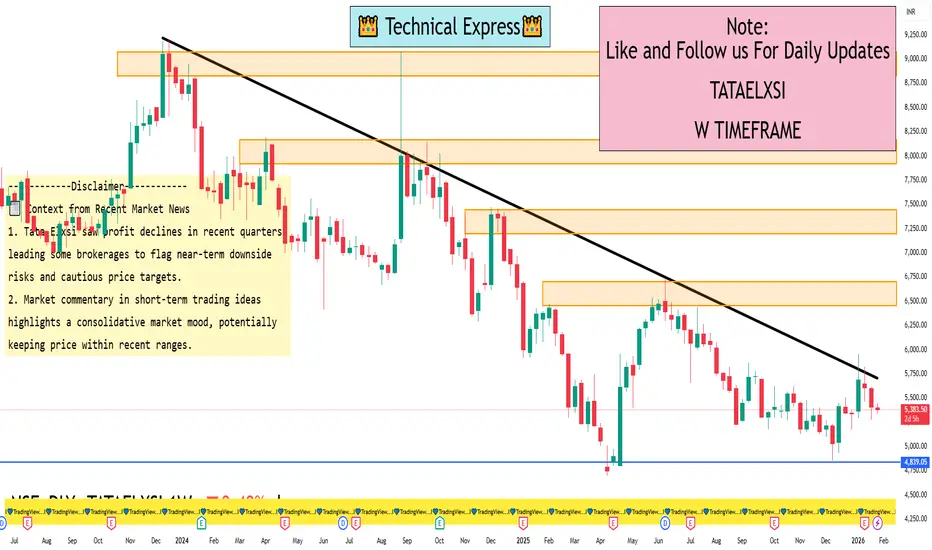
TATAELXSI 1 Week View 📊 Current context
The stock price is in the range of around ₹5,350–₹5,450 (as of last close).
📈 1‑Week Technical Levels
These are typical support/resistance values used by short‑term traders (daily/weekly pivots & swing levels):
🧭 Weekly Support
1. ~₹5,270–₹5,280 — first major weekly support zone.
2. ~₹5,106–₹5,110 — secondary support before lower breakdown risk.
3. ~₹4,700 area — strong downside zone (52‑week low area).
🚧 Weekly Resistance
1. ~₹5,618–₹5,620 — initial weekly resistance level.
2. ~₹5,950–₹6,000 — higher breakout zone for bullish momentum.
3. Above ₹6,300 — strong breakout continuation level.
These weekly levels are useful for planning trades across the next 5–7 sessions — gains above initial resistance suggest near‑term strength, while breaks below support indicate further weakness.
🔁 Daily Pivot Levels (for intraday / short swing)
Pivot Point: ~₹5,400–₹5,407
Support†: ~₹5,355 → ₹5,295 → ₹5,250
Resistance†: ~₹5,460 → ₹5,505 → ₹5,565 (higher targets)
These pivot levels help define day‑to‑day trading range within the week.
LUPIN 1 Day View 📊 Current Market Snapshot (Latest Available Close)
Price: ~₹2,137.20 (NSE) — price range on the most recent session was ₹2,130.30–₹2,178.00.
Previous Close: ₹2,163.20.
52‑week range: ₹1,795.20 low ~ ₹2,226.30 high.
📈 Daily Pivot & Key Levels (Short‑Term Technical)
🔁 Pivot (Reference Level)
Pivot point: ~₹2,166–₹2,160 zone — this is the central level that often defines bull/bear bias intraday.
🔼 Resistance (Upside Levels)
R1: ~₹2,185–₹2,189 — immediate upside barrier.
R2: ~₹2,206–₹2,208 — next medium resistance.
R3: ~₹2,227–₹2,238 — stronger resistance zone (intraday to short‑term).
🔽 Support (Downside Levels)
S1: ~₹2,143–₹2,119 — initial support from recent pivot structures.
S2: ~₹2,124–₹2,100 — mid downside support.
S3: ~₹2,102–₹2,071 — deeper support if bearish momentum accelerates.
🧠 How to Use These Levels Today
Bullish view: Stay above pivot (~₹2,160–₹2,166) for upside bias toward R1→R2.
Neutral/Range: Between S1 and R1 suggests consolidation — trade bounces within this zone.
Bearish breakdown: A close below S2/S3 can indicate deeper correction — watch S2 as key risk cutoff.
(These are not buy/sell recommendations, just short‑term technical reference points.)
HINDALCO 1 Month View 📌 Current Price Snapshot
Approximate recent price: ₹961–₹975 on NSE.
52-week range: ₹546.45 (low) to ~₹985 (high).
📊 1-Month Technical Levels (Support & Resistance)
🔁 Pivot & Balanced Level
Pivot Level: ~₹954 – ₹963 (central zone where trend bias often flips)
📈 Resistance Levels (Upside Barriers)
1. R1: ~₹959 – ₹960 — first key resistance above current pivot.
2. R2: ~₹969 – ₹970 — near recent short-term highs.
3. R3: ~₹975 – ₹980+ — upper resistance and psychological round number area.
💡 Above ~₹980: breakout build-up zone toward recent swing highs (~₹985).
📉 Support Levels (Downside Floors)
1. S1: ~₹944 – ₹945 — first major support zone.
2. S2: ~₹938 – ₹940 — next lower support within recent range.
3. S3: ~₹929 – ₹932 — deeper support if price slides further.
4. Lower structural zone: ~₹907 – ₹921 — broader support band from longer-term pivots.
📅 Trend & Market Context (1-Month)
Momentum: RSI around mid-60s suggesting moderately bullish momentum without being overbought.
Moving averages: Price trading above major short & mid-term averages (20/50 DMA), indicating bullish bias on the monthly view.
Volatility: ATR indicates normal volatility — not extreme swings.
Interpretation:
✔ Stays bullish above ~₹944–₹945 support.
✔ Upside can extend to ~₹969–₹980 if momentum persists.
⚠ A break below ~₹932 could signal deeper pullbacks toward ~₹907 area.
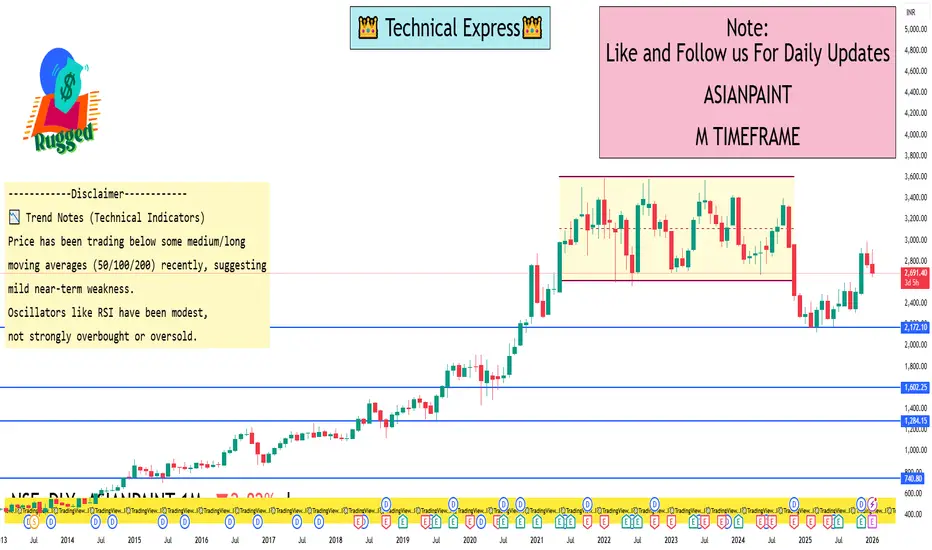
ASIANPAINT 1 Month View 📊 Recent Price Context
Asian Paints trading around ₹2,700–₹2,730 zone as of late Jan 2026 (approximate price) according to live quotes.
🔁 Key Pivot / Support & Resistance (Daily)
(Based on classic pivot calculations — often used by traders for 1-month/short-term analysis)
Resistance Levels:
R1: ~₹2,760–₹2,761 📈
R2: ~₹2,817–₹2,818 📈
R3: ~₹2,852–₹2,853 📈
Pivot (Central Reference):
Pivot: ~₹2,725–₹2,727 🔄
Support Levels:
S1: ~₹2,668–₹2,669 📉
S2: ~₹2,633–₹2,634 📉
S3: ~₹2,576–₹2,577 📉
These levels give a short-term structure of zones where price often reacts (bounces or stalls) on daily charts.
📌 Short Interpretation
Bullish break above ₹2,760–₹2,800 could open the path toward higher resistances near ₹2,820–₹2,850+ in the current move.
Support cluster around ₹2,630–₹2,670 is the key downside band — if this fails, wider losses toward the ₹2,576+ region are possible.
Part 2 Candle Stick PatternOption Buyer vs Option Seller
Option Buyer
Pays premium upfront
Has limited loss (premium)
Unlimited or large profit potential
Suffers from time decay
Option Seller (Writer)
Receives premium upfront
Limited profit (premium received)
Potentially unlimited loss (especially naked calls)
Benefits from time decay
Cross-Market ArbitrageConcept and Rationale
In an ideal and perfectly efficient market, the price of an identical asset should be the same everywhere once adjusted for factors such as transaction costs, taxes, and exchange rates. This principle is often referred to as the law of one price. However, in real-world markets, temporary deviations occur due to differences in liquidity, information flow, trading hours, capital controls, regulatory frameworks, and investor behavior. Cross-market arbitrage aims to capitalize on these deviations before prices converge again.
The strategy plays a critical role in maintaining market efficiency. Arbitrageurs, by acting on price discrepancies, help align prices across markets. As more traders exploit an arbitrage opportunity, buying pressure in the cheaper market and selling pressure in the expensive market gradually eliminate the price gap.
Types of Cross-Market Arbitrage
One of the most common forms is geographical arbitrage, where the same asset trades on exchanges in different countries. For example, a stock listed on both the Indian market and a foreign exchange may trade at slightly different prices due to currency movements or local demand-supply dynamics.
Another major form is exchange-based arbitrage, where price differences exist between two domestic exchanges trading the same instrument. In equity markets, this can occur when a stock is listed on multiple exchanges and short-term inefficiencies arise.
Currency-based cross-market arbitrage involves exploiting mispricing between currency pairs across different forex markets or between the spot and offshore markets. This often overlaps with triangular arbitrage, where inconsistencies between three currency exchange rates create profit opportunities.
Derivative-based arbitrage is also significant. Here, traders exploit price differences between a cash market instrument and its derivative, such as an index and its futures contract traded on different exchanges or jurisdictions.
Mechanics of Execution
Successful cross-market arbitrage requires simultaneous execution of buy and sell orders to eliminate directional market risk. Speed and precision are essential, as arbitrage windows are often extremely short-lived. Institutional traders typically rely on algorithmic trading systems and direct market access to identify and execute opportunities in milliseconds.
For example, if a stock is trading lower on one exchange compared to another after accounting for currency conversion and transaction costs, an arbitrageur would buy the stock in the cheaper market and sell it in the higher-priced market at the same time. The profit is realized once the positions are settled, assuming the price gap closes as expected.
Role of Technology
Technology is a decisive factor in cross-market arbitrage. Modern arbitrage strategies heavily depend on real-time data feeds, low-latency infrastructure, co-location services, and automated execution systems. Without these, price discrepancies are likely to disappear before a trade can be completed.
High-frequency trading firms dominate this space because they can react faster than manual traders. However, longer-duration arbitrage opportunities may still exist in less liquid markets or during periods of high volatility, regulatory changes, or market stress.
Risk Factors
Although cross-market arbitrage is often perceived as low risk, it is not risk-free. Execution risk is one of the most significant concerns. If one leg of the trade is executed while the other fails or is delayed, the trader may be exposed to market movements.
Currency risk arises when trades involve assets priced in different currencies. Even small exchange rate fluctuations can impact profitability if not properly hedged.
Liquidity risk is another challenge, especially in emerging markets. A lack of sufficient volume may prevent traders from executing large orders at expected prices.
Regulatory and settlement risk also play a role. Different markets have varying settlement cycles, taxation rules, and capital restrictions, which can complicate arbitrage trades and increase costs.
Costs and Constraints
Transaction costs such as brokerage fees, exchange fees, taxes, and bid-ask spreads significantly influence the viability of cross-market arbitrage. Even a seemingly attractive price difference can become unprofitable once these costs are considered.
Additionally, capital requirements can be high, as traders must maintain positions in multiple markets simultaneously. Margin rules and leverage limits may further constrain strategy implementation.
Market Impact and Importance
Cross-market arbitrage contributes to price discovery and market integration. By narrowing price differences across markets, arbitrageurs enhance transparency and efficiency. This is particularly important in globalized financial systems where capital flows freely across borders.
During periods of market stress, arbitrage opportunities may widen due to panic selling, liquidity shortages, or regulatory disruptions. While this increases potential returns, it also raises risks, making risk management and capital discipline crucial.
Conclusion
Cross-market arbitrage is a sophisticated trading strategy rooted in the fundamental principle of price convergence across markets. While the theoretical concept is straightforward, practical execution requires advanced technology, deep market understanding, and robust risk controls. As global markets continue to integrate and trading becomes increasingly automated, cross-market arbitrage remains a vital mechanism for maintaining efficiency, though opportunities are often fleeting and highly competitive. For skilled traders and institutions, it offers a compelling blend of analytical rigor, speed, and strategic precision.
Option Chain Terms – A Comprehensive Explanation1. Underlying Asset
The underlying asset is the security on which the option contract is based. This could be an equity stock (like Reliance or TCS), an index (such as NIFTY or BANKNIFTY), a commodity, or a currency. All option prices in the option chain are derived from the movement of this underlying asset.
2. Expiry Date
The expiry date is the last date on which an option contract remains valid. After this date, the option either expires worthless or is settled (cash or physical settlement, depending on the contract). Option chains usually show multiple expiries—weekly, monthly, and sometimes quarterly—allowing traders to choose contracts based on their time horizon.
3. Strike Price
The strike price is the predetermined price at which the underlying asset can be bought (in the case of a Call option) or sold (in the case of a Put option). Strike prices are arranged vertically in the option chain, with Calls on one side and Puts on the other. The choice of strike price reflects the trader’s market view and risk appetite.
4. Call Option (CE)
A Call option gives the buyer the right, but not the obligation, to buy the underlying asset at the strike price before or on the expiry date. In the option chain, Call options are typically displayed on the left side. Rising Call premiums often indicate bullish sentiment, while heavy Call writing may signal resistance levels.
5. Put Option (PE)
A Put option gives the buyer the right, but not the obligation, to sell the underlying asset at the strike price before or on expiry. Put options are shown on the right side of the option chain. Increasing Put premiums usually reflect bearish sentiment or demand for downside protection.
6. Option Premium (Last Traded Price – LTP)
The option premium is the price paid by the option buyer to the seller (writer). In the option chain, this is shown as the Last Traded Price (LTP). The premium consists of intrinsic value and time value and fluctuates based on factors like underlying price, volatility, time to expiry, and interest rates.
7. Intrinsic Value
Intrinsic value is the real, in-the-money value of an option.
For a Call option: Intrinsic Value = Underlying Price − Strike Price
For a Put option: Intrinsic Value = Strike Price − Underlying Price
If this value is negative, intrinsic value is considered zero.
8. Time Value
Time value is the portion of the option premium beyond intrinsic value. It represents the possibility that the option may gain value before expiry. Time value decreases as expiry approaches, a phenomenon known as time decay or theta decay.
9. Open Interest (OI)
Open Interest refers to the total number of outstanding option contracts that have not been settled or closed. High OI indicates strong participation and liquidity at that strike price. Traders analyze changes in OI to understand whether new positions are being created or old ones are being unwound.
10. Change in Open Interest (ΔOI)
Change in Open Interest shows the increase or decrease in OI compared to the previous trading session.
Rising OI with rising price suggests strong trend continuation.
Rising OI with falling price indicates bearish buildup.
Falling OI suggests position unwinding.
11. Volume
Volume represents the number of option contracts traded during a particular trading session. High volume signals active trading interest and often precedes strong price movements.
12. Implied Volatility (IV)
Implied Volatility reflects the market’s expectation of future price fluctuations in the underlying asset. Higher IV means higher option premiums, while lower IV results in cheaper options. Traders closely track IV to decide whether options are expensive or cheap.
13. Bid Price and Ask Price
Bid Price: The highest price a buyer is willing to pay for an option.
Ask Price: The lowest price a seller is willing to accept.
The difference between them is called the bid-ask spread, which indicates liquidity.
14. At-the-Money (ATM), In-the-Money (ITM), Out-of-the-Money (OTM)
ATM: Strike price closest to the current underlying price.
ITM: Options with intrinsic value.
OTM: Options with no intrinsic value.
These classifications help traders select appropriate strikes.
15. Greeks in Option Chain
Some option chains also display Option Greeks, which measure sensitivity:
Delta: Sensitivity to underlying price changes
Gamma: Rate of change of Delta
Theta: Time decay
Vega: Sensitivity to volatility
Rho: Sensitivity to interest rates
Conclusion
An option chain is far more than a list of prices—it is a powerful analytical tool that reveals market psychology, support and resistance levels, volatility expectations, and trading opportunities. By understanding option chain terms such as strike price, open interest, implied volatility, and option Greeks, traders can make informed decisions, manage risk effectively, and build well-structured option strategies. Mastery of option chain terminology is a foundational step toward successful options trading.
PART 2 TECHNNICAL VS. INSTITUTIONALA. Strike Price
The strike price is the predetermined price at which the buyer can buy (CE) or sell (PE) the underlying.
Example:
Nifty Spot = 22,000
You buy Nifty 22,100 CE, meaning you can buy Nifty at 22,100.
B. Premium
Premium is the price you pay (buyer) or receive (seller) to enter the contract. Option prices change based on demand, volatility, time, and underlying movement.
C. Expiry
Options do not last forever. Every option expires:
Weekly (Most popular in Nifty/Bank Nifty)
Monthly
Quarterly (some stocks)
Yearly (LEAPS) in some markets
At expiry, the option will either:
Become In the Money (ITM) → It has intrinsic value.
Become Out of the Money (OTM) → It becomes worthless.
XAUUSD (Gold) | Bullish vs Bearish SetupS | 23rd Jan'2026XAU/USD – Key Levels (23 Jan 2026)
Resistance:
* R1: 4975–4985 → Near-term supply
* R2: 5000–5015 → Psychological breakout zone
Support:
* Pivot / Demand Zone: 4940–4955 → Intraday balance
* Primary Support: 4920–4940 → Trend bullish above
* Secondary Support: 4880–4900 → Strong swing support
* Trend Invalidation: 4850 → Break weakens bullish trend
Bullish Swing Setup
* Buy on Dip: 4920–4940 | SL: 4900 | Targets: 4975 → 5000 → 5015
* Breakout Buy: Above 4985 | SL: 4955 | Targets: 5000 → 5030 → 5050
Bearish Swing Setup (Corrective)
* Pullback Sell: Below 4920 | SL: 4940 | Targets: 4880 → 4850 → 4820
* Trend Shift Sell: Break below 4850 | SL: 4880 | Targets: 4800 → 4760
PART 1 TECHNNICAL VS. INSTITUTIONAL What Are Options?
Options are financial derivatives—meaning their value is derived from an underlying asset such as stock, index, commodity, etc. They are contracts between two parties: the option buyer and the option seller (writer).
There are two types of options:
Call Option (CE) – Right to buy the asset at a fixed price.
Put Option (PE) – Right to sell the asset at a fixed price.
The key point:
The buyer has a right but no obligation. The seller has an obligation but no rights.
Data Centre & Semiconductor Theme Trading A Deep-Dive for Market Participants
The data centre and semiconductor theme has emerged as one of the most powerful structural trades of the decade. It sits at the intersection of AI, cloud computing, digitalization, electrification, and geopolitics, making it a multi-year secular opportunity rather than a short-term cyclical play. For traders and investors, this theme offers momentum bursts, relative-value trades, and long-term compounding stories—if approached with the right framework.
1. Why This Theme Matters
At its core, every digital action—AI inference, cloud storage, video streaming, fintech transactions, autonomous driving—ultimately ends up in data centres powered by semiconductors.
Think of the chain as:
AI / Cloud Demand → Data Centres → Chips → Equipment → Power & Cooling
This creates a stacked value chain where multiple listed companies benefit simultaneously, but at different points in the cycle. Theme trading is about identifying which layer is leading and which is lagging.
2. Structural Demand Drivers
a) Artificial Intelligence Explosion
Generative AI, LLMs, and enterprise AI workloads are orders of magnitude more compute-intensive than traditional applications.
Training AI models requires high-end GPUs / accelerators
Inference workloads demand low latency, high bandwidth memory
AI data centres consume 2–4× more power than traditional centres
This directly fuels demand for:
Advanced semiconductors
Memory (HBM, DRAM)
Networking chips
Power management ICs
b) Cloud & Hyperscale Capex Cycles
Hyperscalers (AWS, Azure, Google, Meta) invest in multi-year capex waves. When capex accelerates:
Semiconductor orders surge first
Data centre construction follows
Cooling, power, and networking companies benefit later
Traders track capex guidance as a leading indicator.
c) Digital Sovereignty & Geopolitics
Governments want domestic chip manufacturing for security reasons:
US CHIPS Act
EU Chips Act
India Semiconductor Mission
This adds a policy-driven floor to semiconductor demand, even during economic slowdowns.
3. Key Segments Within the Theme
a) Semiconductor Designers (High Beta Leaders)
These companies design chips but outsource manufacturing.
Traits
Highest operating leverage
Strong momentum during AI upcycles
Sharp drawdowns during corrections
Trading View
Best for momentum and breakout strategies
Sensitive to earnings surprises and guidance
b) Foundries & Manufacturers
Companies that actually fabricate chips.
Traits
Capital intensive
Long-term contracts
Less volatile than designers
Trading View
Suitable for swing trades around utilization rates
React strongly to capex and yield improvement news
c) Semiconductor Equipment & Materials
They supply lithography, etching, deposition, chemicals, and wafers.
Traits
Benefit before chips are sold
Orders lead end-market demand by 2–4 quarters
Trading View
Ideal for early-cycle positioning
Strong relative performance when capex cycles turn up
d) Data Centre Infrastructure & REITs
Includes:
Data centre builders
Power distribution
Cooling systems
Data centre REITs
Traits
More stable cash flows
Yield + growth combination
Trading View
Better for positional and defensive thematic trades
Outperform during rate cuts or stable macro environments
4. How Theme Trading Actually Works
a) Momentum Phase Trading
When AI or cloud narratives dominate headlines:
Leaders break out of long consolidations
Volume expansion confirms institutional participation
Indicators used
Relative strength vs index
20/50-DMA trend alignment
Sectoral ETF flows
b) Rotation Trades Inside the Theme
Not all sub-segments lead together.
Typical rotation:
Chip designers lead
Equipment stocks catch up
Data centre infra plays follow
Power & cooling benefit last
Advanced traders rotate capital within the theme, not out of it.
c) Mean Reversion & Pullback Buying
Even strong secular themes correct 20–30%.
High-probability setups:
Pullbacks to rising 50-DMA
RSI reset without trend break
Volume contraction during corrections
5. Valuation vs Growth: The Constant Debate
Semiconductor and data centre stocks often look expensive on traditional metrics.
Key point:
In secular tech cycles, earnings catch up to price, not the other way around.
Smart traders:
Focus on forward earnings revisions
Track order backlog growth
Watch capex-to-revenue ratios
Overvaluation becomes a risk only when growth decelerates.
6. Macro Risks to Watch
a) Interest Rates
Data centres are capital-intensive
Higher rates compress valuations, especially REITs
b) Cyclical Slowdowns
Consumer electronics downturns affect legacy chip demand
AI demand may offset but not fully eliminate cyclicality
c) Supply Chain Bottlenecks
Advanced nodes depend on few suppliers
Delays can cause earnings volatility
7. India Angle in This Theme
India is becoming relevant in:
Data centre construction (cloud, fintech, OTT demand)
Semiconductor assembly, testing, and packaging (ATMP)
Power infrastructure and cooling solutions
Indian traders often use:
Global semiconductor indices as trend indicators
Domestic infra & power plays as satellite trades
This creates cross-market correlation opportunities.
8. Portfolio Construction for Theme Traders
A balanced approach:
40% Momentum Leaders – High beta semiconductor names
30% Enablers – Equipment, power, cooling
20% Stability – Data centre REITs / infra
10% Tactical Cash – For sharp corrections
Risk management is critical because these stocks move together during risk-off phases.
9. Why This Is a Multi-Year Trade
Unlike past tech cycles, this theme is supported by:
AI workload explosion
Government policy support
Long-duration capex visibility
Structural digital dependency
This makes the data centre & semiconductor trade closer to an “infrastructure cycle” than a traditional tech boom.
10. Final Takeaway
Data centre and semiconductor theme trading is not about picking one stock—it’s about understanding the ecosystem and riding capital flows. The biggest edge comes from:
Identifying which layer is leading
Entering during healthy pullbacks
Rotating within the theme rather than abandoning it
For traders who respect trend structure and manage risk, this theme remains one of the cleanest, most powerful opportunities of the current decade.
NIFTY : Intraday Trading levels and Plan for 23-Jan-2026📘 NIFTY Trading Plan – 23 Jan 2026
Timeframe: 15-Minute
Gap Considered: 100+ Points
Market Context: After a sharp intraday recovery from lower levels, NIFTY is now approaching a key decision-making zone. Trend is still corrective, with range expansion possible on either side.
🔼 SCENARIO 1: GAP UP OPENING (100+ points) 🚀
If NIFTY opens above 25,498, it indicates follow-through buying and short-covering.
The zone 25,498 – 25,537 will act as the first opening resistance.
Sustained 15-min close above 25,537 can trigger momentum toward:
• 25,666 – 25,718 (Last Resistance Zone)
Above 25,718, trend strength improves and fresh longs may emerge.
Failure to sustain above 25,498 = high probability of rejection and pullback.
📌 Educational Insight:
Gap-up openings near resistance often trap late buyers. Confirmation is mandatory before aggressive longs.
📌 Options View:
• Bull Call Spread preferred over naked CE
• Partial profit booking near resistance
• Avoid chasing premiums 🚀
➡️ SCENARIO 2: FLAT / RANGE OPENING ⚖️
If NIFTY opens between 25,301 – 25,378, expect range-bound and whipsaw price action.
This zone acts as a No-Trade Zone / Balance Area.
Multiple fake breakouts are likely.
Upside confirmation only above 25,498.
Downside weakness below 25,301.
Wait for a 15-min close outside the range before taking trades.
📌 Educational Insight:
Flat opens after volatile sessions usually lead to time correction, not directional moves.
📌 Options View:
• Iron Fly / Short Strangle with strict SL
• Low quantity & fast exits
• Protect capital over profits ⏳
🔽 SCENARIO 3: GAP DOWN OPENING (100+ points) 📉
If NIFTY opens below 25,301, sellers regain short-term control.
Immediate support lies near 25,177.
Break below 25,177 opens downside toward:
• 25,031 – 25,077 (Last Intraday Support)
Below 25,030, bearish momentum can accelerate.
Any pullback toward 25,301 – 25,378 should be treated as sell-on-rise.
📌 Educational Insight:
Gap-down opens demand patience — let volatility settle before initiating trades.
📌 Options View:
• Bear Put Spread preferred
• Avoid PE selling in falling markets
• Trail stop-loss aggressively 📉
🧠 Risk Management Tips for Options Traders 🛡️
Risk only 1–2% of capital per trade.
Expiry proximity = faster theta decay.
Prefer spreads over naked options.
No candle confirmation = no trade.
Avoid overtrading inside no-trade zones.
📌 Summary & Conclusion ✨
NIFTY is trading near a critical equilibrium zone.
📍 25,301 – 25,378 = decision area
📍 Strength only above 25,498 → 25,718
📍 Weakness below 25,301 → 25,177 → 25,030
Patience, discipline, and level-based execution will be key for 23 Jan.
⚠️ Disclaimer
This analysis is strictly for educational purposes only.
I am not a SEBI registered analyst.
Markets are uncertain and I may be wrong.
Please consult your financial advisor before trading.
AXISBANK 1 Week Time Frame 📈 Current Price Context
Axis Bank is trading around ₹1,300–₹1,305 range recently.
🔑 1‑Week Pivot & Key Levels
These levels are commonly used by traders to identify likely reversal zones or breakouts for the week ahead:
🔥 Weekly Resistance (Upside Targets)
1. R1: ~₹1,317–₹1,320 – First resistance zone this week.
2. R2: ~₹1,341–₹1,342 – Next resistance zone if bullish momentum continues.
3. R3: ~₹1,370+ (approx) – Major higher resistance for breakout scenario.
👉 Bullish condition: Week closes above ₹1,317–₹1,320 with volume → look for extended upside moves toward ₹1,340+.
🛡️ Weekly Support (Downside Floors)
1. S1: ~₹1,262–₹1,265 – Near‑term support for the week.
2. S2: ~₹1,230 – Mid‑range support if breakdown below first support happens.
3. S3: ~₹1,206 – Broader downside support level.
👉 Bearish condition: Cleared break below ₹1,262–₹1,265 may accelerate downside toward ₹1,230 → ₹1,206.
📊 Support/Resistance (Pivot‑Based Technical)
From short‑term pivot derivations (daily/weekly calculations):
Resistance
R1: ~₹1,306–₹1,307
R2: ~₹1,319–₹1,320
R3: ~₹1,329–₹1,330
Support
S1: ~₹1,284–₹1,285
S2: ~₹1,274–₹1,275
S3: ~₹1,261–₹1,262
These extra pivot levels (especially R1/R2/S1/S2) help fine‑tune next day or mid‑week entries.
📌 How to Use This Weekly Level View
📈 Bullish Scenario
Hold above ₹1,317–₹1,320 zone
Short‑term resistance becomes support on breakout
Targets → ₹1,340 → ₹1,373+
📉 Bearish Scenario
Close below ₹1,262–₹1,265
Potential decline toward ₹1,230 → ₹1,206 zones
📊 Consolidation Range
If price stays between ₹1,262–₹1,320 → expect range‑bound trading for the week.
Quantitative Trading The Science of Data-Driven Financial MarketCore Concept of Quantitative Trading
At its core, quantitative trading is built on the belief that market behavior follows identifiable patterns that can be measured, modeled, and exploited. Quant traders collect vast amounts of historical and real-time market data—such as price movements, volume, volatility, interest rates, and macroeconomic indicators—and apply mathematical techniques to uncover statistically significant relationships. These insights are then converted into precise trading rules that computers can execute automatically.
The goal is not to predict markets with certainty, but to gain a probabilistic edge. Even a small statistical advantage, when applied consistently across many trades, can lead to meaningful long-term profitability.
Key Components of Quantitative Trading
Quantitative trading systems typically consist of several interlinked components. First is data acquisition, where clean, high-quality data is gathered from exchanges, economic reports, and alternative sources such as satellite data or social media sentiment. Second is model development, where traders use mathematics, statistics, and machine learning to design strategies. These models may focus on trends, mean reversion, arbitrage, or volatility patterns.
Next comes backtesting, a critical step in which strategies are tested against historical data to evaluate performance, risk, and robustness. Finally, execution and risk management ensure that trades are placed efficiently while controlling losses through position sizing, stop-loss rules, and portfolio diversification.
Common Quantitative Trading Strategies
Several well-known strategies form the foundation of quantitative trading. Trend-following strategies aim to capture sustained market movements by identifying upward or downward momentum. Mean reversion strategies assume that prices tend to return to their historical averages after extreme movements. Statistical arbitrage seeks to exploit temporary price discrepancies between related securities, often across stocks, futures, or ETFs.
Another important category is high-frequency trading (HFT), which uses ultra-fast algorithms to execute large numbers of trades within milliseconds, profiting from small price inefficiencies. Factor-based investing, commonly used by hedge funds and asset managers, ranks securities based on factors such as value, momentum, quality, and low volatility.
Role of Technology and Algorithms
Technology is the backbone of quantitative trading. Powerful computers process massive datasets, while programming languages such as Python, R, and C++ are used to build and deploy models. Machine learning and artificial intelligence have further expanded the scope of quant trading by enabling systems to adapt, learn from new data, and improve performance over time.
Algorithmic execution minimizes transaction costs by intelligently splitting large orders and timing trades to reduce market impact. As markets become more competitive, speed, efficiency, and technological sophistication often determine success.
Risk Management in Quantitative Trading
Risk management is just as important as strategy design. Quantitative traders focus on controlling downside risk through diversification, volatility targeting, and strict drawdown limits. Since quant strategies often rely on historical relationships, unexpected market events—such as financial crises or geopolitical shocks—can cause models to fail. Robust risk frameworks help mitigate these risks by limiting exposure and adapting to changing market conditions.
Stress testing and scenario analysis are widely used to evaluate how strategies might perform under extreme conditions. This disciplined approach helps protect capital and ensures long-term sustainability.
Advantages of Quantitative Trading
One of the biggest advantages of quantitative trading is objectivity. Decisions are based on data and rules rather than emotions like fear or greed. Quant strategies are also scalable, allowing traders to manage large portfolios across multiple markets simultaneously. Automation improves consistency, ensuring that strategies are executed exactly as designed without human error.
Additionally, quantitative trading can uncover opportunities that are invisible to the human eye, especially in complex, fast-moving markets where manual analysis is impractical.
Challenges and Limitations
Despite its strengths, quantitative trading is not without challenges. Developing reliable models requires deep expertise in mathematics, programming, and financial theory. Data quality issues, overfitting, and changing market dynamics can reduce effectiveness. As more participants adopt similar strategies, competition increases and profit margins shrink.
Regulatory constraints, technological costs, and the risk of model breakdowns during extreme events also pose significant hurdles. Successful quant traders must continuously research, refine, and adapt their models.
Future of Quantitative Trading
The future of quantitative trading is closely tied to advancements in artificial intelligence, big data, and cloud computing. Alternative data sources, such as satellite imagery and real-time consumer behavior, are expanding the analytical toolkit of quant traders. As markets evolve, quantitative trading is expected to become even more sophisticated, integrating human insight with machine intelligence.
Conclusion
Quantitative trading represents the fusion of finance, mathematics, and technology. By transforming market data into systematic strategies, it offers a disciplined and scalable approach to trading. While it requires significant expertise and resources, quantitative trading continues to shape modern financial markets, redefining how trades are analyzed, executed, and managed in an increasingly data-driven world.
A Complete Guide to Choosing the Right Trading ApproachWhich Trading Style Is Best?
Trading in financial markets is not a one-size-fits-all activity. Every trader has different goals, risk tolerance, time availability, capital size, and psychological makeup. Because of these differences, multiple trading styles have evolved over time. The most important question for any trader—especially beginners—is not which trading style is the most profitable, but which trading style suits me best. Choosing the right trading style can significantly improve consistency, discipline, and long-term success.
Understanding Trading Styles
A trading style refers to the method and timeframe a trader uses to enter and exit the market. It determines how long trades are held, how frequently trades are taken, and how much risk is assumed per trade. Trading styles range from ultra-short-term approaches that last seconds or minutes to long-term strategies that span months or even years.
The most common trading styles include scalping, day trading, swing trading, position trading, and long-term investing. Each style has its own advantages, disadvantages, and suitability depending on the trader’s personality and lifestyle.
Scalping: Fast-Paced and High Intensity
Scalping is the shortest-term trading style. Scalpers aim to profit from very small price movements, often holding trades for seconds or minutes. They execute multiple trades in a single session, relying heavily on technical indicators, order flow, and high liquidity.
This style requires intense focus, quick decision-making, and the ability to handle stress. Scalping suits traders who can monitor markets continuously, have access to low brokerage costs, fast execution platforms, and strict discipline. While individual profits per trade are small, consistency and volume can lead to meaningful returns. However, transaction costs, emotional fatigue, and overtrading are major risks.
Day Trading: Intraday Opportunities
Day trading involves opening and closing all positions within the same trading day. Traders aim to capitalize on intraday volatility while avoiding overnight risks such as global news or gaps.
Day traders typically use technical analysis, chart patterns, volume, and indicators like VWAP, RSI, and moving averages. This style suits individuals who can dedicate several hours daily to the market and prefer quick feedback on their performance. Day trading offers flexibility and frequent opportunities, but it also demands discipline, risk management, and emotional control. Without a structured plan, losses can accumulate rapidly.
Swing Trading: Balance Between Time and Opportunity
Swing trading is one of the most popular trading styles, especially among retail traders. Swing traders hold positions for a few days to a few weeks, aiming to capture medium-term price movements or “swings” within a trend.
This style requires less screen time compared to day trading and allows traders to combine technical analysis with basic fundamentals. Swing trading is suitable for individuals who have jobs or other commitments but can analyze charts during evenings or weekends. While overnight risk exists, it is often manageable with proper position sizing and stop-loss placement. Swing trading offers a good balance between opportunity, time commitment, and stress levels.
Position Trading: Long-Term Market Participation
Position trading is a longer-term trading style where positions are held for weeks, months, or even years. Traders focus on major trends driven by economic cycles, sector performance, and company fundamentals.
This approach requires patience and a strong understanding of macroeconomic factors, financial statements, and long-term technical structures. Position trading suits individuals who prefer fewer decisions, lower trading frequency, and a calm approach to markets. Short-term volatility is largely ignored, which reduces emotional stress. However, capital may remain tied up for extended periods, and trend reversals can impact returns if not monitored carefully.
Long-Term Investing: Wealth Creation Focus
Although technically different from trading, long-term investing is often considered a trading style by market participants. Investors buy assets with the intention of holding them for several years, benefiting from compounding, dividends, and economic growth.
This style suits individuals seeking steady wealth creation with minimal daily involvement. It relies more on fundamental analysis, business quality, and long-term economic outlook rather than short-term price movements. Long-term investing carries lower transaction costs and emotional pressure but requires patience and the ability to endure market cycles.
How to Choose the Right Trading Style
The best trading style depends on several personal factors. Time availability is critical—if you cannot monitor markets during trading hours, intraday styles may not suit you. Risk tolerance also matters; shorter-term styles often involve higher emotional and financial stress. Capital size, brokerage costs, and access to technology play a role as well.
Equally important is psychology. Some traders thrive in fast-paced environments, while others perform better with slower, more deliberate decision-making. A trading style aligned with your personality increases consistency and reduces impulsive behavior.
Conclusion
There is no universally “best” trading style. The best trading style is the one that aligns with your goals, lifestyle, risk tolerance, and mindset. Scalping and day trading offer speed and excitement but demand high discipline and focus. Swing and position trading provide flexibility and balance, while long-term investing emphasizes stability and wealth creation.
Successful traders are not defined by how often they trade, but by how well their trading style fits them. Understanding yourself is just as important as understanding the market. When your trading style matches your personality and resources, long-term success becomes far more achievable.