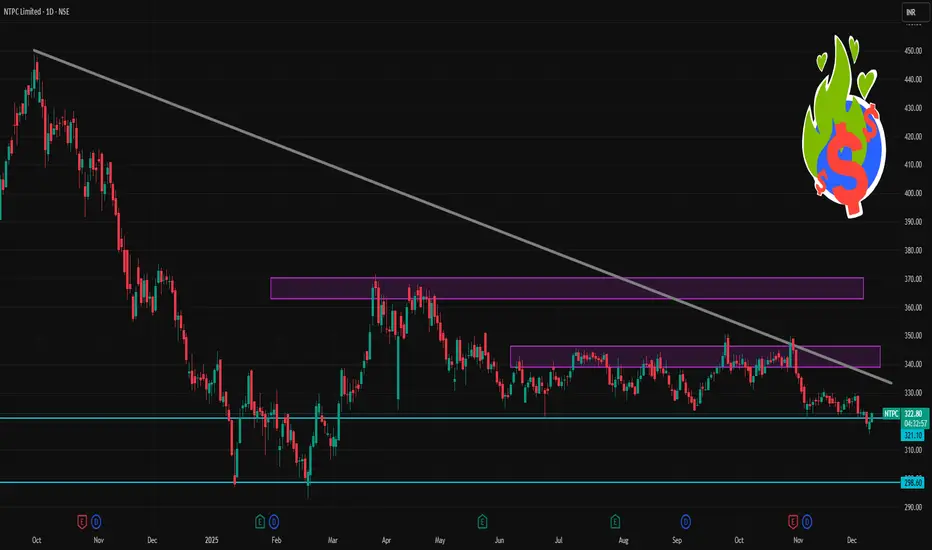
NTPC 1 Day Time Frame 📊 Current Price (Approx)
Trading around ₹319–₹320 on NSE (latest intraday range) — this is the most recent live price you’ll see on charts right now (delayed ~20 sec) and confirmed by TradingView data.
🎯 1-Day Pivot & Support-Resistance Levels
✅ Pivot Point
Central Pivot: ~₹318.9 – ₹319.4 (daily pivot based on recent range)
📈 Resistance Levels
R1: ~₹321–₹322 (first immediate hurdle)
R2: ~₹324–₹325 (stronger resistance)
R3: ~₹327–₹328+ higher barrier if momentum picks up
📉 Support Levels
S1: ~₹316–₹317 — first support zone intraday pivot tests
S2: ~₹313–₹314 — secondary support zone
S3: ~₹310–₹311 — deeper support if the stock weakens sharply
👉 These levels are typical pivot-based support/resistance from standard daily pivot calculations and recent technical tools (Classic/Fibonacci/Camarilla).
Trendcontinuation
Swing Trading Strategies for Indian Stocks1. What Makes Swing Trading Effective in the Indian Market?
The Indian market has certain characteristics that make swing trading powerful:
Trending behaviour: Nifty, Bank Nifty, and sectors show clear medium-term trends.
FII-DII flows impact swings: Foreign inflows cause rallies; domestic booking brings dips.
Sector rotation: IT, Pharma, PSU, Metals, Banks rotate in cycles.
Volatility with direction: Ideal for capturing 3–10 day moves.
High liquidity stocks allow clean chart structures.
Because of these characteristics, stocks like Tata Motors, Reliance, HDFC Bank, L&T, ICICI Bank, BEL, Coal India, LTIM, HAL, and PSU banks offer excellent swing opportunities.
2. Core Swing Trading Concepts
2.1 Trend Structure
Before entering any swing trade, determine the trend:
Higher Highs & Higher Lows (HH-HL) = Uptrend
Lower Highs & Lower Lows (LH-LL) = Downtrend
Sideways consolidation = breakout/breakdown opportunity
Always trade in direction of trend for higher success.
2.2 Pullbacks and Reversals
Swing trades are often taken when:
Price pulls back to support in an uptrend
Price retests resistance in a downtrend
Price breaks out of consolidation
2.3 Support and Resistance Zones
Identify:
Weekly support/resistance
Daily swing highs/lows
Round levels like 100, 200, 500, 1000
50-day or 200-day moving averages
Strong zones = high-probability entries.
3. Best Swing Trading Strategies for Indian Stocks
Below are top-performing swing trading strategies tailor-made for the Indian market.
Strategy 1: Moving Average Pullback Strategy
This is the simplest and most reliable swing strategy.
How it works
Identify a stock in strong uptrend using 20 EMA & 50 EMA
Wait for a pullback to 20 EMA (aggressive) or 50 EMA (conservative)
Price must show bullish candle near EMA
Entry
Buy on bullish confirmation candle
Volume spike increases confidence
Stop Loss
Below recent swing low
Target
2–3x risk
Or next resistance
Best suited for
Trending stocks like PSU, banking, large caps.
Strategy 2: Breakout and Retest Strategy
Breakouts happen often in the Indian market because of strong retail + FII participation.
Steps
Identify a tight consolidation zone (triangle, flag, channel).
Wait for breakout with volume.
Do NOT buy breakout blindly; wait for retest.
Enter when retest shows bullish candle.
Why it works
Retest confirms:
Institutions support the breakout
False breakout is avoided
Best suited for
Midcaps (HAL, BEL, IRFC, JWL)
Momentum stocks
Strategy 3: RSI + Trendline Reversal Strategy
Combines momentum and price structure.
Setup
Draw a trendline connecting swing lows in uptrend.
Wait for price to touch trendline.
Check RSI between 38–45 (oversold in trend).
Entry
Enter when bullish candle appears at trendline.
Stop Loss
Just below trendline
Targets
Recent swing high or 1:2 risk–reward
Why it works
RSI 40 is the “bullish support zone” in strong uptrends.
Strategy 4: Inside Candle (NR4/NR7) Breakout Strategy
NR4/NR7 = Narrow Range candles, which signal volatility contraction.
Indian stocks behave strongly after volatility contraction.
Steps
Identify Inside Candle or NR4/NR7 pattern.
Mark high and low of inside candle.
Buy when price breaks above high.
Sell when price breaks below low.
Works best in
Stocks before results
Momentum phases
Strategy 5: Fibonacci Swing Trading Strategy
Used to find precise swing entries.
Steps
Identify strong impulsive upmove.
Draw Fib retracement.
Key buying zones:
38.2%
50%
61.8%
Confirmation
Bullish candle at zone
RSI above 40
Volume stabilizing
Targets
Previous swing high
127% or 161% extension
This method is widely used by India’s quantitative swing traders.
Strategy 6: Multi-Timeframe Swing Strategy
This increases accuracy by aligning multiple timeframes.
Steps
Check weekly trend (bigger trend)
Identify daily entry (swing pullback or breakout)
Confirm with 4-hour momentum
Example
Weekly shows uptrend
Daily pulls back to support
4H shows breakout candle
This gives extremely high-probability swing trades.
4. How to Select Stocks for Swing Trading in India
Selecting the right stocks matters more than strategy.
4.1 Criteria
High liquidity (above ₹300–500 crore daily turnover)
High relative strength vs Nifty
Stocks above 50-day and 200-day moving averages
Strong sector trend (sector rotation)
Volume patterns showing institutional activity
Best sectors for swing trades
PSU stocks
Banking
Defense
Auto
Metals
FMCG during slow markets
Avoid
Penny stocks
Illiquid stocks
Corporate governance issues
5. Indicators Useful for Swing Trading in India
Use indicators only for confirmation, not as signals.
1. Moving Averages
20 EMA (aggressive swing)
50 SMA (medium)
200 SMA (long trend)
2. RSI
Buy dips when RSI is 40–45 in uptrend
Sell rallies when RSI is 55–60 in downtrend
3. MACD
Confirms trend continuation.
4. Volume
One of the most important indicators:
Breakouts must have high volume
Retests should have low volume
6. Risk Management for Swing Trading
Risk management is the backbone of swing trading.
Position Sizing
Risk only 1–2% of capital per trade.
Stop Loss Placement
Must be based on swing low/high
Never place SL too tight
Profit Target
Maintain at least 1:2 Reward-to-Risk
Trail stop when price moves in your favor
Avoid Overnight Risk
Avoid holding during:
Major events
Budget announcements
RBI policy
Global event risk (US Fed)
7. Tools for Swing Trading
Charting
TradingView
ChartInk (Indian screeners)
Investing.com
Scanners
ChartInk swing scanner
TradingView breakout scanner
Volume surge screeners
Brokerage Platforms
Zerodha Kite
Upstox Pro
ICICI Direct Neo
Angel One Smart
8. Psychology for Swing Trading
Swing trading requires:
Patience to wait for setups
Discipline to exit when stop is hit
Ability to ignore intraday noise
Consistency in following rules
Most swing traders fail because they:
Enter too early
Exit too early
Add to losing trades
Trade too many stocks at once
Focus on quality, not quantity.
9. Example of a Complete Swing Trading Plan
Scan for stocks making higher highs.
Mark support zones on daily chart.
Wait for pullback with decreasing volume.
Enter on bullish candle with volume confirmation.
Place SL below swing low.
Target previous resistance.
Trail stop using 20 EMA.
This simple model can achieve high accuracy.
Final Summary
Swing trading in Indian stocks offers profitable opportunities because of strong trends, sector rotations, and active participation from institutions and retail traders. The most effective strategies include:
Moving average pullbacks
Breakout + retest
RSI + trendline reversals
Inside bar volatility breakouts
Fibonacci retracements
Multi-timeframe confirmation
With proper risk management, psychology, and disciplined execution, swing trading can become one of the most profitable and low-stress trading styles in the Indian equity market.
Divergence Secrets Who Should Trade Options?
Options are suitable for:
Traders looking for leverage with limited risk
Investors wanting to hedge positions
Experienced traders generating income
Anyone willing to learn market structure and volatility
But they require discipline, knowledge, and proper risk management.
Part 2 Support and ResistanceHow Time Decay Affects Option Traders
Time value decays rapidly near expiry. This is why buyers must be accurate about timing, while sellers benefit from time decay.
Buyers lose money if the market doesn’t move quickly.
Sellers gain even if the market doesn’t move at all.
This is why most experienced traders prefer option selling with risk controls.
Part 1 Support and ResistanceWhat Is Option Premium?
The premium is the price paid by the buyer to the seller to purchase the option. It represents the cost of owning the right.
Premium depends on factors like:
Current market price
Strike price
Time left to expiry
Volatility
Interest rates
Demand and supply
Two components decide the premium:
Intrinsic Value – Real value based on price difference.
Time Value – Extra value because the option has time before expiry.
As expiry approaches, time value decreases — this is called Time Decay (Theta).
Part 10 Trade Like Institutions How Option Prices Move
Option prices depend on multiple factors:
1. Movement of the underlying asset
Call option goes up when price rises.
Put option goes up when price falls.
2. Time Decay (Theta)
Options lose value as expiry gets closer.
This is good for sellers, bad for buyers.
3. Volatility (VIX)
Higher volatility increases option premiums.
During events (budget, news), premiums rise sharply.
Part 9 Trading Master ClassWhat Are Options?
An option is a financial contract that gives the buyer the right, but not the obligation, to buy or sell an underlying asset (like Nifty, Bank Nifty, or a stock) at a fixed price before a specific time.
There are two types of options:
1. Call Option
A call option gives the buyer the right to buy the underlying asset at a fixed price (called the strike price).
You buy a call when you expect price to go up.
Example: If Nifty is at 22,000 and you buy a 22,000 CE (Call Option), you profit if Nifty goes above 22,000 (after covering premium).
2. Put Option
A put option gives the buyer the right to sell the underlying asset at a fixed price.
You buy a put when you expect price to fall.
Example: If Bank Nifty is at 48,000 and you buy 48,000 PE (Put Option), you profit if the price falls below 48,000.
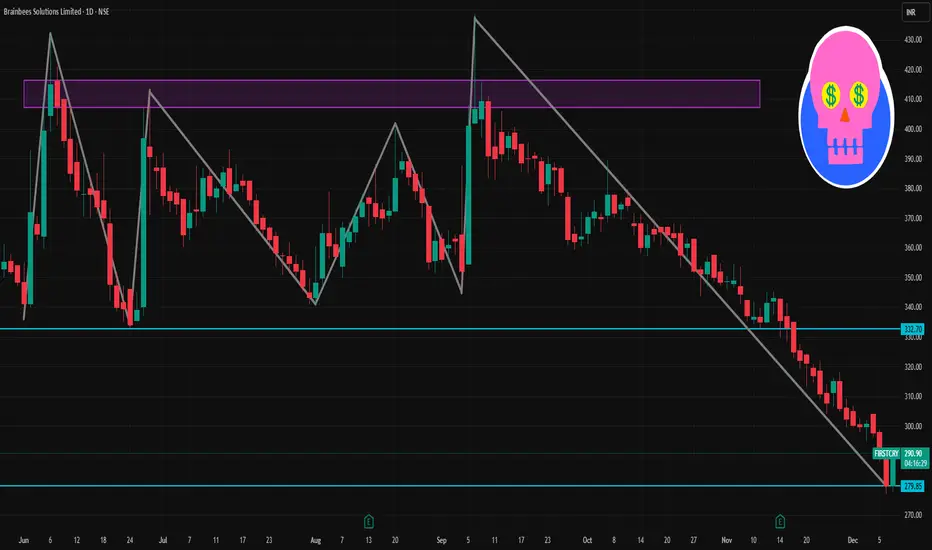
FIRSTCRY 1 Day Time Frame 📊 What the 1‑day chart for Brainbees Solutions currently shows
As of recent trading, the share price of Brainbees Solutions is around ₹ 279–290 on NSE.
The 52‑week high and low band shows a high near ~₹ 664–665 and a low around ~₹ 277–286.
That means at current ~₹ 280–290, the stock is very close to its 52‑week low — which may make the “day‑timeframe level” important for traders looking for a bounce or reversal.
Some technical‑analysis data (on certain days) show bearish momentum: for example, on a recent day the stock hit an all‑time low of ₹ 287, continuing a downtrend.
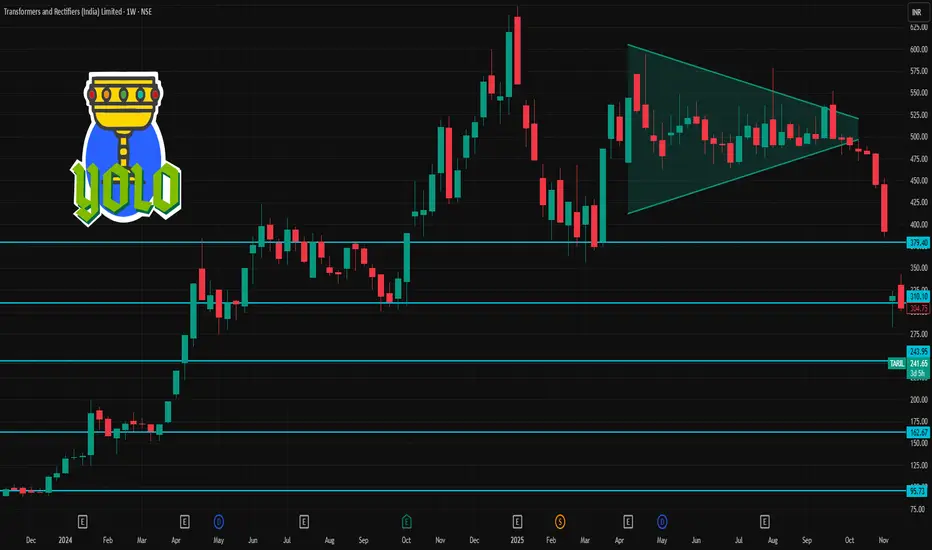
TRIL 1 Week Time Frame 📌 Latest Price & 1‑Week Snapshot
The stock is trading around ₹240–₹241 per share (NSE/BSE).
According to a recent summary, over the last 1 week the stock has moved approximately –7% to –7.4%.
52‑week range: Low ≈ ₹232–₹236, High ≈ ₹648–₹650.
Thus the stock is very near its 52‑week low — down roughly 63% from 52‑week high.
What this suggests (short‑term)
The share is currently at deep discount territory, close to 52‑week bottom — so for traders, this could mean limited downside (barring new negative news), but also that upside is large — albeit requiring major positive triggers.
Given weak near‑term momentum (recent dip, down ‑7% in a week), the stock may consolidate around current levels — ₹230–₹250 zone — unless there’s a strong catalyst.
🎯 What This Means for Short-Term Traders vs Long-Term Investors
Short-term traders: The ₹232–₹240 zone can be considered as a near-term support base. If the stock holds above ~₹235, a bounce is possible — but sharp volatility remains likely. Risk/reward is skewed toward a bounce — but with high uncertainty.
Medium/Long-term investors: The deep discount vs 52‑week high may look attractive — but fundamentals (earnings weakness, recent volatility, sanction overhang) suggest caution. The stock could recover substantially — if the company stabilizes business, wins new orders, and global/sector sentiment improves.
Options Strategies: Spreads, Straddles, and Iron Condor1. Option Spreads
An option spread involves buying one option and simultaneously selling another option of the same type (call or put) but with different strike prices or expiries. Spreads are primarily used to limit risk, reduce premium cost, or target specific price zones.
Types of Option Spreads
a) Vertical Spreads
A vertical spread uses options with the same expiration date but different strike prices.
There are two kinds:
• Bull Call Spread
Used when the trader is moderately bullish.
Buy a lower-strike call, sell a higher-strike call.
Limits both profit and loss.
Example: Buy 100 CE @ ₹10 → Sell 110 CE @ ₹5 → Net cost ₹5.
• Bear Put Spread
Used when the trader is moderately bearish.
Buy higher-strike put, sell lower-strike put.
Limited profit and limited loss.
Example: Buy 100 PE @ ₹12 → Sell 90 PE @ ₹6 → Net cost ₹6.
• Bear Call Spread
A credit spread for bearish to neutral outlook.
Sell lower-strike call, buy higher-strike call.
Net credit received.
• Bull Put Spread
A credit spread for bullish to neutral outlook.
Sell higher-strike put, buy lower-strike put.
Popular due to high probability of profits.
b) Horizontal (Calendar) Spreads
Calendar spreads use the same strike price but different expiry dates.
When is it used?
When the trader expects low near-term volatility but higher long-term volatility.
It benefits from time decay differences (theta) between near and far expiries.
c) Diagonal Spreads
Diagonal spreads combine both different strikes and different expiries.
Why use them?
To take advantage of both direction and time decay.
More flexible but more complex.
Why Traders Use Spreads
Lower capital requirement.
Defined maximum loss.
Can be structured for any market condition.
Reduce the impact of volatility swings and time decay.
Spreads are ideal for traders who aim for risk-controlled trading instead of outright long or short options.
2. Straddles
A straddle is a highly popular volatility strategy where the trader buys or sells both a call and a put option with the same strike price and same expiry.
a) Long Straddle
Buy 1 Call + Buy 1 Put (ATM).
Used when the trader expects big movement but doesn’t know the direction.
This is a volatility-buying strategy.
Maximum loss = total premium paid.
Profit = unlimited on upside, substantial on downside.
Ideal Conditions
Earnings announcements.
RBI policy decisions.
Major news (mergers, litigation, global events).
Low IV (implied volatility) before expected spike.
Example
NIFTY at 22,000:
Buy 22000 CE @ 120
Buy 22000 PE @ 130
Total cost = ₹250.
If NIFTY moves sharply to either:
22,500 (big CE profit), or
21,500 (big PE profit),
the long straddle gains.
Key Greeks
Vega positive → benefits from IV increase.
Theta negative → loses money from time decay.
b) Short Straddle
Sell 1 Call + Sell 1 Put (ATM).
Used when market is expected to be range-bound with very low volatility.
High risk; unlimited loss potential.
Maximum profit = premiums received.
Why use it?
Only experienced traders use short straddles when:
IV is extremely high.
Market is unlikely to move drastically.
Time decay is expected to be fast.
Short Straddle Risks
Sharp moves can cause heavy losses.
Requires strong risk management and hedge understanding.
3. Iron Condor
An Iron Condor is a neutral, limited-risk, limited-reward option strategy. It combines a Bull Put Spread and a Bear Call Spread.
Structure
Sell OTM Put
Buy further OTM Put
Sell OTM Call
Buy further OTM Call
This creates a structure where the trader profits if the price stays within a range.
Why Traders Love Iron Condors
Designed for markets with low volatility and consolidation.
High probability of winning.
Controlled risk.
Takes advantage of time decay (theta positive).
Payoff Characteristics
Maximum profit occurs when the underlying price stays between the sold call and sold put.
Maximum loss is limited to the width of either spread minus net premium received.
Works best in sideways markets.
Example: NIFTY Iron Condor
Assume NIFTY = 22,000.
Sell 22500 CE
Buy 22700 CE
Sell 21500 PE
Buy 21300 PE
Net credit = Suppose ₹60.
Possible Outcomes
If NIFTY expires between 21,500 and 22,500 → Full profit = ₹60.
If it goes beyond either side → Loss limited to defined spread width.
Ideal Conditions
Market expected to remain in a range.
IV is high before selling, expecting it to fall.
Greeks
Delta neutral
Theta positive (time decay benefits)
Vega negative (falling IV helps)
Comparing the Key Strategies
Strategy Market View Risk Reward Volatility Impact
Vertical Spread Mild bullish/bearish Limited Limited Moderate
Long Straddle High volatility expected Limited Unlimited Needs IV rise
Short Straddle Low volatility expected Unlimited Limited Benefits from IV drop
Iron Condor Sideways / range-bound Limited Limited Benefits from IV drop & theta
How to Choose the Right Strategy
Choosing a strategy depends on:
1. Market Direction
Trending markets → vertical spreads
Unknown direction → straddles
Sideways markets → iron condor
2. Volatility Expectations
IV high? Use credit strategies (short straddle, iron condor).
IV low? Use debit strategies (long straddle, debit spreads).
3. Risk Appetite
Conservative traders: spreads, iron condors.
High-risk traders: short straddles.
Speculators expecting big moves: long straddles.
4. Time Horizon
Short-term: spreads and straddles.
Medium-term: calendar and iron condor.
Conclusion
Spreads, Straddles, and Iron Condors are essential strategies for building an effective options trading system. Each offers unique advantages:
Spreads help control risk and reduce costs.
Straddles capitalize on directional uncertainty and volatility spikes.
Iron Condors profit from sideways markets with predictable risk.
A trader who understands when to apply each strategy based on market behavior, volatility, and risk preference can dramatically improve long-term consistency. Mastering these strategies allows traders to navigate all phases of market conditions—trending, volatile, or stable—using a systematic and well-risk-managed approach.
Building a Trader’s Mindset: Patience, Consistency, Adaptability1. Patience – The Foundation of Professional Trading
Patience is not simply “waiting.” It is disciplined inaction until the right opportunity forms. Impatient traders overtrade, chase moves, react emotionally, and burn capital. Patient traders act only when their edge is present.
Why Patience Matters
Markets are mostly noise. True high-probability setups appear occasionally. A patient trader understands that success comes from waiting for conditions that match their plan. The goal is not to trade more, but to trade better.
Forms of Patience in Trading
Waiting for the right setup
You may scan 50 charts and take only one trade. Professional traders understand that most days are not meant for big profits.
Patience in entry execution
Many traders jump early due to fear of missing out (FOMO). But waiting for confirmation, retests, or volatility cooling often determines whether a trade becomes a winner.
Patience in holding a winning trade
Most traders cut winners early. Patience helps you let the trend unfold and ride profits instead of booking small gains.
Patience during drawdowns
A losing streak is temporary, but the emotional urge to “make back losses fast” destroys accounts. Patience helps you reset mentally.
How to Develop Patience
Trade fewer setups but master them deeply.
Use alerts, so you don’t watch charts constantly.
Define your conditions clearly: “I enter only if X, Y, and Z align.”
Practice delayed gratification—a psychological muscle built over time.
Reward process, not outcome—celebrate discipline, not luck.
Patience builds emotional stability, which becomes the core of all other trading skills.
2. Consistency – The Engine That Drives Growth
Consistency is the ability to follow your process repeatedly—same logic, same rules, same risk control—every single day. A consistent trader becomes predictable to themselves, which makes performance measurable and improvable.
Most traders fail not because their strategy is bad but because they apply it inconsistently.
Why Consistency Matters
Markets produce random short-term outcomes. A strategy may win today and lose tomorrow. Consistency ensures that over time your edge plays out. Without consistency:
Risk fluctuates and results become unpredictable.
Emotions dominate decision-making.
You cannot improve because you don’t know what you did right or wrong.
Your trading becomes luck-based rather than skill-based.
Pillars of Consistency
1. A Clear Trading Plan
A plan defines:
Entry rules
Exit rules
Stop-loss and target criteria
Position size
Market conditions you trade
Without a plan, consistency is impossible.
2. Risk Management Discipline
Risk per trade should remain consistent—usually 1–2% of capital. Changing risk based on emotion leads to uneven results.
3. Time and Routine Consistency
Professional traders have fixed routines:
Pre-market preparation
Chart review
Journaling
Performance tracking
Routine eliminates randomness in behavior.
4. Consistent Emotional Regulation
Traders must behave consistently regardless of:
A big win
A big loss
A news event
A volatile session
This detaches performance from temporary emotional states.
How to Build Consistency
Journal every trade—entry, reason, emotions, outcome.
Review weekly—identify patterns of mistakes.
Automate repetitive tasks—alerts, screeners, watchlists.
Reduce strategy hopping—stick to one system for a long enough sample size.
Focus on incremental improvement, not perfection.
Consistency turns trading into a process-driven profession instead of a gambling activity.
3. Adaptability – Surviving and Thriving in Changing Markets
Markets evolve constantly. What worked in a trending market may fail in a sideways one. Adaptability enables a trader to evolve with conditions, update strategies, and stay relevant.
Why Adaptability Matters
Volatility changes.
Liquidity shifts.
Macro events impact trends.
Algo trading affects speed and structure.
Investor psychology evolves over time.
Rigid traders get left behind. Flexible traders stay profitable.
Traits of Adaptable Traders
Open-Mindedness
They are willing to test new ideas, adjust position sizes, or explore different timeframes when conditions shift.
Awareness of Market Context
Instead of forcing trades, they ask:
“Is the market trending, ranging, reversing, or consolidating?”
Ability to Evolve Strategies
Adaptable traders update systems using data, not emotion.
Emotional Flexibility
They accept being wrong quickly—cutting losses, not defending ego.
How to Develop Adaptability
Study multiple market environments: trending, range-bound, high/low volatility.
Maintain multiple tools (trend-following, mean-reversion, breakout strategies).
Regularly backtest and forward-test strategies.
Observe global macro events and their impact.
Keep a growth mindset—stay curious and upgrade skills.
Avoid rigid beliefs like “this stock must go up” or “this pattern always works.”
Adaptability is about changing when necessary while staying disciplined to core principles.
How These Three Traits Work Together
Patience + Consistency
Patience helps you avoid bad trades.
Consistency ensures you execute your good trades properly.
Together they create stable performance.
Patience + Adaptability
Patience lets you wait for the market to show its conditions.
Adaptability allows you to adjust once those conditions shift.
Consistency + Adaptability
Consistency provides structure.
Adaptability keeps the structure flexible enough to survive changing environments.
All Three Combined
A trader who masters patience, consistency, and adaptability:
Takes fewer but high-quality trades
Controls emotions
Stays calm during volatility
Maintains steady profits
Learns continuously
Avoids catastrophic losses
Improves year after year
This mindset separates professionals from amateurs.
Practical Daily Exercises to Build This Mindset
1. Pre-Market Exercise
Write down:
What setups you will trade today
What you will avoid
Maximum loss allowed
This reinforces patience and consistency.
2. Mid-Day Emotion Check
Ask:
Am I following my plan?
Am I trading emotionally?
Am I forcing trades?
This keeps behavior aligned.
3. Post-Market Review
Journal:
Trades taken
Mistakes
Improvements
Market conditions
This builds adaptability.
4. Weekly Reset
Analyze:
Win rate
Risk-to-reward
Emotional patterns
Strategy performance in current conditions
This helps you evolve with the market.
Conclusion
Building a trader’s mindset takes time. It requires unlearning impulsive habits, developing emotional intelligence, and aligning your behavior with long-term goals. Patience keeps you selective. Consistency keeps you disciplined. Adaptability keeps you relevant.
Trading is not about predicting the market—it is about managing yourself. When your mindset is strong, your strategy becomes powerful. When your emotions are controlled, your results become stable. Master these three mindset pillars, and your journey shifts from random outcomes to structured, repeatable success.
Sector Rotation & Business Cycles1. Understanding the Business Cycle
The business cycle refers to the natural rise and fall of economic activity over time. It moves through four major phases:
1. Expansion
Economic growth accelerates.
Employment rises, consumer spending increases.
Corporate profits improve.
Interest rates usually remain moderate.
2. Peak
Growth reaches its maximum level.
Inflation may rise.
Central banks often raise interest rates to cool the economy.
Consumer demand becomes saturated.
3. Contraction (Recession)
Economic growth slows.
Corporate earnings weaken.
Layoffs and spending cuts occur.
Stock markets often decline.
4. Trough
Economic decline bottoms out.
Stimulus measures increase (rate cuts, government spending).
Businesses prepare for recovery.
This cyclical movement is driven by consumer behavior, credit cycles, government policy, global factors, and investor sentiment. Although the timing of cycles varies, the behavioral patterns remain largely consistent.
2. Sector Rotation Explained
Sector rotation is the strategy of moving investments from one sector to another based on expectations of the next phase of the business cycle. Investors aim to hold sectors that are likely to benefit from the upcoming environment while avoiding those expected to underperform.
For example:
When interest rates fall and the economy is bottoming out, cyclical sectors often lead.
When inflation rises or recession hits, defensive sectors typically protect the portfolio.
There are three broad groups of sectors to understand:
A. Defensive Sectors
These sectors provide essential goods or services, meaning demand stays stable even during downturns.
Healthcare
Utilities
Consumer Staples
Telecom
These sectors outperform during recessions or slowdowns because people cannot stop spending on necessities like electricity, medicine, and basic household products.
B. Cyclical Sectors
These rise when the economy is strong and fall during recessions.
Consumer Discretionary
Industrials
Financials
Real Estate
Materials
Cyclicals react strongly to consumer confidence and corporate investment.
C. Growth & Inflation-Linked Sectors
These benefit from technological progress or commodity price cycles.
Technology (growth)
Energy (inflation-linked)
Basic Materials (linked to global demand)
3. How Sector Rotation Works Across the Cycle
Here is how major sectors tend to perform during each stage of the business cycle:
1. Early Expansion (Recovery Phase)
Economic Conditions:
Interest rates are low
GDP growth rebounds
Employment picks up
Consumer confidence rises
Winning Sectors:
Consumer Discretionary: People begin buying non-essential goods.
Industrials: Companies increase production and investment.
Financials: Banks benefit from loan growth and improving credit conditions.
Real Estate: Lower interest rates push property demand.
This stage sees some of the strongest equity returns because the market anticipates stronger earnings.
2. Mid Expansion (Strong Growth Phase)
Economic Conditions:
GDP grows steadily
Inflation remains moderate
Corporate profits are strong
Markets remain bullish
Winning Sectors:
Technology: Innovation drives growth.
Industrials & Materials: Increased global demand supports manufacturing.
Energy: Higher consumption raises oil and gas prices.
Tech often dominates in this stage because companies invest in efficiency and automation while consumers adopt new technologies.
3. Late Expansion (Peak Phase)
Economic Conditions:
Growth slows
Inflation increases
Interest rates rise
Market volatility rises
Winning Sectors:
Energy: Inflation boosts commodity prices.
Materials: Benefit from strong but peaking demand.
Utilities (start to gain): Investors seek safety as cycle becomes uncertain.
Investors gradually rotate from growth and cyclical sectors toward safety as interest rates tighten.
4. Contraction (Recession Phase)
Economic Conditions:
GDP declines
Unemployment rises
Corporate profits fall
Credit tightens
Winning Sectors:
Consumer Staples: Essential goods maintain stable demand.
Healthcare: Non-discretionary spending continues.
Utilities: Consumption of power and water remains stable.
Telecom: Communication services are essential.
Defensive sectors outperform because they have predictable cash flows and stable earnings. Meanwhile, cyclical sectors suffer.
5. Trough (Bottoming Phase)
Economic Conditions:
Government and central banks stimulate the economy
Interest rates fall sharply
Economic activity stabilizes
Winning Sectors:
Financials (early recovery)
Consumer Discretionary
Industrials
Technology
Investors anticipate recovery and rotate back into risk assets. This phase often produces high returns for early movers.
4. Factors That Influence Sector Rotation
Sector performance isn’t solely dictated by the business cycle. Other factors influence sector rotation timing and effectiveness:
A. Interest Rates
Higher rates hurt financials, real estate, tech.
Lower rates boost cyclicals and growth stocks.
B. Inflation
High inflation benefits energy, materials, commodities.
Low inflation supports growth sectors like tech.
C. Government Policies
Fiscal spending boosts infrastructure, defense, renewables.
Regulations impact banks, pharma, telecom.
D. Market Sentiment
Fear and greed cycles can accelerate sector rotation—money moves quickly out of risk sectors into defensives during panic.
E. Global Economic Trends
Global demand strongly impacts:
Energy
Materials
Industrials
5. Sector Rotation Strategies for Traders and Investors
Here are the commonly used approaches:
A. Business Cycle Forecasting
Predicting the next phase of the economy and positioning the portfolio ahead of time. Requires macro analysis, economic indicators, and market sentiment tracking.
B. Momentum-Based Rotation
Invest in sectors showing strong price performance and exit those losing momentum. Often used with sector ETFs.
C. Defensive vs. Cyclical Switching
Shift between defensive and cyclical baskets depending on economic signals like:
PMI
Interest rate trends
Inflation data
Yield curve behavior
D. Thematic Sector Rotation
Focus on themes like:
EVs
Artificial Intelligence
Renewable energy
Digital infrastructure
This works well when the economy is neutral but trends drive specific sectors.
6. Benefits of Sector Rotation
Higher Returns: Capture outperforming sectors during each cycle.
Lower Risk: Avoid sectors likely to decline during downturns.
Diversification: Helps spread exposure across industries.
Alignment with Macro Trends: Keeps portfolio positioned for economic shifts.
7. Limitations of Sector Rotation
Timing is challenging.
Economic cycles may be unpredictable.
External shocks can disrupt the pattern (wars, pandemics).
Requires continuous monitoring of macro data.
Conclusion
Sector rotation is one of the most strategic and systematic ways to navigate financial markets. By understanding how sectors behave during different stages of the business cycle and by monitoring key economic indicators, traders and investors can optimize returns, manage risks, and stay ahead of economic changes. Mastering this approach requires discipline, macroeconomic awareness, and adaptability. But when applied correctly, sector rotation becomes a powerful tool for long-term growth and short-term tactical opportunities.
Order Blocks & Smart Money Concepts (SMC)1. Understanding Smart Money vs. Retail Money
Retail traders usually trade based on indicators—RSI, MACD, moving averages—and often enter late or exit early. But institutions (smart money) cannot enter the market with huge volume suddenly. They need liquidity to fill their orders. So smart money:
Creates liquidity pools
Traps retail traders
Pushes price into zones where their orders are waiting
SMC tries to decode this behavior and trade with institutional flow.
The core belief of SMC is:
Price moves from liquidity to liquidity and respects institutional footprints like Order Blocks.
2. What Are Order Blocks?
Order Blocks (OBs) are the final candles where institutional buying or selling took place before a major price move. These candles reflect zones where big players opened positions.
Types of Order Blocks
Bullish Order Block
The last down candle before an impulsive up move (break of structure).
It shows smart money was buying.
Bearish Order Block
The last up candle before an impulsive down move.
It shows smart money was selling.
Why Order Blocks Matter
They represent areas where institutions left unfilled orders.
Price often returns (mitigation) to these areas before continuing in the original direction.
They provide high-probability entry zones with low stop-loss.
Characteristics of a Good Order Block
Strong displacement afterwards (fast, impulsive move)
Break of key market structure
Alignment with liquidity (e.g., sweep before displacement)
Imbalance or Fair Value Gap nearby
Higher timeframe confluence
3. Market Structure in SMC
SMC is heavily based on market structure: identifying the direction of the trend using swing highs and swing lows.
3.1 BOS – Break of Structure
A BOS occurs when price breaks a previous major swing high/low. It confirms trend continuation.
3.2 CHoCH – Change of Character
A CHoCH signals a trend reversal.
Example: In an uptrend, price forms a lower low → CHoCH → possible new downtrend.
Why Structure Matters
Order Blocks are validated only when a BOS or CHoCH occurs after them.
This proves smart money was indeed behind the move.
4. Liquidity in SMC
Liquidity is fuel for price movement. Smart money seeks liquidity to enter and exit positions.
Types of Liquidity
Equal Highs / Equal Lows (Double Tops/Bottoms)
Retail traders place stop orders here → liquidity pools.
Trendline Liquidity
Too-perfect trendlines attract breakout traders.
Buy/Sell Stops
Stops placed above highs or below lows are markets for institutional orders.
Imbalance / FVG Liquidity
Price returns to fill gaps to balance orders.
Liquidity Principle
“Price takes liquidity before reversing.”
This is where Order Blocks come into play—after grabbing liquidity, price mitigates an OB and then continues.
5. Fair Value Gaps (FVG) and Imbalances
An imbalance occurs when price moves so fast that there is insufficient trading between three candles (Candle A, B, C).
These gaps often get filled because smart money needs balanced positions.
FVGs often appear near:
Valid Order Blocks
Breaker Blocks
Mitigation Blocks
When price returns to these gaps, it becomes a high-probability entry.
6. Inducement: Retail Traps Before Real Move
Inducement is a clever liquidity trick used by institutions.
Example:
Price forms a small high near a bigger liquidity zone.
Retail traders enter early.
Smart money uses these small highs/lows as liquidity to tap, then moves to the real target.
Inducements typically appear:
Just before hitting an Order Block
Above equal highs
Below recent swing points
Understanding inducement helps avoid premature entries.
7. Mitigation: Why Price Revisits Order Blocks
After smart money enters the market with heavy orders, not all positions fill immediately.
So they bring price back to the order block to fill remaining orders.
This return is called mitigation.
Mitigation Concepts
Price taps the OB, grabs liquidity, and continues in the main direction.
It removes institutional drawdown.
It confirms OB validity.
A successful mitigation is one of the strongest signals for trend continuation setups.
8. How to Trade With Order Blocks (SMC Strategy)
Below is a simplified but effective approach:
Step 1: Determine Market Direction
Use BOS and CHoCH to identify trend or reversal.
Uptrend → focus on Bullish Order Blocks
Downtrend → focus on Bearish Order Blocks
Step 2: Mark High-Probability Order Blocks
Select Order Blocks that have:
Strong displacement
BOS confirmation
Nearby liquidity sweep (e.g., equal highs taken)
Nearby FVG (imbalance)
Step 3: Wait for Price to Return
Patience is key. Price almost always returns to OB for mitigation.
Place Buy Limit at Bullish OB
Place Sell Limit at Bearish OB
Step 4: Stop-Loss and Take-Profit
SL: Below OB (for bullish), Above OB (for bearish)
TP Levels:
Next liquidity pool
Opposite OB
FVG fill
This ensures positive risk-reward ratios (1:3 or higher).
9. Example: Bullish Order Block Workflow
Price sweeps liquidity below equal lows.
A strong bullish move creates displacement.
A BOS confirms institutional strength.
Identify the last down candle (bullish OB).
Price returns and mitigates OB.
Enter long position.
Target next liquidity pool above.
This is considered a textbook SMC setup.
10. Limitations of SMC
Although powerful, SMC requires practice.
Challenges
Order Blocks appear frequently; choosing the wrong one is common.
Market structure can be subjective for beginners.
Liquidity grabs may fake out traders.
News events disrupt SMC setups.
SMC should always be combined with:
Timeframe confluence
Session timing (London/NY sessions are best)
Risk management rules
11. Why SMC Works
SMC aligns with institutional behavior, making it uniquely accurate for:
Understanding market manipulation
Identifying highly precise entries
Reducing drawdown
Avoiding false breakouts
Trading with low risk, high return
Institutions leave traces—Order Blocks, FVGs, BOS, inducements.
SMC helps retail traders read these footprints.
Conclusion
Order Blocks & Smart Money Concepts (SMC) form a powerful trading framework focused on understanding institutional behavior. By studying liquidity, market structure, BOS, CHoCH, FVG, and mitigation, traders can read the true intention behind major price movements. Order Blocks act as the foundation of SMC, giving precise, low-risk entries aligned with smart money flow. With discipline, patience, and multi-timeframe confluence, SMC becomes one of the most effective and accurate price-action trading methods available today.
Multi-Timeframe Analysis (MTFA)1. Why Multi-Timeframe Analysis Matters
Markets are fractal in nature—meaning price moves in repeating patterns across all timeframes. A trend visible on the 1-hour chart may simply be a pullback on the daily chart. A breakout on the 5-minute chart may be irrelevant when the weekly trend is sideways.
Relying only on one timeframe creates three common issues:
False breakouts: Lower timeframes give misleading breakouts during higher-timeframe consolidations.
Confusion about trend: The trend on a small timeframe often conflicts with the major trend.
Entries without context: Traders enter without understanding key support/resistance or institutional zones.
MTFA solves all these problems by combining macro and micro views to form decisions rooted in context.
2. The Top-Down Approach (The Standard MTFA Process)
Most traders follow a 3-step method:
Step 1: Identify the Main Trend (Higher Timeframe – HTF)
Use Weekly, Daily, or 4H depending on your style.
Here you look for:
Overall trend direction (uptrend / downtrend / range)
Major support and resistance
Market structure (HH, HL, LH, LL)
Long-term supply and demand zones
HTF gives you the “big picture”—the dominant force of the market.
Step 2: Refine the Setup Zone (Middle Timeframe – MTF)
Use Daily-4H, 4H-1H, or 1H-15M depending on the trade.
This timeframe helps confirm:
Trend alignment
Pullbacks
Break of structure
Chart patterns (flags, triangles, channels)
Key levels where entries may occur
MTF filters out low-probability setups and identifies accurate zones.
Step 3: Execute With Precision (Lower Timeframe – LTF)
Use 1H, 15M, 5M, or 1M for exact entries.
This timeframe helps you:
Time entries
Catch liquidity grabs
Place tight stop-losses
Monitor candle patterns (pin bars, engulfing, doji)
Confirm momentum using volume/RSI/stochastic
This is where the actual trade triggers happen.
3. Choosing the Right Timeframes (Based on Trading Style)
Different trading styles require different combinations.
1. Scalpers
HTF: 1H
MTF: 15M
LTF: 1M–5M
Goal: Quick moves, tight SL, small targets.
2. Intraday Traders
HTF: Daily
MTF: 1H
LTF: 5M–15M
Goal: Catch day moves with strong accuracy.
3. Swing Traders
HTF: Weekly
MTF: Daily
LTF: 4H
Goal: Hold trades for days to weeks.
4. Position Traders
HTF: Monthly
MTF: Weekly
LTF: Daily
Goal: Capture major multi-month trends.
The key rule:
The larger timeframe decides trend direction; the smaller timeframe decides entry timing.
4. How MTFA Improves Trading Accuracy
1. Identifying True Trend Direction
A rise on the 15-minute chart may look bullish, but on the daily chart it may be a simple retracement in a strong downtrend. MTFA prevents trading against the dominant direction.
2. Avoiding Market Noise
Lower timeframes contain lots of fake moves (whipsaws). MTFA filters them out by relying on higher-timeframe structure.
3. Improved Entry and Exit
You can wait for precise structure breaks or candle confirmations on smaller timeframes while holding the higher-timeframe bias.
4. Better Risk Management
Since entries become more accurate, stop-loss distance reduces while keeping the same reward potential, thus improving risk-to-reward ratio (RRR).
5. Practical MTFA Example (Bullish Scenario)
Let’s say you are analyzing a stock or index.
Weekly Chart
Showing a clear uptrend (higher highs and higher lows).
Price currently retracing toward a major support zone.
Bias: Long (buy).
Daily Chart
Shows a bullish reversal pattern—like a double bottom or bullish engulfing candle.
Market structure shifts from lower lows to higher lows.
Bias strengthened: Prepare for long entries.
1-Hour Chart
Shows break of a short-term downward trendline.
A pullback retests a demand zone.
Entry triggers form: pin bar, engulfing, volume spike.
Execution: Enter long with confidence.
Here:
HTF gave direction.
MTF confirmed reversal.
LTF gave precision timing.
6. Understanding Conflicts Between Timeframes
Sometimes timeframes disagree:
Daily is bullish, but 1H is bearish.
4H shows consolidation, but 15M shows breakouts.
This is normal.
Rule:
The higher timeframe always overrides the lower timeframe.
If the HTF is bullish and LTF is bearish, the bearish move is likely a retracement—not a reversal.
Only when HTF breaks its structure should you consider changing bias.
7. Tools and Indicators Used in MTFA
MTFA does not depend on indicators, but indicators can support analysis.
Useful Tools
Price Action & Candlestick Patterns
Market Structure (HH, HL, LH, LL)
Support & Resistance Levels
Trendlines & Channels
Supply and Demand Zones
Helpful Indicators
Moving Averages (20/50/200) – for trend confirmation
RSI or Stochastic – for momentum and overbought/oversold
Volume – confirms strength of breakouts
MACD – for trend shifts
Key rule:
Indicators can support, but higher timeframe structure must lead the analysis.
8. Common MTFA Mistakes to Avoid
1. Overusing Too Many Timeframes
Using more than 3–4 creates confusion.
Stick to a simple framework: HTF + MTF + LTF.
2. Taking Trades Against the Higher-Timeframe Trend
This results in low-probability trades.
3. Forcing Breakouts on Small Timeframes
A breakout on 5M may be meaningless if the daily timeframe is in a strong range.
4. Not Waiting for Alignment
All timeframes must agree before entering.
5. Ignoring Key Levels
Higher-timeframe S/R zones are where major institutions trade.
9. Benefits of Mastering MTFA
Increases trade accuracy
Reduces emotional trades
Provides clear market structure
Helps catch major moves
Improves reward-to-risk
Builds professional-level discipline
Works in any market (stocks, forex, crypto, commodities, indices)
10. Summary of Multi-Timeframe Analysis
MTFA combines higher, middle, and lower timeframe views.
Higher timeframe shows trend and major levels.
Lower timeframe shows entry and precision.
MTFA avoids noise, false breakouts, and misleading signals.
It enhances risk management and trade quality.
All successful traders use MTFA, from scalpers to swing traders.
Part 8 Trading Master Class Option Buyer vs Option Seller
Option Buyer
Pays premium
Risk is limited to premium
Profit potential is unlimited (for call) or large (for put)
Needs a strong directional move
Time decay works against the buyer
Option Seller
Receives premium
Risk can be unlimited (if market moves sharply)
Profit is limited to premium received
Benefits from sideways market
Time decay works in seller’s favour
Option sellers usually need more capital because of higher risk.
Part 7 Trading Master Class How Option Pricing Works
The price of an option (premium) depends on many factors:
1. Underlying Price
If the market moves in the option’s direction (up for call, down for put), the premium rises.
2. Strike Price
Closer the strike to current price, higher the premium.
3. Time to Expiry
More time → higher premium (more chances of movement)
4. Volatility
Higher volatility → higher premium.
5. Interest rates and dividends
These have minor effects but still influence pricing models.
Part 6 Learn Institutional Trading Types of Option Based on Moneyness
In-The-Money (ITM)
Call Option: Strike < Market Price
Put Option: Strike > Market Price
At-The-Money (ATM)
Strike = Market Price (closest)
Out-Of-The-Money (OTM)
Call Option: Strike > Market Price
Put Option: Strike < Market Price
OTM options are cheaper but riskier.
Part 4 Learn Institutional Trading Advantages of Option Trading
1. Limited Risk for Buyers
Buyers can only lose the premium.
2. Leverage
You control a big position with small capital.
3. Flexibility
Can be used for speculation, hedging, income, blending multiple strategies.
4. Huge Earning Potential
Strong moves give massive percentage returns.
Part 2 Ride The Big MovesPopular Option Trading Strategies
Some commonly used strategies:
1. Covered Call
Hold stock + sell a call option for income.
2. Protective Put
Buy a put to hedge stock holdings.
3. Straddle
Buy ATM Call + ATM Put → profits during big movements.
4. Strangle
Buy OTM Call + OTM Put → cheaper than straddle.
5. Iron Condor
Sell OTM Call + Put and hedge with further OTM options.
Used in sideways markets.
6. Spread Strategies (Bull Call Spread, Bear Put Spread)
Buy one option and sell another to reduce cost and risk.
Part 1 Ride The Big MovesTips for Beginners
✔ Start with buying options
You learn direction and risk without big losses.
✔ Focus on one index (like Nifty)
Better to understand one market deeply.
✔ Avoid trading near major news
Volatility can be unpredictable.
✔ Manage risk
Never trade with full capital.
✔ Keep emotions low
Discipline outweighs excitement in option trading.
SUZLON 1 Day Time Frame 📈 Current Price & Range
Last close / recent quote: ~ ₹ 52.80–₹ 52.85.
Today’s intraday range (low → high): ₹ 51.89 → ₹ 53.00.
⚠️ Technical Bias / What It Suggests Short‑Term
Price is hovering near ₹ 52.8–53 region, just above immediate support — suggests a SHORT‑TERM indecision / consolidation.
Unless price clears ₹ 53.7 – 54 convincingly (with volume), upside may remain limited.
On downside, a breakdown below ₹ 51.0 – 50.9 could accelerate toward ₹ 49.5 – 50.1.
🧮 What to Watch / Confirmations
A sustainable daily close above ~ ₹ 54.5–55 could tilt bias bullish (towards ~₹ 56 zone).
A break + close below ~ ₹ 50.9 — especially on higher volume — may open path toward ~ ₹ 49.5 – 50 zone.
Watch intraday volume & market momentum — given SUZLON tends to be volatile, these often define short‑term swing direction.
Premium Chart Patterns Premium patterns help traders understand:
Smart money manipulation
Market structure transitions
Liquidity-based entries
Institutional imbalances
Reversal and continuation logic
They are more reliable than basic chart patterns because they reflect:
Actual institutional logic
Market psychology
Liquidity engineering
Price inefficiencies and corrections
Premium chart patterns are essential for traders who want to trade professionally and understand the true mechanics behind price movement.
Algo Trading & Backtesting1. What Is Algorithmic Trading?
Algorithmic trading (algo trading or automated trading) uses computer programs to execute buy and sell orders based on predefined rules. These rules are written using logic, mathematics, technical indicators, statistical models, or machine learning.
Key characteristics:
Speed: Algorithms execute trades in milliseconds.
Accuracy: Orders are placed exactly as coded, without emotional interference.
Consistency: Strategies run the same way every time.
Scalability: Algorithms can scan hundreds of stocks simultaneously.
Automation: Removes manual effort and human error.
Examples of algo rules:
Buy when the 50-day moving average crosses above the 200-day moving average.
Enter long if RSI < 30 and exit if RSI > 60.
Execute mean reversion when prices deviate from their statistical average.
Place a market-making order when bid-ask spread widens beyond a threshold.
Algo trading is used widely in equities, commodities, forex, crypto, futures, and options markets.
2. Why Algo Trading Matters
Algo trading is not just for institutions anymore. Retail traders now have access to powerful tools like NinjaTrader, TradingView Pine Script, Amibroker AFL, Python (Pandas, NumPy), Zerodha Streak, AlgoBulls, etc.
There are several advantages:
1. Eliminates emotions
Fear, greed, hesitation, revenge trading—algos remove them completely.
2. Enhances speed & efficiency
A computer can process multiple charts at once—no possibility for manual delays.
3. Reduces costs
Efficient execution reduces slippage, spreads, and missed opportunities.
4. Backtesting improves confidence
You know how your strategy performed historically before risking real capital.
5. Suitable for all market styles
Trending, scalping, intraday, swing trading, options strategies—algos cover everything.
3. Core Components of Algo Trading
1. Strategy Logic
The brain of the algorithm. Types include:
Trend-following strategies
Mean reversion models
Breakout systems
Arbitrage models
Options premium-selling/hedging algorithms
Machine learning predictive models
2. Data
The quality of the data determines the quality of your strategy.
Historical data (OHLC, volumes)
Real-time data (market feed)
Fundamental data
Tick/Orderbook data (advanced)
3. Programming Environment
Most common:
Python
TradingView Pine Script
Amibroker AFL
C++ (HFT level)
MetaTrader MQL
Proprietary platforms
4. Execution Engine
A platform that sends orders to the exchange via API.
5. Risk Management Module
Includes:
Stop-loss
Target
Position sizing (fixed lot, % of capital)
Max daily loss
Drawdown limits
Volatility filters
6. Monitoring & Optimization
Live dashboards help track:
Real-time P&L
Slippage
Latency
Execution errors
4. Backtesting – The Heart of Algo Trading
You cannot run an algorithm blindly. You must test it on past data to understand how it behaves. This process is called backtesting.
What Is Backtesting?
Backtesting is the simulation of a trading strategy on historical price data to evaluate its performance. It answers questions like:
Would the strategy have made money?
How much drawdown would it suffer?
What is the risk-reward ratio?
How consistent are returns?
How often does it win?
How Backtesting Works?
Step 1: Define the rules
Example strategy:
Buy when price closes above 20 EMA
Sell when price closes below 20 EMA
Risk 1% of capital per trade
Stop-loss = 1.5%
Target = 3%
Step 2: Select historical data
A minimum of:
2–5 years for intraday
5–10 years for swing
10–15 years for trend models
Step 3: Run the simulation
The software applies your rules on every candle historically.
Step 4: Analyze metrics
Some essential backtesting metrics:
✔ CAGR (Annual Return)
Measures yearly profit.
✔ Win Rate %
How many trades were profitable vs total bets.
✔ Profit Factor
Total gross profit ÷ total gross loss.
PF > 1.5 = Good; PF > 2 = Strong.
✔ Drawdown %
The maximum fall from peak equity.
Lower drawdown = safer strategy.
✔ Sharpe Ratio
Reward/risk ratio based on volatility.
✔ Average trade return
Shows how much each trade earns.
✔ Expectancy
Average win × win rate − average loss × loss rate.
Step 5: Optimize (carefully!)
Adjust parameters to improve performance, but avoid overfitting.
5. Types of Backtesting
1. Historical Backtesting
Runs strategy on past OHLC data.
2. Walk-Forward Testing
Split data into in-sample (training) and out-of-sample (testing).
3. Monte Carlo Simulation
Tests strategy performance across random variations.
4. Paper Trading / Forward Testing
Real-time simulation in live markets without real money.
6. Why Backtesting Can Mislead (Pitfalls)
Backtesting is powerful but dangerous if not done correctly.
1. Overfitting
Your strategy may perform well on history but fail in real markets.
2. Look-Ahead Bias
Using future data unknowingly, giving unrealistic results.
3. Survivorship Bias
Testing only stocks that survived, ignoring delisted ones.
4. Slippage & Transaction Costs
Real-world execution is worse than simulated execution.
5. Market Regime Changes
A strategy profitable during trending phases may fail during sideways markets.
Professional algo traders spend more time fixing biases than writing strategies.
7. Algo Trading Strategies Common in India
1. Trend-Following on NIFTY Futures
EMA crossover, Supertrend, Donchian breakout.
2. Options Selling Strategies
Short Straddle
Short Strangle
Iron Condor
Delta-neutral hedged selling
3. Mean Reversion in Bank Nifty
Price touches lower Bollinger Band → Buy.
4. Intraday Momentum
Breakout of previous day high/low.
5. Arbitrage Models
Cash–futures arbitrage, index arbitrage.
8. Tools & Platforms to Start Algo Trading
Beginner-Friendly
Zerodha Streak
Dhan Options Trader
Angel Algo
TradingView (Pine Script)
Intermediate
Python (using broker APIs)
Amibroker AFL
MetaTrader MQL
Advanced / Professional
QuantConnect
AlgoQuant
C++ HFT engines
Custom low-latency systems
9. Steps to Build a Profitable Algo Trading System
Step 1: Identify a market inefficiency
Find behaviors that occur consistently:
Monday gap filling
Tuesday volatility
Post-2:30 p.m. breakouts
Overnight momentum
Step 2: Create rules
Clear, unambiguous logic.
Step 3: Backtest
Use extensive and high-quality data.
Step 4: Evaluate metrics
Cut poor strategies early.
Step 5: Forward test
Test in real time without money.
Step 6: Deploy small capital
Scale only after long-term stability.
Step 7: Monitor & refine
Markets change → algos must evolve.
Conclusion
Algo trading and backtesting together form a powerful framework for systematic, disciplined, and scalable trading. Instead of relying on emotions or random decisions, traders build clear rules, test them against history, validate them in real-time, and automate execution to gain precision and consistency. With proper design, risk control, and continuous improvement, algorithmic trading can significantly enhance performance in equities, commodities, forex, indices, and options.