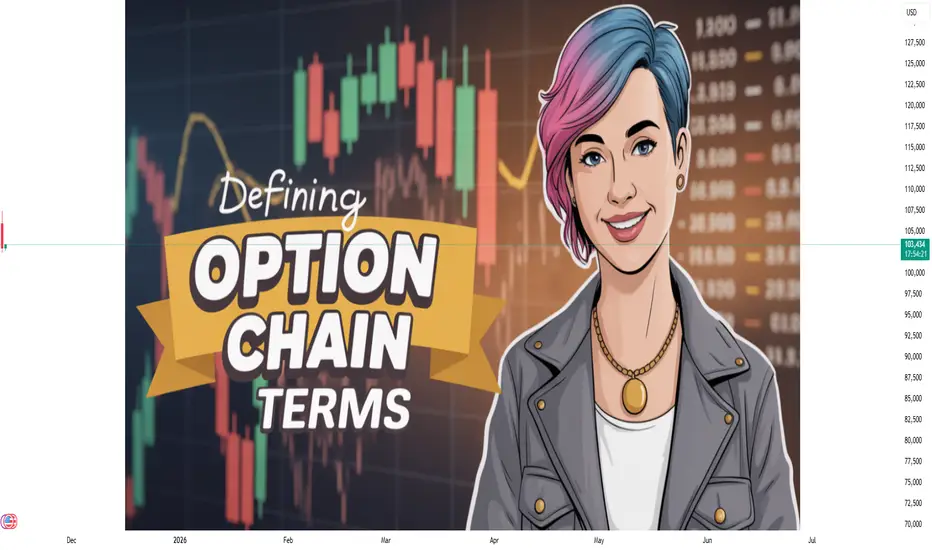
Option Chain: Powerful Tools for Traders and Investors1. What is an Option Chain?
An option chain, also known as an option matrix, lists all the available call and put options for a specific security. Each row represents an individual option contract with its strike price, expiry date, premium, and other key metrics. It helps traders compare multiple options to make informed decisions about trading strategies.
For example, on the NSE (National Stock Exchange of India), you can view the option chain for NIFTY 50, Bank NIFTY, or any stock. It displays both Call Options (CE) on the left and Put Options (PE) on the right.
2. Basic Terms in an Option Chain
a. Call Option (CE)
A Call Option gives the buyer the right, but not the obligation, to buy the underlying asset at a predetermined price (strike price) before or on the expiration date. Buyers of calls expect the underlying price to rise, while sellers (writers) of calls expect it to stay the same or fall.
b. Put Option (PE)
A Put Option gives the buyer the right, but not the obligation, to sell the underlying asset at a predetermined strike price before or on expiration. Buyers of puts expect the underlying asset’s price to fall, while sellers expect it to stay the same or rise.
c. Strike Price
The strike price is the price at which the option holder can buy (for a call) or sell (for a put) the underlying asset. Option chains list multiple strike prices around the current market price of the asset.
Example:
If NIFTY is trading at 22,000, the option chain may show strikes like 21,900, 22,000, 22,100, etc.
d. Expiry Date
The expiry date (or expiration date) is the date when the option contract ceases to exist. In India, options can have weekly or monthly expiries.
Weekly options expire every Thursday.
Monthly options expire on the last Thursday of the month.
After expiry, the option either becomes worthless (out-of-the-money) or is settled for profit/loss (in-the-money).
e. Option Type
Each contract specifies whether it is a Call (CE) or Put (PE). Traders choose the type based on their market outlook:
Bullish traders buy Calls or sell Puts.
Bearish traders buy Puts or sell Calls.
3. Option Chain Data Columns Explained
Each row in an option chain contains various data points. Let’s decode them one by one.
a. Last Traded Price (LTP)
The Last Traded Price is the most recent price at which the option contract was traded. It indicates the current market value or premium of the option.
Example:
If NIFTY 22,000 CE LTP = ₹120, that means the last buyer paid ₹120 for that call option.
b. Change and % Change
This shows how much the premium has moved compared to the previous trading session.
Change = LTP today – LTP yesterday
% Change = (Change / Previous LTP) × 100
It helps traders track intraday momentum and volatility.
c. Bid Price & Ask Price
Bid Price: The highest price a buyer is willing to pay.
Ask Price: The lowest price a seller is willing to accept.
The difference between them is the Bid-Ask Spread, which shows liquidity—narrow spreads indicate higher liquidity.
d. Bid Quantity & Ask Quantity
These represent how many contracts traders are willing to buy or sell at the bid or ask price.
Example:
If Bid Quantity = 1,200, it means traders want to buy 1,200 contracts at the bid price.
e. Open Interest (OI)
Open Interest is one of the most important metrics in an option chain. It represents the total number of outstanding (open) option contracts that have not been settled yet.
Rising OI indicates new positions being created.
Falling OI means positions are being squared off.
Interpretation Example:
Price ↑ and OI ↑ → Strong trend continuation (bullish).
Price ↓ and OI ↑ → Bearish trend strengthening.
Price ↑ and OI ↓ → Short covering.
Price ↓ and OI ↓ → Long unwinding.
f. Change in Open Interest
This shows how much the OI has changed compared to the previous session. It helps identify whether traders are entering new positions or exiting existing ones.
g. Volume
Volume indicates the number of option contracts traded during the day.
High volume shows active trading and high liquidity.
h. Implied Volatility (IV)
Implied Volatility reflects the market’s expectation of future volatility in the underlying asset.
High IV → Expensive premiums (greater uncertainty).
Low IV → Cheaper premiums (stable markets).
Traders use IV to assess whether options are overpriced or underpriced.
i. LTP vs. IV Relationship
If IV rises, option premiums generally increase (even if the underlying doesn’t move).
If IV falls, premiums tend to decline.
j. Intrinsic Value and Time Value
Each option premium consists of:
Intrinsic Value: The actual value if the option were exercised now.
Time Value: The extra value based on time to expiry and volatility.
Example:
If NIFTY = 22,100 and Call Strike = 22,000,
then Intrinsic Value = 100 (22,100 – 22,000).
4. In-the-Money (ITM), At-the-Money (ATM), Out-of-the-Money (OTM)
a. For Call Options:
ITM: Strike < Current Price
ATM: Strike ≈ Current Price
OTM: Strike > Current Price
b. For Put Options:
ITM: Strike > Current Price
ATM: Strike ≈ Current Price
OTM: Strike < Current Price
Traders often focus on ATM and nearby strikes, as they have higher liquidity.
5. Option Chain Analysis Techniques
a. OI Analysis
By comparing Call OI and Put OI, traders can estimate support and resistance levels:
High Call OI → Resistance zone (sellers active).
High Put OI → Support zone (buyers active).
b. Put-Call Ratio (PCR)
PCR = Total Put OI / Total Call OI
PCR > 1 → More Puts, bullish sentiment.
PCR < 1 → More Calls, bearish sentiment.
Traders use PCR as a contrarian indicator when extreme values appear.
c. Max Pain Theory
The Max Pain point is the strike price where the combined loss for option buyers is maximum and sellers benefit most.
At expiry, the underlying price often gravitates toward this level due to hedging and unwinding activity.
6. Real-World Example (NIFTY Option Chain)
Suppose NIFTY = 22,000, and we analyze the option chain:
Strike Call OI Put OI CE LTP PE LTP
21,900 25,000 10,000 160 70
22,000 30,000 28,000 120 120
22,100 45,000 20,000 80 160
Interpretation:
Strong Call OI at 22,100 → Possible resistance.
Strong Put OI at 22,000 → Possible support.
Market range: 22,000–22,100.
7. Advanced Option Chain Terms
a. Delta
Measures how much an option’s price moves for every ₹1 change in the underlying.
Call Delta: 0 to +1
Put Delta: 0 to –1
Example: Delta = 0.5 means the premium moves ₹0.50 for every ₹1 move in the asset.
b. Theta
Represents time decay—how much the option loses in value each day as expiry nears.
c. Gamma
Shows the rate of change of Delta. High Gamma means Delta will change rapidly with price movements.
d. Vega
Measures sensitivity of an option’s price to changes in volatility. High Vega means the option is more affected by IV changes.
e. Rho
Represents sensitivity of option price to interest rate changes.
8. Conclusion
Understanding option chain terms is essential for anyone involved in derivatives trading. The data helps traders:
Gauge market sentiment (bullish or bearish).
Identify support/resistance zones through OI.
Track volatility via IV.
Recognize trading opportunities through volume and price changes.
A skilled trader doesn’t just read numbers — they interpret the psychology behind them. With consistent analysis, the option chain becomes not just a data sheet, but a strategic roadmap for profitable trading decisions in dynamic markets like India’s NSE.
Trendcontinuation
Trading Secrets in the Indian Market1. Understanding Market Structure
One of the most fundamental secrets of successful trading in India lies in mastering the market structure. The Indian market operates through multiple participants: retail traders, domestic institutional investors (DIIs), foreign institutional investors (FIIs), and algorithmic traders. Each group behaves differently, influencing price trends and volatility.
FIIs, for instance, often drive large movements due to their massive volumes, while DIIs provide stability by investing in long-term opportunities. Observing the data from NSE’s FII/DII activity reports can reveal the underlying sentiment of the market. Smart traders align their trades with institutional flow instead of going against it.
2. The Power of Technical Analysis
Technical analysis remains a key secret weapon for traders. Charts reveal the footprints of big players, showing where buying or selling pressure is concentrated.
Common tools like support and resistance, moving averages, candlestick patterns, and indicators such as RSI, MACD, and Bollinger Bands help traders anticipate price movements. However, the real secret lies in combining multiple signals for confirmation. For example, if a stock breaks above a resistance level with high volume and RSI crosses above 50, it indicates strong bullish momentum.
Professional traders also focus on price action trading, which eliminates noise and focuses on pure price movement — a strategy that works well in Indian stocks with high liquidity.
3. Fundamental Strength Matters
While short-term traders often focus on charts, long-term success in the Indian market is built on strong fundamentals. Knowing a company’s business model, revenue growth, debt levels, and profit margins can protect traders from speculative traps.
One secret many professionals use is the combination of technical and fundamental analysis — entering technically strong stocks that are also fundamentally solid. For instance, during bull markets, stocks like HDFC Bank, Infosys, or Reliance Industries often outperform because they have strong fundamentals along with technical confirmation.
4. Risk Management: The Hidden Key
Most traders lose not because of bad strategy, but due to poor risk management. The golden secret of trading is to protect capital first and aim for profit later.
A disciplined trader uses a stop-loss in every trade. The general rule is never risk more than 1–2% of total capital on a single trade. Moreover, position sizing ensures that even a series of losses doesn’t wipe out one’s account.
For instance, if your capital is ₹1,00,000, risking ₹1,000–₹2,000 per trade ensures survival through market volatility. As Warren Buffett famously said, “The first rule of investing is don’t lose money. The second rule is don’t forget rule number one.”
5. Market Psychology and Emotion Control
Another major secret lies in mastering one’s psychology. The Indian market, like any other, tests patience and emotions daily. Fear and greed drive most traders’ decisions — buying when prices soar and selling when panic hits.
Experienced traders, however, do the opposite. They follow a contrarian approach, buying when others are fearful and selling when others are greedy. For example, during market corrections, quality stocks often become undervalued — a golden opportunity for long-term positions.
Maintaining emotional balance through journaling, back-testing, and following a trading plan is essential for consistent performance.
6. Sector Rotation and Market Cycles
The Indian market operates in cycles — not all sectors move together. Understanding sector rotation is one of the least known but most powerful trading secrets.
At times, IT and pharma sectors perform well, especially when the rupee weakens, while banking and infrastructure rally during economic expansion. By tracking sector indices like NIFTY BANK, NIFTY IT, or NIFTY FMCG, traders can identify where money is flowing.
For instance, if NIFTY IT starts outperforming the benchmark NIFTY 50, traders can focus on stocks like TCS or Infosys for better risk-adjusted returns.
7. The Role of Volume and Open Interest
Volume and open interest (OI) provide deep insights into the strength of a trend. Increasing volume during a price rise signals strong buying interest, while high open interest in futures indicates active participation by large traders.
For example, in the derivatives market, if both price and open interest rise simultaneously, it indicates a long build-up. Conversely, rising OI with falling prices shows short build-up.
Smart traders monitor OI data from NSE to confirm the direction before entering trades, especially in index futures like NIFTY and BANKNIFTY.
8. The Secret of Compounding in Positional Trading
While day trading offers quick rewards, positional trading can yield exponential results through compounding. Holding fundamentally strong stocks for weeks or months allows traders to benefit from both price appreciation and dividend payouts.
For instance, investors who held Maruti Suzuki, HDFC Bank, or Infosys for several years witnessed multi-fold returns. The secret lies in letting profits run instead of booking gains too early — a habit that differentiates successful traders from inconsistent ones.
9. News, Events, and Economic Indicators
Another secret weapon is staying informed about macroeconomic and corporate events. In India, announcements like RBI policy decisions, GDP data, inflation rates, and quarterly corporate earnings influence short-term price movements.
Professional traders often anticipate these events and adjust their positions accordingly. For example, during the Union Budget or RBI policy week, volatility spikes — offering opportunities for both breakout and options traders.
10. Algorithmic and Automated Trading
In recent years, algorithmic trading has emerged as a major force in Indian markets. Many institutions and advanced retail traders use automated systems to execute trades based on predefined strategies.
The secret benefit is precision and discipline — algorithms remove emotional bias and can execute hundreds of trades per second. With platforms like Zerodha Streak and AlgoTest, even retail traders can now automate strategies based on indicators or price action, increasing their efficiency.
11. Patience and Discipline Over Prediction
A hidden truth most traders learn late is that discipline beats prediction. No one can predict the market perfectly, but consistent execution of a proven strategy yields results over time.
The best traders focus on probability, not certainty. They understand that losses are part of the game and use them as feedback to refine strategies. Maintaining discipline — following stop-losses, not overtrading, and adhering to trading plans — builds long-term success.
12. The Power of Continuous Learning
The Indian market evolves rapidly. New instruments like index options, ETFs, and sectoral funds constantly appear. Hence, continuous learning becomes a secret ingredient for staying ahead.
Top traders read books, follow market experts, and backtest new strategies regularly. They treat trading as a business, not a gamble — focusing on skill improvement rather than quick profits.
Conclusion
The “secrets” of trading in the Indian market are not hidden in mystery but in discipline, knowledge, and psychology. Success depends on understanding market behavior, managing risks, following technical and fundamental cues, and maintaining emotional balance.
The Indian stock market offers immense opportunities for those who approach it with strategy and patience. By applying these principles — reading institutional flow, following sector trends, using proper risk control, and embracing continuous learning — traders can move from random speculation to consistent profitability.
Ultimately, the biggest secret of trading is simple: there are no shortcuts — only systems, discipline, and experience.
Trading with Automated Systems1. Introduction to Automated Trading Systems
An automated trading system (ATS) is a computer program that follows pre-defined instructions to execute trades in the financial markets. These instructions—based on price, time, indicators, or mathematical models—allow traders to open and close positions automatically without manual input. The main objective of automation is to improve consistency and remove the psychological barriers that often affect manual trading decisions.
The system can operate across multiple asset classes such as equities, commodities, forex, derivatives, and cryptocurrencies. It can analyze multiple charts simultaneously, detect trading opportunities, and place trades within milliseconds—something human traders cannot match.
2. How Automated Trading Works
Automated trading is based on algorithms—sets of rules or formulas that define how and when trades are made. The process usually involves several steps:
Strategy Development:
Traders define a strategy using technical indicators (like moving averages, RSI, MACD) or statistical models (like mean reversion, momentum, or arbitrage).
Coding the Algorithm:
Once the rules are defined, they are coded into a trading platform (such as MetaTrader, NinjaTrader, or Python-based systems) using programming languages like MQL, Python, or C++.
Backtesting:
The system is tested on historical market data to evaluate its performance, profitability, drawdown, and accuracy.
Optimization:
Parameters are adjusted to improve the system’s performance while avoiding “overfitting,” where the model works only for historical data but fails in live markets.
Execution:
Once tested, the system is deployed for live trading. It monitors the market continuously and executes trades automatically when the defined conditions are met.
Monitoring and Maintenance:
Even though the system is automated, traders must monitor its performance to ensure technical stability and make adjustments when market conditions change.
3. Key Components of Automated Trading Systems
Automated systems rely on several essential components for successful operation:
Trading Algorithm: The heart of the system, it defines when to buy or sell based on predefined rules.
Market Data Feed: Provides real-time price, volume, and order book information.
Execution Engine: Places orders in the market and ensures fast, accurate execution.
Risk Management Module: Sets stop losses, take profits, and position sizing limits to control exposure.
Backtesting Engine: Tests strategies on historical data to evaluate performance.
Broker API: Connects the system to the trading platform for real-time order execution.
Each component must work in harmony to ensure the system performs efficiently, reliably, and safely.
4. Advantages of Automated Trading
1. Speed and Efficiency:
Algorithms can process vast amounts of data and execute trades in milliseconds. This speed is crucial in markets where price fluctuations happen within seconds.
2. Emotion-Free Trading:
Human emotions—fear, greed, and impatience—often lead to mistakes. Automated systems eliminate these factors, ensuring decisions are made purely based on logic and data.
3. Consistency and Discipline:
Since the system follows rules without deviation, it ensures trading consistency and discipline.
4. Backtesting Capability:
Traders can test their strategies on past data before risking real capital, allowing them to refine and validate their approaches.
5. Diversification:
Automated systems can trade multiple assets simultaneously, spreading risk across different instruments and markets.
6. 24/7 Operation:
In global markets like forex and crypto, automated systems can operate continuously without breaks, capturing opportunities even when traders are offline.
5. Risks and Challenges in Automated Trading
Despite its benefits, automated trading also has potential drawbacks:
1. Technical Failures:
Power outages, internet disruptions, or server failures can interrupt trade execution, leading to losses.
2. Over-Optimization:
Traders may “curve fit” their strategies to historical data, creating systems that perform well in testing but fail in real-time markets.
3. Market Volatility:
Sudden market shifts or black swan events can cause large losses if the system cannot adapt quickly.
4. Lack of Human Judgment:
Automated systems follow logic blindly and may miss contextual market information or news events that impact price movements.
5. Cost and Complexity:
Developing and maintaining advanced trading algorithms requires technical skills and can be expensive due to data feeds, servers, and platform costs.
6. Latency and Slippage:
Even minor execution delays can cause slippage—where trades occur at a slightly different price than expected, impacting profitability.
6. Types of Automated Trading Strategies
Trend-Following Systems:
These strategies identify and trade in the direction of prevailing market trends using indicators like moving averages and breakouts.
Mean Reversion Strategies:
They assume prices will revert to their average level after deviation and trade accordingly.
Arbitrage Strategies:
Exploit price differences between assets or markets to earn risk-free profits.
Scalping Strategies:
Involve executing a large number of trades to capture small price movements.
High-Frequency Trading (HFT):
Uses powerful computers to execute thousands of trades per second, capitalizing on minute price inefficiencies.
News-Based Trading:
Algorithms analyze economic reports or sentiment data to make quick trades based on market reactions.
Machine Learning-Based Trading:
AI-driven models learn from data patterns to predict price movements and adjust dynamically to market changes.
7. Platforms and Tools for Automated Trading
There are several platforms designed for algorithmic trading:
MetaTrader 4/5: Widely used in forex, supports automated trading through Expert Advisors (EAs).
NinjaTrader: Suitable for futures and equities with advanced charting tools.
Interactive Brokers API: Offers professional-grade access for institutional traders.
TradingView (with Pine Script): Enables custom strategy scripting and backtesting.
Python and R: Common programming languages used for custom algorithm development.
QuantConnect, AlgoTrader, and MetaStock: Cloud-based or hybrid solutions for quantitative traders.
8. Risk Management in Automated Systems
No trading system is perfect, and risk management is crucial. Automated systems should integrate the following controls:
Stop-Loss Orders: Automatically limit losses if prices move unfavorably.
Take-Profit Orders: Lock in profits once a target is achieved.
Position Sizing: Allocate capital proportionally to reduce exposure.
Diversification: Spread investments across assets to mitigate systemic risk.
Periodic Review: Regularly monitor system performance and adjust parameters as needed.
Proper risk control ensures long-term survival even when markets behave unpredictably.
9. The Future of Automated Trading
The future of automated trading is being shaped by artificial intelligence (AI), machine learning (ML), and big data analytics. These technologies allow systems to adapt dynamically, detect hidden patterns, and evolve based on market conditions. Quantum computing may further transform trading by enabling complex computations in real time.
Furthermore, decentralized finance (DeFi) and blockchain-based platforms are introducing smart contract trading bots, expanding automation beyond traditional financial markets. As technology evolves, automation will become more accessible, transparent, and efficient.
10. Conclusion
Automated trading systems have transformed financial markets by combining data analytics, computing power, and strategic precision. They allow traders to operate with discipline, efficiency, and emotion-free execution. However, automation is not a “set-and-forget” solution—it demands rigorous testing, constant monitoring, and sound risk management.
When used wisely, automated trading enhances performance, minimizes human errors, and provides a competitive edge in a fast-moving global marketplace. As technology continues to evolve, the integration of AI, machine learning, and blockchain will make automated trading even more intelligent, adaptive, and powerful—reshaping how both retail and institutional investors participate in the financial world.
Understanding the Master Candle ConceptOption trading is one of the most exciting and flexible segments of the financial markets. It allows traders to profit not only when prices rise, but also when they fall — and even when they stay relatively stable. In simple terms, an option is a financial contract that gives the buyer the right, but not the obligation, to buy or sell an underlying asset at a predetermined price within a specified period. In India, options are primarily traded on stock indices (like NIFTY 50 or BANK NIFTY) and individual stocks on exchanges like the NSE (National Stock Exchange) and BSE (Bombay Stock Exchange).
Option Trading in India – Regulations
Option trading in India is regulated by the Securities and Exchange Board of India (SEBI).
Contracts are standardized and traded through exchanges like NSE and BSE.
All participants must trade through SEBI-registered brokers, and margins are monitored daily to control risk.
How to Use Candlestick Patterns in TradingA candlestick represents price movement for a given time frame.
It shows:
Open price – where the candle started
Close price – where the candle ended
High price – the top point (shadow or wick)
Low price – the bottom point (shadow or wick)
👉 If the close price > open price, it’s a bullish candle (often green or white).
👉 If the close price < open price, it’s a bearish candle (often red or black).
Understanding The Premium Chart Patterns 1. Hedging: To protect against losses in existing positions.
Example: If you own Nifty stocks but fear a market fall, buying a put option acts as insurance.
2. Speculation: To profit from expected price movements with limited risk.
Example: Buying a call if you expect prices to rise.
3. Income Generation: Selling (writing) options to earn a premium — the price paid by the buyer of the option.
Advanced Option Trading StrategiesHedging and Portfolio Protection Strategies
Options are not just for speculation; they are powerful tools for hedging existing stock portfolios. Hedging means protecting against potential losses due to adverse price moves.
Popular Hedging Techniques:
Protective Put: Buy a put option against long stock holdings to limit downside.
Collar Strategy: Hold stock, sell a call, and buy a put — ideal when you expect limited movement.
Index Options for Portfolio Hedge: Traders holding multiple stocks often hedge using Nifty or Bank Nifty puts instead of individual stock options.
Part 11 Trading Master ClassTaxation and Regulations in India
In India:
Profits from options trading are treated as business income.
Traders must file under F&O income while filing Income Tax.
Options trading is regulated by SEBI and executed through NSE/BSE.
Always ensure you trade only through authorized brokers and maintain proper records for compliance.
Part 9 Trading Master ClassChoosing the Right Strategy
Selecting the right options strategy depends on three factors:
Market Outlook:
Bullish → Long Call, Bull Call Spread, Short Put
Bearish → Long Put, Bear Put Spread, Covered Call
Neutral → Iron Condor, Butterfly, Short Straddle
Volatility:
High volatility → Buy options (Straddle, Strangle)
Low volatility → Sell options (Condor, Credit spreads)
Risk Appetite:
Low-risk → Spreads
Medium-risk → Covered/Protective positions
High-risk → Naked calls/puts
Part 8 Trading master Class Types of Option Trading Strategies
Options strategies are broadly divided into single-leg and multi-leg strategies.
Single-leg strategies: Involve buying or selling one option.
Multi-leg strategies: Combine two or more options (calls and puts) to create structured trades for specific market conditions.
Let’s discuss each category in detail.
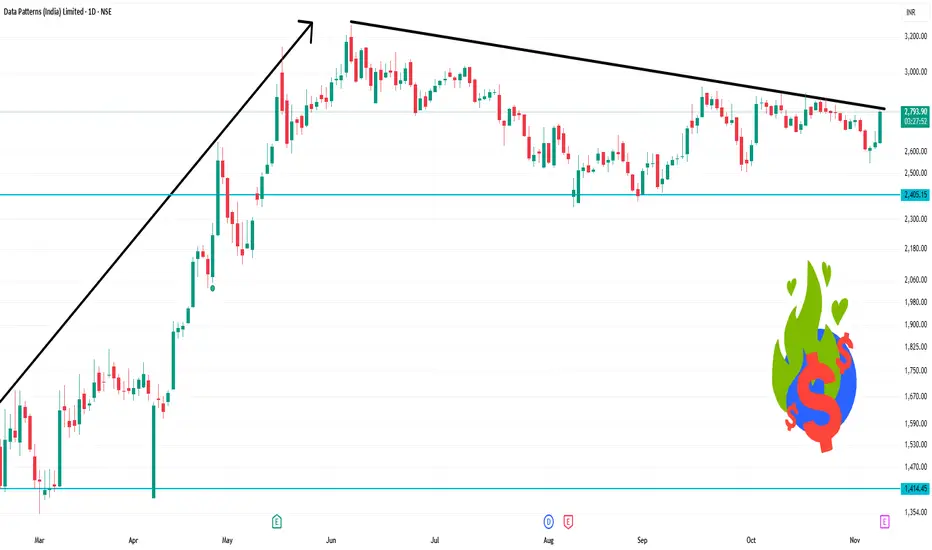
DATAPATTNS 1 Day Time Frame 📋 Key Levels
Accumulated-volume support: ≈ ₹2,576.90.
Fibonacci-based support levels: ~ ₹2,514.67 & ~ ₹2,545.65.
Short-term support (MarketScreener): ~ ₹2,541.40.
Resistance: ~ ₹2,806.80 (accumulated volume)
Short-term resistance (MarketScreener): ~ ₹2,842.
Moving averages:
20-day EMA ~ ₹2,750.69.
50-day EMA ~ ₹2,720.79.
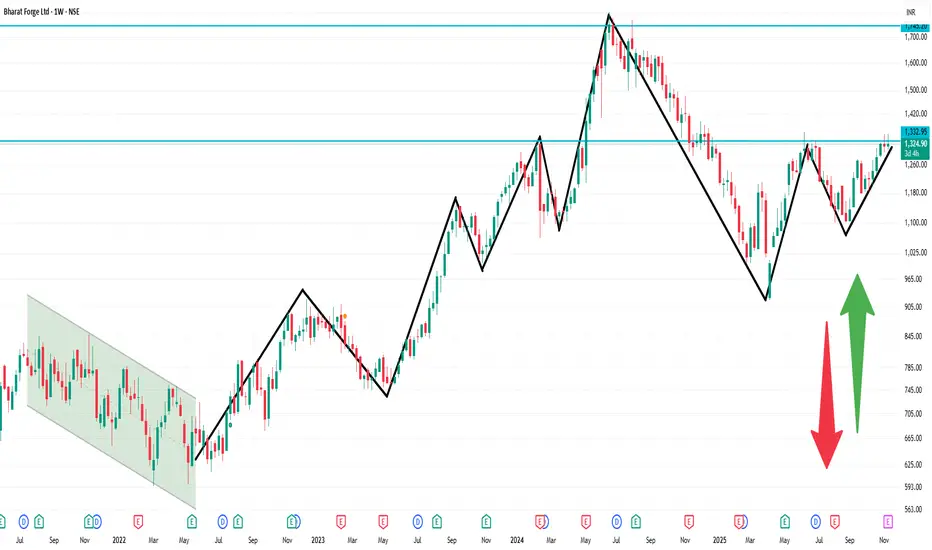
BHARATFORG 1 Week TIme Frame 🔍 Current Snapshot
Latest price approx ₹1,320 (rounded) as per recent quotes.
52-week range: ~₹919 (low) to ~₹1,482 (high).
Valuation: P/E ~60x and P/B ~6–7x.
Key sectors: auto-ancillaries, defence & aerospace.
📉 Key Technical Levels (Short-Term, ~1 Week)
Based on support/resistance and recent trading behaviour, here are levels to watch:
Support: around ₹1,250-1,260. If the price drops and finds buying interest, this is a potential floor zone.
Resistance: near ₹1,350-1,370. If momentum builds, breaking above this could open for further short-term upside.
Watch for range-bound behaviour: If neither major catalyst nor breakdown happens, expect the stock to oscillate between ~₹1,260 and ~₹1,350 in the coming week.
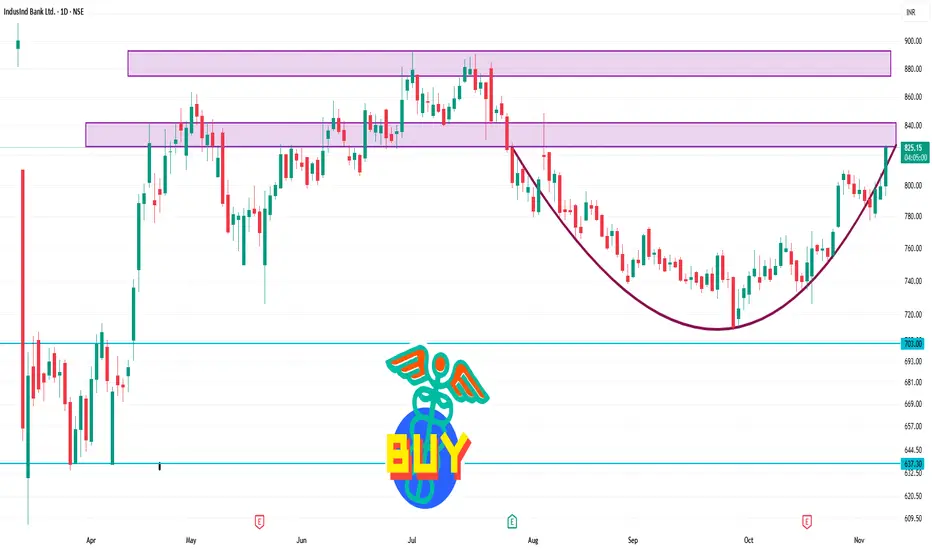
INDUSINDBK 1 Day Time Frame Level 🔍 Current snapshot
Latest live price: ~ ₹825.00.
Today’s approximate range: Low ~ ₹792.80, High ~ ₹826.00.
52-week range: Low ~ ₹606.00, High ~ ₹1,086.55.
📈 Key support & resistance levels
Support zone: ~ ₹790-₹800 — because price has held above ~₹792 today and that region shows earlier low of day.
Immediate resistance: ~ ₹825-₹830 — since the current price is around ₹825; breaking above that may open up.
Stronger resistance: ~ ₹850+ — if momentum builds, aim toward next psychological level.
Deeper support: if price falls below ₹790, next meaningful support could be ~ ₹760-₹770 (not precisely calculated but logical given range).
FINCABLES 1 Day View 📌 Current Price Snapshot
Latest close around ₹ 785.40.
Day’s trading range: roughly ₹ 784 – ₹ 793.95.
52-week range: low ~ ₹ 779.80, high ~ ₹ 1,342.75.
🧭 Key Technical Levels to Watch
Support zone: ~ ₹ 780–790 — price is near its 52-week low and this band may act as immediate support.
Resistance zone: ~ ₹ 800–810 — recent highs in this area, so a breakout above this could be meaningful.
If support breaks: A decisive break below ~₹ 780 could open downside risk; monitor volume.
If resistance breaks: A strong move above ~₹ 810 with volume could target next levels (₹ 820-850+), though those are less “immediate” on one-day timeframe.
✅ What to monitor today
Closing price relative to the above levels (did it hold above support or test resistance?).
Volume — whether any breakout/breakdown is backed by increased activity.
Price reaction around the ₹ 780-790 support band: a bounce could indicate strength; a failure might signal weakness.
Technical Analysis and Chart PatternsIntroduction
Technical analysis is a cornerstone of modern trading and investing. It involves studying price charts and market data to forecast future price movements. Unlike fundamental analysis, which focuses on financial statements, earnings, and economic indicators, technical analysis revolves around price action, volume, and market psychology. It assumes that all relevant information is already reflected in the price, and history tends to repeat itself through recognizable chart patterns and trends.
Core Principles of Technical Analysis
Technical analysis operates on three main principles:
Price Discounts Everything:
All known information—economic data, earnings, market sentiment, or political events—is already factored into the stock price. Therefore, analyzing price action alone can reveal the collective behavior of market participants.
Price Moves in Trends:
Markets rarely move randomly. Prices tend to move in identifiable trends—upward, downward, or sideways. Recognizing these trends early allows traders to position themselves advantageously.
History Repeats Itself:
Human psychology drives markets—fear, greed, hope, and panic repeat across generations. Therefore, patterns formed in the past tend to recur, providing clues about future price action.
Types of Technical Charts
Before identifying patterns, one must understand chart types used in technical analysis:
Line Chart:
It connects closing prices over a specific period, providing a simple view of the trend.
Bar Chart:
Each bar represents the open, high, low, and close (OHLC) for a given period. It gives more insight than a line chart.
Candlestick Chart:
The most popular chart among traders, candlesticks visually show market psychology. A bullish candle (close > open) is often green or white, while a bearish candle (close < open) is red or black.
Candlestick formations help identify reversals and continuations in price.
Trend Analysis
A trend is the general direction of price movement. It can be classified as:
Uptrend: Series of higher highs and higher lows.
Downtrend: Series of lower highs and lower lows.
Sideways/Range: Prices oscillate between support and resistance.
Traders use trendlines and channels to visualize and trade along the trend. The saying “Trend is your friend” highlights the importance of trading with the prevailing direction rather than against it.
Key Tools in Technical Analysis
Support and Resistance Levels:
Support: A price level where buying pressure prevents further decline.
Resistance: A level where selling pressure halts price advances.
When a resistance is broken, it can turn into new support and vice versa.
Moving Averages:
They smooth out price data to identify trend direction.
Simple Moving Average (SMA) – average of closing prices over a period.
Exponential Moving Average (EMA) – gives more weight to recent prices.
Common crossovers like the Golden Cross (short-term MA crosses above long-term MA) and Death Cross (short-term MA crosses below long-term MA) indicate trend reversals.
Volume Analysis:
Volume measures market participation. Increasing volume confirms the strength of a trend, while declining volume may signal weakening momentum.
Indicators and Oscillators:
Tools like Relative Strength Index (RSI), Moving Average Convergence Divergence (MACD), Bollinger Bands, and Stochastic Oscillator help identify overbought/oversold conditions, momentum shifts, and trend confirmation.
Chart Patterns in Technical Analysis
Chart patterns are visual formations created by price movements. They represent the psychological struggle between buyers and sellers and help traders predict potential outcomes.
Patterns are generally divided into reversal patterns and continuation patterns.
1. Reversal Patterns
These indicate that a current trend is likely to change direction.
a. Head and Shoulders
One of the most reliable reversal patterns.
Appears at the end of an uptrend.
Consists of three peaks: a higher middle peak (head) between two smaller ones (shoulders).
Neckline break confirms a bearish reversal.
Inverse Head and Shoulders appears at the bottom of a downtrend and signals a bullish reversal.
b. Double Top and Double Bottom
Double Top: Price hits a resistance twice, forming an “M” shape, signaling a bearish reversal.
Double Bottom: Price touches support twice, forming a “W” shape, indicating a bullish reversal.
c. Triple Top and Triple Bottom
Similar to double patterns but with three peaks or troughs. They confirm stronger reversals after multiple failed attempts to break support/resistance.
d. Rounding Bottom (Saucer Bottom)
Indicates a gradual shift from bearish to bullish sentiment over time. Common in long-term trend reversals.
e. Falling and Rising Wedges
Falling Wedge: Occurs during a downtrend and signals a bullish reversal.
Rising Wedge: Forms during an uptrend and signals a bearish reversal.
The breakout direction typically opposes the wedge slope.
2. Continuation Patterns
These suggest that the existing trend will continue after a brief pause or consolidation.
a. Triangles
Ascending Triangle: Horizontal resistance with rising support. Usually bullish.
Descending Triangle: Horizontal support with falling resistance. Usually bearish.
Symmetrical Triangle: Converging trendlines; breakout can occur in either direction.
b. Flags and Pennants
Flags: Small rectangular consolidations that form after a sharp move (flagpole). Breakout in the same direction resumes the prior trend.
Pennants: Similar to flags but shaped like small symmetrical triangles.
c. Rectangles (Price Channels)
When price oscillates between parallel support and resistance lines, it indicates accumulation or distribution. A breakout determines the next direction.
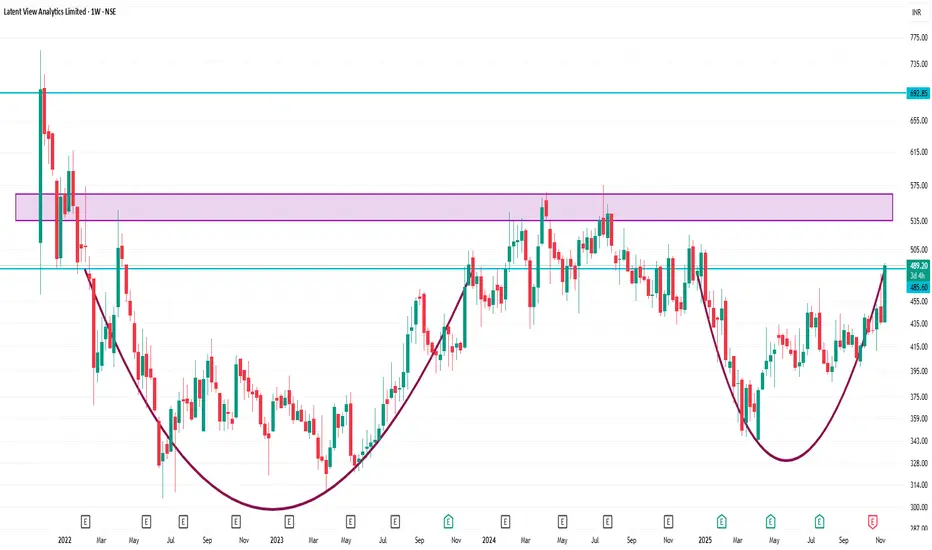
d. Cup and Handle
Looks like a tea cup: a rounded “cup” followed by a small “handle” consolidation. A breakout above the handle signals bullish continuation.
Candlestick Patterns
In addition to chart patterns, candlestick patterns offer short-term trading signals:
Bullish Engulfing: Large bullish candle engulfs the previous bearish candle—signals buying momentum.
Bearish Engulfing: Large bearish candle engulfs the previous bullish one—signals selling pressure.
Doji: Open and close prices are nearly equal, indicating indecision.
Hammer & Inverted Hammer: Found at bottoms, indicating potential reversals.
Shooting Star: Appears at tops, suggesting bearish reversal.
Combining Patterns with Indicators
Professional traders often combine chart patterns with technical indicators for confirmation.
Example:
A head and shoulders pattern confirmed by falling RSI strengthens the bearish outlook.
A cup and handle confirmed by rising volume adds validity to a bullish move.
This multi-factor approach reduces false signals and increases accuracy.
Advantages of Technical Analysis
Quick Decision-Making: Real-time charts provide instant trading opportunities.
Universal Application: Works across stocks, forex, commodities, and crypto.
Captures Market Psychology: Reflects fear and greed through patterns.
Supports Short-Term Trading: Ideal for day traders and swing traders.
Limitations of Technical Analysis
Subjectivity: Two traders may interpret the same chart differently.
False Breakouts: Patterns may fail, especially in volatile markets.
Lagging Indicators: Some tools like moving averages react after price changes.
No Fundamental Insight: It ignores earnings, news, and macroeconomic data.
Conclusion
Technical analysis is both an art and a science. By studying chart patterns, trends, and indicators, traders can anticipate potential price moves with greater confidence. However, success in technical analysis demands discipline, patience, and risk management. Patterns don’t guarantee results; they only increase probabilities. Combining chart patterns with volume analysis, market context, and proper stop-loss strategies creates a strong foundation for consistent profitability.
Ultimately, mastering technical analysis means understanding how market psychology shapes price movements—and using that knowledge to stay one step ahead of the crowd.
Private vs Public Banks in the Indian Market1. Ownership and Management Structure
The fundamental difference between public and private banks lies in ownership.
Public Sector Banks (PSBs) are majority-owned by the Government of India, which holds more than 50% of their equity. The government plays a key role in appointing top executives and formulating policy directions. Examples include State Bank of India (SBI), Punjab National Bank (PNB), Bank of Baroda (BoB), and Canara Bank.
Private Sector Banks (PVBs), on the other hand, are owned and managed by private entities or individuals, with the government having little or no control. The management is typically professional, and boards are accountable to private shareholders. Major private banks include HDFC Bank, ICICI Bank, Axis Bank, Kotak Mahindra Bank, and IndusInd Bank.
This difference in ownership affects how both types of banks operate, their decision-making processes, and their responsiveness to market conditions.
2. Historical Background
Public sector banks form the backbone of India’s traditional banking system. They gained prominence after bank nationalization in 1969 and 1980, which brought 20 major banks under government control. The aim was to ensure that banking services reached rural and underbanked areas, supporting agriculture, small industries, and social development.
Private banks, however, emerged in two waves:
The first phase included old private banks such as Karur Vysya Bank, South Indian Bank, and Federal Bank, which were regional and limited in scale.
The second phase, or the “new generation” private banks, began after the economic liberalization of 1991, when the Reserve Bank of India (RBI) allowed new private players to enter. Banks like HDFC Bank, ICICI Bank, and Axis Bank brought innovation, technology, and competition to the market.
3. Operational Efficiency and Technology
Private sector banks are widely recognized for their efficiency and technological advancement. They were pioneers in introducing digital banking, internet and mobile apps, ATMs, 24/7 customer service, and AI-based financial solutions. Their focus on automation and quick service appeals especially to urban customers.
Public banks, though initially slower to adopt technology, have made significant progress in recent years. Initiatives like YONO by SBI, Bank of Baroda’s digital transformation, and PSB Alliance have modernized public banking. However, public banks still face challenges due to their vast legacy systems and bureaucratic procedures.
4. Customer Service and Experience
Private banks are often perceived as offering superior customer service, with faster processing times, personalized products, and proactive relationship management. Their staff is trained to focus on efficiency and customer satisfaction.
Public banks, however, have traditionally been known for longer processing times and formal procedures. Yet, they provide an essential service to a larger section of society, especially in rural and semi-urban areas where private banks may not have strong penetration. PSBs are more committed to social welfare schemes such as Jan Dhan Yojana, Mudra loans, and agricultural credit programs.
5. Market Reach and Financial Inclusion
In terms of reach, public sector banks hold a dominant position. They have thousands of branches across rural India, ensuring that even remote populations have access to banking facilities. For instance, SBI alone accounts for more than 20% of India’s total banking network.
Private banks, conversely, focus primarily on urban and metropolitan regions where customers demand faster, technology-driven services. However, they are now expanding into Tier 2 and Tier 3 cities to capture a growing middle-class market.
6. Profitability and Performance
Private banks usually exhibit higher profitability, better asset quality, and more stable returns. Their operational flexibility, low non-performing asset (NPA) ratios, and efficiency in cost management contribute to superior financial performance. For instance, banks like HDFC and ICICI consistently report high return on assets (ROA) and return on equity (ROE).
Public banks, due to their social obligations and exposure to priority sectors, often face higher NPAs and lower profitability. Lending to agriculture, infrastructure, and small enterprises—though socially vital—sometimes leads to defaults. However, government support through recapitalization and mergers (like SBI with its associate banks) helps maintain their financial stability.
7. Lending Patterns and Risk Management
Public banks prioritize social and developmental objectives, lending to priority sectors such as agriculture, small industries, and low-income groups. They are also instrumental in implementing government schemes like PMEGP, Stand-Up India, and PM Kisan.
Private banks focus more on profitable segments such as retail loans, home loans, credit cards, and wealth management. They employ advanced risk assessment tools, AI-driven credit scoring, and market-based pricing, which help reduce bad loans and maintain better credit discipline.
8. Employment and Work Culture
Public sector banks provide job security, stable career paths, and government-linked benefits. They attract candidates through national-level exams conducted by IBPS or SBI. However, the work culture can be bureaucratic, hierarchical, and slower in decision-making.
Private banks offer performance-based incentives, faster promotions, and modern work environments, but job security is lower. They emphasize productivity, targets, and results, often leading to higher stress levels but better pay for top performers.
9. Regulatory Environment
Both public and private banks are regulated by the Reserve Bank of India (RBI) and governed by the Banking Regulation Act, 1949. However, PSBs are also accountable to the Ministry of Finance and the Parliament of India, which increases oversight but sometimes limits autonomy. Private banks enjoy greater independence in policy decisions but must adhere strictly to RBI norms.
10. Public Trust and Perception
Public banks enjoy a high level of trust among citizens, especially older generations and rural populations, because of government backing. Depositors believe their money is safe, even if the bank faces trouble, as the government is expected to intervene.
Private banks are viewed as modern, efficient, and customer-friendly, but public confidence fluctuates based on market performance. However, strong brands like HDFC Bank and ICICI Bank have built reputations rivaling public banks in reliability.
11. Future Trends and Outlook
The future of India’s banking sector lies in coexistence and collaboration between public and private players.
Public banks are likely to focus on financial inclusion, rural expansion, and implementation of government initiatives.
Private banks will continue to drive technological innovation, digital lending, and customer-centric growth.
Additionally, the rise of fintech companies, digital payments platforms (like Paytm and PhonePe), and neo-banks is pushing both sectors toward modernization and customer-focused strategies.
Government-led reforms such as bank mergers, recapitalization packages, and privatization plans indicate an evolving structure aimed at improving competitiveness and efficiency. As India’s economy grows, both public and private banks will play complementary roles in supporting national development and financial stability.
Conclusion
In summary, public sector banks represent the traditional, inclusive, and socially driven side of Indian banking, while private sector banks symbolize innovation, efficiency, and profit-oriented growth. Each has its strengths: public banks bring trust, accessibility, and social responsibility, while private banks bring technology, speed, and superior service quality.
The Indian market thrives on this balance — where government-backed institutions ensure inclusive development and private banks drive modernization and competition. Together, they form a robust dual system that continues to evolve, reflecting the dynamic needs of a rapidly developing economy.
Relative Strength Index (RSI) Indicator Secrets1. The Hidden Meaning Behind RSI Levels
Most traders use the 70/30 rule blindly. In reality, RSI levels are relative, not absolute. For instance:
In a strong uptrend, RSI can remain above 70 for a long period — this does not mean the market will immediately reverse. It often indicates strong bullish momentum.
In a downtrend, RSI can stay below 30 for an extended time — signaling strong bearish pressure, not necessarily an immediate bounce.
Secret Tip:
Adjust your RSI levels based on market conditions:
Bullish market: Use RSI zones of 40–80 (support around 40, resistance around 80).
Bearish market: Use RSI zones of 20–60 (resistance around 60, support around 20).
By doing this, you interpret RSI in the context of trend strength rather than treating it as an isolated signal.
2. RSI as a Trend Identifier
One of the most overlooked uses of RSI is trend confirmation. Traders often rely on moving averages or price patterns to identify trends, but RSI can do this more efficiently.
In uptrends, RSI tends to stay above 40 and frequently reach 70–80.
In downtrends, RSI remains below 60 and often hits 20–30.
Secret Insight:
If RSI repeatedly bounces from the 40–50 zone during a price pullback, it suggests that the uptrend is healthy. Conversely, if RSI fails to move above 60 during rallies, it signals weakness in the market.
This method helps traders stay with the trend longer, instead of prematurely exiting a position when RSI crosses traditional overbought or oversold levels.
3. RSI Divergence – The Ultimate Reversal Signal
RSI divergence is one of the strongest signals for trend reversal. It occurs when the price makes a new high or low that isn’t confirmed by the RSI.
Bullish Divergence: Price makes a lower low, but RSI makes a higher low — signaling potential upward reversal.
Bearish Divergence: Price makes a higher high, but RSI makes a lower high — indicating possible downward reversal.
Secret Tip:
For divergence to be effective, it must occur after a strong trend and be confirmed by volume or candlestick patterns (like Doji, hammer, or engulfing). Many traders lose money by trading every small divergence — patience is key.
Additionally, hidden divergence can predict trend continuation:
Hidden Bullish Divergence: RSI makes a lower low, but price makes a higher low → continuation of uptrend.
Hidden Bearish Divergence: RSI makes a higher high, but price makes a lower high → continuation of downtrend.
Combining regular and hidden divergences can give traders early entry signals and improve accuracy.
4. RSI Swing Rejections: The Secret Entry Technique
Welles Wilder’s original writings described an advanced RSI technique called “Swing Rejection”, which most traders overlook.
A bullish swing rejection occurs when:
RSI drops below 30 (oversold zone).
It rises above 30.
Pulls back but stays above 30.
Then breaks its previous high.
This pattern signals a strong bullish reversal — often before the price fully turns up.
A bearish swing rejection is the opposite:
RSI rises above 70.
Falls below 70.
Rebounds but fails to cross 70 again.
Then breaks its prior low — confirming weakness.
Secret Insight:
Swing rejections filter out false overbought/oversold signals and identify high-probability turning points in the market.
5. RSI with Multiple Time Frames
Professional traders rarely rely on a single RSI setting or timeframe. Instead, they confirm RSI signals across multiple timeframes.
For example:
If the daily RSI is oversold but the weekly RSI is still in a downtrend, the bounce may be short-lived.
When both daily and weekly RSI align in the same direction, it indicates a powerful trend reversal or continuation.
Secret Tip:
Use RSI(14) on higher timeframes (daily/weekly) for trend bias, and RSI(7) or RSI(9) on lower timeframes (hourly or 4-hour) for precise entries.
6. RSI and Moving Averages – A Smart Combination
Combining RSI with moving averages creates a more reliable trading system. For example:
Use a 50-period moving average to determine the trend direction.
Trade RSI signals only in the direction of the moving average.
Example:
If the price is above the 50-MA and RSI bounces from 40 → it’s a strong buy signal.
If the price is below the 50-MA and RSI drops from 60 → it’s a strong sell signal.
This combination filters out false signals and aligns trades with the dominant market trend.
7. RSI Range Shifts – The Professional Secret
A rarely discussed RSI secret is the concept of range shifts. In a strong uptrend, RSI tends to move between 40–80 instead of 30–70. In a strong downtrend, it shifts between 20–60. Recognizing this range shift early helps traders identify when the market transitions from sideways to trending behavior.
When RSI consistently fails to fall below 40 and pushes above 70, it confirms that bulls control the market. Conversely, when RSI struggles to rise above 60 and keeps hitting 30, bears dominate.
Spotting a range shift early can help you enter trends sooner and ride them longer.
8. Customizing RSI Periods for Different Assets
Most traders use the default 14-period RSI. However, adjusting the period can dramatically change its responsiveness:
Shorter RSI (5 or 7): More sensitive, gives early signals but more noise.
Longer RSI (20 or 30): Smoother, fewer false signals but more lag.
Secret Tip:
For volatile instruments like cryptocurrencies or small-cap stocks, use a shorter RSI (7–10).
For stable assets like large-cap stocks or indices, use longer RSI (14–21).
Customizing RSI settings according to volatility improves accuracy and reduces whipsaws.
9. Psychological Secrets of RSI
At its core, RSI reflects market psychology — the tug-of-war between buyers and sellers. When RSI rises above 70, it shows traders’ greed; when it falls below 30, it reveals fear. Understanding this helps you trade in the opposite direction of crowd emotions.
The best traders use RSI not just as a technical tool, but as a window into trader sentiment. Combining RSI readings with support/resistance zones or volume analysis offers a powerful edge.
10. Conclusion
The RSI indicator is far more than a simple overbought/oversold tool. Its true strength lies in understanding context, trend structure, divergence, and range behavior. By mastering RSI’s hidden secrets — such as swing rejections, range shifts, and multiple timeframe confirmations — traders can dramatically improve accuracy and timing.
When used intelligently, RSI reveals the rhythm of market momentum and helps traders ride trends, spot reversals, and stay on the right side of price action. Like all tools, it works best when combined with sound risk management, patience, and discipline — the true secrets behind profitable trading.
Artificial Intelligence (AI) has Revolutionized1. Introduction to AI in Trading
AI refers to the simulation of human intelligence through machines that can analyze data, learn from it, and make decisions with minimal human intervention. In trading, AI systems are designed to interpret large volumes of market data, recognize patterns, and execute trades based on pre-defined strategies or learned behaviors. These systems use techniques like machine learning, deep learning, and natural language processing (NLP) to improve performance over time.
Before the AI era, traders relied on intuition, experience, and manual technical analysis. They studied indicators like moving averages, RSI, and MACD, spending hours identifying potential entry and exit points. Today, AI can perform the same analysis within seconds — and with greater precision.
2. How AI Simplifies Trading
AI simplifies trading in multiple ways — from data analysis to strategy automation and risk management. Let’s break it down:
a. Data Processing Power
Markets generate massive amounts of data every second — stock prices, trading volumes, economic indicators, and news headlines. Humans can’t process such data in real time, but AI systems can. They analyze historical and live data simultaneously to identify trends, correlations, and anomalies.
For example, an AI algorithm can scan millions of trades across multiple exchanges to find a small arbitrage opportunity — something no human could do manually.
b. Automated Trading Systems
AI-powered bots can execute trades automatically based on predefined rules or predictive models. These algorithmic trading systems remove emotional decision-making — a common pitfall for human traders.
Once trained, an AI system can:
Identify potential trade setups
Execute buy/sell orders instantly
Adjust position sizes based on risk
Manage stop-loss and take-profit levels
This automation makes trading faster, more efficient, and less stressful.
c. Predictive Analysis
AI’s ability to learn from historical data helps forecast future price movements. Machine learning models use techniques like regression analysis, neural networks, or reinforcement learning to predict market direction.
For example, an AI might recognize that when a specific stock’s moving average crosses above its long-term average and news sentiment is positive, prices tend to rise. The AI can then act on this pattern automatically.
d. Sentiment Analysis
Markets are heavily influenced by news, social media, and global events. AI systems equipped with NLP can scan thousands of news articles, tweets, and financial reports to gauge market sentiment.
If the AI detects positive sentiment around a company, it might increase buying positions. Conversely, negative news or uncertainty could trigger sell orders. This allows traders to act before the broader market reacts.
e. Risk Management
AI doesn’t just trade — it also protects capital. Advanced systems monitor volatility, exposure, and portfolio balance. If risk levels exceed predefined limits, the AI can adjust trades automatically to minimize losses.
For instance, during sudden market crashes, AI can liquidate risky positions or shift funds into safer assets — all within milliseconds.
3. Types of AI-Based Trading Strategies
AI simplifies different trading styles, whether you’re a short-term day trader or a long-term investor.
a. Algorithmic Trading
Algorithms follow structured rules based on price, timing, and quantity. AI enhances these algorithms with adaptive learning, meaning strategies evolve with changing market conditions.
b. High-Frequency Trading (HFT)
HFT uses AI to execute thousands of trades per second to profit from minute price discrepancies. Only AI systems can operate at such speed and accuracy.
c. Quantitative Trading
Quant traders rely on mathematical models. AI refines these models using machine learning, improving accuracy with each trade.
d. Sentiment-Based Trading
AI reads emotions in the market using NLP, helping traders anticipate how public perception affects asset prices.
e. Portfolio Optimization
AI continuously assesses the risk-reward ratio of assets in a portfolio, rebalancing positions for optimal returns.
4. Benefits of AI in Trading
AI provides several clear advantages that make trading easier, smarter, and more profitable:
a. Speed and Efficiency
AI can process information faster than any human, allowing near-instant trade execution — a critical advantage in fast-moving markets.
b. Accuracy and Consistency
Unlike humans, AI doesn’t tire, panic, or act emotionally. It follows logic and data, ensuring consistent execution of strategies.
c. Learning and Improvement
Through machine learning, AI systems continuously adapt to new patterns. Each trade provides more data for the AI to learn from and refine its decisions.
d. Accessibility for Retail Traders
Previously, algorithmic and quantitative trading were available only to institutions. Today, retail traders can access AI-powered tools through trading platforms like Zerodha Streak, Tradetron, 5paisa Algo, or MetaTrader with AI plugins. These platforms make automation simple — no coding required.
e. 24/7 Trading
AI can monitor global markets around the clock — from U.S. stocks to Indian derivatives to cryptocurrency exchanges — ensuring no opportunity is missed.
5. AI Tools That Make Trading Easy
Several user-friendly AI tools are making trading accessible to everyone:
ChatGPT-style analysis bots: Help traders analyze stocks, news, or sentiment instantly.
TradingView AI scripts: Generate automatic signals based on customized indicators.
Zerodha Streak / Tradetron: Allow non-programmers to create and deploy AI trading strategies visually.
MetaTrader Expert Advisors (EAs): Automate forex and stock trading using AI-driven rules.
AI-Powered Analytics: Platforms like TrendSpider, Tickeron, and Kavout provide AI-based pattern recognition and predictions.
These platforms simplify trading so that even beginners can participate confidently without deep technical knowledge.
6. Challenges and Limitations
While AI makes trading easier, it’s not foolproof. Traders must understand its limitations:
Data Dependency: Poor data leads to poor predictions. AI is only as good as the information it’s trained on.
Overfitting: Some AI models may “overlearn” historical data, performing well in backtests but failing in real markets.
Market Volatility: Sudden geopolitical or economic shocks can render even advanced AI models temporarily ineffective.
Ethical and Technical Risks: Over-reliance on automation can cause flash crashes if many algorithms react simultaneously.
Cost and Complexity: Some advanced AI systems are expensive to build and maintain.
Thus, AI is a tool — not a guarantee of profit. Successful traders combine AI insights with human judgment.
7. The Future of AI Trading
The future of trading will be increasingly dominated by AI. Advancements like quantum computing, reinforcement learning, and hybrid human-AI systems will make trading even faster, more adaptive, and more personalized.
AI-driven systems will soon:
Understand market psychology better than human traders
Simulate millions of possible future scenarios in seconds
Provide real-time personalized trading advice
Detect global correlations across stocks, commodities, and currencies
In India, for example, AI-based algorithmic trading is growing rapidly, supported by SEBI regulations and broker integration. Retail traders are adopting automation tools to gain institutional-level efficiency.
8. Conclusion
Trading with AI is indeed easy — not because markets are simple, but because AI simplifies the process. It processes data, executes trades, manages risk, and learns continuously, allowing traders to focus on strategy rather than mechanics. Whether you’re a beginner or a professional, AI empowers you to trade smarter, faster, and more confidently.
However, while AI can make trading easier, it cannot eliminate risk entirely. Success still requires discipline, sound risk management, and an understanding of the technology behind the system. In the evolving world of finance, AI is not replacing traders — it is transforming them into more efficient and informed decision-makers.
In essence, AI doesn’t make trading effortless — it makes it intelligent. And with the right tools, anyone can harness its power to trade effectively in today’s digital markets.
Styles of Trading in the Indian Market1. Intraday Trading
Definition:
Intraday trading, also known as day trading, involves buying and selling financial instruments within the same trading day. The goal is to capitalize on short-term price movements without holding positions overnight.
Characteristics:
Positions are squared off before market close.
Traders rely heavily on technical analysis and price charts.
High liquidity stocks such as Reliance Industries, HDFC Bank, and Infosys are commonly traded.
Traders use tools like candlestick patterns, moving averages, RSI, MACD, and VWAP to identify entry and exit points.
Advantages:
Quick profits within a single day.
No overnight risk from news or global events.
Risks:
Requires constant attention and discipline.
High exposure to market volatility can lead to significant losses if risk management is weak.
In India, intraday trading is highly popular among retail traders because of its low capital requirement and the ability to use margin provided by brokers. However, success depends on speed, precision, and market understanding.
2. Swing Trading
Definition:
Swing trading involves holding positions for a few days to weeks to profit from short- to medium-term market “swings” or trends.
Characteristics:
Combines both technical and fundamental analysis.
Traders identify trend reversals, breakouts, and pullbacks.
Ideal for traders who cannot monitor markets all day but still seek active participation.
Advantages:
Less stressful than intraday trading.
Captures larger price movements.
Suitable for those with moderate risk tolerance.
Risks:
Overnight and weekend risks due to unexpected market news.
Requires patience and a good understanding of trend dynamics.
In the Indian context, swing trading is common among part-time traders and professionals who use stock screeners to identify stocks showing strong price momentum or technical patterns like cup-and-handle, flag, or triangle breakouts.
3. Positional Trading
Definition:
Positional trading focuses on capturing long-term market trends by holding positions for weeks, months, or even years. It lies between investing and active trading.
Characteristics:
Traders rely heavily on fundamental analysis and macroeconomic trends.
Technical indicators such as moving averages and Fibonacci retracements help identify entry points.
Patience and capital stability are key.
Advantages:
Lower transaction costs compared to frequent trading.
Less time-intensive.
Allows traders to ride major market moves.
Risks:
Exposure to long-term volatility, corporate announcements, or global crises.
In India, positional trading suits those who understand company fundamentals, earnings reports, and sector performance. Many long-term investors use this style to hold blue-chip stocks or sector leaders during growth phases.
4. Scalping
Definition:
Scalping is a high-frequency trading style where traders make multiple trades per day to capture very small price changes.
Characteristics:
Trades last from seconds to minutes.
Relies on high liquidity and tight bid-ask spreads.
Requires fast execution and strict risk management.
Advantages:
Low exposure to market-wide risks.
Frequent small profits can accumulate into significant returns.
Risks:
Requires advanced technology and quick decision-making.
Brokerage and transaction costs can reduce profits.
In India, scalping is often done in the derivatives or currency segment where liquidity is high. Professional traders and proprietary trading firms use advanced algorithms and trading terminals like NSE NOW or ODIN for execution.
5. Arbitrage Trading
Definition:
Arbitrage trading involves exploiting price differences of the same or related assets across different markets or instruments.
Types of Arbitrage in India:
Cash and Futures Arbitrage: Buying in the cash market and selling in the futures market when futures are overpriced.
Index Arbitrage: Taking advantage of the price gap between an index and its underlying stocks.
Cross-Exchange Arbitrage: Profiting from price differences of the same stock listed on NSE and BSE.
Advantages:
Low risk since trades are based on price inefficiencies.
Works well in highly liquid markets.
Risks:
Opportunities last for very short periods.
High capital and technology required for quick execution.
In the Indian market, institutional players and hedge funds dominate arbitrage trading. They employ automated systems that can identify and execute trades in milliseconds.
6. Momentum Trading
Definition:
Momentum trading focuses on identifying stocks showing strong upward or downward price momentum and riding that trend until it loses strength.
Characteristics:
Traders look for stocks with high volume and strong relative strength.
Uses indicators like RSI, MACD, and Moving Average Crossover.
The goal is to “buy high and sell higher” or “sell low and buy lower.”
Advantages:
Potential for high returns during trending markets.
Combines elements of both technical and sentiment analysis.
Risks:
Sharp reversals can lead to losses.
Highly dependent on timing and market psychology.
In India, momentum trading gained popularity with digital trading platforms and algorithmic systems. Traders often focus on mid-cap and small-cap stocks that move rapidly due to news, earnings results, or market sentiment.
7. Algorithmic and Quantitative Trading
Definition:
Algorithmic trading (algo trading) uses computer programs and mathematical models to execute trades based on predefined strategies without human intervention.
Characteristics:
Involves back-tested data and high-speed execution.
Strategies include arbitrage, momentum, statistical, and mean-reversion trading.
Trades are triggered by signals generated from real-time data.
Advantages:
Emotion-free and consistent trading.
Ability to process massive data and execute instantly.
Efficient in spotting opportunities invisible to manual traders.
Risks:
System errors or poor coding can cause losses.
Requires strong technical knowledge and infrastructure.
In India, algo trading has grown rapidly after SEBI allowed direct market access for institutional and retail traders. Many brokers now offer APIs to automate strategies through platforms like Zerodha’s Kite Connect and Upstox API.
8. Options and Derivatives Trading
Definition:
This style involves trading derivatives such as futures and options to speculate, hedge, or arbitrage.
Characteristics:
Traders use strategies like call/put buying, writing, straddles, spreads, and iron condors.
Derivatives magnify both profits and losses due to leverage.
Advantages:
Flexibility to profit in bullish, bearish, or neutral markets.
Useful for hedging portfolio risks.
Risks:
Requires deep understanding of volatility, time decay, and market direction.
High leverage can amplify losses.
In India, derivatives trading dominates the NSE market, with NIFTY and BANKNIFTY options being the most popular instruments among traders.
Conclusion
The Indian market offers multiple trading styles suited to various trader profiles — from short-term intraday players to long-term positional investors. Choosing the right style depends on one’s risk appetite, capital, time availability, and market knowledge. While intraday and swing trading attract active participants, positional and algorithmic trading are gaining ground due to technological advancements and increased financial literacy.
Successful traders in India understand that no single style guarantees consistent profits. The key lies in discipline, risk management, back-testing strategies, and continuous learning. As India’s financial ecosystem matures with innovations like algo trading, mobile platforms, and regulatory clarity, traders have unprecedented opportunities to participate effectively in the nation’s evolving markets.
Part 7 Trading Master Class Basics of Options in India
An option is a derivative contract that gives the holder the right but not the obligation to buy or sell an underlying asset (like Nifty, Bank Nifty, or a stock) at a predetermined price (called the strike price) before or on a specified date (expiry).
Call Option (CE): Gives the right to buy.
Put Option (PE): Gives the right to sell.
Traders use options for:
Hedging (protecting portfolio losses)
Speculation (betting on price movements)
Income generation (using premium decay)
In India, options are traded on exchanges like NSE and BSE, primarily on indices (Nifty, Bank Nifty, FinNifty) and individual stocks.
Premium Chart Knowledge Strategy and Leverage
Option trading allows traders to speculate on price movements or hedge positions with limited capital, offering leverage and flexibility through calls (buy) and puts (sell) contracts.
Risk and Reward
Options carry high profit potential but significant risk due to time decay and volatility. Successful trading requires analysis, discipline, and understanding of premium pricing and expiry.
Candle Pattern Explained There are two primary types of options: Call Options and Put Options. A Call Option gives the buyer the right to purchase an underlying asset at a specific price (called the strike price) before or on a certain date (known as the expiry date). Traders buy calls when they expect the price of the asset to rise. Conversely, a Put Option gives the buyer the right to sell the asset at the strike price within a specific period. Traders buy puts when they anticipate the asset’s price will fall.