Part 8 Trading Master Class With Experts Role of Volume & Open Interest
These indicators help understand market participation:
Volume shows activity
Open Interest shows fresh positions
Rising OI + rising price → strong trend
Rising OI + falling price → trend strength in opposite direction
Falling OI → position unwinding
Options with high OI often influence intraday support/resistance.
Trendcontinuation
Part 6 Learn Institutional TradingWhat Is Premium?
Premium is the cost of buying an option.
It depends on multiple factors:
Underlying price
Strike price
Time to expiry
Volatility (IV)
Interest rates
Market demand and supply
If implied volatility is high, premium rises.
If expiry date is near, premium decays faster.
Part 4 Learn Institutional Trading Option Buyer vs. Option Seller
There are two sides to every option trade:
Option Buyer (Holder)
Pays premium
Limited loss
Unlimited profit potential
Needs strong directional movement
Time decay works against them
Option Seller (Writer)
Receives premium
Limited profit (premium only)
Large potential risk
Benefits from sideways/slow markets
Time decay works in favor
Part 3 Learn Institutional Trading Put Option Simplified
A put option is useful when you expect the market to go down.
When you buy a put, you are paying a premium for the right to sell.
If the underlying falls below your strike, your put gains value.
Example:
BANK NIFTY at 48,000. You buy a 48,000 PE.
If it falls to 47,500, your put becomes profitable.
Again, your maximum loss is limited to the premium.
Part 2 Ride The Big Moves Call Option Simplified
A call option is useful when you expect the market to go up.
If you buy a call option, you are paying a premium to the seller.
If the price rises above your strike price before expiry, your call option gains value.
Example:
NIFTY trading at 22,000. You buy a 22,000 CE.
If NIFTY goes to 22,300, your call becomes profitable because you have the right to buy at 22,000.
If the market falls instead, you lose only the premium you paid.
Options TradingIntroduction to Options Trading
Options trading is one of the most powerful yet misunderstood segments of the financial markets. Unlike stocks, which represent ownership in a company, options are financial contracts that give the holder the right, but not the obligation, to buy or sell an underlying asset at a predetermined price within a specific timeframe. Options are part of the derivatives family, meaning their value derives from the price movements of another asset, such as stocks, indices, commodities, or currencies.
Options trading allows investors to hedge risks, generate income, and speculate on market movements with comparatively smaller capital. They are versatile instruments, suitable for conservative hedging strategies as well as aggressive speculative plays. In India, options are actively traded on exchanges like NSE (National Stock Exchange) and are available on equities, indices (like Nifty 50), and commodities.
At its core, options trading is about flexibility and strategy. Unlike buying a stock outright, options let traders create positions that profit in bullish, bearish, or neutral market conditions. This flexibility is why professional traders and institutions frequently use options to manage risk, leverage capital, and optimize returns.
What Are Options?
An option is a contract between two parties: the buyer and the seller (writer). The buyer pays a price called a premium for the right to buy or sell the underlying asset at a specific price, known as the strike price, before the option expires. The seller, in turn, is obligated to fulfill the contract if the buyer exercises it.
Options are categorized into two main types:
Call Options – Give the holder the right to buy the underlying asset at the strike price.
Put Options – Give the holder the right to sell the underlying asset at the strike price.
The price of an option (premium) depends on multiple factors, such as:
The current price of the underlying asset.
The strike price relative to the current price.
Time until expiration (time decay).
Volatility of the underlying asset.
Interest rates and dividends (for equities).
Because options are derivative instruments, they allow traders to control a larger position with smaller capital. For instance, buying one Nifty 50 call option might give exposure equivalent to 50 shares of the index, but at a fraction of the capital required to buy the shares directly.
Options come with an expiration date, after which they become worthless if not exercised or closed. This characteristic introduces an important concept called time decay (Theta), which significantly influences option pricing and strategy.
Calls vs Puts: The Basics
Options are essentially bets on market direction, and the two main instruments—calls and puts—represent opposite positions.
1. Call Options
Definition: A call option gives the buyer the right, but not the obligation, to buy the underlying asset at a predetermined strike price before or on the expiration date.
When to Buy: Traders buy call options when they expect the price of the underlying asset to rise.
Profit Potential: The potential profit is theoretically unlimited, as the asset price can rise indefinitely above the strike price.
Risk: The maximum risk for the call option buyer is the premium paid, which is the cost of acquiring the option.
Example: Suppose Reliance Industries is trading at ₹2,500. A trader buys a call option with a strike price of ₹2,600, paying a premium of ₹50. If the stock rises to ₹2,700, the intrinsic value is ₹100, resulting in a profit of ₹50 per share after deducting the premium.
2. Put Options
Definition: A put option gives the buyer the right, but not the obligation, to sell the underlying asset at a predetermined strike price before or on expiration.
When to Buy: Traders buy put options when they expect the price of the underlying asset to fall.
Profit Potential: The potential profit increases as the price of the underlying asset declines. In theory, the maximum gain occurs if the asset price drops to zero.
Risk: Like calls, the maximum risk is limited to the premium paid.
Example: Suppose Infosys is trading at ₹1,500. A trader buys a put option with a strike price of ₹1,450 for a premium of ₹30. If Infosys falls to ₹1,400, the intrinsic value of the put is ₹50, resulting in a profit of ₹20 per share after deducting the premium.
Comparison Table: Calls vs Puts
Feature Call Option Put Option
Right To buy underlying asset To sell underlying asset
Market Expectation Bullish (price rise) Bearish (price fall)
Maximum Loss Premium paid Premium paid
Maximum Gain Unlimited Strike price minus premium (asset cannot
go below zero)
Used for Speculation, hedging long Speculation, hedging short positions
positions
Importance of Understanding Option Mechanics
Understanding the mechanics of options is crucial for traders to make informed decisions and manage risk effectively. Options are not standalone investments—they interact with market dynamics, time decay, volatility, and pricing models. Misunderstanding these mechanics can lead to significant losses, even in seemingly simple trades.
1. Pricing Factors
The pricing of options depends on variables like the underlying asset’s price, strike price, time to expiration, volatility, and interest rates. Using models like Black-Scholes (for European options) or Binomial models (for American options) helps traders understand fair value and identify mispriced options.
2. Risk Management
Options can limit risk for buyers because the maximum loss is the premium paid, while sellers face theoretically unlimited risk (especially naked call sellers). Understanding the payoff structure allows traders to balance reward vs. risk and design hedging strategies.
3. Strategic Flexibility
Options mechanics allow for sophisticated strategies beyond just buying calls and puts. Traders can combine calls, puts, and underlying assets to create strategies like:
Covered Calls – Generating income on existing holdings.
Protective Puts – Hedging against downside risk.
Spreads and Straddles – Leveraging volatility for profit.
Without a solid grasp of how options work, implementing these strategies can become confusing and risky.
4. Timing and Volatility
Time decay (Theta) erodes option value as expiration approaches. Traders must understand how timing affects profitability. Similarly, volatility (Vega) impacts premiums: higher volatility increases option prices, offering potential for greater profit but also higher cost. Ignoring these factors can lead to unexpected losses even if the market moves in the anticipated direction.
5. Hedging and Speculation
Options are invaluable for hedging. For example, an investor holding a long stock position can buy puts as insurance against market decline. Conversely, options can be used for speculation with leverage, allowing traders to control large positions with limited capital. Understanding mechanics ensures these strategies are applied effectively.
Conclusion
Options trading is a dynamic and versatile arena within financial markets. Understanding what options are, the distinction between calls and puts, and the mechanics behind option pricing is essential for anyone looking to trade wisely. Calls allow traders to profit from rising markets, while puts benefit from falling prices. Both offer defined risk for buyers and strategic opportunities when used correctly.
Mastering option mechanics is not just about predicting market direction—it’s about timing, volatility, premium management, and strategic deployment. Traders who understand these nuances can leverage options for hedging, income generation, and speculation, making them one of the most powerful tools in modern finance.
Introduction to the AI-Driven Trading EraThe Evolution of Trading Technology
To understand the AI-driven era, it is important to look back at how trading technology has evolved. Markets moved from the open-outcry system to electronic trading, and from electronic trading to algorithmic models. Algorithmic trading introduced systematic rule-based execution, but these systems still relied heavily on predefined human logic. AI changes that framework by enabling trading systems to learn, adapt, and optimize themselves using vast amounts of data.
This evolution happened because markets became too fast, too complex, and too data-driven for human traders to handle manually. AI emerged as the natural solution for processing huge datasets, identifying hidden patterns, and executing trades in microseconds.
What Makes AI a Game Changer in Trading?
AI’s advantage lies in its ability to detect nonlinear patterns, its speed, and its capacity to learn autonomously. Unlike conventional formulas that follow static rules, AI models adjust themselves based on new market behavior, making them exceptionally powerful during volatility, regime shifts, or unexpected market events.
Some key strengths of AI-driven trading systems include:
1. Big Data Processing
Financial markets produce enormous amounts of data: price ticks, news, economic indicators, global sentiments, social media activity, institutional flows, and alternative datasets like satellite images or credit card spending. AI models can process all of these simultaneously, generating insights far beyond the reach of human analysis.
2. Predictive Modeling
Machine learning models learn from historical price data and trading patterns to predict potential future outcomes. While no model is perfect, AI significantly improves the probabilities and timing of accurate predictions.
3. Automation and Emotion-Free Decision Making
Human traders often suffer from fear, greed, overconfidence, and biases. AI systems remove emotional interference entirely, sticking to mathematical probabilities and risk-adjusted models.
4. Multi-Factor Integration
AI can combine dozens—or even hundreds—of variables to evaluate a trading opportunity, something impossible for a human trader. These include:
Technical indicators
Market microstructure signals
Volume patterns
Macroeconomic trends
Order book depth
Options flow
Global market correlations
5. Speed and Precision
AI-powered high-speed execution ensures minimal slippage, instant order routing, and accurate position sizing. This is crucial in markets where milliseconds can mean the difference between profit and loss.
The Rise of Machine Learning Models in Trading
Three major categories of ML models dominate AI trading today:
1. Supervised Learning
Models learn from labeled historical data to predict future price movements. Examples include:
Linear regression
Random forests
Gradient boosting models
Neural networks
These models are excellent at forecasting price direction, volatility, and risk.
2. Unsupervised Learning
Used for clustering, anomaly detection, and market regime identification. These models identify hidden structures in the market such as:
Patterns preceding trend reversals
Unusual behavior indicating manipulation
Shifts in market sentiment
3. Reinforcement Learning (RL)
One of the most exciting developments in AI trading, RL models learn by trial and error. They self-optimize by interacting with market environments, much like how AlphaGo learned to play Go. RL trading systems continuously adjust strategies based on reward maximization, making them extremely adaptive.
AI in High-Frequency Trading (HFT)
High-frequency trading firms were among the earliest adopters of AI. Their algorithms operate at lightning speed, executing thousands of trades per second. AI enhances HFT through:
Ultra-fast pattern recognition
Statistical arbitrage
Market-making
Latency arbitrage
Liquidity prediction
HFT remains one of the most profitable yet highly competitive areas of AI-powered markets.
AI for Retail Traders
The democratization of AI has brought powerful tools to retail traders in India and around the world. Cloud computing, open-source ML libraries, and broker APIs allow individuals to build and deploy their own AI models. Many retail traders now use:
AI-based scanners
Sentiment analysis bots
Automated trading systems
Options flow predictors
Reinforcement learning strategies
Platforms like Zerodha, Upstox, and Interactive Brokers support API-driven execution, enabling retail participants to operate like mini-quant firms.
AI and Market Microstructure
Advanced AI tools analyze market microstructure to exploit tiny inefficiencies. They evaluate:
Bid-ask spreads
Order book imbalances
Liquidity pockets
Iceberg orders
Hidden institutional flows
For traders, this means precise entries, better exit timing, and improved risk management.
Sentiment Analysis: The New Frontier
In the AI era, price is no longer the only source of truth. Sentiment is equally powerful. AI models scan:
News
Financial reports
Twitter
Reddit
Analyst commentary
CEO statements
Global events
Natural Language Processing (NLP) converts all this into actionable trading signals. For example, a sudden surge in negative sentiment often predicts a short-term drop in price.
Risks and Limitations of AI-Driven Trading
Despite its advantages, AI also brings challenges:
1. Overfitting
Models may perform well on historical data but poorly in live markets.
2. Black-Box Behavior
Deep learning models can be difficult to interpret.
3. Market Regime Shifts
AI can struggle when markets behave in ways not seen in training data.
4. Data Quality Issues
Incorrect, insufficient, or biased data leads to inaccurate predictions.
5. Overdependence
Traders relying entirely on AI may overlook fundamental risks or black swan events.
Successful AI trading requires human judgment, risk management, and continuous monitoring.
The Future of AI-Driven Trading
The AI trading era has only just begun. The future will likely include:
Fully autonomous trading systems
AI-powered portfolio optimization
Predictive risk models
Quantum computing–based trading algorithms
Personalized AI trading advisors
Real-time global sentiment heat maps
Markets will continue becoming faster, smarter, and more efficient. Traders who adopt AI early will have a powerful edge, while those who ignore it risk falling behind.
Trading Styles in the Indian Market1. Intraday Trading
Intraday trading, commonly known as day trading, is one of the most popular styles in India due to high volatility and leverage availability. It involves entering and exiting trades within the same trading day. The primary objective is to capture small price movements across large volumes.
Key Features
Short time frames: 1–5 minutes, 15 minutes, or hourly charts.
High leverage: Brokers offer margin for intraday trades.
Targets are small: 0.3% to 1.5% moves.
Risk management is crucial due to high volatility.
Popular Strategies
Momentum trading during market opening.
Breakout and breakdown strategies.
VWAP-based institutional flow tracking.
Reversal trades at key supply-demand zones.
Best Suited For
Traders with quick decision-making skills, emotional discipline, and the ability to monitor charts during market hours.
2. Swing Trading
Swing trading is ideally suited for the Indian market because stocks often move in short-term trends driven by news, earnings expectations, institutional flows, and sector rotation. Swing traders typically hold positions for 2–20 days.
Key Features
Higher timeframe analysis: Daily and weekly charts.
Lower stress compared to intraday.
Ideal for people with jobs who cannot monitor the market all day.
Uses technical patterns like flags, triangles, pullbacks, and breakouts.
Popular Swing Indicators
Moving averages (20, 50, 200)
RSI divergences
Fibonacci retracement zones
MACD crossovers
Best Suited For
Traders who prefer moderate risk, medium-term profits, and structured analysis without minute-to-minute monitoring.
3. Positional Trading
Positional trading involves holding trades for weeks to months based on broader market trends. This style is popular among experienced traders and investors who understand macro trends, sectoral cycles, and company fundamentals.
Key Features
Focus on major trends, not minor fluctuations.
Requires patience and conviction.
Uses weekly and monthly charts.
Less stressful than intraday/swing.
Approach
Use fundamentals for selection and technicals for timing.
Sectors like banking, FMCG, pharma, and IT respond well to positional plays.
Key tool: trendlines, moving averages, sector rotation analysis.
Best Suited For
Working professionals, medium-capital traders, and long-term thinkers.
4. Scalping
Scalping is one of the fastest and most advanced trading styles. The goal is to book very small profits (0.05%–0.3%) multiple times throughout the day. Scalping is extensively used in index derivatives—especially NIFTY, BANK NIFTY, and FINNIFTY—because liquidity and depth are extremely high.
Key Features
Extremely quick trades lasting seconds to minutes.
High frequency, low risk per trade.
Requires stable internet and low-latency execution.
Works best during high liquidity periods—opening hour and closing hour.
Tools
Option order flow
VWAP
Depth of market (DOM) data
Tick charts and footprint charts (for advanced scalpers)
Best Suited For
High-skill professional traders with strong reflexes, emotional control, and advanced tools.
5. Algorithmic and System-Based Trading
Algo trading has grown rapidly in India with the availability of APIs, platforms like Zerodha Streak, Tradetron, and custom Python systems. Algorithmic trading uses rules, automation, and backtesting instead of emotional decision-making.
Key Features
Mechanical, rule-based execution.
Removes emotions from trading.
Can handle high-frequency signals.
Backtesting helps refine strategies.
Popular Algo Styles
Trend-following systems.
Mean-reversion systems.
Statistical arbitrage.
Option selling with hedges.
Market-neutral strategies.
Advantages
Consistency and discipline.
Ability to trade multiple symbols simultaneously.
Works even for part-time traders.
Best Suited For
Tech-savvy traders, engineers, data scientists, or those who prefer automation over discretion.
6. BTST / STBT Trading (Buy Today, Sell Tomorrow / Sell Today, Buy Tomorrow)
BTST and STBT trading styles focus on overnight price movements influenced by global cues, economic announcements, or corporate news.
Key Features
BTST: Carry equity positions overnight to capture gap-up openings.
STBT: Mostly used in F&O due to short selling restrictions.
Trades depend on global markets—Dow, SGX NIFTY, crude oil, and currency moves.
Best Suited For
Swing traders who want to avoid intraday volatility but profit from overnight reactions.
7. Options Buying (Directional)
Options trading has exploded in India due to low capital entry and high reward potential. Directional option buyers predict sharp short-term moves.
Focus Areas
ATM/OTM calls and puts.
Breakout-based entries.
Trend days with strong momentum.
Expiry day (Thursday) trades.
Challenges
High theta decay.
Requires accuracy in direction and timing.
Best Suited For
Experienced traders who understand volatility, Greeks, and market structure.
8. Options Selling (Non-Directional or Semi-Directional)
Option selling is preferred by professional traders because it offers consistent income through premium decay.
Popular Strategies
Straddles & strangles.
Iron condor.
Bull/bear spreads.
Calendar spreads.
Advantages
High probability trades.
Beneficial during low-volume consolidations.
Risks
Requires strict hedging.
Black swan events can cause large losses.
Best Suited For
Capital-rich traders with risk-management experience.
9. Trend Following
Trend following is timeless and works well in trending markets like India. Instead of predicting tops and bottoms, trend followers ride the big wave.
Key Features
Use moving averages (20/50/200).
Enter after confirmation, not prediction.
Works extremely well in bull markets.
Requires fewer but high-quality trades.
Psychology
Trend following is simple but emotionally challenging because you must hold winners and cut losers quickly.
10. News-Based and Event Trading
Event traders focus on volatility around:
RBI policy
Budget announcements
Earnings results
Global macro events
Corporate announcements
Approach
Predict volatility, not direction.
Often uses straddles/strangles.
Fast execution is required.
Conclusion
The Indian market provides opportunities for every type of trader—from beginners to advanced professionals. Each trading style has its strengths, weaknesses, and ideal market conditions. To succeed, traders must choose a style that matches their personality, risk tolerance, time availability, and capital. Mastery comes from specialization, risk management, and continuous learning.
Part 1 Ride The Big Moves What Are Options?
Options are derivatives, which means their value is derived from an underlying asset such as stocks, indices, commodities, or currencies. In equity and index markets, options help traders speculate on price movements or protect their existing positions.
An option is essentially a contract that grants the buyer the right (but not the obligation) to buy or sell the underlying asset at a predetermined price (called the strike price) before a specific date (called the expiry).
There are two types:
Call Option – Gives the right to buy
Put Option – Gives the right to sell
Candle Patterns ExplainedCandlestick patterns are one of the most powerful tools in technical analysis. They visually capture the battle between buyers and sellers and show you who is in control of the market at any moment. Each candle represents the market psychology of that particular timeframe—fear, greed, rejection, aggression, and hesitation. When you learn to read candles correctly, you understand the story behind price, not just the price itself.
A single candlestick is made up of four important points: Open, High, Low, and Close (OHLC). The body of the candle represents the distance between open and close. The wicks (also called shadows) show the highest and lowest points reached during the candle. Bullish candles close higher than they open, while bearish candles close lower than they open.
Candle patterns are broadly divided into three categories: Single-candle patterns, Double-candle patterns, and Triple-candle patterns. Each type gives different signals about trend continuation, reversal, or market indecision.
Premium Chart PatternsPremium chart patterns are advanced market structures that go beyond basic triangles, flags, and double tops. These patterns are used by experienced traders, institutional desks, and serious technical analysts to catch moves before the majority notices. What makes them “premium” is their reliability, deeper logic, and ability to identify institutional activity, liquidity traps, and major swing reversals.
While basic chart patterns rely on simple visual structures, premium patterns focus on price psychology, volume behavior, liquidity engineering, and market structure transitions. These tools help traders understand why price is moving in a certain direction—not just how it looks.
KSB 1 Month Time Frame 📊 Recent Price & Context
1. As of this week, KSB share price is trading around ₹ 740–748.
2. Over the past 1 month, the stock has seen a decline: some data suggest ~–10% to –12% monthly movement.
3. 52-week trading range: ~₹ 582 (low) to ~₹ 912 (high).
⭐ What this implies (1-Month Outlook)
Base case (neutral / consolidation): Price may hover between ₹ 702–750, possibly swinging around support-resistance zones if broader markets remain stable.
Bullish near-term bounce: If sentiment or fundamentals improve (orders, demand, sector enthusiasm), KSB could test ₹ 738–750 — a key resistance cluster.
Bearish downside: Weak macro or sector headwinds might push price toward ₹ 690, or — if broken — towards ₹ 678.
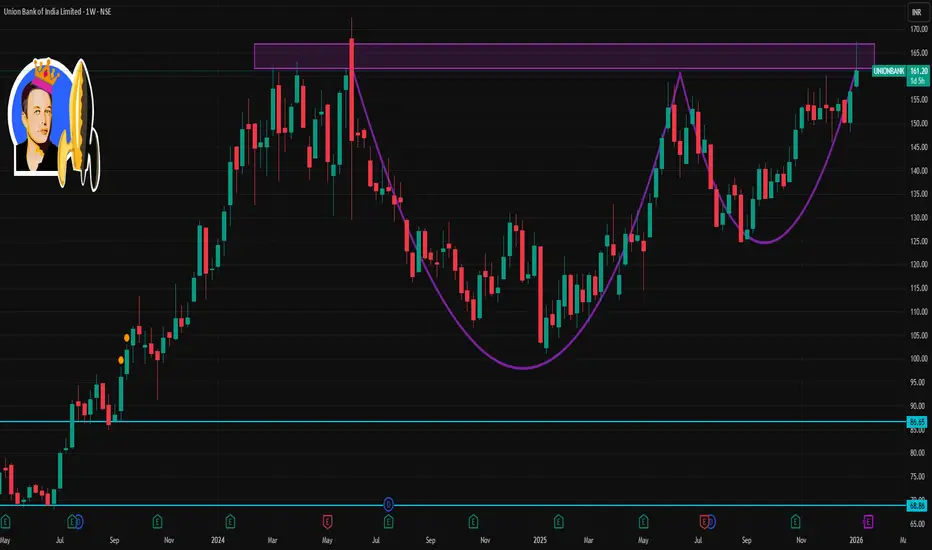
UNIONBANK 1 Week Time Frame 🔎 Current snapshot
Share price recently around ₹152.85–₹156.94.
52-week trading range: ~₹100.81 (low) to ~₹158.65 (high).
Fundamentals wise: low P/E vs peers, reasonable book value / dividend yield.
📈 Short-term (1-week) “Levels to watch”
Based on technical-forecast projections from providers:
Level type Price
Support (down-side) ~ ₹149.7
Alternate lower support ~ ₹140.0 (on a deeper dip)
Base / near-term target (if stable / slightly bullish) ~ ₹157-₹159
Upside breakout target ~ ₹162–₹165 (if momentum picks up)
Interpretation:
If price dips, ₹149–150 may act as immediate support.
On bounce or flat consolidation, ₹157-₹159 is plausible.
A clean breakout could take price toward ₹162–₹165 within a week — though that likely requires favourable macro / market mood.
Introduction to DivergenceShould You Trade Options?
Options are powerful tools, but they require:
Understanding of market structure
Technical or quantitative edge
Patience and discipline
Clear strategy
Risk management
If you want leverage and flexibility, options are excellent.
If you want consistency and low risk, focus on credit spreads or hedged selling.
Introduction to Put-Call Ratio (PCR)Psychology in Option Trading
Option trading is not just technical—it's emotional.
Traders face:
Fear of missing out (FOMO)
Overtrading during high volatility
Holding losers too long
Expecting miracles from OTM options
Disciplined psychological control is essential.
Part 2 Intraday Trading Master ClassMargin and Risk Management
Option buying requires no margin except the premium.
Option selling requires high margin because:
Risk is unlimited.
Exchanges demand safety.
Risk Management Rules
Never sell naked options without stop-loss.
Avoid selling during high volatility events.
Use spreads to reduce risk.
Position size properly—do not over-leverage.
NATIONALUM 1 Week View 📊 Snapshot
Current price: ~ ₹253–254.
Weekly pivot (classic) on weekly timeframe: ≈ ₹254.92.
Weekly support levels: ≈ ₹245.54 (S1), ₹240.40 (S2)
Weekly resistance levels: ≈ ₹260.06 (R1), ₹269.44 (R2)
✅ Key levels to monitor this week
Near term resistance: ~ ₹255–256
Primary target if bullish: ~ ₹260
Extended upside: ~ ₹269 (if strong breakout)
Primary support: ~ ₹245.5
Secondary support: ~ ₹240
⚠️ Risks to watch
Failure to close above ~₹255 this week → possible sideways/weak move.
A drop below ~₹240 could open up more downside risk.
Being in the metals sector, external factors (global aluminium price, energy costs, mining issues) can influence price rapidly even if technicals look okay.
Option Greeks and Advanced Hedging Strategies1. Understanding the Core Option Greeks
1. Delta – Sensitivity to Price Movement
Delta measures how much an option’s price changes for a ₹1 change in the underlying asset.
Call options: Delta ranges from 0 to +1.
Put options: Delta ranges from 0 to –1.
High-delta options behave almost like the underlying, while low-delta options react slowly.
Use: Directional trades, risk measurement, delta-neutral hedging.
2. Gamma – Rate of Change of Delta
Gamma shows how fast delta changes. It is highest for at-the-money options and near expiry.
High gamma means your delta can shift quickly, increasing risk if the market moves suddenly.
Use: Managing intraday fluctuations, protecting against rapid price moves.
3. Theta – Time Decay
Theta measures how much an option’s price erodes daily due to time decay.
Short option sellers benefit from positive theta.
Long option buyers suffer negative theta.
Theta accelerates as expiry approaches, especially for ATM options.
Use: Deciding when to buy or sell options based on time decay.
4. Vega – Sensitivity to Volatility
Vega estimates how much the option price changes when implied volatility changes by 1%.
High vega = large impact of volatility.
ATM and longer-dated options have higher vega.
Use: Volatility trading, earnings strategies, long straddles/strangles, volatility crush hedging.
5. Rho – Sensitivity to Interest Rates
Rho measures how an option’s value changes when interest rates move.
Rho is more relevant in long-dated options (LEAPS).
Higher rates tend to increase call prices and reduce put prices.
Use: Institutional hedging, bond-linked derivatives, macro-based hedging.
2. Why Greeks Matter in Trading
Each Greek reveals a different dimension of risk. A professional trader doesn’t just react to price; they monitor how Greeks shift across time, volatility, and market conditions.
Delta controls directional exposure.
Gamma controls how quickly direction changes.
Theta affects profitability over time.
Vega controls volatility risk.
Rho impacts rate-sensitive options.
A complete risk management system balances all Greeks using hedging strategies.
3. Advanced Hedging Strategies Using Greeks
A. Delta Hedging – Neutralising Directional Risk
Delta hedging means adjusting your underlying shares to keep delta = 0.
Example:
If you hold a long call with delta 0.60, buying 100 calls gives you 60 delta. To hedge, sell 60 shares.
This protects you from directional movement but NOT volatility or time decay.
When to Use Delta Hedging
For market-making
For large option sellers
During high volatility events
For maintaining non-directional strategies like straddles/strangles
B. Gamma Hedging – Controlling Delta Drift
Gamma hedging stabilises delta by using additional options, often opposite positions.
If gamma is high, delta changes rapidly, creating risk during volatile markets.
How It Works
Use options with opposite gamma to neutralise fluctuations.
Typically buy long-dated options with high gamma to stabilise short-dated high-gamma positions.
Gamma hedging is crucial for short option sellers who face rapid delta shifts.
C. Vega Hedging – Reducing Volatility Exposure
Traders hedge volatility by combining options that offset each other’s vega.
Methods
Buy/Sell options in different expiries
Use calendar spreads
Use ratio spreads
Example:
Long a straddle in near-month?
Hedge vega risk by shorting far-month options.
Vega hedging protects you from implied volatility crush (particularly important around earnings).
D. Theta Hedging – Managing Time Decay Exposure
Theta risk affects long option buyers and short sellers differently.
If you are long options, hedge with short theta (credit spreads).
If you are short options, hedge with long options (debit spreads).
Common Theta-hedging tools:
Iron condors
Credit spreads
Calendar spreads
Butterfly spreads
These strategies help balance time decay while limiting risk.
E. Rho Hedging – Interest Rate Risk
For long-dated options, changes in interest rates matter.
Institutions hedge by:
Taking opposite positions in interest-rate futures
Adjusting long-dated calls and puts
Rho hedging is mainly used in currency options, index options, and LEAPS.
4. Advanced Multi-Greek Hedging Strategies
Professional hedging often needs balancing multiple Greeks simultaneously.
1. Delta-Gamma Hedging
Objective: Neutralise both delta and gamma.
Used when markets are expected to stay within a range but may see temporary swings.
How to Construct:
Begin with the main option position.
Add options with opposite gamma until gamma ≈ 0.
Adjust underlying shares to bring delta to zero.
This creates a smoother risk profile.
2. Delta-Vega Hedging
Useful when trading volatility strategies like straddles or calendar spreads.
Approach:
Start with volatility-based position (e.g., long straddle).
Hedge delta with underlying.
Hedge vega by using options in different expiries.
This isolates pure volatility trading.
3. Delta-Theta Hedging
Designed for option sellers to offset excessive time decay sensitivity.
Tools:
Credit spreads
Butterfly adjustments
Ratio spreads
This prevents sudden losses from time decay acceleration.
4. Vega-Gamma Hedging
This is highly advanced and used by professional volatility traders.
Gamma and vega often move together.
High gamma = high vega.
So traders hedge using combinations of:
Calendar spreads
Diagonal spreads
Backspreads
Purpose: Generate controlled exposure to volatility without directional risk.
5. Key Advanced Hedging Strategies in Practice
A. Calendar Spreads (Time Arbitrage)
Buy long-dated options (high vega & low theta) and sell short-dated options (low vega & high theta).
Benefits:
Profits from volatility differences
Controls theta
Low directional risk
Great for hedging earnings uncertainty.
B. Iron Condors (Range-Bound Hedging)
Combines call and put credit spreads.
Purpose:
Profit from time decay
Hedge delta by balancing calls and puts
Low vega exposure
Institutions love condors because they naturally hedge multiple Greeks.
C. Ratio Spreads (Directional Volatility Hedging)
Example: Buy 1 ATM call, sell 2 OTM calls.
Benefits:
Balances delta
Captures volatility
Controls gamma risk
This is used when anticipating gradual price rise, not a breakout.
D. Straddles and Strangles (Gamma & Vega Plays)
Used when expecting high volatility.
To hedge:
Use delta hedging intraday
Use calendar spreads for vega hedging
Use stop adjustments to manage gamma risk
E. Butterfly Spreads (Controlled Gamma Exposure)
Butterflies offer controlled risk with defined payoff.
Benefits:
Low delta
Low vega
Balanced theta
Perfect for traders expecting low volatility and stable prices.
6. Professional Tips for Greek Management
Never hedge only delta—monitor gamma and vega too.
Use options in multiple expiries to stabilise vega and theta.
Avoid high gamma exposure near expiry unless you can adjust quickly.
Hedge dynamically—Greeks change every second.
In volatile markets, hedge more frequently.
Always check net Greeks of your entire portfolio, not individual trades.
Use spreads instead of naked options for balanced Greek profiles.
Conclusion
Option Greeks form the foundation of professional derivatives trading. Delta, gamma, theta, vega, and rho each describe different risk dimensions. Advanced hedging strategies combine these Greeks to build stable, market-neutral, volatility-neutral, or time-neutral portfolios. Whether trading directional moves, volatility events, or range-bound markets, mastery of Greek-based hedging is essential for long-term consistency and capital protection.
Microstructure Trading Edge1. What Is Microstructure Trading?
Microstructure trading focuses on:
Order flow (who is buying/selling and with what urgency)
Liquidity (where big orders sit in the book)
Bid–ask dynamics
Market maker behavior
Execution algorithms
Slippage and transaction cost analysis
Short-term price impact
Instead of predicting future prices using patterns, a microstructure trader reads the real intentions of market participants through order book changes, volume imbalances, and execution footprints.
This gives the trader the ability to:
Enter before breakouts actually occur
Predict fakeouts and liquidity grabs
Spot absorption by big players
Identify high-probability reversal points
Understand when momentum is real or manufactured
In short, microstructure trading is about recognizing the behavior of money, not the movement of lines.
2. The Foundation of Microstructure Edge
A microstructure trading edge emerges when you consistently identify and exploit inefficiencies in:
Order execution
Limit order placement
Market maker risk control
Liquidity distribution
Price impact of aggressive orders
These inefficiencies exist because:
Limit orders are placed by humans and algorithms with predictable patterns
Market makers adjust spreads based on risk
Large players cannot hide their intentions completely
Liquidity is uneven and clustered around obvious levels
Retail traders chase breakout candles, creating temporary mispricings
Understanding these behaviors offers a structural edge rather than a psychological one.
3. Key Elements of Microstructure Trading
(A) Order Flow Analysis
Order flow tells you the story behind every candle.
Key concepts:
Aggressive Buying → Market buy orders lifting liquidity at ask
Aggressive Selling → Market sell orders hitting bids
Delta and Cumulative Delta → Shows the net buying/selling pressure
Example edge:
If price is rising but cumulative delta is falling, it indicates passive absorption, meaning big players are selling into the rally. A sharp drop is likely ahead.
(B) Liquidity Pools
Liquidity pools are areas where large stop-losses or limit orders accumulate:
Swing highs/lows
Round numbers
Previous day high/low
Big figure levels
VWAP
Smart money often pushes price toward these pools to trigger liquidity and fill their large orders.
Edge:
When price aggressively taps a liquidity pool but shows no follow-through, it often marks a reversal or fade opportunity.
(C) Market Maker Behavior
Market makers provide liquidity but also:
Adjust spreads based on volatility
Absorb or reject aggressive orders
Hedge inventory risks
Manipulate micro-movements to attract order flow
A microstructure trader watches for:
Spread widening (hinting at imbalance)
Sudden liquidity removal
Fake liquidity (spoofing)
Iceberg orders
Hidden limit orders
When you know why a market maker widens spreads or pulls liquidity, you get clues about impending volatility or direction.
(D) Price Impact Models
Large institutional orders create predictable patterns:
They move price in the direction of the trade
The price impact is nonlinear—bigger orders have exponentially higher impact
They break orders into small chunks using algorithms (VWAP, TWAP, POV)
A microstructure trader identifies these patterns through:
Consistent small prints at fixed intervals
Volume clustering
Slow grind with no retracements
This often signals algorithmic accumulation or distribution, forming early entries.
(E) Queue Position & Execution Advantage
In limit order markets, queue priority matters.
Being early in the queue gives:
Better fill probability
Lower slippage
Reduced adverse selection
HFT firms exploit this with:
Speed advantage
Order anticipation
Rebate capturing
Retail traders can still gain edge through:
Using limit orders at well-selected liquidity zones
Avoiding poor execution times (open & close volatility)
Minimizing mechanical slippage
This transforms trading from random entries to strategic liquidity positioning.
4. Types of Microstructure Trading Edges
1. Liquidity Edge
Understanding where liquidity sits allows you to anticipate:
Stop hunts
False breakouts
Sharp reversals
You know why price moves, not just where.
2. Order Flow Timing Edge
Knowing when aggressive orders enter the market helps you:
Ride momentum early
Avoid fading strong pressure
Identify trap moves
This is especially powerful during:
First 15–30 minutes
News volatility
Breakout retests
3. Market Maker Pattern Edge
Market makers behave consistently under:
Low liquidity
Sudden volatility
One-sided order flow
Recognizing their footprints gives you:
High-probability scalps
Reversal signals
Safe entry timing
4. Execution Efficiency Edge
Improving order placement reduces:
Slippage
Costs
Unnecessary losses
Over thousands of trades, this becomes a significant edge.
5. Structural Pattern Edge
Microstructure traders often specialize in:
Liquidity grabs
Absorption blocks
Exhaustion prints
Imbalance continuation
Fair value gaps
Order blocks
Auction inefficiencies
These are not traditional chart patterns—they are behavioral signatures of large traders.
5. Practical Microstructure Trading Strategies
(1) Liquidity Grab Reversal Strategy
Steps:
Identify swing high/low with visible liquidity.
Wait for price to spike into the zone aggressively.
Watch order flow:
If volume spikes but price fails to follow → absorption.
Enter toward the opposite direction.
Target nearest imbalance or range midpoint.
Edge: You ride the trapped traders’ pain.
(2) Imbalance Continuation Strategy
Look for strong one-sided delta.
Price creates a displacement (fast move).
Wait for shallow pullback into imbalance or fair value gap.
Enter with trend.
Exit before next liquidity pool.
Edge: You ride institutional execution algorithms.
(3) Absorption Detection Strategy
Price approaches support/resistance.
Aggressive buying/selling is absorbed by opposite passive orders.
Price struggles to break despite large market orders.
Enter opposite direction.
Edge: You detect hidden limit orders absorbing flow.
6. Why Microstructure Trading Works
Human and algorithmic behaviors repeat
Liquidity distribution is predictable
Markets must move to fill large orders
Retail traders consistently provide exploitable patterns
Market makers follow rules and risk constraints
Order flow cannot be completely hidden
Microstructure trading edge is structural and durable, unlike pattern-based edges which decay over time.
7. Final Thoughts
Microstructure trading offers a deep understanding of why price moves, not just where it moves.
By studying order flow, liquidity, market maker behavior, and execution mechanics, traders gain a sustainable edge rooted in the actual functioning of markets. It requires discipline, screen time, and precision, but the rewards are significant—superior timing, reduced risk, and higher accuracy.