Part 5 Advance Trading Strategies Option Trading in Different Market Conditions
A. Trending Market
Buyers get benefit
CE/PE give good returns
B. Sideways Market
Sellers benefit
Strangles, straddles perform well
C. High Volatility
Premium expands
Good for selling post-news
D. Low Volatility
Cheap premiums
Good for buying before breakout
X-indicator
Smallcaps Break down in Five wavesNifty Smallcap 100 broke the falling trend channel on the way down but more than that the recent fall is now a five wave decline that might not be over. A five wave decline means that the larger trend has changed to bearish. It means that we are in a sell on rise market. A five wave decline once complete will also see a bigger retracement but the trend will remain down. Identifying a five wave decline is therefore important. Here we have it.
ABLBL | Bullish Divergence Opportunity | Chart Study🔻 Primary Trend
Stock is trading inside a well-defined falling channel (lower highs & lower lows).
Price is currently near the lower channel support, which is a key reaction zone.
🔁 Bullish RSI Divergence
Price: Made a lower low
RSI (14): Formed a higher low
This bullish divergence suggests selling pressure is weakening.
RSI has bounced from oversold zone (~30) and is curling upward.
📉 MACD Observation
MACD remains below zero but:
Histogram selling pressure is reducing
Momentum loss on the downside → early reversal signal (not confirmed yet)
📍 Support Zone
Strong horizontal + channel support around ₹103–105
Multiple reactions from this zone increase its reliability
🎯 Bullish Opportunity Logic (Study only)
Setup favors a technical pullback / relief bounce
Best confirmation would be:
Price holding above support
RSI crossing 40–45
MACD flattening or bullish crossover
📝 Note
This chart is shared purely for educational and technical study purposes.
It is not a recommendation or trading advice. Please do your own analysis.
NIFTY (analysis)NIFTY - Market View
Nifty is back near its recent swing low. The index has broken earlier swing lows and is clearly forming a lower high–lower low (LH–LL) structure on both higher and lower timeframes. This shows that the trend is still weak for now.
Currently, Nifty is trading near the trendline support and also close to the 0.618 Fibonacci retracement (golden ratio). This zone can act as an important decision area.
If price consolidates here and volatility cools off, there is a probability of a short-term reversal or bounce.
However, if Nifty fails to hold this zone, the next support is likely around 24,580–24,770, which is a deeper Fibonacci retracement area, below that 24330.
At this stage, the market is clearly in wait-and-watch mode.
Aggressively buying small and mid-cap stocks on the first bounce may not work in such conditions.
Let the index stabilise first.
Patience is key.
Follow price, not emotions.
✅ If you like my analysis, please follow me here as a token of appreciation :) in.tradingview.com/u/SatpalS/
📌 For learning and educational purposes only, not a recommendation. Please consult your financial advisor before investing.
XAUUSD (H4) – Liam Buying StrategyXAUUSD (H4) – Liam Continuation Plan
Trend remains strong, but price is extended | Buy pullbacks, not highs
Quick summary
Gold continues to trade firmly within a strong bullish structure. Macro pressure on safe-haven demand has eased slightly as US–EU geopolitical and trade tensions cool, while rising oil prices (supported by Saudi Aramco’s demand outlook) keep inflation expectations alive.
Despite the bullish trend, price is currently extended near the upper range, so execution today should focus on buying pullbacks at structure, not chasing breakouts.
Macro context (supportive, but less explosive)
Reduced geopolitical friction between the US and Europe has eased panic-driven flows.
Oil prices pushing higher keeps inflation expectations sticky, limiting downside pressure on gold.
USD remains relatively stable (USD/CAD holding firm), suggesting gold strength is structure-driven rather than pure fear trade.
➡️ Conclusion: trend-friendly environment, but volatility is now more technical than headline-driven.
Technical view (H4 – based on the chart)
Gold is respecting a clean ascending trendline, with impulsive legs followed by shallow pullbacks.
Key levels from the chart:
✅ Upper extension / continuation target: 5000+ zone
✅ Bullish continuation buy zone: 4580 – 4620 (previous breakout + fib support)
✅ Trendline support: dynamic (ascending)
✅ Deeper correction support: 4400 – 4450
Price is currently trading above the 1.618 fib expansion, which increases the probability of short-term consolidation or pullback before continuation.
Trading scenarios (Liam style: trade the level)
1️⃣ BUY scenarios (priority – trend continuation)
A. BUY pullback into structure (preferred setup)
✅ Buy zone: 4580 – 4620
Condition: hold above trendline + bullish reaction on M15–H1
SL: below structure / trendline
TP1: recent high
TP2: 4900
TP3: extension toward 5000+
Logic: This zone aligns with prior resistance turned support and fib retracement — a higher-probability continuation entry than buying highs.
B. BUY deeper dip (only if volatility increases)
✅ Buy zone: 4400 – 4450
Condition: strong rejection / liquidity sweep
TP: 4580 → 4800+
Logic: This is the last clean structural support within the current trend. A dip here would likely be corrective, not trend-ending.
2️⃣ SELL scenario (counter-trend, tactical only)
❌ No swing SELL bias while price holds above the ascending trendline. Shorts only make sense as very short-term scalps at highs with clear lower-TF rejection.
Key notes
Strong trends punish impatience — wait for pullbacks.
Avoid entries mid-leg after impulsive candles.
If price accelerates vertically without retrace, stand aside.
What’s your approach: waiting for the 4580–4620 pullback to join the trend, or staying flat until a deeper correction toward 4450?
— Liam
XAUUSD (Gold) | Bullish vs Bearish SetupS | 23rd Jan'2026XAU/USD – Key Levels (23 Jan 2026)
Resistance:
* R1: 4975–4985 → Near-term supply
* R2: 5000–5015 → Psychological breakout zone
Support:
* Pivot / Demand Zone: 4940–4955 → Intraday balance
* Primary Support: 4920–4940 → Trend bullish above
* Secondary Support: 4880–4900 → Strong swing support
* Trend Invalidation: 4850 → Break weakens bullish trend
Bullish Swing Setup
* Buy on Dip: 4920–4940 | SL: 4900 | Targets: 4975 → 5000 → 5015
* Breakout Buy: Above 4985 | SL: 4955 | Targets: 5000 → 5030 → 5050
Bearish Swing Setup (Corrective)
* Pullback Sell: Below 4920 | SL: 4940 | Targets: 4880 → 4850 → 4820
* Trend Shift Sell: Break below 4850 | SL: 4880 | Targets: 4800 → 4760
XAUUSD – H2 Technical AnalysisXAUUSD – H2 Technical Outlook: Liquidity Pullback Within a Strong Bullish Structure | Lana ✨
Gold continues to trade within a well-defined bullish structure on the H2 timeframe. The recent surge was impulsive, followed by a healthy retracement that appears to be rebalancing liquidity rather than signaling a trend reversal.
Price action remains constructive as long as the market respects key structural levels and the ascending trendline.
📈 Market Structure & Trend Context
The overall trend remains bullish, with higher highs and higher lows still intact.
Price continues to respect the ascending trendline, which has acted as reliable dynamic support throughout the uptrend.
The recent pullback occurred after an aggressive upside expansion, fitting the classic sequence:
Impulse → Pullback → Continuation
No clear distribution pattern is visible at this stage. As long as structural support holds, the bias remains BUY on pullbacks, not selling strength.
🔍 Key Technical Zones & Value Areas
Primary Buy POC Zone: 4764 – 4770
This area represents a high-volume node (POC) and aligns closely with the rising trendline.
It is a natural zone where price may rebalance before resuming the bullish trend.
Secondary Value Area (VAL–VAH): 4714 – 4718
A deeper liquidity zone that could act as support if sell pressure temporarily increases.
Near-term resistance: 4843
Acceptance above this level strengthens the continuation scenario.
Psychological reaction zone: 4900
Likely to generate short-term hesitation or profit-taking.
Higher-timeframe expansion targets:
5000 (psychological level)
2.618 Fibonacci extension, where major liquidity may be resting.
🎯 Trading Plan – H2 Structure-Based
✅ Primary Scenario: BUY the Pullback
Buy Entry:
👉 4766 – 4770
Lana prefers to engage only if price pulls back into the POC zone and shows bullish confirmation on H1–H2 (trendline hold, strong rejection of lower prices, or bullish follow-through).
Stop Loss:
👉 4756 – 4758
(Placed ~8–10 points below entry, beneath the POC zone and the ascending trendline)
🎯 Take Profit Targets (Scaled Exits)
TP1: 4843
First resistance zone — partial profit-taking recommended.
TP2: 4900
Psychological level with potential short-term reactions.
TP3: 5000
Major psychological milestone and upside expansion target.
TP4 (extension): 5050 – 5080
Area aligned with the 2.618 Fibonacci extension and higher-timeframe liquidity.
The preferred approach is to scale out gradually and protect the position, adjusting risk as price confirms continuation.
🌍 Macro Context (Brief)
According to Goldman Sachs, central banks in emerging markets are expected to continue diversifying reserves away from traditional assets and into gold.
Average annual central bank gold purchases are projected to reach around 60 tons by 2026, reinforcing structural demand for gold.
This ongoing accumulation supports the idea that pullbacks are more likely driven by positioning and profit-taking, rather than a shift in long-term fundamentals.
🧠 Lana’s View
This remains a pullback within a bullish trend, not a bearish reversal.
The focus stays on buying value at key liquidity zones, not chasing price at highs.
Patience, structure, and disciplined execution remain the edge.
✨ Respect the trend, trade the structure, and let price come to your zone.
INDIANB (Indian Bank)INDIAN BANK is showing a strong and constructive setup.
The stock recently made a fresh all-time high near 894, followed by a healthy pullback, which is a positive sign and often helps in building a stronger base for the next move. Importantly, the pullback was well-controlled, indicating limited selling pressure.
Price has now resumed its upward move and is trading above all key EMAs, reflecting continued strength and bullish momentum. The overall structure remains intact with higher highs and higher lows.
A decisive breakout from the current consolidation zone could open the door for a fresh upside move in the coming sessions.
Keep it in your watchlist.
✅ If you like my analysis, please follow me here as a token of appreciation :) in.tradingview.com/u/SatpalS/
📌 For learning and educational purposes only, not a recommendation. Please consult your financial advisor before investing.
NIFTY – Intraday Structure | Breakout from Bullish ConsolidationOn 5m, 15m and 1H timeframes, NIFTY formed a bearish trendline breakout around 2 PM, followed by a pullback and formation of a bullish intraday consolidation channel.
Price is currently consolidating inside this bullish channel, and a decisive break on either side can define the next intraday move.
🔹 Intraday Plan
Upside Scenario:
Break above bullish channel
Targets:
T1: 25,500
T2: 25,550
T3: 25,650
Stop Loss: 25,300 – 25,280
Downside Scenario:
Break below bullish channel
Targets:
T1: 25,150
T2: 25,000
T3: 24,900 – 24,920
Stop Loss: 25,360 – 25,380
This is a pure intraday range-break setup based on post-breakout bullish consolidation.
⚠️ Disclaimer
I am not a SEBI registered advisor or trader.
This analysis is shared only for educational purposes.
Please consult a registered financial advisor before taking any trading decisions.
XRPUSD — Wave 4 Completion in a Fibonacci Confluence ZoneXRP is currently developing a complex Wave 4 correction within a larger impulsive structure.
The internal structure of Wave 4 is unfolding as a W–X–Y correction, where the final leg (Y) is forming as an A–B–C pattern, and the C-wave is nearing completion.
Key Technical Observations
Fibonacci Cluster Confluence
The retracement of Wave 1 → Wave 3 aligns with the 61.8%–78.2% Fibonacci zone, which also matches:
The W–X–Y termination area
A–C extension levels
Higher timeframe liquidity support
This confluence creates a high-probability reaction zone.
Impulse Structure Validation
According to Elliott Wave guidelines:
Wave 4 is allowed to form complex corrections (WXY).
A single liquidity sweep below the WXY low is acceptable.
Sustained price acceptance below the Fibonacci cluster would invalidate the impulsive structure.
Critical Price Level
The $1.50 region is the key decision zone:
Above $1.50 → Wave 4 remains valid, and Wave 5 expansion becomes probable.
Below $1.50 (with strong acceptance) → Impulse failure scenario, signaling a larger corrective cycle.
XAUUSD – ATH now normal, $5,000 target.Market Context – When ATH Is No Longer a Spike
Gold has entered a phase where every pullback is being aggressively bought, signaling strong institutional acceptance of higher prices. The market is no longer reacting emotionally to new highs — instead, ATHs are forming within structure, not as exhaustion.
With:
Persistent safe-haven demand
A cautious Fed outlook
Ongoing geopolitical and macro uncertainty
➡️ $5,000 is evolving from a psychological level into a realistic technical target.
Structure & Price Action (H1)
Bullish structure remains intact with Higher Highs and Higher Lows.
Current declines are corrective pullbacks, not reversals — no bearish CHoCH confirmed.
Price continues to respect the ascending channel and demand zones, confirming trend continuation.
Key takeaway:
👉 No distribution signs at the top — ATHs are being defended by structure.
Trading Plan – MMF Style
Primary Scenario – Trend-Following BUY
Focus on buying pullbacks, not chasing ATH:
BUY Zone 1: 4,837 – 4,782 (Demand + trendline confluence)
BUY Zone 2: 4,713 (Deeper IP / demand zone)
➡️ Execute BUYs only after clear bullish reactions.
➡️ Avoid FOMO at extended levels.
Upside Targets (ATH Continuation):
TP1: 4,919
TP2: 5,027 (Extension zone approaching the $5,000 milestone)
Alternative Scenario
If price holds above 4,919 without a meaningful pullback, wait for a break & retest before looking for continuation BUYs.
Invalidation
H1 close below 4,713 invalidates the bullish structure and requires a full reassessment.
Summary
Gold remains in ATH continuation mode. The optimal strategy is not trying to top-pick, but patiently buying pullbacks in alignment with higher-timeframe flow. At this stage, $5,000 is no longer a question of “if” — only “when.”
BPCL : Trading the Confluence of Price Action & Macro TailwindsThe stock has been consolidating within a defined range over the past few weeks and has recently started forming a solid base. While the breakout volume isn’t a classic “God-candle,” price action continues to hold firmly above key moving averages, which is a constructive sign. That said, the price is somewhat extended from the EMAs, increasing the probability of a mean-reversion move. Hence, the stop loss needs to be placed wider rather than just below the basing structure.
The conviction behind this trade comes largely from the current Goldilocks macro environment we’re witnessing in early 2026. With global crude prices remaining comfortably low, BPCL is benefiting from strong marketing margins across petrol and diesel, supporting near-term earnings visibility.
On the fundamental side, a major catalyst is the Government’s LPG compensation package. BPCL is expected to receive a significant share of the ₹30,000 crore payout allocated to OMCs, which materially improves cash flows in H2 FY26. This inflow also acts as a strong deleveraging trigger, further strengthening an already improving balance sheet that has seen a steady decline in debt-equity levels over recent quarters.
So took this position with 1% risk on the net capital.
📢📢📢
If my perspective changes or if I gather additional fundamental data that influences my views, I will provide updates accordingly.
Thank you for following along with this journey, and I remain committed to sharing insights and updates as my trading strategy evolves. As always, please feel free to reach out with any questions or comments.
Other posts related to this particular position and scrip, if any, will be attached underneath. Do check those out too.
Disclaimer : The analysis shared here is for informational purposes only and should not be considered as financial advice. Trading in all markets carries inherent risks, and past performance is not indicative of future results. It’s essential to conduct your own research and assess your risk tolerance before making any investment decisions. The views expressed in this analysis are solely mine. It’s important to note that I am not a SEBI registered analyst, so the analysis provided does not constitute formal investment advice under SEBI regulations.
NIFTY – Multi-Timeframe Parallel Channel | Long-Term ViewOn Daily, 4H and 1H timeframes, NIFTY continues to trade inside a bullish parallel channel.
This consolidation has been active from April to December, with price repeatedly respecting both the lower and upper channel boundaries.
At the same time, the upper bullish trendline has been continuously extending from April till date, showing that the primary trend remains intact despite time-wise consolidation.
This reflects a time-based consolidation inside an ongoing uptrend, not a distribution structure.
🔹 Key Observations
Same parallel channel aligned on 1H, 4H and Daily
Consolidation range active from April to December
Upper bullish trendline continuing from April till date
Repeated rejections from both channel boundaries
RSI consistently rejects from oversold zones
Strong historical rejection zone near 24,900 – 24,500
🔹 Long-Term Plan (Positional)
Buy on Dips Zone: Around 25,000
Stop Loss (Invalidation): 24,700 – 24,600 (closing basis)
Targets:
T1: 26,000
T2: 26,400
T3: 26,500 – 26,700 (on trendline breakout)
🔹 Scenarios
Sustained breakout above 26,400 and above the upper channel can lead to further upside continuation.
Breakdown below 25,000 can turn the bias negative.
Historically, deep breakdowns have occurred only during extreme events.
Until any major impact news appears, channel continuation remains the higher-probability structure.
⚠️ Disclaimer
I am not a SEBI registered advisor or trader.
This analysis is shared only for educational purposes.
Please consult a registered financial advisor before taking any trading or investment decisions
New Impacts on Stock Market TradingHow Modern Forces Are Reshaping Markets
The stock market is no longer driven solely by company earnings, balance sheets, or traditional economic cycles. In recent years, trading has been transformed by a combination of technological innovation, global interconnectedness, changing investor behavior, regulatory evolution, and macroeconomic shocks. These new forces have fundamentally altered how markets move, how traders operate, and how risk is managed. Understanding these impacts is essential for investors, traders, institutions, and policymakers navigating today’s fast-changing financial environment.
1. Technology and Algorithmic Trading
One of the most powerful new impacts on stock market trading is the rise of algorithmic and high-frequency trading (HFT). Today, a significant portion of market volume is executed by machines rather than humans.
Algorithms analyze massive datasets—price movements, order flow, news sentiment, and correlations—within milliseconds. This has led to:
Faster price discovery
Narrower bid-ask spreads
Increased liquidity during normal conditions
However, it has also introduced new risks, such as flash crashes, sudden liquidity evaporation, and extreme short-term volatility. Human traders now compete with machines that operate at speeds impossible to match, changing the skillset required for successful trading.
2. Retail Investor Revolution
Another major shift is the explosion of retail participation. Zero-commission trading platforms, mobile apps, and social media have brought millions of new traders into the market.
Retail investors now:
Actively trade stocks, options, and derivatives
Coordinate through online forums and social platforms
Influence price action in small- and mid-cap stocks
This has reduced the dominance of institutions in certain segments of the market. Retail flows can now create sharp rallies or collapses that are disconnected from fundamentals, making markets more sentiment-driven and unpredictable in the short term.
3. Impact of Social Media and News Velocity
Information moves faster than ever. A single tweet, post, or breaking headline can trigger instant market reactions. Traders no longer wait for official reports; markets respond in real time to:
Central bank statements
Political developments
Corporate announcements
Geopolitical events
This speed has increased event-driven volatility. Stocks can move sharply within minutes, rewarding traders who can react quickly while punishing those who rely solely on traditional analysis. News sentiment analysis has now become a trading strategy in itself.
4. Globalization and Cross-Market Influence
Stock markets are now deeply interconnected. A shock in one region can instantly impact markets worldwide. For example:
U.S. Federal Reserve policy affects emerging markets
Commodity price swings influence equity sectors
Currency movements impact multinational companies
As a result, traders must monitor global indices, bond yields, commodities, and currencies alongside equities. Purely domestic analysis is no longer sufficient. Correlations across asset classes have increased, especially during periods of stress.
5. Central Banks and Monetary Policy Dominance
Modern trading is heavily influenced by central bank actions. Interest rate decisions, liquidity injections, and policy guidance have become major market drivers.
Low-interest-rate environments have:
Pushed investors toward equities
Increased leverage and risk-taking
Inflated asset valuations
Conversely, tightening cycles can rapidly reverse trends. Markets today often react more strongly to central bank commentary than to corporate earnings, reflecting how policy has become a primary force shaping capital flows.
6. Rise of Derivatives and Options Trading
Options trading has grown dramatically, particularly among retail traders. Weekly and zero-day options have increased short-term volatility and intraday swings.
This growth has:
Increased gamma effects near key price levels
Amplified market moves during expiries
Made index and stock movements more mechanical
Traders now watch options open interest, implied volatility, and dealer positioning to anticipate price behavior—factors that barely mattered to traditional investors a decade ago.
7. Passive Investing and ETF Dominance
The expansion of exchange-traded funds (ETFs) and passive investing has also reshaped trading dynamics. Large inflows or outflows into index funds can move entire sectors or markets regardless of individual company performance.
This has led to:
Increased correlation between stocks
Reduced importance of company-specific fundamentals
Sharp moves during index rebalancing
While passive investing has lowered costs and increased accessibility, it has also contributed to crowding and systemic risks during market stress.
8. Volatility as a Trading Opportunity
Modern markets experience frequent volatility spikes due to macro events, data releases, and geopolitical uncertainty. As a result, volatility itself has become a tradable asset.
Traders now actively use:
Volatility indices
Options strategies
Hedging instruments
Rather than avoiding volatility, many market participants seek to profit from it. This represents a major shift from traditional buy-and-hold approaches.
9. Regulatory and Structural Changes
Regulations around transparency, margin requirements, and derivatives trading have evolved in response to new market risks. While regulation aims to protect investors and maintain stability, it can also change liquidity patterns and trading costs.
Market structure changes—such as new trading venues, extended hours, and alternative order types—have further diversified how and where trading occurs.
10. Psychological and Behavioral Shifts
Finally, modern trading is shaped by behavioral factors more than ever. Fear of missing out (FOMO), panic selling, and crowd psychology are amplified by real-time price tracking and social media discussion.
Shorter attention spans and constant market access have increased:
Overtrading
Emotional decision-making
Short-term speculation
Successful traders now emphasize discipline, risk management, and emotional control as much as technical or fundamental analysis.
Conclusion
The stock market today operates in a vastly different environment than in the past. Technology, retail participation, global connectivity, derivatives, central bank influence, and rapid information flow have created markets that are faster, more complex, and more volatile. Trading has shifted from long-term, fundamentals-driven decisions toward dynamic, multi-factor, and risk-aware strategies.
To succeed in this new era, traders and investors must continuously adapt—embracing technology, understanding cross-asset signals, managing risk carefully, and remaining psychologically resilient. The future of stock market trading belongs not to those who react emotionally, but to those who understand and navigate these new impacts with clarity and discipline.
Bullish Ascending Triangle Spotted in Coforge LimitedCoforge Limited, formerly known as NIIT Technologies, is a promising stock in the future segment and is currently forming a bullish ascending triangle on the charts. Since May 2024, the stock has remained range-bound, characterized by higher lows and a flat resistance zone, which is a classic bullish continuation structure.
A key positive visible on the chart is the presence of a Law Of Polarity zone coinciding with the support area. This confluence significantly increases the probability of a valid and strong support, reinforcing the bullish bias. Additionally, clear volume spikes near each higher low indicate healthy accumulation and confirm the strength of the reversals at support levels.
From this structure, the stock has the potential to move upward, and upon a decisive breakout, it may deliver three upside targets:
First target: around 2400
Second target: around 3150
Final target: around 4500
However, it is important to note that the entire bullish setup will be invalidated if the price breaks and closes decisively below 1520.
Stock will take time to complete targets, all the patterns look awesome on chart but there are 100 of other possibilities, always give priority to capital protection and apply logical stoploss.
Understanding Long-Term Breakouts: Lessons from JINDALSTEL📈 Understanding Long-Term Breakouts: Lessons from JINDALSTEL
1. Long-Term Breakout: Why It Matters
A long-term breakout occurs when a stock surpasses a major resistance level that has held for years.
In JINDALSTEL’s case, the August 2010 high of ₹796 was finally breached in March 2024, after nearly 14 years.
Such breakouts are significant because they often mark a shift in market perception—investors are willing to pay higher prices than ever before, signaling confidence in the company’s future.
Key Insight: The longer the resistance holds, the more powerful the breakout tends to be, as it represents years of accumulated supply being absorbed.
2. Resistance Turned Support: The Golden Rule
Once a resistance level is broken, it often becomes a new support level.
JINDALSTEL pulled back to this zone (around ₹796–₹800), tested it, and then reversed upward.
This behavior shows that buyers defended the level, confirming its importance.
Why It Matters:
Respecting resistance-turned-support validates the breakout.
It reassures traders that the move wasn’t a false breakout but a genuine shift in demand.
3. Latest High Breakout: Continuation of Buying Interest
After the pullback, the stock began breaching its latest weekly highs.
This indicates follow-up buying—new participants are entering, and existing holders are adding positions.
A breakout after a successful retest of support is often seen as a high-probability continuation pattern.
Takeaway:
Breakouts after pullbacks are stronger than straight-line moves because they show healthy consolidation and renewed demand.
4. Risk Management: The Unsung Hero
Even the strongest chart setups require disciplined risk management:
Stop-loss placement: Below the new support (₹796–₹800 zone in this case).
Position sizing: Avoid overexposure; allocate capital wisely.
Trend awareness: Long-term breakouts can be powerful, but corrections are inevitable.
Avoid chasing: Enter near support or on confirmed breakouts, not in the middle of volatile moves.
5. Investor & Trader Takeaways
For Investors:
Long-term breakouts often signal a new growth phase.
Sustaining above old highs shows structural strength in the company.
For Traders:
Respect resistance-turned-support zones—they are ideal entry points.
Breakouts after pullbacks are high conviction trades.
Always pair technical setups with risk management discipline.
✨ Final Thoughts
JINDALSTEL’s chart is a textbook example of how markets reward patience.
A 14-year breakout signals a major shift.
The pullback to support and reversal confirms strength.
The latest high breakout shows continued buying interest.
For both investors and traders, this case highlights the importance of respecting technical levels, waiting for confirmation, and managing risk effectively.
Biocon: Range to Trend Expansion in ProgressBiocon’s weekly chart highlights a well-structured range-bound consolidation transitioning into a rising trend. Over the past several quarters, the stock has repeatedly faced supply near the upper resistance zone around 400–420, as marked by multiple rejections. This clearly establishes a strong overhead resistance where sellers have historically dominated.
On the downside, price action has respected a rising support trendline, forming higher lows over time. Each dip toward this support zone has attracted fresh buying interest, indicating accumulation at lower levels. This combination of flat-to-rising resistance and rising support reflects improving demand strength and a gradual tightening of price structure.
The recent pullback toward the support area near 360–370 is technically healthy rather than bearish. Such retracements often act as retest phases, allowing the market to absorb supply before attempting the next directional move. As long as Biocon holds above this rising support, the broader bullish structure remains intact.
A decisive weekly close above the resistance band (420+) would confirm a breakout from this prolonged consolidation. Post-breakout, the chart opens room for a strong upside expansion, with projected targets gradually extending toward the 460–500 zone based on the height of the prior range and trend continuation principles.
From a risk perspective, the setup stays valid while price sustains above the rising trendline. A breakdown below this support would delay the bullish thesis and could push the stock back into consolidation. Until then, Biocon remains in a favorable positional structure, where patience around support and confirmation near resistance can offer high-quality risk–reward opportunities for medium- to long-term traders and investors.
NIFTY KEY LEVELS FOR 23.01.2026NIFTY KEY LEVELS FOR 23.01.2026
Timeframe: 3 Minutes
If the candle stays above the pivot point, it is considered a bullish bias; if it remains below, it indicates a bearish bias. Price may reverse near Resistance 1 or Support 1. If it moves further, the next potential reversal zone is near Resistance 2 or Support 2. If these levels are also broken, we can expect the trend.
When a support or resistance level is broken, it often reverses its role; a broken resistance becomes the new support, and a broken support becomes the new resistance.
If the range(R2-S2) is narrow, the market may become volatile or trend strongly. If the range is wide, the market is more likely to remain sideways
please like and share my idea if you find it helpful
📢 Disclaimer
I am not a SEBI-registered financial adviser.
The information, views, and ideas shared here are purely for educational and informational purposes only. They are not intended as investment advice or a recommendation to buy, sell, or hold any financial instruments.
Please consult with your SEBI-registered financial advisor before making any trading or investment decisions.
Trading and investing in the stock market involves risk, and you should do your own research and analysis. You are solely responsible for any decisions made based on this research.
#NIFTY Intraday Support and Resistance Levels - 23/01/2026A flat opening is expected in Nifty 50, indicating continuation of the ongoing consolidation after the recent sharp sell-off and recovery attempts. The index is currently trading in a well-defined range, where buyers and sellers are both active near key levels, resulting in choppy price action. This kind of opening usually suggests that the market is waiting for fresh triggers and confirmation before committing to a directional move, especially after multiple volatile sessions.
From a technical standpoint, the 25250–25300 zone is acting as an important intraday support and decision-making area. If Nifty manages to sustain above 25250, it signals short-term strength and opens the door for a reversal-based long trade. In such a case, upside targets can be expected near 25350, followed by 25400 and 25450+, where previous supply zones are placed. However, traders should note that this upside is likely to face resistance near 25450, which remains a strong hurdle unless there is a clear breakout with volume.
On the downside, the 25450–25400 zone continues to behave as a strong resistance area. Any rejection or failure to sustain above this region can trigger selling pressure again. Short positions can be considered near 25450–25400 with a cautious approach, aiming for pullbacks towards 25350, 25300, and 25250. This makes the upper range a selling-on-rise zone rather than a breakout-buying zone, unless price decisively closes above resistance.
If Nifty breaks and sustains below 25200, the structure may turn weak once again. A breakdown below this level can accelerate downside momentum towards 25100, 25050, and 25000, which are important psychological and technical supports. Any sharp move into these lower levels could invite temporary bounces, but overall sentiment would remain cautious as long as the index trades below the major resistance zones.
Overall, the broader view suggests a range-bound market with mild bearish undertones, where aggressive trades should be avoided. Traders are advised to focus on level-based trades, book partial profits quickly, and keep strict stop-losses. Patience will be key, as a clear directional move is likely to emerge only after Nifty breaks out decisively from this consolidation range.
#BANKNIFTY PE & CE Levels(23/01/2026)A flat opening is expected in Bank Nifty, indicating a pause after the recent volatile swings and suggesting that the market is entering a short-term consolidation phase. Price action over the last few sessions clearly shows sharp intraday moves on both sides, followed by quick pullbacks, which reflects indecision and lack of strong directional conviction among participants. This kind of structure usually favors level-based trading rather than aggressive trend-following trades, especially during the first half of the session.
From a technical perspective, the 59050–59100 zone is acting as a crucial intraday pivot and demand area. As long as Bank Nifty holds above this region, the bias remains mildly positive with scope for a gradual upside move. Sustained trading above 59100 can trigger fresh long interest and short covering, which may push the index towards 59250, followed by 59350 and 59450+. However, this upside is likely to be slow and grindy, not impulsive, unless there is a strong breakout candle with volume confirmation above the higher resistance.
On the flip side, the 59450–59400 zone continues to behave as a strong supply and selling area. Any rejection from this region, especially if the price forms long upper wicks or fails to sustain above it, can invite renewed selling pressure. In such a scenario, PE buying near 59450–59400 becomes valid, with downside targets towards 59250, then 59150, and 59050. This makes the 59400–59500 band a critical area where traders should be extremely cautious and avoid chasing breakouts without confirmation.
If selling pressure intensifies and Bank Nifty breaks decisively below 59050, the structure may again turn weak. A breakdown below this support can open the gates for a deeper correction towards 58950–58900, and further down to 58750, 58650, and 58550. These lower levels are strong higher-timeframe supports, so any sharp fall into these zones could again attract bounce-based buying, keeping volatility elevated.
Overall, the broader trend still leans sideways to mildly bearish, with repeated failures near resistance and limited follow-through on rallies. Traders should focus on support-resistance reactions, avoid overtrading during choppy moves, and wait for clear confirmation before committing to large positions. A disciplined approach with strict risk management will be crucial, as Bank Nifty is likely to remain range-bound with sudden spikes on either side during the session.
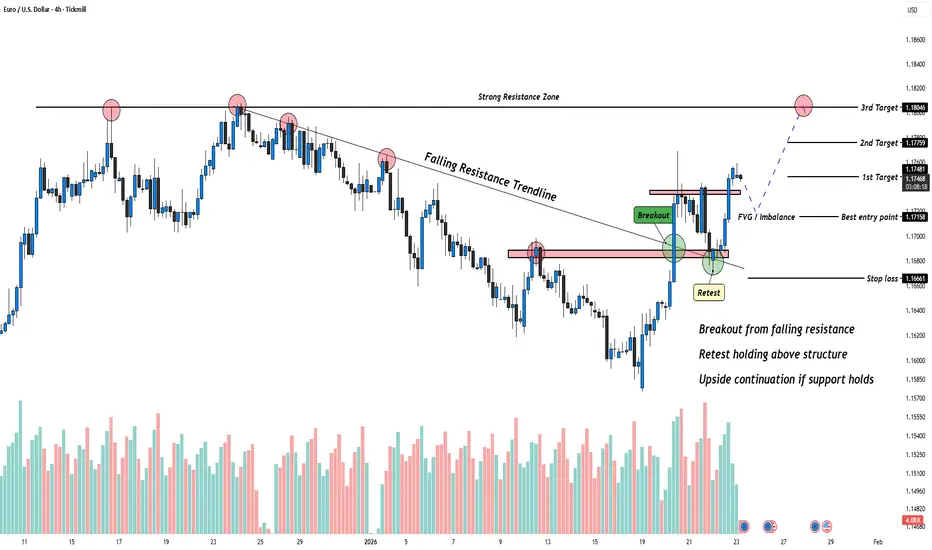
EURUSD – Breakout From Falling Resistance, Retest Holding WellEUR/USD was trading under a falling resistance trendline for a long time, with sellers consistently stepping in at higher levels. Recently, price managed to break above this trendline, which was the first sign that bearish pressure was easing.
After the breakout, price came back for a retest of the broken structure and previous resistance area. This retest is holding well so far, showing that buyers are defending the level and not allowing price to slip back below the structure.
What stands out here is how price respected the retest and then pushed higher, leaving behind a small imbalance. This often indicates acceptance above the breakout level rather than a false move.
As long as price holds above the retest zone and structure support, the path of least resistance remains to the upside, with higher resistance levels marked on the chart. A clean breakdown below this area would invalidate the bullish view.
This is a structure-based idea, not a prediction. Let price continue to confirm.
Disclaimer: This analysis is for educational purposes only and does not constitute financial advice. Trading involves risk. Please manage risk responsibly.


