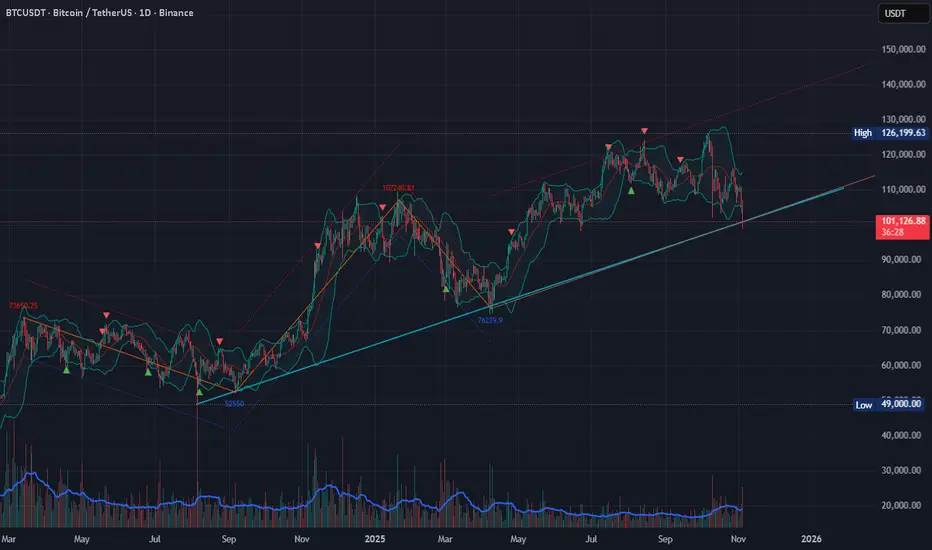
watch this trendline in BTCwe clearly havea trendline here, must hold 98k, anyway looks like capitulation like IPOs, nowsecondvawe must begin imoby miradornocaima0
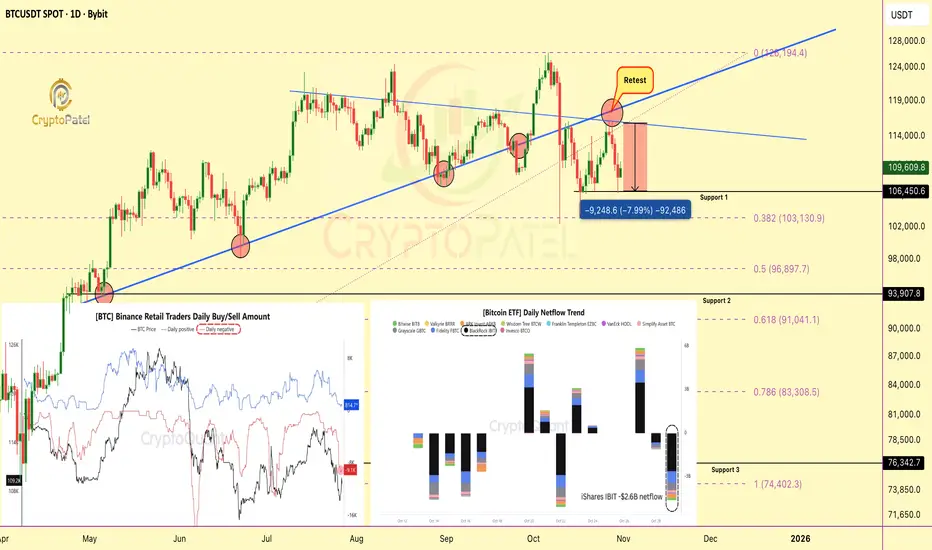
BTC First Weekly BB Break Since March: This Changes EverythingFirst Weekly BB Break Since March: This Changes Everything! Bitcoin is currently testing a key support zone around $104K, forming what appears to be the 5th major support retest in this ongoing bullish cycle. Historical Pattern Insight: Each of the previous four support retests (1–4) led to substantial rallies ranging from +70% to +200%, as shown in the green zones. If the pattern repeats, the next potential upside move (Wave 5) could project CRYPTOCAP:BTC toward the $200K region, marking a ~100% upside from current levels. New Technical Development: This week marks Bitcoin’s first breach of the lower Bollinger Band (BB) on the weekly timeframe since March, signaling heightened volatility and potential exhaustion of the current corrective phase. Bearish Scenario: A confirmed breakdown below this critical support could trigger a deeper correction toward the $50K area (–55%), similar to previous cycle corrections highlighted in red. Key Levels to Watch: 🔹 Support: $103K–$100K 🔹 Resistance: $110K, then $135K 🔹 Upside Target: $200K 🔹 Downside Risk: $50K Indicators: Bollinger Bands remain squeezed, indicating volatility expansion is near. The weekly mid-band continues to act as dynamic support, but a sustained close below it could shift the bias short-term. 🟩 Bullish Bias remains valid above $100K, invalidated only on a weekly close below support. 🟩 Pattern repetition or deviation here will define Bitcoin’s next macro leg. NFA & DYORby CryptoPatel4
BTC/USDT (4h timeframe)...BTC/USDT (4h timeframe), I can summarize what’s visible and help interpret my targets: Current price: Around $107,469 Chart setup: my using Ichimoku Cloud (Kumo) with marked zones: Resistance level (green zone) around $107,000 – $108,000 Two target points drawn on the chart: First target point: around $111,350 – $111,500 Second (higher) target point: around $116,500 – $117,000 ✅ Summary of target levels visible on my chart: 1. Target 1: ~$111,350 2. Target 2: ~$116,700 These targets are likely based on a breakout above the Ichimoku Cloud and prior resistance zones.Longby HussaiN_JaNiUpdated 449
[SeoVereign] BITCOIN BEARISH Outlook – November 03, 2025I would like to share my Bitcoin idea as of November 3. This idea is an extension of the one from October 27. The short positions entered on the 27th will be closed in profit in connection with this idea, and I plan to add some additional positions at the same time. This idea is based on a bearish (short) perspective, and I see a high possibility of a downward correction based on technical grounds. First Basis — FIBONACCI 1.272 Retracement Currently, Bitcoin is located in the 1.272 retracement zone relative to the previous downward movement. This is generally recognized as the completion zone of a rebound, where buying pressure tends to weaken and selling pressure begins to appear. Second Basis — Trendline Breakdown Bitcoin has clearly broken below the short-term ascending trendline. This indicates the end of the short-term upward movement and suggests the potential for a new downward trend reversal. Accordingly, I set the average target price around 100,600 USDT. Further position management and updates will be provided depending on market developments. Thank you for reading.Shortby SeoVereign5
Part 12 Trading Master Class With Experts Types of Options There are two main types of options: Call Option – A call gives the buyer the right to buy the underlying asset at the strike price before expiration. Traders buy calls when they expect the price of the underlying asset to rise. Put Option – A put gives the buyer the right to sell the underlying asset at the strike price before expiration. Traders buy puts when they expect the price of the underlying asset to fall. Each option can also be American-style (exercisable anytime before expiry) or European-style (exercisable only on the expiry date). In India, most index options like NIFTY or BANKNIFTY are European-style.Education30:00by SkyTradingZone1
BtcThis chart shows BTC/USDT on the H1 timeframe analyzed using the Kumo-Only v2.2 system. Price is currently testing the Kumo cloud area with RSI staying above 50, suggesting potential bullish continuation. Key levels: Cloud top and bottom, recent swing high/low. Trade plan: Target 1.5R, stop loss below the nearest swing low. Volume confirmation is used when it exceeds the 20-period average.Longby lekimquy98112
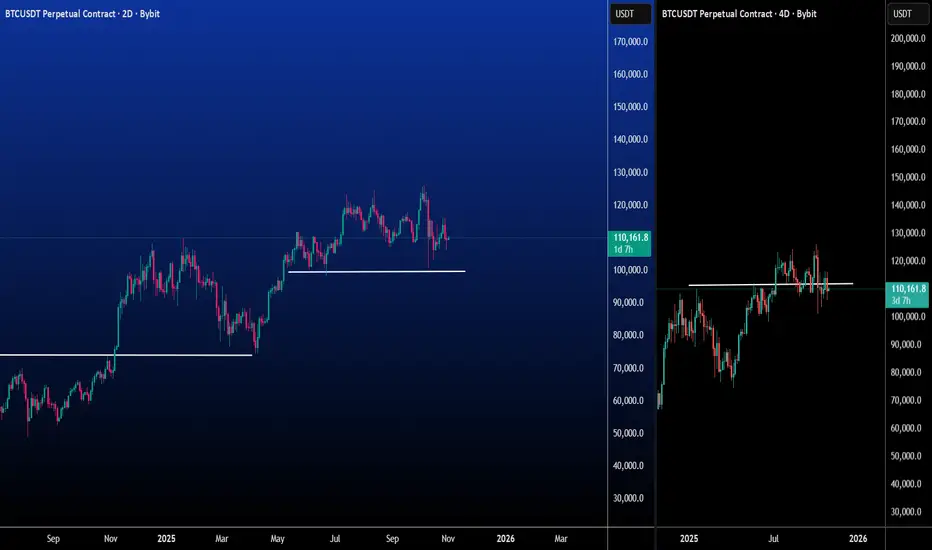
ByBit BTCUSDT Chart ( Mid Term Trade )Welcome Back To My Page. Very Simple Chart. -> First Trend Line -> Second Trend Line As we see the the pullback from the first Trend Line in Left Graph, Right Side Graph shows that Price got rejected from it's ATH and looking to take the support at Second Trend Line. Like If your view align with my view. Make sure any strong new now capable to Dump the price so take this advantage as December arrives soon. Note : This is not a financial advice. Made just for Educational purposeEducationby Riddhesh-Kale1
DAILY BULLISHCurrently Daily Structure looks bullish to me until we are going fail to hold the Higher Lows on the Daily time frame. Structure remains the same until we broke the HL Longby Traderx_xD0
Retail Panic Meets ETF Outflows: $1B Bitcoin Sell-Off Hits MarkeRetail Panic Meets ETF Outflows: $1B Bitcoin Sell-Off Hits Markets Bitcoin saw renewed selling pressure on Oct 30, as Binance retail traders dumped over 9,200 BTC (~$1B) around $107.7K, just days after another 12,000 BTC sell wave near $108.3K. Technical View: Retail traders are aggressively selling into weakness, while long-term holders remain largely inactive. Historically, these sharp sell-offs from short-term players often form local bottoms, liquidity events where smart money quietly accumulates. Fundamental Side: Spot Bitcoin ETFs added more weight to the downside: 🔹 BlackRock: -$2.6B 🔹 Fidelity: -$790M 🔹 Grayscale: -$500M These ETF outflows likely shifted capital to spot exchanges, amplifying short-term selling pressure. Key Insight: ▶️ Retail capitulation + ETF outflows = short-term volatility ▶️ But remember, markets often bottom when retail panic peaks. Note: NFA & DYOR by CryptoPatel1151
Part 1 Ride The Big Moves Role of Options in Hedging and Speculation Options serve two primary purposes—hedging and speculation. Hedging: Investors use options to protect their portfolios from adverse price movements. For example, a fund manager expecting a market downturn might buy put options on an index to limit potential losses. Speculation: Traders use options to bet on the direction of price movements with relatively low capital compared to buying stocks outright. For instance, buying a call option allows participation in a stock’s upside potential without investing the full stock price. Thus, options balance the needs of both conservative and aggressive market participants.Education28:28by SkyTradingZone229
What Are Cryptocurrencies? A Simplified Overview1. The Basic Definition: What Is a Cryptocurrency? A cryptocurrency is a digital or virtual form of money that uses cryptography (a method of securing information) to ensure secure transactions. Unlike traditional currencies such as the rupee, dollar, or euro — which are issued and controlled by governments or central banks — cryptocurrencies operate on decentralized networks, usually based on blockchain technology. This means no single authority, like a bank or government, controls cryptocurrency. Instead, users themselves verify and record transactions through computer networks spread across the globe. In short: Cryptocurrency = Digital Money + Cryptography + Decentralization 2. The Birth of Cryptocurrency: A Revolution in Digital Money The idea of digital money isn’t entirely new. Efforts to create online currencies started as early as the 1980s and 1990s. But these early systems failed because they depended on a central authority, which made them vulnerable to fraud and manipulation. The real breakthrough came in 2009, when a mysterious individual (or group) under the name Satoshi Nakamoto introduced Bitcoin — the first successful decentralized cryptocurrency. Bitcoin solved two major problems that earlier attempts couldn’t: Double-spending problem – ensuring digital money couldn’t be copied or spent twice. Trust problem – enabling users to transact without needing to trust a middleman or central authority. The launch of Bitcoin marked the beginning of a new financial era — one where money could move freely and securely on the internet. 3. How Cryptocurrencies Work At the heart of every cryptocurrency lies a technology called the blockchain. Think of a blockchain as a public digital ledger — a kind of record book that’s accessible to everyone but can’t be changed or tampered with. Here’s how it works step by step: Transaction Creation: When someone sends cryptocurrency to another person (say, sending Bitcoin to a friend), that transaction is broadcast to a network of computers. Verification: These computers (called nodes) verify the transaction details — ensuring the sender actually has enough funds and that there’s no duplication. Block Formation: Verified transactions are grouped together into a “block”. Blockchain Addition: Once verified, this block is added to the existing chain of previous transactions — forming a continuous and secure “blockchain”. Immutability: Once a block is added, it cannot be altered. This makes blockchain systems highly secure and transparent. Every participant in the network can view the transactions, but nobody can modify them. This creates a trustless system, meaning people don’t need to trust each other — they only need to trust the system’s mathematics and cryptography. 4. Mining: The Backbone of Cryptocurrency Creation Most cryptocurrencies (like Bitcoin) are “mined” rather than printed. Mining refers to the process of using powerful computers to solve complex mathematical problems that validate transactions and create new coins. When miners solve these problems, they add new blocks to the blockchain. As a reward for their effort and energy, they receive new cryptocurrency coins. This process not only issues new coins into circulation but also keeps the network secure and decentralized. However, mining requires significant computing power and electricity. As a result, it has raised environmental concerns, leading newer cryptocurrencies to adopt more energy-efficient methods such as Proof of Stake (PoS) instead of Proof of Work (PoW) used by Bitcoin. 5. Types of Cryptocurrencies While Bitcoin was the pioneer, thousands of other cryptocurrencies have since emerged, each with unique purposes and features. Some popular examples include: Bitcoin (BTC): The original and most valuable cryptocurrency. Often referred to as “digital gold”. Ethereum (ETH): Introduced the concept of smart contracts — programmable digital agreements that execute automatically when conditions are met. Ripple (XRP): Designed to make international payments faster and cheaper, especially for banks and financial institutions. Litecoin (LTC): A lighter, faster version of Bitcoin, often used for smaller transactions. Cardano (ADA) and Solana (SOL): Focus on scalability and energy efficiency for decentralized applications (DApps). Stablecoins (like USDT, USDC): These are cryptocurrencies pegged to stable assets like the US dollar to reduce volatility. Meme coins (like Dogecoin, Shiba Inu): Created for fun or community engagement, though some gained massive popularity. The cryptocurrency ecosystem continues to expand, with coins serving purposes from gaming and supply chain management to healthcare and finance. 6. Why Are Cryptocurrencies So Popular? Several reasons explain why cryptocurrencies have gained such massive popularity worldwide: Decentralization and Independence: People are drawn to the idea of money that isn’t controlled by banks or governments. High Return Potential: Early investors in Bitcoin and other cryptocurrencies saw extraordinary gains, inspiring millions to invest. Transparency and Security: Blockchain records are public and cannot be altered, which increases trust. Borderless Transactions: You can send money across countries instantly, with minimal fees and no need for conversion. Financial Inclusion: Cryptocurrencies can provide banking access to people in remote areas who lack traditional financial infrastructure. Technological Innovation: Blockchain technology opened the door for smart contracts, NFTs, and decentralized finance (DeFi), reshaping industries. 7. Risks and Challenges of Cryptocurrencies Despite their promise, cryptocurrencies also come with significant challenges and risks: Volatility: Prices of cryptocurrencies can fluctuate dramatically. Bitcoin, for example, can gain or lose thousands of dollars in a single day. Regulatory Uncertainty: Governments worldwide are still developing laws to regulate crypto trading, taxation, and consumer protection. Security Risks: While blockchains are secure, cryptocurrency exchanges and wallets can be hacked if users are careless. Environmental Concerns: Mining consumes large amounts of electricity, raising questions about sustainability. Lack of Understanding: Many people invest without fully understanding the technology, leading to poor financial decisions. Scams and Fraud: Fake coins, Ponzi schemes, and rug pulls have caused investors to lose billions globally. These issues show that while crypto offers freedom and innovation, it also demands responsibility, education, and regulation. 8. The Role of Blockchain: The Foundation of Crypto Blockchain is the real hero behind cryptocurrencies. It ensures transparency, security, and decentralization. Each block in the blockchain contains: A list of transactions A timestamp A unique code (hash) A reference to the previous block This interconnected system prevents tampering and creates a permanent record of all transactions. Beyond cryptocurrencies, blockchain is now being adopted in industries like: Banking (for fast settlements) Supply Chain Management (to track goods) Healthcare (for secure patient data) Voting Systems (to prevent fraud) Real Estate (for transparent ownership records) This shows that blockchain’s potential goes far beyond digital money — it can revolutionize how trust and information are managed in society. 9. The Legal and Regulatory Landscape Different countries view cryptocurrencies differently: El Salvador became the first nation to adopt Bitcoin as legal tender in 2021. India, the U.S., and the European Union allow crypto trading but are working on stricter rules for taxation and anti-money laundering. Some countries like China have banned crypto transactions altogether. In India, the government does not recognize crypto as legal tender but allows its trading and taxes it at 30% on profits, similar to gambling or speculative income. This reflects a cautious but open approach. Over time, global regulation is expected to bring more clarity, investor protection, and institutional participation in the crypto market. 10. The Future of Cryptocurrencies The future of cryptocurrencies is still being written. Some believe crypto will replace traditional banking systems, while others see it as a speculative bubble. However, one thing is certain — the underlying technology is here to stay. Here are a few emerging trends shaping the future: Central Bank Digital Currencies (CBDCs): Many countries are launching their own digital versions of national currencies (like India’s Digital Rupee) to combine the benefits of crypto with government control. Decentralized Finance (DeFi): Platforms allowing people to lend, borrow, and trade without banks are gaining massive popularity. Tokenization of Assets: Real-world assets like real estate, gold, or art are being represented digitally through blockchain tokens. Mainstream Adoption: Companies like Tesla, PayPal, and Visa are integrating cryptocurrencies into their payment systems. Regulated Crypto Ecosystems: With better laws and security, institutional investors (like mutual funds and pension funds) are entering the market, bringing legitimacy and stability. Despite challenges, crypto continues to evolve, pushing the boundaries of how we define money and value. 11. The Human Side: A Shift in Financial Power Beyond technology, cryptocurrencies represent a philosophical and social shift. For centuries, financial systems have been controlled by powerful intermediaries — banks, governments, and corporations. Crypto challenges this by empowering individuals directly. It promotes: Financial freedom Transparency Equal access Innovation through collaboration In this sense, cryptocurrencies are not just a new asset class — they symbolize a movement toward democratizing finance. 12. Conclusion: The Evolution of Money Cryptocurrencies began as a simple idea — to create digital money independent of centralized control. In just over a decade, they have transformed into a global financial revolution influencing technology, policy, and economics. They are more than an investment trend; they represent the next evolution of how humans exchange value, trust systems, and manage wealth. Yet, as with all powerful innovations, they require understanding, caution, and responsibility. As the world continues to embrace digital transformation, cryptocurrencies will likely play an essential role — whether as alternative investments, technology enablers, or the foundation of the next-generation financial system.Educationby TechnicalExpress448
BTC - Buy - Price @ Support areaBTC is testing the W support area as per SMC retest. Interest Rate cut is super bullish for BTC and markets in general Longby venkatfx8
The 1% Rule – How to Survive Long-Term in Crypto TradingHello Traders! Most traders think the secret to success in crypto is catching the next 10x coin. But real wealth in trading doesn’t come from big wins, it comes from not blowing up your account. The difference between a professional and a gambler is simple: risk per trade. That’s where the legendary 1% Rule comes in, the rule that separates survivors from those who disappear after every market crash. 1. What Is the 1% Rule? The 1% Rule means you never risk more than 1% of your total capital on a single trade. If your trading account is $10,000, your maximum loss per trade should not exceed $100. This rule doesn’t limit your profit, it protects your ability to keep playing the game. In crypto, where volatility is extreme, following this one principle can literally decide whether you last one month or one decade. 2. Why It Works in Every Market It removes emotional pressure, because you know even a losing trade won’t destroy your account. It keeps you focused on process, not outcome. It builds discipline automatically, you start thinking in probabilities, not predictions. Most traders fail because they risk 10–20% per trade hoping to get rich fast. They might win a few time, but it only takes one bad trade to lose everything. 3. How to Apply It Practically First, calculate your total trading capital (only what you can afford to lose). Multiply it by 0.01, that’s your maximum loss per trade. Now adjust your position size so that your stop loss equals that 1%. For example: if your stop loss is 5%, your position size should be 20% of your total capital. This method works whether you’re trading Bitcoin, Ethereum, or even meme coins. 4. The Psychological Edge It Gives You When you know your loss is small, you stop fearing the market. You think more clearly, follow rules better, and avoid revenge trades. Over time, this creates emotional stability, the most powerful trading skill of all. The 1% Rule is not just about numbers, it’s about peace of mind. Rahul’s Tip: Every professional trader survives on one rule: Protect capital first, profit second. If you lose 50% of your account, you need 100% gain just to recover. But if you risk only 1% per trade, you can lose 10 trades in a row and still live to trade again. Conclusion: The 1% Rule may sound boring, but it’s the foundation of every consistent trader’s journey. It teaches patience, discipline, and emotional control, the real “alpha” in trading. Follow it long enough, and you’ll realize success in crypto isn’t about being lucky, it’s about being alive in the market long enough to win. If this post helped you see risk in a new way, like it, share your thoughts in comments, and follow for more practical trading psychology insights!Educationby TraderRahulPal3325
Will Bitcoin Ready to Next leg down toward $76000?CRYPTOCAP:BTC has completed a bearish retest at the $116K resistance zone, maintaining a bearish bias below $116K–$117K If price continues to reject this level, I’m anticipating a corrective move toward: $105K → $93K → $76K However, a confirmed breakout above $117K would invalidate the bearish structure and could trigger an extended rally toward $150K+. Resistance: $116K–$117K Support: $105K / $93K / $76K Bias: Bearish below $116K | Bullish above $117K Stay disciplined — structure > sentiment. NFA & DYORShortby CryptoPatel64
THE ENTIRE MARKET IS ABOUT TO HARD DUMPTHE ENTIRE MARKET IS ABOUT TO HARD DUMP If #Bitcoin holds the $107K–$104K support: next stop $150K 🚀 But if it fails… prepare for a hard dump toward the $80K zone 😳 This is the make-or-break level. NFA & DYORShortby CryptoPatel7
Rise of Retail Traders and the New Financial FrontierIntroduction The global financial markets have undergone a seismic shift over the past two decades. Once dominated by institutional investors, hedge funds, and professional traders, the financial landscape is now witnessing an unprecedented rise of retail traders — individual investors who manage their own capital, trade through digital platforms, and actively participate in shaping market trends. This transformation represents a new financial frontier, driven by technology, information accessibility, and the democratization of investing tools. The rise of retail traders is more than just a market phenomenon — it symbolizes the empowerment of individuals in a once-elitist financial ecosystem. From commission-free trading apps to social media-fueled investment movements, retail traders are redefining market behavior, liquidity dynamics, and even corporate governance. The Evolution of Retail Trading 1. The Pre-Digital Era: Limited Access Before the 2000s, retail participation in financial markets was minimal. Investors relied on brokers, who charged high commissions, offered limited transparency, and acted as gatekeepers to exchanges. Financial data and research were expensive and often reserved for institutional players. The typical individual investor engaged in long-term investing through mutual funds or retirement accounts, not active trading. 2. The Internet Revolution The late 1990s and early 2000s marked a turning point. The internet began democratizing access to financial information. Online brokers like E*TRADE, Charles Schwab, and Ameritrade introduced electronic trading platforms, reducing commission costs and enabling individuals to buy and sell securities directly. This era laid the foundation for retail trading’s evolution, but participation was still moderate compared to today. 3. The 2010s: The Age of Mobile and Zero-Commission Trading The true explosion came in the 2010s with the advent of smartphones and mobile trading apps. Platforms like Robinhood, Zerodha, eToro, and Upstox eliminated trading commissions and made investing as easy as sending a text message. These apps, combined with fractional share investing and real-time analytics, opened the markets to millions of young investors globally. In India, for example, Zerodha’s Kite platform revolutionized retail participation by providing an intuitive interface and near-zero brokerage costs. Similarly, Robinhood’s entry in the U.S. made trading accessible to anyone with a smartphone, catalyzing a cultural shift toward do-it-yourself investing. Factors Driving the Rise of Retail Traders 1. Technological Advancements Technology has made market participation frictionless. Mobile apps, algorithmic tools, and cloud computing have provided traders with instant access to global markets. Automation and AI-driven analytics offer retail traders insights once exclusive to professional analysts. 2. Social Media and Information Flow Social media has emerged as a key driver of retail investing culture. Platforms like Reddit (WallStreetBets), Twitter (X), and YouTube have transformed how traders share insights, strategies, and news. Information that once took days to circulate now spreads in seconds. This has given rise to collective trading movements, where thousands of small investors act in coordination — as seen during the GameStop and AMC short squeezes of 2021. 3. Pandemic and the Work-From-Home Era The COVID-19 pandemic accelerated the retail trading boom. With more time at home, extra savings, and stimulus checks in many economies, individuals turned to the markets for opportunity. Global brokerage account openings surged dramatically in 2020–2021. This era also marked the convergence of entertainment and investing — trading became not just a financial activity, but a social experience. 4. Financial Education and Online Communities YouTube channels, podcasts, and online courses have democratized financial education. Retail traders can now learn technical analysis, risk management, and macroeconomics for free. Communities built around transparency and shared learning have fostered a culture of financial independence. 5. Low-Interest-Rate Environment For nearly a decade following the 2008 financial crisis, interest rates remained historically low. Traditional savings and fixed-income instruments offered negligible returns, pushing individuals toward riskier assets like stocks, options, and cryptocurrencies. The Tools Empowering Retail Traders 1. Commission-Free Trading Platforms Platforms like Robinhood, Zerodha, Webull, and Fidelity have eliminated commissions, making frequent trading economically feasible. Fractional share ownership has further reduced entry barriers, allowing investors to own portions of high-value stocks like Tesla or Amazon. 2. Advanced Charting and Analytics Retail traders today use sophisticated tools such as TradingView, MetaTrader, and Thinkorswim for technical analysis, algorithmic alerts, and backtesting strategies. These tools level the analytical playing field with institutional traders. 3. Artificial Intelligence and Automation AI-driven bots and robo-advisors assist retail investors in portfolio management, market prediction, and execution speed. Platforms are integrating machine learning to help identify trends and reduce emotional biases in trading. 4. Access to Global Assets With global brokerage accounts, retail traders can now trade across markets — from U.S. equities and forex to commodities, ETFs, and cryptocurrencies. This interconnected access has globalized retail participation. The Cultural Shift: Investing as a Movement 1. The “Meme Stock” Phenomenon The meme stock revolution epitomized the power of collective retail action. In early 2021, retail traders on Reddit’s WallStreetBets coordinated massive buying of heavily shorted stocks like GameStop (GME) and AMC Entertainment, forcing institutional short sellers to cover positions at significant losses. This event exposed the vulnerability of hedge funds and highlighted the democratizing power of social networks in finance. 2. Crypto Trading and the Decentralized Frontier Cryptocurrencies introduced retail investors to an entirely new asset class. Platforms like Coinbase, Binance, and WazirX made crypto accessible to the masses. Blockchain technology promised decentralization — removing traditional intermediaries and giving individuals direct control over their assets. Retail traders became early adopters and evangelists of this decentralized financial (DeFi) ecosystem. 3. Financial Independence and the “Retail Revolution” Mindset Retail trading is increasingly viewed as a path to financial independence. Movements like FIRE (Financial Independence, Retire Early) and “side hustle investing” reflect a generational desire for autonomy over income and wealth creation. Millennials and Gen Z investors are less trustful of traditional financial institutions, choosing instead to manage their own portfolios. Impact on Financial Markets 1. Increased Market Liquidity Retail trading has significantly improved liquidity in several asset classes. The influx of small trades adds depth to the market, making price discovery more efficient. However, it can also amplify volatility, especially in small-cap or speculative stocks. 2. Volatility and Herd Behavior Retail investors, influenced by social sentiment, can create sharp price swings. Coordinated buying and selling have led to short squeezes and flash rallies, challenging traditional valuation models. This new dynamic forces institutional traders to adapt to unpredictable retail-driven trends. 3. Institutional Response Financial institutions are now closely monitoring retail flows using sentiment analytics and social media data. Many funds have begun mimicking retail momentum or creating exchange-traded funds (ETFs) that track retail-favored stocks. Brokerages have also revamped their platforms to appeal to the new generation of traders. 4. Regulatory Scrutiny The rise of retail trading has prompted regulators to reassess market structures. Issues such as payment for order flow, market manipulation, and gamification of trading have come under scrutiny. Regulators like the U.S. SEC and India’s SEBI are developing new frameworks to ensure transparency and investor protection. Challenges Faced by Retail Traders Despite their growing influence, retail traders face several obstacles: Information Overload: The vast availability of unverified market data and social media speculation can lead to poor decision-making. Emotional Trading: Without disciplined risk management, retail traders are prone to fear and greed cycles. Short-Term Focus: Many traders prioritize quick profits over long-term wealth building, exposing themselves to unnecessary risk. Lack of Institutional Resources: Institutions still possess superior access to data analytics, liquidity networks, and capital efficiency. Regulatory Barriers: Certain financial instruments, like complex derivatives, remain restricted or difficult for retail investors to access. The Future: A New Financial Frontier The next decade promises to further blur the line between retail and institutional finance. Several trends are shaping this new frontier: 1. Tokenization of Assets Blockchain will enable fractional ownership of real-world assets — from real estate and art to corporate equity. Retail investors will gain access to asset classes that were once exclusive to the ultra-wealthy. 2. Artificial Intelligence in Personal Finance AI-driven personal trading assistants will help optimize portfolios, manage risk, and even execute trades autonomously. This will reduce human error and improve efficiency for retail participants. 3. Decentralized Finance (DeFi) and Smart Contracts DeFi platforms are redefining how people lend, borrow, and earn yields without intermediaries. Retail traders will play a central role in this decentralized system, effectively participating in what some call “Finance 3.0.” 4. Hybrid Investor Models We will see the emergence of hybrid investors — retail participants who use institutional-level tools, quantitative models, and AI integration. The difference between an individual and a hedge fund trader will continue to shrink. 5. Global Retail Connectivity Cross-border platforms will unify retail investors worldwide, enabling 24/7 access to diversified global assets. A retail trader in India could easily trade U.S. equities, European ETFs, or digital commodities with minimal friction. Conclusion The rise of retail traders signifies more than just a market transformation — it’s a societal and technological revolution. It embodies the shift from financial centralization to democratization, from gatekeeping to empowerment. Retail traders are not merely participants; they are market makers of the modern age, reshaping narratives and challenging institutional dominance. As technology advances and financial literacy expands, this new financial frontier will continue to evolve. The balance of power is no longer confined to Wall Street or Dalal Street — it lies within the smartphones and strategies of millions of global retail traders who dare to redefine the future of finance. The rise of retail trading thus marks the beginning of an era where finance becomes inclusive, transparent, and participatory — a world where anyone, regardless of background or capital, can influence markets and create wealth in the digital age.Educationby TechnicalExpress1
Intraday Long Setup | Oct 26th 2025 | Valid Until Daily ClosePrice might retrace to a strong pivot zone. Structure remains bullish with potential for continuation after pullback. Tight risk control. Watch for price reaction within the red zone. Entry only if confirmation appears The setup expires at end of the daily candle close.Longby pivottrader88Updated 1
BTC USDTBITCOIN 4H shows rejection from Top. This could be liquidity sweep pending below. It can retrace back to demand zone. Can show rejection from there and then continue to break previous day high which is external liquidity.Shortby VishantC100diaUpdated 2
BTCUSDTBitcoin will expand upside. Retracement was small. Will liquidate the previous Day high.Longby VishantC100diaUpdated 1
BTC USDT ShortBitcoin is going towards internal liquidity pool or Left Imbalance or Price gap on to at 1H time. Price can retrace from current point and continue to push up from Demand. Then fall from top Supply as shown by green Line.Shortby VishantC100diaUpdated 0
BTC USDTBitcoin is generating sell side liquidity. There is sign of rejections from top. Wait for Price to get into the supply zone and starting showing rejections in 4H, followed by 1H. Can take a deep retracement into supply. So I will wait till we have favourable sell conditions. - Safe Entry. Wait for Daily rejection. Then wait fro 4H retracement. 4H rejection and we enter. Shortby VishantC100dia1
Introduction to Volatility Index TradingUnderstanding Volatility Volatility is a statistical measure of the dispersion of returns for a given security or market index. It is often calculated using standard deviation or variance, indicating how much the price of an asset deviates from its average value over a period. There are two main types of volatility: Historical Volatility (HV): Measures past price fluctuations of a security over a defined time period. It is backward-looking and often used to assess the past risk profile. Implied Volatility (IV): Reflects the market’s expectation of future price movements, derived from the pricing of options contracts. It is forward-looking and integral to VIX calculations. The VIX specifically captures implied volatility, giving traders a sense of expected market turbulence. High VIX readings indicate a volatile market environment with increased fear, while low readings suggest calm or complacency among investors. The VIX – The Fear Gauge Introduced by the Chicago Board Options Exchange (CBOE) in 1993, the VIX measures expected volatility over the next 30 days using a wide range of S&P 500 options. Its calculation is unique: The VIX is based on the weighted prices of out-of-the-money calls and puts. It estimates expected volatility in percentage terms on an annualized basis. For instance, a VIX value of 20 implies an expected annualized volatility of 20%, roughly translating to a 5.8% monthly expected move in the S&P 500 (20% ÷ √12). The VIX does not move linearly with market indices. Instead, it has an inverse correlation with the S&P 500. When markets fall sharply, fear rises, pushing the VIX higher. Conversely, when markets rally steadily, the VIX tends to decline. Instruments for Volatility Trading Volatility trading is not confined to the VIX itself. Traders can access volatility exposure through several instruments: VIX Futures: Contracts that allow speculation on the future value of the VIX. They are cash-settled and are widely used for hedging or trading volatility directly. VIX Options: Options on VIX futures provide leveraged exposure to volatility movements. They are complex instruments that require an understanding of the VIX’s unique behavior. Exchange-Traded Products (ETPs): ETFs and ETNs track volatility indices or VIX futures. Examples include VXX and UVXY, which are designed to mimic VIX futures performance but are subject to daily rebalancing effects. Volatility Swaps: Over-the-counter derivatives that allow traders to exchange fixed volatility for realized volatility. These instruments are mostly used by institutional traders. Options on Stocks and Indices: Trading strategies using options can indirectly target volatility by exploiting changes in implied volatility levels. Strategies in Volatility Trading Volatility trading strategies are diverse and can be categorized into speculative, hedging, and arbitrage strategies: 1. Speculative Trading Traders often speculate on market fear or complacency using the VIX: Long VIX Futures or Calls: Investors buy VIX futures or call options expecting a spike in market volatility. This strategy pays off during market sell-offs or crises. Short VIX Futures or Puts: Selling VIX futures or put options benefits when markets remain calm and volatility decreases. Speculative trades require careful timing because volatility exhibits mean-reversion behavior—spikes are typically followed by declines, and prolonged periods of low volatility tend to precede sudden increases. 2. Hedging Strategies Volatility instruments are crucial for hedging portfolios: Portfolio Insurance: Investors holding large equity positions can buy VIX call options to protect against sudden market drops. Tail Risk Hedging: This involves purchasing deep out-of-the-money VIX options to hedge against extreme events like financial crises. Hedging reduces potential losses but comes at the cost of premiums, which can erode returns if volatility remains low. 3. Volatility Arbitrage Volatility arbitrage exploits discrepancies between implied and realized volatility: Long/Short Options: Traders buy underpriced options and sell overpriced ones, profiting when implied volatility converges with realized volatility. Calendar Spreads: These involve taking positions in options with different expirations to profit from changes in implied volatility over time. Arbitrage strategies require sophisticated modeling and constant monitoring of market conditions. Key Concepts for VIX Traders Volatility trading relies on several unique concepts that differ from traditional market trading: Mean Reversion: Volatility tends to revert to a long-term average over time. Extreme spikes are typically temporary, which affects timing and strategy decisions. Contango and Backwardation: VIX futures markets are often in contango (futures prices higher than spot VIX) or backwardation (futures lower than spot VIX). These conditions impact returns for products tracking VIX futures. Implied vs. Realized Volatility: Traders monitor discrepancies between expected (implied) and actual (realized) volatility to identify trading opportunities. Leverage and Decay: Many VIX-linked ETPs use leverage and daily rebalancing, which can lead to performance decay over long holding periods due to compounding effects. Risks in Volatility Trading While volatility trading offers opportunities, it also comes with significant risks: High Leverage Risk: Many volatility instruments amplify gains and losses, requiring disciplined risk management. Complexity Risk: VIX derivatives and ETFs can behave differently than spot volatility, and misinterpretation can lead to unexpected losses. Market Timing Risk: Correctly predicting volatility spikes or declines is extremely challenging. Liquidity Risk: Some instruments, particularly over-the-counter derivatives, may have limited liquidity. Decay Risk: Leveraged volatility products are subject to time decay and volatility drag, eroding value in prolonged trends. Because of these risks, volatility trading is generally suited for experienced traders and institutional investors, not beginners. Practical Applications of Volatility Trading Despite its complexity, VIX trading has practical applications: Hedging Equity Portfolios: Using VIX calls or futures, investors can mitigate losses during market corrections. Speculative Opportunities: Traders can profit from market fear spikes or periods of extreme complacency. Diversification Tool: Volatility often moves independently of traditional asset classes, providing diversification benefits. Market Sentiment Analysis: Monitoring the VIX helps gauge investor fear and sentiment, informing broader investment decisions. Volatility in Market Crises Historical market events highlight the importance of volatility trading: 2008 Global Financial Crisis: VIX spiked to over 80, reflecting extreme investor fear and market uncertainty. COVID-19 Pandemic (2020): VIX surged above 80 during initial market panic, showcasing the critical role of volatility instruments for hedging and speculation. These crises demonstrate that VIX trading is particularly relevant during periods of extreme market stress, providing both risk management tools and trading opportunities. Conclusion Volatility Index trading is a sophisticated domain of financial markets that goes beyond traditional buy-and-hold strategies. By providing insight into market fear and expected fluctuations, the VIX enables traders and investors to hedge risk, speculate on market sentiment, and diversify portfolios. Successful volatility trading requires a deep understanding of implied vs. realized volatility, market timing, derivatives mechanics, and risk management principles. While opportunities in volatility trading are significant, they are accompanied by equally significant risks, particularly due to leverage, market unpredictability, and instrument complexity. Therefore, mastering VIX trading demands experience, discipline, and continuous monitoring of global market conditions. In an era of increasing market uncertainty, understanding and trading volatility is not just an advanced financial skill—it is an essential tool for navigating the ever-changing landscape of global markets.Educationby TechnicalExpress1
[SeoVereign] BITCOIN BEARISH Outlook – October 24, 2025Today, as of October 24th, I would like to share my bearish (short) outlook on Bitcoin. Currently, after taking partial profits from the short position entered on October 21st, I am still holding the remaining portion. A meaningful short entry zone has been identified on the chart today, and I am considering an additional entry. If a downward move unfolds, I plan to scale into the position further based on this idea. However, since part of the position has already been established and the new entry zone overlaps with the previous one, I will proceed with caution, gradually adding to the position rather than entering aggressively. The reasons for considering an additional short entry are as follows: First Basis — FIBONACCI 0.886~1.13 Bitcoin is currently positioned within the 0.886–1.13 range relative to the upper structure. This zone is generally interpreted as an overbought region, often marking the final extension of a prior upward wave. Therefore, once the price enters this zone, selling pressure tends to increase, which can signal a short-term correction or a potential trend reversal. Second Basis — WAVE.M = WAVE.N × 0.786 In terms of wave structure, the ongoing arbitrary M wave shows a ratio of approximately 0.786 relative to a previous arbitrary N wave. This ratio frequently appears near turning points, indicating that the momentum of the upward wave is gradually weakening. Accordingly, the average target price is set around 109,136 USDT. Depending on future price developments, I will provide further updates regarding any changes to this idea and my position management strategy. Thank you for reading.Shortby SeoVereign21