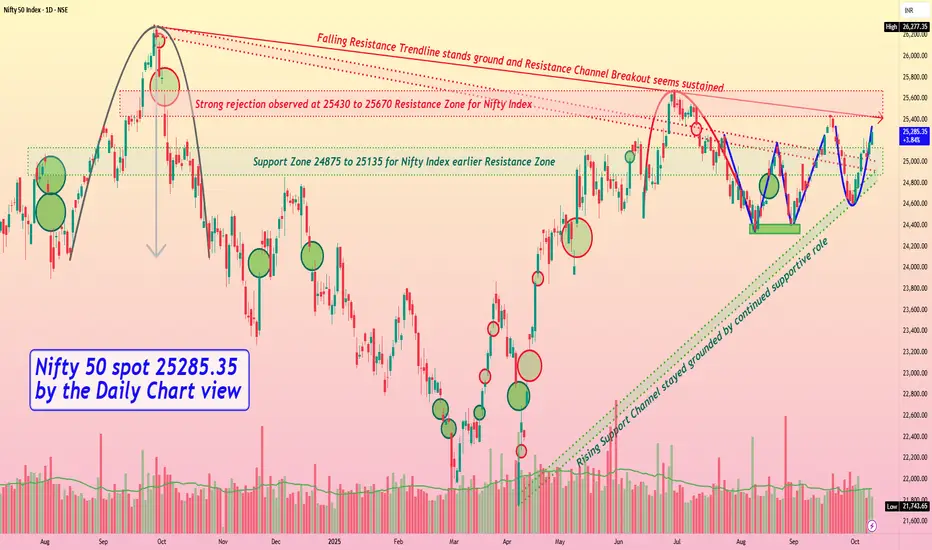
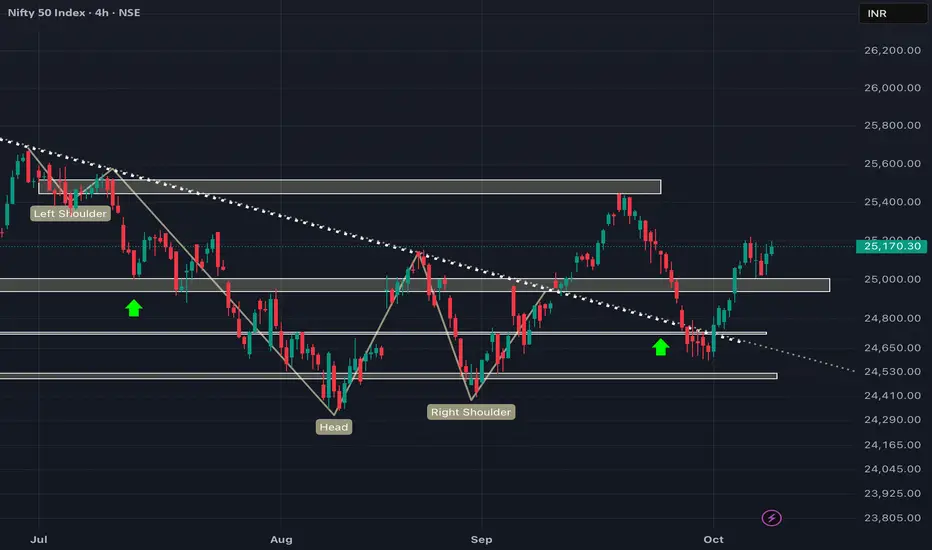
Nifty 50 spot 25285.35 by the Daily Chart view - Weekly updateNifty 50 spot 25285.35 by the Daily Chart view - Weekly update
- Support Zone 24875 to 25135 for Nifty Index earlier Resistance Zone
- Rising Support Channel stayed grounded by continued supportive role
- Strong rejection observed at 25430 to 25670 Resistance Zone for Nifty Index
- Falling Resistance Trendline stands ground and Resistance Channel Breakout seems sustained
- Bullish Technical patterns of "W" Double Bottom followed by Rounding Bottom formed around Support Zone
Trade ideas
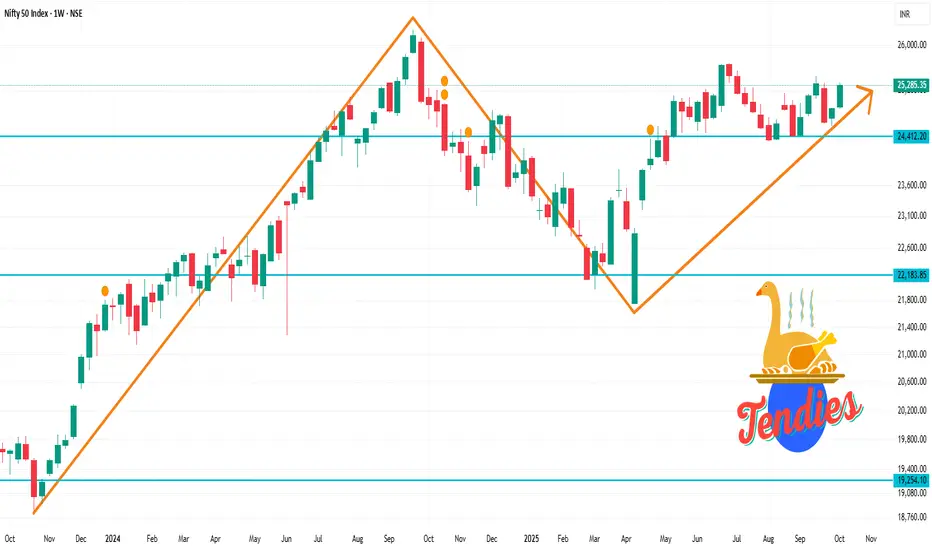
Nifty 50 1 Week time frame Key Technical Levels for the Week Ahead:
Resistance Levels:
25,000–25,100: This zone has been identified as a significant resistance area. A breakout above 25,100 could potentially lead to a rally towards 25,400.
Support Levels:
24,400–24,500: This range is considered a key support zone. A failure to hold above this level may indicate weakness in the index.
Analysts suggest that the Nifty 50 may trade within a defined range in the near term, with resistance expected around the 24,800 mark and strong support near the 200-day exponential moving average at 24,200.
Impact of US Federal Reserve Interest Rate on the Indian EconomyIntroduction
The United States Federal Reserve (commonly known as the Fed) plays a central role in shaping global monetary policy. As the world’s most influential central bank, the Fed’s decisions on interest rates have a ripple effect across global financial markets, influencing currencies, stock markets, trade flows, inflation, and investment decisions worldwide. For emerging economies like India, the impact of US Fed rate changes is particularly significant.
India, being a major developing economy with increasing integration into global markets, is deeply influenced by the movements of the US dollar, capital flows, and investor sentiment — all of which are affected by Fed policies. This relationship underscores how a rate hike or cut by the Fed can either strengthen or strain India’s financial stability, economic growth, and trade balance.
This essay explores how the US Federal Reserve’s interest rate policies affect the Indian economy in multiple dimensions — including the exchange rate, capital markets, inflation, foreign investments, trade, and monetary policy alignment — while also discussing historical trends, recent developments, and possible future scenarios.
Understanding the US Federal Reserve and Its Policy Decisions
The US Federal Reserve determines monetary policy primarily through three tools:
Federal Funds Rate: The benchmark interest rate at which banks lend to each other overnight.
Open Market Operations: Buying or selling government securities to control liquidity.
Reserve Requirements: The portion of deposits that banks must hold as reserves.
When the Fed raises interest rates, it aims to control inflation by making borrowing costlier, reducing consumption and investment in the US economy. Conversely, when it lowers rates, it stimulates economic growth by making credit cheaper.
However, since the US dollar is the world’s dominant reserve currency and global trade is largely denominated in dollars, these decisions extend far beyond the US borders. Emerging markets like India feel the heat (or benefit) almost immediately through movements in capital flows, exchange rates, and commodity prices.
Mechanism of Transmission to the Indian Economy
The Fed’s rate changes affect India through several interconnected channels:
Capital Flows:
Higher US interest rates attract investors to shift funds from emerging markets to the US for better returns. This leads to capital outflows from India, putting pressure on the rupee and Indian financial markets.
Exchange Rate Movements:
As foreign investors withdraw funds, the Indian Rupee (INR) tends to depreciate against the US Dollar (USD). This increases the cost of imports and can worsen India’s trade deficit.
Commodity Prices:
A stronger dollar generally leads to a decline in global commodity prices (such as oil and metals), which can both benefit and hurt India depending on the price elasticity and sectoral dependencies.
Inflationary Impact:
A weaker rupee makes imported goods (especially crude oil) more expensive, contributing to imported inflation.
Stock Market Reactions:
Rate hikes in the US often trigger foreign institutional investors (FIIs) to sell equities in emerging markets. This can cause short-term corrections or volatility in Indian markets.
Monetary Policy Coordination:
The Reserve Bank of India (RBI) often aligns its monetary stance with global trends to maintain stability. If the Fed tightens, the RBI may follow suit to prevent excessive capital flight.
Historical Perspective: Fed Rate Movements and India’s Response
1. The 2008 Global Financial Crisis and Aftermath:
After the 2008 crisis, the Fed reduced rates to near zero and introduced Quantitative Easing (QE) to infuse liquidity into the system. This led to an abundance of cheap money flowing into emerging economies, including India.
India witnessed strong capital inflows, a booming stock market, and currency appreciation during this period.
However, the excess liquidity also created inflationary pressures and asset bubbles.
2. The 2013 “Taper Tantrum”:
When the Fed announced plans to scale back QE, emerging markets faced sudden outflows. India’s rupee depreciated sharply — from around ₹55 to ₹68 per USD — and inflation spiked.
The RBI had to intervene by tightening monetary policy and using foreign exchange reserves to stabilize the rupee.
This episode demonstrated India’s vulnerability to Fed policy shifts.
3. The 2015–2018 Rate Hike Cycle:
The Fed gradually raised rates as the US economy recovered. India faced moderate outflows, but due to strong domestic fundamentals and stable inflation, it managed to withstand the shock better than in 2013.
4. The COVID-19 Pandemic (2020–2021):
During the pandemic, the Fed once again cut rates to near zero and launched massive stimulus programs. This led to large foreign inflows into Indian equity markets, boosting stock valuations and liquidity.
The Sensex and Nifty reached record highs, and the rupee stabilized despite the economic slowdown.
5. The 2022–2023 Rate Hike Cycle:
To combat post-pandemic inflation, the Fed aggressively raised rates. The impact on India was notable — capital outflows increased, the rupee depreciated to record lows near ₹83/USD, and inflationary pressures persisted.
RBI responded with its own rate hikes to maintain balance and defend the currency.
Impact on Key Sectors of the Indian Economy
1. Exchange Rate and External Sector:
The rupee’s value is directly influenced by Fed rate decisions. A stronger dollar reduces the attractiveness of the rupee, leading to depreciation. This has mixed effects:
Positive: Exports (like IT services and pharmaceuticals) become more competitive.
Negative: Imports (especially crude oil, electronics, and gold) become costlier, widening the current account deficit.
2. Inflation and Monetary Policy:
A weaker rupee increases the price of imported goods, pushing inflation higher. To counteract this, RBI may raise domestic interest rates — which can slow down growth and investment.
3. Stock and Bond Markets:
Foreign portfolio investors (FPIs) play a huge role in India’s financial markets.
When US rates rise, they tend to pull out investments from Indian equities and bonds, leading to volatility.
Conversely, when US rates fall, India often witnesses renewed FPI inflows.
4. Banking and Financial Sector:
Higher global rates influence the cost of borrowing for Indian companies with external debt. Firms with significant dollar-denominated loans face higher repayment burdens.
Banks with foreign liabilities may also experience tighter liquidity and reduced profitability.
5. Corporate and Consumer Borrowing:
If RBI raises rates in response to Fed hikes, domestic loan rates increase, affecting business expansion, real estate demand, and consumer spending.
Impact on Foreign Investments (FII and FDI)
Foreign Institutional Investors (FIIs):
FIIs are highly sensitive to interest rate differentials. A higher US yield reduces the relative attractiveness of Indian assets. Sudden outflows can lead to currency depreciation and market instability.
Foreign Direct Investment (FDI):
While FDI is more long-term and less sensitive to short-term rate movements, prolonged tightening cycles can still affect investor sentiment and the cost of capital for multinational corporations investing in India.
Trade Balance and Current Account Deficit (CAD)
When the dollar strengthens due to Fed hikes, India’s import bill rises, especially since the country imports over 80% of its crude oil requirements.
This worsens the Current Account Deficit (CAD), which in turn can pressure the rupee further.
Export-oriented sectors may benefit, but the overall impact on the trade balance is often negative due to high import dependency.
RBI’s Role in Managing the Spillover Effects
The Reserve Bank of India uses multiple strategies to mitigate the impact of Fed rate decisions:
Monetary Policy Adjustments: Aligning repo rate hikes or cuts to maintain interest rate parity and control inflation.
Forex Market Intervention: Selling or buying dollars from its reserves to manage rupee volatility.
Macroprudential Measures: Encouraging domestic capital formation and diversifying external borrowing.
Strengthening Foreign Exchange Reserves: India’s reserves (over $650 billion as of 2024) act as a buffer against external shocks.
Opportunities for India Amid Fed Tightening
While rate hikes pose challenges, they also present strategic opportunities:
Boost for Exporters: A weaker rupee improves export competitiveness.
Domestic Manufacturing Incentives: Costlier imports push local industries to enhance production capabilities under the Make in India initiative.
Long-term Stability: The RBI’s cautious approach helps build macroeconomic resilience and investor confidence.
Challenges Ahead
Despite policy resilience, India faces several ongoing challenges from Fed policy shifts:
Currency Volatility: Persistent depreciation pressures can erode investor confidence.
High Inflation Risk: Imported inflation through oil and commodities can strain household budgets.
Debt Servicing Costs: Higher global interest rates increase repayment costs for companies with external debt.
Portfolio Outflows: Unstable FII flows make Indian markets vulnerable to global risk sentiment.
Future Outlook
As global monetary policy gradually normalizes, India must navigate a complex environment of tightening liquidity, evolving inflation dynamics, and changing investor sentiment.
Short-term: Volatility in currency and equity markets may persist. RBI is likely to continue balancing growth and inflation through calibrated rate moves.
Medium-term: If India maintains fiscal discipline, deepens domestic capital markets, and enhances manufacturing, it can absorb external shocks more effectively.
Long-term: India’s growing economic strength, demographic advantage, and digital transformation position it to emerge as a resilient economy, even amid global monetary tightening cycles.
Conclusion
The US Federal Reserve’s interest rate decisions have profound implications for the Indian economy, influencing everything from currency value and inflation to capital flows and trade dynamics. While India cannot fully insulate itself from global shocks, prudent policy coordination between the RBI and the government has enabled the country to withstand past crises and build a stronger macroeconomic foundation.
Ultimately, the key lies in maintaining a balanced approach — fostering sustainable growth while safeguarding financial stability. As India continues to integrate into the global economy, understanding and anticipating the Fed’s moves will remain essential for policymakers, investors, and businesses alike.
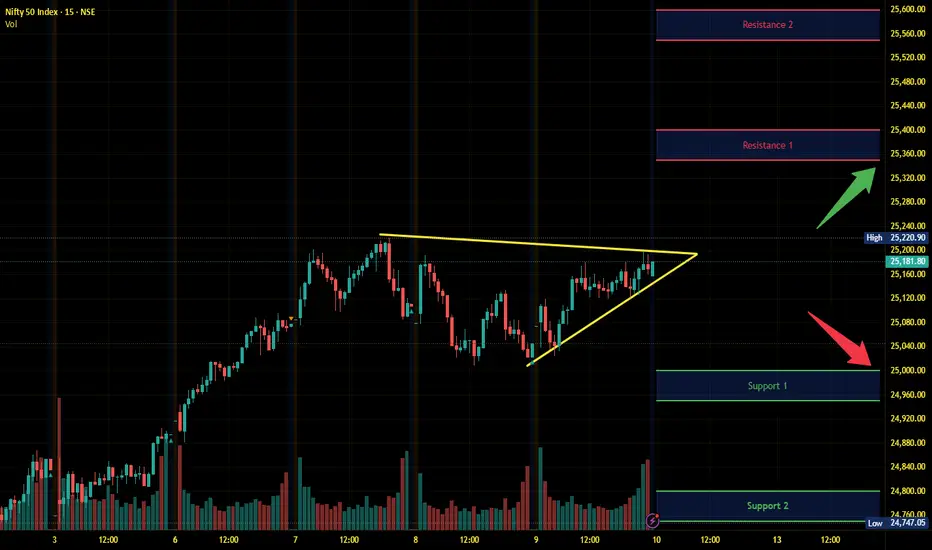
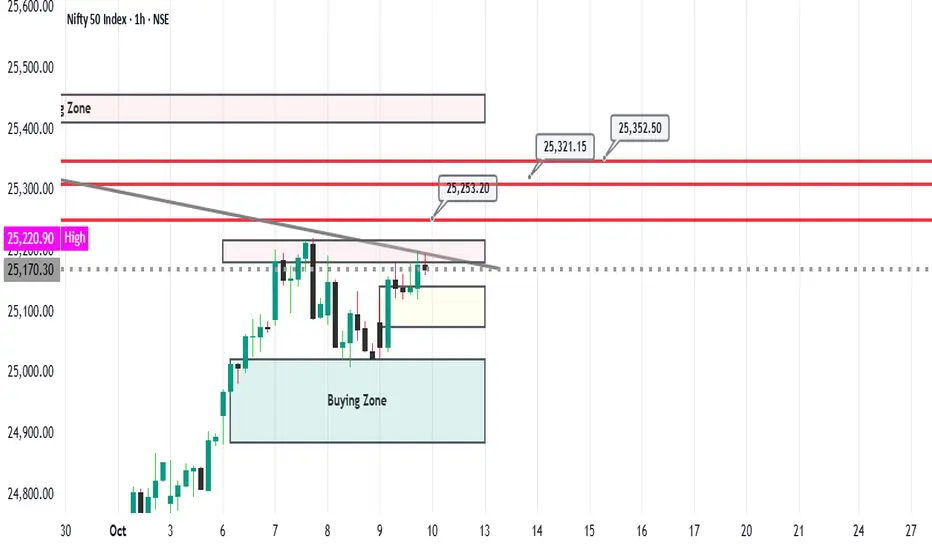
Nifty Intraday Analysis for 10th October 2025NSE:NIFTY
Index has resistance near 25350 – 25400 range and if index crosses and sustains above this level then may reach near 25550 – 25600 range.
Nifty has immediate support near 25000 – 24950 range and if this support is broken then index may tank near 24800 – 24750 range.
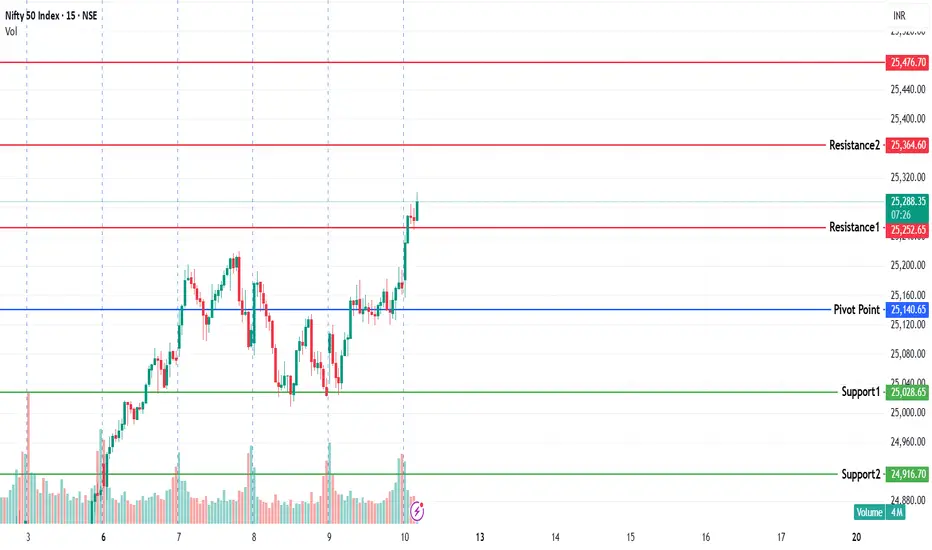
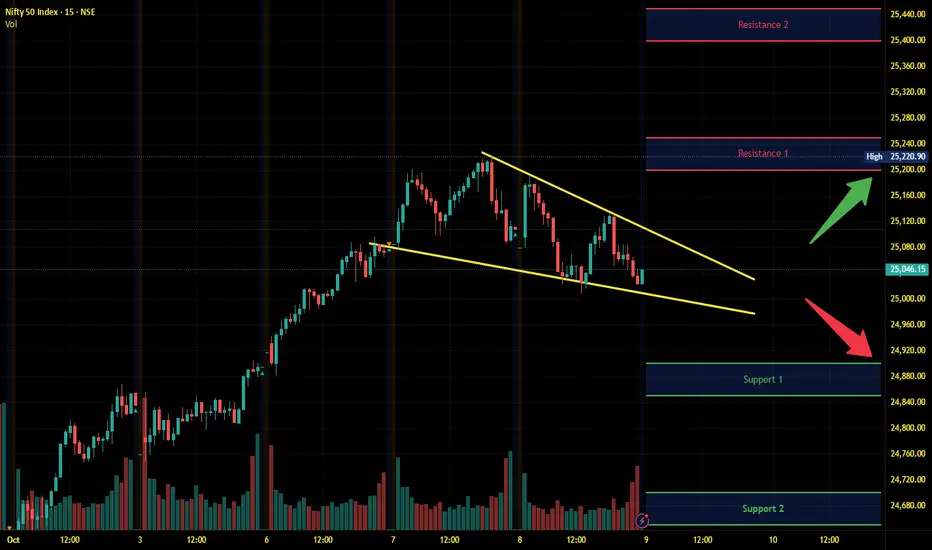
NIFTY KEY LEVELS FOR 10.10.2025NIFTY KEY LEVELS FOR 10.10.2025
Timeframe: 3 Minutes
If the candle stays above the pivot point, it is considered a bullish bias; if it remains below, it indicates a bearish bias. Price may reverse near Resistance 1 or Support 1. If it moves further, the next potential reversal zone is near Resistance 2 or Support 2. If these levels are also broken, we can expect the trend.
When a support or resistance level is broken, it often reverses its role; a broken resistance becomes the new support, and a broken support becomes the new resistance.
If the range(R2-S2) is narrow, the market may become volatile or trend strongly. If the range is wide, the market is more likely to remain sideways
please like and share my idea if you find it helpful
📢 Disclaimer
I am not a SEBI-registered financial adviser.
The information, views, and ideas shared here are purely for educational and informational purposes only. They are not intended as investment advice or a recommendation to buy, sell, or hold any financial instruments.
Please consult with your SEBI-registered financial advisor before making any trading or investment decisions.
Trading and investing in the stock market involves risk, and you should do your own research and analysis. You are solely responsible for any decisions made based on this research.
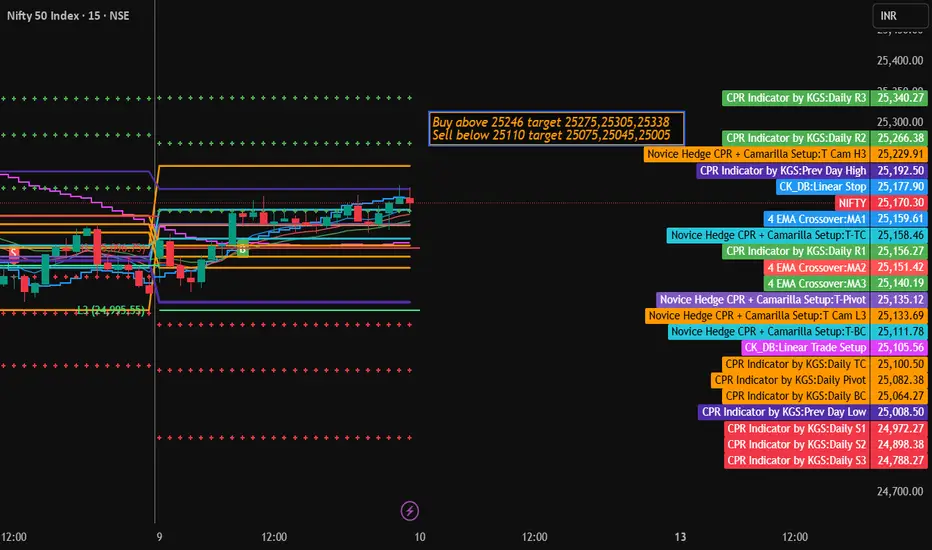
Nifty Trading Strategy for 10th October 2025📊 NIFTY Intraday Trading Plan
🟩 Buy Setup
Entry: Buy above the high of the 5-minute candle if the price closes above 25,246
Targets:
🎯 Target 1: 25,275
🎯 Target 2: 25,305
🎯 Target 3: 25,338
Stop Loss: Below the low of the breakout candle
🟥 Sell Setup
Entry: Sell below the low of the 15-minute candle if the price closes below 25,110
Targets:
🎯 Target 1: 25,075
🎯 Target 2: 25,045
🎯 Target 3: 25,005
Stop Loss: Above the high of the breakdown candle
⚙️ Trade Management Tips
Wait for a candle close confirmation before entering.
Avoid trading during high volatility news events.
Use strict risk management — never risk more than 1–2% of your capital on a single trade.
Trail stop-loss after each target hits to lock in profits.
⚠️ Disclaimer
📢 This analysis is for educational and informational purposes only.
💡 I am not a SEBI-registered analyst or advisor.
💼 Trading in stock markets involves risk. Please consult your financial advisor before taking any position.
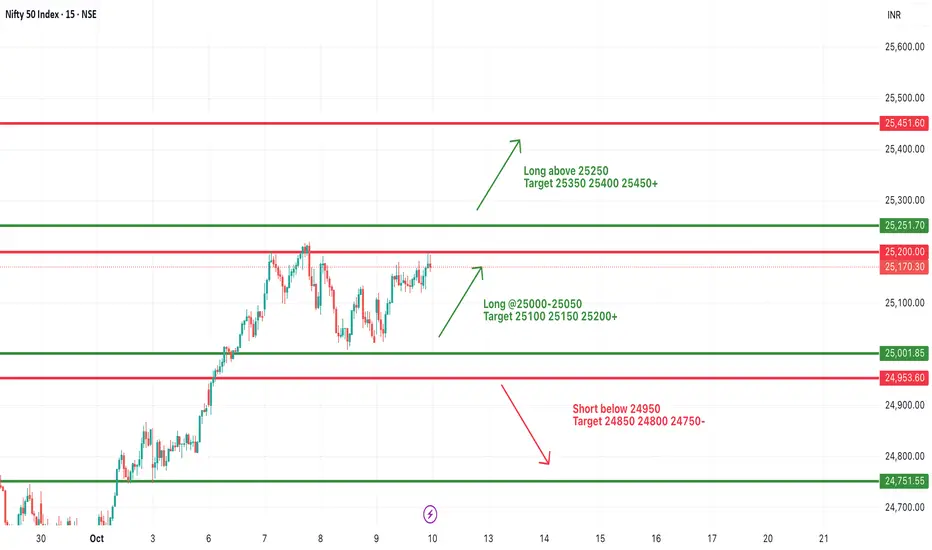
#NIFTY Intraday Support and Resistance Levels - 10/10/2025Nifty is expected to open flat around the 25,150–25,200 zone, indicating a neutral start after recent sessions of consolidation. The index is trading near a crucial resistance area, suggesting that traders may wait for a breakout before committing to fresh positions.
If Nifty sustains above 25,000–25,050, it can gradually move higher toward 25,100, 25,150, and 25,200 levels. A breakout above 25,250 will further strengthen the bullish momentum, paving the way for an extended rally toward 25,350–25,450+.
On the downside, immediate support lies near 24,950. A breakdown below this level may invite short-term selling pressure, pushing the index toward 24,850, 24,800, and 24,750-.
Overall, the sentiment remains range-bound with a slight bullish bias. Traders should wait for a confirmed move beyond 25,250 or below 24,950 for directional clarity, keeping strict stop-loss levels in place for intraday trades.
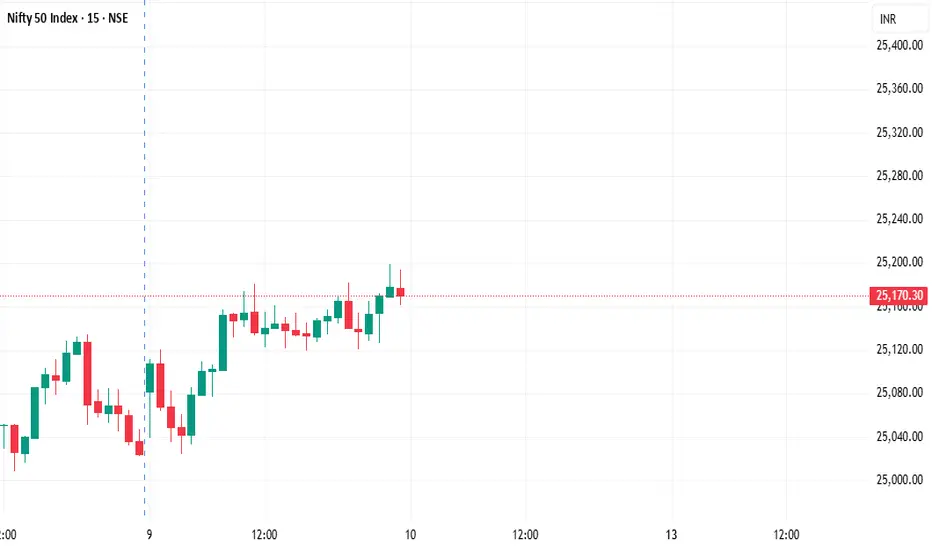
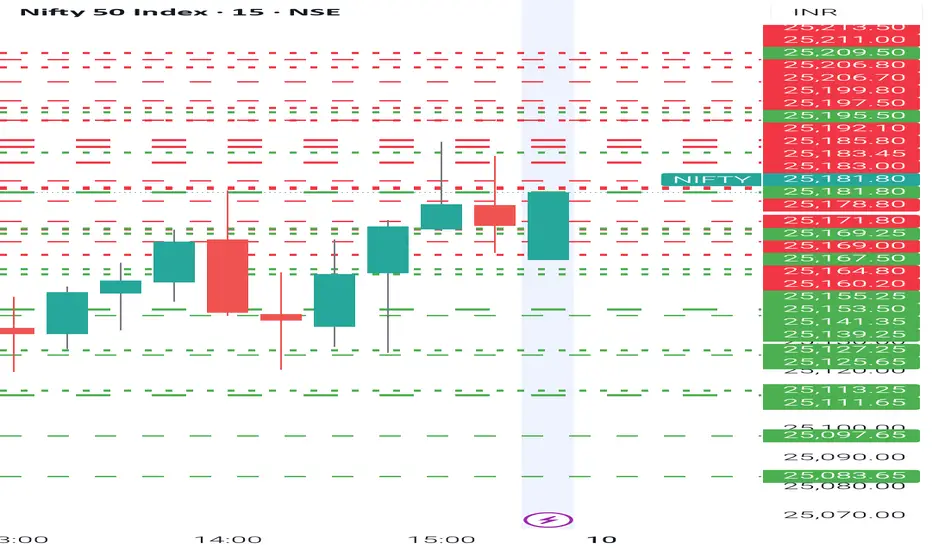
NIFTY Levels for Today
Here are the NIFTY's Levels for intraday (in the image below) today. Based on market movement, these levels can act as support, resistance or both.
Please consider these levels only if there is movement in index and 15m candle sustains at the given levels. The SL (Stop loss) for each BUY trade should be the previous RED candle below the given level. Similarly, the SL (Stop loss) for each SELL trade should be the previous GREEN candle above the given level.
Note: This idea and these levels are only for learning and educational purpose.
Your likes and boosts gives us motivation for continued learning and support.
Nifty Analysis - 10/10/25Market is bullish so look for CE trades. Buy on dip should be followed. On daily and hourly TF we see bullish trend. If we break trendline then we can go for CE with the targets mentioned above. Unless its a big gap down opening I do not see bearish trend on chart. Will update levels if anything unusual happens.
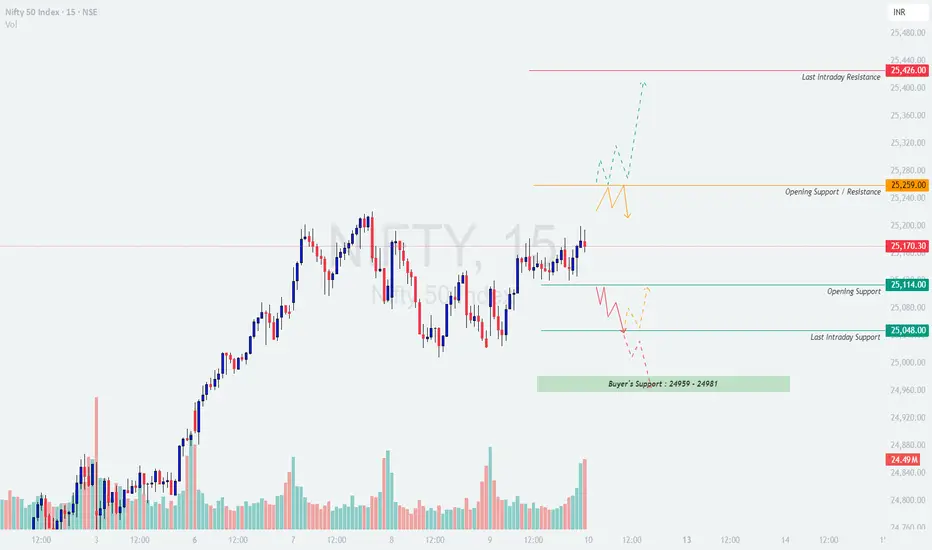
NIFTY : Trading levels and plan for 10-10-2025💼 NIFTY TRADING PLAN – 10-Oct-2025
📊 Chart Timeframe: 15-min
📍 Last Close: 25,170.30 | 🔻 Change: -7.40 pts (-0.03%)
📅 Analysis Based on Psychological & Technical Levels
🔍 Key Technical Zones
🟧 Opening Support / Resistance: 25,259
🟥 Last Intraday Resistance: 25,426
🟩 Opening Support: 25,114
🟢 Last Intraday Support: 25,048
💚 Buyer’s Support Zone: 24,959 – 24,981
🚀 Scenario 1 – Gap Up Opening (100+ pts above 25,270)
If Nifty opens near or above 25,270, it will directly approach the opening resistance zone.
A sustained move above 25,259 with strong green candles could trigger momentum buying toward 25,426, which is the last intraday resistance.
Avoid chasing the first 15 minutes — wait for a minor pullback to 25,259–25,280 and look for support confirmation before going long.
If Nifty fails to sustain above 25,259, expect short-term profit booking that can drag prices toward 25,170 or even 25,114.
Fresh shorts should be avoided until there’s a confirmed reversal candle near 25,400–25,426, as this area may trigger volatility and fake breakouts.]
🧠 Educational Insight:
Gap-up openings near resistance often create a “trap zone.” Patience is key — let the price test and confirm breakout strength before entering directional trades.
⚖️ Scenario 2 – Flat Opening (Around 25,150 ± 50 pts)
A flat start indicates market indecision and provides both long and short opportunities based on level reactions.
If the index sustains above 25,170–25,200, buyers may attempt to push prices toward 25,259 → 25,426. Watch for volume expansion to confirm momentum.
If Nifty rejects 25,259, expect a dip toward 25,114–25,048, which will act as short-term intraday supports.
Buyers can look for reversal confirmation from 25,048–25,114 zone for potential bounce trades.
A decisive hourly close below 25,048 may shift intraday trend bearish toward 24,981–24,959 (Buyer’s Support Zone).]
💡 Educational Note:
Flat openings favor disciplined traders who react to confirmation rather than prediction. Combining 15-min chart patterns with volume clues gives higher probability entries.
📉 Scenario 3 – Gap Down Opening (100+ pts below 25,060)
If Nifty opens around or below 25,060, it enters the support testing zone.
Monitor early reactions near 25,048–25,020. A quick recovery from this area can lead to a short-covering rally back toward 25,114–25,170.
If the index sustains below 25,020, expect a gradual slide toward the Buyer’s Support Zone (24,959–24,981) — a critical area where bulls might attempt to defend.
Failure to hold 24,959 could invite further downside toward 24,880–24,840, so avoid catching a falling knife without confirmation.
Intraday traders should prefer trading only on sustained 15-min candle closes below key levels to avoid whipsaws.]
🧠 Educational Insight:
Gap-down openings can trigger emotional decisions — let the first 30 minutes unfold before entering trades. Reversal setups are only valid with clear rejection wicks or bullish engulfing candles near key supports.
🛡️ Risk Management Tips for Options Traders
Limit trade exposure to 2–3% of total capital per trade.
Always use a stop loss based on 15-min candle close to avoid fake breakouts.
Prefer ATM or slightly ITM options for better delta and reduced time decay.
Avoid holding losing positions after 2:45 PM, as premium decay accelerates.
When volatility rises, use spreads (Bull Call / Bear Put) to manage theta and vega risk.
Never average losing trades — protect capital before chasing profit. 💎
📊 Summary & Conclusion
Nifty remains in a neutral-to-bullish structure, as long as it sustains above 25,048.
Upside momentum may resume only above 25,259, targeting 25,426.
A breakdown below 25,048 could shift control to sellers, pulling prices toward 24,981–24,959.
Traders should watch 15-min closing confirmations and volume expansion before taking directional positions.]
🎯 Focus Zone for 10-Oct-2025:
🟩 25,048 → 24,959 (Buyers’ Defensive Zone)
🟥 25,259 → 25,426 (Sellers’ Dominance Zone)
📢 Disclaimer:
I am not a SEBI-registered analyst . This analysis is purely for educational and informational purposes. Traders should perform their own due diligence or consult with a financial advisor before making trading decisions.
RETEST DONE!! Heading towards 25500 now! EXPLAINED!!NIFTY did showed strength exactly as analysed which was followed by a RETEST which can add fuel to the fire to the rally. We have also asked to BUY at important demand zones as we stood by our analysis. Now that it has also taken SUPPORT at important demand zone, we can expect NIFTY to continue its rally towards 25500 which is its next SUPPLY ZONE. So, keep watching and plan your trades accordingly.
“Nifty 50 Intraday Key Levels | Buy & Sell Zones 10th Oct 2025”“Want to learn more? Like this post and follow me!”
25390 🔴 Above 10m closing Shot Cover Level
Strong resistance — short covering likely above this.
25288 🟠 Below 10m hold PE By level /
Above 10m hold CE by level
25218 🟣 Above 10M hold positive trade view
Below 10M hold negative trade view
Sentiment deciding level — crucial for trend direction.
25090 ⚫ Above Opening S1 10m Hold CE By level
Bullish entry level — CE hold area.
25018 🟠 Below Opening R1 10m Hold PE By level
Below 10m hold PE By Risky Zone Weak zone — PE may strengthen below this.
24920🟢 Above 10M hold CE By Safe Zone level
Safe bullish zone — CE can be held confidently above.
24,4920 🔵 BELOW 10M hold UNWINDING level
Breakdown zone — unwinding or heavy selling possible below.
NIFTY- Intraday Levels - 10th October 2025Lot of near by levels, it hard to judge important levels when market is closed. I will try my best to judge the important levels. My views for tomorrow is sell on rise.
If NIFTY sustain above 25183/85 above this bullish then around 25192/99 then 25206/13 above this more bullish then around 25225/229 strong level and if it comes then watch for around 25252/275 or 25298/311 level above this wait
If NIFTY sustain below 25181/178 below this bearish around 25171/169/167 strong level if sustain below this more bearish 25155/153 then 24141/139 then 25113/11 or 25097/83 below this wait
Consider some buffer points in above levels.
Please do your due diligence before trading or investment.
**Disclaimer -
I am not a SEBI registered analyst or advisor. I does not represent or endorse the accuracy or reliability of any information, conversation, or content. Stock trading is inherently risky and the users agree to assume complete and full responsibility for the outcomes of all trading decisions that they make, including but not limited to loss of capital. None of these communications should be construed as an offer to buy or sell securities, nor advice to do so. The users understands and acknowledges that there is a very high risk involved in trading securities. By using this information, the user agrees that use of this information is entirely at their own risk.
Thank you.
Nifty Intraday Analysis for 09th October 2025NSE:NIFTY
Index has resistance near 25200 – 25250 range and if index crosses and sustains above this level then may reach near 25400 – 25450 range.
Nifty has immediate support near 24900 – 24850 range and if this support is broken then index may tank near 24700 – 24650 range.
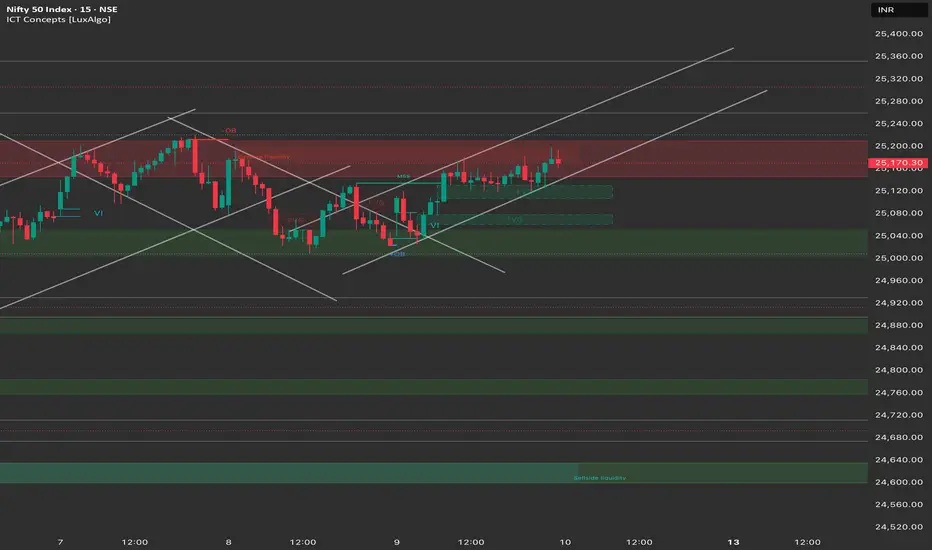
Nifty Structure Analysis & Trade Plan: 10th OctoberDetailed Market Structure Breakdown
4-Hour Chart (Macro Trend)
Structure: The Nifty is firmly in a bullish recovery phase. The selling pressure seen on Wednesday was a brief correction, which was quickly bought up. The price has reclaimed the 25,100 level and is moving strongly within a new, steep ascending channel. The rally is aggressive, suggesting large institutional buying (DIIs) is still active.
Key Levels:
Major Supply (Resistance): 25,250 - 25,350. This area is a critical supply zone and a short-term Order Block (OB). A clean breakout here would confirm the continuation towards the September high (25,450).
Major Demand (Support): 25,000 - 25,050. This area, which includes the psychological 25,000 mark and the lower boundary of the ascending channel, is the key support.
Outlook: The short-term bias is strongly bullish. The market is poised to challenge the 25,250 resistance.
1-Hour Chart (Intermediate View)
Structure: The 1H chart shows the market successfully defending the 25,000 support and resuming the upward trajectory. The strong closing candle (part of a bullish continuation pattern) confirms the end of Wednesday's short-term correction.
Key Levels:
Immediate Resistance: 25,250.
Immediate Support: 25,100 (Prior breakout level and a strong short-term support).
15-Minute Chart (Intraday View)
Structure: The 15M chart shows a clear Break of Structure (BOS) on the upside on Thursday. The index closed at the upper end of a consolidation range, setting up for a bullish opening. The strong close suggests momentum is favorable for continuation.
Key Levels:
Intraday Supply: 25,250.
Intraday Demand: 25,100 - 25,150.
Outlook: Strongly Bullish.
📈 Trade Plan (Friday, 10th October)
Market Outlook: The Nifty is showing strong underlying strength and is poised to challenge the next major resistance. TCS results were announced after market hours on Thursday and will be the main driver for IT stocks and the index at the open. The primary strategy will be to buy on continuation.
Bullish Scenario (Primary Plan)
Justification: The confirmed bullish reversal from 25,000 and the strong close near the highs suggest a continuation toward the next major supply zone.
Entry: Long entry on a decisive break and 15-minute candle close above 25,250.
Stop Loss (SL): Place a stop loss below 25,100 (below the immediate swing low/breakout level).
Targets:
T1: 25,350 (Major Order Block/Supply).
T2: 25,450 (Previous swing high).
Bearish Scenario (Counter-Trend Plan)
Justification: Only valid if TCS results are strongly negative or global cues cause a sharp rejection/gap down.
Trigger: A decisive break and 1-hour candle close below 25,000.
Entry: Short entry below 25,000.
Stop Loss (SL): Above 25,150.
Targets:
T1: 24,900 (Lower channel trendline).
T2: 24,800 (Major FVG support).
Key Levels for Observation:
Immediate Decision Point: 25,100 - 25,250 zone.
Bullish Confirmation: A break and sustained move above 25,250.
Bearish Warning: A move below 25,000 would suggest the bounce has failed.
Line in the Sand: 25,000. Below this level, the short-term bullish bias is nullified.
Daily Analysis Nifty: 09/10/25Longs have been booked with profits and keeping the volatility in mins, no carry forwards in Nifty is suggested.
A pullback is quite possible in the 24980-24960 range, which is not a change of the trend, per se.
The resistance range or bearish/pullback invalidation is above the 25150-25180 range.
Part 1 Ride The Big Moves Introduction to Options Trading
Options trading is one of the most fascinating and flexible instruments in the financial market. It allows traders and investors to speculate, hedge, and generate income — all from the same market tool.
An option is a financial derivative — meaning its value is derived from an underlying asset, such as stocks, indices, commodities, or currencies. Options are contracts that give the buyer the right, but not the obligation, to buy or sell an asset at a specific price (called the strike price) before or on a particular date (called the expiry date).
In essence, options trading helps investors control large positions with relatively smaller amounts of capital while limiting risk when used correctly.
Trading Gold and Cryptocurrency in the Indian Market1. Overview of Gold Trading in India
Gold has deep cultural and economic significance in India. It is widely used in jewelry, savings, and investment, making India one of the largest consumers of gold globally.
1.1 Forms of Gold Investment
In India, gold trading occurs in several forms:
Physical Gold – Jewelry, coins, and bars.
Gold ETFs (Exchange-Traded Funds) – Allow investors to buy units representing gold without physically holding it.
Sovereign Gold Bonds (SGBs) – Issued by the Reserve Bank of India (RBI), providing interest along with appreciation in gold price.
Futures and Options – Traded on the Multi Commodity Exchange (MCX), providing leveraged exposure.
1.2 Gold Trading Mechanics
Gold trading in India, especially in the futures market, involves contracts with standard weights (1 kg, 100 grams, etc.). Prices fluctuate based on domestic demand, international gold prices, USD/INR exchange rates, and geopolitical tensions. Traders can go long (buy) or short (sell), using leverage to maximize returns, though this increases risk.
1.3 Strategies in Gold Trading
Trend Trading: Identifying upward or downward trends in international or domestic gold prices and trading accordingly.
Hedging: Using gold futures to protect portfolios from inflation or currency depreciation.
Arbitrage: Exploiting price differences between spot markets, ETFs, and futures.
1.4 Risks and Considerations
Gold is influenced by global market volatility.
Leverage can magnify losses.
Liquidity in physical gold is higher, but online platforms provide faster execution.
2. Overview of Cryptocurrency Trading in India
Cryptocurrency trading in India is still evolving. Cryptos are digital or virtual currencies that operate on blockchain technology. The most popular are Bitcoin (BTC), Ethereum (ETH), Ripple (XRP), and several altcoins.
2.1 Cryptocurrency Market in India
India has seen explosive growth in cryptocurrency adoption over the last few years. Exchanges like WazirX, CoinDCX, and ZebPay provide platforms for trading Bitcoin and other digital assets. Trading can occur in:
Spot Market: Buying and selling cryptocurrencies at current market prices.
Futures Market: Contracts allowing traders to speculate on future prices.
Margin Trading: Trading using borrowed funds to amplify gains (and risks).
2.2 Regulatory Landscape
Cryptocurrency regulations in India remain in flux:
RBI Restrictions: Previously, banks were restricted from providing services to crypto exchanges, but this has eased after Supreme Court intervention.
Taxation: Cryptocurrency gains are taxed at 30%, with a 1% TDS on transactions above a certain threshold.
Legal Status: Cryptos are legal to trade but not recognized as legal tender.
2.3 Strategies for Crypto Trading
Day Trading: Taking advantage of intraday volatility to make profits.
Swing Trading: Capitalizing on medium-term trends lasting days or weeks.
HODLing: Long-term holding based on belief in price appreciation.
Arbitrage: Exploiting price differences across exchanges.
2.4 Risks and Considerations
Cryptocurrencies are highly volatile; prices can swing 10-20% within hours.
Exchanges may face liquidity or security issues.
Regulatory changes can significantly impact prices.
3. Trading Platforms in India
3.1 Gold Trading Platforms
MCX (Multi Commodity Exchange): Futures and options.
Stock Broker Platforms: Zerodha, Upstox, ICICI Direct provide access to ETFs and SGBs.
Banks and Post Offices: For Sovereign Gold Bonds and physical gold.
3.2 Crypto Trading Platforms
WazirX: Popular for beginners with simple UI.
CoinDCX: Offers derivatives trading and margin facilities.
ZebPay: Secure platform with various coins available.
International Platforms: Binance and Kraken for Indian residents (with caution on regulations).
4. Technical and Fundamental Analysis
4.1 Gold
Technical Analysis: Uses price charts, trendlines, moving averages, and RSI to predict price movements.
Fundamental Analysis: Considers inflation rates, global demand, central bank policies, and geopolitical events.
4.2 Cryptocurrency
Technical Analysis: Chart patterns, candlestick formations, MACD, Bollinger Bands, and volume analysis.
Fundamental Analysis: Blockchain adoption, regulatory news, network updates, and market sentiment.
5. Risk Management
5.1 Gold
Diversify between physical gold, ETFs, and futures.
Limit leverage to avoid margin calls.
Monitor global gold prices and USD/INR movements.
5.2 Cryptocurrency
Trade only with capital you can afford to lose.
Use stop-loss orders to minimize losses.
Keep funds in secure wallets rather than exchanges for long-term holding.
Diversify across coins to spread risk.
6. Future Outlook
6.1 Gold
Gold will remain a core part of Indian investment due to cultural affinity and inflation hedging.
Global uncertainties, such as currency devaluation or geopolitical tensions, can drive prices higher.
6.2 Cryptocurrency
Adoption is expected to rise as digital literacy grows.
Regulations will play a pivotal role in shaping market stability.
Potential for blockchain-based applications beyond trading, including NFTs, DeFi, and metaverse assets.
Conclusion
Trading gold and cryptocurrencies in India offers unique opportunities for portfolio diversification. Gold provides stability and hedging against inflation, while cryptocurrencies offer potential high returns at higher risk. Success in both markets requires understanding the instruments, staying updated with global and domestic trends, employing technical and fundamental analysis, and practicing disciplined risk management.
Indian traders now have access to sophisticated platforms and instruments that enable both short-term speculation and long-term investment. Combining gold and cryptocurrencies strategically can help investors achieve a balance of security, growth, and speculative gains, ensuring a resilient and profitable portfolio in a rapidly evolving financial landscape.
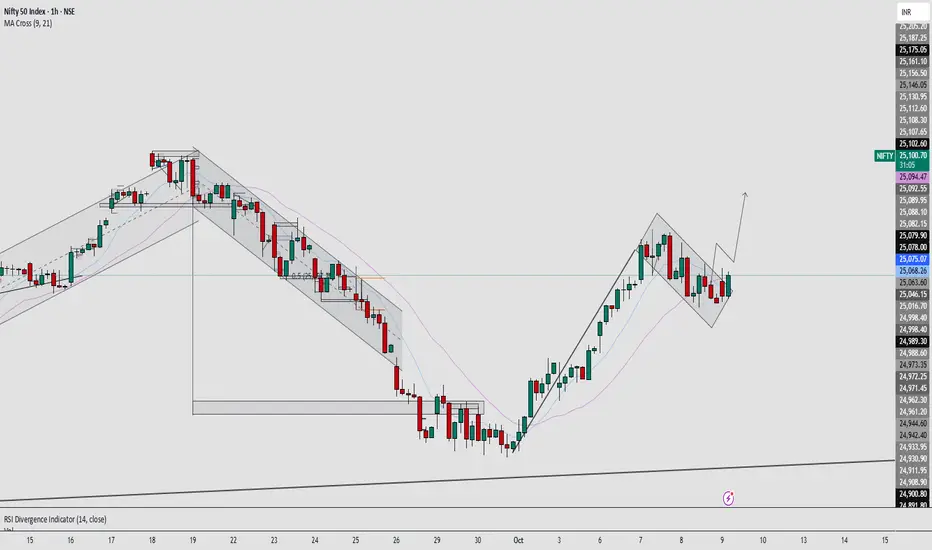
NIFTY 50 – Bullish Flag Breakout in Progress | Continuation NIFTY 50 is showing a clean bullish flag breakout on the 1H chart after a strong impulsive leg from recent lows.
This consolidation phase acted as a flag correction, where price stayed within a downward-sloping channel before breaking to the upside.
The breakout suggests a continuation of the existing uptrend , supported by price closing above the EMA cluster and reclaiming short-term momentum.
Key Observations:
🚀 Impulsive bullish rally followed by tight flag formation.
🔹 Breakout candle confirming strength above 25,080 zone.
📈 If momentum sustains, next upside targets are 25,180 → 25,250 → 25,300.
⚠️ Invalid if price falls back below 25,05 0 with strong volume.
NIFTY breaking out from a bullish flag pattern 🚀
Continuation setup in play after a strong impulse move.
🔹 Above 25,080 = bullish
🔹 Targets: 25,180 / 25,250 / 25,300
🔹 Invalidation: below 25,050
#NIFTY #PriceAction #Breakout #BullishFlag #TechnicalAnalysis #HenishMavani
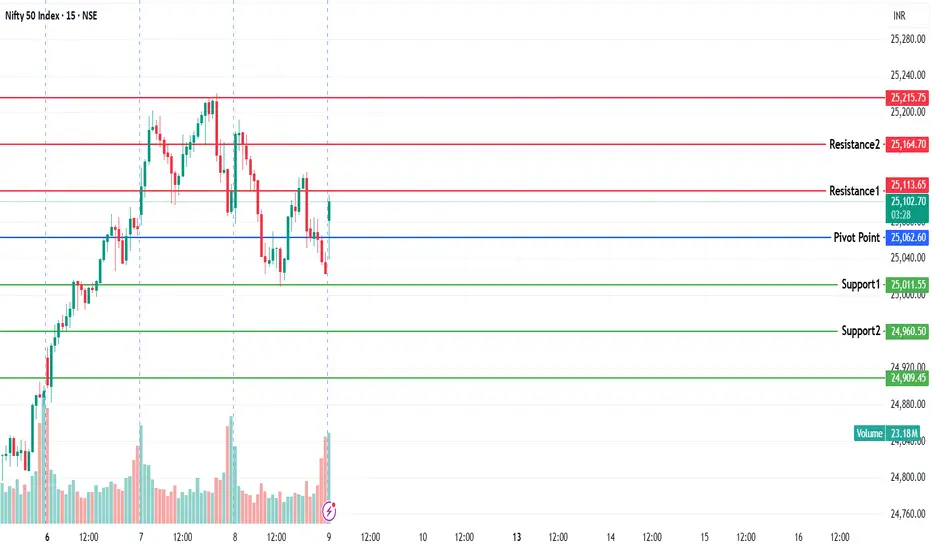
NIFTY KEY LEVELS FOR 09.10.2025NIFTY KEY LEVELS FOR 09.10.2025
Timeframe: 3 Minutes
If the candle stays above the pivot point, it is considered a bullish bias; if it remains below, it indicates a bearish bias. Price may reverse near Resistance 1 or Support 1. If it moves further, the next potential reversal zone is near Resistance 2 or Support 2. If these levels are also broken, we can expect the trend.
When a support or resistance level is broken, it often reverses its role; a broken resistance becomes the new support, and a broken support becomes the new resistance.
If the range(R2-S2) is narrow, the market may become volatile or trend strongly. If the range is wide, the market is more likely to remain sideways
please like and share my idea if you find it helpful
📢 Disclaimer
I am not a SEBI-registered financial adviser.
The information, views, and ideas shared here are purely for educational and informational purposes only. They are not intended as investment advice or a recommendation to buy, sell, or hold any financial instruments.
Please consult with your SEBI-registered financial advisor before making any trading or investment decisions.
Trading and investing in the stock market involves risk, and you should do your own research and analysis. You are solely responsible for any decisions made based on this research.