Part 5 Best Trading Strategies Simple Example to Understand
Scenario
Nifty at 21500
You expect it to go to 21650.
Call Option Buy
Buy 21500 CE
If Nifty moves up → premium increases → profit
If Nifty falls → premium collapses → loss
Put Option Buy
Not useful in this scenario
Option Seller’s View
If seller expects market t
S&P 500 Index
No trades
About S&P 500 Index
Standard & Poor’s 500 is an American stock market index consisting of 500 large companies having common stock listed on the NYSE or NASDAQ and their market capitalizations. It captures approximately 80% coverage of available market capitalization. Because it includes both growth stocks and value stocks it is one of the most followed equity indices and is considered to be one of the best representations of the U.S. stock market and a trend indicator for the U.S. economy. S&P introduced its first index in 1923 and its present day form on March 4,1957. It was developed and continues to maintained by S&P Dow Jones Indices, a joint venture majority owned by McGraw Hill Financial.
Part 4 Institutional VS. Technical1. Delta
Measures how much the premium changes with a ₹1 move in the underlying.
Call delta: +0.0 to +1.0
Put delta: –0.0 to –1.0
High delta = faster premium movement.
2. Gamma
Measures how fast delta changes. Used to evaluate momentum and risk.
3. Theta
Measures time decay—how much premium
Equity Market Trends: An In-Depth Analysis1. Defining Equity Market Trends
At its core, an equity market trend refers to the general direction in which stock prices move over a period. These trends can be upward (bullish), downward (bearish), or sideways (neutral/consolidation). Bullish trends indicate sustained buying pressure, reflecting
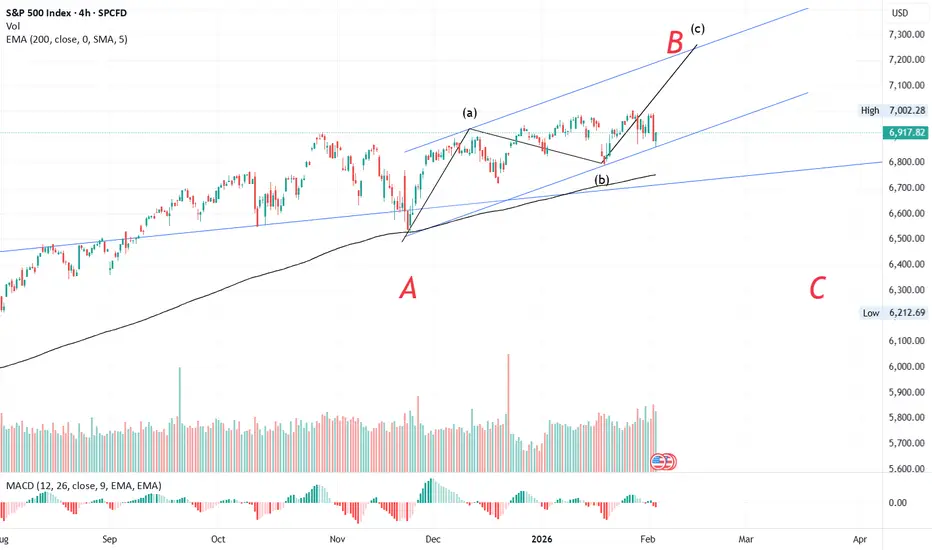
S&P 500: Late-Stage Structure Worth WatchingThe S&P 500’s recent advance is showing overlapping price action and narrowing ranges , raising the possibility of a developing Ending Diagonal near the highs.
Internally, the move lacks impulsive strength , with Wave (v) struggling for follow-through and RSI hovering around the mid-50s, sugg
Part 2 Technical VS. Institutional Common Options Trading Strategies
Options trading is not limited to buying calls and puts. Some widely used strategies include:
Covered Call: Holding a stock and selling a call option to earn premium income.
Protective Put: Buying a put option to protect a stock holding from downside risk.
Strad
Is this a Top in US500 Bearish Divergence + Rising WedgeThe US500 is forming higher highs in price, while the RSI is showing a clear bearish divergence, failing to confirm the move and indicating weakening momentum. Additionally, the price action is developing a rising wedge pattern, which typically signals exhaustion. A decisive close below the lows of
Part 11 Trading Master Class With Experts What Are Options?
Options are derivative contracts, meaning their value is derived from an underlying asset such as:
Stocks
Index (Nifty, Bank Nifty)
Commodities (Gold, Crude)
Currency pairs
ETFs
An option gives the buyer the right, but not the obligation, to buy or sell the underlying asset
SPY - Hope it tops this time :)US markets have been super resilient, sucking capital from across the world.
We have a good pattern in place, as the triggers for pushing the market up have been reducing with time, with everything running quite thin.
The rally has been quite low on breadth and is supported on weak pillars - but st
See all ideas
Displays a symbol's value movements over previous years to identify recurring trends.
Frequently Asked Questions
S&P 500 Index reached its highest quote on Jan 28, 2026 — 7,013.7 USD. See more data on the S&P 500 Index chart.
The lowest ever quote of S&P 500 Index is 665.6 USD. It was reached on Mar 6, 2009. See more data on the S&P 500 Index chart.
S&P 500 Index is just a number that lets you track performance of the instruments comprising the index, so you can't invest in it directly. But you can buy S&P 500 Index futures or funds or invest in its components.