Beyond Technical Analysis
Part 7 Trading Master Class With Experts Non-Directional Strategies
Used when markets are expected to be sideways or volatile.
1. Straddle (Buy Call + Buy Put)
Profit from high volatility in any direction.
2. Strangle
Cheaper version of straddle, using OTM options.
3. Iron Condor
Sell OTM call and put spreads.
Used for stable markets to earn premium.
4. Butterfly Spread
Low-cost strategy for low volatility expectations.
These strategies help traders benefit from volatility, time decay, and neutral price movements.
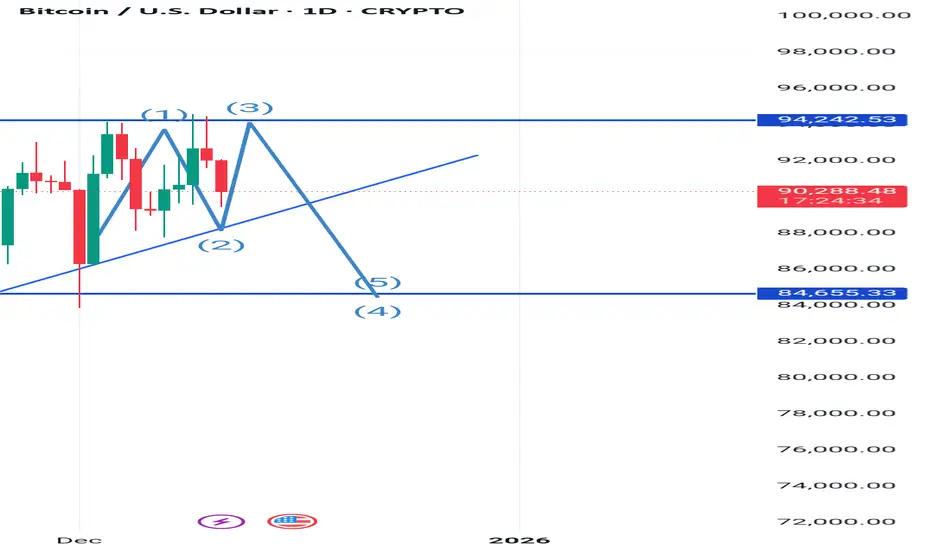
BTC # Bitcoin Free fall still pending....Here as per critical box range trading btc bitcoin can free fall if it breaks below . And ot will try to sweep stoplosses of previous weekly low. As marked in chart you can notice this easily that how btc can free fall to hunt more stop losses.
So trade accordingly to see weather it only hunts stop losses and reverses or it will take a continuous fall.
Earnings Season Trading1. What Makes Earnings Season Important?
Earnings reports reveal the true financial health of a company. This data often contradicts or validates market expectations built over the previous quarter. When results surprise on the upside or downside, stocks can react with sudden gaps, breakouts, or reversals. Because these results directly influence valuation metrics like P/E ratio, growth trajectory, and forward guidance, institutions and retail traders adjust their positions, creating volatility.
Additionally, the commentary provided during earnings calls—about demand trends, inflationary pressures, capex plans, and future growth—shapes market sentiment for weeks or months. Sectors such as banking, IT, pharmaceuticals, autos, and FMCG often show correlated moves during earnings, offering broader index-level opportunities.
2. Key Components of an Earnings Report
To trade earnings effectively, you must understand the elements of the quarterly report:
a. Revenue (Top Line)
Measures the total sales generated. Higher-than-expected revenue indicates strong demand.
b. Net Profit / EPS (Bottom Line)
Earnings per share (EPS) is the most watched metric. A beat or miss relative to analysts’ expectations heavily influences stock reactions.
c. Operating Margins
Margin expansion or contraction shows pricing power, cost control, and business efficiency. For some sectors—like FMCG or metals—margins matter more than revenue.
d. Guidance
Future expectations provided by management. Often, guidance has more impact than the current quarter’s results because markets are forward-looking.
e. Commentary
Insights on economic conditions, demand trends, and risks can swing sentiment quickly.
Understanding these elements helps traders anticipate market reaction better.
3. Why Stocks Move So Much During Earnings?
Stocks move based on:
a. Expectation vs Reality
Markets don’t move on results alone—they move on surprises.
Positive surprise → strong rally
Negative surprise → sharp fall
In-line results → muted reaction or volatility fade
b. Market Sentiment
Even a positive result can lead to selling if the stock had already run up before earnings. This is called “buy the rumour, sell the news.”
c. Options Positioning
Options traders often take hedged positions before earnings. When implied volatility (IV) collapses after results, this can create large directional moves, especially in stocks like Apple, Google, Infosys, Reliance, or HDFC Bank.
d. Institutional Flows
Big players re-balance their portfolios based on earnings quality, driving big price swings.
4. Trading Strategies During Earnings Season
Earnings season offers multiple profitable strategies, but each comes with specific risks. Here are the most effective ones:
**1. Pre-Earnings Momentum Trading
Some stocks show clear directional movement as earnings approach.
If sentiment is bullish and analysts expect a beat, stock may rise before results.
Conversely, if the company already warned of weak numbers, traders short it before earnings.
But this strategy is risky—the stock can gap against you post-results.
**2. Trading Earnings Gaps
Once results are released, stocks often open with big gap ups or gap downs. Traders look for:
Gap continuation (if stock breaks above or below resistance convincingly)
Gap fading (if the reaction seems exaggerated)
For example:
A stock gaps up 10% on fantastic results but immediately fails to hold levels → short opportunity.
**3. Post-Earnings Trend Trading
The safest earnings strategy. Instead of gambling on the announcement, traders wait for the results to come out and trade the trend that follows.
If results are strong and stock sustains above key levels, you enter long and ride the trend for days or weeks.
Advantages:
No overnight risk
You trade based on confirmed data
Institutional flow supports the move
**4. Options Trading – Implied Volatility Play
Earnings season sees a spike in IV. After results, IV collapses sharply (IV crush).
Strategies to use:
Straddles / Strangles before earnings (for expected big move)
Iron condors (if expecting limited movement)
Post-earnings debit spreads (lower IV = cheaper premium)
Options trading around earnings is powerful but requires skill and risk-management.
5. Risk Management During Earnings Trading
Earnings season is profitable but risky. Here are essential risk-control rules:
a. Avoid Overleveraging
Extreme volatility can wipe out leveraged positions instantly.
b. Use Stop-Loss Orders
Volatility spikes can trap traders in losing trades. SLs protect capital.
c. Position Sizing
Limit exposure to a single stock to 2–5% of portfolio during earnings week.
d. Never Hold a Large Position Overnight
Unexpected results can cause massive gaps.
e. Analyze Sector Trends
If the entire sector is weak, even good results may not lead to big rallies.
6. Fundamental and Technical Tools for Earnings Trading
Fundamental Tools
Analyst estimates (Bloomberg, Reuters)
YoY and QoQ performance trends
Management guidance
Peer performance
Macro environment (inflation, interest rates, global cues)
Technical Tools
Support and resistance levels
Volume analysis
Gap trading indicators
RSI, MACD, ADX for momentum
Candlestick signals around results
Combining both technical and fundamental analysis gives a competitive edge.
7. How Institutions Trade Earnings
Institutional investors like FIIs, DIIs, and mutual funds:
Focus more on long-term guidance than short-term results
Increase positions in companies showing stable margin improvement
Reduce positions if management commentary signals future weakness
Hedge through index options rather than individual stocks
Understanding institutional behavior helps predict sustained trends.
8. Common Mistakes Traders Should Avoid
• Gambling on earnings direction
Predicting results is risky; avoid blindly holding through results.
• Ignoring guidance
Even excellent results can cause a fall if forward guidance is weak.
• Trading too many stocks at once
Focus on high-liquidity names only.
• Not checking macro events
Inflation data, Fed meetings, RBI policy can overpower earnings impact.
Conclusion
Earnings season is a golden period for traders, packed with volatility, opportunity, and market-shaping trends. To trade successfully, it’s essential to understand the relationship between expectations and outcomes, interpret earnings reports correctly, and apply robust risk-management techniques. The best approach is a balanced one—avoiding excessive risk while taking advantage of clear post-earnings trends. When executed well, earnings season trading can significantly boost your returns and provide valuable insights into market behavior.
Nifty & Bank Nifty Options Trading1. Understanding Nifty & Bank Nifty as Option Underlyings
Nifty 50
A diversified index covering 13 sectors, representing India’s overall equity market.
Lower volatility compared to Bank Nifty
Stable and predictable movements
Preferred by positional traders and institutional hedgers
Bank Nifty
Composed of major banking stocks, highly sensitive to interest rates, RBI actions, liquidity flows, and global banking events.
Extremely high volatility
Fast intraday swings (frequently 300–700 points in a day)
Preferred by aggressive intraday option buyers and advanced traders
Liquidity in both instruments is extremely high, making them ideal for buying and selling options.
2. How Index Options Work
Option Types
You deal with two primary instruments:
Call Options (CE) – You profit when the index goes up
Put Options (PE) – You profit when the index goes down
Expiry Cycles
Both Nifty and Bank Nifty have:
Weekly expiry
Monthly expiry
Quarterly (some strikes)
Bank Nifty earlier had only weekly expiry on Thursday, but now expiries rotate due to SEBI’s rules. Nifty expires every Thursday as usual (unless it is a trading holiday).
Lot Sizes
Nifty lot size: typically 50 units
Bank Nifty lot size: typically 15 units
(These vary slightly during periodic revisions.)
3. Pricing Dynamics: Why Option Premiums Move
Option premiums are governed by:
i. Intrinsic Value
The real, quantifiable value.
CE intrinsic value = Spot price – Strike
PE intrinsic value = Strike – Spot
ii. Time Value (Theta)
Time value decreases as expiry comes closer.
Buyers get hurt by theta decay
Sellers benefit from theta decay
Bank Nifty has rapid intraday time decay, so sellers often dominate.
iii. Volatility (Vega)
Bank Nifty has higher volatility, meaning:
Higher premiums
Larger impact of news
Bigger risk and reward potential
iv. Delta
Measures how quickly the premium moves with respect to the index.
Example:
Delta 0.50 → Option moves 50% of index move
ATM options typically have delta ~0.5
Bank Nifty deltas shift faster due to rapid price movement.
4. Why Nifty & Bank Nifty Are Perfect for Options Trading
1. Deep liquidity
Instant order execution, tight spreads.
2. Weekly expiries
Fast premium decay → perfect for option sellers
Low cost → attractive for option buyers
3. High volatility (Bank Nifty)
Good for intraday scalping.
4. Large participation
FIIs, DIIs, proprietary desks, retail traders provide continuous order flow.
5. Common Trading Styles
A. Option Buying
Best for:
Trending markets
Breakout strategies
Intraday volatility plays
Pros:
Limited risk (premium paid)
High returns when market trends strongly
Cons:
Theta decay kills slow markets
Needs precise timing and direction
Bank Nifty is favored by buyers due to sudden moves.
B. Option Selling
Best for:
Range-bound markets
High probability income
Weekly expiry trading
Pros:
Higher win-rate
Time decay works in seller’s favor
Cons:
Potential for large losses if market trends
Must use hedging
Nifty is preferred by conservative sellers due to calmer moves.
Bank Nifty selling is profitable but demands skill and hedging discipline.
6. Key Strategies Used in Nifty & Bank Nifty
1. ATM/ITM Scalping (Intraday)
Used for 1–3 minute charts.
Buyers use fast entries on breakouts; sellers sell on reversals.
2. Straddles
Sell ATM CE + ATM PE.
Ideal when expecting low volatility.
Highly used on:
Expiry days
Fridays in monthly series
3. Strangles
Sell OTM CE + OTM PE.
Safer than straddles, with wider breathing space.
4. Credit Spreads
Bear call spread
Bull put spread
Controlled-risk selling strategies.
5. Iron Condor
For sideways markets with limited risk.
6. Directional Option Buying
Buyers typically look for:
Trendline breakouts
VWAP bounces
CPR (Central Pivot Range) breakout
Previous day high/low rejection
Bank Nifty gives the best directional follow-through.
7. Hedge-Based Positional Trades
Nifty traders often hold:
Bull Call Spreads
Bear Put Spreads
Calendar spreads
for monthly swings.
7. Expiry Day Dynamics
Expiry days (especially Thursday) are unique:
For Nifty & Bank Nifty
Accelerated theta decay
Frequent stop-hunt wicks
Sudden option premium collapse
Wild moves in the last 30 minutes
Scalpers thrive; beginners get trapped.
Option selling is usually profitable on expiry days, but only if:
You hedge
You manage risk
You avoid naked selling
Option buying works only during big directional moves or volatility spikes.
8. Risk Management (Non-Negotiable)
Without risk management, Nifty & Bank Nifty options will punish you. Follow these guidelines:
1. Use Stop-Loss Always
Options move insanely fast.
Bank Nifty can wipe out capital in minutes.
2. Never Sell Naked Options
Unhedged selling can cause large losses.
3. Control Position Size
Risk per trade should not exceed:
1–2% of capital (positional)
0.5–1% (intraday)
4. Avoid Overtrading
Chasing every move is a losing habit.
5. Understand News Events
Avoid trading near:
RBI policy
Budget
FOMC
Inflation data
Major geopolitical news
These events create sudden spikes.
9. Psychological Discipline
Options trading is 70% psychology.
Don’t chase runaway premiums
Don’t revenge trade
Don’t hold losing trades hoping they “come back”
Don’t keep adding to a losing position
If you can stay calm during fast index swings, you will trade better than most participants.
10. Final Practical Advice
I’ll be direct with you—Nifty & Bank Nifty options can help you grow your capital fast only if you learn structured trading. Otherwise, they can drain your account.
Here’s the right mindset:
Learn the basics thoroughly
Trade small and build skill
Specialize in one or two strategies
Stick to charts, not emotions
Think like a risk manager first, trader second
If you invest time in practice and discipline, index options can become your strongest trading edge.
BTC vs DXY – Critical Support Retest as Dollar StrengthensBitcoin is currently testing a key weekly support zone while the U.S. Dollar Index (DXY) continues to show strength. This is a classic inverse-correlation moment in the market.
🔹 BTC Analysis
Price has pulled back into a major support zone highlighted on the chart.
The ascending long-term trendline has also been touched.
This zone is a crucial decision area:
Hold → potential continuation toward 100k–120k
Break → deeper drop toward the red support zone below (70k–75k)
The market is reacting sharply here, indicating large-player interest.
🔹 DXY Analysis
The Dollar Index is showing renewed bullish momentum.
Price is moving up from its recent lows and pressing into a resistance/liquidity zone.
Historically, a rising dollar puts pressure on Bitcoin and risk assets.
🔹 Correlation Outlook
If DXY continues upward → BTC may struggle or retrace deeper.
If DXY gets rejected at resistance → BTC may bounce strongly from current support.
🔹 My Outlook
At the moment, BTC is at a make-or-break level.
I'm watching:
Support around the trendline
Reaction to the red zone below
DXY’s continuation or rejection at resistance
A confirmed bounce from here could send BTC toward new highs, but a break below this support would open the door for a larger correction.
Let the price action decide — this zone is where big moves begin.
Nifty Technical view 21-11-2025
- Market open gap down, wait for price action.
- Took sell side trade after IRL breakdown, but there
was a trap. hit stoploss.
- wait for price traded premium zone OR break IRH.
- After 13:05 market form FTC , took sell side trade . wait with 38+ points.
-Market retest again and form a DT. took sell side trade and got good return. took trade with RSI combination to confirm bearish divergence.
thats it for today.
Gold Drops to 4050 – Testing a Key Support Zone📊 Market Overview:
Gold continues to fall toward the 4050 region as the US Dollar strengthens and US bond yields edge higher, reducing safe-haven demand. The market is now awaiting clearer signals from the Fed minutes and upcoming US economic data, causing bullish momentum to weaken.
________________________________________
📉 Technical Analysis:
Key Resistance: 4072 – 4085
Stronger Resistance: 4095 – 4105
Nearest Support: 4055
Stronger Support: 4045 – 4040
EMA09: Price is trading below the EMA09 on the H1 chart → short-term bearish signal.
Candlestick / Momentum:
H1 candles continue forming lower highs, showing sellers are in control. Volume is gradually decreasing, indicating the market is waiting for a reaction at the 4050 support zone.
________________________________________
📌 Outlook:
• Gold may continue to decline in the short term if price breaks below 4045.
• Conversely, if gold bounces strongly from 4050 with a clear reversal candle, price could retrace toward 4072–4085, and may extend to 4095 if buying pressure strengthens.
________________________________________
💡 Suggested Trading Strategy:
🔻 SELL XAU/USD at: 4082 – 4085
🎯 TP: 40 / 80 / 200 pips
❌ SL: 4088
🔺 BUY XAU/USD at: 4040 – 4037
🎯 TP: 40 / 80 / 200 pips
❌ SL: 4035
In about an hour, UK Retail Sales data will be releasedIn about an hour, UK Retail Sales data will be released.
We’ve analyzed every report since 2022 to build this insight-packed dashboard showing how GBPUSD typically reacts within 4 hours after the print:
📊 Historical Breakdown (32 events total):
🔹 Bullish trend: 46.9% → 15 events
🔸 Bearish trend: 53.1% → 17 events
📉 Average bearish move: -30.35 pips
📈 Average bullish move: +22.13 pips
No crystal ball — just statistics and probabilities.
NIFTY 50 – At the Doorstep of ATH RESISTANCE📈 NIFTY 50 – At the Doorstep of ATH Resistance | Make of Break Levels
🧠 Educational Analysis
NIFTY 50 is once again testing its All-Time High (ATH) zone around 26,279.
This level has acted as a major ceiling in the past, triggering a large correction previously.
Currently, price has retraced back into this crucial level after forming a higher structural swing, showing significant buying strength.
However, no major breakout can be confirmed until NIFTY closes decisively above 26,280.
This chart serves as a clear example of how markets behave around psychological levels and previous ATH zones.
🔍 Technical Highlights
26,279 – All-Time High (ATH) & will act as Strong resistance zone where sellers previously pushed price down sharply.
Big Rally can begin only above ATH, as marked on the chart.
Dotted Path Downside Demonstrates possible retracement path if NIFTY fails to break ATH.
📘 Educational Purpose
This chart is shared only for educational analysis, to illustrate:
How ATH zones act as major decision points
How markets create two-sided scenarios (breakout vs. rejection)
How higher-timeframe structures influence trend continuation
Learners can use this as a real-world study of structure, ATH behavior, and confirmation setups.
⚠️ Disclaimer
This analysis is not financial advice.
All observations are shared purely for technical education and learning purposes.
Always do your own research or consult a financial advisor before making any trading decisions.
Nifty sell trade logic !Nifty sell side trade reason behind it:
*Nifty open gap down, so my todays plan was sell. but when to sell
-- After market open it goes up like rocket.
-- i want structure shift in smller time frame.
-- In 1 min time frame i got it near 09:39 and i need to slight pullback in FVA and -ve poi there.
-- Bearish rejection candle give us chance to trade with good R:R, stop loss must required. bz market mere bolne se nahi chalta. so i need to put sl.
-- As u know target would be swing low.
--And we got target luckillly...
Daily Macro, Market Mood Swings, & the Stories Behind the NoiseThe Stale Jobs Report Nobody Asked For
The much-delayed US September jobs report finally arrived yesterday —only to reveal that its insights are about as fresh as leftovers forgotten in the office fridge. Not only are the numbers too “stale” to be useful, but even if we pretend they’re not, the report still refuses to shed meaningful light on where the labor market actually stands. In short: lots of data, very little enlightenment, and definitely no peace treaty for the Federal Reserve’s ongoing internal policy debate.
Shutdown Fog and the Market Mood Swing
Adding to the confusion, the BLS has now said the November NFP print won’t drop until after the December FOMC meeting. Combine that with a government-shutdown haze apparently scheduled to lift sometime in 2026, and markets did what markets do best—panic elegantly. US equities went from hopeful green to tragic red faster than you can say “data dependency.”
Fed Officials: United in Caution, Divided in Direction
With just weeks until the Fed’s final meeting of the year, policymakers are broadcasting a delightful mix of caution, hesitation, and the occasional rate-cut cheerleading. Goolsbee, Hammack, and Cook are all expressing varying shades of “let’s not rush this,” while Waller is enthusiastically waving the December-cut flag. The collective mood reinforces Powell’s recent reminder that a December cut is “not a foregone conclusion,” and judging by the chatter, the “no” camp seems to be gaining momentum.
The Dollar Puts on Its Superhero Cape
Meanwhile, the US Dollar is out here having a fantastic week. Fuelled by fading expectations of a December Fed rate cut—and boosted by a surprisingly strong September NFP reading showing 119K new jobs—the Greenback marched to six-month highs. The DXY even broke past the 100 mark, flexing its muscles despite falling Treasury yields
A Data-Packed Day Ahead
If all that wasn’t enough, today’s global data calendar is busier than a central banker at a press conference. We’ve got PMI prints from the Eurozone, UK, and US; UK retail sales; ECB President Lagarde holding court; and a parade of Fed speakers including Williams, Barr, Jefferson, and Logan. Throw in the U-Michigan Consumer Sentiment Index, and you’ve got a full economic buffet—with plenty of opportunities for markets to overreact yet again.
Market Pulse — Nifty: structurally strong, tactically cautiousOn 20 November 2025, Indian markets once again displayed resilience despite mixed global cues. The intraday structure across the 5-minute and 1-hour charts remained decisively bullish. The market respected the short-term trade line that began on 19 November, repeatedly defended the 25,850–25,913 support band on lower timeframes, and closed near recent highs. Nvidia’s quarterly beat provided relief to global risk sentiment and temporarily eased concerns surrounding the AI sector. However, the larger structural risk remains the wave of unprofitable AI startups that depend on continuous funding. Domestically the market tone remains constructive; globally the environment remains fragile and highly sensitive to events.
Market Context — What Moved Price Today
• Global markets reacted positively to stronger-than-expected results from a major AI-chip manufacturer, easing fears of a broader technology-led shock.
• Indian markets absorbed early weakness and showed buying at previously tested short-term supports around 25,850–25,913. Multiple sessions without a clean breakdown below this area have turned it into a reliable demand zone.
• Volatility remained driven by events. Options positioning and volume spikes revealed aggressive institutional adjustments around major index levels, especially between 26,100–26,300 on the call side and 25,800–26,000 on the put side.
Technical Read — Structure, Levels and What to Watch
High-Level Bias: Daily and Weekly
• The trend remains bullish. Daily and weekly charts show higher highs and higher lows, with the index trading above important moving averages after recently breaking out of a multi-month consolidation.
• Weekly support sits around 25,400–25,600. A break below this region would indicate participation from broader sellers.
Intraday Structure: 1-Hour and 15-Minute
• The upward-sloping trade line from the 19 November low continues to guide short-term momentum. Sustaining above 26,100–26,120 keeps the bias positive.
• Immediate resistance lies at 26,200–26,300. A strong hourly close above 26,300 increases the likelihood of a move to record highs.
• Immediate support rests at 26,050–26,100, followed by 25,850–25,913, a zone that has been protected for several sessions.
• A daily close below 25,700–25,650 would weaken the overall structure and open the possibility of a deeper retracement towards 25,350–25,400.
5-Minute Micro Structure
• The market has been building a sequence of higher lows since 19 November. A clear 5-minute breakdown below the trade line or below 25,913 may trigger a quick intraday fade.
• Upward impulses have been supported by strong volume. Watch for volume divergence near resistance, which would suggest waning momentum.
Options and Positioning
• Options interest remains concentrated between 26,200–26,300 on calls and 25,900–26,000 on puts. This creates a zone where market-makers hedge aggressively, increasing intraday volatility.
• With expiry approaching, option decay accelerates. Significant moves can cause rapid repricing of options.
• Conservative strategies or defined-risk spreads are preferable to naked options during such conditions.
Macro and Fundamental Overlay
• Domestic fundamentals remain supportive. Recent data shows easing inflation, firm consumption trends, and steady policy direction. This backdrop has encouraged domestic investors to buy dips even when global markets show weakness.
• Foreign investor flows have been inconsistent, but domestic institutions and mutual funds have consistently provided depth and absorbed selling pressure. This dynamic keeps India relatively stable, though not immune to global risk-off phases.
• A major sector rotation risk remains in global technology. The rapid flow of capital into AI-linked assets has left valuations stretched. As large global companies report results, any slowdown in momentum can trigger broader de-risking.
Risk Map — What Could Destabilize the Rally
1. A slowdown in funding for unprofitable AI startups, leading to leveraged unwinding and reduced demand for hardware.
2. Weak US data or unexpected central bank shifts that affect global risk appetite.
3. Negative developments in India-US trade discussions or unfavourable geopolitical moves.
4. Domestic macro surprises or policy issues that disrupt the current liquidity environment.
Practical Trading Framework
Short-Term Intraday (5-Minute / 15-Minute)
• Long trades are favourable if price sustains above 26,100 with stops below 26,050. Upside targets lie around 26,300 and 26,400.
• Short trades become valid if price breaks below 25,913 on a 5-minute close, with targets near 25,850 and 25,700. Position sizing should remain controlled.
Swing Outlook (1 Day to 2 Weeks)
• Dips into 25,850–25,700 remain opportunities for staggered long entries, with stops below 25,600.
• Exposure to highly valued AI and tech names should be moderated. Prefer sectors reinforced by domestic fundamentals such as financials, cyclicals and consumption-linked names.
Options and Hedging
• Portfolio hedges using put options near major supports can help if volatility suddenly rises.
• Defined-risk bullish call spreads offer upside exposure without excessive premium outlay.
Psychology and Positioning
• The extended AI rally created concentration risks in global portfolios. When sentiment shifts, exits tend to be correlated across the same sector.
• Diversification and disciplined sector exposure limit this risk.
• Indian investors have taken a measured approach, using volatility as opportunity rather than reacting with fear.
Levels and News to Monitor
• Daily close above 26,300 indicates bullish continuation.
• Daily close below 25,650 signals broad structural weakness.
• Intraday: 26,100–26,150 as support; 26,200–26,300 as resistance.
• Flows: monitor daily FII/DII activity and mutual fund allocations.
• Domestic macro releases: inflation, consumption indicators, policy commentary.
• Global cues: US technology earnings, commentary from major AI-related firms, US bond yields, and developments in India-US trade discussions.
Conclusion
Indian markets remain structurally strong. Buyers continue to defend support zones, short-term trade lines remain intact, and price action reflects confidence rather than complacency. The global landscape, however, remains sensitive due to stretched AI valuations and key technology earnings. The prudent stance is to maintain a positive bias while managing risk carefully. Buying into well-defined support zones, trimming exposure to overheated segments, and hedging when necessary remain sensible strategies. Any deep correction driven by global factors would likely offer strong long-term opportunities in fundamentally sound, domestically aligned sectors.
TATACONSUMas per technical view next short term resistance : 1190,1200 & +10....
DISCLAIMER
it's just my technical view. I'M NOT A SEBI REGISTERED ANALYST. Before taking trade or Invest consult your financial advisor.
✅Here we provide TECHNICAL Levels and Charts.💯
✅This channel is for educational and self analysis purposes only!
Note :
DIGITAL TRADING FLOOR - Growing Online trading Community. We are providing market updates, recommendations and technical views are educational purposes only and it's taken from multiple sources that are not generated by our own. So before taking trading and investment kindly ensure your financial advisor.
Daily Macro, Market Mood Swings, & the Stories Behind the NoiseNvidia: The Market’s Emergency Generator
Nvidia didn’t just beat expectations—it blew past them like a power surge through an already overloaded grid. The post-market 5% jump wasn’t enough to revisit October highs, but it was enough to jolt the entire AI complex back to life. More importantly, it single-handedly revived hopes of a December melt-up. When the biggest weight in the S&P 500 delivers, the whole market exhales.
Fed: The Decider-In-Chief
Whether this relief rally becomes a full Santa run now rests squarely with the Federal Reserve. Markets want a clean 25bp cut; futures, however, are quickly losing faith. The October minutes leaned hawkish, with officials openly mulling rates on hold through end-2025. Inflation is sticky, data is messy, and the FOMC is split between “trust the lagging indicators” and “avoid repeating the 1970s.” Cozy.
Dollar Dynamics & Data Fog
The dollar index climbed above 100.1—its highest in nearly two weeks—as traders dialed back December rate-cut expectations. Markets now assign only ~34% odds to a 25bps cut. The confusion deepened when the BLS confirmed the October jobs report won’t be published, since household data can’t be retro-collected. The missing report will be folded into November’s release, adding one more blindfold to the Fed’s labor-market assessment.
Global Moves: Yen Wobbles, JGBs Rebel, Europe Steadies
The dollar strengthened against the yen, pushing the Japanese currency to a 10-month low and prompting Finance Minister Katayama to announce that Tokyo is monitoring markets with “a high sense of urgency”—which is bureaucratic for “this is not fine.” Meanwhile, Japanese bond yields broke every rule in the stimulus textbook, with the 40-year hitting a record and the 30-year touching 3.334%.
In India, benchmark equities reversed early losses as foreign inflows and a bounce in IT helped restore calm.
Across Europe, the Eurozone headline CPI held steady at 2.1%, while UK CPI eased to 3.6%, matching expectations and giving central bankers one less thing to stress about.
Ahead Today: The Data Lineup
A busy U.S. docket awaits:
• September non-farm payrolls & unemployment
• October industrial production
• Initial jobless claims
• Existing home sales
This One GBP Option Has 4 Red Flags — All Pointing UpA new GBP put option at 1.27 on the March futures contract entered the CME market quietly — and the price reacted almost immediately, starting to move in that direction.
👉 That’s Signal #1: Price is respecting the flow.
But it gets more interesting:
Signal #2: The position was built very rapidly — over a tight time window.
Fast accumulation like this often signals "big money" action.
Signal #3: The size is just over $1 million — not "epic", but definitely material for GBP options.
Worth watching.
Now check the CME heatmap for this option series — and you’ll see:
This level of volume inflow hasn’t occurred in over a month.
👉 That’s Signal #4: Unusual option activity. Fresh positioning. Aka institutional footprint.
📌 Bottom line:
We’re not jumping in — we’re watching for acceptable R/R short setup.
But when four signals align like this, you don’t ignore them.
Domestic Resilience VS Global CautionNifty holds 25,850; AI / Nvidia risk remains the primary external overhang.
The Nifty 50 showed notable strength on 19 November 2024. The session opened with mild selling pressure but quickly stabilised at the 25,850 zone, a level that has been protected for three consecutive sessions. Neither the 5-minute nor the 15-minute timeframe has produced a clean candle close below this region, indicating the presence of steady demand at this support.
During the day, the index encountered supply at 25,925–25,935, a zone that rejected price action in the previous session. This time, however, that supply was absorbed. Recovery from the same levels that failed earlier is a sign of improving intraday strength. Despite broadly weaker global markets and declines across major Asian peers, Indian indices held firm, signalling that domestic valuations, which were previously a concern, have become more balanced and attractive to buyers.
From a broader perspective, the Indian market has not posted a new all-time high since late September 2024, yet it has successfully navigated several global shocks without experiencing a structural breakdown. Even when the market dipped towards the 22,000 range earlier in the year, the selling never evolved into capitulation. Each decline created opportunities for long-term investors, and the index continues to trade in the upper band of its long-term range. This persistence underscores the “New India” and “Invest in India” narrative where structural reforms, domestic consumption, and macro stability contribute meaningfully to market resilience.
For now, the domestic backdrop remains constructive. Inflation has moderated compared to earlier spikes, tax rationalisation and consumption-linked GST cuts have supported household spending, and a stable policy environment has allowed investment and capex cycles to continue without interruption. Institutional flows reflect this dynamic: foreign investors have remained selective, but domestic institutions and mutual funds have consistently provided depth during periods of global volatility, preventing one-sided declines.
Two external variables, however, remain crucial. The first is global sentiment surrounding the artificial intelligence cycle. Nvidia’s quarterly results, due this week, have become a global event risk because AI-linked stocks dominate US index weightage and investor positioning. While market leaders such as Nvidia and Microsoft continue to generate strong earnings, valuation concentration and rapid capital allocation into AI themes have left the broader market sensitive to any disappointment. A weaker-than-expected print could trigger de-risking across global equities, including India, even if domestic fundamentals remain intact. Conversely, a strong set of results could stabilise sentiment and support risk appetite.
The second factor is the ongoing India–US trade negotiations. Recent commentary from both sides has been constructive, and the possibility of a mutually beneficial deal remains on the table. Such an agreement would act as a structural uplift for multiple Indian sectors, especially manufacturing and export-oriented industries. However, until there is clarity, this remains a binary trigger capable of influencing short-term direction.
Technically, Nifty continues to maintain a constructive structure. The 25,850–25,900 band remains first support, and a daily close below 25,700 would be required to signal weakening momentum. On the upside, the 26,100–26,300 zone represents major overhead supply. A sustained close above this region would indicate a shift toward the next leg of the long-term uptrend. On the lower timeframes, supply absorption at 25,925–25,935 and the sequence of higher lows across hourly and four-hour charts indicate that buyers remain in control unless external shocks intervene.
Given current conditions, it is reasonable to expect that the market will hold above 25,850 as long as no adverse global triggers emerge. If global cues stabilise and if progress on the India–US trade front accelerates, the index has room to resume its upward trajectory, potentially targeting the 29,000 region over the next several months. Conversely, any negative surprise from global technology earnings or policy developments may introduce volatility, but even such phases are likely to provide opportunities in a structurally strong domestic market.
Overall, India remains fundamentally well-positioned. The market has handled volatility with resilience, buyers have defended critical supports, and structural drivers continue to anchor long-term confidence. The near-term requires caution due to global event risk, but the medium- to long-term outlook remains favourable for disciplined investors.
Groww ideal Buying zone at 145-150 levelsGroww ideal Buying zone at 145-150 levels where complete ABC correction of 5 Elliot wave structure ends starting up move. Can accumulate at 145-150 levels as broader Nifty Index is also supporting at 25900+ levels for ATH and marching towards 28000 levels. Would support all broking stocks.
Daily Macro, Market Mood Swings, & the Stories Behind the NoiseThe Background Buzz
What’s the market mood?
Think of a machine that’s been running too long, too hot, too fast — now humming with that faint, hollow “something’s-off” vibration. The AI complex, once the unstoppable locomotive of 2025, suddenly sounds like someone poured sand into the gearbox. Not a crash, not a panic — just a market cruising at high altitude on borrowed oxygen, slowly realizing the air’s getting thin.
Four Red Days & A Rising VIX
Four straight down days in the S&P, a VIX inching toward 25, and a vibe shift that feels more psychological than mechanical. Nearly half of institutional investors now say the biggest tail risk is an AI bubble — not inflation, not yields, not geopolitics. When AI beats everything else on the anxiety leaderboard, you know the mood’s changed.
Global Markets Join the Gloom
Add in global weakness — Japan and Korea dropping over 3%, Europe sliding 1%, CCC yields punching above 10%, and the Nasdaq looking bruised — and you get a market that isn’t dumping AI… just interrogating it like a detective who skipped lunch.
Nvidia, the Market’s Mood Ring
Which brings us to Nvidia — part deity, part executioner. Tomorrow’s earnings aren’t just important; they’re the emotional thermostat of the entire AI universe. One guidance blip from Nvidia and global sentiment swings like a ceiling fan with a loose screw.
Layoffs Add to the Chill
Meanwhile, the labor tape isn’t helping. U.S. companies are trimming about 2,500 jobs a week, and October’s mass layoffs hit 39,000. It’s the kind of data that makes markets squint and ask, “Is this still a soft landing or did someone remove the padding?”
Rate Cut Whispers
Fresh data showed continued unemployment claims hitting a two-month high at 1.9 million for the week ending Oct 18.and gold and silver immediately tried to shake off their three-day slump.
Markets now price nearly a 50% chance of a Fed cut on Dec 9–10, up from 46% earlier in the day — proof that even basis points can cause mood swings.
India Feels the Ripple
India’s benchmark equities finally slipped after a six-day rally, caught in the global selloff as traders turn cautious ahead of key U.S. data.
The rupee, meanwhile, logged a second straight gain — helped by optimism around a potential U.S. trade deal.
Gold Shines, Crypto Sulks
Gold and silver climbed as rate-cut hopes firmed and risk assets took more damage. Cryptos, unfortunately, were the designated punching bag of the day.
⸻
10. The Day Ahead
US: Industrial production, housing starts, trade data, FOMC minutes
UK: CPI
Eurozone: CPI