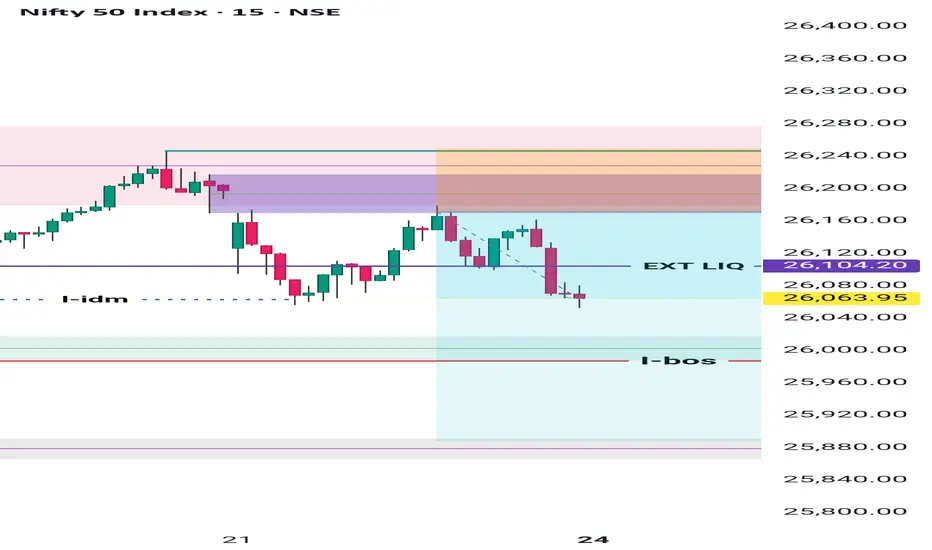
Nifty Structure Analysis & Trade Plan: 6th October
Detailed Market Structure Breakdown
4-Hour Chart (Macro Trend)
Structure: The Nifty is now in a confirmed bullish bounce phase. The decisive move on Wednesday (Oct 1st) and the follow-through on Friday (Oct 3rd) have broken the steep descending channel shown in your charts. The market is now trading within a clear ascending channel, and the recent low at 24,600 looks like a significant bottom for the correction.
Key Levels:
Major Supply (Resistance): 25,000 - 25,150. This area is the next significant hurdle, aligning with the psychological 25,000 mark and prior consolidation/supply zones.
Major Demand (Support): 24,750 - 24,800. This area, which includes a FVG (Fair Value Gap) and the lower trendline of the new ascending channel, is the key support.
Outlook: The medium-term bias has shifted to cautiously bullish. The strategy is firmly "Buy on Dips" as long as the price holds above 24,700.
1-Hour Chart (Intermediate View)
Structure: The 1H chart shows an unmistakable Break of Structure (BOS) on the upside. The price has established a pattern of higher highs and higher lows and is confidently moving within the new ascending channel.
Key Levels:
Immediate Resistance: 24,950 (The high of Friday's consolidation).
Immediate Support: 24,800 (Lower boundary of the new ascending channel).
15-Minute Chart (Intraday View)
Structure: The 15M chart shows a clean continuation of the bullish momentum. After breaking out of the descending channel, the index consolidated beautifully in a tight flag pattern and moved higher. The market closed near its high, indicating strong control by the bulls.
Key Levels:
Intraday Supply: 24,950.
Intraday Demand: 24,850 - 24,800.
Outlook: Strongly Bullish.
📈 Trade Plan (Monday, 6th October)
Market Outlook: The Nifty is in a strong bounce phase with a clear bullish structure. The primary strategy will be to buy on dips or buy on continuation.
Bullish Scenario (Primary Plan)
Justification: The market structure is bullish on all timeframes, supported by the RBI catalyst and follow-through buying. The momentum favors a break of 25,000.
Entry: Long entry on a decisive break and 15-minute candle close above 24,950. Alternatively, look for a dip entry near 24,800 (the channel and FVG support zone).
Stop Loss (SL): Place a stop loss below 24,750 (below the key support and rising trendline).
Targets:
T1: 25,050 (Psychological resistance).
T2: 25,150 (Major supply zone).
T3: 25,250 (Extension target).
Bearish Scenario (Counter-Trend Plan)
Justification: This high-risk, counter-trend plan only becomes valid if the rally fails dramatically.
Trigger: A decisive break and 1-hour candle close below 24,700.
Entry: Short entry below 24,700.
Stop Loss (SL): Above 24,850 (above the rising trendline).
Targets:
T1: 24,600 (Recent swing low).
T2: 24,400 (Deeper demand zone).
Key Levels for Observation:
Immediate Decision Point: 24,900 - 25,000 zone.
Bullish Confirmation: A break and sustained move above 25,000.
Bearish Warning: A break below 24,750 suggests a failure of the bounce.
Line in the Sand: 24,700. Below this level, the short-term bias shifts back to neutral-to-bearish.
Beyond Technical Analysis
Two Precision Setups for a Major Move | Breakout vs. ReboundChart: NSE:NALCO | Daily Timeframe
📈 Executive Summary:
Nalco Ltd. is at a technical crossroads, compressed between a massive 12-month descending trendline and a rock-solid multi-touch support zone. This creates two high-probability, well-defined trading opportunities for both momentum and value traders. The key for both setups will be confirmation with above-average volume.
🔥 Scenario 1: The Mega Breakout (Momentum Play)
This setup capitalizes on a decisive shift in long-term trend dynamics.
The Structure: A dominant Descending Trendline connects the November 2024 high (₹250) with the recent October 2025 high (₹225). This line has contained all major rallies for nearly a year.
The Trigger & Confirmation: A strong, 'big green' daily candle that closes decisively above ₹225. This move must be supported by above-average volume to confirm genuine buying interest and not a false breakout.
The Logic: A breakout from such a long-standing consolidation has the potential to unleash significant pent-up momentum, targeting the previous major high.
🎯 Trading Plan (Breakout):
🎯 Entry: On a daily close above ₹225, confirmed by above-average volume.
⛔ Stop Loss: Low of the breakout candle. This pragmatic level protects against a false breakout and allows for a tight, logical risk definition.
🎯 Target: ₹250 (The origin point of the trendline, acting as a logical and psychological target).
⚖️ Risk-Reward: Highly favorable, estimated above 1:3.
🛡️ Scenario 2: The Support Bounce (Value Play)
This is a classic "buy low, sell high" strategy at a proven demand zone.
The Structure: The ₹199 level is a historic support and resistance zone, tested multiple times since October 2024. It currently acts as a strong support floor.
The Trigger & Confirmation: The price must retrace and hold the ₹199-202 zone and then form a clear bullish reversal candlestick pattern (e.g., Hammer, Bullish Engulfing) with above-average volume on the daily timeframe.
The Logic: Entering at a proven support level with a candlestick confirmation provides a high-probability entry with an excellent risk-to-reward profile.
🎯 Trading Plan (Support Bounce):
🎯 Entry: On the confirmation of the bullish candlestick pattern (e.g., a close above the high of the pattern's candle) in the ₹199-202 zone, with volume confirmation.
⛔ Stop Loss: Low of the identified reversal candlestick pattern. This minimizes risk by invalidating the setup if the support fails immediately.
🎯 Target 1: 1:1 Risk-Reward Level (e.g., if risk is ₹5, target is Entry + ₹5).
🎯 Target 2: ₹225 (The recent swing high and trendline resistance). Once Target 1 is hit, trail the stop loss to lock in profits and ride the move towards ₹225.
Key Levels At a Glance:
All-Out Resistance: ₹225 (The 12-Month Trendline)
Foundational Support: ₹199 (The Multi-Touch Zone)
Breakout Target: ₹250
Support Bounce Target: ₹210-225
Final Note: Both setups require patience and discipline. Wait for the specific trigger and volume confirmation. Do not pre-empt the trade.
Disclaimer: This idea represents a technical analysis perspective and is not financial advice. All trading decisions carry risk. Please perform your own due diligence.
ICICI Bank: Resistance Turned Support Powers Next RallyTechnical Analysis
ICICI Bank showcases another remarkable wealth creation story spanning over two decades. The stock has delivered an extraordinary super bullish rally, transforming from ₹40 to the current trading level of ₹1,351 - representing an impressive 33.8x growth over 20+ years.
The ₹1,345-₹1,365 zone has historically acted as a strong resistance, tested multiple times. However, with the confirmation of strong FY25 results, the stock decisively broke out from this resistance zone and created a new all-time high at ₹1,500.
Following the breakout peak, the stock witnessed a sudden fall and is now trading back in the same zone at current market price of ₹1,351. This presents a critical juncture - if the earlier resistance zone transforms into support with bullish candlestick pattern confirmations, it could signal the next leg of the rally.
Entry Strategy: Enter only on confirmation of ₹1,345-₹1,365 zone acting as support with bullish patterns.
Targets:
Target 1: ₹1,400
Target 2: ₹1,450
Target 3: ₹1,500
Stop Losses:
Critical Support: ₹1,200 (crucial demand zone)
If ₹1,200 level doesn't sustain, no more expectations on this stock.
FY25 Financial Highlights (vs FY24 & FY23)
Total Income: ₹1,86,331 Cr (↑ +17% YoY from ₹1,59,516 Cr; ↑ +95% from FY23 ₹95,407 Cr)
Total Expenses: ₹1,30,078 Cr (↑ +31% YoY from ₹99,560 Cr; ↑ +48% from FY23 ₹87,864 Cr)
Financing Profit: ₹-32,775 Cr (Improved from ₹-14,152 Cr in FY24)
Profit Before Tax: ₹72,854 Cr (↑ +21% YoY from ₹60,434 Cr; ↑ +58% from FY23 ₹46,256 Cr)
Profit After Tax: ₹54,569 Cr (↑ +18% YoY from ₹46,081 Cr; ↑ +54% from FY23 ₹35,461 Cr)
Diluted EPS: ₹71.65 (↑ +14% YoY from ₹63.02; ↑ +47% from FY23 ₹48.74)
Fundamental Highlights
ICICI Bank delivered robust FY25 performance with 18% PAT growth to ₹54,569 crore, supported by strong 17% revenue growth. The bank announced Q4 FY25 net profit of ₹12,630 crore, marking 18% increase, and declared ₹11 per share dividend reflecting strong financial health.
Market cap stands at ₹9,71,186 crore (up 4.06% in 1 year) with total revenue reaching ₹1,90,830 crore and profit of ₹56,563 crore. Stock is trading at 3.08 times its book value, indicating reasonable valuation for quality franchise.
Asset quality continues to improve with gross NPA dropping to 1.97% in Q2FY25 from 2.48% in Q2FY24, while net NPA ratio remained healthy at 0.43% in Q1 FY25. This demonstrates effective risk management and strong credit discipline.
The bank shows strength near key support zone of 1370-1390 on daily charts, with technical indicators suggesting potential diamond pattern formation around 1380-1400 range. Analysts expect stable net interest margins and continued momentum.
Strong digital banking initiatives, expanding retail franchise, and consistent delivery of 14-18% profit growth across quarters validates the bank's operational excellence and market leadership position in private banking sector.
Conclusion
ICICI Bank's remarkable 20+ year journey from ₹40 to ₹1,500 all-time high, backed by strong FY25 fundamentals showing 18% PAT growth and ₹11 dividend, validates the sustained growth thesis. The critical ₹1,345-₹1,365 resistance-to-support transformation offers attractive entry opportunity for targeting ₹1,500 retest. Improving asset quality with 1.97% gross NPA, strong ROE profile, and digital transformation drive provide multiple growth catalysts. Key support at ₹1,200 provides risk management framework for this quality banking franchise.
Disclaimer: tinyurl.com
1 of the best Gold Swing Trading Strategy with Fibonacci Levels!Hello Traders!
Gold (XAU/USD) is a perfect instrument for swing trading because of its clean technical reactions.
One of the most reliable tools to trade gold swings is the Fibonacci retracement .
When used correctly, it helps you catch pullbacks and ride the next wave in the trend. Let’s break it down step by step.
1. Identify the Swing Move
First, find a strong impulse move on gold, either bullish or bearish.
This becomes your “anchor move” for drawing Fibonacci levels.
The idea is to wait for price to retrace part of this move before continuing in the main direction.
2. Draw Fibonacci Levels
Take the swing low to swing high (for bullish) or swing high to swing low (for bearish).
Mark key retracement levels: 38.2%, 50%, and 61.8% .
These levels often act as strong support or resistance zones for gold.
3. Look for Confirmation
Don’t trade blindly at a Fib level. Wait for confirmation like reversal candlesticks (pin bars, engulfing) or RSI divergence.
Volume spikes near Fibonacci zones also confirm institutional buying/selling.
4. Entry & Risk Management
Enter trades near 38.2%, 50%, or 61.8% retracements when confirmation appears.
Place stop loss just beyond the next Fibonacci level.
Set targets at previous swing highs/lows or Fibonacci extension levels like 127% and 161.8%.
5. Why It Works Well on Gold
Gold respects technical levels strongly due to high liquidity.
Institutions also use Fibonacci retracements to scale in and out of positions.
This makes Fibonacci one of the most effective tools for swing traders in gold.
Rahul’s Tip:
Always combine Fibonacci with structure. If a Fib level aligns with a key support/resistance, that zone becomes even stronger.
Conclusion:
Swing trading gold with Fibonacci retracements is simple yet powerful.
By focusing on impulse moves, waiting for retracements, and confirming with price action, you can trade gold with more confidence and less guesswork.
If this post gave you a clear strategy, like it, share your thoughts in comments, and follow for more practical gold trading setups!
HDFC Bank: Three Decades of Excellence ContinuesTechnical Analysis
HDFC Bank represents one of the most remarkable wealth creation stories in Indian equity markets. The stock has delivered an extraordinary super bullish rally over three decades, transforming from ₹1 to the current trading level of ₹955 - representing an astounding 955x growth over 30 years.
Currently, the stock is taking strong support in the ₹935-₹945 zone, which has acted as a crucial demand area. This support zone has been tested multiple times and held firm, indicating institutional accumulation at these levels.
If the three-decade bullish rally continues from current support levels, the technical setup favors resumption of the uptrend. The stock is well-positioned for the next leg of growth from the established support zone.
Entry Strategy: Accumulate in the ₹935-₹955 range with strong support confirmation.
🎯Targets:
Target 1: ₹980
Target 2: ₹1,000
Target 3: ₹1,020
Stop Losses:
Minor Support: ₹850 (intermediate demand zone)
Major Support: ₹650 (strong long-term support)
If ₹650 level breaks down, no more expectations on this stock.
FY25 Financial Highlights (vs FY24 & FY23)
Total Income: ₹3,36,367 Cr (↑ +19% YoY from ₹2,83,649 Cr; ↑ +97% from FY23 ₹1,70,754 Cr)
Total Expenses: ₹1,86,974 Cr (↑ +7% YoY from ₹1,74,196 Cr; ↑ +197% from FY23 ₹63,042 Cr)
Financing Profit: ₹-34,501 Cr (Improved from ₹-44,685 Cr in FY24)
Profit Before Tax: ₹96,242 Cr (↑ +26% YoY from ₹76,569 Cr; ↑ +57% from FY23 ₹61,498 Cr)
Profit After Tax: ₹73,440 Cr (↑ +12% YoY from ₹65,446 Cr; ↑ +59% from FY23 ₹46,149 Cr)
Diluted EPS: ₹46.26 (↑ +10% YoY from ₹42.16; ↑ +12% from FY23 ₹41.22)
Fundamental Highlights
HDFC Bank delivered strong FY25 performance with consolidated PAT growing 12% YoY to ₹73,440 crore, supported by robust 19% revenue growth to ₹3,36,367 crore. The bank declared ₹22 dividend reflecting confidence in sustained profitability.
Market cap stands at ₹14,51,630 crore (up 7.84% in 1 year) with stock trading at 2.77 times book value. Total revenue for FY25 reached ₹3,42,193 crore with profit of ₹73,343 crore, demonstrating consistent financial strength.
Q4 FY25 standalone net profit grew 6.7% YoY to ₹17,616 crore, with net interest income (NII) increasing 10.3% YoY to ₹32,070 crore. Net interest margin (NIM) stood at 3.54% on total assets, reflecting stable spreads despite competitive environment.
Asset quality remains robust with gross NPAs at 1.36% and net NPAs at 0.33% of net advances. Average deposits for Q4 FY25 grew 15.8% YoY to ₹25,280 billion, while CASA deposits grew 5.7% YoY to ₹8,289 billion, maintaining stable share in deposit mix.
The bank is strategically managing its credit-deposit (CD) ratio and planning measured loan growth in FY26 to maintain balance sheet quality. Strong subsidiary performance and digital banking initiatives continue to drive franchise value.
Conclusion
HDFC Bank's remarkable 30-year journey from ₹1 to ₹955, backed by strong FY25 fundamentals showing 12% PAT growth and ₹22 dividend declaration, validates the long-term investment thesis. The ₹935-₹945 support zone offers attractive accumulation opportunity for targeting ₹1,020+ levels. Robust asset quality with 1.36% gross NPA, 15.8% deposit growth, and stable 3.54% NIM demonstrate operational excellence. The stock remains a core banking sector holding with multiple support levels providing risk management framework.
Disclaimer: tinyurl.com
E-Commerce Trading1. Introduction
E-commerce trading, also known as electronic commerce trading, represents the buying and selling of goods and services over digital platforms. Unlike traditional trading, which relies on physical stores, direct interaction, and manual processes, e-commerce operates over the internet, enabling global access, efficiency, and automation. With the exponential growth of internet penetration, smartphone usage, and digital payment systems, e-commerce trading has become one of the fastest-growing segments of the global economy.
E-commerce trading encompasses a broad spectrum of activities, including retail trading, wholesale trading, business-to-business (B2B) transactions, business-to-consumer (B2C) sales, consumer-to-consumer (C2C) platforms, and increasingly, business-to-government (B2G) operations. This digital marketplace has transformed traditional commerce by integrating technology, logistics, marketing, and finance, enabling businesses and consumers to interact seamlessly.
2. History and Evolution
Early Beginnings
The concept of e-commerce trading dates back to the late 20th century. Early examples include Electronic Data Interchange (EDI) systems used by corporations to exchange business documents electronically. The first online retail sale is often credited to the 1994 sale of a Sting CD via the website NetMarket. Soon after, Amazon and eBay emerged as pioneers, creating the blueprint for online marketplaces.
Technological Milestones
Several technological developments accelerated the growth of e-commerce trading:
Internet Expansion: The widespread availability of broadband internet allowed users to access online stores easily.
Secure Payment Gateways: Innovations like SSL encryption, PayPal, and later UPI, digital wallets, and credit/debit card integrations made online transactions secure and convenient.
Mobile Commerce: With smartphones becoming ubiquitous, mobile apps and responsive websites enabled trading anytime, anywhere.
AI and Data Analytics: Personalized recommendations, demand forecasting, and dynamic pricing became possible, improving trading efficiency.
Cloud Computing: Allowed scalable online storefronts and storage solutions for businesses without heavy infrastructure investments.
3. Types of E-Commerce Trading
E-commerce trading is not a monolithic concept; it can be categorized based on the nature of participants:
3.1 Business-to-Consumer (B2C)
B2C trading involves businesses selling directly to consumers. Amazon, Flipkart, Myntra, and Walmart are classic examples. This segment focuses on:
Product variety and convenience.
Personalized marketing using AI and customer analytics.
Rapid delivery services.
Seamless payment methods, including COD, wallets, and UPI.
3.2 Business-to-Business (B2B)
B2B platforms facilitate transactions between companies. Examples include Alibaba, IndiaMART, and ThomasNet. Key characteristics:
Bulk transactions at negotiated prices.
Long-term partnerships and contracts.
Integration of supply chain management with trading platforms.
3.3 Consumer-to-Consumer (C2C)
C2C platforms allow individuals to trade with each other. eBay, OLX, and Quikr are examples. Features include:
Peer-to-peer sales of used goods or handmade items.
Trust-building through rating systems.
Secure payment mechanisms to ensure safe trades.
3.4 Business-to-Government (B2G)
B2G trading involves businesses providing products or services to government agencies. Digital tendering platforms, government e-procurement systems, and contracts for public projects are part of this domain.
4. Key Components of E-Commerce Trading
E-commerce trading relies on multiple integrated components that ensure smooth operation:
4.1 Online Marketplace Platforms
Platforms such as Amazon, Flipkart, Shopify, and Etsy provide the digital infrastructure for trading. These platforms host multiple sellers, offer product search and categorization, manage orders, and facilitate payments.
4.2 Payment Gateways and Financial Services
Secure payment systems are the backbone of e-commerce. Payment gateways process online transactions, while financial technologies (FinTech) like UPI, PayPal, Stripe, and digital wallets ensure instant transfers and refunds.
4.3 Logistics and Supply Chain Management
Efficient trading requires prompt delivery. Logistics includes warehousing, transportation, inventory management, and last-mile delivery. Companies like DHL, FedEx, and Indian startups like Delhivery revolutionized supply chain efficiency.
4.4 Digital Marketing
E-commerce trading thrives on digital marketing strategies, including:
Search Engine Optimization (SEO)
Social media advertising
Influencer marketing
Email campaigns and retargeting
Personalized recommendation engines
4.5 Technology Infrastructure
Modern e-commerce trading depends on advanced technologies:
Cloud computing for scalable server architecture.
AI and machine learning for predictive analytics and chatbots.
Big data for consumer insights.
AR/VR for immersive shopping experiences.
Blockchain for secure transactions and supply chain transparency.
5. Advantages of E-Commerce Trading
E-commerce trading offers numerous benefits for both businesses and consumers:
5.1 Global Reach
Unlike traditional stores limited by location, e-commerce platforms enable businesses to reach customers worldwide, expanding market potential significantly.
5.2 Cost Efficiency
Lower overhead costs due to the absence of physical storefronts, reduced staff requirements, and automation in operations contribute to cost efficiency.
5.3 Convenience
Consumers can shop 24/7, compare prices, read reviews, and receive products at their doorstep, enhancing customer satisfaction.
5.4 Personalized Experiences
Using AI-driven recommendations and behavioral analytics, e-commerce platforms provide tailored product suggestions, increasing sales and customer loyalty.
5.5 Analytics-Driven Decisions
Real-time tracking of sales, customer preferences, and market trends allows businesses to make informed decisions about inventory, pricing, and marketing.
6. Challenges in E-Commerce Trading
Despite its growth, e-commerce trading faces significant challenges:
6.1 Cybersecurity Risks
Hacking, data breaches, and fraudulent transactions threaten businesses and consumer trust.
6.2 Logistics and Supply Chain Bottlenecks
Delivery delays, damaged products, and inventory mismanagement can reduce customer satisfaction.
6.3 Intense Competition
Low barriers to entry in e-commerce result in fierce competition, driving prices down and impacting profit margins.
6.4 Regulatory and Legal Issues
Compliance with tax laws, consumer protection regulations, cross-border trade laws, and data privacy rules is complex.
6.5 Technological Dependence
Overreliance on digital infrastructure exposes businesses to risks of downtime, server failures, or software glitches.
Conclusion
E-commerce trading has transformed the way businesses and consumers interact, creating an ecosystem that is fast, efficient, and global. It bridges the gap between markets and customers, empowers small businesses, and drives technological innovation. While challenges like cybersecurity, logistics, and competition remain, emerging trends in mobile commerce, AI, AR, and sustainability promise a bright and transformative future.
Businesses that adapt quickly, embrace technology, and prioritize customer-centric strategies are likely to thrive, while traditional models will need to evolve or collaborate with digital platforms to remain relevant. In essence, e-commerce trading is not just a trend—it is the new norm in global commerce, reshaping the very fabric of trade in the 21st century.
Cross-Market Arbitrage Opportunities1. Understanding Cross-Market Arbitrage
Arbitrage is the simultaneous buying and selling of an asset to profit from price differences in different markets or forms. Cross-market arbitrage occurs when an asset, security, or derivative is traded across two or more markets (such as stock exchanges, commodity markets, or currency markets), and a trader exploits the temporary price mismatch.
1.1 Basic Concept
Imagine a stock listed on two exchanges—say, Exchange A and Exchange B. If the stock trades at $100 on Exchange A but $102 on Exchange B, a trader could theoretically buy at $100 on Exchange A and sell at $102 on Exchange B, locking in a risk-free profit of $2 per share (ignoring transaction costs). This opportunity exists because markets are not perfectly efficient at all times. Cross-market arbitrage seeks to exploit such temporary inefficiencies.
1.2 Importance in Financial Markets
Cross-market arbitrage contributes to:
Market efficiency: By exploiting price differences, arbitrageurs help align prices across markets.
Liquidity enhancement: Arbitrage strategies increase trading activity and liquidity.
Risk management: Investors use cross-market arbitrage in hedging strategies to manage exposure to price fluctuations.
2. Types of Cross-Market Arbitrage
Cross-market arbitrage can be categorized based on the types of assets, markets, and instruments involved. Below are the most common types:
2.1 Stock Arbitrage Across Exchanges
Stocks listed on multiple exchanges often exhibit price discrepancies due to differences in trading hours, liquidity, and investor behavior.
Example: An Indian company’s stock listed both on the NSE (National Stock Exchange) and BSE (Bombay Stock Exchange). If NSE trades at ₹1,000 and BSE at ₹1,005, arbitrageurs can buy on NSE and sell on BSE simultaneously.
2.2 Currency Arbitrage
Foreign exchange markets provide cross-market opportunities when the same currency pair trades at slightly different rates in different markets.
Triangular arbitrage is a common method, where traders exploit discrepancies among three currencies in different forex markets.
Example: USD/INR trades at 83.50 in New York and 83.60 in London. Buying USD in New York and selling in London can yield a profit.
2.3 Commodity Arbitrage
Commodities like gold, oil, and agricultural products are often traded in multiple markets. Price differences can arise due to storage costs, transportation costs, and market demand.
Example: Gold trades at $1,900 per ounce on the London Bullion Market and $1,905 in Mumbai. Traders can buy in London and sell in Mumbai after accounting for transaction costs.
2.4 Derivative and Futures Arbitrage
Arbitrage opportunities exist between the spot market and the futures market or across derivative exchanges.
Cash-and-carry arbitrage is a common example where traders buy an underlying asset in the spot market and sell futures contracts if the futures price is overpriced relative to the spot price.
Reverse cash-and-carry occurs when futures are underpriced.
3. Mechanics of Cross-Market Arbitrage
To execute a cross-market arbitrage strategy, traders follow these steps:
3.1 Identify Price Discrepancies
The first step is to monitor multiple markets and identify assets trading at different prices. Sophisticated traders use algorithmic systems, real-time data feeds, and market scanners to detect these differences within milliseconds.
3.3 Simultaneous Execution
Cross-market arbitrage requires executing buy and sell orders almost simultaneously to avoid market risk (the risk of prices changing before both trades are completed). This is often achieved through:
High-frequency trading (HFT) algorithms
Direct market access (DMA) platforms
Automated trading bots
3.4 Risk Management
Even “risk-free” arbitrage carries risks such as:
Execution risk
Liquidity risk
Regulatory restrictions
Currency or settlement risk in international markets
Professional arbitrageurs hedge these risks using derivatives or diversification strategies.
4. Popular Cross-Market Arbitrage Strategies
4.1 Dual-Listed Stock Arbitrage
Concept: Exploit price differences in a stock listed on two exchanges.
Example: Infosys Ltd., dual-listed in India and the US as ADRs (American Depository Receipts). Traders can arbitrage price differences between NSE/BSE and NYSE markets.
4.2 Index Arbitrage
Concept: Exploit differences between a stock index and its futures contract.
Mechanism: If the futures price is higher than the fair value implied by the index, traders buy the index components and sell futures simultaneously.
4.3 Cross-Currency Arbitrage
Triangular arbitrage involves three currencies. For instance, if USD/INR, USD/EUR, and EUR/INR exchange rates are misaligned, traders can make a profit by converting currencies sequentially.
4.4 Commodity Arbitrage
Traders exploit price discrepancies in commodities across global exchanges, often factoring in shipping, storage, and hedging costs.
Example: Oil traded in NYMEX versus Brent crude in ICE Europe.
4.5 Derivative Arbitrage
Exploiting differences between options, futures, and underlying assets.
Example: Convertible bond arbitrage, where traders hedge the bond portion and speculate on the stock portion to lock profits.
5. Advantages of Cross-Market Arbitrage
Risk-Adjusted Returns: Offers relatively low-risk profits when executed correctly.
Market Efficiency: Aligns prices across markets, reducing mispricing.
Liquidity Generation: Arbitrage trading increases market depth.
Diversification: Arbitrage can diversify an investor’s portfolio by introducing trades that are market-neutral.
Predictability: Unlike directional trades, arbitrage profits rely on price discrepancies rather than market trends.
6. Challenges and Risks
Despite being considered “low-risk,” cross-market arbitrage has challenges:
6.1 Execution Risk
Delays in order execution can erase profits. Markets move quickly, so any lag can turn an arbitrage opportunity into a loss.
6.2 Transaction Costs
Trading fees, broker commissions, and taxes can reduce or nullify arbitrage gains.
6.3 Liquidity Risk
Insufficient market liquidity can prevent traders from executing trades at desired prices.
6.4 Regulatory Risk
Different countries have distinct trading rules and capital controls, especially for cross-border arbitrage.
6.5 Currency Risk
For international arbitrage, fluctuations in exchange rates can impact profits.
6.6 Competition
High-frequency trading firms and institutional players dominate cross-market arbitrage, making it less accessible for retail traders.
7. Future Trends
AI-Powered Arbitrage: AI models will identify patterns and predict mispricings with greater accuracy.
Blockchain and Cryptocurrencies: Cross-exchange crypto arbitrage is gaining traction due to high volatility and fragmented exchanges.
Global Market Integration: Increased connectivity may reduce arbitrage opportunities but also create short-lived micro-opportunities.
Retail Access: As technology becomes more accessible, retail investors may participate in smaller-scale arbitrage.
8. Conclusion
Cross-market arbitrage is a sophisticated, yet fundamentally simple, trading strategy that capitalizes on temporary price discrepancies across markets. It requires speed, precision, and careful risk management. While large institutional players dominate this space, technology is gradually enabling wider participation.
Arbitrage benefits markets by enhancing efficiency, improving liquidity, and contributing to price discovery. However, it is not without risks. Transaction costs, execution delays, and regulatory hurdles are significant challenges. Understanding the mechanics, types, and tools of cross-market arbitrage is essential for traders seeking to profit in an increasingly competitive global market.
Ultimately, successful cross-market arbitrage combines market insight, technological proficiency, and disciplined execution, making it a cornerstone strategy for risk-conscious investors in the 21st century.
Daily Nifty Analysis: 03/10/25The cup and handle pattern is under formation here.
Support is 24760
Resistance and entry criteria are breached at the 24800-24805 level.
The target of the pattern is 25000, i.e., 200 points above.
On the contrary, the sell will be below 24760, for which I am not focusing much at the moment. On either way, the downside levels are also mentioned.
DLF Downtrend Intact – Eyeing 675 Next!DLF is clearly locked in a downtrend, with lower highs forming under the descending trendline. Price is struggling to break above the capped supply zone near 735–740, which continues to act as strong resistance. As long as the stock remains below this zone, the pressure stays on the downside with the next major support seen around 675–672. A break toward this level looks likely in the coming sessions, unless bulls manage to reclaim and sustain above the capped zone, which would temporarily ease the selling pressure. Until then, the structure remains bearish, with sellers holding control. Trade safe !
Nifty Faces Heavy Resistance – 23,500 on the Cards!Nifty is currently trading into a strong resistance zone near 24900–25000, where price has faced repeated supply pressure in the past. The index is struggling to sustain above this level, suggesting sellers are defending the zone aggressively. As long as Nifty remains capped below 25000, the structure leans bearish and points toward a corrective leg lower. The first key support is seen near 23500, which aligns with a major horizontal base and prior demand area. A breakdown into this zone over the coming sessions would confirm further weakness. However, a daily close above 25000–25050 would invalidate this bearish outlook and potentially shift momentum back toward 25300–25500. Until that invalidation occurs, the short-term bias favors downside, with 23500 as the primary target in the coming days. Trade safe !
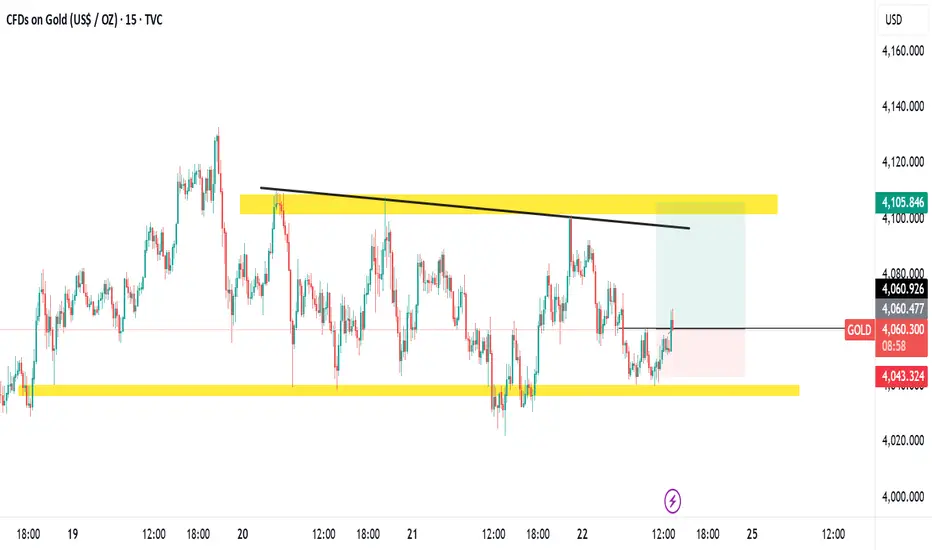
Gold Day Trading Outlook: Resistance Holding! Gold is showing signs of weakness as the resistance around 3860–3865 continues to hold strong, keeping the intraday sentiment tilted to the bearish side. As long as price stays below this band, the market is vulnerable to further downside pressure with immediate support seen near 3827 and an extended target towards 3798. Any minor pullbacks into the 3855–3860 region may attract sellers, maintaining the short-term bearish structure. However, a decisive hourly close above 3865 would invalidate this bearish view and shift the bias back to the upside, opening the door for a possible retest of 3880–3900. Until then, day trading leans bearish with sellers holding the upper hand. Trade safe !
Minda Corp: Gearing Up for a BreakoutThe chart of Minda Corp provides delineates critical price thresholds that signify breakout points, along with specific support levels that serve as indicators of where buying interest may manifest.
Additionally, the chart highlights regions likely to act as ceiling points for future price ascensions, allowing for informed decisions on entry and exit strategies.
Disclaimer: The information contained in this technical analysis report is intended solely for informational and educational purposes. It should not be interpreted as financial advice or a recommendation to buy or sell any security. Investors are strongly encouraged to conduct their own research and consult with a qualified financial advisor before making any investment decisions.
EURUSD – Head and Shoulders Breakdown in Play!!The chart is showing a clear Head and Shoulders formation, a bearish reversal structure that signals the market may be preparing for a deeper drop if neckline support gives way.
Chart validation:
Left Shoulder, Head, and Right Shoulder are well-defined.
The neckline sits around 1.1646 – this is the critical level to watch.
Current price is hovering above the neckline, but pressure is building on the downside.
Invalidation sits above 1.1850 – if price pushes past this level, the bearish setup is negated.
Targets from the structure:
A clean break below 1.1646 confirms the pattern.
Measured move points towards 1.1430 area as the downside objective.
Along the way, short-term jolts could test 1.1550, but the major momentum favors sellers if neckline breaks.
Trading view:
As long as EURUSD stays below the right shoulder resistance and 1.1850, bias leans bearish. The neckline is the trigger – once broken, the head and shoulders formation comes into full effect, opening space for a sharper correction.Trade safe !!
Ethereum – Strong Uptrend but Needs a Breakout!!Ether is still holding its strong uptrend, and the recent rejection from support has kept the bullish structure intact. The bigger picture remains positive, but short-term price action now demands a clear breakout to confirm continuation.
Current structure:
Price bounced cleanly from the 4000 zone, showing that buyers are defending the base.
The rally stalled just below the 4800–4850 resistance. This is the key barrier that needs to give way for the next leg higher.
Until then, we are stuck in a consolidation between strong support below and heavy resistance above.
Key levels to track:
Support: 4050–3950. As long as this zone holds, bulls keep the upper hand.
Breakout zone: 4768–4834. A weekly close above here should trigger momentum buyers.
Upside targets: 5515 → 5550, and if momentum extends, 6,000+.
Short-term view:
Ethereum is in a strong trend but needs that breakout above 4,800 to unlock the next wave higher. If buyers fail to push through, expect more back-and-forth action near support before another attempt.
The structure favors patience – wait for the breakout confirmation rather than chasing inside the range. Trade safe.
US30 – Rising Wedge on Thin Ice ! The Dow has been pushing higher for weeks, but the structure it’s building isn’t the most comfortable for bulls. Right now, price is sitting inside a rising wedge — a pattern that often looks strong until momentum fades and it breaks lower.
What’s happening now?
Buyers are still trying to defend near the top of the wedge, but every new push looks weaker than the last.
The candles are tightening, which usually signals a volatility squeeze. Once it snaps, the move tends to be quick.
Momentum hasn’t kept pace with price. That mismatch is an early warning sign.
Levels I’m watching
Target 1: 45900–46000. First line of support. If this gives way, short-term weakness will expand.
Target 2: 45200. A deeper pullback zone where profit-taking could slow the drop.
Final zone: 44200–44300. If the wedge fully unwinds, this is where I expect the sell-off to stretch, followed by a bounce attempt.
Short-term view:
For bulls, the only way to flip sentiment is a clean breakout above the wedge resistance. Until then, upside looks limited while the downside risk is gradually opening up. Chasing longs here carries more risk than reward. A confirmed break below support would tilt momentum decisively bearish. Trade safe!
Sensex Structure Analysis & Trade Plan: 3rd October
The Sensex closed on Wednesday, October 1, by snapping an eight-day losing streak, confirming a strong technical bounce from its major support zone.
Detailed Market Structure Breakdown
4-Hour Chart (Macro Trend)
Structure: The Sensex has confirmed a strong technical bounce from the crucial 80,200 - 80,400 macro demand zone. The strong bullish candle on Wednesday (following the RBI policy) has broken out of the steep descending channel and has recovered a significant portion of the recent decline. This is a clear Break of Structure (BOS) on the short-term bearish trend.
Key Levels:
Major Supply (Resistance): 81,600 - 81,800. This area is a significant overhead resistance, which was a prior breakdown zone and a major FVG (Fair Value Gap).
Major Demand (Support): 80,400 - 80,600. This is the key reversal zone. As long as the Sensex trades above 80,400, the bullish bounce is in control.
Outlook: The short-term bias has shifted from bearish to cautiously bullish (Bounce Phase). The trend is now "Buy on Dips" until the index retests the major resistance at 81,600.
1-Hour Chart (Intermediate View)
Structure: The 1H chart shows a clear BOS on the upside, as the market broke the descending channel and closed strongly above the 80,800 level. The momentum has shifted in favor of the bulls.
Key Levels:
Immediate Resistance: 81,200. This aligns with a previous support/resistance flip zone and the middle of a short-term FVG.
Immediate Support: 80,750 - 80,850 (Recent swing high/consolidation zone).
15-Minute Chart (Intraday View)
Structure: The 15M chart confirms strong bullish momentum. The index successfully reclaimed the blue EMA and is making higher lows and higher highs. The price closed with a strong bullish surge, suggesting continuation is likely.
Key Levels:
Intraday Supply: 81,200.
Intraday Demand: 80,800.
Outlook: Strongly Bullish.
Trade Plan (Friday, 3rd October)
Market Outlook: The Sensex is in a strong bounce phase after the RBI policy catalyst. The primary strategy will be to buy on dips or buy on continuation.
Bullish Scenario (Primary Plan)
Justification: The market has confirmed a short-term reversal, and the strong momentum should lead to continuation toward the next major resistance.
Entry: Long entry on a decisive break and 15-minute candle close above 81,200. Alternatively, look for a dip entry near 80,800 if the market retraces.
Stop Loss (SL): Place a stop loss below 80,500 (below the macro reversal zone).
Targets:
T1: 81,600 (Major FVG resistance).
T2: 81,800 (Major supply zone).
T3: 82,200 (Upper resistance).
Bearish Scenario (Counter-Trend Plan)
Justification: This high-risk, counter-trend plan only becomes valid if the rally fails dramatically.
Trigger: A decisive break and 1-hour candle close below 80,400.
Entry: Short entry below 80,400.
Stop Loss (SL): Above 80,700.
Targets:
T1: 80,000 (Psychological support).
T2: 79,700 (Deeper demand zone).
Key Levels for Observation:
Immediate Decision Point: 80,800 - 81,200 zone.
Bullish Confirmation: A break and sustained move above 81,200.
Bearish Warning: A move below 80,800 suggests consolidation.
Line in the Sand: 80,400. A break below this level nullifies the reversal bounce.
Banknifty Structure Analysis & Trade Plan: 3rd October
Detailed Market Structure Breakdown
4-Hour Chart (Macro Trend)
Structure: The Bank Nifty has confirmed a strong bullish reversal. The index decisively broke out of the steep descending corrective channel and closed well above the critical 55,050 - 55,200 support zone. The large bullish candle has moved past the 38.2% Fibonacci retracement of the prior leg down and suggests that the corrective phase is over for now.
Key Levels:
Major Supply (Resistance): 55,800 - 56,000. This remains the key overhead supply zone from the September highs.
Major Demand (Support): 55,000 - 55,200. This area, which includes the FVG (Fair Value Gap) and the broken channel resistance, is now the new, crucial support.
Outlook: The short-term bias has shifted from bearish to strongly bullish. The trend is now "Buy on Dips" as the Bank Nifty is a market leader and its action reinforces the broader market recovery.
1-Hour Chart (Intermediate View)
Structure: The 1H chart shows a clear Break of Structure (BOS) to the upside. The price broke the descending trendline and reclaimed the moving averages. It closed right below the upper trendline of a broader triangular pattern, setting up for a potential breakout.
Key Levels:
Immediate Resistance: The upper boundary of the triangular pattern, near 55,400.
Immediate Support: 55,100 - 55,200.
15-Minute Chart (Intraday View)
Structure: The 15M chart confirms the strong bullish momentum. The market saw a significant rally, which included taking out Sell-side Liquidity before the final surge. The price is currently consolidating just below the 55,400 resistance.
Key Levels:
Intraday Supply: 55,400 - 55,500. A breakout here would confirm the continuation of the morning rally.
Intraday Demand: 55,100 - 55,200.
Outlook: Strongly Bullish.
📈 Trade Plan (Friday, 3rd October)
Market Outlook: The Bank Nifty is exhibiting strong bullish momentum after the RBI policy event. The primary strategy will be to buy on dips or buy on continuation.
Bullish Scenario (Primary Plan)
Justification: The sharp reversal and clear break of structure across multiple timeframes suggest a continuation towards the monthly high.
Entry: Long entry on a decisive break and 15-minute candle close above 55,500. Alternatively, look for a dip entry near 55,200 if the market opens flat or with a small gap down.
Stop Loss (SL): Place a stop loss below 55,000 (below the FVG support).
Targets:
T1: 55,800 (Previous swing high).
T2: 56,000 (Major supply zone).
T3: 56,200 (Extension target).
Bearish Scenario (Counter-Trend Plan)
Justification: This high-risk, counter-trend plan only becomes valid if the rally fails dramatically.
Trigger: A decisive break and 1-hour candle close below 55,000.
Entry: Short entry below 55,000.
Stop Loss (SL): Above 55,250.
Targets:
T1: 54,750 (Minor support/FVG).
T2: 54,400 (Deeper demand zone).
Key Levels for Observation:
Immediate Decision Point: 55,400 - 55,500 zone.
Bullish Confirmation: A break and sustained move above 55,500.
Bearish Warning: A move below 55,000 would be a major warning sign.
Line in the Sand: 55,000. A break below this level nullifies the reversal bounce.
NIFTY 50 Analysis & Trade Plan: 3rd OctoberMarket Context: The Nifty snapped its eight-day losing streak on Wednesday (October 1st), following the RBI MPC decision to hold the repo rate. This confirms a strong reversal from the critical 24,600 support zone.
Detailed Market Structure Breakdown
4-Hour Chart (Macro Trend)
Structure: The Nifty has decisively broken out of the steep descending corrective channel. The strong bullish candle on Wednesday (October 1st) has closed well above the channel's upper trendline, signaling a high-probability short-term reversal. The market has now recovered more than 50% of the last major leg down.
Key Levels:
Major Supply (Resistance): 25,050 - 25,150. This area is the next significant hurdle, aligning with the prior consolidation zone.
Major Demand (Support): 24,600 - 24,700. This is the key reversal zone. As long as the Nifty trades above 24,700, the bullish bounce is in control.
Outlook: The short-term bias has shifted from bearish to cautiously bullish. The trend will be "Buy on Dips" until the index retests the 25,150 zone.
1-Hour Chart (Intermediate View)
Structure: The 1H chart shows a clear Break of Structure (BOS) on the upside, as the price broke the descending channel and closed strongly. The market is now back in a short-term upward trajectory.
Key Levels:
Immediate Resistance: 24,880. This is the high of the current bounce and a minor psychological resistance.
Immediate Support: 24,750 (The top of the recent consolidation and FVG support).
15-Minute Chart (Intraday View)
Structure: The 15M chart shows strong bullish momentum. The index successfully took out Sell-side Liquidity below 24,600 and then reversed sharply. It closed strongly above the EMA and is forming a continuation pattern (flag) right below 24,900.
Key Levels:
Intraday Supply: 24,900.
Intraday Demand: 24,800.
Outlook: Strongly Bullish for the session open.
📈 Trade Plan (Friday, 3rd October)
Market Outlook: The Nifty is in a strong bounce phase after the RBI policy catalyst. The primary strategy will be to buy on dips or buy on continuation.
Bullish Scenario (Primary Plan)
Justification: The strong close and confirmed reversal pattern across timeframes favor continuation towards the next major supply zone.
Entry: Long entry on a decisive break and 15-minute candle close above 24,900. Alternatively, look for a dip entry near 24,750 if the market retraces.
Stop Loss (SL): Place a stop loss below 24,700 (below the immediate FVG support).
Targets:
T1: 25,050 (Psychological level).
T2: 25,150 (Major supply zone).
T3: 25,250 (Upper resistance).
Bearish Scenario (Counter-Trend Plan)
Justification: This high-risk, counter-trend plan only becomes valid if the bounce is completely rejected.
Trigger: A decisive break and 1-hour candle close below 24,700.
Entry: Short entry below 24,700.
Stop Loss (SL): Above 24,850 (above the recent swing high).
Targets:
T1: 24,600 (Key reversal support).
T2: 24,400 (Deeper demand zone).
[ b]Key Levels for Observation:
Immediate Decision Point: 24,800 - 24,900 zone.
Bullish Confirmation: A break and sustained move above 24,900.
Bearish Warning: A move below 24,700 suggests a reversal failure and consolidation.
Line in the Sand: 24,600. A break below this level nullifies the reversal bounce.
LORDSCHLO Price ActionLords Chloro Alkali Limited (LORDSCHLO) traded positively today, closing at 176.5 after an upward move of 2.77% for the session. The stock opened at 173.45, reached a high of 178.0, and dropped to a low of 169.05 during the day. Trading volume was below average, with about 13,620 shares traded, indicating moderate investor activity.
Price action was characterized by a firm bullish undertone, as the stock built on its gains and held well above both its 50-day and 200-day averages, reflecting underlying strength amidst broader market uncertainty. Support was established just below 170, while resistance near 178 capped further advances. With an EPS of 5.52 and PE around 32, momentum appears strong, and the stock is consolidating above key moving averages, suggesting potential for further upside if buying continues.
SUNPHARMA 1D Time frameOpening Price: ₹1,611.90
Closing Price: ₹1,628.20
Day Range: ₹1,611.90 – ₹1,651.50
Previous Close: ₹1,594.30
📉 Trend Analysis
Short-Term Trend: Bearish — The stock is trading below key moving averages, confirming the bearish trend.
Medium-Term Trend: Neutral — The stock is in a consolidation phase, characterized by lower highs and lower lows.
Long-Term Trend: Neutral — No significant trend identified; the stock is trading within a range.
OLAELEC Price ActionOlectra Greentech Ltd (OLAELEC) posted a strong performance today, trading around ₹1,390 with a notable upward move. The stock has been on a bullish trajectory over the past week, rebounding from its recent support near ₹1,350. Short-term moving averages indicate continued positive momentum, with the price well above both the 20- and 50-day averages.
Technical indicators like RSI suggest mild overbought conditions, confirming robust buying interest but also signaling potential consolidation if the stock fails to hold above its current highs. The immediate resistance zone lies near ₹1,420, while strong support is seen at ₹1,350. A sustained breakout above resistance could propel the stock towards ₹1,500 in the coming sessions, whereas a slip below support may lead to a short-term pullback.
Overall, OLAELEC is showing solid relative strength, buoyed by expectations of new contracts and strong demand in the electric vehicle bus segment. Market sentiment remains positive, but traders should be wary of profit booking near resistance. The short-term outlook stays bullish as long as the price holds above its key support levels.