NIFTY 50 PUT 25150 (20 OCT 2025) BUY SETUP ANALYSISChart Timeframe: 15-Minute
Instrument: NIFTY25 25150 PE
Trade Plan (Educational Purpose Only)
use algo for placing order if you are not expet
yo can get multitime profit at this lavel .you can sell also at uper level
Buy Zone: Around 145.90
Enter when candle closes above green line
Confirm with volume or a strong green candle close
Stop Loss (SL):
Keep a 2-point SL from entry level
⚙️ If SL hits — don’t worry, re-enter again at the same level
You can retry max 3 times if the setup remains valid
Targets:
Target 1: 145.90
Target 2 (100%): 152.25
Max Profit Zone: 170.95
Use trailing stop above 157.50 for extended move
Sell / Exit Zone:
Exit or short near 157.50 if candle fails to close above this resistance
Rejection Rule:
Market may test level 2–3 times before breakout — wait for a confirmed close above green line
Trailing Strategy:
After 1st target hit → move SL near entry
After 2nd target → book partial profit
Above 157.50 → trail and hold for 170+
Disclaimer (Educational Purpose Only)
This setup is shared only for learning and educational purposes to understand price action, confirmation, and risk management.
It is not a buy/sell recommendation. Always confirm with your own analysis before taking any trade.
Beyond Technical Analysis
Who I'm Betting On Amid U.S.–China Trade TensionsThe Redoubling is my own research project, which is designed to answer the following question: How long will it take me to double my capital? Each article will focus on a different company that I've added to my model portfolio. I'll use the close price of the last daily candle on the day the article is published as the initial buy limit price. I'll make all my decisions based on fundamental analysis. Furthermore, I'm not going to use leverage in my calculations, but I'll reduce my capital by the amount of commissions (0.1% per trade) and taxes (20% capital gains and 25% dividend). To find out the current price of the company's shares, just click the Play button on the chart. But please use this stuff only for educational purposes. Just so you know, this isn't investment advice.
Here is a company overview of Silergy Corp. (Ticker: TWSE:6415 )
1. Main areas of activity Silergy Corp. is a fabless analog / mixed‑signal integrated circuit (IC) design company, with core strength in power management, signal-chain, and analog ICs used across consumer, industrial, automotive and computing segments. It positions itself with a “virtual IDM” model (i.e. outsourcing wafer fabrication while internally handling design, integration, and system-level functions).
2. Business model Silergy operates on a fabless IC design + licensing / product sales model. It designs analog, mixed-signal, and power-management chips, outsources manufacturing to foundries, then sells the finished ICs (and related services, such as reference designs, simulation tools, technical support). Its customers tend to be OEMs in consumer electronics, automotive, industrial applications, and computing, giving it a B2B business model.
3. Flagship products or services Key product lines include DC–DC regulators, AC/DC converters, power modules, LED drivers, battery management ICs, and signal chain devices (e.g. analog front ends). One notable acquisition is Teridian Semiconductor from Maxim, giving Silergy capabilities in energy‑metering / smart metering ICs. Silergy also invests heavily in R&D (with many engineers) and offers design / simulation support for its customers.
4. Key countries for business While headquartered (and significantly centered) in China (Hangzhou), Silergy also maintains key technology presence in Taiwan (its listing jurisdiction) and in the United States (technology / design offices in Santa Clara, CA). Given its customer base, it likely sells into global electronics markets (Asia, North America, Europe) through its design center networks.
5. Main competitors Silergy competes with global analog / power IC firms such as Texas Instruments, Infineon, ON Semiconductor, Analog Devices, Maxim Integrated (now part of Analog Devices), and other rising Chinese analog IC challengers. In particular, in the PMIC (power management IC) segment, these established global firms are strong incumbents.
6. External and internal factors contributing to profit growth External factors:
Rising demand for power-efficient devices (smartphones, IoT, electric vehicles, renewable energy systems) increases demand for analog / power management ICs.
Global electrification / green energy trends (e.g. energy management, battery systems) create new addressable markets.
The push for regional supply chain localization (e.g. China’s desire for domestic semiconductor capability) could favor Silergy.
Industry cycle recovery in semiconductors may lift demand and pricing conditions.
Internal factors:
Deep R&D investment and engineering talent allow Silergy to bring differentiated designs and higher integration.
Acquisition of Teridian gives it new capabilities and market reach in energy metering / smart grid space.
Its virtual IDM model keeps capital expenditure lower (no major fabs) and allows flexibility in scaling.
Strong relationships with foundries and customers, and its reference design / support offerings, can lock in customers and generate recurring design wins.
7. External and internal factors contributing to profit decline External factors:
Intense competition from entrenched analog / power IC giants that have scale, brand, and ecosystem advantages.
Price pressure in commoditized analog / power segments.
Volatility in semiconductor industry cycles, supply chain disruptions, or foundry capacity constraints.
Regulatory / geopolitical risks (e.g. U.S. export restrictions on advanced semiconductor tech to China) could hamper access or partnership.
Currency fluctuations, especially between TWD, USD, and RMB.
Internal factors:
Dependence on external foundries introduces operational and supply risks.
High R&D and design costs must be offset by sufficient sales volume; design failures or delayed product launches can be costly.
Execution risk in scaling new products / markets (e.g. smart metering) may stretch management.
If margins erode due to pricing or competition, profitability could suffer.
8. Stability of management Executive changes over the past 5 years:
Silergy was founded by a group of Silicon Valley veterans; among its key executives are Chen Wei (Chairman) and You Budong (Co‑CEO). While public filings do not emphasize frequent CEO turnover, as a relatively young and growth semiconductor company, leadership continuity has been fairly stable. (I did not find widely publicized recent CEO or CFO shake‑ups.)
Impact on strategy, priorities, culture:
The relative management stability seems to have supported a long‑term R&D and growth orientation. The acquisition of Teridian, expansion into U.S. design centers, and continued investment in analog / power domains suggest management has prioritized technological scale and geographic reach. The continuity in leadership aids consistency in corporate strategy.
Why am I going to add this company to my model portfolio?
I see growth in both earnings per share and total revenue. However, the days sales outstanding ratio has not changed. Although operating, investing, and financing cash flows are volatile, the balance sheet remains solid. The debt-to-revenue ratio, current liquidity, and interest coverage are all strong. Additional indicators, such as growing return on equity, a stable gross margin, lower operating expenses, and good payment terms, confirm the company’s resilience. The P/E ratio is 33.332, which I consider acceptable, given the company’s growth; however, continued execution remains important. I did not find any critical news that could affect the company's existence. With a diversification coefficient of 20 and a current stock price that deviates by more than 16 EPS from its annual average, I will allocate 15% of my capital to this company. This balanced decision is based on growth indicators and a strong balance sheet while maintaining caution due to the risks related to the external factors.
FOMO Trading – The #1 Killer in Crypto Market!Hello Traders!
Every bull run, the same story repeats, people buy when prices are high, panic when they drop, and wonder why they always lose.
It’s not the strategy or the market that fails, it’s FOMO (Fear of Missing Out) .
FOMO is the most powerful psychological trap in the crypto world, and it silently destroys more accounts than any other mistake. Let’s break it down.
1. What is FOMO in Trading?
FOMO happens when you see others making profits, and you jump in late out of fear of missing out.
You don’t analyze, you react emotionally.
By the time you buy, smart money is usually exiting, leaving you to hold the bag.
2. How FOMO Starts
Social media hype, influencer tweets, or fast-moving green candles create excitement.
Your brain says, “I’m missing this move, I need to enter now.”
That emotion makes you forget your plan, position sizing, and stop loss.
This is exactly when professionals take advantage, because they know retail is chasing.
3. The FOMO Cycle
You see price pumping → You buy high.
Price drops → You panic and sell low.
Price recovers → You feel regret and chase again.
Repeat, until your capital is gone.
4. How to Break the FOMO Habit
Remind yourself: the market will always give another opportunity.
Set rules, if a trade has already moved 5–10% without you, skip it.
Focus on setup quality, not speed.
Plan your trades when the market is calm, not when your heart is racing.
Rahul’s Tip:
The best traders are not the fastest, they’re the most patient.
Every missed trade teaches discipline; every forced trade teaches pain. Choose your lesson wisely.
Conclusion:
FOMO is not just a bad habit, it’s emotional trading disguised as “opportunity.”
The moment you stop chasing, your trading transforms from desperate to disciplined.
In crypto, the patient trader always outlasts the impulsive one.
If this post helped you see how FOMO affects your trading, like it, share your thoughts in comments, and follow for more real-world trading psychology insights!
Deepak Nitrite Ltd: At a Crossroad After a Decade-long Rally🔍 Technical Analysis
Deepak Nitrite has experienced an extraordinary rally over the past decade—from below ₹100 to a peak near ₹3,000 in October 2021. The ₹3,000–₹3,200 zone has repeatedly acted as resistance, while the ₹1,700–₹1,800 range has served as a strong support zone. Currently, the stock trades around ₹1,760, hovering near that support.
Lately, fundamentals have decelerated: after years of strong growth until ~2022, the company has faced negative year-on-year profits in recent periods. This makes the current technical zone even more critical: any push above ₹2,000 could reignite a rally, but entry should be confirmed with improving financials.
Targets:
Target 1: ₹2,300
Target 2: ₹2,600
Target 3: ₹3,000
If the ₹1,700–₹1,800 zone fails to hold, the bullish thesis would be invalidated—expect limited upside in that case.
💰 FY25 Financial Highlights (vs FY24 & FY23)
Total Income: ₹8,282 Cr (↑ ~7.8% vs ₹7,682 Cr; ↑ ~8% vs ₹7,972 Cr)
Total Expenses: ₹7,682 Cr (essentially flat vs FY24; declined vs FY23)
Profit Before Tax: ₹953 Cr (↓ vs ₹1,102 Cr in FY24; ↓ vs ₹1,146 Cr in FY23)
Profit After Tax: ₹697 Cr (↓ from ₹811 Cr in FY24 and ₹852 Cr in FY23)
EPS: ₹51.12 (down from ₹59.45 in FY24 and ₹62.47 in FY23)
📌 Despite revenue growth, margins and net profits have contracted, under pressure from rising costs and operating inefficiencies.
🧠 Fundamental Highlights
The company has committed to a ₹8,500 Cr investment in PC resin/phenol capacity, aiming to vertically integrate and reduce dependency on external suppliers.
FY25 saw an 8% rise in revenue, reaching ₹8,366 Cr. However, net profit dropped ~14% to ₹697 Cr due to cost pressures.
Margins under stress: Gross margins compressed as input costs increased—impacting profitability despite revenue gains.
Valuation & Sentiment: JM Financial continues to rate Deepak Nitrite as a Buy, keeping the target at ₹2,305 amid expectations of turnaround.
Dividend & Financial Position: The company retains modest dividend payouts (~0.4% yield) with a payout ratio around 13%.
Balance Sheet: In FY25, a significant jump in long-term debt to ₹1,267 Cr raised leverage risks vs prior years.
✅ Conclusion
Deepak Nitrite is perched at a pivotal level. While its long-term technical setup still holds promise, recent financial trends introduce caution. A break above ₹2,000 with improving fundamentals could trigger new upside, but a failure of the ₹1,700–₹1,800 support zone would cast doubt on future growth.
Zinccrucial update at weekly double top of 1 yearZinc made double top pattern in one year scenario now breifly analysis of this condition are below
Zinc hurdel as per pattern 300 if mkt sustain abv than next rally till 31--318++++ thna after may be touch 340++ or if mkt fail to cross pattern or stya blw 290 than expect dwn fall from 285--275+++ than sell on rise with 297 sl or let see.
now eyes on silver if this pattern follow than silver 7-10000 point dwn possible from 15900--158000@
Bajaj Finance: All-Time High Breakout Powers Growth🔍 Technical Analysis
Bajaj Finance Limited showcases one of the most spectacular wealth creation stories in Indian equity markets. Over the past two decades, the stock has delivered an extraordinary super bullish rally from below ₹1 to creating an all-time high of ₹1,042 today - representing an exceptional 1,000x+ growth over 20 years.
The stock reached its all-time high at ₹1,042 today and has pulled back slightly to trade at ₹1,019. The previous Q1 FY26 results were positive, setting a strong foundation for continued momentum.
Key support levels are established at ₹975 (recent support), ₹850 (next support), and ₹700 (major demand zone). The stock offers multiple accumulation opportunities based on position sizing at any of these levels.
With Q2 results announcement scheduled for this month-end, this presents another crucial catalyst. If positive results continue, it could validate the breakout and trigger the next rally phase.
Entry Strategy: Start accumulating at current levels or on dips to support zones based on position sizing.
Targets:
Target 1: ₹1,080
Target 2: ₹1,120
Target 3: ₹1,160
Stop Losses:
Recent Support: ₹975
Next Support: ₹850
Major Demand: ₹700
If support levels and demand zone don't sustain, no more expectations on this stock.
💰 Q1 FY26 Financial Highlights (vs Q4 FY25 & Q1 FY25)
Total Income: ₹19,524 Cr (↑ +6% QoQ from ₹18,457 Cr; ↑ +21% YoY from ₹16,100 Cr)
Total Expenses: ₹5,992 Cr (↓ -1% QoQ from ₹6,026 Cr; ↑ +21% YoY from ₹4,956 Cr)
Operating Profit: ₹6,614 Cr (↑ +13% QoQ from ₹5,879 Cr; ↑ +21% YoY from ₹5,460 Cr)
Profit Before Tax: ₹6,368 Cr (↑ +13% QoQ from ₹5,647 Cr; ↑ +21% YoY from ₹5,265 Cr)
Profit After Tax: ₹4,765 Cr (↑ +5% QoQ from ₹4,546 Cr; ↑ +22% YoY from ₹3,912 Cr)
Diluted EPS: ₹7.56 (↑ +5% QoQ from ₹7.21; ↑ +20% YoY from ₹6.32)
🧠 Fundamental Highlights
Bajaj Finance delivered robust Q1 FY26 performance with 22% YoY net profit growth and strong operational metrics. The company reported exceptional Q2 FY26 provisional update showing strong growth momentum with AUM up 24% YoY and new loans up 26%.
Market cap stands at ₹6,45,116 crore (up 43.8% in 1 year) with annual revenue of ₹73,107 crore and profit of ₹17,633 crore. Promoter holding remains stable at 54.7%, indicating strong management confidence.
Customer franchise grew to 110.64 million as of September 30, 2025, from 92.09 million the previous year, representing significant 20.2% YoY growth. AUM climbed to ₹4.62 lakh crore in Q2 FY26, with quarterly increase of ₹20,800 crore, demonstrating robust business expansion.
New loans booked rose 26% YoY to 12.17 million in Q2 FY26, indicating strong origination activity. The deposit book continued expanding steadily to approximately ₹69,750 crore, providing stable funding base.
Asset quality remains superior with lower gross and net NPA ratios compared to peers in the NBFC space. The company operates 4,192 branches providing broader coverage and market penetration across India.
✅ Conclusion
Bajaj Finance's remarkable 20-year journey from sub-₹1 to ₹1,042 all-time high, backed by exceptional Q1 FY26 fundamentals showing 22% PAT growth and strong Q2 provisional update with 24% AUM growth, validates the sustained growth thesis. Customer franchise expansion to 110.64 million and AUM reaching ₹4.62 lakh crore demonstrate market leadership. Multiple support levels at ₹975, ₹850, and ₹700 provide attractive accumulation opportunities. Q2 results scheduled for month-end could be the next catalyst for ₹1,160 target. Stock remains a core NBFC holding with strong fundamentals supporting premium valuation.
DLF: Resistance Turned Support Awaits Q2 Catalyst🔍 Technical Analysis
DLF has demonstrated an impressive bullish rally over the past decade, transforming from below ₹100 to reaching an all-time high of ₹968 by April 2024 - representing an exceptional 9.7x growth in 10 years.
Post the peak, the stock entered a corrective phase, falling to ₹600 levels while forming lower lows and lower highs. The last lower high at ₹720 was decisively taken out with super positive Q4 results, propelling the stock to ₹887.
However, negative Q1 FY26 results triggered another fall, bringing the stock back to test the ₹720 level - which acted as resistance earlier. Currently trading at ₹740, this critical level transformation from resistance to support will determine the next directional move.
With Q2 results announcement scheduled this month, this presents a crucial catalyst. Positive results could validate the support and trigger the next rally.
Entry Strategy: Enter only post Q2 results if positive and ₹720 support holds with bullish confirmations.
Targets:
Target 1: ₹800
Target 2: ₹880
Target 3: ₹960 (All-Time High)
Stop Losses:
Critical Support: ₹720 (previous resistance, now key support)
If ₹720 level doesn't sustain or results disappoint expectations, no more expectations on this stock.
💰 FY25 Financial Highlights (vs FY24 & FY23)
Total Income: ₹7,994 Cr (↑ +24% YoY from ₹6,427 Cr; ↑ +40% from FY23 ₹5,695 Cr)
Total Expenses: ₹5,885 Cr (↑ +37% YoY from ₹4,303 Cr; ↑ +48% from FY23 ₹3,969 Cr)
Financing Profit: ₹2,109 Cr (↓ -1% YoY from ₹2,124 Cr; ↑ +22% from FY23 ₹1,726 Cr)
Profit Before Tax: ₹2,261 Cr (↑ +5% YoY from ₹2,151 Cr; ↑ +51% from FY23 ₹1,502 Cr)
Profit After Tax: ₹4,367 Cr (↑ +60% YoY from ₹2,724 Cr; ↑ +115% from FY23 ₹2,034 Cr)
Diluted EPS: ₹17.64 (↑ +60% YoY from ₹11.02; ↑ +115% from FY23 ₹8.22)
🧠 Fundamental Highlights
DLF delivered exceptional FY25 performance with PAT surging 60% to ₹4,367 crore and EPS growth of 60% to ₹17.64, demonstrating strong operational leverage. The company achieved record sales bookings of ₹21,223 crore in FY25, up 44% YoY.
Q1 FY26 results showed 18% profit growth to ₹763 crore with revenue doubling to ₹2,717 crore. Market cap stands at ₹1,83,470 crore with promoter holding at 74.1%. The company has set ambitious target to cross annual rental income of ₹10,000 crore in medium-term from commercial properties.
DLF plans ₹17,000 crore residential projects launch in FY26 and targets ₹20,000-22,000 crore in sales driven by strong demand in luxury segment. The company has 280 million square feet of development potential across residential and commercial segments.
Q4 FY25 posted robust 39% profit rise with 46% revenue growth, driven by record sales from luxury projects and steady rental performance. Analysts project rental income to grow at 11% annually over FY25-FY28, with JM Financial maintaining "Buy" rating at ₹1,000 target.
Listed developers including DLF are set for strong Q2 earnings with resilient pre-sales and margin growth. The company is on track to meet or beat FY26 pre-sales guidance despite seasonal monsoon weakness, backed by strong launch pipeline.
✅ Conclusion
DLF's remarkable 10-year journey from sub-₹100 to ₹968 all-time high, backed by exceptional FY25 fundamentals showing 60% PAT growth and record ₹21,223 crore bookings, validates the long-term growth thesis. The critical ₹720 resistance-to-support transformation awaits Q2 results catalyst for direction. Ambitious ₹10,000 crore rental income target, ₹17,000 crore FY26 project pipeline, and 280 million sq ft development potential provide strong visibility. Technical setup favors ₹960 retest if Q2 results are positive and ₹720 support holds.
Part 12 Trading Master Class With Experts Common Option Trading Strategies
Options can be combined in different ways to create strategies with defined risk and reward profiles.
Some popular strategies include:
Covered Call – Holding a stock and selling a call option on it (income strategy).
Protective Put – Holding a stock and buying a put to protect downside risk.
Straddle – Buying both call and put at the same strike to profit from big moves.
Strangle – Similar to a straddle, but strikes are different.
Iron Condor – Selling both a call and a put spread to profit from a sideways market.
Sensex Structure Analysis & Trade Plan: 15th October
Based on the charts and the market's performance on Tuesday, October 14, the Sensex experienced a sharp pullback from its high, confirming strong selling pressure and a Market Structure Shift (MSS) to the downside.
Detailed Market Structure Breakdown
4-Hour Chart (Macro Trend)
Structure: The Sensex has confirmed a strong short-term corrective phase. The price failed to sustain the move above the 82,300 resistance and broke below the lower trendline of its short-term ascending channel. The strong red candle confirms bears are back in control, pushing the price toward the major support area.
Key Levels:
Major Supply (Resistance): 82,200 - 82,400. This area is the critical overhead supply zone (Order Block) and the high of the recent swing.
Major Demand (Support): 81,600 - 81,800. This area is the key FVG (Fair Value Gap) and the new must-hold zone for the current uptrend. Breaking this level would signal a deeper correction.
Outlook: The short-term bias is sideways-to-bearish. The market is expected to test the 81,600 - 81,800 support zone.
1-Hour Chart (Intermediate View)
Structure: The 1H chart shows a clear Break of Structure (BOS) to the downside. The price is now trading within a descending channel, having broken the immediate swing low. The current price is right on the 9-period EMA, suggesting a temporary bounce is possible before further selling.
Key Levels:
Immediate Resistance: 82,200 (Upper trendline of the descending channel).
Immediate Support: 81,800 (Lower boundary of the current corrective channel).
15-Minute Chart (Intraday View)
Structure: The 15M chart confirms the sharp selling pressure. The market broke down from the 82,300 level and is now forming a descending channel. The late-day selling (marked by the red candles) indicates bears were dominant.
Key Levels:
Intraday Supply: 82,200.
Intraday Demand: 81,800.
Outlook: Bearish. A "Sell on Rise" strategy is recommended near 82,000 - 82,200.
📈 Trade Plan (Wednesday, 15th October)
Market Outlook: The Sensex is undergoing a sharp short-term correction. The primary strategy will be to sell into strength or on a breakdown of immediate support. Tech Mahindra and Persistent Systems Q2 results are due today, which may provide sector-specific volatility.
Bearish Scenario (Primary Plan)
Justification: The breakdown of the channel and the strong rejection from the highs favor continuation of the correction.
Entry: Short entry on a successful retest and rejection of the 82,200 level (upper channel resistance/FVG). Alternatively, short a decisive break and 15-minute candle close below 81,800.
Stop Loss (SL): Place a stop loss above 82,400 (above the immediate swing high/supply zone).
Targets:
T1: 81,600 (Major FVG support).
T2: 81,200 (Next major support).
Bullish Scenario (Counter-Trend/Reversal Plan)
Justification: Only valid if Q2 results provide a strong positive surprise, leading to a move that negates the current selling pressure.
Trigger: A sustained move and close above the resistance at 82,400.
Entry: Long entry on a confirmed 15-minute close above 82,400.
Stop Loss (SL): Below 82,100.
Targets:
T1: 82,600 (Upper resistance).
T2: 82,900 (Extension target).
Key Levels for Observation:
Immediate Decision Point: 81,800 - 82,200 zone.
Bearish Confirmation: A break and sustained move below 81,800.
Bullish Confirmation: A move back above 82,400.
Line in the Sand: 81,800. Below this level, the short-term bullish bias is nullified.
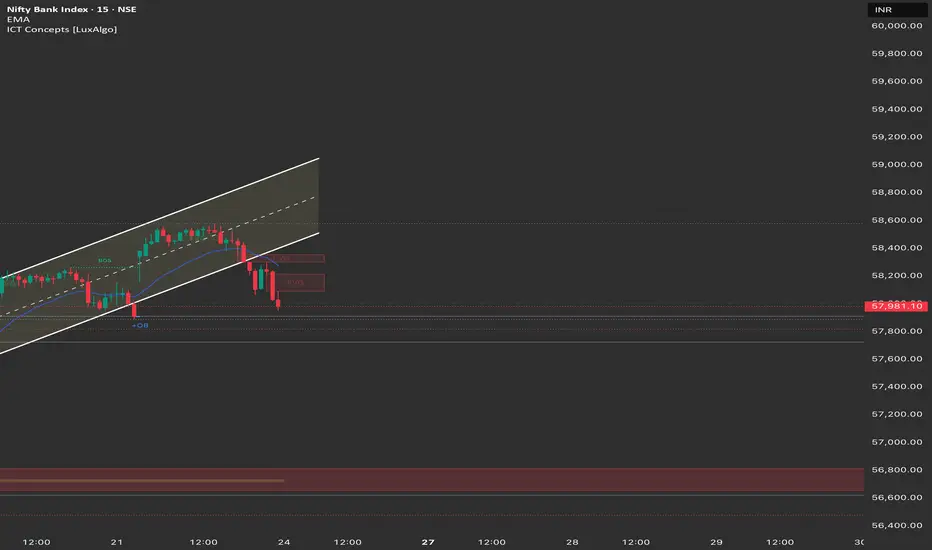
Banknifty Structure Analysis & Trade Plan: 15th OctoberBased on the charts and the market's performance on Tuesday, October 14, the Bank Nifty experienced a sharp reversal from its highs and a breakdown from its short-term ascending channel. The momentum has shifted to a short-term corrective bias.
Detailed Market Structure Breakdown
4-Hour Chart (Macro Trend)
Structure: The Bank Nifty is still in a bullish uptrend, but the price has broken below the lower trendline of its steep short-term ascending channel. The last 4H candle is a strong bearish candle that confirms the Market Structure Shift (MSS) to the downside, signaling a likely deeper pullback.
Key Levels:
Major Supply (Resistance): 56,600 - 56,800. This area is the immediate overhead supply zone, aligning with the rejection high.
Major Demand (Support): 55,400 - 55,600. This area is the key FVG (Fair Value Gap) and the most significant horizontal support for the current uptrend.
Outlook: The trend has shifted to sideways-to-bearish. The market is expected to consolidate or correct towards the 55,400 - 55,600 zone.
1-Hour Chart (Intermediate View)
Structure: The 1H chart shows a clear breakdown from the steep ascending channel. The price is now trading within a newly formed descending channel, making lower highs and lower lows.
Key Levels:
Immediate Resistance: The upper trendline of the descending channel, near 56,300.
Immediate Support: 56,000 (The psychological level and the bottom of the current corrective channel).
15-Minute Chart (Intraday View)
Structure: The 15M chart confirms the intraday bearish momentum. The price broke out of a small consolidation range to the downside and closed near its low, indicating strong bearish control.
Key Levels:
Intraday Supply: 56,300.
Intraday Demand: 56,000.
Outlook: Bearish. A "Sell on Rise" strategy is recommended near 56,300.
📈 Trade Plan (Wednesday, 15th October)
Market Outlook: The Bank Nifty is undergoing a sharp short-term correction. The primary strategy will be to sell into strength or on a breakdown of immediate support. Tech Mahindra and Persistent Systems Q2 results are due today, which may provide sector-specific volatility.
Bearish Scenario (Primary Plan)
Justification: The breakdown of the steep channel and the rejection from the highs favor a continuation of the correction.
Entry: Short entry on a successful retest and rejection of the 56,300 level (upper channel resistance). Alternatively, short a decisive break and 15-minute candle close below 56,000.
Stop Loss (SL): Place a stop loss above 56,600 (above the immediate swing high/supply zone).
Targets:
T1: 55,800 (Minor support/FVG).
T2: 55,400 (Major FVG support).
Bullish Scenario (Counter-Trend/Reversal Plan)
Justification: Only valid if Q2 results provide a strong positive surprise, leading to a break of the current channel.
Trigger: A sustained move and close above the major resistance at 56,600.
Entry: Long entry on a confirmed 15-minute close above 56,600.
Stop Loss (SL): Below 56,400.
Targets:
T1: 57,000 (Psychological target).
T2: 57,300 (Extension target).
Key Levels for Observation:
Immediate Decision Point: 56,000 - 56,300 zone.
Bearish Confirmation: A break and sustained move below 56,000.
Bullish Confirmation: A move back above 56,600.
Line in the Sand: 55,800. Below this level, the short-term bullish bias is severely challenged.
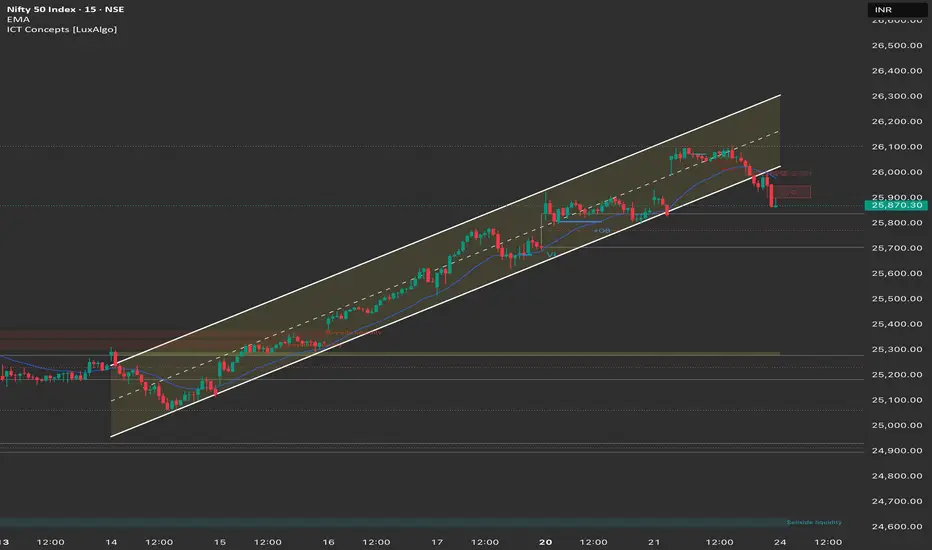
Nifty Structure Analysis & Trade Plan: 15th OctoberBased on the charts and the market's performance on Tuesday, October 14, the Nifty experienced a sharp reversal from its high and a breakdown from a short-term consolidation, indicating a shift to a short-term corrective bias.
Detailed Market Structure Breakdown
4-Hour Chart (Macro Trend)
Structure: The Nifty is now in a corrective phase within its broader bullish trend. The sharp red candle on the 4H chart indicates that the 25,250 - 25,350 supply zone has held firm.
Key Levels:
Major Supply (Resistance): 25,180 - 25,250. This area is now the critical overhead hurdle, coinciding with the previous high and a fresh Order Block (OB).
Major Demand (Support): 25,000 - 25,050. This area includes the psychological 25,000 mark and a prior FVG (Fair Value Gap), serving as the must-hold zone to prevent a deeper correction.
Outlook: The trend has shifted to sideways-to-bearish. The market is expected to test the 25,000 support zone.
1-Hour Chart (Intermediate View)
Structure: The 1H chart shows a clear Break of Structure (BOS) to the downside. The price sold off sharply after failing to sustain the move above 25,250, breaking the immediate swing low and closing below the lower trendline of the ascending channel.
Key Levels:
Immediate Resistance: 25,180 (Prior support, now resistance).
Immediate Support: 25,050 (The lower boundary of the consolidation range).
15-Minute Chart (Intraday View)
Structure: The 15M chart confirms the sharp selling pressure. The market broke out of a small consolidation range to the downside, confirming intraday bearish control. The index is currently moving within a small descending channel.
Key Levels:
Intraday Supply: 25,180.
Intraday Demand: 25,000.
Outlook: Bearish. A "Sell on Rise" strategy is recommended near 25,180.
📈 Trade Plan (Wednesday, 15th October)
Market Outlook: The Nifty is undergoing a sharp short-term correction. The primary strategy will be to sell into strength or on a breakdown of immediate support. Tech Mahindra and Persistent Systems Q2 results are due today, which will heavily influence the market.
Bearish Scenario (Primary Plan)
Justification: The market has confirmed a short-term reversal, and the structure is now corrective. Continuation toward the primary support is favored.
Entry: Short entry on a decisive break and 15-minute candle close below 25,050. Alternatively, short a retest and rejection of the 25,180 level.
Stop Loss (SL): Place a stop loss above 25,250 (above the immediate swing high/supply zone).
Targets:
T1: 25,000 (Psychological support).
T2: 24,900 (Major FVG support).
Bullish Scenario (Counter-Trend/Reversal Plan)
Justification: Only valid if Q2 results are exceptionally strong, leading to a strong move that negates the current selling pressure.
Trigger: A sustained move and close above the resistance at 25,250.
Entry: Long entry on a confirmed 15-minute close above 25,250.
Stop Loss (SL): Below 25,180.
Targets:
T1: 25,350 (Upper resistance).
T2: 25,450 (Previous high).
Key Levels for Observation:
Immediate Decision Point: 25,050 - 25,180 zone.
Bearish Confirmation: A break and sustained move below 25,050.
Bullish Confirmation: A move back above 25,250.
Line in the Sand: 25,000. Below this level, the short-term bullish bias is nullified.
Part 2 Support and Resistance Why Traders Use Options
Options are versatile instruments. Traders use them for:
Speculation – Betting on price movement to earn profits.
Hedging – Protecting existing investments from adverse price moves.
Income Generation – Selling options (writing) to earn the premium.
For example:
A trader may buy a call option expecting prices to rise.
A portfolio manager may buy put options to protect their stocks from falling prices.
An experienced investor may sell covered calls to earn regular income.
ACE Price Action with probable 18R trade set up- Current Price: Around ₹1,081 as of October 2025.
- Market Capitalization: Approximately ₹12,870 Crores.
- 52-week Range: The stock traded between ₹917 and ₹1,600 in the past year.
- PE Ratio: Roughly 31, indicating moderate to high valuation relative to earnings.
- EPS: Around ₹34.4 (TTM).
- Price-to-Book Ratio: About 8, suggesting a premium valuation relative to its book value.
- Dividend Yield: Low, approximately 0.19%.
- Revenue and Profit: Latest annual revenue near ₹3,245 Crores and net profit around ₹423 Crores.
- Price Trend: The stock has faced some downside pressure recently with a 19% decline over the last year but historical performance showing strong growth over 3-5 years.
- Volatility: The stock is moderately volatile, about 3.2 times more than the Nifty index.
- Sector: ACE operates in the heavy machinery and industrial equipment sector, showing good profitability and efficiency metrics with consistent earnings growth.
Overall, ACE trades at a premium valuation reflecting growth expectations but recent price corrections indicate some caution in the market. The company shows good fundamentals with strong earnings growth potential balanced against sector cyclicality and market volatility.
VIMTALABS: Probable pyramid entries
- Current Price: Around ₹715 as of early October 2025, with daily price fluctuations between approximately ₹700 and ₹723.
- 52-week Range: The stock has traded from a low near ₹270 to a high around ₹903, showing strong growth over the past year.
- Market Capitalization: About ₹3,180 Crores.
- Valuation: PE ratio stands near 45, indicating a moderately high valuation relative to earnings.
- Earnings: EPS is about ₹15.9.
- Moving Averages: The 50-day average price is roughly ₹719, and the 200-day average is near ₹545, indicating medium-term momentum in an uptrend.
- Dividend Yield: Very low at around 0.14%, consistent with growth-oriented companies.
- Volume: Recent trading volumes average about 60 lakh shares daily, indicating good liquidity.
- Price Trend: The stock has experienced some volatility but sustained gains overall, with occasional pullbacks and rebounds, reflecting investor confidence in the company’s niche testing and laboratory services sector.
- The stock price structure indicates a bullish phase supported by improving fundamentals and positive market sentiment.
Overall, Vimta Labs shows strong upward price momentum with a solid growth profile, trading at a premium that reflects optimism about its expanding testing services business.
Why Longs Blew Up in the Great $19B Liquidation?Hello Traders!
Recently, crypto markets witnessed one of the biggest shakeouts in history, a $19 billion liquidation that wiped out long traders across Bitcoin, Ethereum, and altcoins in just a few hours.
Everyone called it a “crash,” but what really happened was a classic case of leverage, greed, and poor risk management colliding. Let’s break down the truth behind it.
1. Excessive Leverage Builds the Trap
During bullish phases, traders pile into long positions with 25x, 50x, or even 100x leverage.
The higher the leverage, the smaller the move needed to wipe you out.
Even a 1–2% drop in price can liquidate millions worth of positions instantly.
When too many traders are leveraged in the same direction, the market becomes top-heavy and unstable.
2. Liquidity Hunt – The Smart Money Move
Big players know where the retail stop losses and liquidation points sit, usually below obvious support levels.
They push price just far enough to trigger those liquidations.
Once the forced selling begins, it cascades, creating a chain reaction that accelerates the fall.
It’s not manipulation; it’s how liquidity flows work in leveraged markets.
3. The Domino Effect of Liquidations
When one big position gets liquidated, it triggers auto-sell orders.
Those sells push prices lower, causing more positions to get liquidated.
In minutes, you see billions vanish as exchanges auto-close overleveraged longs.
That’s exactly what created the $19B wipeout, a domino collapse fueled by forced exits.
4. How to Avoid Becoming the Next Victim
Use leverage only if you can handle losing that position completely.
Keep your stop loss and margin buffer wide enough to survive small swings.
Never risk more than 1–2% of your account on a single trade.
And most importantly, don’t chase FOMO entries near resistance levels.
Rahul’s Tip:
Leverage isn’t evil, greed is .
The same tool that builds accounts can destroy them if used recklessly.
In crypto, survival is the real skill, because only survivors get the next bull run.
Conclusion:
The Great $19B liquidation was not random, it was the market teaching a painful lesson about leverage and discipline.
If you want to last long in this game, learn to respect risk before chasing reward.
If this post helped you understand what really happened, like it, share your view in comments, and follow for more realistic market breakdowns!
HDFCAMC Pyramid Price ActionHDFC Asset Management Company Ltd (HDFCAMC) is currently trading around ₹5,669. The stock has recently advanced nearly 2.7% in a single day, with session lows near ₹5,550 and highs close to ₹5,684. Its 52-week range sits between ₹3,525 and ₹5,926, putting the current price near the upper end of its yearly band.
The company’s market capitalization is approximately ₹1,21,300 Crores. Average daily volume is around 12,000 shares, indicating reasonable liquidity for a large-cap stock. The stock holds a trailing P/E ratio of about 47, based on an EPS of ₹121, which is above the broader market average but within the range for premium asset management firms. The dividend yield is around 1.6%. Both 50-day and 200-day averages are close to ₹5,662 and ₹4,717, respectively, illustrating solid medium-term momentum.
Price trends show steady upward bias in 2025, with periodic pullbacks being well-supported and followed by new highs, reflecting investor confidence in HDFC AMC’s market potential, earnings consistency, and recent management initiatives such as a bonus share issue.HDFC Asset Management Company Ltd (HDFCAMC) is currently trading near ₹5,669, showing a strong recent uptrend with prices moving between ₹5,550 and ₹5,684 during the latest session. The 52-week range stands at approximately ₹3,525 to ₹5,926, placing the stock close to its yearly highs.
The company’s market cap is about ₹1,21,000 Crores. Its P/E ratio is around 47 (EPS of ₹121), which reflects a premium over broader market averages but is typical for the asset management sector. Recent daily volumes show consistent interest, and the 50-day and 200-day averages are ₹5,662 and ₹4,717, respectively, confirming a steady upward trend. The dividend yield is close to 1.6%.
Overall price momentum in 2025 remains positive, supported by strong institutional confidence, a track record of earnings growth, and optimism around management initiatives like bonus share announcements.
ARVINDFASN Price ActionArvind Fashions Ltd (ARVINDFASN) price analysis without references:
- Current Price: Around ₹518, with recent trading between ₹497 and ₹520 in mid-October 2025.
- Yearly Range: Approximately ₹320 low to ₹640 high.
- Market Capitalization: About ₹6,900 Crores.
- Price Movements: The stock has shown moderate volatility in recent weeks, oscillating mostly in the ₹500 to ₹540 range.
- Valuation: The P/E is negative due to recent losses, but on recovery trend; a dividend yield near 0.3%.
- Volume: Daily traded volumes average 2-4 lakh shares.
- Moving Averages: The 50-day moving average is near ₹531, and the 200-day moving average is about ₹470, indicating medium-term support.
- Business: Engaged in branded apparel retail with a portfolio of international brands; showing revenue roughly ₹4,700 Crores annually.
- Recent Price Direction: After a slow decline in September 2025, the stock has seen a small upward correction in early October backed by steady market interest.
Overall, Arvind Fashions is trading close to mid-range levels for the year, with potential for recovery but still reflecting some challenges in profitability pressure from the fashion retail sector. The stock price reflects cautious investor sentiment with room for further upside if turnaround efforts gain traction.
Fortis Healthcare’s share price analysisFortis Healthcare’s share price is currently around ₹667, reflecting strong momentum and significant outperformance over the past year, with a return of about 49%. The stock recently touched a 52-week high of ₹744.5 and a low of ₹406, indicating a broad trading range and robust investor interest
Analyst sentiment remains bullish, with most forecasts targeting a price range of ₹736 to ₹850 over the next 12 months, suggesting a potential upside of around 10–20% from current levels . Some projections are even more optimistic, with year-end 2025 targets as high as ₹933 if market conditions remain favorable . Technical indicators currently point to a bullish trend, supporting the positive outlook .
Fundamentally, Fortis Healthcare has reported strong financial results, including an 84% year-on-year jump in net profit for Q3 FY2024-25 and a 40% quarterly profit increase, underscoring operational momentum . The company trades at a price-to-earnings (PE) ratio of about 65, which is above the sector average, indicating that the stock is priced at a premium due to its growth prospects . The price-to-book (PB) ratio is 3.49, and the dividend yield is modest at 0.24% .
In summary, Fortis Healthcare is in a bullish phase, supported by strong earnings growth and positive analyst outlooks. While the stock is trading at a premium valuation, its growth trajectory and sector leadership continue to attract investor interest, with further upside likely if current trends persist
TATAINVEST Price ActionTata Investment Corporation Ltd (TATAINVEST) currently trades near ₹9,300, with recent fluctuation between ₹9,150 and ₹9,450. The stock has ranged from a 52-week low of about ₹5,145 up to ₹11,847 at its high in 2025. Market capitalization is around ₹47,400 Crores, and it remains actively traded with substantial daily volumes.
Valuation is elevated, with a PE ratio near 144 and price-to-book around 1.3. Dividend yield stands at about 0.29%. The book value per share is close to ₹7,266, and earnings per share for the trailing twelve months is approximately ₹65. Revenue for the fiscal year is around ₹308 Crores, with profit roughly ₹327 Crores. Return ratios, like ROE, are conservative at near 1.3%.
The stock's trend in recent months showed a rapid surge from around ₹7,300 to above ₹10,000, followed by some correction as markets consolidated. TATAINVEST generally trades at a premium due to the value of its portfolio and strong investor confidence in its underlying Tata Group holdings.