HINDALCO 1 Week TIme Frame 📌 Current Snapshot
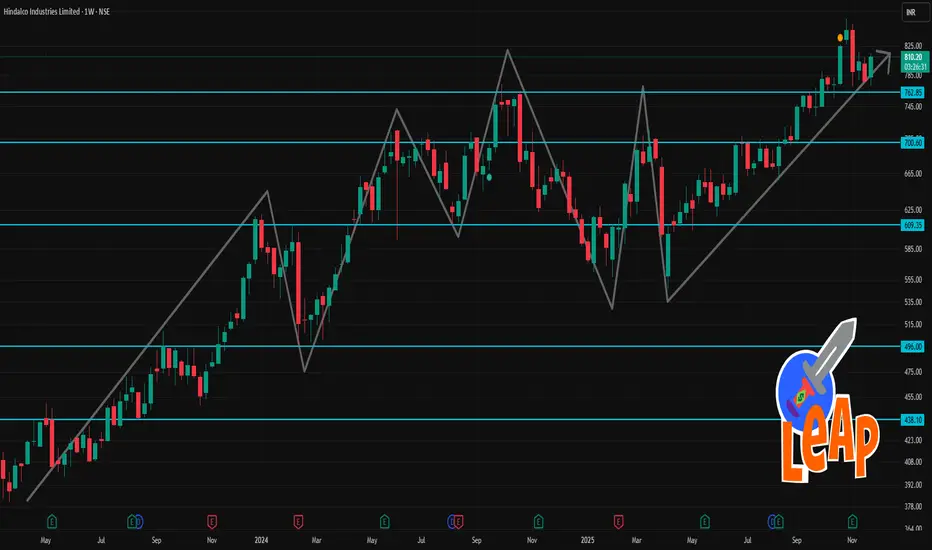
Current price: ~ ₹810–812.
52‑week high / low: ₹864 / ₹546.45
Over the past week, the stock has gained roughly 4–5%.
📈 Key Technical Levels for This Week
If price holds above ~₹766–770, bias remains neutral-to-bullish.
A decisive close above ~₹820 could open upside toward previous highs / next resistance zones.
If price breaks below ~₹755–760, risk of downside increases — watch for potential decline toward lower support zones.
Chartsneverlie
SRF 1 Day Time Frame ✅ Current context
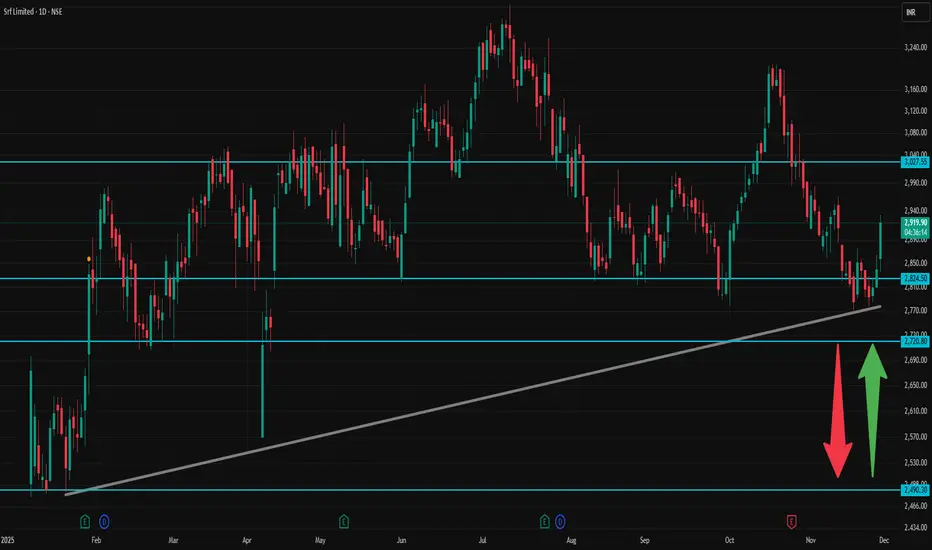
According to public price data, SRF’s recent high for the day is ~ ₹ 2,933, low ~ ₹ 2,836.80.
As per a technical‑analysis summary: moving averages (short-to-medium term) and oscillators on daily timeframe show a bullish bias (Strong Buy on many signals).
🎯 How to interpret / trade with these levels
As long as price stays above Pivot (~₹ 2,866), bias remains mildly bullish — look for R1 → R2 → R3 as possible targets.
If momentum is strong (volume + positive broader market), a break above R2 (~₹ 2,920) could push toward R3 (~₹ 2,933–2,937+).
On downside, supports at ₹ 2,811.93 → ₹ 2,783.87 → ₹ 2,757.73 are key — loss of S1 may open S2/S3.
For conservative traders: good entry or add-on zones could be near S1 or pivot, with stop‑loss a little below S2/S3 depending on risk tolerance.
⚠️ Important caveats
These are static pivot-based levels, and real market moves may overshoot or not respect them depending on news, volume, macro‑market sentiment.
Given volatility (as seen in day’s high-low range), levels above R2 or below S2 can get tested — intraday discipline (stop-loss, position sizing) is crucial.
Always watch volume, overall index trend (Nifty/Sensex), sector news — technical levels work better when confirmed by context.
TATATECH 1 Day Time Frame 📌 Key recent data (approx as of last close):
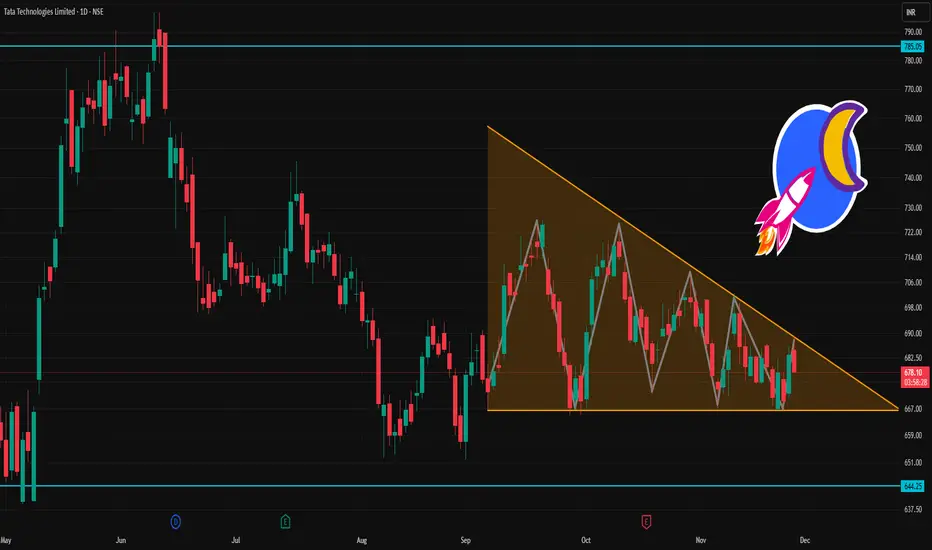
Last traded price: ~ ₹676.75.
Day high / low: ~ ₹679 / ₹670.25.
52‑week high: ~ ₹973.85; 52‑week low: ~ ₹597.
🧮 What this suggests for today (intraday / short‑term only):
If Tata Tech trades above ₹672.7, it could aim for ₹677–684 as short‑term resistance.
A fall below ₹672.7 might push price toward ₹665–661 as support.
₹684–696 could act as a more extended intraday upside zone, if there’s bullish momentum.
🔎 Context & What to Watch Out For
The 52‑week high is still much higher — so in a broader sense, the stock remains far off prior highs.
On short‑term charts, some indicators (e.g. moving‑average crossovers / candle‑pattern heuristics) recently gave bearish / neutral signals.
Volatility and broader market sentiment (especially in the auto / engineering‑services / global tech outsourcing space) can swing prices significantly — so these levels are very approximate.
Gold 1 Day Time Frame 🔎 Current Context
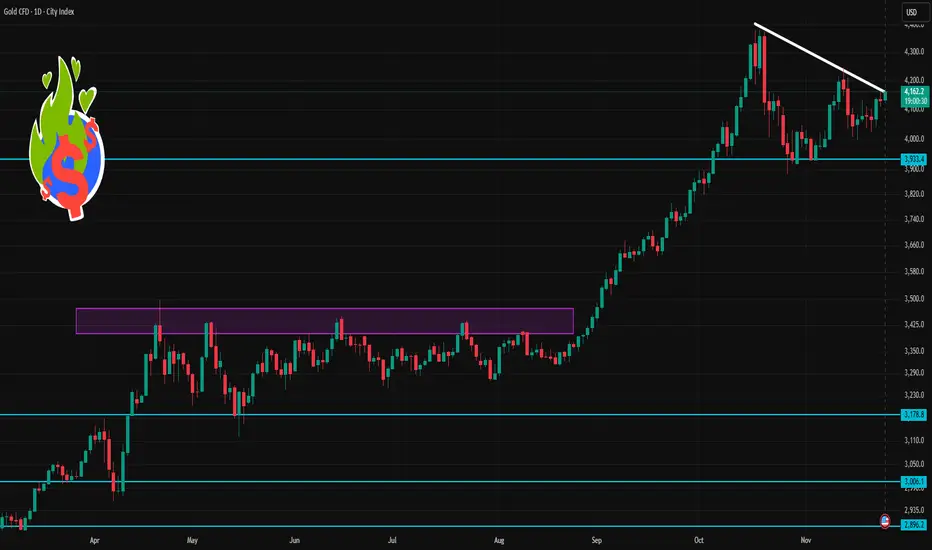
1. Gold currently trades around US $4,160–4,165/oz.
2. Many technical-analysis services show daily momentum as bullish: moving averages, RSI/MACD and other indicators point toward a positive bias.
3. But macro factors (strong USD, Fed policy, global risk sentiment) remain important and may cause sharp swings.
⚠️ What to Watch Out For
Volatility: Gold remains sensitive to macro events — USD strength, rate expectations, major economic data — so price can easily break support/resistance zones.
False Breakouts: Even if price crosses a level, it may revert quickly. Combine with other indicators (volume, price action, confirmations) before acting.
Trend Shifts: A major change in global risk sentiment or central-bank moves can rapidly change trend direction, invalidating technical levels.
CASTROLIND 1 Week View 🔍 Key Levels
Based on recent technical data:
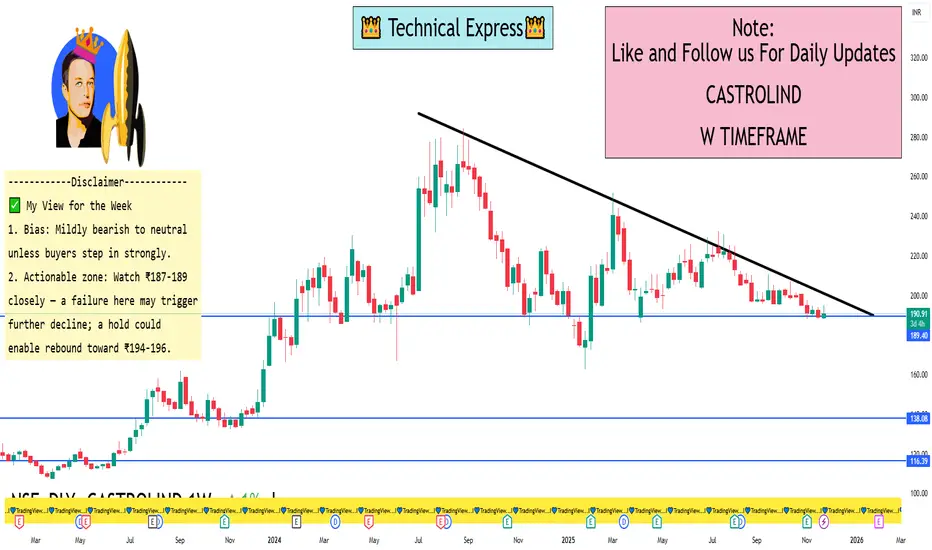
Support zone: ~ ₹187 – ₹189 (ET Money shows S3 ≈ ₹185.42, S2 ≈ ₹186.71)
Pivot / near-term equilibrium: ~ ₹190 – ₹191 (Weekly central pivot ~₹190.42)
Upside resistance: ~ ₹194 - ₹196 (Weekly R1 ~₹192.83, R2 ~₹196.64)
📈 Short-Term Bias & Likely Scenarios
The momentum indicators (RSI ~33, CCI negative) show the stock is under downward pressure/weak momentum.
If the price stays above ₹187-189, one could anticipate a bounce up into the ₹194-196 zone this week.
If it breaks below ~₹187-189 decisively, support further down could be ~₹183-185 (based on extension levels)
✅ My View for the Week
Bias: Mildly bearish to neutral unless buyers step in strongly.
Actionable zone: Watch ₹187-189 closely — a failure here may trigger further decline; a hold could enable rebound toward ₹194-196.
If you want a more aggressive trade setup (with stop-loss, reward ratio), I can map that too.
BEL 1 Day Time Frame✅ Current Status
Latest price around ₹407 – ₹410 on the NSE/BSE.
Technical indicators (daily time frame) are leaning bearish/weak: e.g., daily moving averages show more “sell” signals than “buy”.
📌 Key Levels to Watch (Daily Chart)
Based on available pivot/level data and recent price action, here are approximate levels:
Support levels:
S1 ~ ₹407–₹408
S2 ~ ₹405–₹406
A deeper support zone if this breaks might be ₹400-₹404.
Resistance levels:
Pivot ~ ₹413-₹414
R2 ~ ₹416-₹417
R3 ~ ₹419-₹420+
🔍 Short-Term Outlook
Because the stock is hovering just above support (~₹407-₹408), holding above this zone is important to maintain near-term structure.
If price breaks below ~₹405, risk of further weakness increases.
On the upside, a successful breakout above ~₹416-₹417 could open space towards ~₹419-₹420.
The current momentum is weak/negative, so any upside will likely need a catalyst (volume, news) to gain strength.
ENRIN 1 Day Time Frame 🔍 Key Price Info
Last traded ~ ₹3,090 (as of ~10:44 AM IST) on 25 Nov 2025.
Day’s high-low range: ~ ₹3,090 – ₹3,303 (intraday high reported ~₹3,303).
52-week range: ~ ₹2,508.80 – ₹3,625.00.
🎯 Support & Resistance Levels (Short Term)
Support Levels:
~ ₹3,050 – ₹3,070: close to current price, would be first level of support.
~ ₹3,000 – ₹3,030: if the stock breaks below the above, this zone becomes important.
~ ₹2,950 – ₹2,990: deeper support and closer to lower end of recent consolidation.
Resistance Levels:
~ ₹3,250 – ₹3,300: recent high zone around ₹3,303, so getting above this would be bullish.
~ ₹3,350 – ₹3,400: next significant zone before approaching the 52-week high.
~ ₹3,600+: near the 52-week high (₹3,625) and a major resistance barrier.
📉 Intraday Trading View
If the stock holds above ~₹3,050-₹3,070 with strong volume, it could attempt a push toward the resistance zone of ~₹3,250-₹3,300.
If it loses support at ~₹3,050, watch for potential slide toward ~₹3,000 or lower ~₹2,950 zone.
Volume, market sentiment & any corporate news will greatly influence whether it can break resistance or find support.
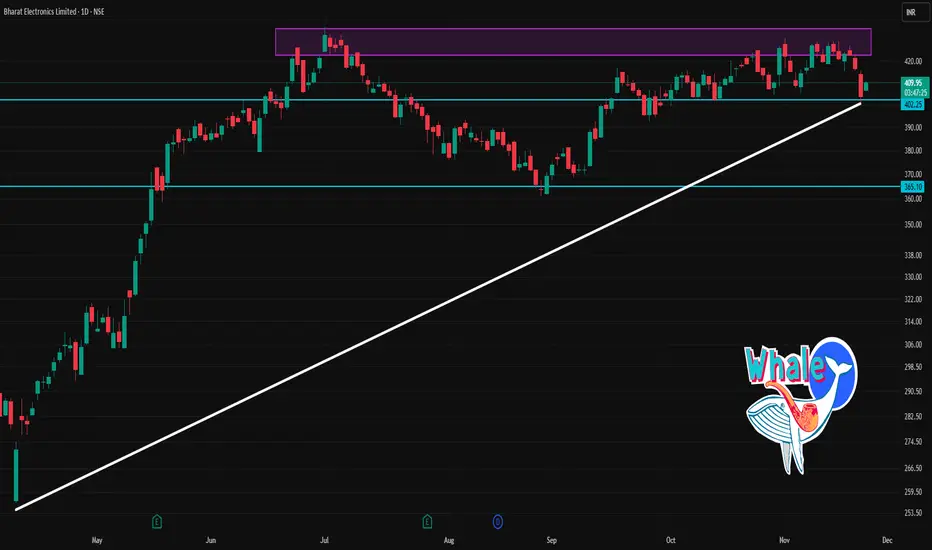
BEL 1 Month Time Frame📌 Key Levels & Observations
Current price: approximately ₹ 416.35 per share.
Recent range: Daily highs ~₹ 423–424, lows ~₹ 415.50.
52-week high ~₹ 436 and 52-week low ~₹ 240.25.
🎯 Short-Term (1-Month) Important Levels
Support zone: ~₹ 405-410 — falling below this may weaken short-term structure.
Resistance zone: ~₹ 430-435 — breaking above this could open scope toward ₹ 440.
Near-term target range: If bullish momentum holds, look toward ~₹ 430-440.
Risk zone: If momentum falters and the support zone fails, price may drift back toward ~₹ 400 or lower.
⚠️ Caveats
These levels are technical estimates, not fundamental valuations or guarantees.
Market sentiment, order flows (for BEL), defence‐policy changes, etc. can shift the picture quickly.
Always use stop-loss or risk controls.
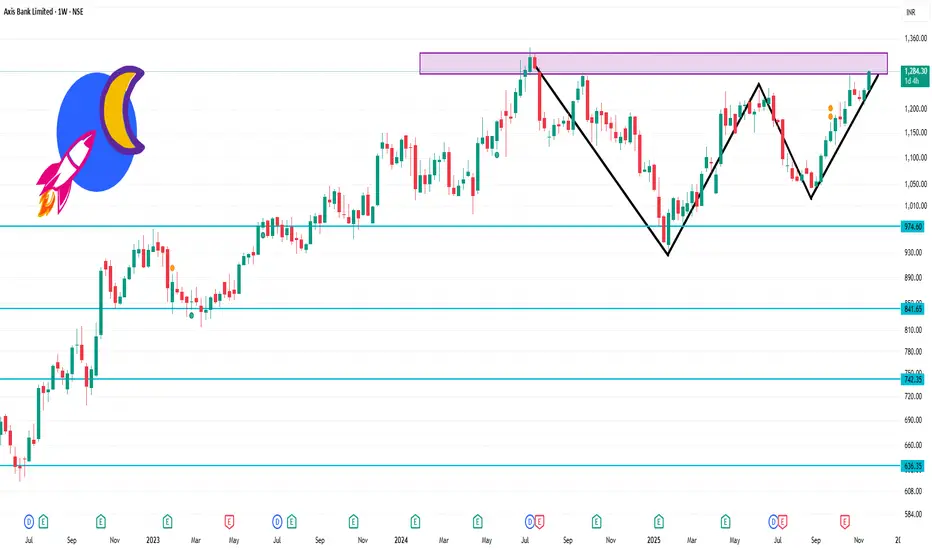
AXISBANK 1 Week Time Frame 🔍 Key Levels for the Week
Based on recent pivot/technical data:
Resistance levels: ~ ₹1,276 to ₹1,282 (around daily R1/R2)
Higher resistance: ~ ₹1,290-₹1,302 if uplink happens
Support levels: ~ ₹1,252-₹1,246 as near-term floor
Broader weekly support: ~ ₹1,232-₹1,218 region if deeper pullback
⚠️ Things to keep in mind
Current price is near the 52-week high region (~₹1,284) which increases risk of resistance/strain.
Short-term signals/pivots are useful but market news, macro banking events, FII/DII flows can quickly shift dynamics.
Use stop-losses or risk-controls if trading around these levels given the tight range and possible whipsaw.
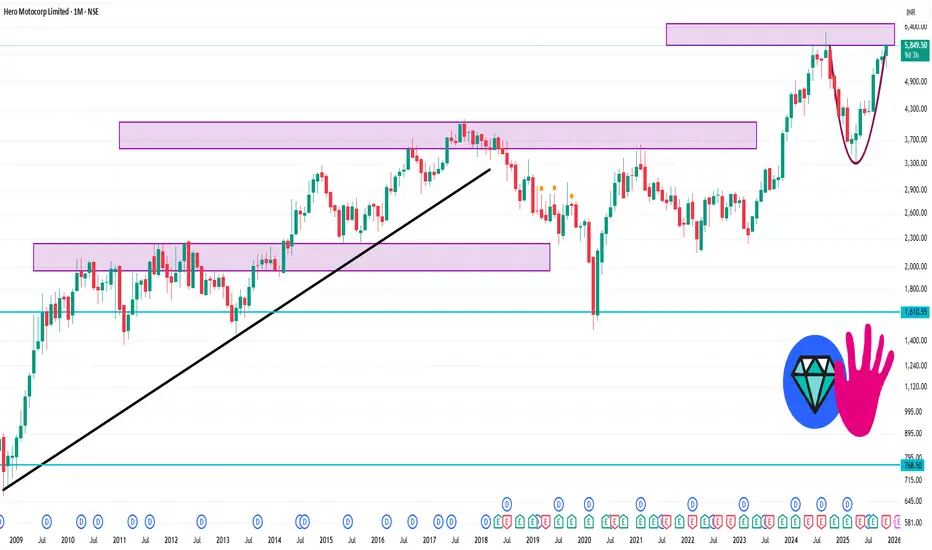
HEROMOTOCO 1 Month Time Frame 🎯 Key Price Levels (1-Month Timeframe)
Here are approximate support & resistance levels you may watch in the next month:
Resistance levels:
~ ₹5,850-₹5,900: Price is already trading around this band (Trendlyne shows ~₹5,850).
Next major resistance might lie closer to ~ ₹6,000-₹6,100 if momentum carries on (psychological level + prior swing highs).
Support levels:
First major support: ~ ₹5,600-₹5,650 (just under current trading zone)
Secondary support: ~ ₹5,300-₹5,400 zone — a deeper pull-back level if the first support gives way.
Pivot / mid-zone:
A pivot or neutral zone around ~ ₹5,700-₹5,800 may act as a battleground between bulls & bears.
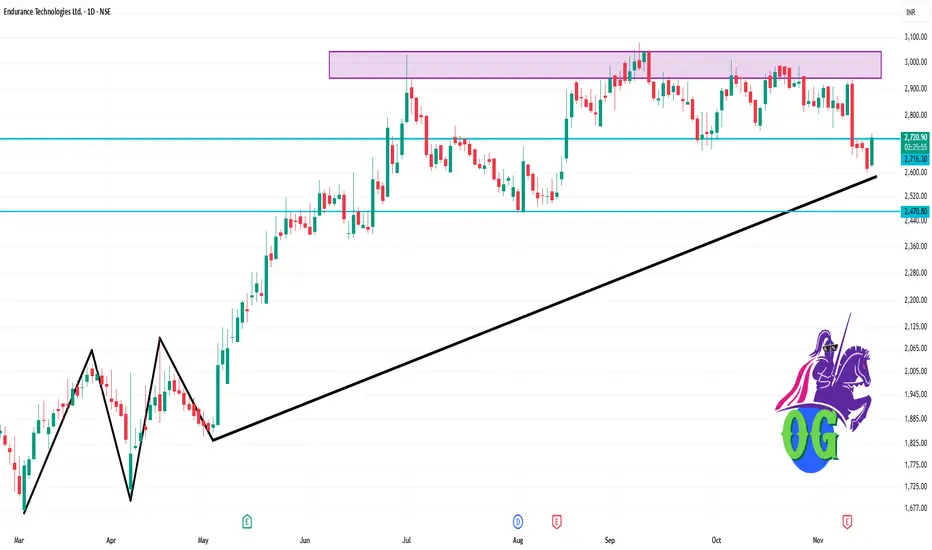
ENDURANCE 1 Day Time Frame 📌 Key Price Data
Last traded price: ~ ₹2,720.50 (as of 19 Nov 2025, ~11:57 AM IST)
Day’s high ~ ₹2,729.90, day’s low ~ ₹2,616.10
Previous close: ~ ₹2,615.10
📉 Daily Support & Resistance Zones
Based on the intraday range and recent levels:
Immediate support zone: ~ ₹2,620 – ₹2,650 (just above the day’s low)
Second support: ~ ₹2,580 – ₹2,600 (below current trading, potential break level)
Immediate resistance zone: ~ ₹2,730 – ₹2,760 (near day’s high)
Higher resistance: ~ ₹2,900 – ₹3,000+ (a more medium-term zone)
LICI 1 Week View 🔢 Current status
The stock is currently trading around ₹ 911 on the NSE.
Day-range recently: approx ₹ 906.60 to ₹ 920.60.
52-week range: approx ₹ 715.30 to ₹ 1,007.80.
📉 Key levels to watch for the coming week
Support zone: Roughly around ₹ 895-₹ 900 — the recent trading floor is around that area.
Resistance zone: Near ₹ 920-₹ 930 — this is where the recent high end of the day‐ranges have been.
If price breaks above ~₹ 930 with strength, that could open a move toward ~₹ 950 in the short term (assuming favourable market context).
If price falls below ~₹ 895, risk of a slip toward ~₹ 880 or lower until a new base is found.
⚠️ What to Watch / Risks
The 1-week gain is modest; there’s no strong breakout yet.
If broader market or sector weakens (insurance/financials), LICI could get caught in the drift.
Watch news / earnings triggers that could suddenly shift sentiment.
📝 Disclaimer
This is not a recommendation to buy or sell. Viewing over just one week is very short‐term and subject to high uncertainty. Please consider your own risk profile and possibly consult a financial advisor.
AVANTIFEED 1 Day Time Frame 🔍 Key Levels
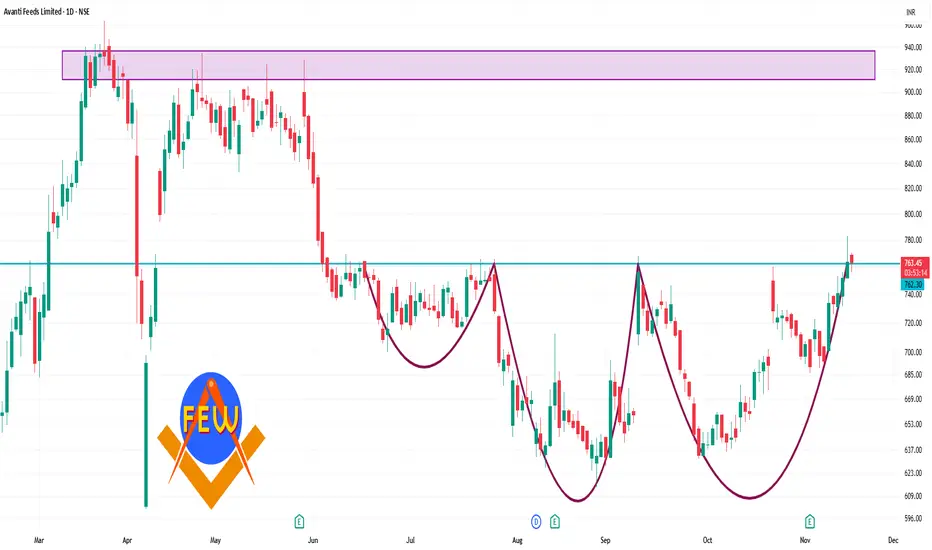
Pivot (Daily): ~ ₹ 746.47
Resistance levels:
R1 ~ ₹ 761.48
R2 ~ ₹ 770.92
R3 ~ ₹ 785.93
Support levels:
S1 ~ ₹ 737.03
S2 ~ ₹ 722.02
S3 ~ ₹ 712.58
✅ Interpretation & Use
If price holds above ~₹ 746.47 and shows strength, the next meaningful resistance zone is ~ ₹ 761-771.
If price drops below the pivot, then supports around ~ ₹ 737, and further down ~ ₹ 722 or ~ ₹ 712 become relevant.
The momentum indicators (RSI ~67.6, MACD positive) suggest bullish bias but note: when RSI gets high → risk of pull-back increases.
Bollinger Bands: How to Stop Being a Slave to the Markets.Bollinger Bands: How to Stop Being a Slave to the Markets.
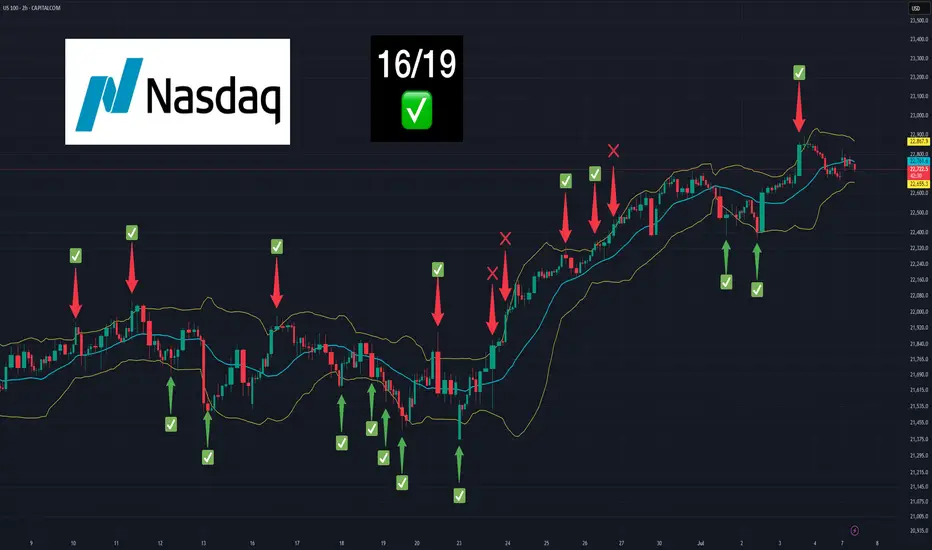
Bollinger Bands are a technical analysis indicator widely used in trading to assess the volatility of a financial asset and anticipate price movements. Created in the 1980s by John Bollinger, they consist of three lines superimposed on the price chart:
The middle band: a simple moving average, generally calculated over 20 periods.
The upper band: the moving average to which two standard deviations are added.
The lower band: the moving average to which two standard deviations are subtracted.
These bands form a dynamic channel around the price, which widens during periods of high volatility and narrows when the market is calm. When a price touches or exceeds a band, it can signal an overbought or oversold situation, or a potential trend reversal or continuation, depending on the market context.
What are Bollinger Bands used for? Measuring volatility: The wider the bands spread, the higher the volatility.
Identifying dynamic support and resistance zones.
Detecting market excesses: A price touching the upper or lower band may indicate a temporary excess.
Anticipating reversals or consolidations: A tightening of the bands often heralds an upcoming burst of volatility.
Why is the 2-hour time frame so widely used and relevant?
The 2-hour (H2) time frame is particularly popular with many traders for several reasons:
Perfect balance between noise and relevance: The H2 offers a compromise between very short time frames (often too noisy, generating many false signals) and long time frames (slower to react). This allows you to capture significant movements without being overwhelmed by minor fluctuations.
Suitable for swing trading and intraday trading: This timeframe allows you to hold a position for several hours or days, while maintaining good responsiveness to take advantage of intermediate trends.
Clearer reading of chart patterns: Technical patterns (triangles, double tops, Wolfe waves, etc.) are often clearer and more reliable on H2 than on shorter timeframes, which facilitates decision-making.
Less stress, better time management: On H2, there is no need to constantly monitor screens. Monitoring every two hours is sufficient, which is ideal for active traders who don't want to be slaves to the market.
Statistical relevance: Numerous backtests show that technical signals (such as those from Bollinger Bands) are more robust and less prone to false signals on this intermediate timeframe.
In summary, the 2-hour timeframe is often considered "amazing" because it combines the precision of intraday trading with the reliability of swing trading, providing superior signals for most technical strategies, especially those using Bollinger Bands.
To summarize
Bollinger Bands measure volatility and help identify overbought/oversold areas or potential reversals.
The 2-hour timeframe is highly valued because it filters out market noise while remaining sufficiently responsive, making it particularly useful for technical analysis and trading decision-making.
Real Success Rates of the Falling Wedge in TradingReal Success Rates of the Falling Wedge in Trading
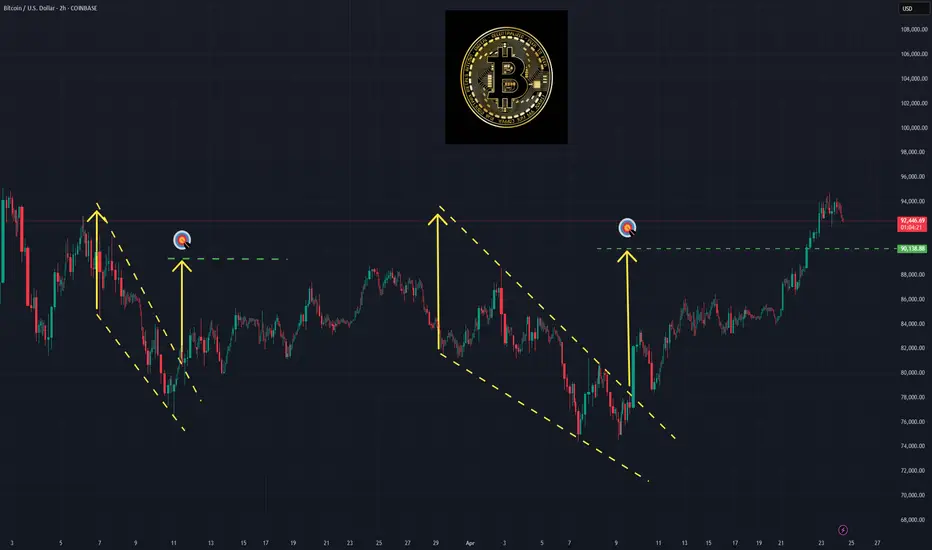
The falling wedge is a chart pattern highly valued by traders for its potential for bullish reversals after a bearish or consolidation phase. Its effectiveness has been extensively studied and documented by various technical analysts and leading authors.
Key Statistics
Bullish Exit: In 82% of cases, the exit from the falling wedge is upward, making it one of the most reliable patterns for anticipating a positive reversal.
Price Target Achieved: The pattern's theoretical target (calculated by plotting the height of the wedge at the breakout point) is achieved in approximately 63% to 88% of cases, depending on the source, demonstrating a high success rate for profit-taking.
Trend Reversal: In 55% to 68% of cases, the falling wedge acts as a reversal pattern, signaling the end of a downtrend and the beginning of a new bullish phase.
Pullback: After the breakout, a pullback (return to the resistance line) occurs in approximately 53% to 56% of cases, which can provide a second entry opportunity but tends to reduce the pattern's overall performance.
False Breakouts: False exits represent between 10% and 27% of cases. However, a false bullish breakout only results in a true bearish breakout in 3% of cases, making the bullish signal particularly robust.
Performance and Context
Bull Market: The pattern performs particularly well when it appears during a corrective phase of an uptrend, with a profit target reached in 70% of cases within three months.
Gain Potential: The maximum gain potential can reach 32% in half of cases during a bullish breakout, according to statistical studies on equity markets.
Formation Time: The wider the wedge and the steeper the trend lines, the faster and more violent the post-breakout upward movement will be.
Comparative Summary of Success Rates:
Criteria Rate ..........................................Observed Frequency
Bullish Exit ........................................................82%
Price Target Achieved ........................................63% to 88%
Reversal Pattern ..............................................55% to 68%
Pullback After Breakout .....................................53% to 56%
False Breakouts (False Exits) ...............................10% to 27%
Bullish False Breakouts Leading to a Downside ..............3%
Points of Attention
The falling wedge is a rare and difficult pattern to correctly identify, requiring at least five contact points to be valid.
Performance is best when the breakout occurs around 60% of the pattern's length and when volume increases at the time of the breakout.
Pullbacks, although frequent, tend to weaken the initial bullish momentum.
Conclusion
The falling wedge has a remarkable success rate, with more than 8 out of 10 cases resulting in a bullish exit and a price target being reached in the majority of cases. However, it remains essential to validate the pattern with other technical signals (volume, momentum) and to remain vigilant against false breakouts, even if their rate is relatively low. When mastered, this pattern proves to be a valuable tool for traders looking for optimized entry points on bullish reversals.
Adverse excursion: a key concept for risk managementAs a professional trader, I can tell you about the adverse excursion and its crucial importance in the world of trading.
Adverse excursion: a key concept for risk management
Adverse excursion refers to the unfavorable movement of the price of an asset after a position is opened. More precisely, it is the difference between the entry price and the worst point the price reaches before the position becomes profitable again or is closed.
Maximum Adverse Excursion (MAE)
The concept of Maximum Adverse Excursion (MAE), developed by John Sweeney, is particularly useful. It measures the maximum floating loss suffered by a position before it turns in your favor or is closed. The MAE is a powerful statistical tool for analyzing drawdowns in an open position.
Trading Efficiency
Using MAE has several benefits for traders:
Optimizing Stop-Loss: By analyzing MAE over a series of trades, the optimal level for placing stop-loss orders can be statistically determined.
Evaluating Trading Systems: MAE helps evaluate the performance of trading systems and identify areas for improvement.
Refining Risk Management Strategies: By understanding the maximum adverse moves, traders can refine their strategies to better preserve their capital.
Improving Trading Efficiency: MAE analysis can help improve decision-making and execute trades with greater accuracy and confidence.
Practical Application
To effectively use the concept of adverse excursion, it is crucial to collect data on a large number of trades. For example, if you observe a series of MAEs like this: 15, 23, 18, 16, 0, 11, 31, 17, 8, 0, 19, 26, 0, 38, 22, you can deduce valuable information about the behavior of your trades and adjust your stop-loss levels accordingly.
In conclusion, the adverse excursion and especially the MAE are powerful tools for any serious trader. They allow to optimize risk management, improve the performance of strategies and make more informed decisions. As they say in the trade, "who controls his risks, controls his profits".
_______
Using the Maximum Adverse Excursion (MAE) has several significant advantages over traditional stop-loss placement methods:
Data-driven optimization
The MAE allows for a more precise and data-driven approach to stop-loss placement:
Statistical analysis: By examining the distribution of the MAE over a large number of trades, the optimal level for placing stop-loss orders can be statistically determined.
Performance visualization: The graphical representation of the MAE provides a clear overview of trade performance, allowing the most effective stop-loss levels to be visually identified.
Balancing protection and performance
The MAE helps to find an optimal balance between capital protection and trading performance:
Retention of winning trades: The stop-loss can be placed to retain 75-85% of winning trades, thus avoiding prematurely cutting potentially profitable positions.
Elimination of large losses: At the same time, this approach eliminates trades that suffer large losses, thus protecting capital.
Adaptation to the specific strategy
The MAE adapts to the unique characteristics of each trading strategy:
Customization: Unlike generic methods, the MAE takes into account the specific behavior of the trades of a given strategy.
Flexibility: This approach can be applied to a variety of strategies, whether short-term trading, swing trading, or long-term positions3.
Improved risk management
Using the MAE contributes to better overall risk management:
Deep understanding: The MAE provides a more nuanced understanding of how trades evolve, allowing for better risk assessment.
Reduced stress: By having a solid basis for placing stop-losses, traders can reduce the stress associated with real-time decision-making.
Complementarity with other tools
The MAE can be used in conjunction with other techniques:
Combination with the MFE: The analysis of the Maximum Favorable Excursion (MFE) in parallel can help to optimize not only the stop-losses, but also the profit-taking.
Cross-validation: The results obtained by the MAE analysis can be compared with those of traditional parameter optimization methods for greater confidence in the strategy.
Real Success Rates of the "Rising Wedge" in TradingReal Success Rates of the Rising Wedge in Trading
Introduction
The rising wedge, also known as the "rising wedge" in English, is a chart pattern that has a remarkable success rate in trading. This analysis details its performance, reliability and complementary indicators to optimize its use.
Success Rate and Performance
-Key Statistics
Overall success rate: 81% in bull markets
Average potential profit: 38% in an existing uptrend
-Breakout Direction
Bearish: 60% of cases
Bullish: 40% of cases
Contextual Reliability
Bull market: 81% success, average gain of 38%
After a downtrend: 51% success, average decline of 9%
Important Considerations
The rising wedge is generally a bearish pattern, indicating a potential reversal.
Reliability increases with the duration of the pattern formation.
Confirmation of the breakout by other indicators, especially volume, is crucial.
Complementary Indicators
-Volume
Gradual decrease during formation
Significant increase during breakout
-Oscillators
RSI (Relative Strength Index): Identifies overbought/oversold conditions
Stochastics: Detects price/indicator divergences
-Moving Averages
Crossovers: Signal trend changes
-Dynamic Support/Resistance: Confirm the validity of the wedge
-Momentum Indicators
MACD: Identifies price/indicator divergences
Momentum: Assesses the exhaustion of the trend
-Other Elements
Fibonacci Levels: Identify potential support/resistance
Japanese Candlestick Analysis: Provides indications of reversals
Conclusion
The rising wedge is a powerful tool for traders, offering a high success rate and significant profit potential. The combined use of complementary indicators increases the reliability of the signal and improves the accuracy of trading decisions. It is essential to look for a convergence of signals from multiple sources to minimize false signals and optimize trading performance.
_______________________________________________
Here are the best times to enter a trade after a rising wedge, in a professional manner:
-The confirmed breakout
Wait for the candle to close below the support line of the wedge.
Look for a significant increase in volume during the breakout to confirm its validity.
-The retest
Look for a pullback on the broken support line, which has become resistance.
Enter when the price rebounds downward on this new resistance, confirming the downtrend.
-The post-breakout consolidation
Identify the formation of a flag or pennant after the initial breakout.
Enter when this mini-formation breaks in the direction of the main downtrend.
-The confirmed divergences
Spot bearish divergences on oscillators such as the RSI or the MACD.
Enter when price confirms divergence by breaking a nearby support.
-Timing with Japanese Candlesticks
Identify bearish formations such as the Evening Star, Bearish Harami, or Dark Cloud.
Enter as soon as the next candle confirms the bearish pattern.
-Important Considerations
Always place a stop-loss to manage risk effectively.
Be patient and wait for the setup to be confirmed before entering the trade
Check the trend on higher timeframes to ensure the consistency of the trade.
Integrate the analysis of the rising wedge with other technical indicators to improve the quality of decisions.
By following these recommendations, traders can optimize their entries on rising wedges while minimizing the risk of false signals.
The Symmetrical Triangle: Real Success Rates + Breakout.The Symmetrical Triangle: Real Success Rates + Breakout.
The symmetrical triangle is an important chart pattern in technical analysis, deserving special attention from professional traders.
This formation is characterized by a convergence of prices between two trendlines, one descending and the other ascending, creating a consolidation zone where indecision between buyers and sellers is palpable.
Statistical Analysis
Empirical data reveals that the success rate of the symmetrical triangle for a trend continuation is approximately 54%. This percentage, although higher than 50%, underlines the importance of a cautious approach and rigorous risk management in using this pattern.
Breakout Point
The breakout of the symmetrical triangle usually occurs when the price has traveled approximately 75% of the distance to the apex. This point is crucial for traders, as it often represents the moment when volatility increases and a new trend can be established.
Risks and False Exits
It is essential to note that the symmetrical triangle has a relatively high rate of false exits. Statistics indicate that approximately 13% of cases in a bear market can result in a false exit to the bottom. This phenomenon underlines the need for additional confirmation before entering a position.
Strategy of use
To effectively exploit the symmetrical triangle, professional traders must:
-Identify the formation accurately.
-Wait for the breakout near the point of convergence of the trendlines.
-Confirm the breakout with other technical indicators or an increase in volume.
-Put in place strict risk management to protect against false exits.
In conclusion, the symmetrical triangle, although being a valuable tool in the trader's arsenal, requires a methodical approach and a thorough understanding of its characteristics to be used effectively in a trading strategy.
The 45 Degree Line: A Very Effective Tool in Trading.The 45 Degree Line: A Very Effective Tool in Trading.
When the ppix of an asset explodes and forms a very steep slope, the 45 degree line, also known as the 1x1 Gannangle, is an important and very useful tool in technical analysis, used to identify and predict market corrections.
Meaning of the 45 degree line:
The 45 degree line represents an equilibrium trend in technical analysis. It is considered an average support or resistance line, indicating a balance between time and price. This line is particularly important because it suggests a constant and balanced progression of the market.
Main characteristics
-Angle: The 45 degree line forms an angle of 45° with the horizontal axis of the chart.
-Notation: It is often noted 1x1, which means that it represents a movement of one unit of price for one unit of time.
-Interpretation: A trend following this angle is generally considered strong and likely to continue in the same direction.
Use in Technical Analysis
Traders use the 45-degree line in several ways:
-Identifying trend strength: A trend that follows or exceeds the 45-degree angle is considered strong.
-Support and resistance: The line can act as a dynamic level of support in an uptrend or resistance in a downtrend.
-Forecasting movements: Traders can anticipate trend changes when price deviates significantly from the 45-degree line.
-Multi-timeframe analysis: The line can be applied on different time frames, from short-term to long-term, for a more comprehensive analysis.
Integration with other tools
The 45-degree line is often used in conjunction with other technical analysis tools for a more robust analysis. It can be combined with indicators, chart patterns, or other Gannangles to confirm trading signals and improve forecast accuracy.
In conclusion, the 45-degree line is a powerful but often underestimated tool in technical analysis. Its simplicity and versatility make it a valuable tool for traders looking to identify and follow market trends with precision.
The "Head and Shoulders": Real success rates.The "Head and Shoulders": Real success rates.
Inverted Head and Shoulders: WATCH volumes when the neckline breaks!!
Here is what we can say about the success rate of the inverted head and shoulders pattern in trading:
- The inverted head and shoulders pattern is considered one of the most reliable chart patterns to anticipate a bullish reversal.
- According to some sources, the success rate of this pattern would be very high, with approximately 98% of cases resulting in a bullish exit.
- More precisely, in 63% of cases, the price would reach the price target calculated from the pattern when the neckline is broken.
- A pull-back (return to the neckline after the break) would occur in 45% of cases.
- However, it should be noted that these very optimistic figures must be qualified. Other sources indicate more modest success rates, around 60%.
-The reliability of the pattern depends on several factors such as respect for proportions, the break of the neckline, volumes, etc. A rigorous analysis is necessary.
-It is recommended to use this pattern in addition to other indicators and analyses, rather than relying on it blindly.
In conclusion, although the inverse head and shoulders pattern is considered a very reliable pattern, its actual success rate is probably closer to 60-70% than the 98% sometimes claimed. It remains a useful tool but must be used with caution and in addition to other analyses.
__________________________________________________________________
Head and Shoulders:
Here is what we can say about the success rate of the head and shoulders pattern in trading:
-The head and shoulders pattern is considered one of the most reliable chart patterns, but its exact success rate is debated among technical analysts. Here are the key takeaways:
- Some sources claim very high success rates, up to 93% or 96%. However, these figures are likely exaggerated and do not reflect the reality of trading.
- In reality, the success rate is likely more modest. One cited study indicates that the price target is reached in about 60% of cases for a classic head and shoulders pattern.
- It is important to note that the head and shoulders pattern is not an infallible pattern. Its presence alone is not enough to guarantee a trend reversal.
- The reliability of the pattern depends on several factors such as respect for proportions, the breakout of the neckline, volumes, etc. Rigorous analysis is necessary.
- Many experienced traders recommend using this pattern in addition to other indicators and analyses, rather than relying on it blindly.
In conclusion, while the head and shoulders pattern is considered a reliable pattern, its actual success rate is probably closer to 60% than the 90%+ sometimes claimed. It remains a useful tool but should be used with caution and in conjunction with other analyses.
_____________________________________________________________________________
NB: In comparison, the classic (bearish) head and shoulders pattern would have a slightly lower success rate, with around 60% of cases where the price target is reached.
The “Fan Principle” is a powerful technique in tradingThe “Fan Principle” is a powerful technique in trading, using trendlines to predict price movements.
Highlights
📈 Powerful Technique: The Fan Principle is formidable in technical analysis.
📉 Identifying Points: Drawing trendlines from three key points.
🔴 Trading Signals: Buy or sell signals can be identified depending on the pattern.
📊 Practical Examples: Analyzing price movements on charts to illustrate the technique.
💰 Profit Opportunities: Strategies can result in significant gains, up to 22%.
🛑 Risk Management: Importance of placing stop-losses to protect investments.
🔍 Additional Resources: Detailed information and charts will be shared to deepen understanding.
Key Insights
📈 Technique Effectiveness: The Fan Principle helps identify clear trends using reference points, making the strategy both simple and effective.
📉 Importance of Confirmation: Validating trendlines with a third point builds confidence in trading signals, increasing the chances of success.
🔴 Warning Signals: Sell or buy signals, as shown in the video, can lead to strategic decisions based on historical analysis.
📊 Visual Analysis: Visualizing data on charts helps understand market movements, which is essential for technical analysis.
💰 Profit Potential: Trades based on the Fan Principle can provide significant profit opportunities, highlighting its effectiveness.
🛑 Protection Strategies: Placing stop-losses above resistance points is crucial to limit losses in the event of adverse market movements.
🔍 Access to resources: The information shared in the description and on other platforms offers ways to deepen the understanding of the technique and improve trading skills.
__________________________________________________________________
The fan principle in trading is a strategy that consists of opening several positions on the same asset at different price levels. Here are the main aspects of this approach:
How it works
The idea is to open several positions (or "lots") on the same financial asset at different price levels, thus forming a "fan" of positions.
These positions are opened at points considered as potential market reversals.
The objective is to let these positions unfold like a fan or to close them gradually according to the evolution of the market.
Advantages
Risk diversification: By entering the market at different levels, the trader reduces the impact of a single bad entry.
Movement capture: This approach allows to take advantage of different phases of a price movement.
Flexibility: The trader can adjust his strategy by closing some positions while keeping others open.
Complementary Tools
The fan principle can be combined with other technical analysis tools to improve its effectiveness:
Fibonacci Fan: This tool automatically draws trendlines at key levels (38.2%, 50%, 61.8%) that can serve as entry points for fan positions.
Gann Angles: These lines, drawn at different angles (82.5°, 75°, 71.25°, etc.), can also help identify potential levels to open positions.
RSI (Relative Strength Index): Some traders combine the fan principle with the RSI to confirm entry points.
Important Considerations
This strategy requires good risk management, as it involves opening multiple positions.
It is crucial to set stop-loss and take-profit levels for each position in the range.
Using this approach requires a thorough understanding of the market and significant trading experience.
NVIDIA: Bearish: Possible Head and Shoulders: Warning!NVIDIA: Bearish: Possible Head and Shoulders: Warning!
Hello everyone The Wolf of Zurich has detected a possible "head and shoulder" on Nvidia, which would bring the price down to around $42.
I have also drawn a trend line that you absolutely must watch!
The level to watch is around $98-98
Here, watch your Fibonacci levels as well as your exponential mobile means
Have a nice day everyone
Some information to know about Nvidia:
Nvidia, the world leader in graphics chips and AI, is enjoying a flourishing situation despite a recent drop in its stock price.
Here is a summary of its current situation:
-Dominant position in the AI market
Nvidia occupies a quasi-monopolistic position in the field of chips for artificial intelligence. Its GPUs, especially the H100 series, are essential for the development of cutting-edge AI systems and are selling at high prices around the world.
-Stock market performance
Despite a recent 9.53% drop in its share price, Nvidia has posted an impressive 120% increase since the beginning of the year and nearly 400% over 3 years. This one-off drop does not seem to worry analysts, who still see significant growth potential.
-Technological innovations
Nvidia recently presented its new Blackwell GPU architecture, with the B200 and GB200 processors. These chips promise performance multiplied by 5 compared to the previous generation in the field of AI. The company also reassured investors by announcing that it had resolved the production problems initially encountered.
-Future Outlook
With its dominance in AI training chips and its comprehensive software ecosystem, Nvidia appears well positioned for continued growth. The company continues to innovate and strengthen its position in the AI market, which suggests a positive outlook for the future.