FOXCONN of India - A overlook on DIXON TECHNSE:DIXON
Hey Folks,
Today we are talking about Dixon Technologies aka foxconn of India. the Q3 results shows +68% in PAT. which looks good as headline numbers. but diving deep I found that Dixon tech slides over a thin margin module as it is high-volume producer to marquee clients and that operating margin didn't show up as good as the other metrics, which seems attractive.
So, considering current geopolitics any slight hike in raw material could easily affect the operating cost thus affect on the profits.
But Yesterday, we found out the US INDIA Trade Deal out of blue which likely seemed to give more edge to the company in the export service. also the New budget aligns in favour with the manufacturing sector, that's also likely to give certain edge if the company keep the capital expenditure in check with the expectation to the last quarter.
Now, looking technically for long term perspective on the weekly chart. it has sustained above the 200EMA with a large green candle today. Also it closed above the last key support of 10650 (horizontal line in the chart). next target is the 0.78 level of fib i.e. 11700 to tackle. if it breaks that finds it fair value above that zone. we might see the new high of DIXON in near future.
I do not complicate much in technicals for long term view. So open to discussion how you look at it.
:) Thanks. Happy trading.
Earningsanalysis
Alpha Capture Through Earnings SurprisesUnderstanding Alpha and Earnings Surprises
Alpha represents returns above a benchmark (like the Nifty 50 or S&P 500) after adjusting for risk. If the index gives 12% and your strategy gives 18% with similar risk, that extra 6% is alpha.
An earnings surprise occurs when a company’s reported earnings (EPS or profits) differ materially from analyst expectations. These expectations are not casual guesses—they’re baked into prices through forecasts, models, options pricing, and institutional positioning.
Positive earnings surprise: Actual earnings > Expected earnings
Negative earnings surprise: Actual earnings < Expected earnings
The key insight: markets often underreact or overreact to earnings surprises, and that behavioral inefficiency creates tradable opportunities.
Why Earnings Surprises Move Markets
Stock prices are forward-looking. By the time earnings are announced, much of the “known” information is already priced in. What moves the stock is new information.
Earnings surprises deliver exactly that:
New data on profitability
Updated signals about demand, margins, and costs
Management commentary on future guidance
A strong earnings beat doesn’t just say “this quarter was good”—it often forces analysts to revise future estimates upward. That repricing process takes time, which is where alpha lives.
The Post-Earnings Announcement Drift (PEAD)
One of the most well-documented anomalies in finance is Post-Earnings Announcement Drift (PEAD).
What it means:
Stocks with positive earnings surprises tend to continue rising for weeks or months
Stocks with negative surprises tend to continue falling
This directly contradicts the Efficient Market Hypothesis, which assumes prices instantly reflect all information.
Why does PEAD exist?
Institutional investors adjust positions gradually
Analysts revise forecasts slowly
Behavioral biases delay full price discovery
Risk managers scale exposure over time, not instantly
This slow digestion of information allows traders and investors to ride the trend.
Types of Earnings Surprise Strategies
1. Earnings Momentum Strategy
This strategy focuses on stocks that consistently beat earnings expectations.
Core logic:
Companies that beat once are more likely to beat again
Strong operational momentum persists
Traders rank stocks based on:
Size of earnings surprise
Frequency of past beats
Strength of guidance
Positions are taken long in strong beaters and short in consistent underperformers.
2. Short-Term Earnings Reaction Trades
This is more tactical and event-driven.
Approach:
Trade immediately after earnings announcement
Capture sharp price movement over 1–5 days
Key signals:
Gap-up with high volume after a beat
Gap-down breakdown after a miss
The trick here is not the earnings number alone, but how the market reacts to it.
3. Earnings Surprise + Valuation Filter
Not all earnings beats are equal.
A company trading at:
Reasonable valuation + earnings beat = sustainable upside
Extremely high valuation + small beat = risk of sell-off
Combining surprise data with valuation metrics (P/E, EV/EBITDA) improves risk-adjusted returns.
4. Earnings Surprise with Guidance Analysis
Often, guidance matters more than reported earnings.
Scenarios:
Earnings beat + raised guidance → very bullish
Earnings beat + cautious guidance → mixed reaction
Earnings miss + strong guidance → potential reversal
Sophisticated traders focus on forward-looking statements, not just historical numbers.
Measuring Earnings Surprises
Professionals don’t rely on headlines. They use precise metrics:
Standardized Unexpected Earnings (SUE)
(Actual EPS – Expected EPS) / Standard deviation of EPS estimates
Revenue Surprise
Often more important in growth stocks
Margin Surprise
Indicates pricing power and cost control
Large positive SUE values tend to produce stronger post-earnings drift.
Behavioral Finance Angle
Earnings surprise strategies work because humans are involved.
Common biases:
Anchoring: Investors stick to old price targets
Confirmation bias: Ignoring bad news for favorite stocks
Overconfidence: Analysts slow to admit forecast errors
Herd behavior: Institutions wait for consensus before acting
These biases delay price adjustment, allowing alpha to persist.
Role of Options and Volatility
Earnings announcements are volatility events.
Before earnings:
Implied volatility rises
Options become expensive
After earnings:
Volatility collapses (IV crush)
Advanced alpha strategies:
Buy stock + sell expensive options
Trade post-earnings directional moves once uncertainty clears
Use straddles/strangles when surprise magnitude is expected to be large
Options markets often reveal expectations, helping traders anticipate surprise risk.
Risks in Earnings Surprise Trading
This strategy is powerful—but not easy money.
Key risks:
False breakouts after earnings
One-time gains masking weak core business
Market-wide risk-off events overpowering company results
Liquidity traps in small-cap stocks
Earnings surprises work best when:
Market trend supports the trade
Liquidity is strong
Risk management is strict
Stop losses and position sizing are non-negotiable.
Earnings Surprises in Emerging Markets (India Context)
In markets like India:
Information asymmetry is higher
Analyst coverage varies widely
Retail participation increases volatility
This actually enhances earnings surprise alpha, especially in mid-cap and small-cap stocks.
However:
Corporate governance risk must be filtered
One-off accounting gains should be excluded
Promoter commentary carries outsized influence
Smart traders combine earnings data with balance-sheet quality and cash-flow analysis.
Building a Sustainable Alpha Model
A robust earnings surprise alpha framework includes:
Clean earnings data
Analyst expectation tracking
Surprise magnitude ranking
Volume and price confirmation
Risk filters (market trend, sector strength)
Alpha is not captured from one trade—it’s harvested over many disciplined repetitions.
Final Thoughts
Alpha capture through earnings surprises works because markets are human systems, not perfect machines. Even with advanced algorithms and instant news, information takes time to be fully absorbed, interpreted, and acted upon.
Earnings surprises sit at the intersection of:
Fundamental truth
Market expectations
Human psychology
For traders and investors who respect data, manage risk, and understand behavior, earnings season is not chaos—it’s opportunity.
DMART - What can you possibly expect next......💹 Avenue Supermarts Ltd (DMart)
Context: Q3 FY26 Results vs Market Expectations
Chart View: Daily
Market Context: When Good Results Are Not Enough
DMart reported growth in both revenue and profit in its latest quarterly results. The company continues to add stores, customer demand remains steady, and the business model is stable. There was no major negative surprise in the results, and the long-term business story remains intact.
However, the stock market does not react only to whether results are good or bad. It reacts to whether results are better or worse than what the market was expecting. Before the results, many participants were expecting faster sales growth, better margin improvement, and clearer signs of stronger earnings momentum.
The reported numbers, although positive, did not go much beyond these expectations. Because of this, the stock price did not show a strong positive reaction. When a stock is already trading at higher valuations, the market looks for improvement, not just stability.
This difference between expectations and actual results explains the price behaviour. When expectations are high and results only meet them, prices often move sideways or see short-term selling. This does not mean the business is weak — it simply means the market is adjusting its expectations.
From a chart point of view, the stock is facing selling pressure near earlier price levels. Buying interest is limited for now, and price action suggests the stock is taking time to absorb the results rather than moving in a clear direction.
While DMart continues to report double-digit growth, the market is becoming cautious about the pace of that growth. Revenue growth in the latest quarter was lower than the company’s longer-term average and also slower than the rate at which new stores are being added. This suggests pressure on same-store sales. In addition, margins are facing challenges due to intense competition, price cuts in daily-use products, and changes in GST rates. These factors explain why the stock price has remained under pressure despite healthy headline numbers.
The key learning for beginners is simple: stocks do not always go up after good results. Sometimes prices move sideways to allow expectations to cool down. Patience and understanding the bigger picture are more important than reacting emotionally to quarterly numbers.
⚠️ Disclosure & Disclaimer
This post is shared only for educational and informational purposes. It is not investment advice or a recommendation. Stock market investments involve risk. Please consult a SEBI-registered financial advisor before making any investment or trading decisions.
🚀 Stay Calm. Stay Clean. Trade With Patience. Trade Smart | Learn Zones | Be Self-Reliant
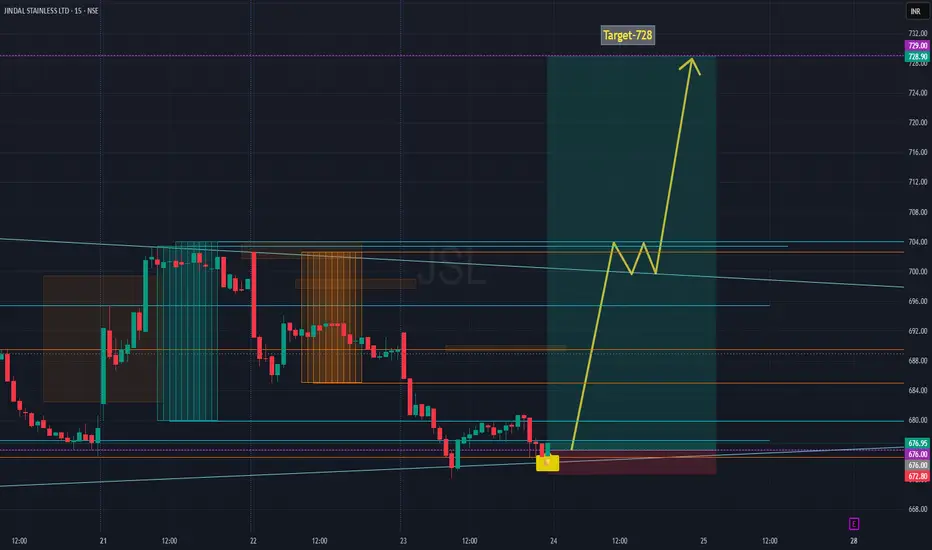
JSL Reversal Zone Identified -Path to 728 [Post Q1 Result]Structure-Based Intraday Outlook | Jindal Stainless (JSL)
Price reacted near a confluence support zone, overlapping key trendlines and historical liquidity area.
The yellow caution label appeared, marking a potential high-probability trend shift based on Leola Lens SignalPro.
Rejection from this zone suggests early signs of accumulation.
If price sustains above this base, the pathway builds towards ₹728.
Watch for intermediate resistance zones around ₹702–₹706, which may offer short-term reactions before continuation.
⚠️ Educational Outlook Only — No Buy/Sell advice.
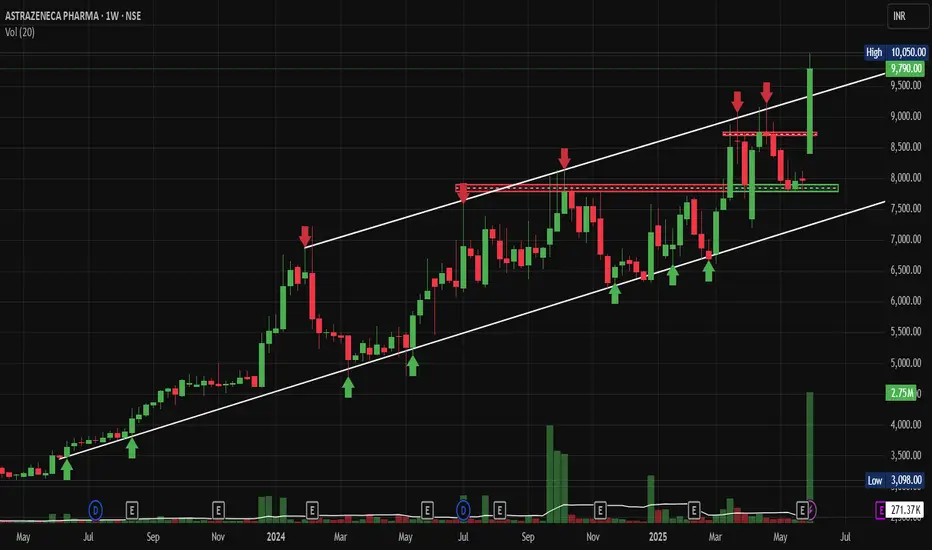
AstraZeneca Breakout Above 10000 Could Signal Next Leg, Post Q4NSE:ASTRAZEN Breakout Above 10000 Could Signal Next Leg, Post Spectacular Q4 and FY25 Numbers. Breaking out of Rising Channel, hence selected for this Week's "Chart of the WEEK"
Price Action Analysis:
• Stock has been in a strong uptrend since May 2024, rising from around 3000 levels to current levels near 9800
• Recent price action shows consolidation between the 7500-8500 levels with multiple tests of resistance
• Current price at 9409 represents a +22.80% gain, showing strong momentum
• Volume spike visible in recent sessions at 2.75M shares vs average, indicating institutional interest
• Price structure shows a higher highs and higher lows pattern intact.
Key Support and Resistance Levels:
• Primary Support: 8000-8200 zone (previous resistance turned support)
• Secondary Support: 7500-7600 (multiple bounce zone)
• Key Resistance: 8500-8600 (red horizontal line showing multiple rejections)
• Breakout Resistance: 9000 psychological level
• Current High: 10,950 acting as immediate resistance
Base Formation and Patterns:
• Rectangle consolidation pattern formed between 7500-8500 from September 2024 to March 2025
• Bullish flag pattern visible after the breakout above 8500
• Ascending triangle formation with higher lows and flat resistance around 8500
• Volume expansion during breakout confirms pattern validity
Technical Indicators:
• Strong upward-trending channel maintained since mid-2024
• Price trading above all major moving averages
• Momentum appears to be building after the recent consolidation phase
• Volume profile shows accumulation during base formation
Trade Setup:
Entry Strategy:
• Primary Entry: On pullback to 8800-9000 support zone
• Aggressive Entry: Current market price around 9400 for momentum play
• Conservative Entry: Wait for retest of 8500 breakout level
Exit Levels:
• Target 1: 10,500 (psychological resistance)
• Target 2: 11,200 (measured move from rectangle pattern)
• Target 3: 12,000 (extension target based on trend channel)
Risk Management:
• Stop Loss: 8200 for entries around 9000 (tight stop)
• Stop Loss: 7800 for swing positions (wider stop)
• Position Size: Risk 1-2% of portfolio per trade
• Risk-Reward Ratio: Minimum 1:2 for all entries
Position Sizing Guidelines:
• For 1% risk: Calculate position size based on distance to stop loss
• Maximum exposure: 3-5% of portfolio in a single stock
• Scale in approach: 50% on initial entry, 30% on pullback, 20% on confirmation
Sectoral and Fundamental Backdrop:
Pharmaceutical Sector Overview:
• Indian pharma sector benefiting from global generic drug demand
• Regulatory approvals and US FDA compliance driving growth
• Export-oriented companies are seeing currency tailwinds
• Increased healthcare spending post-pandemic, supporting sector growth
AstraZeneca Pharma Fundamentals:
• Strong presence in oncology and respiratory segments
• Robust pipeline of innovative drugs and biosimilars
• Strategic partnerships with global pharmaceutical companies
• Consistent revenue growth and expanding market share in India
• Strong balance sheet with healthy cash flows
Market Dynamics:
• Institutional buying is visible through increased volumes
• FII interest in pharmaceutical stocks remains positive
• Sector rotation favouring defensive healthcare plays
• Government initiatives supporting pharmaceutical manufacturing
Risk Factors:
Technical Risks:
• High volatility near resistance levels
• Potential for false breakouts given extended rally
• Volume confirmation required for sustained moves
• Overbought conditions in the short term
Fundamental Risks:
• Regulatory changes in pharmaceutical pricing
• Currency fluctuation impact on export revenues
• Competition from generic drug manufacturers
• Global economic slowdown affecting healthcare spending
Market Risks:
• Overall market correction could impact individual stocks
• Sector rotation away from pharmaceuticals
• Profit booking by institutional investors
• Global pharmaceutical industry headwinds
My Take:
NSE:ASTRAZEN presents a compelling technical setup with a clear breakout above long-term resistance. The stock's strong fundamentals post Q4 and FY25, combined with favourable sector dynamics, make it an attractive investment opportunity. However, risk management remains crucial given the extended nature of the current rally. Traders should consider scaling into positions on pullbacks while maintaining strict stop-loss discipline.
Keep in the Watchlist.
NO RECO. For Buy/Sell.
📌Thank you for exploring my idea! I hope you found it valuable.
🙏FOLLOW for more
👍BOOST if you found it useful.
✍️COMMENT below with your views.
Meanwhile, check out my other stock ideas on the right side until this trade is activated. I would love your feedback.
Disclaimer: "I am not a SEBI REGISTERED RESEARCH ANALYST AND INVESTMENT ADVISER."
This analysis is intended solely for informational and educational purposes and should not be interpreted as financial advice. It is advisable to consult a qualified financial advisor or conduct thorough research before making investment decisions.
Fundamental vs Technical: AARTIINDAnother fundamental vs technical scenario.
On breakout of 729 price-level, AARTI IND is set to rally till 772-783 as upside targets.
On brea of 710 support, prices will drop till 683-678.50 range as S2 (or T1 for the short side trade entry) and 625 as S3 (T2).
Prices in spot.
GRWRHITECH - 3 Months Downtrend Breakout Garware Hi Tech Films Ltd
1) Time Frame - Daily.
2) The Stock has been in a Downtrend since (February, 2024). Now It has given a Downtrend / Consolidation breakout & Closed with good volume & good bullish momentum candle in Daily Time Frame.
3) The next resistance would be it's Previous Life Time High (2200 - 6.25% from the price 2070.30). If the stock gives another breakout at (2200) It may move higher and find resistance around (2680 - 29.45% from the price 2070.30).
4) Stock with good fundamentals.
5) Recommendation - Strong Buy
INVESTMENT PICK ASTRAL NSE:ASTRAL \
This is a positional trade
The stock is daily resistances zone ones it breaks there will a great upside move
The first target is 1980 and final target is 2100
We should accumulated around 1650 .
The company has posted a good quarterly result.
This is for educational purpose
Cipla Earnings special analysis | #LetsMakeMoneyTogetherMy fav symmetrical triangle breakout ... upper trendline been tested many times and is clean meaning no gap ups above the line and coming down back into the zone of triangle .... a closing above the line on 15m or u can watch for a good risk at 5 min too depends on your RR ratio and RM system. Take the trade as per
Happy trading :)
Long LT Foods on minor correctionsDaawat looks promising price strength-wise and earnings wise. i will be looking to initiate a position on corrections of 10/15%
Technical: Daawat has clocked the highest monthly volume since Jan 2018 and it's up 50% in June 2020. Makes the case to look at it for a trade
Fundamental:
This stock shows decent sales and profit growth.
3 years of sales growth - 9.6%
3 years of profit growth - 9.2%
Margins at a higher level of 11%, If the margins sustain or go higher we can see higher profits and further price appreciation
TTM earnings are up 45%
If there are no earnings surprise in the next quarter, we can expect it to go up by 50-60%
ITC Earning season 25 May / Short trade @ 200 ITC in a breakout positon
Earning is on 25th may
1. 7%+ rally before earning season
2. divergence on money flow
3. resistance on 190-193 level (Technical analysis)
4. Resisitance as per option chain data is at 200.
Option chain data
Resistance strike 200 call - 33.5 lakh OI
Support at strike 180 put - 14.8 lakh oI
Bear looks more powerfull here.
Trade plan
Short
if stock price reaches 200 short SL 205 TGT1 190 TGT2 180
if stock price crosses 190 short SL 195 TGT1 180
Long
if stock price crosses 200 long SL 195 TGT
LONG ON BHARTIARTL(NSE)This analysis is only for educational purposes, Invest at your own risk!
A narrowing Uptrend can be seen on BHARTIARTL which closed at 554.10 INR on Friday.
The price has approached close to resistance level and gives a pretty good long opportunity for traders .
The High created on 15th April at 535.30 INR serves as a resistance level for the price .
The stick is also approaching its 52 Week high and also has earnings coming out on Monday (18th May).
Getting into a long position at 554.10-555.00 INR and selling at a profit of 1.15-1.20% i.e around 563-565 INR may prove to be profitable.
The ON BALANCE VOLUME indicator also shows us an uptrend making our decision even more strong.
ALL THE BEST TO EVERYONE !
Cheers!
CIPLA BUY SL564/ TGT 583 /sell below 564 tgt downside 520Cipla in a breakout position, just before its earning day, we are currently trading near support of gap up we had in start of April. If it breaks 564 Cipla can touch 520 on downside or if it stays above 564 tgt 583.
One can trail stop loss using 20 day hull moving avg.