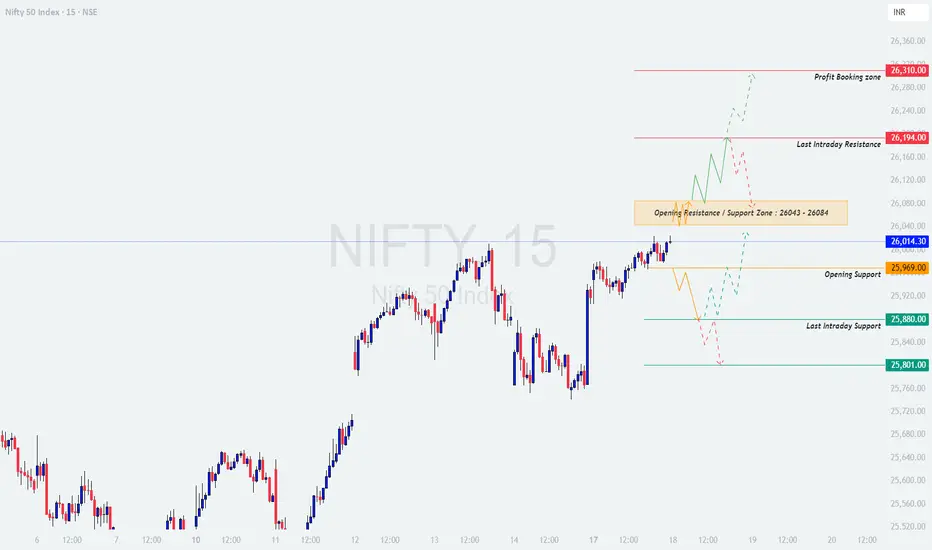
NIFTY : Trading levels and Plan for 18-Nov-2025📊 NIFTY TRADING PLAN — 18 NOV 2025
(Timeframe Reference: 15-Min Chart)
Chart Summary:
Nifty closed near 26,014 , maintaining a strong recovery momentum with higher highs formation. The index is currently hovering just below the Opening Resistance / Support Zone (26,043 – 26,084) , suggesting that 18th November could be a pivotal session for short-term trend continuation or reversal.
Immediate resistance is visible at 26,194 (Last Intraday Resistance) and a Profit Booking Zone near 26,310 . On the downside, the nearest supports are located at 25,969 (Opening Support) and 25,880 – 25,801 (Last Intraday Support Zone) .
The structure favors a bullish bias as long as price sustains above 25,969 , but traders should remain cautious around higher resistances where profit-taking may emerge.
Key Zones to Watch:
🟩 Supports: 25,969 / 25,880 / 25,801
🟥 Resistances: 26,084 / 26,194 / 26,310
⚖️ Bias: Bullish above 26,084 | Bearish below 25,969
🟢 Scenario 1: GAP-UP Opening (100+ Points)
If Nifty opens around 26,120 – 26,180 , it will start near the Last Intraday Resistance (26,194) . Such openings near resistance often cause early hesitation or consolidation before direction becomes clear.
If price sustains above 26,194 for 15–20 minutes with strong volume, expect a quick move toward the Profit Booking Zone (26,310) .
A breakout above 26,194 followed by a successful retest offers a low-risk buying opportunity for 26,270–26,310 targets.
If rejection candles (like upper wicks or bearish engulfing) appear near 26,194 – 26,310 , expect a short-term pullback toward 26,084 – 26,000 .
Avoid chasing the initial gap-up rally; instead, wait for price to confirm strength or provide a retest entry.
💡 Educational Insight:
Gap-up openings near resistance zones test trader psychology. Retail traders often buy impulsively at highs — professionals wait for confirmation of sustained strength. Always let price action validate breakout continuation before committing capital.
🟧 Scenario 2: FLAT Opening (Around 26,000 – 26,040 Zone)
A flat opening near 26,014 keeps Nifty right within the Opening Resistance / Support Zone (26,043 – 26,084) . This zone acts as a decision point — a breakout could continue bullish momentum, while rejection could trigger short-term correction.
If the index sustains above 26,084 , expect bullish continuation toward 26,194 – 26,310 .
If the index faces rejection and falls below 25,969 , a short-term retracement toward 25,880 – 25,801 is likely.
Avoid taking trades inside 26,000 – 26,080 initially — this zone may witness indecision.
Wait for a strong directional candle close outside the range for trade confirmation.
🧠 Educational Tip:
Flat openings are common near key inflection zones. Avoid being the first to act — let the first 15 minutes set the tone. Volume-backed breakouts from such zones often lead to sustained moves.
🔴 Scenario 3: GAP-DOWN Opening (100+ Points)
If Nifty opens around 25,900 – 25,850 , it will open below the Opening Support (25,969) and closer to the Last Intraday Support Zone (25,880 – 25,801) . This area will be critical to watch for either a quick reversal or extended weakness.
If reversal candles (hammer or bullish engulfing) appear near 25,880 – 25,801 , expect a recovery toward 26,000 – 26,043 .
If the price fails to sustain above 25,880 , bearish momentum may drag Nifty toward 25,700 – 25,600 .
Avoid panic shorting after gap-downs — let the market test supports first.
Watch for volume divergence: if selling volume declines near support, it signals exhaustion and possible intraday reversal.
📘 Educational Note:
Gap-down openings are emotional traps for retail participants. Professionals focus on reaction, not the gap itself. A strong bounce from support zones often provides safer and more rewarding opportunities than chasing fear-driven momentum.
💼 RISK MANAGEMENT TIPS FOR OPTIONS TRADERS:
Avoid trading during the first 15 minutes of market open — volatility is highest and direction unclear.
Never risk more than 1–2% of your capital per trade .
Use ATM or slightly ITM options for directional trades — they move more effectively with price.
Trail stop-loss once the position gains 30–40 points in your favor — protect profits.
Book partial profits at intermediate zones (like 26,084 / 26,194) and hold the rest with SL.
Avoid averaging losing trades — discipline is key.
When in doubt or volatility spikes unexpectedly, step aside; missing a trade is better than forcing one.
⚠️ Golden Rule:
Focus on capital protection over profit chasing . Consistency builds wealth — not aggression.
📈 SUMMARY:
🟩 Key Supports: 25,969 / 25,880 / 25,801
🟥 Key Resistances: 26,084 / 26,194 / 26,310
⚖️ Bias: Bullish above 26,084 | Bearish below 25,969
🎯 Intraday Levels to Watch:
- Breakout above 26,084 → Target 26,194 → 26,310
- Breakdown below 25,969 → Target 25,880 → 25,801
📚 CONCLUSION:
Nifty stands at a critical juncture, oscillating just below major resistance. A breakout above 26,084 can open the path toward 26,310 , while a breakdown below 25,969 may trigger intraday profit booking toward 25,880 – 25,801 .
For 18th November, the key lies in the opening reaction — whether the market builds on momentum or witnesses short-term exhaustion. Stay disciplined, trade only post-confirmation, and align your direction with trend and volume.
📊 Trading success lies not in predicting the move, but in reacting wisely to what unfolds.
⚠️ DISCLAIMER:
I am not a SEBI-registered analyst . The views shared here are purely for educational and informational purposes . Please conduct your own analysis or consult a certified financial advisor before making any trading or investment decisions.
Niftyoutlook
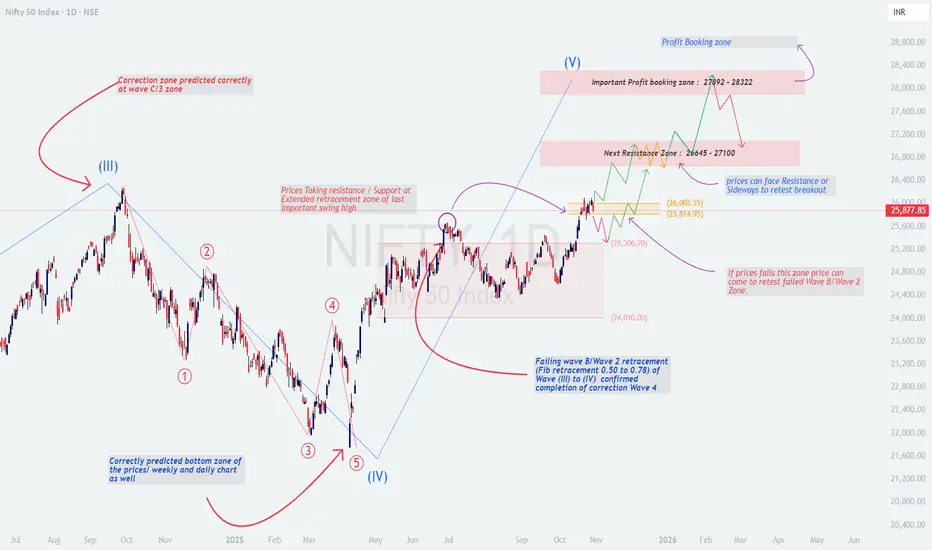
NIFTY : HIT or MISS? Next Move Explained🧠 Nifty Elliott Wave Analysis | Accurate Highs & Bottoms Predicted | Next Move Explained
I had accurately predicted both the top (Wave III) and the bottom (Wave IV) of the Nifty move — as seen in the attached chart 📈
The corrective zone at Wave C / 3 and the final retracement completion around Wave 4 were both identified in advance, confirming the accuracy of our earlier projection.
🔍 Current Technical Outlook
Nifty has completed its Wave (IV) correction and is now attempting to form an impulsive Wave (V) move.
Price is currently trading around 25,880, taking resistance near the extended retracement zone of the previous swing high.
If this level is crossed and sustained, the next upside momentum can unfold in multiple stages as shown below.
📈 Upside Projections
Next Resistance Zone: 26,645 – 27,100
🔸 Price may slow down or move sideways to retest the breakout here.
Major Profit Booking Zone: 27,892 – 28,322
🔸 This is a key Fibonacci extension and Wave (V) target area where partial booking is advised.
⚙️ Support & Risk Levels
Immediate Support: 25,814 – 26,000
Major Support: 25,306
Critical Support / Reconfirmation Zone: 24,010 (Failed Wave B / Wave 2 zone)
📉 If prices fail to hold 25,800–25,300, we may see a retest toward 24,000–24,200, which would only delay but not invalidate the long-term bullish structure.
🧭 Expected Price Behaviour
As long as Nifty stays above 25,300, the Wave (V) uptrend remains intact.
Prices can show sideways consolidation or retest near the breakout before pushing higher.
Any strong breakout above 26,650–27,100 can open the gate for 28,000+ targets.
⚠️ Keep Watch & Stay Cautious
Watch for rejection candles or low-volume breakouts near 26,600–27,000 zone.
Stay alert for profit booking or reversal signals near 27,800+.
Ideal approach: Buy on dips, book partial profits near resistance, trail stop-loss.
📅 Posted on: 30 Oct 2025
NIFTY KEY LEVELS FOR 17.11.2025NIFTY KEY LEVELS FOR 17.11.2025
Timeframe: 3 Minutes
Sorry for the delayed post.
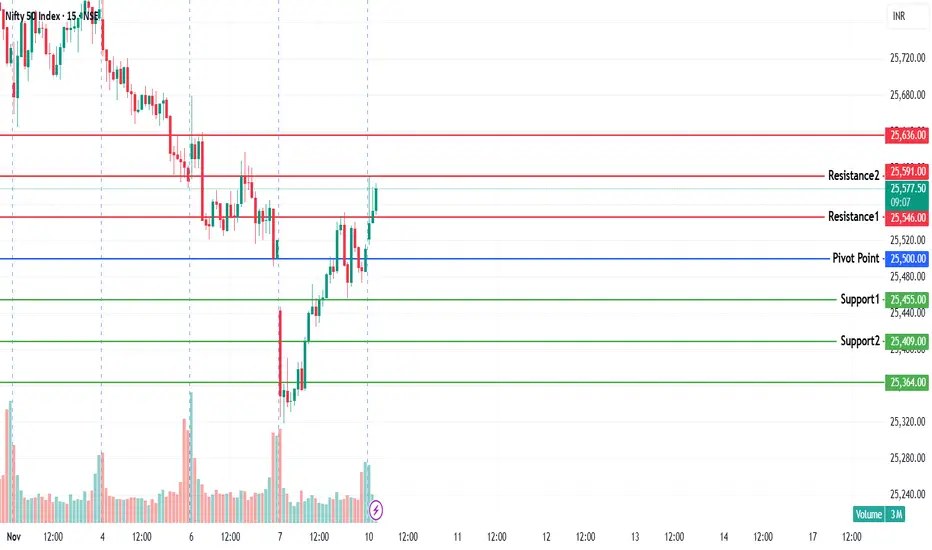
If the candle stays above the pivot point, it is considered a bullish bias; if it remains below, it indicates a bearish bias. Price may reverse near Resistance 1 or Support 1. If it moves further, the next potential reversal zone is near Resistance 2 or Support 2. If these levels are also broken, we can expect the trend.
When a support or resistance level is broken, it often reverses its role; a broken resistance becomes the new support, and a broken support becomes the new resistance.
If the range(R2-S2) is narrow, the market may become volatile or trend strongly. If the range is wide, the market is more likely to remain sideways
please like and share my idea if you find it helpful
📢 Disclaimer
I am not a SEBI-registered financial adviser.
The information, views, and ideas shared here are purely for educational and informational purposes only. They are not intended as investment advice or a recommendation to buy, sell, or hold any financial instruments.
Please consult with your SEBI-registered financial advisor before making any trading or investment decisions.
Trading and investing in the stock market involves risk, and you should do your own research and analysis. You are solely responsible for any decisions made based on this research.
NIFTY : Trading levels and Plan for 17-Nov-2025📊 NIFTY TRADING PLAN — 17 NOV 2025
(Timeframe Reference: 15-Min Chart)
Chart Summary:
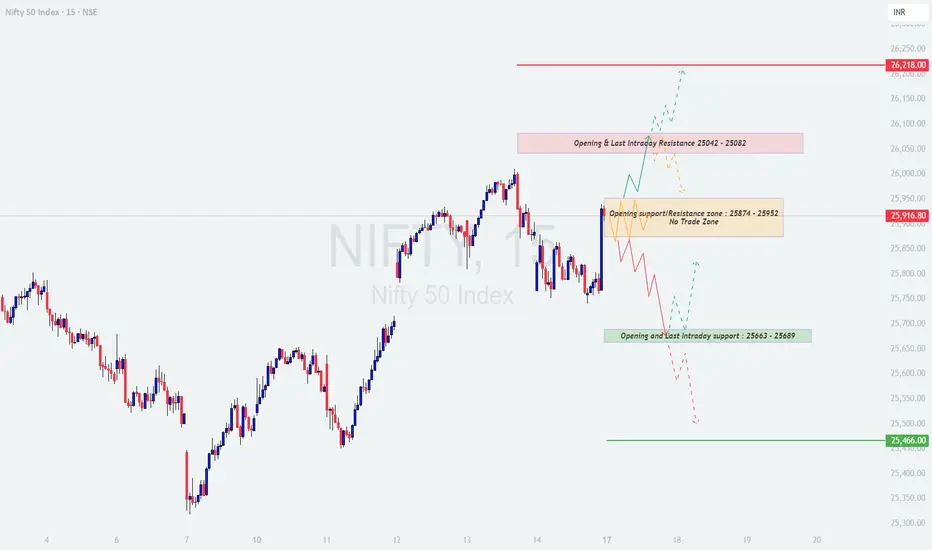
Nifty closed around 25,916 , maintaining a balanced but cautious structure ahead of the new trading week. The index currently trades near the Opening Support / Resistance Zone (25,874 – 25,952) , which is a key “no-trade” area as highlighted on the chart.
Immediate resistance lies at 26,042 – 26,082 (Opening & Last Intraday Resistance Zone) , while strong support exists near 25,663 – 25,689 (Opening & Last Intraday Support Zone) .
The index currently shows a neutral-to-slightly bullish undertone as long as price sustains above 25,874 . A breakout above 25,952 can trigger an upmove toward 26,082 – 26,218 , while a breakdown below 25,874 may lead to short-term weakness toward 25,680 – 25,466 .
Key Zones to Watch:
🟩 Support Levels: 25,689 / 25,466
🟥 Resistance Levels: 25,952 / 26,082 / 26,218
⚖️ No Trade Zone: 25,874 – 25,952 (avoid trading until breakout confirmation)
---
🟢 Scenario 1: GAP-UP Opening (100+ Points)
If Nifty opens around or above 26,020 – 26,050 , it will directly test the Last Intraday Resistance Zone (26,042 – 26,082) . A strong gap-up near resistance often attracts early profit booking or sideways consolidation before directional clarity emerges.
If the price sustains above 26,082 with a strong bullish candle and volume confirmation, upside targets open toward 26,180 – 26,218 .
If price faces rejection at 26,082 (long upper wicks or doji patterns), expect a pullback toward 25,952 – 25,874 .
Traders should avoid buying calls immediately after a gap-up; instead, wait for a retest of the 26,042 zone for better confirmation.
Sustained momentum beyond 26,100 will confirm strength and can lead to intraday trend continuation.
💡 Educational Note:
Gap-ups near major resistance zones often trap impulsive traders. The best approach is to let the market test and confirm whether the breakout is genuine or just a liquidity trap. Watch for rising volume with closing candles above the breakout level for confirmation.
---
🟧 Scenario 2: FLAT Opening (Around 25,880 – 25,920 Zone)
A flat opening within the No Trade Zone (25,874 – 25,952) indicates indecision. The price may spend the first 15–30 minutes moving sideways as buyers and sellers battle for control.
Avoid trading inside this range — it’s a “neutral zone” with no clear edge.
If price breaks and sustains above 25,952 , bullish continuation can take Nifty toward 26,082 – 26,218 .
If price breaks below 25,874 , weakness may extend toward 25,689 – 25,466 .
Wait for a strong 15-min candle close beyond the range for confirmation — don’t pre-empt the breakout.
🧠 Educational Tip:
Flat openings near key levels require patience. Most false breakouts occur when traders enter without confirmation. Wait for candle structure and volume validation before committing. Strong moves often follow after consolidations — let the direction emerge naturally.
---
🔴 Scenario 3: GAP-DOWN Opening (100+ Points)
If Nifty opens around 25,700 – 25,750 , it will directly test the Opening & Last Intraday Support Zone (25,663 – 25,689) . This zone will be critical for bulls to defend — a breakdown below could open room for deeper correction.
If reversal patterns (hammer, bullish engulfing) appear around 25,680 , expect a bounce toward 25,874 – 25,952 .
If the price fails to hold 25,663 , next support lies near 25,466 — which can act as a short-term target zone for sellers.
Avoid chasing short trades at the open; instead, wait for a pullback toward 25,850 – 25,880 to initiate low-risk entries.
Volume divergence (falling volume with declining price) near support is often a sign of selling exhaustion — watch closely for reversals.
📘 Educational Insight:
Gap-down openings are often ruled by emotions — panic selling and fear dominate. Experienced traders look for structure, not emotion. Reversal signals near major supports usually offer high reward-to-risk setups once panic subsides.
---
💼 RISK MANAGEMENT TIPS FOR OPTIONS TRADERS:
Avoid entering trades in the first 15 minutes of market open — IV spikes and volatility whipsaws can distort option prices.
Use only 1–2% of total trading capital per position. Focus on longevity, not short-term aggression.
Prefer ATM or slightly ITM options for better delta exposure and lower time decay impact.
Always set a stop-loss — trail it once the trade moves 30–40 points in your favor.
Book partial profits at nearby supports/resistances — protect gains and avoid greed traps.
Do not average losing positions; instead, accept small losses and preserve capital for better setups.
⚠️ Golden Rule: Avoid overtrading in choppy or low-volume conditions — professional traders focus on quality, not quantity.
---
📈 SUMMARY:
🟧 No Trade Zone: 25,874 – 25,952
🟥 Resistance Zones: 26,082 / 26,218
🟩 Support Zones: 25,689 / 25,466
⚖️ Bias: Bullish above 25,952 | Bearish below 25,874
---
📚 CONCLUSION:
Nifty remains at a decisive inflection point near 25,900 . The day’s directional tone will depend on how price reacts around the No Trade Zone (25,874 – 25,952) . Sustained breakout above 25,952 could trigger a move toward 26,218 , whereas a breakdown below 25,874 may pull the index toward 25,680 – 25,466 .
For intraday traders, patience will be the most valuable skill on 17 Nov. Let price confirm before execution — impulsive entries near range zones often lead to losses.
📊 Remember: Markets reward patience and discipline — clarity always follows confirmation.
---
⚠️ DISCLAIMER:
I am not a SEBI-registered analyst . The analysis shared here is purely for educational and informational purposes . Please do your own research or consult a certified financial advisor before making any trading or investment decisions.
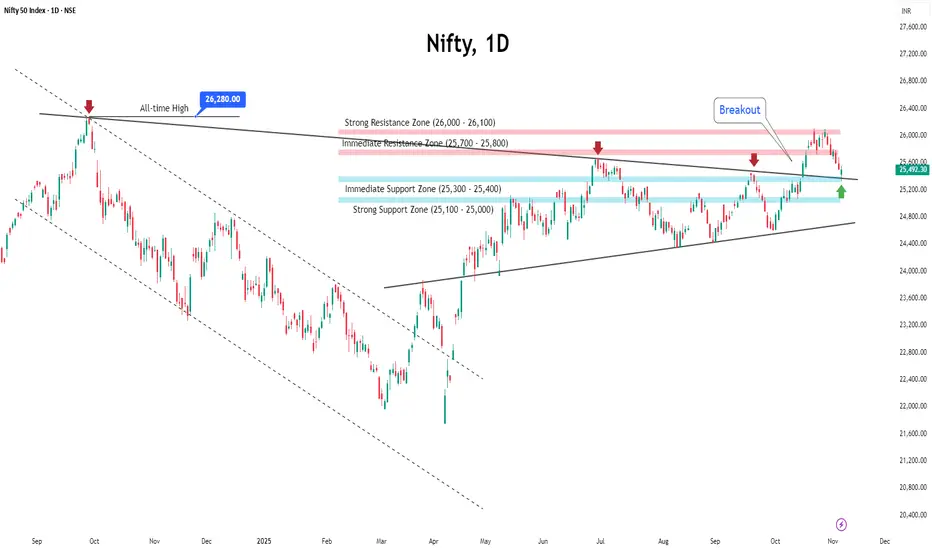
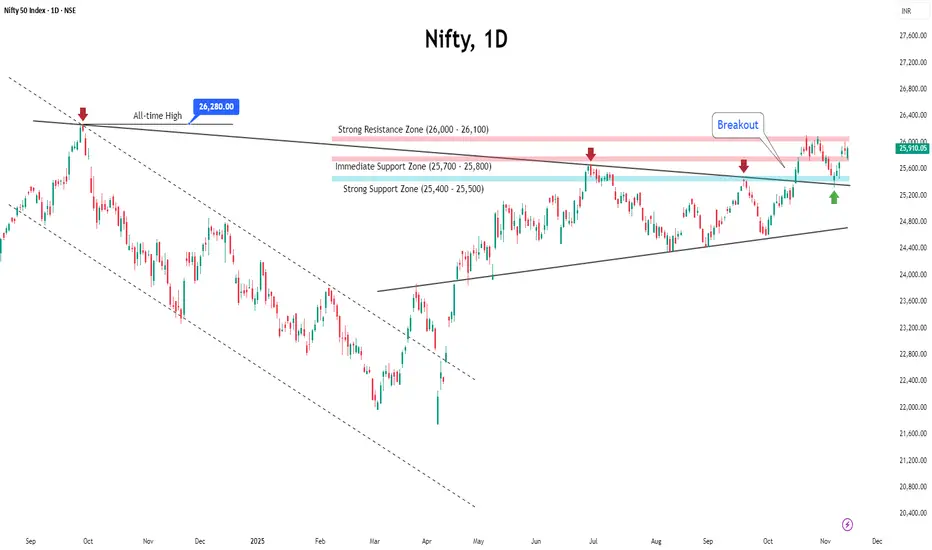
Nifty Near Key Supply Zone: Breakout Could Unlock 20–25% UpsideNifty is currently trading near a key supply zone and requires a decisive close above 26,100 to confirm further bullish continuation.
The first support is placed around the 25,100–25,200 zone, while major support lies between 24,300–24,450.
A post cup-and-handle retest has been completed, and the price continues to move within a rising channel. Overall, the short-term trend remains positive.
If Nifty successfully breaks through the 25,900 supply zone, a 20–25% upside over the next 10 months appears achievable.
Cup & Handle Breakout Opportunity in Reliance IndustriesReliance Industries, currently trading near ₹1518 on the weekly charts, is showing signs of a cup & handle breakout at the top of a consolidation zone. This pattern, combined with strong Relative Strength Index (RSI) readings across multiple timeframes, highlights a potential bullish opportunity.
🔍 What is a Cup & Handle Pattern?
Cup Formation:
Price declines, then gradually recovers, forming a rounded bottom resembling a “cup.”
Handle Formation:
A short consolidation or pullback after the cup, forming the “handle.”
Breakout Point:
When price breaks above the handle’s resistance, it signals continuation of the uptrend.
Reliance Industries Case:
Cup & handle is forming/completing at the top of consolidation.
Price is now ready to break out of the handle’s endpoint, suggesting bullish momentum.
📊 RSI Confirmation
The Relative Strength Index (RSI) is a momentum indicator that measures strength of price movements.
Key Levels:
Above 50 → Indicates bullish momentum.
Moving toward 70 → Signals strong upside strength.
Reliance Industries RSI:
Daily RSI trending above 50 and preparing to cross 70.
Monthly, weekly, and daily RSI all above 50, showing broad-based momentum.
This alignment across timeframes adds conviction to the breakout.
🎯 Learning Points for Traders
Pattern Recognition:
Cup & handle is a continuation pattern often seen before strong rallies.
Breakout above the handle confirms bullish intent.
Multi-Timeframe Analysis:
RSI above 50 across monthly, weekly, and daily charts strengthens the setup.
Multiple timeframe confirmation reduces false signals.
Momentum + Pattern Combination:
Chart patterns show structure, RSI confirms strength.
Together, they create a high-probability trading opportunity.
Risk Management:
Stop-loss can be placed below the handle’s low.
Avoid entering before breakout confirmation.
📝 Conclusion
Reliance Industries’ cup & handle breakout, supported by RSI strength across all timeframes, is a textbook example of how price patterns and momentum indicators work together. For learners, this case highlights the importance of combining technical structures with RSI confirmation to identify reliable breakout opportunities.
Nifty Builds Momentum, Breakout Looks Within ReachThe Indian market ended last week on a positive note, supported by the stronger-than-expected performance of the National Democratic Alliance (NDA) in the 2025 Bihar elections.
Nifty jumped over 1.5% to close at 25,910, just below the key resistance level of 26,000. Volatility also eased, with the India VIX falling over 5% on a weekly basis to settle at 11.93.
Open interest data suggests that the 25,700–25,800 zone will now act as immediate support, while 25,500 remains a strong support level.
Recent price action indicates that Nifty may attempt to break above the 26,000 resistance in the coming sessions.
In the week ahead, the overall sentiment is expected to stay positive due to strong domestic cues. Globally, market direction will depend on key U.S. economic releases, including the minutes of the latest FOMC meeting.
Investors should stick to a stock-specific approach, focusing on sectors supported by domestic demand. For traders, a buy-on-dips strategy remains favourable as long as Nifty holds above its key support zones.
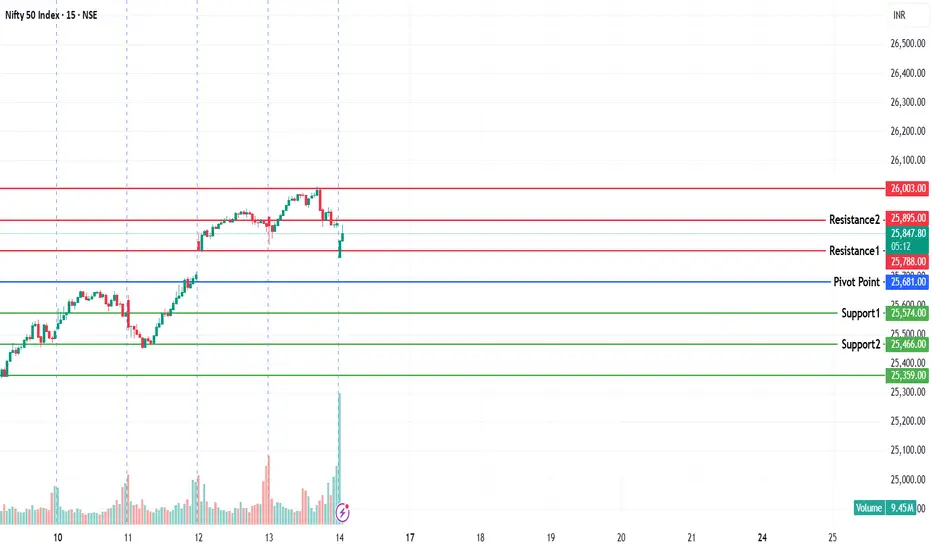
NIFTY KEY LEVELS FOR 14.11.2025NIFTY KEY LEVELS FOR 14.11.2025
Timeframe: 3 Minutes
If the candle stays above the pivot point, it is considered a bullish bias; if it remains below, it indicates a bearish bias. Price may reverse near Resistance 1 or Support 1. If it moves further, the next potential reversal zone is near Resistance 2 or Support 2. If these levels are also broken, we can expect the trend.
When a support or resistance level is broken, it often reverses its role; a broken resistance becomes the new support, and a broken support becomes the new resistance.
If the range(R2-S2) is narrow, the market may become volatile or trend strongly. If the range is wide, the market is more likely to remain sideways
please like and share my idea if you find it helpful
📢 Disclaimer
I am not a SEBI-registered financial adviser.
The information, views, and ideas shared here are purely for educational and informational purposes only. They are not intended as investment advice or a recommendation to buy, sell, or hold any financial instruments.
Please consult with your SEBI-registered financial advisor before making any trading or investment decisions.
Trading and investing in the stock market involves risk, and you should do your own research and analysis. You are solely responsible for any decisions made based on this research.
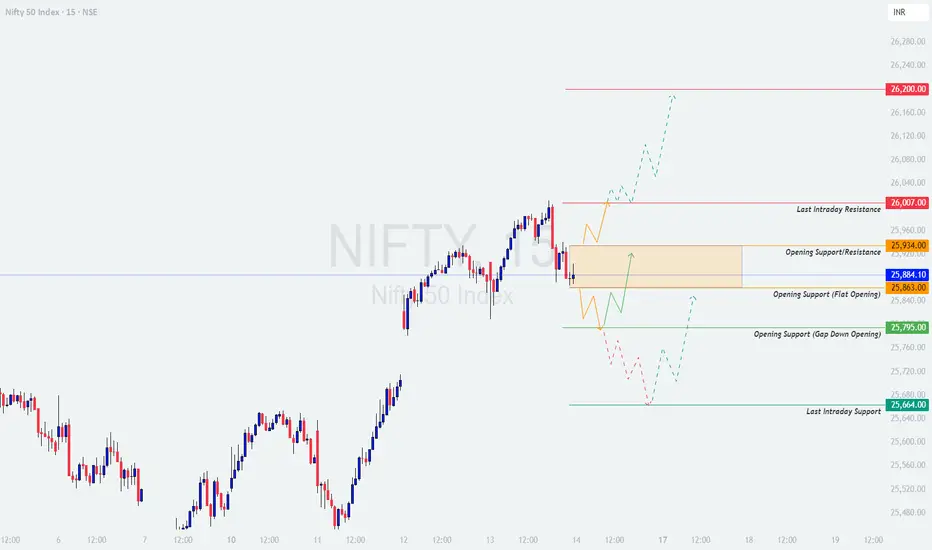
NIFTY : Trading levels and Plan for 14-Nov-2025📊 NIFTY TRADING PLAN — 14 NOV 2025
(Timeframe Reference: 15-Min Chart)
Chart Summary:
Nifty closed near 25,884 , forming a balanced structure after recent upside momentum. The index is currently positioned within the Opening Support / Resistance Zone (25,863 – 25,934) , suggesting indecision as participants await directional clarity.
Above this range, key resistance levels lie at 26,007 (Last Intraday Resistance) and 26,200 . On the downside, supports exist near 25,795 (Gap-down Support) and 25,664 (Last Intraday Support) .
The index remains in a neutral-to-bullish bias as long as it holds above 25,795 . Sustaining above 25,934 may trigger renewed upward movement toward 26,200.
Key Levels to Watch:
🟩 Supports: 25,795 / 25,664
🟥 Resistances: 25,934 / 26,007 / 26,200
⚖️ Bias Zone: 25,863 – 25,934 (No-Trade Zone – Wait for breakout confirmation)
🟢 Scenario 1: GAP-UP Opening (100+ Points)
If Nifty opens above 26,000 – 26,050 , it will open directly near or above the Last Intraday Resistance (26,007) . Such a gap-up could trigger excitement at the open, but traders must wait for confirmation of strength.
If price sustains above 26,007 for 15–20 minutes with strong bullish candles, the next upside targets could be 26,120 – 26,200 .
If price fails to sustain above 26,007 and forms rejection wicks, expect a pullback toward 25,934 – 25,884 .
Avoid chasing a gap-up immediately — wait for a retest near 26,000 for better entry confirmation.
If price reclaims 26,000 after a pullback with rising volume, it could confirm continuation momentum.
💡 Educational Note:
Gap-ups near resistance zones often create emotional entry traps. Always let the price establish strength through retests and volume confirmation. A breakout sustained by strong candles signals genuine trend continuation, while sharp reversals at resistance suggest false breakouts.
🟧 Scenario 2: FLAT Opening (Around 25,860 – 25,900 Zone)
A flat opening near the Opening Support / Resistance Zone (25,863 – 25,934) indicates early indecision. Price may spend time consolidating before choosing direction.
Avoid entering within this zone in the first 15 minutes — volatility may remain erratic.
If Nifty sustains above 25,934 with strong green candles, upside targets open toward 26,007 – 26,200 .
If it breaks below 25,863 , weakness may push the index toward 25,795 – 25,664 .
Trade breakout confirmation only — fakeouts are common in flat openings. Wait for candle closure and volume support.
🧠 Educational Tip:
Flat openings test trader discipline. Most false breakouts occur when traders predict rather than wait. Breakouts that occur after a consolidation period with strong volume tend to have better follow-through. The key is patience and confirmation, not prediction.
🔴 Scenario 3: GAP-DOWN Opening (100+ Points)
If Nifty opens near 25,770 – 25,800 , it will enter the Opening Support Zone . This area will be critical for bulls to defend.
If price forms reversal candles (hammer, bullish engulfing) near 25,795 , expect a rebound toward 25,863 – 25,934 .
If the index fails to hold above 25,795 , further weakness could extend toward 25,664 (Last Intraday Support) .
Avoid panic shorting after a large gap-down — instead, wait for pullbacks toward 25,860 – 25,880 for better entry risk-reward.
Watch for volume behavior — decreasing volume near support often indicates exhaustion, hinting at a short-covering rally.
📘 Educational Insight:
Gap-downs attract panic sellers early in the session. Experienced traders wait for signs of stabilization at support levels. Sharp reversals with strong volume often mark the beginning of intraday recoveries. Patience pays more than impulse in such setups.
💼 RISK MANAGEMENT TIPS FOR OPTIONS TRADERS:
Avoid option entries during the first 15–20 minutes — IV (Implied Volatility) spikes inflate premium values, leading to quick time decay afterward.
Limit exposure to 1–2% of total capital per trade . Consistency in risk control is key to longevity.
Prefer ATM or ITM options for directional plays; avoid deep OTM options unless trading clear breakout momentum.
Always use stop-losses — trail them once the position moves 30–40 points in your favor.
Book partial profits at strong support/resistance zones to lock in gains.
If the day turns choppy or non-trending, step back — capital preservation > forced trading.
📈 SUMMARY:
🟧 Neutral Zone: 25,863 – 25,934
🟥 Resistance Zones: 26,007 / 26,200
🟩 Support Zones: 25,795 / 25,664
⚖️ Bias: Bullish above 25,934 | Bearish below 25,863
📚 CONCLUSION:
Nifty is at a decisive point, trading within a narrow consolidation zone between 25,863 – 25,934 . A breakout above this zone could drive momentum toward 26,200 , while a breakdown below 25,863 could lead to a retest of 25,795 – 25,664 .
Patience and observation will be the most valuable tools for traders on 14 Nov. Let price confirm direction with volume support before executing trades. Avoid emotional entries — precision and timing matter more than frequency.
📊 In trading, waiting for confirmation isn’t missing out — it’s aligning with probability and discipline.
⚠️ DISCLAIMER:
I am not a SEBI-registered analyst . The above analysis and levels are shared purely for educational and informational purposes . Please conduct your own research or consult a certified financial advisor before making trading or investment decisions.
NIFTY KEY LEVELS FOR 13.11.2025NIFTY KEY LEVELS FOR 13.11.2025
Timeframe: 3 Minutes
If the candle stays above the pivot point, it is considered a bullish bias; if it remains below, it indicates a bearish bias. Price may reverse near Resistance 1 or Support 1. If it moves further, the next potential reversal zone is near Resistance 2 or Support 2. If these levels are also broken, we can expect the trend.
When a support or resistance level is broken, it often reverses its role; a broken resistance becomes the new support, and a broken support becomes the new resistance.
If the range(R2-S2) is narrow, the market may become volatile or trend strongly. If the range is wide, the market is more likely to remain sideways
please like and share my idea if you find it helpful
📢 Disclaimer
I am not a SEBI-registered financial adviser.
The information, views, and ideas shared here are purely for educational and informational purposes only. They are not intended as investment advice or a recommendation to buy, sell, or hold any financial instruments.
Please consult with your SEBI-registered financial advisor before making any trading or investment decisions.
Trading and investing in the stock market involves risk, and you should do your own research and analysis. You are solely responsible for any decisions made based on this research.
NIFTY : Trading levels and Plan for 13-Nov-2025📊 NIFTY TRADING PLAN — 13 NOV 2025
(Timeframe Reference: 15-Min Chart)
Chart Summary:
Nifty closed near 25,874 , positioned within a tight No-Trade Zone (25,863 – 25,935) , reflecting indecision and a short-term pause after a strong rally. The index is facing an immediate Opening Resistance Zone near 26,004 , while its Opening Support Zone lies at 25,745 – 25,765 .
The price structure suggests that momentum players are waiting for confirmation — either a breakout above 25,935 to push toward 26,193, or a breakdown below 25,745 to retest lower supports. Volatility could remain high due to positional adjustments ahead of the weekend.
Key Levels to Watch:
🟩 Supports: 25,765 / 25,745 / 25,664
🟥 Resistances: 25,935 / 26,004 / 26,193
⚖️ Bias Zone: Between 25,863 – 25,935 (No-Trade Zone)
🟢 Scenario 1: GAP-UP Opening (100+ Points)
If Nifty opens above 25,950 – 26,000 , it will directly enter the Opening Resistance Zone . Bulls must sustain the gap for continuation toward higher levels.
If price sustains above 26,004 with strong bullish candles and increasing volume, a move toward 26,120 – 26,193 is likely.
However, if the index opens higher but fails to hold above 26,004 , a pullback toward 25,935 – 25,874 may occur.
Ideal plan: Wait for the first 15–30 minutes to confirm whether buyers can sustain above 26,004 . Enter long positions only after a successful retest with proper confirmation.
If rejection appears near 26,120 – 26,193 , partial profit booking or trailing stops is advised.
💡 Educational Note:
Gap-ups near resistance often trap early buyers. Strong conviction comes not from the open itself but from whether the price holds above breakout levels after initial volatility. Let price show you control — strength confirmed through retest and volume is far more reliable than the first impulse.
🟧 Scenario 2: FLAT Opening (Within 25,863 – 25,935 Zone)
A flat opening inside the No-Trade Zone suggests early choppiness. Traders should avoid getting caught in this indecision range until a clear breakout occurs.
Avoid taking trades inside 25,863 – 25,935 as whipsaws are common.
If the index breaks and sustains above 25,935 , upside targets open toward 26,004 – 26,193 .
If price breaks below 25,863 , it could trigger weakness toward 25,765 – 25,745 .
Focus on the breakout candle — confirmation with strong body and volume gives confidence in the move’s sustainability.
🧠 Educational Tip:
Flat openings require traders to be patient and disciplined. Most false signals occur when traders predict rather than react. Waiting for the range to break provides a statistical edge — successful trades come from confirmation, not anticipation.
🔴 Scenario 3: GAP-DOWN Opening (100+ Points)
If Nifty opens below 25,770 – 25,740 , it will test the Opening Support Zone . This area will decide whether bulls defend the recent uptrend or allow bears to take over.
If a reversal pattern forms near 25,745 – 25,765 (hammer or bullish engulfing), expect a short-covering rally back toward 25,874 – 25,935 .
If price breaks and sustains below 25,745 , weakness may extend toward 25,664 and possibly 25,502 .
Avoid shorting immediately after a deep gap-down — wait for a retracement toward 25,745 – 25,800 for better risk-reward.
Volume near support zones will indicate whether selling is continuing or exhausting. Falling volume often hints at reversal setups.
📘 Educational Insight:
Gap-downs tend to amplify emotional trading. Many participants panic-sell into support zones, providing opportunities for disciplined traders who wait for reversals. The key is to let the first few candles reveal intent — a steady base near support usually signals potential bounce setups.
💼 RISK MANAGEMENT TIPS FOR OPTIONS TRADERS:
Avoid trading options in the first 15–20 minutes — high Implied Volatility (IV) inflates premiums and causes quick time decay as the market stabilizes.
Define your risk before entry — limit exposure to 1–2% of total capital per trade.
Prefer ITM or ATM options for directional plays; avoid far OTM options unless volatility breakout is confirmed.
Use stop-loss orders and trail them as positions move in your favor by 30–40 points to protect profits.
Avoid overtrading after multiple stop-outs — conserving capital is more important than chasing missed moves.
Always book partial profits at major resistance/support levels to lock in gains.
📈 SUMMARY:
🟧 No-Trade Zone: 25,863 – 25,935
🟥 Resistance Zones: 26,004 / 26,193
🟩 Support Zones: 25,765 / 25,745 / 25,664
⚖️ Bias: Neutral-to-Bullish above 25,935 | Weakness below 25,863
📚 CONCLUSION:
Nifty sits at a key decision point — 25,863 – 25,935 defines the immediate battleground. A breakout above 25,935 could fuel a bullish continuation toward 26,193 , while a drop below 25,863 may invite selling pressure toward 25,745 – 25,664 .
Patience is essential — avoid early entries within the no-trade zone and trade only when confirmation aligns with volume strength. Trade the trend, not the noise.
📊 Remember: Markets reward clarity and discipline — every avoided bad trade is a hidden profit.
⚠️ DISCLAIMER:
I am not a SEBI-registered analyst . The above analysis and levels are shared purely for educational purposes . Please conduct your own research or consult a certified financial advisor before making any trading or investment decisions.
NIFTY : TRADING LEVELS AND PLAN FOR 12-NOV-2025📊 NIFTY TRADING PLAN — 12 NOV 2025
(Timeframe Reference: 15-Min Chart)
Chart Summary:
Nifty closed near 25,705 , just above its key Opening Support / Resistance Zone (25,666 – 25,705) . The index recently bounced strongly from lower supports, but now faces an overhead supply zone near 25,800 – 25,935 , which coincides with the Last Resistance Zone .
The structure suggests short-term bullish momentum, though a profit-booking phase is possible near resistance levels. The immediate bias remains mildly positive as long as Nifty sustains above 25,617 .
Key Levels to Watch:
🟩 Support Zones: 25,705 / 25,617 / 25,502
🟥 Resistance Zones: 25,800 / 25,863 – 25,935
⚖️ Bias Zone: Between 25,666 – 25,705
🟢 Scenario 1: GAP-UP Opening (100+ Points)
If Nifty opens above 25,800 , it will enter the upper resistance zone, making it crucial to observe whether bulls can sustain the breakout or not.
If price sustains above 25,800 with strong bullish candles and rising volume, it may target 25,863 – 25,935 . Sustained strength beyond 25,935 could trigger momentum buying and further continuation.
However, if the index opens higher but fails to sustain above 25,800 , expect a quick pullback toward 25,705 – 25,666 .
Avoid chasing the gap-up opening blindly; instead, wait for a retest of 25,800 as support to confirm breakout validity.
If rejection candles appear near 25,863 – 25,935 , short-term profit booking may emerge. Conservative traders can book partial profits there.
💡 Educational Note:
Gap-ups are often emotional moves driven by overnight sentiment. The key is to differentiate between strength and exhaustion. A gap-up followed by strong volume confirmation indicates genuine buying, while thin volume and upper wicks suggest weakness. Let the first few candles reveal intent before acting.
🟧 Scenario 2: FLAT Opening (Within 25,666 – 25,705 Zone)
A flat opening near this zone indicates early consolidation. Both buyers and sellers may attempt to establish control, creating short-lived volatility.
Avoid entering trades immediately within 25,666 – 25,705 as it’s a “neutral zone.”
If price breaks and sustains above 25,705 , momentum may build toward 25,800 and later 25,863 .
If price slips below 25,666 , weakness could extend toward 25,617 – 25,502 .
Traders should watch for volume surges and candle confirmations before breakout entries — low-volume moves tend to reverse quickly.
🧠 Educational Tip:
Flat openings are ideal for breakout traders who wait patiently. Most false moves occur when traders anticipate direction without waiting for confirmation. Patience during the first 30 minutes helps avoid traps and enables trades aligned with actual market momentum.
🔴 Scenario 3: GAP-DOWN Opening (100+ Points)
If Nifty opens near or below 25,600 , it will test the strength of the Last Intraday Support (25,502 – 25,617) . This area is crucial for bulls to defend.
If a reversal pattern forms near 25,502 – 25,550 (hammer, bullish engulfing, or double bottom), it could trigger a rebound toward 25,666 – 25,705 .
However, if price breaks and sustains below 25,502 with high volume, the next support lies around 25,400 – 25,360 .
Avoid shorting aggressively after a deep gap-down — wait for a pullback toward resistance for better entries and risk-reward ratios.
Watch volume near supports; declining volume during a fall suggests seller exhaustion, often leading to intraday reversals.
📘 Educational Insight:
Gap-downs are emotionally charged opens that often test trader psychology. Smart traders avoid reacting impulsively and instead focus on structure. If sellers fail to maintain control below strong support zones, a short-covering rally can provide sharp intraday opportunities.
💼 RISK MANAGEMENT TIPS FOR OPTIONS TRADERS:
Avoid buying options during the first 15 minutes — inflated IV (Implied Volatility) can decay quickly as the market stabilizes.
Always set a predefined stop-loss; never risk more than 1–2% of your total capital on any trade.
Prefer ITM options for directional conviction and avoid far OTM strikes on range-bound days.
Trail stop-losses after gaining 30–40 points in favor to lock profits and manage emotions.
On volatile sessions, consider partial exits to secure gains — remember, consistency matters more than perfection.
Avoid averaging down losing trades — protect capital first; opportunities will always reappear.
📈 SUMMARY:
🟧 Key Zone: 25,666 – 25,705
🟥 Resistance Levels: 25,800 / 25,863 – 25,935
🟩 Support Levels: 25,617 / 25,502
⚖️ Bias: Neutral-to-Bullish above 25,705 | Weakness below 25,666
📚 CONCLUSION:
Nifty is at a pivotal turning zone — the 25,666 – 25,705 range will dictate tomorrow’s intraday tone. A breakout above 25,705 could fuel momentum toward 25,800 – 25,935 , while a fall below 25,666 could invite a retest of 25,617 – 25,502 .
The best approach is to let the first few candles reveal intent before taking directional trades. Stay alert, respect levels, and trade based on structure rather than emotion.
📊 In trading, patience is your strongest edge — clarity follows discipline, not prediction.
⚠️ DISCLAIMER:
I am not a SEBI-registered analyst . The analysis and views shared here are purely for educational purposes . Please do your own research or consult a certified financial advisor before making any trading or investment decisions.
NIFTY KEY LEVELS FOR 12.11.2025NIFTY KEY LEVELS FOR 12.11.2025
Timeframe: 3 Minutes
If the candle stays above the pivot point, it is considered a bullish bias; if it remains below, it indicates a bearish bias. Price may reverse near Resistance 1 or Support 1. If it moves further, the next potential reversal zone is near Resistance 2 or Support 2. If these levels are also broken, we can expect the trend.
When a support or resistance level is broken, it often reverses its role; a broken resistance becomes the new support, and a broken support becomes the new resistance.
If the range(R2-S2) is narrow, the market may become volatile or trend strongly. If the range is wide, the market is more likely to remain sideways
please like and share my idea if you find it helpful
📢 Disclaimer
I am not a SEBI-registered financial adviser.
The information, views, and ideas shared here are purely for educational and informational purposes only. They are not intended as investment advice or a recommendation to buy, sell, or hold any financial instruments.
Please consult with your SEBI-registered financial advisor before making any trading or investment decisions.
Trading and investing in the stock market involves risk, and you should do your own research and analysis. You are solely responsible for any decisions made based on this research.
NIFTY KEY LEVELS FOR 11.11.2025NIFTY KEY LEVELS FOR 11.11.2025
Timeframe: 3 Minutes
If the candle stays above the pivot point, it is considered a bullish bias; if it remains below, it indicates a bearish bias. Price may reverse near Resistance 1 or Support 1. If it moves further, the next potential reversal zone is near Resistance 2 or Support 2. If these levels are also broken, we can expect the trend.
When a support or resistance level is broken, it often reverses its role; a broken resistance becomes the new support, and a broken support becomes the new resistance.
If the range(R2-S2) is narrow, the market may become volatile or trend strongly. If the range is wide, the market is more likely to remain sideways
please like and share my idea if you find it helpful
📢 Disclaimer
I am not a SEBI-registered financial adviser.
The information, views, and ideas shared here are purely for educational and informational purposes only. They are not intended as investment advice or a recommendation to buy, sell, or hold any financial instruments.
Please consult with your SEBI-registered financial advisor before making any trading or investment decisions.
Trading and investing in the stock market involves risk, and you should do your own research and analysis. You are solely responsible for any decisions made based on this research.
NIFTY : Trading levels and Plan for 11-Nov-2025📊 NIFTY TRADING PLAN — 11 NOV 2025
(Timeframe Reference: 15-Min Chart)
Chart Summary:
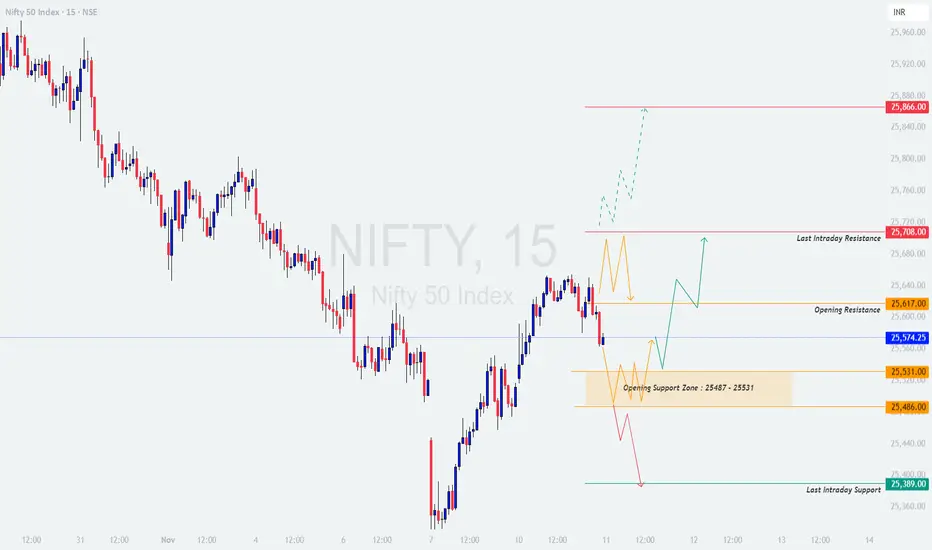
Nifty is currently trading near 25,574 , positioned just below the Opening Resistance (25,617) and slightly above the Opening Support Zone (25,487 – 25,531) . The index continues to consolidate in a tight range after a short-term rebound, suggesting that a breakout is imminent.
The structure indicates that the market is at a decision point — a sustained move above 25,617 may invite further upside momentum, while slipping below 25,487 could expose the lower support near 25,389 .
Volatility may increase as traders position ahead of the weekend and key economic data.
Key Levels to Watch:
🟢 Supports: 25,531 / 25,487 / 25,389
🟥 Resistances: 25,617 / 25,708 / 25,866
⚖️ Bias Zone: 25,487 – 25,617 (Opening Range)
🟢 Scenario 1: GAP-UP Opening (100+ Points)
If Nifty opens above 25,670 – 25,700 , it will be opening close to the Last Intraday Resistance (25,708) . Bulls will need to sustain above this zone to extend momentum toward 25,866 .
If price sustains above 25,708 with strong bullish candles and rising volume, a move toward 25,820 – 25,866 is likely.
However, if Nifty opens higher but fails to hold above 25,708 , it may trigger profit booking back toward 25,617 – 25,574 .
Traders should avoid emotional long entries at the open — instead, wait for a retest of 25,617 to confirm support before going long.
Use trailing stops once the price moves 30–40 points in your favor to secure profits in case of sharp reversals.
💡 Educational Note:
Gap-up openings can often be deceptive — they excite traders into premature entries without confirming strength. True momentum is validated only when the market holds above resistance zones with rising volume and strong candle closes. Always let the first few candles define control between bulls and bears.
🟧 Scenario 2: FLAT Opening (Within 25,487 – 25,617)
A flat opening around the current range will likely lead to a period of early consolidation and directionless moves. The first half-hour will be crucial to identify whether the breakout happens upward or downward.
If price sustains above 25,617 with volume expansion, expect an upside continuation toward 25,708 – 25,866 .
If price breaks below 25,487 , weakness may extend toward 25,389 .
Avoid trading within this range — it’s a “no-clear-edge” zone that traps both sides. Wait for the breakout retest confirmation before entering.
Scalpers can focus on rejection wicks or engulfing patterns near extremes for quick intraday setups.
🧠 Educational Tip:
Flat openings require traders to be patient and disciplined. Most of the false moves occur within the first 30 minutes when traders try to predict direction instead of reacting to it. The best opportunities come once a breakout confirms and retests with volume-backed follow-through.
🔴 Scenario 3: GAP-DOWN Opening (100+ Points)
If Nifty opens below 25,470 or near 25,430 – 25,400 , it will test the Opening Support Zone (25,487 – 25,531) and potentially move toward Last Intraday Support (25,389) .
If a reversal candle (hammer, bullish engulfing) appears near 25,389 , buyers may attempt a short-covering move toward 25,531 – 25,574 .
However, a sustained break below 25,389 with strong red candles and volume can extend weakness toward 25,320 – 25,280 .
Avoid shorting immediately on a deep gap-down — instead, wait for a pullback toward resistance zones like 25,487 – 25,531 for better risk-reward.
Volume analysis near the support zone will help confirm whether selling pressure is continuing or exhausting.
📘 Educational Insight:
Gap-downs are driven by overnight panic, and traders often overreact during the first few minutes. Smart money usually waits for sellers to exhaust before entering for reversals. Watching the candle structure and volume at key supports gives clues to whether it’s a continuation or reversal day.
💼 RISK MANAGEMENT TIPS FOR OPTIONS TRADERS:
Avoid buying options during the first 15 minutes after market open — early IV spikes inflate premiums and reduce your edge.
Always define your risk before entering; limit your exposure to 1–2% of total capital per trade .
Prefer ITM options for directional conviction, as they are less affected by time decay.
If using OTM options, exit quickly after 20–30 points in your favor — don’t let greed turn into decay.
Trail stop-losses as soon as your position gains momentum, and never remove stop-losses hoping for a bounce.
Remember: Consistency in managing risk is what keeps traders in the game, not catching every move.
📈 SUMMARY:
🟧 Opening Range Zone: 25,487 – 25,617
🟥 Resistance Levels: 25,708 / 25,866
🟩 Support Levels: 25,531 / 25,487 / 25,389
⚖️ Bias: Neutral-to-Bullish above 25,617 | Weakness below 25,487
📚 CONCLUSION:
Nifty is currently at a tight consolidation zone, preparing for a decisive breakout. A move above 25,617 could attract bullish continuation toward 25,708 – 25,866 , while slipping below 25,487 might tilt control toward bears with potential tests of 25,389 or lower.
Tomorrow’s session will reward patient traders who wait for breakout confirmation and avoid early traps.
Stay objective, respect the levels, and let price action lead the way.
📊 The best trades come not from prediction but from preparation and disciplined execution.
⚠️ DISCLAIMER:
I am not a SEBI-registered analyst . The views and analysis shared above are solely for educational purposes . Please do your own research or consult a certified financial advisor before making any trading or investment decisions.
NIFTY KEY LEVELS FOR 10.11.2025NIFTY KEY LEVELS FOR 10.11.2025
Timeframe: 3 Minutes
If the candle stays above the pivot point, it is considered a bullish bias; if it remains below, it indicates a bearish bias. Price may reverse near Resistance 1 or Support 1. If it moves further, the next potential reversal zone is near Resistance 2 or Support 2. If these levels are also broken, we can expect the trend.
When a support or resistance level is broken, it often reverses its role; a broken resistance becomes the new support, and a broken support becomes the new resistance.
If the range(R2-S2) is narrow, the market may become volatile or trend strongly. If the range is wide, the market is more likely to remain sideways
please like and share my idea if you find it helpful
📢 Disclaimer
I am not a SEBI-registered financial adviser.
The information, views, and ideas shared here are purely for educational and informational purposes only. They are not intended as investment advice or a recommendation to buy, sell, or hold any financial instruments.
Please consult with your SEBI-registered financial advisor before making any trading or investment decisions.
Trading and investing in the stock market involves risk, and you should do your own research and analysis. You are solely responsible for any decisions made based on this research.
NIFTY - Trading levels and Plan for 10-Nov-2025📊 NIFTY TRADING PLAN — 10 NOV 2025
(Timeframe Reference: 15-Min Chart)
Chart Summary:
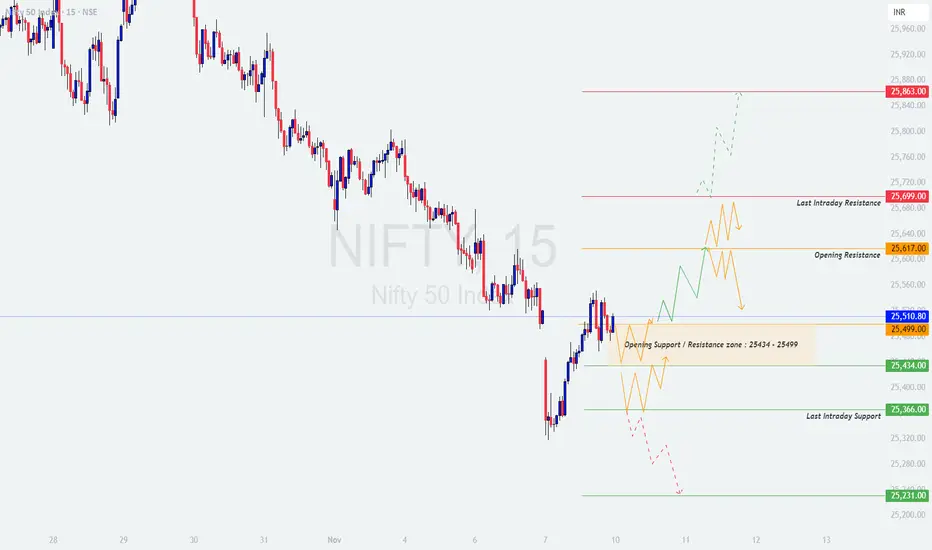
Nifty is currently trading around the 25,510 zone, situated right near the Opening Support / Resistance Zone (25,434 – 25,499) . The market structure shows a short-term base building, with the index now oscillating between 25,434 on the downside and 25,617 on the upside. A breakout beyond either level could define the trend for the session.
Key levels to watch include:
🟢 Resistance Zones: 25,617 (Opening Resistance), 25,699 (Last Intraday Resistance), 25,863 (Next Upside Level)
🔴 Support Zones: 25,434 (Immediate), 25,366 (Last Intraday Support), 25,231 (Final Support)
With volatility expected due to global cues and options expiry positioning, traders should emphasize patience, discipline, and confirmation before entry.
🟢 Scenario 1: GAP-UP Opening (100+ Points)
If Nifty opens near or above 25,610 – 25,640 , it will directly test the Opening Resistance zone. Bulls need to sustain above this level to maintain control.
If price sustains above 25,617 for 15–30 minutes with strong candle closings and rising volume, a move toward 25,699 and possibly 25,863 can unfold.
However, if price fails to sustain above 25,617 and forms rejection candles or bearish patterns (like shooting star or engulfing), traders can expect a pullback toward 25,510 – 25,499 .
A failed breakout above 25,617 can offer a short-term shorting opportunity back into the consolidation range.
Avoid aggressive long entries immediately after the gap-up — wait for retests and volume confirmations.
💡 Educational Note:
A gap-up does not guarantee continuation. Many traders get trapped in "breakout euphoria" without waiting for confirmation. The key is sustained price action with strong volume. Smart traders often buy on dips after confirmation, not at the peak of the first candle.
🟧 Scenario 2: FLAT Opening (Within 25,434 – 25,499 Zone)
A flat opening inside the Opening Support / Resistance Zone will likely cause initial indecision. The market may first trap both sides before picking direction.
Avoid trading the first few 15-min candles if price stays within 25,434 – 25,499 .
If price breaks above 25,499 decisively with strength, the momentum could carry it toward 25,617 and 25,699 .
If price breaks below 25,434 , it may drag the index lower toward 25,366 , and in case of strong selling, 25,231 .
Ideal strategy: Wait for breakouts with closing confirmation. Avoid countertrend trades in this setup.
🧠 Educational Tip:
Flat openings test patience — they’re designed to frustrate impulsive traders. Remember: The first move after a flat open is often false. Wait for clear direction confirmed by price structure and volume alignment before taking a stance.
🔴 Scenario 3: GAP-DOWN Opening (100+ Points)
If Nifty opens below 25,410 or near 25,366 , sentiment may turn weak initially, bringing the Last Intraday Support (25,366 – 25,231) into focus.
If a reversal candle forms near 25,366 – 25,231 (hammer or bullish engulfing), traders can look for short-covering opportunities toward 25,434 – 25,499 .
However, if price sustains below 25,366 , then weakness can extend further, possibly toward 25,200 – 25,150 zones.
Avoid shorting immediately after a big gap-down. Wait for a pullback toward resistance levels for better entry and risk-reward balance.
Volume confirmation near support zones is critical — weak volume during selloffs often precedes reversals.
📘 Educational Insight:
Gap-downs tend to trigger fear-based selling early in the session. The best approach is to observe — not react — in the first few minutes. If buyers start stepping in near strong support levels, that’s often where reversals begin. Let price tell you its story before taking sides.
💼 RISK MANAGEMENT TIPS FOR OPTIONS TRADERS:
Avoid buying options during the first 15 minutes of volatile openings — inflated IV spikes can cause fast premium decay.
Always define your stop-loss before entry and risk a maximum of 1–2% of total capital per trade.
Use ITM options for cleaner directional plays; avoid far OTM contracts unless volatility breakout is confirmed.
Trail stop-losses once your trade moves 30–40 points in your favor — protect profits and minimize emotional exits.
Never trade without a plan. The best traders protect their capital first, profits come next.
📈 SUMMARY:
🟧 Opening Support / Resistance Zone: 25,434 – 25,499
🟥 Resistance Zones: 25,617 / 25,699 / 25,863
🟩 Support Zones: 25,434 / 25,366 / 25,231
⚖️ Bias: Neutral-to-Bullish above 25,499 | Weakness below 25,434
📚 CONCLUSION:
Nifty is currently at a pivotal range, consolidating before its next major breakout. The 25,434 – 25,499 zone is the short-term decision point. A break above 25,499 can reignite bullish sentiment, while a fall below 25,434 may extend weakness toward 25,366 or even 25,231 .
Be patient during the opening volatility and focus on clarity over speed. The first 15–30 minutes often decide the day’s fate — don’t rush into uncertain setups.
📊 Consistency in following your plan is more powerful than chasing every move.
⚠️ DISCLAIMER:
I am not a SEBI-registered analyst . The views and levels shared are for educational purposes only . Please do your own research or consult a registered financial advisor before making any trading or investment decisions.
07 Nov 2025–308pts profits and counting on the Nifty short tradeNifty Stance Bearish 🐻
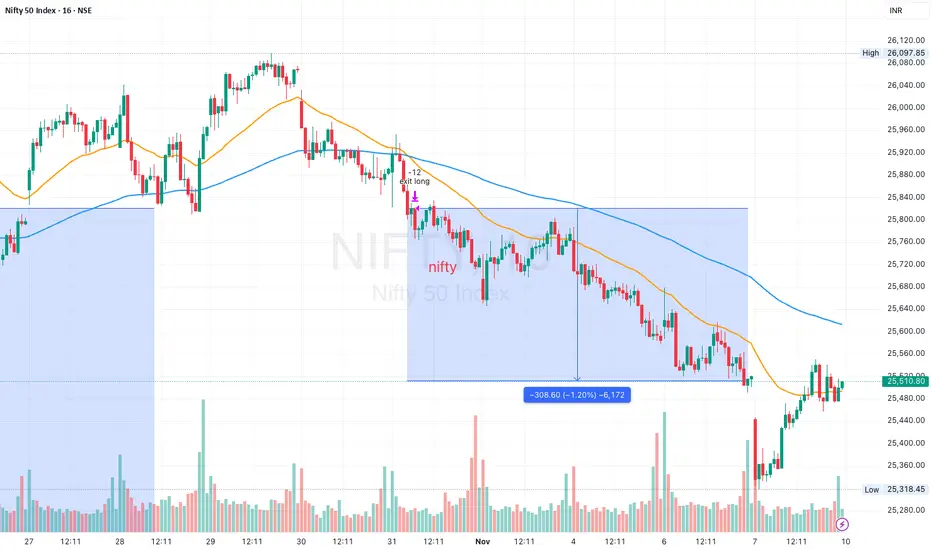
We went short on Nifty last Friday, and this complete week, we have had a decent one-way fall. So far, we have fallen 308pts, and it looks like more shorts could enter the system even if we remain flattish over the next two days. There was a holiday in between, but it did not affect the markets, and the journey has been one-sided so far this week.
One interesting technical data point is the first candle of today, when we fell to 25318, and from there we saw an intraday recovery of 234+ pts. We might have ended the day in green, but for the lack of momentum in the last hour of trade.
My nearest support levels are at 25219 and 25003, and I was really surprised to see markets take a U-turn at 25318. The closest resistance is at 25681, followed by 25906.
Nifty Slips for 2nd Week: Consolidation Ahead amid Rising VIXIndian markets ended lower for the second straight week, weighed down by persistent foreign fund outflows, mixed corporate earnings, and cautious global cues.
Nifty slipped nearly 0.8% to close at 25,490, while India VIX rose over 3% to 12.55, reflecting a slight uptick in market volatility.
Key Levels to Watch
Nifty is currently retesting the apex of its ascending triangle breakout, around the 25,300–25,400 zone. This area is supported by significant put writing, as reflected in recent open interest data, making it an important near-term support.
Below this, the next strong support lies near 25,000.
On the upside, the 25,700–25,800 zone could act as an immediate resistance due to heavy call writing, while 26,000 remains a major resistance level to watch.
Outlook
Given the current setup, markets are likely to trade within a neutral range in the coming week. Volatility may stay elevated as global uncertainties, FII outflows, and a busy flow of economic and earnings data continue to influence sentiment.
While near-term sentiment remains cautious, strong domestic macro fundamentals and steady corporate performance are expected to provide underlying support to the broader trend.
Traders are advised to stay stock-specific, focusing on banking and financials—particularly PSU banks—which continue to display relative strength.
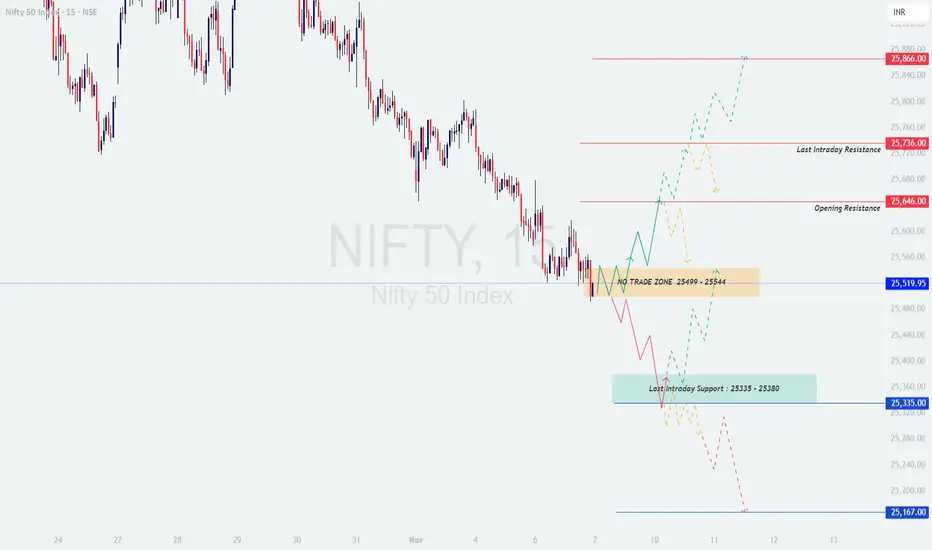
NIFTY : Trading levels and Plan for 07-Nov-2025📊 NIFTY TRADING PLAN — 07 NOV 2025
(Timeframe Reference: 15-Min Chart)
Chart Summary:
Nifty is currently trading near the 25,520 zone, which lies just below the identified Opening Resistance (25,646) and slightly above the No-Trade Zone (25,449 – 25,544) . The index remains range-bound, but volatility is expected to pick up as it approaches key breakout zones. A decisive move beyond these levels could trigger strong directional momentum — either continuation or reversal.
The broader trend bias remains neutral-to-bullish unless Nifty slips below 25,380 , which marks the last intraday support area.
🟢 Scenario 1: GAP-UP Opening (100+ Points)
If Nifty opens around or above 25,620 – 25,650 , it will open directly near the Opening Resistance zone. A strong gap-up needs immediate follow-through to sustain bullish momentum.
If price sustains above 25,646 with strong bullish candles and volume confirmation, traders can look for long entries targeting 25,736 and 25,866 .
However, failure to hold above 25,646 may indicate exhaustion. Rejection candles near resistance could invite short-term profit booking and a retracement toward 25,544 – 25,490 .
Ideal strategy: Wait for the first 15–30 minutes to confirm momentum. Enter on pullbacks rather than chasing the initial move.
💡 Educational Note: Gap-ups often lure traders into impulsive entries. The key is confirmation — a sustained break above the resistance with rising volume confirms institutional participation. Always avoid long positions if the first candle forms a wick-type rejection near resistance.
🟧 Scenario 2: FLAT Opening (Within 25,449 – 25,544)
This range represents the No-Trade Zone . Flat openings within this area typically cause early volatility and indecision. Traders should avoid taking trades immediately as price may oscillate rapidly before choosing direction.
Avoid entering trades within the 25,449 – 25,544 band.
If price breaks above 25,544 decisively with strong green candles, upside targets remain 25,646 → 25,736 .
If price breaks below 25,449 , it could drift lower toward 25,380 – 25,335 (the last intraday support zone). Sustained selling may extend weakness toward 25,167 .
🧠 Educational Tip: During flat openings, avoid predicting direction. Let the breakout confirm. Early trades inside such zones are mostly hit by stop-loss whipsaws. The best trades emerge after clarity, not anticipation.
🔴 Scenario 3: GAP-DOWN Opening (100+ Points)
If Nifty opens below 25,420 , sentiment will likely turn weak, and price may test the Last Intraday Support (25,335 – 25,380) .
If a reversal candle (hammer or bullish engulfing) forms within the 25,335 – 25,380 support area, it can offer a short-covering opportunity toward 25,490 – 25,544 .
However, if Nifty breaks and sustains below 25,335 , further downside may open toward 25,167 .
Avoid shorting directly on deep gap-downs — wait for a pullback near 25,490 – 25,544 to get a better entry with favorable risk-reward.
📘 Educational Insight: Gap-downs often lead to panic selling in the opening moments. Patience and confirmation are crucial. If volume starts drying near support zones, it usually indicates seller fatigue and potential reversal setups.
💼 RISK MANAGEMENT TIPS FOR OPTIONS TRADERS:
Avoid buying options in the first 15 minutes of volatile openings — IV (Implied Volatility) spikes can cause inflated premiums.
Always define your stop-loss before entering a trade; risk no more than 1–2% of your total capital per setup.
Use ITM options for directional conviction and avoid OTM strikes in a range-bound market.
Trail your stop-loss once your position gains 30–40 points in favor.
Remember: Capital protection is your first priority; missing a trade is better than a forced loss.
📈 SUMMARY:
🟧 No-Trade Zone: 25,449 – 25,544
🟥 Resistance Zones: 25,646 / 25,736 / 25,866
🟩 Support Zones: 25,380 – 25,335 / 25,167
⚖️ Bias: Neutral-to-Bullish above 25,544 | Weakness below 25,449
📚 CONCLUSION:
Nifty stands at a critical juncture between consolidation and breakout. The 25,544 level acts as a trigger for directional clarity — a sustained move above can revive bullish sentiment, while a fall below 25,449 may bring further weakness.
Be patient during opening volatility, focus on level confirmations, and let price action guide you rather than emotions.
📊 Trading is not about catching every move — it’s about catching the right move at the right time.
⚠️ DISCLAIMER:
I am not a SEBI-registered analyst . The analysis shared above is purely for educational purposes and market understanding. Please consult a certified financial advisor before taking any trading or investment decisions.
NIFTY KEY LEVELS FOR 07.11.2025NIFTY KEY LEVELS FOR 07.11.2025
Timeframe: 3 Minutes
If the candle stays above the pivot point, it is considered a bullish bias; if it remains below, it indicates a bearish bias. Price may reverse near Resistance 1 or Support 1. If it moves further, the next potential reversal zone is near Resistance 2 or Support 2. If these levels are also broken, we can expect the trend.
When a support or resistance level is broken, it often reverses its role; a broken resistance becomes the new support, and a broken support becomes the new resistance.
If the range(R2-S2) is narrow, the market may become volatile or trend strongly. If the range is wide, the market is more likely to remain sideways
please like and share my idea if you find it helpful
📢 Disclaimer
I am not a SEBI-registered financial adviser.
The information, views, and ideas shared here are purely for educational and informational purposes only. They are not intended as investment advice or a recommendation to buy, sell, or hold any financial instruments.
Please consult with your SEBI-registered financial advisor before making any trading or investment decisions.
Trading and investing in the stock market involves risk, and you should do your own research and analysis. You are solely responsible for any decisions made based on this research.
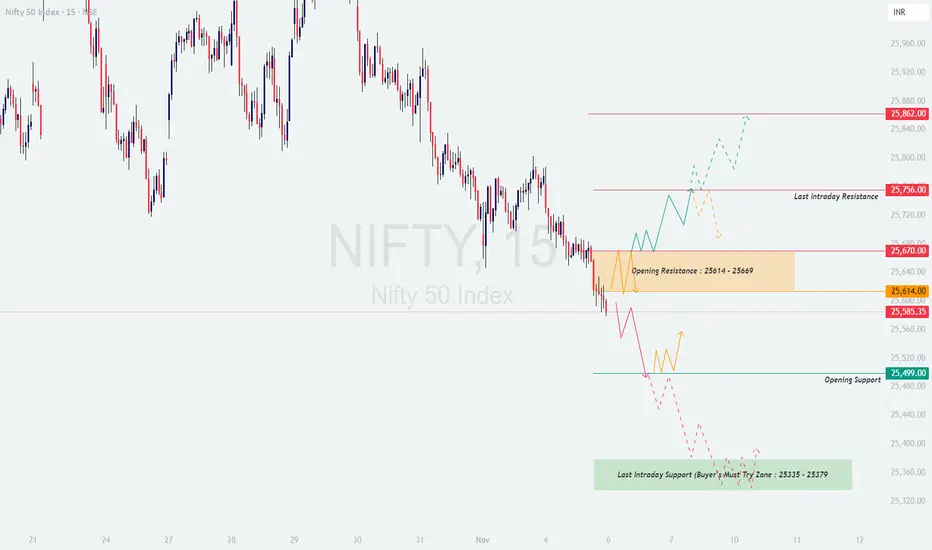
NIFTY : Trading levels and plan for 05-Nov-2025🔹 NIFTY Trading Plan for 05-Nov-2025
(Based on psychological correction theory & intraday structural behavior)
Chart Reference Levels:
🟧 Opening Resistance Zone: 25,614 – 25,669
🟥 Last Intraday Resistance: 25,756
🟩 Opening Support: 25,499
🟢 Last Intraday Support (Buyers’ Must-Try Zone): 25,335 – 25,379
❤️ Upside Extension: 25,862
🟢 Scenario 1: Gap-Up Opening (100+ points above previous close)
If Nifty opens around or above 25,670, it will directly test the Opening Resistance Zone (25,614 – 25,669). Here, traders should observe how the market reacts — a rejection with long upper wicks or high volatility candles could indicate distribution.
For bullish continuation, Nifty must sustain above 25,669 with a decisive 15-min candle close. A breakout can invite fresh momentum, pushing the index toward 25,756 and possibly extending up to 25,862.
Failure to hold above 25,669 may trigger a quick pullback to 25,614 or even back to the Opening Support at 25,499, where intraday buyers might reattempt to defend.
📘 Educational Note: Gap-up openings are often emotional reactions to overnight cues. Let the market confirm strength before chasing momentum. Look for stability above key resistance levels before taking directional calls.
🟠 Scenario 2: Flat Opening (±50 points around 25,585)
A flat open near the current zone (25,560–25,600) keeps Nifty in a balancing phase between bulls and bears. This range can act as a decision-making area for the day.
Sustained price action above 25,614 will likely attract buying interest, taking prices toward 25,669 – 25,756 levels.
On the downside, if Nifty slips below 25,499, selling pressure can intensify, dragging the index toward 25,379, which is the “Buyers’ Must-Try Zone.”
📘 Educational Note: Flat openings provide the cleanest opportunities for structured intraday setups. Patience during the first 30 minutes helps identify whether smart money is accumulating (bullish bias) or distributing (bearish bias).
🔴 Scenario 3: Gap-Down Opening (100+ points below previous close)
A gap-down below 25,500 directly places the index near the Opening Support or Last Intraday Support zone (25,335 – 25,379).
Watch this area carefully — if buyers fail to defend, weakness can extend further. However, a strong reversal candle or volume divergence could trigger short-covering opportunities.
Recovery back above 25,499 would indicate that buyers are attempting to regain control. In that case, a bounce toward 25,614 may unfold, where traders can re-evaluate the next move.
📘 Educational Note: Gap-downs often start with fear-driven selling. Smart traders wait for confirmation candles before entering, as the first impulse frequently fades when institutional players absorb liquidity at lower levels.
💡 Risk Management Tips for Options Traders
Define your maximum risk per trade (1–2% of capital) before entry.
Use hourly candle close-based stop losses to avoid false triggers from volatility spikes.
Avoid buying far OTM options post 11:00 AM; time decay accelerates rapidly.
If volatility (IV) is elevated, consider vertical spreads instead of naked calls or puts.
Always plan both entry and exit before executing — emotions should not decide your stop loss.
📊 Summary & Conclusion:
Above 25,669 → Bullish momentum possible toward 25,756 – 25,862.
Between 25,499 – 25,614 → Neutral consolidation; intraday reactions will decide direction.
Below 25,499 → Weakness likely toward 25,379 and 25,335 zones.
In summary, 05-Nov-2025 looks like a crucial reaction day — buyers must defend supports, while sellers may try to push the market lower. The best approach is to stay patient for the first half-hour, identify structure, and trade based on confirmation, not assumptions.
⚠️ Disclaimer:
I am not a SEBI-registered analyst . The analysis above is purely for educational and informational purposes. Traders are advised to do their own research or consult a certified financial advisor before making any trading decisions.