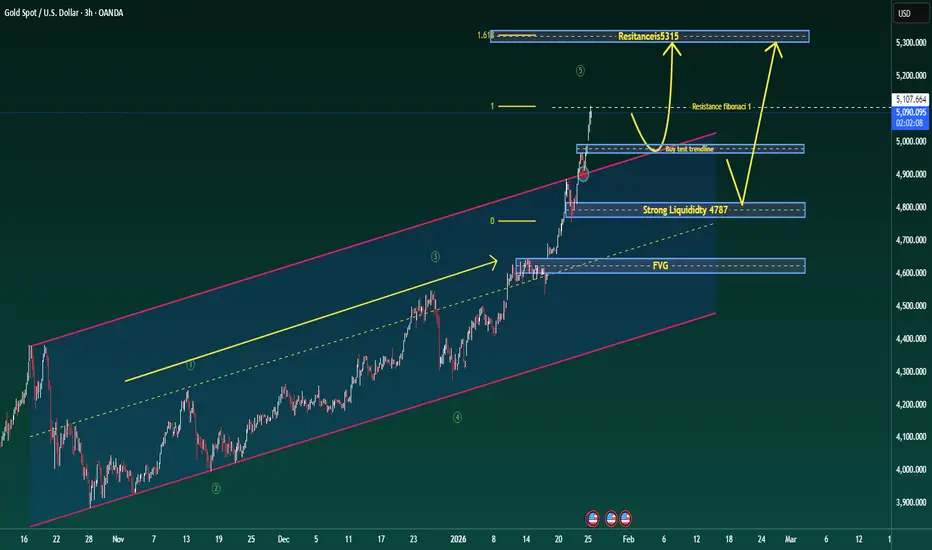
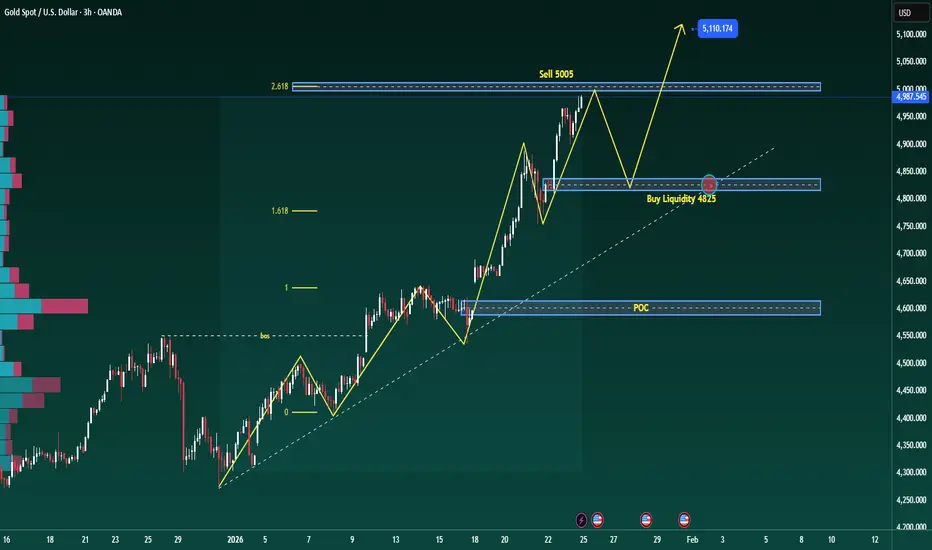
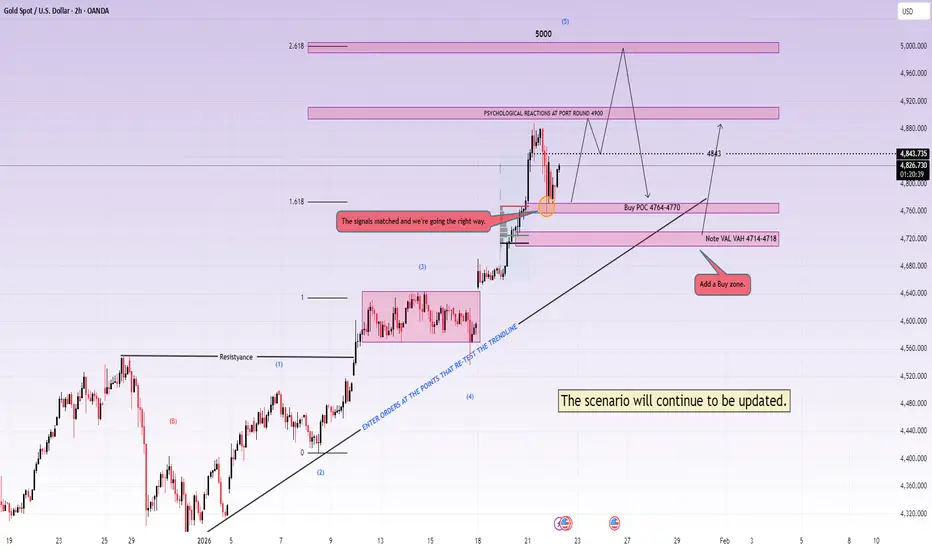
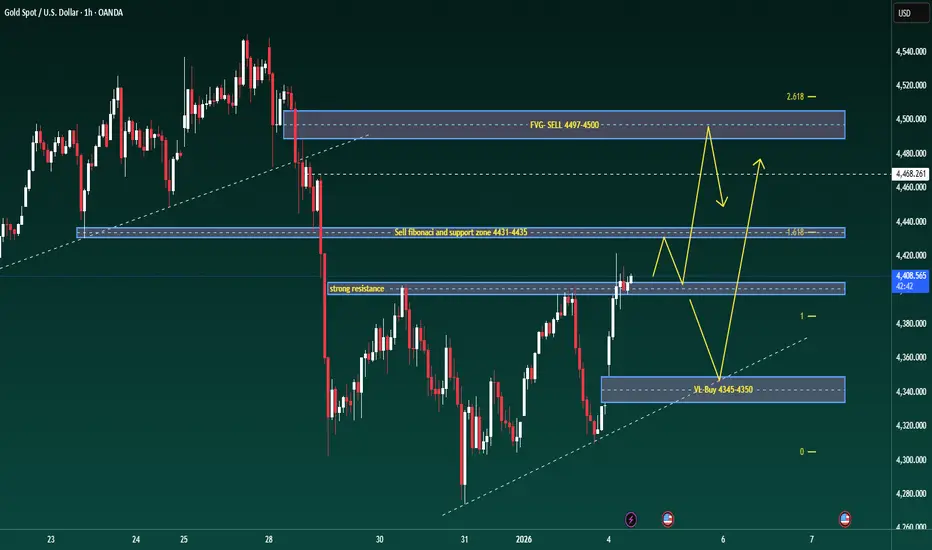
XAUUSD (H1) – Early-week Selling biasSharp drop from ATH, look to sell the pullback into resistance & liquidity
Strategy summary
Gold opened the week with a fast sell-off (roughly a $20 drop intraday), signalling strong profit-taking after the All-Time High sweep. With the current structure, my focus is SELL on pullbacks, using the trendline / resistance zones and nearby liquidity clusters as execution areas.
1) Technical read (H1 – based on your chart)
All-Time High remains a major psychological ceiling. After an ATH sweep, a corrective leg is common.
Price is trading below the Buyside Liquidity band, which often gets retested before the next directional move.
Key levels on your chart:
Sell zone: 4494 – 4497 (main pullback sell area)
Strong Liquidity: around 4474 (reaction / decision point)
Lower liquidity supports: 4441 – 4444 and 4403 – 4406 (areas to watch for reactions)
2) Trade plan (Liam style: trade the level)
Scenario A (priority): SELL the pullback
✅ Sell zone: 4494 – 4497
SL (guide): above the zone (refine on lower TF / spread)
TP1: 4474
TP2: 4441 – 4444
TP3: 4403 – 4406
Logic: This is a clean resistance / pullback area. Selling the reaction is safer than chasing shorts at the lows.
Scenario B: BUY reaction at lower liquidity (scalp only)
If the sell leg extends into support, you can consider a short-term bounce trade:
Buy: 4441 – 4444 (quick reaction zone)
Deeper buy: 4403 – 4406 (better value zone)
Only take buys with clear holding signals on lower timeframes — no catching falling knives.
3) Macro context (news) – why gold is swinging
The sharp move lower suggests markets are re-pricing risk after an extended rally.
US–Israel tensions are elevated, with Trump and Netanyahu reportedly clashing over Gaza, Iran and post-war order — geopolitical risk can trigger fast liquidity-driven swings.
In headline-driven sessions, gold often runs a two-step pattern: liquidity sweep → correction → direction. That’s why I’m sticking to level-based execution and avoiding FOMO.
4) Risk notes
Don’t chase shorts during heavy red candles.
Focus on 4494–4497 for shorts and scale out at the TP levels.
Max risk per trade: 1–2%.
What’s your bias for this week: selling the 4494–4497 pullback, or waiting for 444x/440x to buy a reaction bounce?
Tradingforex
XAUUSD (H1) – Bearish Correction After ATHLana focuses on selling rallies, waiting for a deeper buying zone 💛
Quick overview
Market state: Sharp sell-off after failing to hold above ATH
Timeframe: H1
Current structure: Strong bearish impulse → corrective rebound in progress
Intraday bias: Sell on pullbacks, buy only at major support
Technical picture (based on the chart)
Gold printed a clear distribution top near ATH, followed by a strong bearish displacement. This move broke the short-term bullish structure and shifted momentum to the downside.
Price is now attempting a technical rebound, but so far this looks corrective rather than impulsive. As long as price stays below key resistance, Lana treats this as a sell-the-rally environment.
Key observations:
Strong bearish candle confirms loss of bullish control
Current rebound is moving into prior liquidity + Fibonacci reaction zone
Market is likely building a lower high before the next move
Key levels to trade
Sell zone – priority setup
Sell: 4392 – 4395
This zone aligns with:
Prior structure resistance
Fibonacci retracement area
Liquidity resting above current price
If price reaches this zone and shows rejection, Lana will look for sell continuation.
Buy zone – only at strong support
Buy: 4275 – 4278
This is a higher-timeframe support zone and the first area where buyers may attempt to step back in. Lana only considers buys here if price shows clear reaction and stabilization.
Intraday scenarios
Scenario 1 – Rejection at resistance (preferred)
Price retraces into 4392–4395, fails to break higher, and rolls over → continuation to the downside, targeting deeper liquidity.
Scenario 2 – Deeper correction then recovery
If selling pressure extends, price may sweep liquidity into 4275–4278 before forming a base for a larger rebound into the new year.
Market tone
The recent move reflects profit-taking and risk reduction after an extended rally. With year-end liquidity thinning out, price action can remain volatile and deceptive, making zone-based trading essential.
This analysis reflects Lana’s technical view and is not financial advice. Always manage your own risk and wait for confirmation before entering trades 💛
Part 7 Trading Master Class With Experts How Options Work
Options provide leverage. For a fraction of the underlying asset's price, traders can control a large position. For example, buying 100 shares of a stock directly may cost $10,000, but buying a call option on those shares could cost $500, offering similar profit potential if the stock rises.
Profit Scenarios
Call Option Buyer: Gains when the underlying price rises above strike + premium paid.
Put Option Buyer: Gains when the underlying price falls below strike - premium paid.
Seller (Writer) of Options: Receives the premium upfront but assumes the risk of adverse price movement.
Part 4 Learn Institutional Trading Option Terminology
To trade options effectively, one must understand key terminologies:
Premium: The price paid to buy an option. It’s influenced by intrinsic and extrinsic factors.
Intrinsic Value: The value of the option if exercised immediately. For calls, it’s the difference between the underlying price and strike price if positive; for puts, it’s the difference between strike price and underlying price if positive.
Extrinsic Value (Time Value): The part of the premium based on time until expiration and volatility.
In-the-Money (ITM): A call is ITM if the underlying price is above the strike; a put is ITM if the underlying price is below the strike.
Out-of-the-Money (OTM): A call is OTM if the underlying price is below the strike; a put is OTM if above.
At-the-Money (ATM): The underlying price is equal to the strike price.
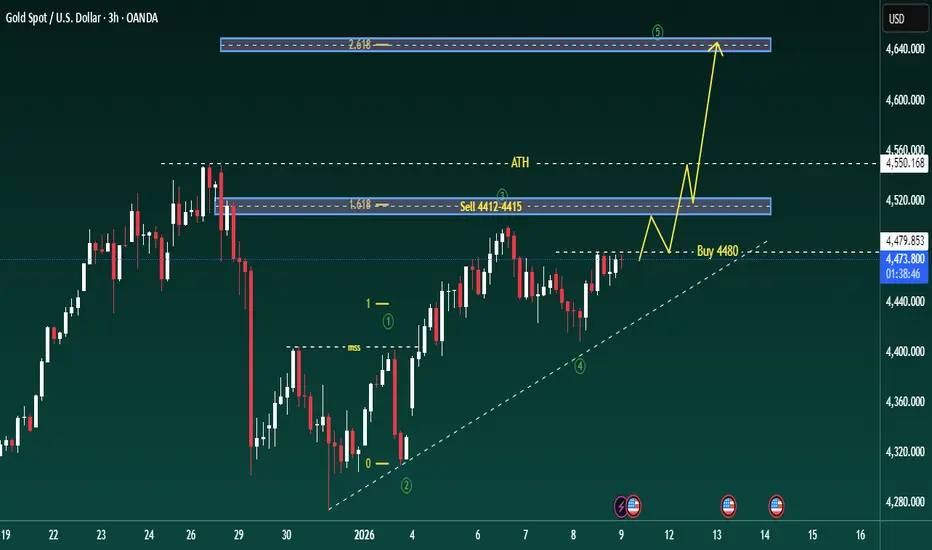
XAUUSD (H1) – Trading BUY Liquidity Stay bullish with the rising channel, buy the pullback into liquidity
Quick view
Gold is still moving inside a rising channel. After the strong impulsive push, price is now consolidating / compressing. For today, I’m prioritising BUY setups at liquidity + trendline retests, while keeping a reaction SELL plan at the premium Fibonacci zone above.
Macro context (why volatility can stay elevated)
Trump signing a record number of executive orders and the growing shift of power towards the executive branch increases policy uncertainty (tariffs, federal cuts, geopolitical moves). In uncertain environments, flows often rotate into safe-haven assets like gold.
That said, this kind of headline risk can also move the USD sharply, so the best approach is still: trade the levels, not emotions.
Key Levels (from your chart)
✅ Buy zone Liquidity: 4410 – 4413
✅ Buy trendline retest: 4480 – 4483
✅ Sell zone (Fibo 1.618): 4603 – 4606
Today’s trading scenarios (Liam style: trade the level)
1) BUY scenario (priority)
A. Trendline retest = best structural entry
Buy: 4480 – 4483
SL: below the zone (guide: 4472–4475, adjust on lower TF / spread)
TP1: 4515 – 4520
TP2: 4580 – 4600
B. Deeper liquidity buy (if we get a sweep)
Buy: 4410 – 4413
SL: below the zone (guide: 4402–4405)
TP: 4480 → 4520
Logic: These are the cleanest liquidity areas on the chart. No chasing mid-range — I only act when price returns to the zone and reacts.
2) SELL scenario (reaction only — no chasing)
Sell: 4603 – 4606
SL: 4612
TP1: 4550
TP2: 4483
Logic: The 1.618 premium zone often attracts profit-taking. I only sell if price taps the zone and shows clear weakness on the lower timeframe.
Notes
If price keeps holding the trendline and printing higher lows → BUY bias remains stronger.
If we break the trendline and fail to reclaim it → reduce size and wait for a fresh structure.
Which side are you leaning today: buying the pullback, or waiting for 4603–4606 to sell the reaction?
Policy Matters in Trading DevelopmentBuilding a Stable, Transparent, and Growth-Oriented Market Ecosystem
Trading development does not happen in isolation. It is deeply influenced by government policies, regulatory frameworks, monetary decisions, and institutional rules that shape how markets function. Policies act as the backbone of trading ecosystems by ensuring fairness, transparency, stability, and long-term growth. Without strong and adaptive policies, trading markets can become vulnerable to manipulation, excessive volatility, and systemic risks. The following discussion explains in detail why policy matters are crucial in trading development and how they impact different dimensions of financial markets.
1. Role of Policy in Market Stability
One of the primary objectives of trading-related policies is maintaining market stability. Financial markets are sensitive to economic shocks, speculative excesses, and global events. Regulatory policies such as circuit breakers, margin requirements, and position limits help prevent panic-driven crashes and extreme volatility. These mechanisms protect both retail and institutional investors from sudden market breakdowns and ensure orderly trading conditions.
Stable markets encourage long-term participation, attract foreign investors, and build confidence in the financial system. Without such policies, markets can experience frequent bubbles and crashes, undermining economic growth.
2. Ensuring Fairness and Transparency
Fair trading practices are the foundation of healthy market development. Policies related to disclosure norms, insider trading restrictions, and market surveillance ensure that all participants operate on a level playing field. Transparent rules require companies to disclose financial results, material events, and governance practices, enabling traders to make informed decisions.
Strong transparency policies reduce information asymmetry, where only a few participants have access to critical information. This builds trust, especially among retail traders, and increases overall market participation.
3. Investor Protection and Confidence
Investor protection policies are essential for sustainable trading development. Regulations governing broker conduct, client fund segregation, grievance redressal mechanisms, and compensation funds protect investors from fraud and misconduct.
When traders feel protected, they are more willing to participate actively in markets. Investor confidence leads to higher liquidity, better price discovery, and deeper markets. In contrast, weak protection policies often result in capital flight and reduced participation.
4. Impact of Monetary Policy on Trading
Monetary policy decisions—such as interest rate changes, liquidity measures, and inflation control—directly influence trading behavior. Lower interest rates generally push investors toward equities and risk assets, while higher rates may shift capital toward fixed-income instruments.
Central bank policies affect currency markets, bond yields, commodity prices, and equity valuations. Traders closely monitor policy statements and economic projections to anticipate market movements. Thus, monetary policy plays a crucial role in shaping trading strategies and asset allocation decisions.
5. Fiscal Policy and Market Development
Fiscal policies, including taxation, government spending, and subsidies, also significantly affect trading development. Changes in capital gains tax, securities transaction tax, or corporate tax rates can alter trading volumes and investment preferences.
Pro-growth fiscal policies often boost corporate earnings expectations, leading to bullish market sentiment. Conversely, restrictive fiscal measures may dampen market activity. Well-designed fiscal policies balance revenue generation with market competitiveness.
6. Regulatory Frameworks and Market Integrity
Strong regulatory institutions are vital for maintaining market integrity. Regulations covering market manipulation, algorithmic trading, derivatives, and high-frequency trading ensure that innovation does not compromise fairness.
As markets evolve with technology, policies must adapt to new trading instruments and platforms. Robust regulatory frameworks help manage risks associated with leverage, complex derivatives, and automated trading systems.
7. Encouraging Innovation and Technological Growth
Policy support is critical for encouraging innovation in trading infrastructure. Regulations that allow electronic trading platforms, fintech participation, and digital settlement systems enhance efficiency and reduce transaction costs.
At the same time, policies must address cybersecurity risks, data privacy, and operational resilience. A balanced policy approach fosters innovation while safeguarding market stability.
8. Role of Policies in Market Liquidity
Liquidity is the lifeblood of trading markets. Policies related to market-making, short-selling, and institutional participation influence liquidity levels. Allowing controlled short-selling, for example, improves price discovery and reduces bid-ask spreads.
Well-designed liquidity policies ensure smooth execution of trades, reduce volatility, and make markets more attractive to global investors.
9. Global Trade and Cross-Border Policies
In an interconnected world, trading development is influenced by international policies and agreements. Foreign investment regulations, capital flow controls, and trade agreements affect cross-border trading activity.
Harmonized global policies improve market access and integration, while protectionist measures can restrict capital flows and increase uncertainty. Traders must account for geopolitical and policy risks in their strategies.
10. Risk Management and Systemic Stability
Policies related to risk management play a crucial role in preventing systemic crises. Capital adequacy norms, stress testing, and exposure limits help financial institutions manage risks effectively.
These policies ensure that failures of individual participants do not escalate into broader market crises. Strong risk management frameworks protect the overall trading ecosystem and the real economy.
11. Development of Derivatives and Advanced Markets
The growth of derivatives markets depends heavily on regulatory clarity. Policies defining contract specifications, margin norms, and settlement mechanisms are essential for safe derivatives trading.
Well-regulated derivatives markets allow traders to hedge risks, improve price discovery, and manage volatility. Poorly regulated derivatives, however, can amplify risks and lead to financial instability.
12. Long-Term Economic Growth and Capital Formation
Trading markets play a vital role in capital formation and economic development. Policies that support efficient capital markets enable companies to raise funds for expansion, innovation, and job creation.
By aligning trading policies with broader economic goals, governments can ensure that financial markets contribute positively to national development rather than becoming purely speculative arenas.
13. Education, Awareness, and Policy Support
Policies promoting financial literacy and trader education are increasingly important. Educated traders make better decisions, reduce herd behavior, and contribute to market stability.
Regulatory bodies often support awareness programs, research initiatives, and training to improve market understanding. This strengthens the overall trading ecosystem.
Conclusion
Policy matters are central to trading development because they shape the environment in which markets operate. Effective policies ensure stability, fairness, transparency, and investor protection while encouraging innovation and growth. Monetary and fiscal policies influence market behavior, regulatory frameworks maintain integrity, and global policies affect cross-border participation.
In a rapidly evolving financial landscape, adaptive and well-balanced policies are essential for sustainable trading development. When policies align with economic objectives and market realities, they create resilient trading systems that support long-term growth, confidence, and prosperity.
Institutional Trading Win: Big Money Dominates Financial MarketsIntroduction: Understanding Institutional Trading Power
Institutional trading refers to market activity conducted by large organizations such as mutual funds, hedge funds, pension funds, insurance companies, investment banks, and sovereign wealth funds. These institutions control massive pools of capital and operate with sophisticated strategies, advanced technology, and deep market access. When institutions “win” in the market, it is not by chance—it is the result of structural advantages, superior information flow, disciplined execution, and long-term planning. Understanding how institutional trading works is crucial for grasping modern market dynamics and for retail traders aiming to align with smart money rather than trade against it.
Who Are Institutional Traders?
Institutional traders represent entities that manage money on behalf of clients or beneficiaries. Their primary objective is not short-term speculation but consistent returns with controlled risk. Unlike retail traders, institutions must adhere to mandates, regulations, and risk frameworks. Examples include:
Mutual funds managing public investments
Hedge funds employing aggressive alpha-seeking strategies
Pension funds focused on long-term capital preservation
Banks and proprietary desks providing liquidity and market-making
Their sheer size means their trades can move markets, influence price trends, and define support and resistance zones.
Capital Advantage: Size That Shapes Markets
The most obvious institutional advantage is capital. Institutions trade in volumes that far exceed retail participation. This allows them to accumulate positions over time, absorb market volatility, and withstand temporary drawdowns. Large capital enables:
Position scaling across multiple price levels
Long-term holding without emotional pressure
Strategic accumulation during low-volatility phases
Because of this, institutions often create the very trends that retail traders attempt to follow.
Information Edge and Research Depth
Institutional wins are driven by superior research. Institutions employ teams of economists, analysts, quants, and sector specialists. Their research covers:
Macroeconomic trends (inflation, interest rates, GDP)
Corporate fundamentals (earnings, balance sheets, cash flow)
Sector rotation and inter-market analysis
Policy decisions and global capital flows
This depth of analysis allows institutions to position themselves well before information becomes mainstream.
Technology and Algorithmic Execution
Modern institutional trading relies heavily on technology. Algorithms help institutions execute large orders without disturbing the market. Instead of placing one large order, they break it into smaller chunks using:
VWAP (Volume Weighted Average Price)
TWAP (Time Weighted Average Price)
Iceberg and dark pool executions
This stealth execution enables institutions to enter and exit positions efficiently while minimizing slippage and detection.
Market Structure Knowledge and Liquidity Control
Institutions understand market microstructure better than any participant. They know where liquidity resides—near highs, lows, round numbers, and breakout zones. Retail traders often place stop-loss orders in predictable areas, and institutions use these zones to build positions.
This leads to phenomena like:
False breakouts
Stop-loss hunting
Liquidity sweeps before trend continuation
What appears as manipulation is often institutional positioning driven by liquidity needs.
Psychological Discipline and Risk Management
Institutional trading success is built on discipline. Decisions are rule-based, not emotional. Risk management is central to every trade, including:
Defined maximum loss per position
Portfolio diversification across assets
Hedging using derivatives
Scenario-based stress testing
Retail traders often focus on entry points, while institutions focus on risk first, return second. This mindset difference is a key reason institutions win consistently.
Time Horizon Advantage: Patience Beats Speed
Institutions trade across multiple time horizons—intraday, swing, positional, and long-term. Unlike retail traders chasing quick profits, institutions are patient. They may hold positions for months or years if the macro thesis remains intact.
This patience allows institutions to:
Ride major trends
Ignore short-term noise
Benefit from compounding
Markets reward patience, and institutions are structured to wait.
Institutional Footprints in Price Action
Even without access to proprietary data, institutional activity leaves footprints on charts. These include:
Strong volume spikes at key levels
Consolidation before big moves
Breakouts followed by retests
Sustained trends with shallow pullbacks
Smart retail traders learn to read price action and volume to align with institutional flows rather than predict tops and bottoms.
Why Retail Traders Often Lose Against Institutions
Retail traders usually lose not because markets are unfair, but because they lack structure. Common mistakes include:
Overleveraging
Emotional trading
Chasing breakouts without confirmation
Ignoring higher time-frame trends
Institutions exploit these behavioral patterns, intentionally or unintentionally, as part of normal market functioning.
How Retail Traders Can Benefit from Institutional Wins
Retail traders cannot compete with institutions, but they can follow institutional direction. Strategies include:
Trading with the trend, not against it
Using higher time-frame levels
Focusing on liquidity zones
Being patient with entries and exits
When retail traders align their trades with institutional momentum, probabilities improve significantly.
Conclusion: Institutional Trading Wins Define Market Reality
Institutional trading wins are not about beating retail traders—they are about capital efficiency, discipline, and strategic execution. Institutions shape market trends, control liquidity, and define price direction through informed decision-making and advanced infrastructure. For anyone participating in financial markets, understanding institutional behavior is no longer optional—it is essential.
Markets move not on opinions, but on capital. And institutional capital, when deployed intelligently, almost always wins in the long run.
Divergence Secrets What Are Options?
Options are financial contracts that give the buyer the right, but not the obligation, to buy or sell an asset (usually a stock or index) at a fixed price (called the strike price) before or on a specific date (the expiry).
There are two types of options:
Call Option – Right to buy
Put Option – Right to sell
The seller (writer) of the option has the obligation to honor the contract.
Real-life Example
If you think a stock will go up, you buy a Call Option.
If you think it will go down, you buy a Put Option.
XAUUSD (H4) – Tuesday ForecastBroke the old ATH, trend continuation | Buy the pullback at 4442, sell premium at 4559
Strategy summary
Gold has broken the previous all-time high (ATH) and the bullish structure remains intact. Today my priority is still buying with the trend, but only on a clean pullback — no chasing. The secondary plan is a reaction sell at a premium Fibonacci zone if price extends too aggressively.
1) Technical view (based on your chart)
The breakout above the old ATH is a strong bullish signal: we have a clear higher high and price is building a new base.
The chart highlights a Buy VL / value area just below current price — a logical pullback zone to reload longs.
Above, there’s a 1.618 Fibonacci premium sell zone, where profit-taking often shows up.
Key point: The trend is bullish, but the higher we go, the more likely we see sharp wicks and quick pullbacks. Stay disciplined and trade the levels.
2) Trade plan for today (clear entry, SL, target)
Scenario A (priority): BUY the Asia pullback
✅ Buy: 4442
SL: 4435
Target: 4747 (your projected target)
Logic: This is a clean pullback into the session value area. If price holds here, continuation becomes the higher-probability path.
Scenario B: SELL the premium Fibonacci reaction
✅ Sell: 4559
SL: 4568
TP: scale out on the reaction (short-term profit-taking), or manage based on momentum after rejection
Logic: 4559 is a premium Fibonacci zone. If price spikes into it, a rejection move is very common — but only sell with reaction, not by chasing.
3) Macro context (why gold stays supported)
XAU/USD is building on yesterday’s strong rally (+2%) and is printing fresh record highs for a second day.
Price is pushing toward the 4,500 psychological level during Asia, supported by multiple safe-haven drivers.
Comments from US Treasury Secretary Scott Bessent add uncertainty around the long-term reliability of Fed policy — and uncertainty typically supports gold.
4) Risk management (Liam rule)
Don’t chase after breakout. Only buy at 4442 as planned.
Risk per trade: max 1–2%.
If stopped out, wait for the next structure — no revenge trading.
What’s your bias today: buying the 4442 pullback, or waiting for a 4559 reaction sell?
DIXON 1 Day Time Frame 📊 Live Price Snapshot (Daily View)
Latest price range: ~₹12,800 – ₹13,445 (recent session)
Previous close around ₹13,268 – ₹12,845 (market fell)
📍 Daily Technical Levels (Support / Pivot / Resistance)
Classic Pivot Levels (1‑Day) — useful for intraday/daily trading
(from pivot calculations updated recently)
Level Price (Approx) Meaning
R3 (Strong Resistance) ~₹13,693 Major upside barrier
R2 (Resistance) ~₹13,536 Near‑term resistance
R1 (First Resistance) ~₹13,402 First resistance above price
Pivot (Daily Centre) ~₹13,245 Neutral pivot zone
S1 (First Support) ~₹13,111 Immediate downside support
S2 (Support) ~₹12,955 Next support zone
S3 (Lower Support) ~₹12,820 Stronger downside base
Camarilla pivot aligns closely:
Support ~₹13,107, resistance ~₹13,294–₹13,348 levels
📌 Quick Summary
Current price context: ~₹12.8k – ₹13.4k daily range
Pivot: ~₹13,245
Primary Resistance: ~₹13,402 – ₹13,536
Primary Support: ~₹13,111 – ₹12,955
Major downside base: ~₹12,820
Trade Gold and Crypto: Profitable Dual-Asset TradingTrading gold and cryptocurrencies has become one of the most popular strategies among modern traders. These two asset classes represent opposite ends of the financial spectrum: gold is a traditional safe-haven asset with centuries of trust, while crypto is a high-growth, high-volatility digital asset born from technological innovation. Understanding how to trade both effectively allows traders to balance stability with opportunity, manage risk better, and adapt to changing global market conditions.
Understanding Gold Trading
Gold has always been a symbol of value, wealth, and security. In financial markets, gold is primarily traded as a hedge against inflation, currency weakness, geopolitical risk, and economic uncertainty. When confidence in paper currencies or equity markets declines, gold often rises.
Gold can be traded in several ways:
Spot Gold (XAU/USD) in forex markets
Gold Futures on commodity exchanges
Gold ETFs like SPDR Gold Shares
Physical Gold, though less practical for active trading
Gold prices are influenced by factors such as:
US dollar strength (gold usually moves inversely)
Interest rates and bond yields
Inflation data
Central bank buying or selling
Geopolitical tensions and crises
Because gold moves more slowly compared to crypto, it is favored by swing traders, position traders, and conservative investors. Its price action respects technical levels well, making it suitable for chart-based trading strategies.
Understanding Crypto Trading
Cryptocurrencies such as Bitcoin, Ethereum, and altcoins represent a new financial ecosystem based on blockchain technology. Crypto trading offers high volatility, rapid price movements, and strong trending phases, making it attractive for aggressive traders.
Crypto assets are traded via:
Spot trading on exchanges
Futures and perpetual contracts
Options
Decentralized exchanges (DEXs)
Key drivers of crypto prices include:
Market sentiment and speculation
Adoption by institutions and governments
Regulatory news
Technology upgrades and network activity
Liquidity and whale movements
Unlike gold, crypto markets operate 24/7, offering continuous opportunities but also requiring strong discipline. Crypto trading suits day traders, scalpers, and momentum traders who can handle fast price swings.
Key Differences Between Gold and Crypto Trading
Gold and crypto behave very differently in market conditions:
Stability vs Volatility: Gold is relatively stable; crypto is highly volatile.
Market Hours: Gold trades during global market sessions; crypto trades nonstop.
Regulation: Gold is heavily regulated; crypto regulation varies by country.
Risk Profile: Gold is low to moderate risk; crypto is high risk, high reward.
Historical Trust: Gold has thousands of years of credibility; crypto is still evolving.
Understanding these differences is crucial when trading both assets together.
Why Trade Gold and Crypto Together?
Trading both gold and crypto provides diversification across time-tested and future-focused assets. When equity markets crash or inflation spikes, gold often performs well. When liquidity is abundant and risk appetite is high, crypto tends to outperform.
This dual-asset approach allows traders to:
Balance risk and reward
Trade in all market cycles
Hedge positions across asset classes
Reduce emotional overtrading by shifting focus
For example, during global uncertainty, traders may reduce crypto exposure and increase gold positions. During bullish risk-on environments, crypto trading may dominate while gold consolidates.
Trading Strategies for Gold
Some common gold trading strategies include:
Trend Following
Gold often trends cleanly on higher timeframes. Traders use moving averages, trendlines, and breakout levels to ride sustained moves.
Support and Resistance Trading
Gold respects key price zones. Buying near strong support and selling near resistance works well in range-bound conditions.
News-Based Trading
Events such as US inflation data, Federal Reserve decisions, and geopolitical developments often cause sharp gold moves.
Hedging Strategy
Traders use gold to hedge equity or currency exposure during volatile periods.
Trading Strategies for Crypto
Crypto trading strategies are usually faster and more aggressive:
Momentum Trading
Traders enter strong breakouts with high volume, riding rapid price expansions.
Scalping and Day Trading
Small, frequent trades using short timeframes are common due to volatility.
Swing Trading
Capturing multi-day or multi-week trends, especially in Bitcoin and Ethereum.
Narrative and News Trading
Crypto reacts strongly to ETF approvals, regulation news, and ecosystem upgrades.
Risk Management in Gold and Crypto Trading
Risk management is more important than strategy, especially when trading crypto.
Key principles include:
Never risk more than a small percentage of capital per trade
Always use stop-loss orders
Avoid over-leveraging, particularly in crypto futures
Adjust position size based on volatility
Separate long-term investments from trading capital
Gold allows higher position sizing due to lower volatility, while crypto positions should be smaller to manage risk effectively.
Psychological Discipline
Gold trading tests patience, as moves can be slow and methodical. Crypto trading tests emotional control, as sudden spikes and crashes can trigger fear and greed.
Successful traders:
Stick to predefined trading plans
Avoid chasing pumps or panic selling
Accept losses as part of trading
Remain consistent across both asset classes
Combining gold and crypto trading helps develop balanced trading psychology—calm decision-making from gold trading and sharp execution from crypto trading.
Long-Term Outlook
Gold is likely to remain relevant as long as inflation, debt, and geopolitical risks exist. Central banks continue to accumulate gold, reinforcing its long-term value.
Crypto represents the future of digital finance, decentralized systems, and alternative monetary structures. While volatility will remain high, adoption continues to grow.
Traders who understand both assets gain a strategic edge, positioning themselves to benefit from traditional market safety and modern financial innovation.
Conclusion
Trading gold and crypto together is not about choosing one over the other—it is about mastering balance. Gold offers stability, protection, and reliability, while crypto delivers speed, opportunity, and growth potential. By understanding their unique behaviors, applying suitable strategies, and maintaining strong risk management, traders can navigate any market environment with confidence.
In a world where financial markets evolve rapidly, the ability to trade both gold and crypto effectively is a powerful skill—bridging the past, present, and future of global trading.
XAUUSD (H4) – Weekly Outlook (Dec 22–26)Buy the dip inside the channel, watch for a short-term correction after Wave 5
Strategy summary for next week
On the H4 chart, gold is still trading inside a mid-term rising channel. However, the wave structure suggests Wave 5 is likely finished, so next week I’m focusing on two main ideas:
Mid-term BUY bias, but only if price pulls back to a better liquidity area.
Short-term SELL correction, triggered only with confirmation (break below 4309) on the lower timeframe.
1) Technical view: Uptrend channel holds, but a correction is likely
Price is currently in the upper half of the channel → not an ideal spot to chase buys.
The chart highlights two key liquidity areas:
Liquidity Sell Zone near 4433 (upside target, only valid if price builds a clean path higher).
Strong Liquidity around 4254 (the area where I want to reload mid-term buys).
Meaning: The channel is still the main framework, but if Wave 5 has finished, a pullback/correction is normal before the next directional leg.
2) Mid-term plan (priority): BUY at channel liquidity
✅ Buy zone: 4250 – 4255
SL: 4240
Expectation: A rebound back toward the channel’s midline, and if momentum returns, continuation toward 4433.
Logic: This is the “better price” area aligned with the channel structure + key liquidity. Risk-reward is far cleaner than buying at the highs.
3) Short-term plan: SELL the correction only after confirmation
Because Wave 5 looks completed, a corrective sell is valid — but I only want to sell after the market confirms on the lower timeframe:
✅ Bearish confirmation: break below 4309
After the break, prefer a sell on retest (no chasing).
A realistic correction target is a move back toward the 425x liquidity zone.
Note: This is a short-term correction trade and doesn’t conflict with the mid-term buy bias.
4) Fundamentals next week: Holiday liquidity = more sweeps
Dec 22–26 includes multiple European holidays, which often means thin liquidity: price may not trend hard, but it can still wick and sweep stops.
Geopolitical risk remains elevated: Israeli officials plan to brief Trump on potential new strikes on Iran — this can trigger sudden safe-haven flows into gold.
Action: Trade smaller, trade cleaner, and avoid getting trapped in abnormal volatility.
5) Execution checklist
Mid-term BUY: wait for 4250–4255, SL 4240.
Short-term SELL: only activate if 4309 breaks, then sell the retest on lower TF.
No FOMO in a low-volume holiday week.
Which scenario are you leaning into next week: buying 425x, or waiting for a 4309 breakdown to sell the correction?
Part 7 Tading Mater Class Option Trading vs Stock Trading
Compared to stock trading, option trading is more versatile but also more demanding. Stock trading typically benefits from long-term price appreciation, whereas options are time-bound instruments. Options can outperform stocks in short-term, volatile, or sideways markets, but they require accurate timing and discipline.
XAUUSD H4 – Medium-Term Outlook for the Coming WeekGold remains within a broad rising channel, but recent price action shows clear rejection at the upper trendline. For the week ahead, the focus is on a potential technical pullback, while keeping an alternative bullish scenario if the market fully accepts higher prices.
PRIORITY SCENARIO – MAIN SCENARIO
Wait for structural confirmation to sell the medium-term corrective move.
Key confirmation level: a break of the trendline around 4317.
Trade idea: look for confirmation below 4317 to sell the corrective leg within the rising channel.
Technical context: price is trading near the upper boundary of the channel and showing rejection, a common setup before a rotation back toward lower value areas.
Position management:
Sell positions should be treated strictly as corrective trades within a broader uptrend. If price fails to stay below 4317 and regains bullish structure, risk should be reduced and short positions avoided.
ALTERNATIVE SCENARIO – SECONDARY SCENARIO
Trend continuation if price breaks to new highs and finds acceptance.
Trigger condition: a clean breakout to new highs with sustained bullish momentum.
Trade idea: prioritize buy setups once the market clearly accepts higher prices.
Technical context: successful breakouts often lead to range expansion, making short positions unfavorable.
KEY MEDIUM-TERM BUY ZONE
Liquidity-based opportunity in the event of a deeper pullback.
Reference buy zone: around 4220.
Rationale: this area represents a major liquidity cluster and a logical zone to monitor for bullish reactions during a deeper year-end pullback.
KEY TECHNICAL REASONS
The dominant H4 trend remains bullish, but rejection at the upper channel increases the probability of a technical correction.
The 4317 level acts as a key decision point to distinguish between a genuine pullback and temporary consolidation.
The 4220 area serves as a value zone aligned with liquidity for potential trend-following buys.
MACRO AND NEWS CONTEXT
Recent comments have reinforced expectations of future rate cuts to address labor market risks, which remains supportive for gold in the broader context. Geopolitical developments, including discussions around the next steps in the Gaza peace process, continue to underpin safe-haven demand. However, year-end holiday conditions often result in thinner liquidity, wider spreads, and less reliable price moves, making discipline and risk control essential.
RISK MANAGEMENT AND WEEKLY PLAN
Avoid chasing long positions near the upper trendline of the rising channel. Only consider short positions after clear confirmation below 4317, avoiding emotional top-picking in a bullish market. If price breaks and holds above recent highs, shift focus back to trend-following buy setups. Reduce position size during the holiday week and prioritize trades around well-defined key levels rather than extended moves.
Candle Pattern What Are Candlestick Patterns?
Candlestick patterns originate from Japanese rice traders and represent the open, high, low, and close of price. They are especially useful for identifying short-term reversals, continuations, and market indecision.
Common Mistakes Traders Make
Trading patterns without confirmation
Ignoring higher timeframes
Overtrading every pattern
Forgetting risk management
Ignoring market context and trend
Patterns work best when aligned with:
Trend direction
Support & resistance
Volume
Broader market sentiment
Demat Account Secrets: The Hidden Mechanics That Smart Investors Use to Build Wealth
A Demat (Dematerialized) account is often introduced as a basic requirement for investing in stocks, mutual funds, ETFs, bonds, and other securities. Most investors see it as a simple storage place—an electronic locker that holds shares instead of physical certificates. However, behind this seemingly simple function lie several powerful “secrets” that experienced investors and traders quietly use to improve efficiency, reduce costs, manage risk, and grow wealth more intelligently. Understanding these hidden aspects of a Demat account can transform the way you participate in financial markets.
1. The Demat Account Is Not Just Storage—It’s a Control Center
The first secret is that a Demat account is not merely a holding account; it is the central control system of your entire investment life. Every buy, sell, corporate action, pledge, or transfer flows through it. When used wisely, it allows investors to track portfolio performance, monitor asset allocation, and maintain long-term discipline. Smart investors regularly analyze their Demat holdings to rebalance portfolios, identify overexposure to a single sector, and plan tax-efficient exits.
2. One Investor, Multiple Demat Accounts—A Strategic Advantage
Many investors assume they are allowed only one Demat account. In reality, you can open multiple Demat accounts (with different brokers or the same broker) as long as they are linked to the same PAN. Advanced investors use this to separate long-term investments from short-term trading, high-risk strategies from conservative holdings, or even family goals such as retirement and children’s education. This separation improves clarity, reduces emotional decision-making, and helps maintain discipline.
3. Cost Structures Can Quietly Eat Your Returns
A major Demat account secret lies in understanding hidden and visible costs. Annual Maintenance Charges (AMC), transaction fees, DP charges, pledging fees, and off-market transfer charges vary from broker to broker. Many beginners focus only on brokerage but ignore DP charges, which are applied every time shares are sold. Over time, these small costs compound and reduce net returns. Smart investors compare total cost structures and periodically review whether their Demat account still suits their trading or investing style.
4. Corporate Actions Are Silent Wealth Builders
Dividends, bonus shares, stock splits, rights issues, and mergers all reflect automatically in a Demat account. The secret is that many investors ignore these entries, while experienced investors track them carefully. Bonus shares and splits can significantly increase quantity holdings without additional investment. Rights issues often allow purchase of shares at discounted prices. Monitoring corporate actions helps investors unlock additional value that is often overlooked.
5. Demat Accounts Enable Collateral Power
One of the most underutilized features of a Demat account is pledging securities as collateral. Long-term investors can pledge shares or ETFs to get margin for trading or liquidity for short-term needs without selling their investments. This allows them to remain invested while still accessing funds. However, this power must be used cautiously, as excessive leverage can amplify losses. The secret is disciplined collateral usage—not blind borrowing.
6. Seamless Diversification Beyond Equity
Modern Demat accounts are gateways to multiple asset classes. Apart from equities, they support mutual funds, bonds, government securities, sovereign gold bonds (SGBs), REITs, InvITs, and ETFs. Investors who understand this use a single Demat account to build a diversified, multi-asset portfolio. This reduces reliance on any one market and smoothens long-term returns, especially during volatile phases.
7. Tax Efficiency Starts at the Demat Level
Every transaction in a Demat account is recorded and reported, making it the foundation of tax planning. Capital gains—short-term or long-term—are calculated based on Demat transaction history. Smart investors use this data to plan holding periods, harvest losses to offset gains, and time exits efficiently. Keeping Demat statements organized simplifies income tax filing and reduces the risk of errors or notices.
8. Power of Nomination and Transmission
A crucial but often ignored secret is the nomination facility in Demat accounts. Proper nomination ensures smooth transfer of securities to legal heirs without lengthy legal procedures. In the absence of nomination, families may face delays, documentation challenges, and emotional stress. Responsible investors update nominations regularly, treating the Demat account as an important part of estate planning.
9. Technology, Alerts, and Automation
Modern Demat platforms offer advanced tools such as price alerts, corporate action notifications, portfolio analytics, and automated investment features. Most investors barely scratch the surface of these tools. Those who master them gain a significant edge by reacting faster to market changes, tracking performance metrics, and avoiding emotional decisions. Automation, such as SIPs in ETFs or mutual funds through Demat, ensures consistency and discipline.
10. Security Is a Personal Responsibility
While brokers and depositories provide strong security systems, investors play a vital role in protecting their Demat accounts. Two-factor authentication, strong passwords, regular monitoring of transaction alerts, and avoiding phishing links are essential practices. Experienced investors treat Demat security with the same seriousness as bank security, knowing that a single lapse can be costly.
11. Long-Term Mindset Beats Frequent Churning
One of the deepest secrets of Demat account success is behavioral, not technical. Data shows that excessive buying and selling—enabled by easy Demat access—often reduces returns due to costs and emotional decisions. Investors who use their Demat account as a long-term wealth-building tool, rather than a constant trading machine, tend to outperform over time.
Conclusion
A Demat account is far more powerful than it appears on the surface. It is a financial command center that integrates investing, trading, tax planning, diversification, and risk management. The real “secrets” lie not in opening the account, but in understanding its features deeply and using them strategically. Investors who respect costs, leverage corporate actions, maintain discipline, and prioritize security turn their Demat accounts into long-term wealth engines. In contrast, those who treat it casually often miss opportunities hiding in plain sight. Mastering these Demat account secrets is not optional—it is essential for anyone serious about financial growth in modern markets.
Managing Losses and Drawdowns: The Psychology Behind DrawdownsUnderstanding Losses and Drawdowns
A loss is the negative outcome of an individual trade, while a drawdown refers to the peak-to-trough decline in an account’s equity over a period of time. Drawdowns can be shallow and short-lived or deep and prolonged. Every trading system, no matter how robust, experiences drawdowns due to changing market conditions, randomness, and uncertainty.
The problem is not the drawdown itself but how the trader reacts to it. Poor psychological responses often turn manageable drawdowns into catastrophic losses.
Why Drawdowns Hurt So Much Psychologically
Human psychology is not naturally suited for probabilistic environments like financial markets. Several deep-rooted psychological biases intensify the pain of drawdowns:
Loss Aversion
People feel the pain of losses roughly twice as strongly as the pleasure of gains. A 10% loss emotionally outweighs a 10% gain. During drawdowns, this bias magnifies fear and discomfort, pushing traders to make irrational decisions.
Ego and Identity Attachment
Many traders subconsciously link their self-worth to their trading performance. When losses occur, they don’t just feel financial pain—they feel personal failure. This emotional attachment makes it difficult to accept losses objectively.
Recency Bias
Traders tend to overweight recent outcomes. After a series of losses, the mind starts believing that losses will continue indefinitely, even if the strategy is statistically sound. This leads to abandoning good systems at the worst possible time.
Need for Control
Markets are uncertain, but the human brain craves control. Drawdowns expose the illusion of control, triggering anxiety and impulsive behavior such as overtrading, revenge trading, or excessive position sizing.
Common Psychological Mistakes During Drawdowns
Drawdowns often trigger destructive behaviors that worsen the situation:
Revenge Trading: Trying to recover losses quickly by taking oversized or low-quality trades.
System Hopping: Abandoning a strategy mid-drawdown and jumping to another, often just before the original strategy recovers.
Freezing: Becoming so afraid of further losses that the trader stops executing valid setups.
Risk Escalation: Increasing risk per trade to “get back to breakeven,” which usually deepens the drawdown.
These behaviors stem from emotional reactions rather than rational analysis.
Reframing Drawdowns as a Normal Cost
One of the most powerful psychological shifts is reframing drawdowns as a business expense rather than a failure. Just as a business has operating costs, trading has unavoidable drawdowns. The goal is not to eliminate drawdowns but to keep them within acceptable limits.
Professional traders expect drawdowns. They plan for them, measure them, and structure their risk management around them. When a drawdown occurs, it is seen as confirmation that the system is operating within normal statistical boundaries—not as a sign that something is broken.
Risk Management as Psychological Protection
Effective risk management is not just a mathematical tool; it is psychological armor.
Fixed Risk Per Trade: Limiting risk to a small percentage (e.g., 0.5–2%) ensures that no single trade can cause emotional or financial devastation.
Maximum Drawdown Limits: Predefining a maximum acceptable drawdown (for example, 10–15%) creates a safety net and reduces panic.
Position Sizing Discipline: Smaller position sizes reduce emotional pressure, making it easier to follow the plan consistently.
When risk is controlled, the mind remains clearer during losing streaks.
Building Psychological Resilience
Managing drawdowns requires emotional resilience, which can be developed over time:
Process Over Outcome Focus
Judge success by how well you followed your trading plan, not by short-term profits or losses. A well-executed losing trade is still a successful action.
Statistical Confidence
Deep understanding of your strategy’s historical performance—win rate, expectancy, and worst-case drawdowns—builds confidence during difficult periods. When you know what is “normal,” fear loses its power.
Journaling and Self-Awareness
Maintaining a trading journal that records not just trades but emotions helps identify psychological patterns. Awareness is the first step to control.
Emotional Detachment
Viewing trades as independent events rather than personal judgments reduces emotional volatility. You are not your P&L.
The Role of Patience and Time
Drawdowns often resolve not through action but through patience. Many traders fail because they cannot tolerate discomfort long enough for probabilities to play out. Markets reward discipline over time, not emotional reactions in the short term.
Understanding that recovery from a drawdown mathematically requires time and consistency helps align expectations with reality. A calm, patient trader is statistically advantaged over an emotionally reactive one.
Learning from Drawdowns Without Overreacting
Not all drawdowns are meaningless. Some indicate genuine issues such as changing market regimes or flawed execution. The key is objective analysis, not emotional reaction. Traders should review drawdowns calmly, asking:
Did I follow my rules?
Has market structure changed?
Is this within historical norms?
If the drawdown is normal, continue. If something is structurally wrong, make measured adjustments—never impulsive ones.
Conclusion
Managing losses and drawdowns is primarily a psychological challenge, not a technical one. Drawdowns test discipline, patience, confidence, and emotional control. They expose weaknesses in mindset more than flaws in strategy. Traders who survive and thrive are those who accept drawdowns as inevitable, manage risk intelligently, and maintain emotional stability during periods of stress.
Ultimately, success in trading is not about avoiding losses—it is about learning how to lose well. Those who master the psychology behind drawdowns transform adversity into endurance, and endurance into long-term profitability.
Divergence Secrets Risks That Affect Profitability
a) Time Decay Loss
Buyers suffer if price stays flat.
b) High Volatility Mispricing
Premiums may be expensive.
c) Liquidity Issues
Wide spreads reduce net profit.
d) Black Swan Events
Unexpected crashes may impact sellers severely.
e) Poor Risk Management
Over-leveraging reduces long-term profit.
Part 2 Candle Patterns Profit Potential in Buying Options
a) Unlimited Upside in Call Buying
Max profit can be extremely high if stock surges.
b) High Return on Small Investment
Low premium gives high leverage.
Example: ₹5,000 investment generating ₹25,000 profit.
c) Best for Momentum Trades
Short-term sharp moves create strong premium expansion.
d) Limited Risk
Maximum loss = premium paid.
This helps manage losses clearly.
e) News-Based Profit Opportunity
Earnings announcements
Budget events
Interest rate decisions
Part 1 Candle Stick Patterns Understanding What Option Trading Profits Mean
Option trading profits refer to the financial gains a trader earns by buying or selling options contracts.
These profits arise from correctly predicting price movement in the market.
Options are leveraged instruments, so small price moves can generate large returns.
Profit is calculated based on premium difference, time decay, volatility changes, and strike-to-spot movement.
Best Knowledge of Candle Patterns CANDLESTICK PATTERNS
Candlestick patterns show price action for a specific time period using:
open
high
low
close
They reveal emotions on a smaller scale than chart patterns—short-term sentiment, reversals, or continuation signals.
Candles combine psychology with real-time supply-demand shifts.
Premium Chart Patterns CHART PATTERNS
Chart patterns are price formations created when the market moves in a particular shape. They reflect the ongoing battle between bulls and bears, and they help traders anticipate future movements. Chart patterns usually fall into three major categories:
Continuation Patterns
Reversal Patterns
Bilateral Patterns
Let’s begin with the major chart patterns.
Mastering Complex Techniques for Consistent Market ProfitsAdvanced Option Strategies
Options trading goes far beyond simple call buying or put selling. While basic strategies help beginners understand direction-based trades, advanced option strategies are designed for experienced traders who want to profit from volatility, time decay, range-bound markets, and risk asymmetry. These strategies focus not just on predicting price direction, but on managing probability, risk, and reward with precision.
This guide explores advanced option strategies in a structured way, helping you understand when to use them, how they work, and why professionals rely on them.
1. The Philosophy Behind Advanced Option Strategies
Advanced option strategies are built on three core option variables, often called the Option Greeks:
Delta – sensitivity to price movement
Theta – impact of time decay
Vega – sensitivity to volatility
Professional traders don’t trade opinions; they trade probabilities. Advanced strategies aim to:
Control downside risk
Benefit from time decay
Capture volatility changes
Maintain flexibility under different market conditions
These strategies are especially effective in sideways, low-volatility, or event-driven markets, where simple directional trades fail.
2. Multi-Leg Option Structures
Advanced strategies typically involve multiple option legs (combination of calls and puts). These structures allow traders to:
Reduce capital required
Hedge risk efficiently
Improve probability of success
Generate steady income
Unlike naked options, multi-leg strategies define risk upfront, making them suitable for disciplined traders.
3. Iron Condor Strategy
The Iron Condor is one of the most popular advanced strategies for range-bound markets.
Structure:
Sell one out-of-the-money call
Buy one higher strike call
Sell one out-of-the-money put
Buy one lower strike put
Market View: Neutral
Profit Source: Time decay (Theta)
Risk: Limited on both sides
This strategy works best when:
Volatility is high and expected to fall
The underlying asset stays within a defined range
No major news or events are expected
Iron Condors are widely used by institutional traders to generate consistent income.
4. Butterfly Spread Strategy
A Butterfly Spread is designed for situations where the trader expects very low volatility and price consolidation.
Structure (Call Butterfly):
Buy one lower strike call
Sell two at-the-money calls
Buy one higher strike call
Market View: Neutral
Profit Zone: Near the middle strike
Risk: Very low, predefined
Butterflies offer:
High reward-to-risk ratio
Low capital requirement
Precision-based trading
However, timing is critical—this strategy performs best close to expiry.
5. Calendar Spread (Time Spread)
Calendar spreads exploit differences in time decay between near-term and far-term options.
Structure:
Sell a near-expiry option
Buy a far-expiry option at the same strike
Market View: Mild directional or neutral
Profit Source: Faster decay of short-term option
Best Environment: Low volatility, stable price
This strategy is commonly used before:
Earnings announcements
Economic events
Policy decisions
Traders benefit when the underlying price stays close to the strike while time passes.
6. Ratio Spread Strategy
A Ratio Spread involves unequal numbers of bought and sold options.
Example:
Buy one call
Sell two higher strike calls
Market View: Moderately bullish or bearish
Risk: Can be unlimited if unhedged
Ratio spreads are used when traders expect:
Controlled price movement
Volatility contraction
Strong resistance or support levels
This strategy demands active monitoring and deep understanding of risk.
7. Backspread Strategy
The Backspread is a volatility-focused strategy, often used ahead of major market moves.
Structure (Call Backspread):
Sell one at-the-money call
Buy two out-of-the-money calls
Market View: Strong directional move expected
Profit Source: Volatility expansion
Risk: Limited
Backspreads are ideal when:
Volatility is low but expected to rise sharply
Big news or events are approaching
Traders want asymmetric payoff
This strategy can deliver explosive profits if the market moves aggressively.
8. Diagonal Spread Strategy
Diagonal spreads combine different strikes and different expiries, offering more flexibility than calendar spreads.
Benefits:
Directional bias with time decay advantage
Adjustable risk profile
Better control over delta and theta
Traders use diagonal spreads for slow trending markets, where price moves steadily over time.
9. Advanced Volatility-Based Strategies
Professional traders focus heavily on volatility rather than direction.
Key volatility strategies include:
Long straddle/strangle (volatility expansion)
Short straddle/strangle (volatility contraction with strict risk control)
Vega-neutral portfolios
Understanding Implied Volatility (IV) is crucial:
Buy options when IV is low
Sell options when IV is high
This single principle separates amateurs from professionals.
10. Risk Management in Advanced Option Trading
No advanced strategy works without disciplined risk management.
Key rules:
Always define maximum loss before entry
Avoid over-leveraging
Adjust positions proactively
Exit when probabilities shift
Advanced traders treat option strategies like business setups, not gambling tools.
11. Common Mistakes Traders Make
Ignoring volatility environment
Holding short options into major events
Overtrading complex structures
Focusing only on profit, not probability
Simplicity with discipline often outperforms unnecessary complexity.
12. Final Thoughts: Becoming a Professional Option Trader
Advanced option strategies are not about predicting markets perfectly. They are about positioning intelligently based on probability, volatility, and time.
By mastering these strategies, traders can:
Generate income in sideways markets
Protect capital during uncertainty
Achieve consistent long-term performance
The real edge lies not in the strategy itself, but in execution, patience, and risk control. When used correctly, advanced option strategies transform options trading from speculation into a structured, professional trading approach.