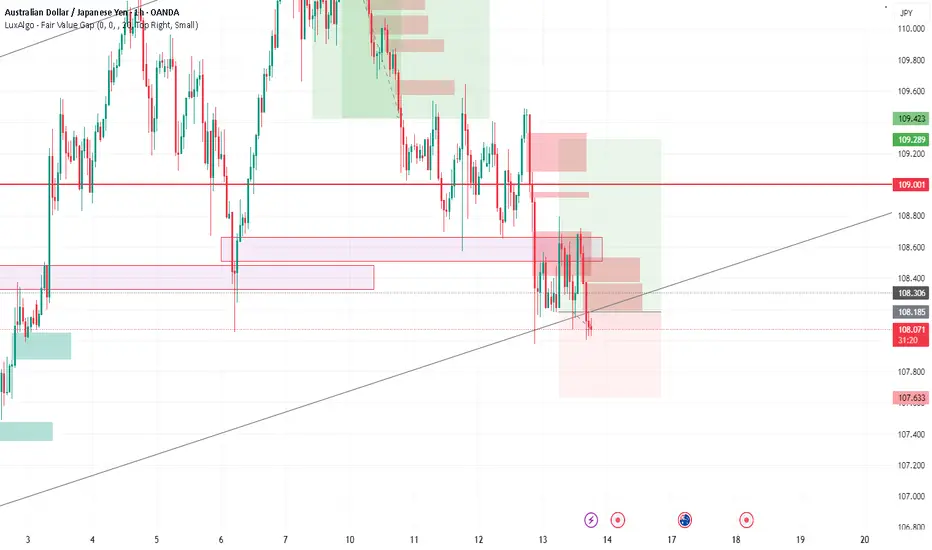
AUDJPY – Bullish Reversal From Trendline SupportAUDJPY is reacting strongly from a major ascending trendline support on the 1H timeframe. Price swept liquidity below the structure, tapped into the demand zone, and immediately rejected — signaling buyer strength.
we entered long around 108.180, which aligns perfectly with the technicals.
📈 Why This Is a Bullish Setup
Price tapped the HTF trendline and respected it
Multiple liquidity sweeps beneath the zone, trapping sellers
Formation of a bullish rejection wick right at support
Price is still inside a discount area, ideal for longs
Recent bearish attempts failde to close below the trendline
Strong probability of a bullish push toward 109.20 – 109.50 liquidity zones
This is a classic trendline + demand + liquidity sweep confluence setup.
📋 Trade Parameters
Entry: 108.180 (executed)
Stop-Loss: ~55 pips (below liquidity sweep + structure low)
Take-Profit: ~110 pips (towards upper liquidity & imbalance zones)
Risk-to-Reward: ~1:2
Forex market
NZD/JPY – Buy Entry Points📈 NZD/JPY – Buy Entry Points (Structured Plan)
Since you prefer clear trading levels, here is a clean buy setup plan.
🟢 1️⃣ Aggressive Buy (Trend Continuation)
Condition: Price holding above short-term support
Entry: 92.534 (on small pullback)
Stop Loss: 91.937
Target 1: 93.70
Target 2: 94.20
Target 3: 94.90
Multipolar World & Geopolitical Risk Premiums1. What Is a Multipolar World?
A multipolar world refers to an international system in which power is distributed among several major states rather than concentrated in one (unipolar) or two (bipolar) dominant powers. In the 19th century, Europe functioned as a multipolar system with empires such as the United Kingdom, France, Austria-Hungary, Russia, and Prussia balancing one another.
After World War II, the world shifted into a bipolar structure dominated by the United States and the Soviet Union. Following the Soviet collapse in 1991, the U.S. emerged as the sole superpower in what many analysts described as a unipolar moment.
Today, however, global politics increasingly resembles multipolarity. Major actors shaping global outcomes include:
United States
China
Russia
European Union
India
These actors compete and cooperate across domains such as trade, technology, energy, military alliances, and financial systems.
2. Characteristics of a Multipolar System
A multipolar world has several defining features:
A. Diffusion of Power
Military, economic, technological, and financial power are more evenly spread. No single country can unilaterally dictate global rules.
B. Flexible Alliances
Unlike rigid Cold War blocs, alliances are fluid. For example, India maintains strategic ties with the United States while continuing defense and energy cooperation with Russia.
C. Regional Power Centers
Regional actors assert influence:
Turkey in the Middle East
Brazil in Latin America
Saudi Arabia in energy markets
D. Institutional Fragmentation
Global institutions such as the United Nations and the World Trade Organization face gridlock as great-power rivalry intensifies.
3. Geopolitical Risk: Concept and Evolution
Geopolitical risk (GPR) refers to the risk that political tensions, conflicts, wars, sanctions, or policy uncertainty will disrupt economic stability and financial markets.
Examples include:
The Russia-Ukraine War
Rising tensions between China and Taiwan
Sanctions imposed by the United States on Iran
In a multipolar system, geopolitical risks tend to increase because:
Power transitions create instability.
Strategic mistrust grows among major powers.
Economic interdependence becomes weaponized (e.g., trade restrictions, export controls).
4. What Is a Geopolitical Risk Premium?
A geopolitical risk premium is the additional compensation investors demand for holding assets exposed to geopolitical uncertainty.
It appears in various markets:
Oil prices rise when conflict threatens supply.
Government bond yields increase for politically unstable countries.
Equity markets decline amid war fears.
Currencies depreciate in high-risk environments.
For example, during the Russia-Ukraine War, global oil prices surged because markets priced in supply disruption risks.
In essence:
Geopolitical Risk Premium = Extra expected return required due to political uncertainty.
5. How Multipolarity Increases Risk Premiums
Multipolarity amplifies geopolitical risk premiums through several channels:
A. Strategic Competition
The rivalry between the United States and China spans semiconductors, artificial intelligence, rare earth minerals, and trade routes. Export controls and technology bans create uncertainty for global firms.
Investors therefore demand higher returns for exposure to supply chains dependent on either power.
B. Sanctions & Economic Weaponization
Financial sanctions have become common tools. When the United States and its allies restricted Russian banks’ access to SWIFT, it signaled that access to the global financial system is not politically neutral.
Countries now diversify reserves away from the U.S. dollar, increasing fragmentation and uncertainty.
C. Energy & Commodity Volatility
In multipolar competition, energy security becomes strategic. Actions by OPEC and geopolitical tensions in the Middle East directly affect global inflation.
Energy-importing countries face risk premiums in currency and bond markets when oil prices spike.
D. Supply Chain Reconfiguration
“Friend-shoring” and “near-shoring” reduce efficiency but improve resilience. However, restructuring supply chains increases short-term costs and uncertainty, contributing to equity risk premiums.
6. Historical Comparisons
During 19th-century European multipolarity, shifting alliances and arms races eventually contributed to World War I. While today’s world differs due to nuclear deterrence and economic interdependence, instability risks remain.
The Cold War bipolar system was tense but predictable. The current multipolar system is arguably less predictable because:
There are more actors.
Strategic alignments shift.
Middle powers exercise autonomy.
7. Financial Market Transmission Channels
Geopolitical risk premiums transmit through several mechanisms:
1. Equity Markets
Stock prices decline during crises due to uncertainty and earnings risk.
2. Fixed Income Markets
Emerging market bonds widen in spread when political risk rises.
3. Commodity Markets
War risk increases prices of oil, gas, wheat, and metals.
4. Currency Markets
Safe-haven currencies (USD, CHF, JPY) appreciate.
8. The Role of Emerging Powers
Emerging powers such as India and Brazil are not passive players. They practice “strategic autonomy,” balancing between great powers to maximize national interest.
This fluid positioning makes geopolitical forecasting more complex and increases uncertainty premiums.
9. Implications for Policymakers
Governments respond to multipolar risk by:
Increasing defense spending
Diversifying energy sources
Building regional trade blocs
Accumulating foreign reserves
Central banks must also account for geopolitical shocks when setting interest rates, as conflicts often trigger inflation via commodity prices.
10. Implications for Investors
Investors adapt by:
Diversifying geographically
Holding commodities and gold as hedges
Reducing exposure to politically fragile regions
Monitoring sanction regimes and trade policy
Risk modeling increasingly incorporates geopolitical indicators alongside macroeconomic variables.
11. Is Multipolarity More Dangerous?
Scholars debate whether multipolar systems are inherently more unstable. Some argue they create balancing mechanisms that prevent dominance. Others argue they increase miscalculation risk.
What is clear is that:
Economic interdependence no longer guarantees peace.
Political fragmentation raises structural uncertainty.
Markets now price geopolitical tension as a persistent feature, not a temporary shock.
Conclusion
The transition toward a multipolar world marks one of the most significant structural shifts in international relations since the Cold War. Power is diffusing across multiple centers, alliances are flexible, and economic tools are increasingly weaponized.
As a result, geopolitical risk premiums are becoming structurally embedded in global markets. Investors demand higher returns to compensate for political uncertainty. Governments must adapt to a world where stability cannot be assumed, and economic globalization is no longer frictionless.
In short:
Multipolarity increases complexity.
Complexity increases uncertainty.
Uncertainty increases risk premiums.
The coming decades will likely be defined not by a single hegemon but by competitive coexistence among major powers—where economics, finance, and geopolitics are deeply intertwined.
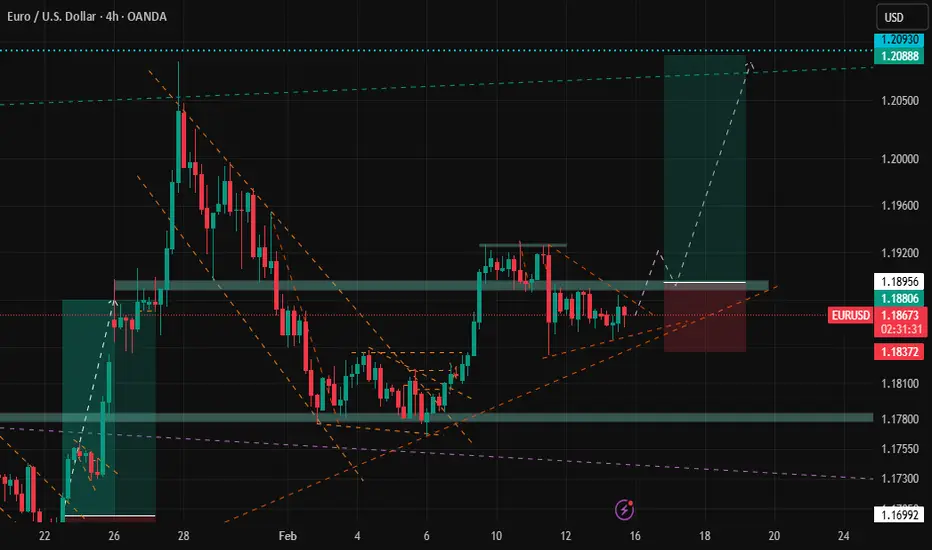
EURUSD BUY Breakout + Retest Entry
➡️ Break & Buy Above: 1.18956
When price decisively breaks above key resistance and holds, this signals bullish continuation.
📌 Stop-Loss: 1.1372
📌 Targets:
• TP1: 1.20888
• TP2: 1.21500
Why this works: Breakouts that retest previous resistance as support can unleash strong up moves.
FOREX "PAIRS IN PLAY" Session 32 13 02 26Scanning multiple forex pairs to filter high-quality trade setups. No trades are forced—only structure-based opportunities.
Note: There may be a delay in this video due to upload processing time.
Disclaimer: FX trading involves high leverage and substantial risk, and losses can exceed your initial investment. This content is for educational purposes only and should not be considered financial advice. Trade at your own risk.
EURUSD - 4H - SHORTFOREXCOM:EURUSD
Hello traders , here is the full multi time frame analysis for this pair, let me know in the comment section below if you have any questions, the entry will be taken only if all rules of the strategies will be satisfied. wait for more Smart Money to develop before taking any position . I suggest you keep this pair on your watchlist and see if the rules of your strategy are satisfied...
Keep trading
Hustle hard
Markets can be Unpredictable, research before trading.
Disclaimer: This trade idea is based on Smart money concept and is for informational purposes only. Trading involves risks; seek professional advice before making any financial decisions. Informational only!!!
FOREX "PAIRS IN PLAY" Session 31 12 02 26Scanning multiple forex pairs to filter high-quality trade setups. No trades are forced—only structure-based opportunities.
Note: There may be a delay in this video due to upload processing time.
Disclaimer: FX trading involves high leverage and substantial risk, and losses can exceed your initial investment. This content is for educational purposes only and should not be considered financial advice. Trade at your own risk.
EURJPY pullback from Discount ZoneBias: Short-term bullish retracement inside overall bearish structure
After the aggressive sell-off and multiple BOS to the downside, price tapped into the discount zone + weak low liquidity area (~181.45–181.55) and reacted strongly with displacement.
Now we’re seeing a corrective push upward.
🔎 Trade Plan
🟢 Buy Zone: 181.5 (minor pullback into intraday imbalance)
🎯 Targets:
TP1: 182.78 (internal supply / 50% of last leg)
🛑 Stop Loss: Below 180.967 (weak low sweep)
🧠 Logic
Strong bearish impulse → liquidity taken below weak low
Reaction from discount zone
Short-term market structure shifting on lower TF
Targeting imbalance fill + 4H supply retracement
Disclaimer: For educational Purpose
EURUSD Weekly Outlook (SMC + HTF Resistance Confluence)📊 Market Structure Overview
EURUSD is currently trading into a major weekly supply / resistance zone while respecting a long-term descending trendline connecting multiple swing highs. Price has approached this area several times historically and reacted with strong bearish momentum — making it a high-probability reaction zone on the HTF.
🔎 Key Technical Observations
Price is testing a multi-year descending trendline → strong dynamic resistance.
Presence of SMC concepts on chart: BOS / CHoCH and visible FVG zones below current price.
Current rally looks like a liquidity grab into premium pricing within weekly structure.
Equal / relative highs marked — potential buy-side liquidity before reversal.
HTF structure overall remains bearish / corrective, not a confirmed bullish trend reversal.
📍 Trading Plan (Idea — Not Financial Advice)
➡️ Primary Bias: Bearish from weekly resistance.
➡️ Entry Concept:
Wait for lower-timeframe confirmation such as:
Bearish engulfing candle
Pin bar rejection
Market structure shift / CHoCH
➡️ Targets:
First reaction → mid FVG / internal demand
Major target → HTF demand zone around parity region (~1.00 area)
Extended bearish scenario → deeper weekly demand near lower red zone
⚠️ Risk Factors / Invalidation
Strong weekly close above trendline and resistance zone.
Bullish continuation with sustained higher highs + higher lows on HTF.
Macro catalysts (ECB/Fed policy shifts) could accelerate volatility.
🧠 Final Thoughts
This setup aligns with a classic premium sell model — price rallies into HTF supply + trendline confluence before targeting imbalances below. Patience is key: confirmation matters more than prediction.