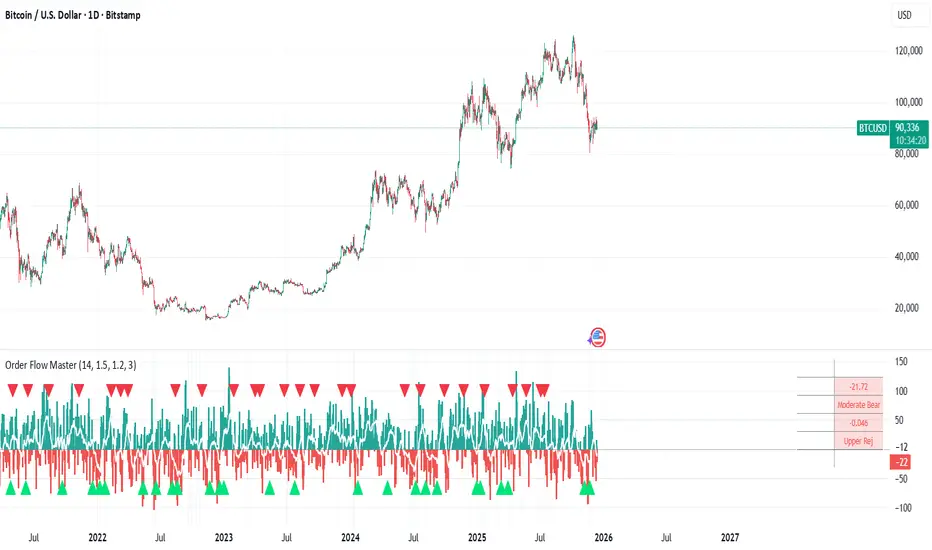
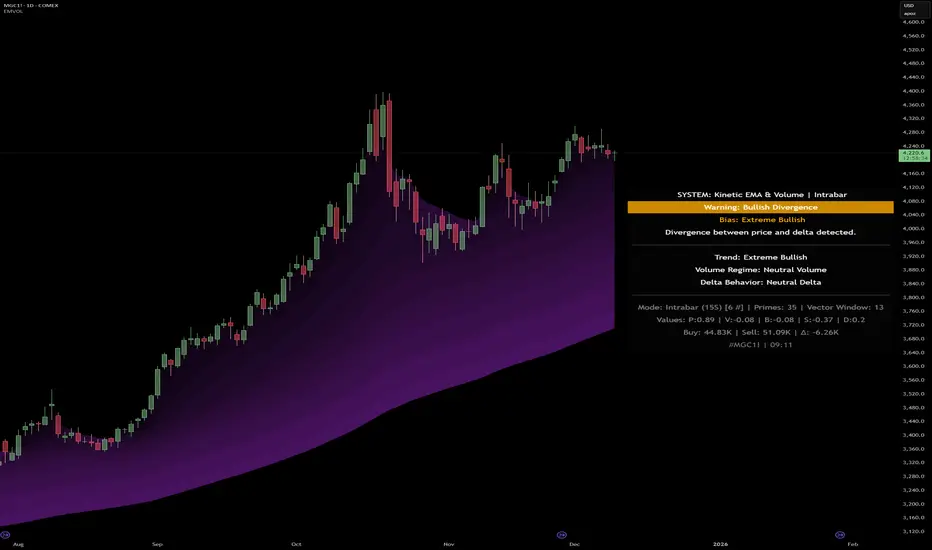
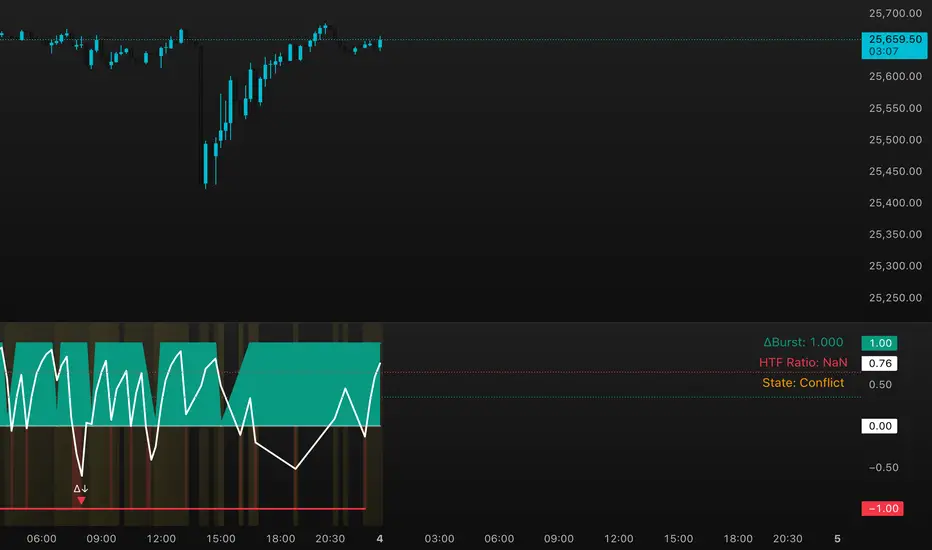
SHDW AlphaDesk|ProShort summary
Institutional multi-timeframe trend map that shows a clean Bull / Bear regime for 5m → 1M at a glance, using price structure, trend filters and momentum.
---
Concept
SHDW AlphaDesk|Pro is a desk-style trend regime dashboard.
The goal is simple: when you open a chart, you instantly know if the asset is trading in a bullish or bearish environment on each major timeframe.
The script does not try to be a signal generator or an automated strategy.
Instead, it focuses on three pillars:
* Price behaviour: swing structure and directional context.
* Trend filters: dynamic moving averages and a trend-strength filter.
* Momentum: classic RSI and optional RSI price levels on the chart.
All of this is condensed into a compact table that shows, for every timeframe from 5m to 1M:
* `Trend` → Bull or Bear regime
* `RSI` → 14-period RSI value
The output is always binary (Bull or Bear) to keep the message clear and help avoid hesitation or “neutral” noise.
---
Profiles
The engine is pre-calibrated with three institutional profiles:
* Scalping/Intraday (Crypto): more reactive, tuned for intraday flow, faster regime changes.
* Swing/Conservative (Crypto): smoother behaviour, designed for position and swing trading.
* Institutional (Stocks): slower and more conservative, anchored to higher-timeframe trend for equity and index flows.
All key parameters behind the scenes are handled automatically by the selected profile, so you can switch behaviour without tweaking numbers manually.
---
What the script shows
On every bar:
* A multi-timeframe dashboard on the right side with TF / Trend / RSI.
* Optional EMA/SMA overlays on the price chart for visual alignment with the regime.
* Optional RSI Levels mapped into price, giving approximate areas where RSI would reach common overbought/oversold zones.
There is no trade entry, exit or risk sizing logic.
The script is a trend-reading and context tool , not a full trading system.
---
How to use (institutional view)
A practical way to use SHDW AlphaDesk|Pro is:
1. Start from the top-down.
* Check 1M → 1W → 1D to establish the dominant regime (Bull or Bear).
* Only then look at intraday timeframes (12h, 4h, 1h, 15m, 5m).
2. Trade in the direction of the regime.
* Prefer long setups when the higher-timeframe column is Bull.
* Prefer short setups when the higher-timeframe column is Bear.
3. Use pivots and RSI.
* The snapshot explains how a pivot on a lower timeframe can confirm or anticipate structure on the next higher timeframe (for example, a bullish pivot on 5m confirming a higher low on 15m, etc.).
* Oversold (RSI ≤ 30) on a lower TF often warns that a higher low may be forming one step above.
* Overbought (RSI ≥ 70) on a lower TF often warns that a lower high may be forming one step above.
4. Watch for trend breaks.
* When a significant low is lost (or a strong bearish pivot appears) on a timeframe, zoom out to the next one and re-evaluate the regime there.
* On very high timeframes, a clean break of a major structural low is treated as a bear-market context.
5. Combine with your own execution.
* Use the dashboard to align direction and timing, then apply your own entry models, risk management and trade management rules.
---
Important notes
* This tool is intended for educational and informational purposes only and should be combined with independent analysis and risk management.
Pine Script® indicator