About DAX Index
The German stock index DAX 30 (GER30) was introduced under "DAX" on July, 1st in 1988 by the Frankfurt Stock Exchange. It consists of the 30 largest companies listed on the Frankfurt Stock Exchange based on the market capitalization and liquidity. The trading hours for the Frankfurt Stock Exchange take place from 9:00 a.m. to 5:30 p.m. CET. The DAX30 is usually reported as a performance index, which means that the dividends of the companies are reinvested. In a price index the corporate distributions remains disregarded (this can be seen e.g. in EUROSTOXX50). If a company wants to be included in the DAX, it must be listed in the Prime Standard, it has to be traded continuously in Xetra and have at least a free float of 10 %. Additionally, the company must have a registered office in Germany or the main focus of its traded volume in shares is in Frankfurt and the company has a seat in the EU. Based on market capitalization, the five biggest German companies listed in the DAX 30 are Bayer (BAYN), Daimler (DAI), Siemens (SIE), Allianz (ALV) and BASF (BAS). The development in the DAX is often seen as an indicator for the development of the German economy. As a result, the DAX can be seen as a proxy for European economic health since the German economy accounts for almost one third of the total value of the Eurozone economy. The DAX 30s counterparts in Europe are the CAC 40 in France and the FTSE 100 in Britain.
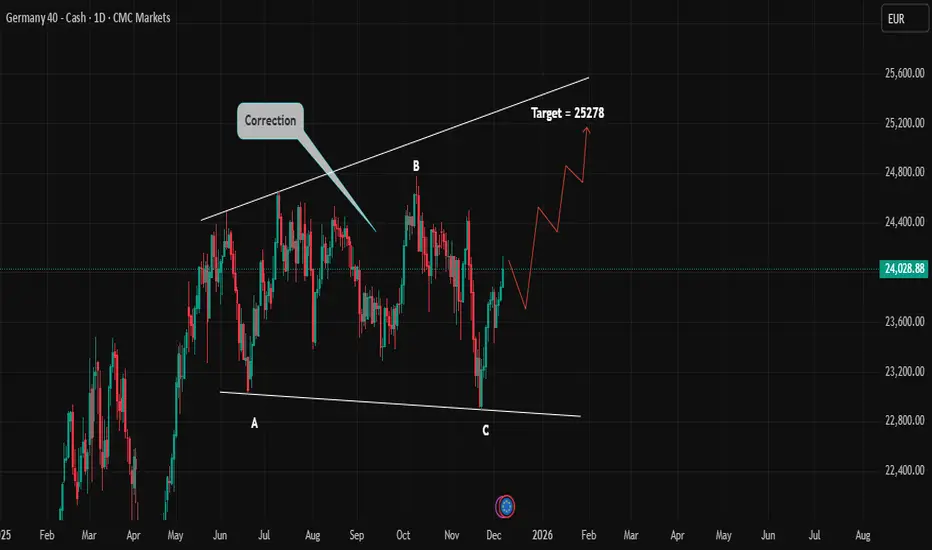
GER40 Holds Key Fibonacci Support – Upside Continuation LikelyThe GER40 chart indicates that a larger A-B-C corrective structure has been completed at the recent low, marked as (C), after which the index began a fresh impulsive upward move. From that bottom, price has formed a clean five-wave advance, confirming the start of a new bullish cycle. The recent pul
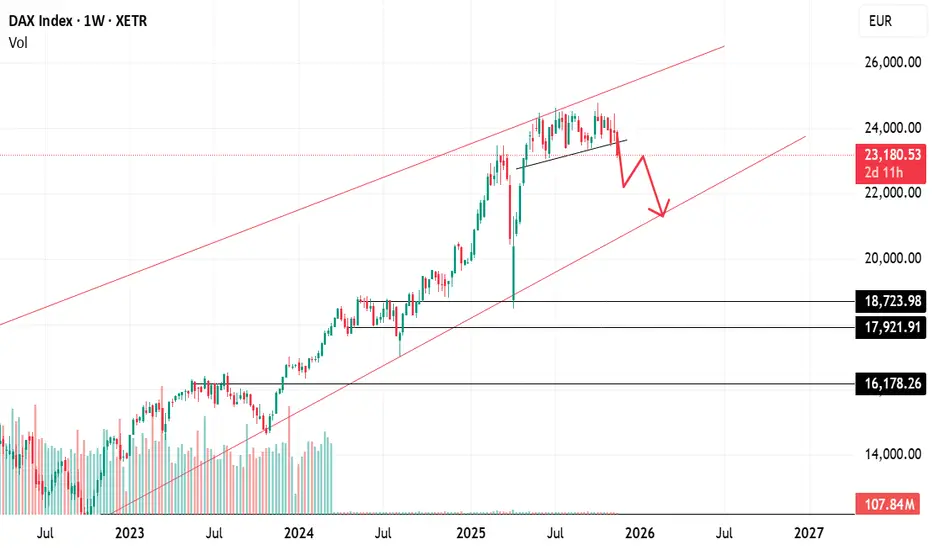
DAX breaking 7-month consolidationDAX Weekly Outlook – Consolidation Breakdown in Progress
The DAX has been moving in a broad 7-month consolidation range, showing neither a clear uptrend nor a downtrend. Such long consolidations often act as distribution zones, where smart money gradually exits positions before a larger move begins
DAX Breaks H&S Pattern – Eyes 22,300–22,200🔎 Chart Setup
DAX has given a breakdown of the Head & Shoulders pattern on the daily chart. This is a strong bearish reversal pattern, usually signaling further downside.
⚖️ Downside Targets
With the breakdown confirmed, the pattern target lies in the 22,300–22,200 zone.
As long as 24,000 (on a
Head & Shoulders on DAX Daily Chart – Watch for BreakdownThe DAX index is currently forming a Head and Shoulders pattern on the daily chart, a well-known bearish reversal formation. This pattern typically signals a potential shift in trend from bullish to bearish if the breakdown occurs.
Left Shoulder – Formed when prices peaked, followed by a correction
See all ideas
Displays a symbol's value movements over previous years to identify recurring trends.
Frequently Asked Questions
DAX Index reached its highest quote on Oct 9, 2025 — 24,795.07 EUR. See more data on the DAX Index chart.
The lowest ever quote of DAX Index is 372.30 EUR. It was reached on Nov 7, 1974. See more data on the DAX Index chart.
DAX Index is just a number that lets you track performance of the instruments comprising the index, so you can't invest in it directly. But you can buy DAX Index futures or funds or invest in its components.