Types of entry in the marketsTypes of entry in the markets 1- Aggerasive entry for high rewards 2- Conservative entry 3- Highly confirmed entry Educationby jain_abhishek114
Bajaj Hindusthan Sugar - Cup and Handle (Weekly Chart)A cup and handle pattern on a stock chart is an pattern which resembles a cup with a handle, where the cup is in the shape of a "u" and the handle has a slight downward drift or consolidation. The cup and handle is considered a bullish signal, with the right-hand side of the pattern typically experiencing lower trading volume. A cup and handle is considered a bullish signal extending an uptrend, and it is used to spot opportunities to go long. Target Measurement - The depth (which is the bottom price of the cup till neckline) is measured and placed on the neckline to get the final target Technical traders using this indicator should place a stop buy at the bottom of the handle on closing basis Educationby Imran_I_Ahmed77179
Nifty - Market Sentiment Cycle on Actual ChartThere are 14 stages of market sentiment cycle, the 2 stages which are the most interesting and which every seasoned trader tries to identify are Euphoria and Despondency / Depression. Euphoria stage - This is the point of maximum financial risk Despondency / Depression - Point of maximum financial opportunity Have tried to plot the best estimate to understand where are we currently in the market sentiment cycle. Markets are completely unpredictable and the shared chart is only for an understanding to try and plot the sentiment cycle in real-world scenario Educationby Imran_I_Ahmed5561
#Intraday trading strategy #BB Band A Bollinger Band is a technical analysis tool defined by a set of trendlines plotted two standard deviations (positively and negatively) away from a simple moving average (SMA) of a security's price, but which can be adjusted to user preferences. Bollinger Bands are a highly popular technique. Many traders believe the closer the prices move to the upper band, the more overbought the market, and the closer the prices move to the lower band, the more oversold the market. Key takes Bollinger Bands are a technical analysis tool developed by John Bollinger for generating oversold or overbought signals There are three lines that compose Bollinger Bands: A simple moving average (middle band) and an upper and lower band. The upper and lower bands are typically 2 standard deviations +/- from a 20-day simple moving average (which is the centre line), but they can be modified. When the price continually touches the upper Bollinger Band, it can indicate an overbought signal while continually touching the lower band indicates an oversold signal Education11:41by CA_Chetanbhasin2223
Emotions should not affect our trade management systemTrader should identify emotions that are affecting our trading management decisions, and find genuine solution to over come from the same to become a better trader. Most investors treat trading as a hobby because they have a full-time job doing something else. However, If you treat trading like a business, it will pay you like a business. If you treat like a hobby, hobbies don't pay, they cost you...! Disclaimer. I am not sebi registered analyst. My studies are for educational purpose only. Please Consult your financial advisor before trading or investing. I am not responsible for any kinds of your profits and your losses.Educationby RK_Chaarts4432
Let's Know Top 10 Chart Patterns With Most Success RatesBefore it, let's learn about types of chart patterns because it's important to know that the pattern is a reversal or continuation because it will help us decide whether the market is making a reversal or a continuation pattern. 1. Continuation patterns : A Pattern which gives you an indication of continuation meaning continuing the trend. For example :- flag patterns, wedges patterns or a pennant pattern can be classified into this. 2. Reversal Patterns : Patterns which give you an indication of reversal meaning if the market is going up and then a reversal pattern forms then it should go down. For Example : Head and Shoulders Pattern, Double Top and Bottom Pattern can be classified into this. Now Let's Learn about the Top 10 Chart Patterns With the most Success rates 1. Head and shoulders 2. Double top or bottom 3. J Pattern 4. Rounding bottom or Top 5. Cup and handle 6. Wedges 7. Pennant 8. Descending Triangle or Ascending Triangle 9. Bullish Flags or Bearish Flags 10. Symmetrical triangle or A Symmetrical Triangle -------------------------------------------------------------------------------------------------------------------------------------------------------------------------------------- 1. Head and Shoulders :- Traders use the head and shoulders pattern in technical analysis chart to anticipate likely changes in a price trend. After a bullish trend, it is common to see a bearish pattern emerge that is renowned for its accuracy in predicting a trend reversal. There are three peaks in the pattern where the middle one is the highest and the remaining two are known as "shoulders" with similar and lower heights. Once the price passes over the "neckline," which is a trendline tying the lowest points between the peaks of the two troughs, the design is finished. The head and shoulders pattern indicates the end of an uptrend, causing traders to use it as a sell signal. There is a possibility that a decline will occur afterwards. The pattern is utilized by certain traders as an indication to engage in short positions, while keeping a stop loss above the neckline. It should be kept in mind that the occurrence of a head and shoulders pattern does not necessarily guarantee a reversal, therefore traders should rely on supplementary technical analysis and implement risk management strategies before trading. 2. Double top or bottom :- A double top pattern occurs when the price of a stock reaches its peak, declines, then surges back up to the peak level but is unable to surpass it before falling once more. A resistance level formed by two peaks is encountered by the price, which is unable to break through it. When the price drops below the valley level that existed in between the two peaks, the pattern is over. The double top pattern is thought to be a bearish sign, indicating a possible price decline. A double bottom pattern, on the other hand, is the polar opposite of a double top pattern and resembles a mirror image. The price decreases to a certain level, rebounds, drops back down to the same level, but does not surpass it, and subsequently recovers again. The support level created by the two valleys is a point that cannot be breached by the price. The pattern is only finished when the price surpasses the peak level that was established between the two valleys. It is crucial to remember that depending solely on these patterns for trading decisions is not recommended, as they are only among several instruments applied in technical analysis. It is advisable for traders to take into account additional elements aside from technical analysis, such as fundamental analysis. When making investment decisions, take into consideration both market trends and the management of risk. 3. J Pattern :- The term "J pattern" denotes a distinct chart pattern that may manifest over a duration of time in the movement of a particular stock's price. The J-shaped trend seen in a company's stocks entails an abrupt decline in value that is succeeded by a more protracted rehabilitation. The name of the pattern originates from its formation on a price chart, which bears a similarity to the letter "J". Frequently, this trend can be observed in shares that encounter adverse circumstances or updates leading to the first decline in value, and later, garner support as investors regain trust in the potential profitability of the stocks. 4. Rounding bottom or Top :- In technical analysis of financial markets, there are two patterns referred to as rounding top and bottom. The pattern on a chart known as a rounding top signifies a gradual transition in the market from an upward pattern to a downward one. A gentle decrease in pricing is followed by a gentle increase, resulting in a curved contour. The pattern reveals that the market seems to be losing its force, implying that there could be a potential drop in prices. Conversely, a chart pattern known as a rounding bottom indicates a change in the market direction, from a downtrend to an uptrend. The observed trend exhibits a gentle decrease in values accompanied by a gentle growth, creating a curvilinear appearance. The indication is that the market is growing based on this trend. 5. Cup and Handle The cup and handle pattern serves as a tool in technical analysis utilized in the stock market for detecting potential chances to purchase. This formation signifies the continuation of a bull market; it is observed after a stock has undergone a notable increase and then encountered a phase of stabilization. The shape of the design, which resembles a container with a grip, is what the pattern is named for. A cup-shaped pattern forms when, following a strong upward trend in stock prices, there is a significant decrease that creates a rounded bottom resembling a U. The handle section on the chart emerges once the stock price remains within a tight range for several weeks or months without any significant rise, before finally breaking out and reaching new highs. I Think That's too much we will continue the remaining 5 in the next one I hope you learned something new if then pls do like and follow us Thank you ♥ Educationby MAYANKTECHRESEARCHING4428
The Ultimate Rules for Options Day Trading SuccessNSE:BANKNIFTY Introduction If you want to be a successful options day trader, it's not just about having a good strategy. You also need to develop your expertise, seek guidance when needed, and be dedicated to your goals. To do this, you need to be disciplined and follow some options day trading rules. These rules can help you avoid common mistakes and take away the guesswork. Here are some rules that every options day trader should know and if you use them in a disciplined manner then they have been proven to help beginners become winning options day traders. Some important rules are :- Rule 1 Setting Realistic Goals for Options Day Trading One of the most important rules for success in options day trading is to have realistic expectations. Options trading is not a way to get rich quickly, but it can be a profitable career if you put in the time and effort to learn and master the craft. You need to be prepared for a learning curve and be willing to stick with it even when it gets tough. You should also expect losses, as no strategy can guarantee gains all the time. Good money and risk management can help minimize losses. Rule 2 Start Small to Grow Big When you're new to day trading options, it's important to be cautious. You're still learning about options trading and the financial market, so take your time. Don't rush into things, even if you're excited. Start by practicing with paper trading and then move on to smaller options positions. Gradually increase your positions as you become more familiar with day trading options. This approach helps you minimize your losses and develop a systematic method for entering positions. Rule 3 Know your limits You may be tempted to trade as much as possible to develop a winning monthly average but that strategy will have the opposite effect and land you with a losing average. Remember that every options trader needs careful consideration before that contract is set up. Never overtrade and tie up your Capital. Overtrading will make money for your broker not you. Rule 4 Get Prepared Mentally, Physically, and Emotionally for Options Trading To succeed in options day trading, you need to take care of your mental, physical, and emotional health. This means getting enough sleep, eating a healthy diet, exercising regularly, avoiding excessive alcohol and smoking, and reducing stress in your environment. These habits will help you stay alert and focused throughout the day. So, take the time to care for yourself and perform at your best every day. Rule 5 Do Your Homework Daily – Plan your day Before the market opens, study the financial environment and news to develop a daily trading plan. This is called pre-market preparation and it's essential to stay competitive and align your strategy with the day's conditions. Develop a pre-market checklist that includes evaluating support and resistance, checking the news, assessing volume and competition, determining safe exits for losing positions, and considering market seasonality. Rule 6 Analyse Your Daily Performance Track your options day trading performance daily to notice patterns in your profits and losses. This will help you understand why you're gaining or losing money and fine-tune your processes for maximum returns. Reviewing your daily performance will also help you make long-term decisions for your options day trading career. Rule 7 Pay Attention to Volatility Volatility is how likely the price will change over time in the financial market. It can be good or bad for an options day trader, depending on their goals and position. Many factors affect volatility, like the economy, world events, and news reports. Straddle and strangle strategies are helpful in volatile markets. There are three types of volatility: price, historical, and implied. Price is based on supply and demand, historical looks at past performance, and implied predicts future performance. Rule 8 Use Option Greeks Greeks are measures that help to determine an option's price sensitivity in relation to other factors. They are represented by letters from the Greek alphabet and are used in complex formulas to determine option pricing. Despite their complexity, Greeks can be calculated quickly and efficiently, allowing options day traders to use them to improve their trades for maximum profit. Delta, Gamma, Vega, Theta, Rho Learn about option greeks from here I hope you found this helpful. Please like and comment. Keep Learning, Happy Trading! Editors' picksEducationby SANJAYPATIDAR_44191
5 Tips For Managing Losing Trades (It Happens To Everyone)Losing trades happen. They are a part of the journey. There is simply no such thing as a trader or investor who wins all the time. All the famous investors or traders you know have LOST many times in their careers. It is perfectly normal. Did you know the famed hedge fund manager Ray Dalio lost everything in his 30s? He went broke. He had to start over from scratch. This post will address what losing trades really mean and how to deal with it. Before we begin, let us state the obvious: - Be careful of people who claim they don't lose. - Avoid people who flaunt win rates or success rates that are simply not possible. - Losing trades happen to everyone! You are not alone. Now, let's talk about what bad trades mean and 5 tips for managing them: Number 1: A losing trade is different from a bad trade The most experienced traders are well aware of their risk before they ever place a trade. Each losing trade is a small component of a bigger process that relates to a system, plan or strategy that has been thoroughly tested and studied. A losing trade is a calculated event for experienced traders. They defined their risk, position size, stop loss, and profit target. 🎯 A bad trade is very different. A bad trade implies someone risked their hard-earned money with no plan or process. A bad trade is reckless and indiscriminate trading. This often happens to new investors or traders who do not yet understand the time, studying, and research that goes into making a rock-solid plan. Be sure to remember the difference between a calculated losing trade and a bad trade with no plan or process. TradingView Tip: there are several ways to get started with a plan, system or process. Paper trading, backtesting and/or working with proficient traders who give valuable feedback are all ways to get started. Don't risk your money without first doing research. Number 2: Every losing trade provides data to get better As we've mentioned several times now, losing trades happen to everyone. But remember, losing trades are also filled with insightful information and data. You can learn a lot from analyzing losing trades. 🔍 At the end of each trading day, week or month, experienced traders will analyze their losing trades in detail. What patterns are appearing? What do they share in common? Why did they happen? With this information, a trader or investor can adjust their strategy based on what they've uncovered. Number 3: Do not let losing trades impact your health Your mental and physical health are just as important as your financial health. Do not let losing trades impact either of those. If your system is breaking down or several losing trades are starting to impact your emotions, step away from the computer or phone. Turn everything off and walk away. The markets have been open for hundreds of years and are not going away. When you're ready to come back, they'll be there. Get up, get some fresh air, and get back in the arena when you're ready. Number 4: Share your experiences with others Traders and investors across the globe want to learn from your stories and losing trades. These are invaluable experiences that we all share in common. Social networks allow you to chat, share, and meet people who are going through similar things. We can all learn from each other. Sure, the temptation to share your winners or act like the best trader who ever existed is tempting 😜 - but it's clear we learn together and get better when we share lessons from the loses. This is where the deepest insights are found, and together, it's where we can grow as a community of traders all trying to outperform the market. Share and ask for constructive feedback! Number 5: Keep Going Markets are a game of learning, relearning, and progressing forward. New themes, trends, and stories appear and disappear daily. The journey is long and it never stops. When implementing your trading plan or investing plan, it's important to do it with the long-term in mind. One or two losing trades in a single day or week is a small fraction of what's to come many months and years down the road. 🌎 Keep going. Keep building. Keep refining your plan. Study the data. We hope you enjoyed this post! We hope you learned something new or informative! Please leave any comments below and our team will read them. - TradingView ❤️ Feel free to check us out on Instagram , and Twitter for more awesome content! Editors' picksEducationby TradingView2828392
'Shades' of 'Trades' - color of the marketIn this color season let's have an insight into how the market plays 'Holi' with traders with its binary colors. The above line sounds fascinating but it's not let me elaborate a bit more. Yes, the market plays with colors with traders but the market uses only binary colors. Many of you may think of white and black as binary colors, but this is not the case here. The market only uses two primary colors green and red to play with traders but we play with colors only on 'Holi' it seems that markets are very fond of playing with colors so it does probably every trading day it either colors the trader's position page with the green of red. Though we have only two colors in markets which can be divided into four shades which are the following:- -> Light Green - symbolizes a small profit -> Dark Green - symbolizes a big profit ( Trader's Favorite ) -> Light Red - symbolizes a small loss -> Dark Red - symbolizes a big loss ( Hazardous to account ) In this article let's dive into the depth of these colors and the reason for incurring such colors on your position page. -->How to get light green color -- Aimed for steady and regular profits . -> Trader can incur this only if they are consistent and aims for regular profit cause markets aren't trending every day. -> Discipline is the key to consistency. I think many of you have heard of the story of sage Vishwamitra who was meditating for a purpose and Menka was used to break the meditation and misguide him from his path. The same is the case of markets if you are in the market to generate regular profits then you must be disciplined as markets have negative behavior of creating illusions to trap the traders just like Menka . -> I suggest developing a trading system or set of rules on which you are going to take the trade if you want to generate regular and steady profits cause if the system is profitable you will also be profitable. Don't rely on price action on an intraday basis unless you're a champ in the same. -->How to get dark green color -- Aimed for sporadic and occasional profits. -> Though everyone wants profits it's not obvious as said earlier markets aren't trending every day. -> But if you are keen on watching market movements, you could probably catch these sporadic days and generate big profits. -> Fear should reside out to ride big profits. I think why many of us aren't able to ride big profits because of the opulence of loss that has developed fear in our minds due to which we try to book profits early without getting any sign of weakness in our trades. Our mindset says to us "Something is better than nothing". -> To overcome this fear I suggest backtesting your trades which can help you in gaining self-confidence if anyhow you can develop faith in yourself then fear naturally resides. -->Reasons to get light red color -- Quite obvious as a part of the game. -> It's quite obvious if you getting small losses as loss is a part of the trade game. -> There is nothing to be stressed about or to ponder upon these small losses if it comes along with profits as there is no such trading system or trader which only gives or generates profit. -> This usually happens when stop-loss is hit and you must be thankful to yourself that you had placed a stop and accept the small loss. Markets reward traders who admit their errors and change their ways whereas punish traders who are obstinate and won't change. I think everyone must check the reason for each loss they incur if it's due to the system you are following and the system is profitable in long run then the loss is fine but if it's due to your own mistake, learn from it and rectify the same as quick as possible. -->Reasons to get dark red color -- Hazardous and may lead to termination. -> One must avoid these big losses at all costs; otherwise, you may find yourself in a situation where you are unable to pay any costs. -> Most hazardous and may sometimes lead to the termination of your trading journey. -> This usually happens due to the stubborn nature of traders where they don't accept that they are wrong or don't have the guts to book their stop losses. I think why many of us incur big losses because of neglecting the use of system stop-loss. Traders have realized the significance of stop-loss hence they decide on the sl before entering into the trade but what they do is keep sl in mind rather than the system and when the price reaches the sl level they don't have the guts to book the loss due to which small loss turn into a big loss. This is the reason why everybody should place system stop-loss as a computer doesn't have emotion. As stated earlier Markets reward traders who admit their errors and change their ways whereas punish traders who are obstinate and won't change. That means that if the trader does not recognize their mistake and book, the sl market will penalize them with a large loss. I suppose that all of you have got great knowledge of the 'Shades' of 'Trades' and an insight into all outcomes of a trade. And I think that I was able to explain to you how the market also likes to play with color and now the first line doesn't seem to be fascinating but obvious. I hope this 'Holi' market colors you all with dark green, and wish you all a 'Happy Holi'. Editors' picksEducationby Chaser306660
How to select the Right Time Frame for Day Trading (Intraday) ?The selection of right time frame for day trading (Intraday) is a very subjective question and is frequently asked by the novice traders. The selection of the time frame depends on many parameters. But according to my experience it depends on mainly two parameters. 1. Stoploss 2. Signal strength of your trading strategy. The time frame from 1 minute to 1 hour is best for day trading. Let us discuss these parameters in detail. 1. Stoploss: Each time frame has a different stoploss level. The higher time frame has a deep stoploss level as compared to the lower time frame. So, we have to select the time frame according to the stoploss or we can say that the right time frame depends on the amount of money you afford to lose in one trade . Before entering into the trade, check the stoploss for different time frames and then choose the time frame according to the bearable amount of money to lose in one trade. 2. Signal strength of your trading strategy: Whatever strategy you choose to trade, the entry and exit signals are always strong on the higher time frame as compared to the lower time frame because the lower time frames has high volatility as compared to the higher time frames. It means the success rate is high on the higher time frames as compared to the lower time frames. Both of these parameters are directly proportional to each other. So, the selection of the time frame for day trading must depend on both of these parameters. We have to select the time frame on which our signal strength is good and also the comfortable amount of money which we afford to lose in one trade. Thanks Educationby ssvirdi556
If you are not 'INSIDE' you are 'OUTSIDE' In the stock market, if you are not inside, you are outside. I expect all those reading this article wants to be inside the market. So, if you want to participate in the market then you must develop a deep insight into the key market players i.e. your competitors who drive day to day movement of the market. Key Market Players:- The following are the three types of market participants. ->Retail - general public also called clients ->High Net Worth Investors - commonly known as HNI clients. ->Proprietary Trading - also called 'Pro' are firms. ->Institutions - referred to as trading organizations. Let's dive into the details of each of them listed above . Retail Investors :- They are the general public who invest or trade in the market individually with very small capital as compared to other participants. They are at the bottom of the market food chain when considered individually but in recent few years, the retail participants as a whole have seen a significant rise in numbers. High Net Worth Investors: - They are also an individual but with big sums in their pockets. They have a deeper access to the markets, inside news, and all. They don't participate in day-to-day trading. Proprietary Traders :- Also known as 'Pro 'are those firms/banks which also trade in the daily market with the firm's funds. They are at the middle of the market food chain i.e. above retail but below institutions. Actively participate in daily market movements. Institutional Investors :- They are organizations taking part actively in market movements. They are at the top of the market food chain. They can be further divided into two groups: ->FII (Foreign Institutional Investors): Institutions whose origin is outside India but still they invest in Indian markets. Actively participate in daily market movements. ->DII (Domestic Institutional Investors): Institutions whose origin is India. They are inactive in the derivatives segment. Among the participants listed above Retail, Pro & FII are actively involved in the daily market trading and encourage derivatives segment. We all have seen everyone in markets talking about FIIs that are bearish/bullish on markets but why? The above figure is of FII+Pro & Client correlation with nifty, this describes the reason why the positions of FII are significant. We can draw the following conclusion:- 1. Majority of the time FII is correct to predict the market movement. 2. Clients generally build position against FII and max times have an opposite correlation with market movements. Now, have a look at how the FII and client positions affect the market movement The above figure justifies the correlation. We can draw the following conclusions:- 1. Maximum time FII are net short in nifty whereas clients are net long in nifty. 2. When FII cover their shorts and deploys the longs we see an uptrend but at the same time, the client unwinds long and deploys shorts which are generally against the trend i.e. client likes to drive in opposite direction. 3. And when FII positions converge with the Client there is previous trend exhaustion and the arrival of a sideways market or sometimes a new trend. As of now the index is clearly explained but what about stocks how much significant is FII in stocks? To answer the above question let's take an example of a very famous stock ITC:- The above figure says that FII has increased holding in the interval of Jun2022 - Sep2022 from 12.7% to 44.5% and by the time client has decreased the holding from 44.5% to 14.8%. Does the change in position affect the stock price of ITC? let's have a look Now it's clear that FII have ultimate power because when they started to increase their holding in ITC the price shoot up during this time Public who were holding it for the last 2yrs exited when ITC has just begun to move. Hope the readers had understood the mightiness of FII and the oppositeness of the Public and also have got a deep insight about their competitors . Also, thanks to @biswapatra for requesting me to write an article on this topic. You can also suggest an topic on which you want to have analysis.Editors' picksEducationby Chaser30151567
When to know the market is going to bullHello Everyone, So after a very long time i am publishing a new educational idea on how can we catch such bull trends like this to make ourselves profit and also we will see how to know that a rally is ending or 5 signals to a bull market so let's go But before we start we should know what is a bull run or bear run means So a bull run means that it may feel you like prices are at the sky and not ready to come downs and in long-term in this investors love to see their portfolios during a bull markets because their stocks run like a jet in the sky. However, since markets are fluctuating, nobody knows when it will end also some investors are fearful when they see bull markets as a sell signal at anytime to take the maximum profit while others feel it very comfortable buying in a bull trend and "warren buffet" has said " Be Fearful When others are Greedy and be Greedy when others are fearful ". Do the following analysis to predict these bulls :- 1. Always seek for high trading volume and demand in markets:- It will feel like everyone is just in the market to buy up and no one is ready to sell their stocks as the market continues to climb upwards. Bull markets always have greater demand compared to supply, high trading volume, and next level liquidity touching the sky. 2. Lower interest rates :- Like whenever Banks interests are low there is the sign that the market is bull. 3. High Growth Rate :- Bull markets are often seen when low unemployment is and so for people have money to spend, and when people spend their money and buy their products so their profits increase and their stocks increase and so for the market increases. 4. Growing Economy :- Bull markets are also seen when the economy is growing. 5. Divergence:- When the market is up even indicators and other metrics are showing down even through. Thank you Educationby MAYANKTECHRESEARCHING5
Viewing Deep Preview on Fibonaccisjust now Hey Everyone, Today we are again with a lot of information and a bunch of topics, so consider following us for regular ideas and market updates Let's go Strictly into the idea So In the last idea we covered an overview but now lets cover a detailed view and even learn about Fibonacci Extensions, Fibonacci Number and Lines and more and more. What Are Fibonacci Retracement Levels ? Fibonacci retracement levels are horizontal lines that indicating where support and resistance can take place . Each level is having their own percentage. The Fibonacci retracement levels are 78.6% , 61.8% , 23.6% and 38.2% . But the most working levels of a Fibonacci are 38.2%, 61.8% and 78.6% . The indicator is very useful because it can be drawn easily and it can tell you many thing such as support and resistance . It can be drawn between high and low where the lines form is your support and resistances . What Are Fibonacci Extensions ? Fibonacci extensions is a tool that can be used to target Profit or approximate how far a price should travel after a pullback ends . Extension levels are also the areas where the price may reverse These levels are based on Fibonacci ratios . Common Fibonacci extension levels are 261.8% , 200% ,161.8% , 100% , and 61.8% . What Is the Fibonacci Number and Lines ? The Fibonacci Numbers and Lines the sequence of numbers , is a slowly increasing series where every number is the equal to sum of the preceding two numbers . We will meet you very soon so consider following you can unfollow us any time Thanks for reading it and giving it your time Bye 😁 Educationby MAYANKTECHRESEARCHING112
How to find High Probability trades? Hi all, hope you guys are doing well. It’s been a long time since I last posted. Apologies for that. 🙏 In this post, we are going to see how we can combine different indicators/concepts to create confluence zones and find high-probability trades. Introduction A trade that has a greater chance of success than a regular trade is called a high-probability trade. Obviously, it's our assumption that some trades have higher chances of success as compared to others because they have more supporting factors. Nevertheless, a high probability trade can also result in a loss. How to find high-probability trades? There are a few things that you can observe to find a confluence of various important factors such as a support/resistance level, demand/supply zone, Fibonacci level, moving averages, volume, RSI, etc. Depending on your knowledge and trading style, the confluence zone can be derived using a combination of various different concepts or indicators. In this post, I am going to share the factors that I look at for finding good trades. How to find confluence zones? In order to find the confluence zones, you need to understand the concepts and the indicators, then combine them together to create the whole picture. It's like building a jigsaw puzzle - first, you need to identify the individual pieces, and then you need to put them together. Let’s dive into all of these concepts one by one. 1. Market structure Market structure is simply a basic form of understanding how the markets move . The price action is how the market moves based just on price, without the consideration of trends and how they may continue. But the market structure is focused mainly on the trend. I have covered market structure in various different threads that you can read here: 2. Consolidation before Breakout If a stock consolidates before giving a breakout, there are higher chances that it will be a true breakout. This is because all the residual supply gets absorbed at the resistance zone and most of the pending demand orders get filled. Ideally, once a stock goes into consolidation, one of the two processes occurs: Accumulation Distribution In layman’s terms, - If demand is more aggressive than supply, then the price rallies, which confirms accumulation. - Similarly, if the supply is more aggressive than the demand, then the price falls down, which confirms distribution. If you are struggling with identifying the breakouts, be sure to read this post. 3. Support-Resistance levels S/R levels are critical parts of trend analysis because they are used to highlight important zones. The fact that these levels flip roles between support and resistance can be used to determine the range of a market, trade reversals, bounces, or breakouts. These levels exist due to the influx of buyers and sellers at key junctures. Flip zone acting as resistance: Flip zone acting as support: If you are looking for an in-depth tutorial on support and resistance, please check out my old guide here: 4. Supply-Demand zones S/D demand zones are one of the most important things that I look at while charting. The stronger the S/D zone, the higher the chances of a reaction. Always look for these zones in the direction of the major trend. 5. Location of 200MA or 200EMA Always observe the position of 200MA/EMA with respect to price. Once the price interacts with the moving average, study the reaction. If you are looking for a long trade, then look for a positive reaction as the price reacts with the moving average. 6. Overlap with a Fibonacci level A lot of times, the price will come back to a Fibonacci level. You need to observe the price behaviour near these levels. If you are not familiar with the Fibonacci tool, please check my old guide on Fibonacci retracement and extension. 7. Candlestick pattern and the size of the candles The candle spread plays an important role in determining the strength and mood of the underlying trend. In layman's terms, big-bodied candles indicate strength and small-bodied candles act as noise. In any case, the candlestick pattern and candle spread should only be viewed at an important level. The context plays a crucial role. 8. Chart patterns This is pretty self-explanatory. If you trade patterns, you can combine them with other factors to strengthen your analysis. 9. Volume expansion Ideally, at the time of the breakout, the volumes should rise . The volume can be deceiving and we need to see orderflow for a clear picture. Obviously, the majority of us are not looking at the orderflow and hence the volumes can be deceiving. But, for a normal trader, the simple volume indicator is more than enough. So, these are mainly all of the factors that I look at while analyzing the charts. Please note that the usage of the concepts will vary with charts. Sometimes only 3-4 factors may be at play and the other times, 6-7. High Probability trade checklist: 1. Market structure 2. Consolidation before the Breakout 3. Support-Resistance levels 4. Supply-Demand zones 5. Location of 200MA or 200EMA 6. Overlap with a Fibonacci level 7. Candlestick pattern and the size of candles 8. Chart pattern 9. Volume expansion In the example above, you can notice the following things: 1. The market structure was bullish before the breakout, which was evident from the formation of higher highs and higher lows. Don't confuse the internal structure (Low time frame structure) with the external structure (High time frame structure). 2. The price was consolidating in the rectangle/parallel channel for a good amount of time. 3. When the price reached the previous demand zone, the selling pressure started to decrease and the buyers started to step in. 4. When the price interacted with 200MA/EMA, there was a strong reaction to the upside. This means that the buyers want to take the price higher. 6. The buying interest can be seen by an increase in the volume in the last few sessions before the breakout. The volume can be deceiving and we need to see orderflow for a clear picture. But in general, you do not need to complicate this, just use volumes in conjunction with other factors. 7. We always look for some reversal or indecision candlesticks in the confluence zone. In the chart above, at the point of interaction with the moving average and the demand zone, we can see the formation of exhaustion candles. Again, we need to look at these patterns only at specific important levels (like support or resistance levels) and disregard the formations in between the levels. 8. When the price broke above the previous major resistance with a massive bullish candle, there was a heavy volume expansion. More examples: You can read and revise this post until you understand all the concepts. Thanks for reading. I hope you found this helpful! 😊 Disclaimer : This is NOT investment advice. This post is meant for learning purposes only. Invest your capital at your own risk. Happy learning. Cheers! Rajat Kumar Singh (@johntradingwick) Community Manager (India), TradingView Editors' picksEducationby johntradingwick5252 1.5 K
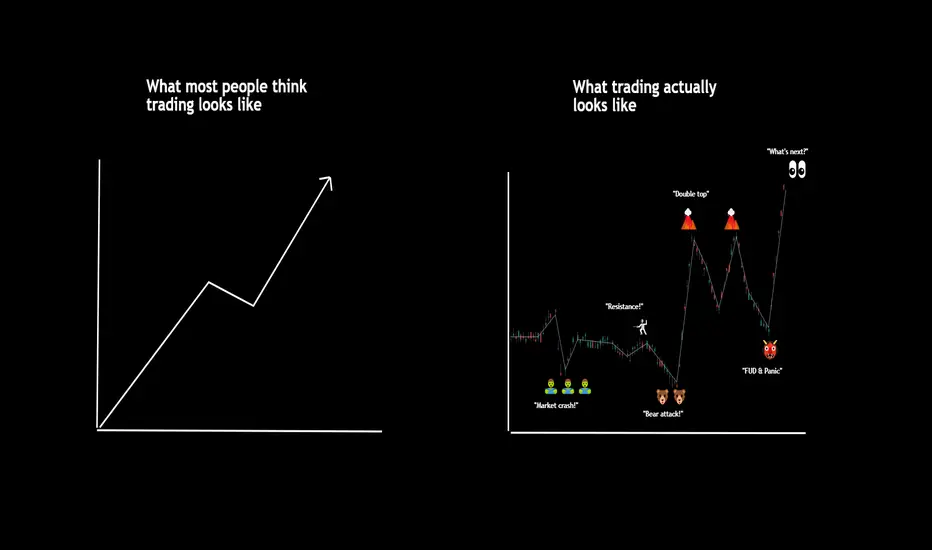
10 things to remember about bear markets, volatility, and panicTrading & investing is not easy. If it were, everyone would be rich. One of the most difficult moments for all traders, and especially investors, is when markets are abnormally bearish, trending downward or in a direction that goes against their positions. Adding to that difficulty is when volatility is rising and when uncertainty is high. These events have occurred throughout market history and should be expected. Every trader or investor should remember a simple truth: markets will go against you at some point. Be prepared. Learning to trade or invest in bearish and volatile markets requires great skill, experience, and composure. The last 12 months have demonstrated that. Stocks, bonds, forex, crypto, and futures have seen heightened volatility over the last 12 months. So what should we do? What now? Let's revisit the basics - the skills, traits, and mindset that are required to survive these moments. 1. Plan ahead 🗺 Plan your trade, trade your plan. Every trade, and every investment, should have an underlying plan. Write out the basic questions before you buy or sell. For example, what is your desired entry price? What is your desired exit price? What is your stop loss? How much money are you risking? Why are you making this trade or investment in the first place? In times of volatility, these questions matter more than ever. Get back to the basics. 2. Don't rush 🧘♂️ Volatility, and especially market panic, cause people to make quick reactions. The pressure, the fast price action, often forces people to act without a moment to revisit their original plan. Don't do this! Take your time. Stay composed and deal with the hand you have been dealt. 3. Be patient with entries 🎯 Many traders & investors speak of buying dips, but this phrase does explain the steps required. You don't buy dips without a plan. You plan out your strategy, you wait for the perfect entry, and you let the market come to you. When the market is in a downtrend, and volatility is high, it is paramount that you remain patient, waiting for the perfect entry. Use limit orders wisely. 4. Know your timeframe ⏰ Are you trading for one day? One month? Or 5 years? These basic questions will remind you of what you're trying to accomplish and how rushed or patient you should really be. They will also remind you about the chart you should be looking at, whether you should be zoomed in to a 30-minute chart or zoomed out to a weekly chart, showing years of price history. 5. Have an exit strategy 🚨 An exit strategy means that no matter what happens, you know where your stop loss is and you know where your profit target is. No matter what happens, up or down or sideways, you have an exit plan. Do not leave any entry or exit up to chance. Create your exit strategy before you place the trade and follow it. 6. Tighten position size 💪 Added volatility and uncertainty need to be factored into your game plan before it begins in the first place. However, many new investors and traders forget to do this. If that's you, it's time to adjust your strategy, and your plan, for larger trading ranges, and volatility. The year-long trends that defined a previous market are now less valid. 7. Zoom out for historical context 🔎 Zoom out on your charts. Then keep zooming out. And now zoom out some more. Circle the latest candle, line, or price movement and let it serve as a reminder about where the price is today vs. where it came from. There's a saying: when in doubt, zoom out. Do not get lost in the moment, looking only at the day or week, but instead go research the entire history of price. Learn about what has happened in the past. 8. Cash is a position 💸 Want to dollar cost average into a trade? Want to buy more? Want to trade more? You need cash to do that. There is comfort in being able to participate in the volatility whenever you want. Cash is a position and guarantees this. 9. Avoid panic, FUD, and FOMO 😳 When emotions are running high, some of the biggest psychological mistakes can occur. FUD stands for fear, uncertainty, and doom. FOMO stands for fear of missing out. These are two common emotions in crashing markets. On one hand, everyone thinks the end is near and then on the other hand every little up move is the next bull run. Do not let these emotions take you. 10. Take a break 😀 Sometimes it helps to step away. Log out, close your apps, get outside and get some exercise. Come back to the markets when you're ready. Your mind will also be well rested now. We hope you enjoyed this post and we hope it helps you as you navigate the markets. Please feel free to write any additional tips or pieces of advice in the comments section below! See you all next week. 🙂 – Team TradingView Do check us out on Instagram and YouTube for more awesome content! 💘Editors' picksEducationby TradingView99438
The Top 3 Elements found in all good trading plansHey everyone! 👋 This month, we have been theming our posts around the concept of building a solid trading plan. Our first post asked you to think about the kinds of factors that can predict long-term success. Our second post looked at why trading plans are so important. Both of these posts you can find linked at the end 👇 Having talked about the *what* and the *why*, it’s time to talk about the *how*. Today we will be taking a look at the top 3 elements found in all good trading plans! 1️⃣ Element 1: Every good trading plan knows why it wins. In trading, there are two variables that matter: Bat Rate, and Win / Loss. ► Bat Rate describes what percentage of the time a trade ends up as a win. A trader with a 90% bat rate wins 9 out of every 10 trades. ► Win / Loss describes how big the average win is, relative to the average loss. A trader with a 0.5 Win / Loss takes losses twice the size of his wins. If you multiply these numbers together, you will get an “Expected Value”. For example, a trader with a Bat Rate of 50% (wins half of the time) and a Win / Loss of 1 (Losses the same size as wins) is a perfectly “Breakeven” trader. In order to make money in the long term, all you need to do is make the multiplication of these values be a positive value. The breakeven trader above only needs to win 51% of trades to begin making money, if his W/L remains constant. ☝🏽To get these numbers into positive “expected value” territory, every good trading plan needs to devise a way to systematically find trading opportunities that it thinks have an edge. The inputs of this system are completely up to the trader, but they are typically rooted in repeating price patterns, fundamental observations, macro trends, or other patterns and cycles. Backtesting can be useful here for getting a general idea of whether or not an idea for a trading strategy has borne out to be true over time. In short, no matter what it looks like, good trading plans identify their edge before risking capital. Why start a business without a business plan? 2️⃣ Element 2: Every good trading plan takes into account the emotional character of the trader. This is the hardest element to quantify, but also arguably one of the most important pieces of a good written trading plan - the ability to work around a trader’s individual strengths and weaknesses. This is less important for banks and hedge funds, as decisions are typically made with oversight, but for retail traders, there is no-one around to temper your personal flaws. You can do whatever you want! - but it’s a double edged sword of responsibility that your trading plan needs to prepare you for. In short, you can best get an idea of where you are emotionally weakest by looking at your trading history. Nobody can do this for you, so it requires quite a bit of self-awareness. However, the rewards of removing emotional risk from a trading plan make it worth the effort. 😱 All trading is based on fear. You need to understand which fear is stronger - the fear of missing out, or the fear of losing capital. Figure out which is stronger, and plan accordingly. Just because you understand a certain strategy and other people make money trading it, doesn’t mean that you will be able to. Executing with 100% consistency at 30% efficiency is more important than finding a strategy with 100% efficiency that you can only trade with 10% consistency. Make life easy on yourself! 3️⃣ Element 3: Every good trading plan outlines risk. Whether you have one thousand dollars or one billion dollars, ignoring risk is a sure way to experience massively increased monetary and emotional volatility , which can have a huge negative impact on long term profitability. Here are a few simple-to-implement mechanisms that Banks, Hedge Funds, and Prop Firms use to reduce risk significantly - good trading plans don’t skip these. 💵 Total Account Stop Exactly what it sounds like: once you lose a certain percentage of your capital, you stop trading, liquidate your positions, and assess what went wrong. Only once you’re satisfied that you have fixed the issue are you allowed to re-enter the market. In the industry, this number is commonly 10%. 💵 Per Theme Risk This ensures that you aren’t too concentrated on a single “bet”, even if the bet is spread across multiple instruments. For example, if you own multiple companies in the same sector, their performance will likely be correlated to some degree even if they have different products or services. Adding a hard cap to this type of risk can massively reduce risky or over concentrated allocations. 💵 Per Position Risk Many successful Professional Traders and Hedge Funds use the concept of “Free Capital” in order to manage risk. “Free Capital” is the amount of money in hard dollars that makes up the buffer between an account’s current equity, and the total account stop number. For example, If a currency trader at a bank has a 10% total account stop out, and runs a $10,000,000 currency book, then he can really only “lose” $1,000,000 before his bosses pull him aside to have a talk. His “Free Capital” is $1,000,000. He will then size his positions to where he only risks 1-5% of his Free Capital per trade. This way, he has room to be wrong a minimum of 20 times in a row before any negative consequences come his way. Implementing a “free capital” risk limit per position ensures that you have a TON of room for error. Yes, this typically prevents you from doubling your account overnight, but again, that isn’t the goal. Long term profitability is. Some people call this per position risk “one R” (one risk unit). ☝🏽Whatever it looks like, including a plan for managing your risk is essential for *actually* managing your risk. If these plans aren’t written out and acted upon, they’re also a lot easier to ignore. 🙏🏽 Thanks for reading! Hope this was helpful! - TradingView Team ❤️❤️ Make sure you follow us on Instagram and YouTube for more awesome content! 💘Editors' picksEducationby TradingView88232
Who would you Stake?Hey everyone! 👋 In the next few posts, we'll be looking at the key elements involved in building a solid trading plan, but today, to introduce the concepts in a fun way, we will be looking at a completely hypothetical situation. - Let’s say that you’re walking down the street, and a stranger approaches you with a business proposal; he’s recently sold his business, and come into a significant amount of capital - 1,00,00,000 INR. Additionally, word of the sale has gotten to two separate aspiring traders, who have approached him asking him if they can manage his money in return for a fee. The stranger has heard from a family friend that you’re interested in trading, and he wants your help in picking out which trader to invest the money in. In return for your help, He’s going to split the profits he makes 50-50 with you. Obviously, it’s in your best interest to help him make a decision that will make the most money for the longest period of time, with the least amount of risk. The stranger then pulls out contact information for both traders and asks you to interview them separately. - Here's our question to you: if you only get to ask the traders three questions to gauge their likely future performance, what would you ask them? What questions dive to the heart of risk, reward, and sustainability? We look forward to your replies, and in next week's post, we will begin looking at how some of the likely responses can go towards building out a consistent, profitable process! - Team TradingView Feel free to check us out on Instagram , Telegram , and YouTube for more awesome content! 💘Editors' picksEducationby TradingView1515170
CPR - Central Pivot Range Trading ConceptThe Central Pivot Range (CPR) is absolutely, without a doubt, the most powerful part of the Floor Pivots indicator. It has three lines, Upper line is called "TC", lower line is called "BC" and the Middle line is the "PP-Pivot Point" Formula to Calculate CPR : TC = (Pivot - BC) + Pivot Pivot = (High + Low + Close)!3 BC = (High + Low)/2 At any given time, the range can be support or resistance, it can forecast trending or sideways price behavior, dictate the day's direction, or serve as an integral part of a trend. By seeing the gap/width between TC & BC we will be able to know how the session is going to be i.e "Trending / Sideways". If the Gap is very Narrow we can expect Trending market either side. If the Gap is wide that particular session will Volatile / Rangebound market. There are 7 CPR - Two day relationship concepts available which will indicate you the next day trend direction. (Comparing the Current session CPR with Previous Session CPR where the three lines are formed and its relationship.) Higher Value = Bullish Overlapping Higher Value = Moderately Bullish Lower Value = Bearish Overlapping Lower Value = Moderately Bearish Unchanged value = Sideways / Breakout Outside Value = Sideways Happy Trading, Follow me for more updates, education details, concepts and ideas.Educationby ViVenTraders7713
Trading Performance PsychologyThe greater the difficulty, the more glory in surmounting it. Skillful pilots gain their reputation from storms and tempests. - Epictetus. Hey everyone! 👋 This week, we thought it would be interesting to dive into a less-commonly discussed topic: performance psychology - and discuss how it relates to Trading. Specifically, we're going to look at the following question: What actually drives outperformance from one trader to the next? From a process standpoint, there are lots of things that aspiring traders can take from other performance disciplines (like sports) in order to better understand the necessary steps to get where they would like to be. Let's jump in! Time is the common element to expertise ⏰ Mastery is built over time. First through exploration, then knowledge building, then well-structured practice. To invest the great amounts of time and effort required for mastery, an individual typically bonds emotionally with the field, creating a long-term relationship. Present in almost all extremely high performing traders is an inherent, intrinsic love of trading itself. This means a love for analyzing charts, working on strategies, looking at markets, and trying to fit the pieces together in one's head. In this frame - Trading isn't a job, it's a CRAFT. If you just love the status, the lifestyle, or the income, then it's likely that you won't reach the true heights of the profession. The highest performing traders spend hours and hours working on their trading; not because they WANT to, but because they LOVE to. Finding a niche ❤️ The greats do not become great by working hard; they work hard because they find a great niche: a field that captures their talents, interests, and imagination. The best pitcher in the world might make a terrible hitter. If you're early on in your journey (or lost), something to consider is trying to find a niche that you truly resonate with. A great deal of importance is placed on niches in other professions and institutionally within finance, as hospitals and banks have rotational programs to expose newcomers to different types of experiences. Why then, don't individual traders do this? A great way to center your thinking is by constructing a rotational program for yourself. Here's a list of the most popular asset classes & trading styles. Give each a google , or look for ideas here on TradingView, and see what you resonate with most strongly. Set yourself up for long term mastery by actually finding something you love doing day in and day out. Liquid Asset Classes: -Stocks -Currencies -Cryptocurrencies -Futures -Fixed Income -Volatility Styles (Timeframe): -Intraday - holding time is seconds to hours -Swing - holding time is days to weeks -Position - holding time is weeks to months Which holding style fits with your temperament? What topics do you like learning about? The Learning Process ✅ In trading and in life, we often hear that "Practice makes perfect". A better saying may be "Perfect practice makes perfect". How practice time is structured makes the difference between a performer who has five years of experience and someone who has one year of experience repeated five times over. So; how should you structure your practice? In performance psychology, there's a concept known as a "learning loop". It has three parts. Performance -> Feedback -> Learning (repeated). This is crucial because feedback is the key to improvement. Trading is a solo sport, which means that figuring out how to incorporate a feedback process that allows for reflection is absolutely critical. P/L is feedback, but there can be some problems with it singularly as your feedback mechanism. Even the best traders who execute the best looking trades can be on the opposite side of variance on given days. The process is king. Get feedback from your performance that doesn't have to do with P/L so you can track the inputs to your decision making. Some traders take copious notes, some record their screens, and some record data points that aren't P/L related (hours slept, hydration, mood, etc). (We have a "notes" feature built into the charts you can use for this purpose.) If you gather up all of these items together to create a long-term blueprint for building mastery, it should look something like this: 1.) Find out what you truly love about trading 2.) Explore it more deeply 3.) Stick with it through time and allow your intrinsic enjoyment to motivate you through the ups and downs 4.) Structure your performance through that time in such a way that you can generate feedback for yourself 5.) Incorporate that feedback to continually improve your process. Allow learning loops to be your engine of long-term performance. Hope you enjoyed reading, and stay safe out there! - Team TradingViewEditors' picksEducationby TradingView77419
A beginner's guide to trading - Chapter 5As a newbie trader everybody has doubts like, “Am I analysing the charts well?”, “Does my analysis skills are improving?”, “Have I changed my trading style?” etc... How to know these? By journaling you can know and measure your progress. Best way to journal your analysis is using trading view and publishing your analysis. You can publish as private ideas, if you don’t want others to see it. Since the charts are dynamic, any time you can check your analysis and the market movement after that. Lets say person A has just started analysing and he use trend lines. In the above chart when the price breaks the trend line he plans to go short. The trend line break was good and gave good profit. In the above chart the analysis was to go long when the price break the trend line. After breaking the trend line the price went sideways. Very less movement only. The price was falling and plan was to go long once the down trend was over by breaking the trend line. The price gave break out upside, but did not sustain and went sideways. Analysis 1 : good move Analysis 2 : very small move. Analysis 3 : No move. Total – 3 worked – 2 Did not work – 1 Next step was to improve further. You can add conditions like volume support, current market situation. Analysis 1 : Price was unable to break the resistance and was falling from resistance so we can go short. Analysis 2 : Price was not having volume support to move up further. Analysis 3 : Less volume and did not move up. These observations you can do in live market only. First analyse, plan and be ready for market. Then during market hours, observe and trade. After market hours check how your analysis worked, how you traded, what mistakes you have done in analysis and trading. Make this process as a habit. If you did not develop this as a habit from the starting itself, then making it as a habit becomes a tough process. Journaling your trades help you to improve and measure your progress. Start today if you have not done it so far. Perfection comes from practise. Dont stress yourself by expecting perfection from day 1. As a trader you have to make yourself ready to face the market, adapt the market and measure you progress. Remember you can trade better than you think, if you follow this process. Educationby vanathi7747
A beginner's guide to trading - Chapter 4This question has been asked before. It has been asked now. I will be asked in future. What question is that? It is nothing but, “How to select stocks to trade?” From beginners to expert traders, everybody knows stock selection is important. Especially for intraday it is very important as same stock won’t give movement daily. There are two methods. One is to trade on active stocks and another is selecting a stock which has formed trade set up as per your strategy. Ok, now how to select stocks? For intraday, the stock you trade should be an active stock. If the price is above 400 rs means, generally the movement will be good. The price will move with momentum & show trend strength. The stocks you select should be -- Active -- Above 400 Rs -- No spikes in movement (very long upper & lower wicks). Let us take an example. Beml is in my active stock list. In the above chart on June 9th price was narrowing within a narrow range forming a symmetrical triangle. It means we can expect break out any side. I selected this stock to trade on June 10th. Next step is to prepare a trading plan. Bearish below 1330, I can go short if the price showed bearish strength with 10 points as stop. Bullish above 1350, I can go long if the price showed bullish strength with points as stop. When you have a list of active stocks, you can filter them by pattern formation like the above example and trade. Below is another example. In the above example, I have selected the stock because of the consolidation. I have expected consolidation break out once the price moves out of the zone. The levels are marked in the chart. Another method to select stocks is based on the strategy you use. I have posted the strategy used already. Please refer the link below if you have not read it. This trade set up forms in live market. So you have to wait for 15 minutes to know whether your trade set up has formed. These are just examples. Your strategy and trade set ups can have unique features depending on your trading style. It does not matter whether it is intraday or short term trading, always trade on stocks which is active and which forms the trade set up as per the strategy you use. Editors' picksEducationby vanathiUpdated 1111175
How to create high quality trade ideas?Hey everyone! 👋 This week, we will be taking a look at the ingredients that go into creating and posting high-quality trade ideas. While many think that a good trade idea begins and ends with finding a high probability chart setup in a liquid, volatile asset, the *best* trade ideas often combine multiple disciplines - which could include macroeconomic analysis, fundamental analysis, technical analysis, or some combination therein - into one cohesive unit. Getting in the habit of incorporating all of these factors into your thought process can lead to much higher quality setups, whether or not you choose to share them with the community. Let’s jump in! There are a couple of questions that you should ask yourself when trying to come up with high-quality ideas, and they boil down to the familiar five: Who, What, Where, When, and Why. Let's start with Who. WHO: Who is this trade idea meant for? When posting a trade idea, don’t assume that the idea is one-size-fits-all. The most obvious way TradingView helps in this regard is by categorizing posts by asset class, so FX traders are looking mostly at FX ideas, and crypto investors aren’t constantly exposed to commodity futures spreads. However, there are more subtle ways this happens as well. Different traders and investors often have different styles of trading, and so even within a single asset class, a long-term investment idea may not be applicable to a short-term trader. When creating a trade idea, it may make sense to identify to readers (and yourself) who this idea is for, and within what strategy it might best fit. WHAT: Most ideas do a great job at answering this question! It’s very simple: at its core, what does this idea want to do? Whether that idea boils down to shorting the stock market or building a long/short cryptocurrency spread, make sure that your idea clearly identifies what the core thrust of the trade is. WHY: This is the crux of any good trade idea. Why should someone commit capital and risk money according to your vision? It is common for traders, especially new traders, to think that answering this question comes down to building up a confluence of price patterns, indicators, and chart drawings until they line up and it is all systems go. In some cases, this serves as a reasonable answer to the “why” question - especially when assets have strong momentum. However, oftentimes this approach may not go deep enough. What if the long technical setup on your chart is in a stock where the company’s business outlook is worsening? What if the descending triangle you’re looking at trading occurs within a larger bull market? This is where incorporating multiple disciplines, whether it’s fundamental analysis or macroeconomic understanding, can improve the quality of your trade ideas. Understanding some of the context surrounding the asset you’re trading can serve to layer probability in your favor. Here’s the bottom line: the current price in any market is a reflection of the consensus view of the future. It’s important to illustrate *why* that pricing might be materially incorrect. WHERE / WHEN: It’s important to illustrate why *right now* is the right time to act on the idea, and this is where technicals can come in very handy. Broadly speaking, fundamental data on most assets only comes out once every couple of weeks, if that. It’s even longer between fundamental data releases for stocks. Because of this, utilizing price patterns, indicators, candlestick charting, and other technical analysis can be extremely helpful in defining risk, pinpointing entries, and trading more efficiently overall. This is also where clean charting comes in. It’s important to identify how trader positioning, supply and demand zones, and other factors (that technicals help illustrate) affect the timing and risk of the idea. In addition, when publishing an idea on TradingView, the chart is one of the most visible and prevalent ways of communicating this information. Making these items clearly defined can significantly improve the quality of a trading idea and ensure clear communication of the important information. So there you have it - the key questions that are at the core of any good trading idea! We look forward to seeing how this framework is incorporated into future posts. Thanks for reading! Hope this was helpful! See you all next week. 🙂 – Team TradingView Feel free to check us out on Twitter and Instagram for more awesome content! 💘 Editors' picksEducationby TradingView44268
Trading ExecutionThis post is about simple entry,stop & exit,adapting the market movement. It will be useful to new traders. Watch it fully so that you wont miss important points. Most of the time we do analysis and market give completely different scenario to handle. In this post I have explained about the trading execution using my yesterday’s analysis. I have explained the entries & stop. Analysis - Reliance – Double top resistance @ 2400 – 2410. Mildly bearish. Price didn’t fall and went up. Analysis-HDFC – Trend line support – neutral. Today took support & gave 35 pts move. I have marked the entry in the video. Analysis-Infy – Consolidation –neutral. Today gave break out of 50 pts. Analysis-TCS – Trend line support – neutral. Took support. Analysis-ICICIBank - @ trend line support – neutral. Today gave 15 pts move. Analysis-HDFCBank – Consolidation – no trend. 40 pts move today. Analysis-SBIN – Consolidation – no trend. Gave upside break out for 10 pts. Analysis-Kotak Bank - @ trend line support –neutral. Took support and gave 50 pts move. Analysis-Axis bank – Descending triangle – bearish. Gave upside break out. I have shared the link in which I have done the analysis. Education04:59by vanathi101038