Trend Analysis
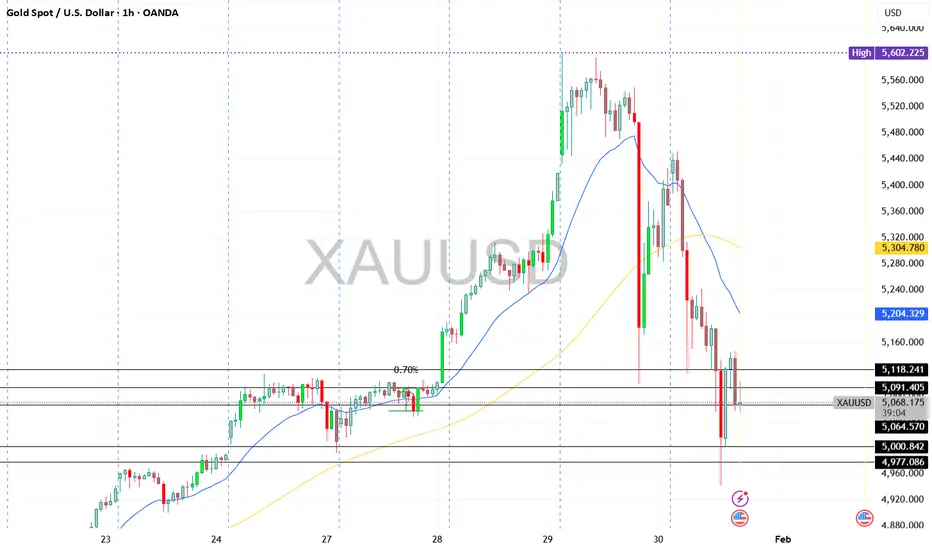
GOLD (XAUUSD) Retracement Buy Zones-Long Bias Only**Description:**
Gold is currently in a bullish structure and I am waiting for a **healthy retracement into my marked demand zones**.
My plan is simple: **ONLY look for BUY opportunities** from these zones and ignore sells.
Price previously respected this area as support and also aligns with structure + retracement levels.
If price taps into the zone and shows bullish confirmation (rejection candle / structure shift), I will look for long entries.
**Trade Plan:**
✅ Direction: BUY only
📍 Entry: Inside marked retracement zone
🎯 Target 1: Previous high
🎯 Target 2: Next resistance / liquidity
🛑 Stop Loss: Below the zone (structure invalidation)
**Reason for Bias:**
• Overall trend = bullish
• Zone = previous demand area
• Waiting for retracement, not chasing price
• Risk-reward favorable from this area
⚠️ No trade if price breaks and closes below the zone.
I will wait patiently for price to come to me.
**Disclaimer:**
This is my personal analysis, not financial advice.
Always manage your risk and wait for confirmation before entering.
#XAUUSD #Gold #PriceAction #SupplyAndDemand #Forex #TradingView #BuyZone #SmartMoney #TrendTrading
GOLD Buy Pullbacks in Bullish TrendMarket Context (M30)
Gold continues to trade within a strong bullish continuation phase, holding firmly inside a well-defined ascending channel. Recent pullbacks are technical retracements for liquidity rebalancing, not signs of distribution or trend exhaustion.
On the macro side, persistent USD weakness, sustained safe-haven demand, and only modest Fed easing expectations keep the broader backdrop supportive for gold. This combination allows upside momentum to remain controlled and constructive rather than emotional.
➡️ Overall bias: Bullish – prioritize BUY setups aligned with the main trend.
Structure & Price Action
M30 structure remains intact with clear Higher Highs and Higher Lows.
Price continues to respect previous demand and key levels, confirming active buyer participation.
No bearish CHoCH has been confirmed.
The current leg is expanding toward higher Fibonacci extensions, reinforcing trend continuation.
Key insight:
👉 As long as structure holds, pullbacks represent opportunity — not risk.
Trading Plan – MMF Style
Primary Scenario – Trend-Following BUY
Focus on patience and execution at discounted levels, not chasing price at extensions.
BUY Zone 1: 5,185 – 5,170
(Short-term demand + channel support)
BUY Zone 2: 5,106 – 5,085
(Key level confluence + trendline support)
➡️ Execute BUYs only after clear bullish reaction and structure confirmation.
➡️ Avoid FOMO at extended highs.
Upside Targets:
TP1: 5,250
TP2: 5,309 (Next ATH extension zone)
Alternative Scenario
If price holds firmly above 5,250 without a meaningful pullback, wait for a break & retest before looking for continuation BUYs.
Invalidation
A confirmed M30 close below 5,044 would weaken the current bullish structure and require reassessment.
Summary
Gold remains in a controlled bullish expansion, driven by structure and macro flow. The edge is not calling the top, but buying pullbacks within demand while the trend remains intact. As long as structure holds, higher prices remain the path of least resistance.
XAUUSD (H1) – Liam Plan (Jan 27) Bullish TrendQuick summary
Gold is still trending higher inside a clean rising channel, but price is now approaching a weak high / liquidity pocket where stop-runs are likely.
Macro backdrop adds fuel for volatility: reports suggest the US is pressuring Ukraine toward territorial concessions as part of peace talks — this kind of uncertainty often keeps safe-haven demand supported, but it can also create fast spikes + fake breaks.
➡️ Today’s rule: follow the uptrend, but only buy at liquidity test points. No chasing highs.
1) Macro context (why spikes are likely)
If markets start pricing a forced compromise in the Ukraine conflict:
risk sentiment can swing quickly,
headlines can trigger instant pumps, then sharp retraces.
✅ Safe approach: let price hit your zones first, then trade the reaction — not the headline.
2) Technical view (H1 – based on your chart)
Price is respecting an ascending channel and building liquidity around key levels.
Key levels (from the chart):
✅ Support / buy liquidity zone: 4,995 – 5,000
✅ Flip / reaction zone: 5,047
✅ Upper resistance / supply: 5,142
✅ Weak High / liquidity target: 5,192.6
✅ Extension target (1.618): 5,240.8
Bias stays bullish while inside the channel, but near 5,192–5,240 we should expect liquidity sweep → pullback behavior.
3) Trading scenarios (Liam style: trade the level)
A) BUY scenarios (priority – trend continuation)
A1. BUY the pullback into the flip zone (cleanest R:R)
✅ Buy: 5,045 – 5,050 (around 5,047)
Condition: hold + bullish reaction (HL / rejection / MSS on M15)
SL (guide): below 5,030 (or below the reaction low)
TP1: 5,085 – 5,100
TP2: 5,142
TP3: 5,192.6
Logic: This is the best “trend-following” entry — buy support, sell into liquidity above.
A2. BUY deep liquidity sweep (only if volatility hits)
✅ Buy: 4,995 – 5,000
Condition: sweep + strong reclaim (fast rejection / displacement up)
SL: below 4,980
TP: 5,047 → 5,142
Logic: This is the strongest liquidity test zone on your chart — ideal for a bounce if price flushes.
B) SELL scenarios (secondary – reaction scalps only)
B1. SELL the weak high sweep (tactical scalp)
✅ If price runs 5,192.6 and shows rejection:
Sell: 5,190 – 5,200
SL: above the sweep high
TP: 5,142 → 5,085
Logic: Weak highs often get swept first. Great for quick mean reversion back into the channel.
B2. SELL extension (highest-risk, but best location)
✅ Sell zone: 5,235 – 5,245 (around 5,240.8)
Only with clear weakness on M15–H1
TP: 5,192 → 5,142
Logic: 1.618 extension is a common exhaustion pocket — don’t short early, short the reaction.
4) Key notes
Don’t trade mid-range between 5,085–5,142 unless you’re scalping with tight rules.
Expect false breakouts near 5,192 and 5,240 during headlines.
Best execution today = buy support, take profits into liquidity.
Question:
Are you buying the 5,047 pullback, or waiting for the 5,192 sweep to sell the reaction?
— Liam
Gold Trading Strategy for 28th January 2026🟡 GOLD ($) TRADING PLAN
📊 TREND TRADING (Intraday)
📈 BUY SETUP
🟢 Condition:
➡️ Buy above the high of 30-min candle
➡️ Candle must close above $5244
🎯 Targets:
💰 $5255
💰 $5266
💰 $5277
🛑 Stop Loss:
🔻 Below the low of the breakout candle
📉 SELL SETUP
🔴 Condition:
➡️ Sell below the low of 1-hour candle
➡️ Candle must close below $5125
🎯 Targets:
💰 $5115
💰 $5105
💰 $5095
🛑 Stop Loss:
🔺 Above the high of the breakdown candle
⚡ SCALPING STRATEGY
🔻 SELL SCALPING (Resistance – $5244)
❌ Price tests $5244 zone
❌ 15-min candle rejection observed
📍 Entry:
➡️ Sell below the low of rejected 15-min candle
🛑 Stop Loss:
🔺 Above the high of rejected candle
⏱️ 5–10 points max or trail SL
📌 Trade Management:
🔄 Trail stop once price moves in favor
🔺 BUY SCALPING (Support – $5125)
✅ Price tests $5125 zone
✅ 15-min candle rejection observed
📍 Entry:
➡️ Buy above the high of rejected 15-min candle
🛑 Stop Loss:
🔻 Below the low of rejected candle
⏱️ 5–10 points max or trail SL
📌 Trade Management:
🔄 Trail stop once price moves in favor
⚠️ DISCLAIMER
🚨 This is not investment advice.
📉 Trading in commodities involves high risk.
💸 Past performance does not guarantee future results.
🧠 Trade only with proper risk management.
📌 Always consult your financial advisor before trading.
❗ Author is not responsible for any profit or loss.
BANKNIFTY Levels for Today
Here are the BANKNIFTY’s Levels for intraday (in the image below) today. Based on market movement, these levels can act as support, resistance or both.
Please consider these levels only if there is movement in index and 15m candle sustains at the given levels. The SL (Stop loss) for each BUY trade should be the previous RED candle below the given level. Similarly, the SL (Stop loss) for each SELL trade should be the previous GREEN candle above the given level.
Note: This idea and these levels are only for learning and educational purpose.
Your likes and boosts gives us motivation for continued learning and support.
#BANKNIFTY PE & CE Levels(28/01/2026)A gap-up opening in Bank Nifty indicates a positive start to the session, supported by short-covering and fresh buying interest from lower levels. The index has opened above the immediate intraday support zone, which suggests that bulls are attempting to regain control after recent consolidation. However, despite the gap-up, the market is still trading within a broader range, so confirmation through price sustain is crucial before assuming a strong trending move.
From a technical structure point of view, the 59050–59100 zone is acting as a major demand and decision area. Holding above this region keeps the bullish bias intact for the intraday session. If Bank Nifty sustains above 59050, buying Call options becomes favorable, with upside targets placed near 59250, followed by 59350, and then 59450+. These levels correspond to previous supply zones and minor swing highs, where profit booking or partial exit should be considered due to potential resistance.
A stronger bullish continuation will only be confirmed if the index manages to break and sustain above 59550. Above this level, momentum buying can accelerate, opening the path towards 59750, 59850, and eventually 59950+, which is a major resistance area marked by previous rejections. This zone is critical, as failure to cross it decisively may again push the index back into consolidation or minor correction.
On the downside, 59450–59400 is the first intraday support. A breakdown below this zone may trigger short-term weakness, making Put options attractive with targets around 59250, 59150, and 59050. If selling pressure increases and Bank Nifty slips below 58950, the structure turns weaker, and further downside targets open up towards 58750, 58650, and 58550, which are stronger demand zones from where bounce-back attempts can emerge.
Overall, the gap-up opening reflects positive sentiment, but the market is still trading near crucial resistance bands. Traders should avoid chasing the gap and instead focus on price acceptance above key levels. A sustained move above resistance confirms bullish strength, while rejection from higher zones can quickly lead to a pullback. Maintaining strict stop-losses, booking partial profits near targets, and trading strictly based on levels will be essential due to expected volatility around these zones.
KOTAKBASNK: BUDGET Special Level Analysis for 30th JAN 2026+KOTAKBASNK: BUDGET Special Level Analysis for 30th JAN 2026+
━━━━━━━━━₹₹₹₹₹₹₹₹₹₹₹₹━━━━━━━━
💥Level Interpretation / description:
L#1: If the candle crossed & stays above the “Buy Gen”, it is treated / considered as Bullish bias.
L#2: Possibility / Probability of REVERSAL near RLB#1 & UBTgt
L#3: If the candle stays above “Sell Gen” but below “Buy Gen”, it is treated / considered as Sidewise. Aggressive Traders can take Long position near “Sell Gen” either retesting or crossed from Below & vice-versa i.e. can take Short position near “Buy Gen” either retesting or crossed downward from Above.
L#4: If the candle crossed & stays below the “Sell Gen”, it is treated / considered a Bearish bias.
L#5: Possibility / Probability of REVERSAL near RLS#1 & USTgt
HZB (Buy side) & HZS (Sell side) => Hurdle Zone,
*** Specialty of “HZB#1, HZB#2 HZS#1 & HZS#2” is Sidewise (behaviour in Nature)
Rest Plotted and Mentioned on Chart
Color code Used:
Green =. Positive bias.
Red =. Negative bias.
RED in Between Green means Trend Finder / Momentum Change
/ CYCLE Change and Vice Versa.
Notice One thing: HOW LEVELS are Working.
Use any Momentum Indicator / Oscillator or as you "USED to" to Take entry.
━━━━━━━━━━━━━━━━━━━━━━━━━━━━━━━━━━━━━━━━━━━
⚠️ DISCLAIMER:
The information, views, and ideas shared here are purely for educational and informational purposes only. They are not intended as investment advice or a recommendation to buy, sell, or hold any financial instruments. I am not a SEBI-registered financial adviser.
Trading and investing in the stock market involves risk, and you should do your own research and analysis. You are solely responsible for any decisions made based on this research.
"As HARD EARNED MONEY IS YOUR's, So DECISION SHOULD HAVE TO BE YOUR's".
━━━━━━━━━━━━━━━━━━━━━━━━━━━━━━━━━
❇️ Follow notification about periodical View
💥 Do Comment for Stock WEEKLY Level Analysis.🚀
📊 Do you agree with this view?
✈️ HIT THE PLANE ICON if this technical observation resonates with you. It will Motivate me.
━━━━━━━━━━━━━━━━━━━━━━━━━━━━━━━━━
💡 If You LOOKING any CHART & want for Level and ANALYZE?
Share your desired stock names in the comments below! I will try to analyze the chart Levels, patterns and share my technical view (so far my Knowledge).
If Viewers think It can identify meaningful setups. Looking forward to hearing from all of you — let's keep this discussion going and help each other make better trading decisions.
BEL : High-Quality Setup Despite Market Weakness📊 Technical Catalysts :
This is a perfect VCP structure with a clean breakout supported by strong volume, clearly indicating institutional interest. The stop loss is well placed below the basing formation, keeping risk structurally defined. The 20 EMA crossing above the 50 EMA further confirms a bullish trend shift.
EPS and Sales are continuously increasing for the past few quarter. The only dip was in June and this is not a stock specific event but a market wide scenario.
🏭 Fundamental Catalysts :
Good Results ; EPS and Sales are continuously increasing for the past few quarter. The only dip was in June and this is not a stock specific event but a market wide scenario.
Q3 Beat: Net profit grew 20.4% YoY (₹1,590 Cr), comfortably beating street estimates. Revenue execution is at an all-time high.
The EU FTA Factor: The "Mother of All Deals" signed on Jan 27 opens up a $750B market for Indian defense electronics. BEL is the primary beneficiary as it scales up exports to European nations looking to de-risk from China/Russia.
Budget 2026 Speculation: With the Union Budget on Feb 1, the market is front-running a likely increase in defense capital outlay.
Even though the broader market is showing signs of weakness, the confluence of strong technical structure, volume-backed breakout, moving-average crossover, and improving fundamentals provides enough confidence to take this trade, while still maintaining disciplined risk management with a standard 1% risk per trade.
📢📢📢
If my perspective changes or if I gather additional fundamental data that influences my views, I will provide updates accordingly.
Thank you for following along with this journey, and I remain committed to sharing insights and updates as my trading strategy evolves. As always, please feel free to reach out with any questions or comments.
Other posts related to this particular position and scrip, if any, will be attached underneath. Do check those out too.
Disclaimer : The analysis shared here is for informational purposes only and should not be considered as financial advice. Trading in all markets carries inherent risks, and past performance is not indicative of future results. It’s essential to conduct your own research and assess your risk tolerance before making any investment decisions. The views expressed in this analysis are solely mine. It’s important to note that I am not a SEBI registered analyst, so the analysis provided does not constitute formal investment advice under SEBI regulations.
The U.S. Tech Sector’s Engagement With The Indian Market1. Introduction: U.S. Tech in India — A Strategic Presence
The United States technology sector plays a central role in India’s digital and economic transformation. American tech companies, from platform giants like Amazon, Microsoft, and Google to niche cloud and AI providers, are investing heavily in India — not just in revenue generation, but also in infrastructure, innovation, skill development and supply chain diversification. These movements reflect a deepening integration between the two largest democracies’ economies, specifically in advanced technologies like cloud computing, artificial intelligence (AI), SaaS, and semiconductors.
2. Scale of Investment: Billions Committed
In recent years, U.S. tech giants have announced multi‑billion‑dollar investments focused on India’s future tech stack:
Amazon has committed more than $35 billion through 2030 to grow AI capabilities, exports, logistics, and jobs in India — part of a larger history of $40 billion in investments since 2010. This push is aimed at making India a major AI and e‑commerce hub, with a target of creating 1 million jobs by the end of the decade.
Microsoft plans to invest around $17.5 billion over approximately four years to expand cloud, AI, and digital infrastructure. A major part of this is enhancing AI skills — having doubled its commitments to train millions of Indians in AI technologies.
Google is investing $15 billion to establish what it calls its largest AI hub outside the U.S. in Visakhapatnam, complete with data centers, fiber‑optic networks, and subsea connectivity that will accelerate AI development and digital services across the region.
Together, these demonstrate how U.S. tech capital is flowing into India’s infrastructure layer, not just in customer‑facing products but in foundational compute and AI resources.
3. Market Drivers: Why U.S. Tech Is Betting on India
Several compelling factors make India attractive to U.S. technology companies:
a. Huge and Growing Digital Economy
India is one of the fastest‑growing digital markets in the world, with increasing internet penetration, mobile usage, and consumer tech adoption. Domestic IT spending, including cloud and AI subscriptions, has been rising rapidly (with forecasts indicating enterprise IT spending crossing over $176 billion in 2026).
b. Talent and Capabilities
India’s large pool of software developers, engineers, and digital professionals is a key asset. India accounts for over 50% of global global capability centers (GCCs) — specialized tech and engineering hubs set up by multinationals to serve global operations. These centers allow U.S. firms to innovate and deliver services worldwide from India.
c. Strategic Regulatory Environment
India’s business environment permits 100% foreign direct investment (FDI) in software, cloud services, and technology platforms through automatic routes — making entry and operations smoother for U.S. companies. Policies like the Digital Personal Data Protection Act and bilateral frameworks like the United States–India Initiative on Critical and Emerging Technology (iCET) further support cooperation in AI, quantum computing, semiconductors, and more.
4. Partnerships and Collaborative Innovation
Beyond large capital outlays, U.S. tech firms are partnering with Indian organizations in several strategic ways:
Many companies are linking with local partners on infrastructure projects — for example, Google’s Visakhapatnam AI hub is developed in collaboration with India’s Adani Group.
U.S. firms are increasingly integrating with India’s “digital public infrastructure” — including systems like Aadhaar, UPI, and other digital frameworks that streamline payments, identity management, and cloud‑native services.
Venture capital and private equity firms (e.g., Accel) continue to fund Indian startup ecosystems, aligning U.S. capital with India’s burgeoning SaaS, edtech, and fintech companies.
These collaborations not only help U.S. companies localize their offerings but also stimulate innovation within India’s tech ecosystem itself.
5. Workforce Dynamics: Migration and Skill Exchange
The tech workforce interplay between the U.S. and India is complex and evolving:
Longstanding trends saw Indian professionals taking up tech roles in the U.S., especially through the H‑1B visa program. New policy changes and uncertainty around visas have contributed to a reverse flow, with more tech workers relocating to India — a shift captured in recent LinkedIn data showing a 40 % rise in U.S. tech professionals moving to India.
Conversely, Indian IT companies historically employed hundreds of thousands of Americans, contributing significantly to the U.S. economy through jobs and revenue.
This dynamic reflects a maturing global tech labor market, where India is emerging not only as a talent supplier but also as a destination for global tech careers.
6. Economic Impact on Indian Market Players
American tech investments affect Indian companies in both competitive and complementary ways:
Indian IT services firms (such as TCS, Infosys, Wipro, HCL) still derive a sizable portion of their revenues from the U.S. market — often through outsourcing contracts and enterprise services. Stocks of these companies can be sensitive to U.S. policy shifts and macroeconomic trends. Recent visa policy changes have at times triggered volatility in Indian IT shares, highlighting their dependence on U.S. demand.
U.S. cloud platforms (AWS, Azure, Google Cloud) are expanding services to Indian enterprises, increasing competition with domestic cloud players but also raising the overall tech spending pie through digital transformation.
7. Challenges and Risks Facing U.S. Tech in India
Despite strong growth prospects, several challenges persist:
a. Regulatory and Policy Risks
Data localization, cross‑border flow restrictions, and evolving digital regulation can create uncertainty for foreign tech firms balancing compliance and innovation.
b. Geopolitical Shifts
U.S.–China trade tensions and shifting visa policies in the U.S. can indirectly impact strategy and workforce planning for tech companies in India.
c. Infrastructure and Talent Gaps
While India’s talent base is deep, there are skills mismatches in areas like advanced AI research and semiconductor fabrication capacity — which U.S. firms are trying to address through training initiatives and collaborations.
8. Looking Ahead: Strategic Future Opportunities
The trajectory of U.S. tech in India points toward deepening involvement in core technological domains, including:
AI and machine learning infrastructure development
Cloud and edge computing expansion
Semiconductor partnerships and manufacturing ecosystems
Joint research in quantum, cybersecurity, and digital infrastructure
Both countries’ governments are also strengthening tech ties through initiatives like iCET, which aim to institutionalize cooperation in emerging technologies — potentially accelerating innovation hubs, talent exchange and joint R&D on a global scale.
9. Conclusion: U.S. Tech as a Pillar of India’s Digital Growth
In summary, the U.S. tech sector’s engagement with the Indian market has matured from services‑oriented outsourcing to deep strategic investment across cloud, AI, infrastructure, and talent development. This evolving partnership is transforming India into a global tech hub, driven by massive capital commitments from U.S. firms and supported by India’s regulatory reforms, digital initiatives, and talent base. As technologies such as AI and cloud computing reshape global markets, the U.S.–India tech linkage is likely to become even more central to global innovation ecosystems in the coming decade.
ZEE Entertainment - Target 120With the recent result , we see a clear Head & Shoulder Pattern in hourly chart. One can keep a target of 120.
The Zee5 business has posted a EBITDA positive result which can be seen as turnaround. If promoters increase their holdings this can again reach to 140 levels.
AI and Technology Stocks: A Comprehensive Overview1. Understanding AI and Technology Stocks
Technology stocks broadly include companies engaged in software development, hardware manufacturing, cloud computing, semiconductors, networking, and IT services. Within this sector, AI stocks are a subset focused on companies that develop artificial intelligence solutions, including machine learning, natural language processing, computer vision, and robotics. Leading AI stocks are often also technology companies but with a significant focus on AI-enabled products or services.
Major players in AI and technology include companies such as Microsoft, NVIDIA, Alphabet (Google), Amazon, Meta Platforms, Tesla, and Intel. Each of these companies leverages AI differently: NVIDIA through AI chipsets, Microsoft and Google via AI cloud services and software, Amazon through AI-driven logistics and recommendation engines, and Tesla with AI for autonomous vehicles.
2. Drivers of Growth in AI and Technology Stocks
Several macro and microeconomic factors have driven the growth of AI and technology stocks:
Cloud Computing and Big Data: The adoption of cloud infrastructure has expanded rapidly, with AI algorithms requiring massive computational power and storage. Companies providing cloud solutions, like Amazon Web Services, Microsoft Azure, and Google Cloud, benefit from both AI and broader technology trends.
AI Integration Across Industries: AI is no longer confined to tech companies. Financial services, healthcare, automotive, retail, and manufacturing increasingly implement AI for efficiency, predictive analytics, and automation. This cross-industry adoption fuels revenue growth for AI technology providers.
Semiconductor Demand: AI applications rely heavily on GPUs and specialized AI chips. Companies like NVIDIA and AMD have become central to AI development, as their processors are critical for training large language models and running complex AI workloads.
Automation and Productivity: AI enhances operational efficiency by automating repetitive tasks, improving decision-making through predictive analytics, and reducing costs. This value proposition makes AI investments appealing both to enterprises and investors.
Research and Innovation: AI research, including breakthroughs in natural language processing (NLP), computer vision, reinforcement learning, and generative AI, has accelerated. Investment in R&D strengthens competitive moats for technology companies, which is reflected in stock valuations.
3. Investment Characteristics of AI and Technology Stocks
Investing in AI and technology stocks has distinct characteristics:
High Growth Potential: AI and tech stocks often outperform traditional sectors due to their growth-oriented nature. Revenue growth rates in AI-focused companies can be exponential, driven by adoption of AI tools, cloud computing, and SaaS (Software as a Service) solutions.
Volatility: High growth comes with high volatility. AI and technology stocks are sensitive to market sentiment, technological shifts, regulatory changes, and macroeconomic conditions like interest rates. Short-term price swings can be significant, requiring investors to have a long-term perspective.
Valuation Challenges: Many AI and tech stocks trade at premium valuations relative to earnings, reflecting expected future growth rather than current profitability. Metrics such as price-to-earnings (P/E), price-to-sales (P/S), and enterprise value-to-revenue (EV/R) are often higher than the broader market, reflecting investor optimism.
Network Effects: Many AI and tech companies benefit from network effects. For example, social media platforms like Meta gain value as user engagement increases, while cloud platforms become more entrenched as enterprises build ecosystems on them.
Recurring Revenue Models: AI and software companies often rely on subscription-based models, providing predictable and recurring revenue streams. SaaS and AI-as-a-Service offerings contribute to long-term profitability and valuation stability.
4. Key Sectors within AI and Technology
AI and technology stocks span multiple sub-sectors:
Semiconductors: The backbone of AI computing, companies like NVIDIA, Intel, AMD, and Qualcomm dominate chip production for AI, data centers, and edge computing.
Cloud Computing and SaaS: AI-driven cloud services are essential for enterprise digital transformation. Microsoft, Amazon, Salesforce, and Snowflake exemplify this sector.
Autonomous Vehicles and Robotics: AI powers autonomous driving, drones, and industrial robotics. Tesla, Waymo, Boston Dynamics, and ABB leverage AI for automation, which opens new revenue streams.
Cybersecurity: AI is crucial in threat detection, anomaly detection, and automated response systems. Companies like Palo Alto Networks, CrowdStrike, and Fortinet integrate AI into their cybersecurity solutions.
Consumer Technology and Platforms: AI enables recommendation systems, personalization, and smart devices. Apple, Alphabet, and Meta integrate AI into consumer products and services to enhance engagement and monetization.
5. Trends Shaping AI and Technology Stocks
Several trends are shaping the AI and technology sector:
Generative AI: Generative AI models like ChatGPT, DALL-E, and other large language models have opened new commercial applications, from content creation to automated coding, fueling investor enthusiasm.
AI Democratization: Cloud-based AI platforms enable smaller companies to adopt AI without heavy infrastructure investment, broadening market adoption and creating new investment opportunities.
Edge Computing and IoT: AI integration in Internet of Things (IoT) devices allows real-time processing at the edge, expanding applications in smart homes, industrial automation, and healthcare monitoring.
Mergers and Acquisitions: Large tech companies are acquiring AI startups to accelerate innovation, expand capabilities, and secure talent, impacting stock valuations and sector dynamics.
Regulatory Focus: Governments worldwide are exploring AI regulation to address ethical concerns, data privacy, and job displacement. While regulation can limit certain practices, clear rules may also enhance investor confidence in sustainable AI adoption.
6. Risks and Challenges
Investing in AI and technology stocks carries risks:
Market Volatility: High-growth AI and tech stocks are sensitive to interest rate changes, inflation, and market cycles, which can create sharp declines during downturns.
Competition: Rapid innovation attracts competition. Startups can disrupt established players, while large firms must continually innovate to maintain dominance.
Regulatory Risks: AI-specific regulations, antitrust concerns, and data privacy laws may affect profitability and business models.
Ethical and Social Implications: AI adoption raises questions about job displacement, algorithmic bias, and misuse, which could impact public perception and lead to policy intervention.
Valuation Risk: High valuations mean that even minor setbacks or earnings misses can trigger large corrections in stock prices.
7. Investment Strategies
Investors approach AI and technology stocks differently based on risk tolerance and objectives:
Growth Investing: Focused on high-growth AI and tech leaders, anticipating long-term revenue and market expansion.
Diversification: Using ETFs or mutual funds like the Global X Artificial Intelligence & Technology ETF (AIQ) to mitigate company-specific risks while gaining exposure to the sector.
Thematic Investing: Targeting AI, cloud computing, robotics, or cybersecurity themes within the broader technology space.
Long-Term Horizon: Many AI technologies require years to reach maturity, so patient capital tends to benefit from the compounding growth of leaders in the space.
8. Outlook
The outlook for AI and technology stocks remains bullish, driven by continuous innovation, expanding applications, and increasing global digitalization. However, volatility, regulatory developments, and competitive pressures will shape the trajectory. Investors who focus on high-quality companies with strong AI integration, robust balance sheets, and scalable business models are likely to capture the sector's long-term growth.
AI and technology stocks are more than just market trends—they represent a paradigm shift in the global economy, influencing productivity, business models, and societal interaction. While the ride can be volatile, the potential rewards are significant for investors willing to embrace innovation and understand the transformative impact of AI and technology.
GODREJPROP Level Analysis: Intraswing for 30th JAN 2026+GODREJPROP Level Analysis: Intraswing for 30th JAN 2026+
Pause after Perfect H&S Correction.
━━━━━━━━━₹₹₹₹₹₹₹₹₹₹₹₹━━━━━━━━
💥Level Interpretation / description:
L#1: If the candle crossed & stays above the “Buy Gen”, it is treated / considered as Bullish bias.
L#2: Possibility / Probability of REVERSAL near RLB#1 & UBTgt
L#3: If the candle stays above “Sell Gen” but below “Buy Gen”, it is treated / considered as Sidewise. Aggressive Traders can take Long position near “Sell Gen” either retesting or crossed from Below & vice-versa i.e. can take Short position near “Buy Gen” either retesting or crossed downward from Above.
L#4: If the candle crossed & stays below the “Sell Gen”, it is treated / considered a Bearish bias.
L#5: Possibility / Probability of REVERSAL near RLS#1 & USTgt
HZB (Buy side) & HZS (Sell side) => Hurdle Zone,
*** Specialty of “HZB#1, HZB#2 HZS#1 & HZS#2” is Sidewise (behaviour in Nature)
Rest Plotted and Mentioned on Chart
Color code Used:
Green =. Positive bias.
Red =. Negative bias.
RED in Between Green means Trend Finder / Momentum Change
/ CYCLE Change and Vice Versa.
Notice One thing: HOW LEVELS are Working.
Use any Momentum Indicator / Oscillator or as you "USED to" to Take entry.
━━━━━━━━━━━━━━━━━━━━━━━━━━━━━━━━━━━━━━━━━━━
⚠️ DISCLAIMER:
The information, views, and ideas shared here are purely for educational and informational purposes only. They are not intended as investment advice or a recommendation to buy, sell, or hold any financial instruments. I am not a SEBI-registered financial adviser.
Trading and investing in the stock market involves risk, and you should do your own research and analysis. You are solely responsible for any decisions made based on this research.
"As HARD EARNED MONEY IS YOUR's, So DECISION SHOULD HAVE TO BE YOUR's".
━━━━━━━━━━━━━━━━━━━━━━━━━━━━━━━━━
❇️ Follow notification about periodical View
💥 Do Comment for Stock WEEKLY Level Analysis.🚀
📊 Do you agree with this view?
✈️ HIT THE PLANE ICON if this technical observation resonates with you. It will Motivate me.
━━━━━━━━━━━━━━━━━━━━━━━━━━━━━━━━━
💡 If You LOOKING any CHART & want for Level and ANALYZE?
Share your desired stock names in the comments below! I will try to analyze the chart Levels, patterns and share my technical view (so far my Knowledge).
If Viewers think It can identify meaningful setups. Looking forward to hearing from all of you — let's keep this discussion going and help each other make better trading decisions.
Elliott Wave Analysis XAUUSD – January 30, 2025
1. Momentum
Weekly timeframe (W1)
Weekly momentum is currently rising. With this condition, the market is likely to continue moving higher or remain sideways for at least the next 1–2 weeks.
Daily timeframe (D1)
Daily momentum is currently declining. This suggests that over the next 1–2 days, price may continue to fall or move sideways until D1 momentum reaches the oversold zone.
H4 timeframe
H4 momentum is compressed and overlapping in the oversold area. This indicates that the current bearish or sideways phase may continue, however, the probability of a bullish reversal on H4 is relatively high.
2. Wave Structure
Weekly Wave Structure (W1)
On the weekly chart, the five-wave structure (1–2–3–4–5) in blue is still forming.
Yesterday, price experienced a strong decline. However, to confirm that blue wave 5 has completed, price needs to produce a bearish close below the 4282 level.
At the moment, since W1 momentum remains bullish, this decline is more likely a corrective move within blue wave 5, rather than a completed top.
Daily Wave Structure (D1)
Daily momentum is declining, therefore price may continue to move lower or sideways for another 1–2 days until D1 momentum reaches oversold conditions.
Within the context of blue wave 5, price is likely forming yellow wave 4, which belongs to the internal 1–2–3–4–5 yellow structure of blue wave 5.
Once yellow wave 4 is completed, price is expected to resume its advance to form yellow wave 5, thereby completing blue wave 5.
From the RSI perspective, the previous rally reached extremely overbought conditions. This suggests that buying pressure remains strong enough to support at least one more push to a new high, potentially accompanied by bearish divergence at the top. This further supports the scenario that yellow wave 5 will form, and that the market is currently in yellow wave 4.
H4 Wave Structure
The current decline has already reached the 0.382 Fibonacci retracement of yellow wave 3.
From a momentum standpoint, D1 momentum is still declining, so in the near term, another 1–2 days of decline or sideways movement remain possible. Meanwhile, H4 momentum is compressed in the oversold zone, indicating a high probability of a bullish reversal on H4.
Therefore, the most likely scenario is continued sideways movement on H4, or a minor continuation lower before a bullish reaction develops.
RSI from the prior bullish leg remains in a strongly overbought condition, reinforcing the idea that the current decline is corrective in nature, and that the market may still form a new high afterward.
3. Trading Plan
Swing setups:
At this stage, there are no attractive swing positions, as the market is currently in the late phase of an extended wave, where price behavior becomes difficult to predict.
Additionally, today is Friday and also the monthly candle close, which significantly increases volatility risk. The appropriate approach is to remain patient and observe, waiting for D1 momentum to reach the oversold zone, at which point higher-probability swing setups can be considered.
XAUUSD – Brian | 30M – Value Shift AfterXAUUSD – Brian | 30M – Value Shift After a Sharp Volatility Move
Gold has just experienced a significant volatility event, with price selling off aggressively from the highs before rebounding sharply. The market is now trading around a newly formed value area, a typical behavior when price transitions from expansion into a rebalancing phase. In this environment, value and POC levels tend to guide price more effectively than individual candles.
Macro Context (Brief)
Market sentiment remains sensitive to macro risks, including commodity volatility, geopolitical tensions, and monetary policy expectations. Gold ETF holdings have shown no meaningful change recently, suggesting no clear signs of institutional liquidation. The current volatility therefore appears more consistent with a positioning adjustment rather than a broader trend reversal.
Technical Analysis from the Chart (30M)
Following the sharp sell-off, price is now forming a well-defined trading range, with value areas acting as key reference points:
1) Upper Supply / Reaction Zones
POC – SELL: 5,531–5,526
The previous high-value zone, where selling pressure may re-emerge if price retraces higher.
Sell VAH: 5,365–5,369
The value area high, typically a reaction zone if distribution pressure remains present.
2) Current Balance Area
The 5,180–5,200 region is currently acting as a balancing zone after the volatility. Acceptance and consolidation above this area would increase the probability of a move back towards the VAH.
3) Lower Demand / Support Zones
POC Buy (scalping): 5,187
A short-term support area for technical reactions.
Buy VAL – Support: 5,058–5,064
The most important lower support zone. If a deeper liquidity sweep occurs, this area is likely to attract attention for potential absorption and short-term reversal.
Price Scenarios (Structure-Based)
Scenario A (Preferred if value holds):
Price holds above 5,180–5,200 → recovery towards 5,365–5,369 (VAH).
Scenario B (Rejection from above):
Price retraces into the VAH zone but faces clear rejection → rotation back towards the 5,187 / 5,180 area.
Scenario C (Deeper liquidation):
Loss of 5,180 → liquidity sweep into 5,058–5,064 (VAL) before attempting to rebuild.
Key Takeaway
In a rebalancing phase, value acceptance matters more than directional prediction. Focus on how price behaves around 5,180–5,200, the reaction at 5,365–5,369, and whether deeper support at 5,058–5,064 attracts meaningful buying interest.
Refer to the chart for detailed POC, VAH and VAL levels.
Follow the TradingView channel to receive early structure insights and join the discussion.
Premium Chart Pattern Limitations
No Guarantees: Patterns only indicate probabilities, not certainties.
False Signals: Markets can generate fake breakouts or pattern failures.
Subjectivity: Interpretation can vary among traders.
Context Matters: Patterns work best with trend confirmation and other technical indicators like RSI, MACD, and moving averages.
XAUUSD – H1 volatility surge | liquidity reset ongoingMarket Context
Gold is entering a high-volatility phase after an extended bullish run. The recent sharp impulse down from the upper zone is not random — it reflects liquidity distribution and aggressive profit-taking near highs, amplified by fast USD flows and event-driven positioning.
In this environment, Gold is no longer trending smoothly. Instead, it is rotating between liquidity zones, creating two-way risk intraday.
➡️ Key mindset: trade reactions at levels, not direction.
Structure & Price Action (H1)
The prior bullish structure has been temporarily broken by a strong bearish impulse.
Price failed to hold above 5,427 – 5,532, confirming this area as active supply / distribution.
The move down shows range expansion, typical after ATH phases.
Current price action suggests rebalancing and liquidity search, not a confirmed macro reversal yet.
Key read:
👉 Above supply = rejection
👉 Below supply = corrective / bearish bias until proven otherwise
Trading Plan – MMF Style
🔴 Primary Scenario – SELL on Pullback (Volatility Play)
While price remains below key supply, selling reactions is favored.
SELL Zone 1: 5,427 – 5,432
(Former demand → supply flip + trendline rejection)
SELL Zone 2: 5,301 – 5,315
(Mid-range supply / corrective retest)
Targets:
TP1: 5,215
TP2: 5,111
TP3: 5,060
Extension: 4,919 (major liquidity pool)
➡️ Only SELL after clear rejection / bearish confirmation.
➡️ No chasing breakdowns.
🟢 Alternative Scenario – BUY at Deep Liquidity
If price sweeps lower liquidity and shows absorption:
BUY Zone: 4,920 – 4,900
(Major demand + liquidity sweep zone)
Reaction targets:
5,060 → 5,215 → 5,300+
➡️ BUY only if structure stabilizes and bullish reaction appears.
Invalidation
A clean H1 close back above 5,432 invalidates the short-term bearish bias and shifts focus back to bullish continuation.
Summary
Gold is transitioning from trend extension to volatility expansion.
This is a market for discipline and level-based execution, not prediction.
MMF principle:
Volatility = opportunity, but only for those who wait for reaction.
Trade the levels. Control risk. Let price confirm.
XAUUSD/GOLD 15MIN SELL LIMIT PROJECTION 30.01.26XAUUSD (Gold) – 15 Minute Sell Limit Projection | 30-01-2026
Gold is currently moving in a higher-timeframe uptrend, but in the short term, price is showing signs of a pullback and potential rejection.
The marked sell limit zone is a strong resistance area formed by the 1-hour trendline and the 50% Fibonacci retracement level. This confluence increases the probability of a bearish reaction from this zone.
Trade Idea
Sell Entry: Near the 1H trendline + 50% retracement resistance
Stop Loss: Above the resistance zone (trendline break level)
Target: Previous demand / liquidity area around 5238
Market Expectation
Price may first move upward to test resistance, then reject and continue downward toward the target zone.
This setup is a retracement sell, not a trend reversal.
Risk Note
Always wait for price action confirmation on lower timeframes and manage risk properly, as gold volatility remains high.
ATHERENERG 1 Day View 📌 Live Price Snapshot
Current Price (approx): ~₹620–₹630 range in recent sessions (market data can vary intraday).
📊 Daily Levels (1 Day Time Frame)
📍 Pivot & Key Levels
(Based on most recent technical calculations from current price action)
Central Pivot (PP): ~ ₹611–₹617
Resistance Levels:
R1: ~ ₹620–₹630
R2: ~ ₹632–₹643
R3: ~ ₹653–₹654
Support Levels:
S1: ~ ₹606–₹598
S2: ~ ₹594–₹589
S3: ~ ₹582–₹576
(Daily pivot and S/R are based on previous session ranges)
🧠 Notes
These levels are typically used for intraday or very short‑term trading and shift daily based on price action. Harsh deviations can occur on high volatility.
Always check a live chart or broker feed for minute‑by‑minute exact pivot/S/R values — the ones here are approximate based on latest calculated pivot data.
Price data is subject to real‑time movement and can differ slightly if markets are open.