PSU Banks Rising: Understanding the Structural Turnaround1. Resolution of the NPA Crisis
The most important reason behind the rise of PSU banks is the significant improvement in asset quality. Between 2015 and 2019, PSU banks were hit hard by a surge in Non-Performing Assets (NPAs), mainly from stressed corporate loans in sectors such as infrastructure, power, steel, and telecom. This period forced banks to recognize bad loans transparently under stricter RBI norms.
With the introduction of the Insolvency and Bankruptcy Code (IBC), banks finally received a structured mechanism to resolve stressed assets. Large recoveries from major defaulters, write-offs of legacy bad loans, and aggressive provisioning cleaned up balance sheets. As a result, Gross NPA and Net NPA ratios of PSU banks have fallen sharply, restoring investor confidence.
2. Strong Credit Growth Cycle
India is currently witnessing a strong credit growth cycle, supported by economic expansion, rising consumption, infrastructure spending, and corporate capex revival. PSU banks, with their extensive branch networks and dominance in corporate and MSME lending, are well-positioned to benefit from this trend.
Loan growth for PSU banks has accelerated across segments such as retail loans, agriculture credit, MSMEs, and large corporates. Unlike earlier cycles, this growth is more diversified and less concentrated in risky sectors, reducing the probability of future asset quality stress.
3. Improved Profitability and ROE Expansion
Another major driver behind the rally in PSU bank stocks is improving profitability. Several factors are contributing to this:
Lower credit costs due to reduced NPAs
Higher Net Interest Margins (NIMs) from better loan pricing
Rising fee income from retail banking and government-linked transactions
Operating leverage as credit growth outpaces cost growth
As a result, PSU banks are now reporting strong quarterly profits and a steady improvement in Return on Equity (ROE) and Return on Assets (ROA). Investors who once dismissed PSU banks as low-return institutions are now re-rating them as sustainable profit generators.
4. Government Reforms and Capital Support
The government has played a crucial role in reviving PSU banks. Large-scale recapitalization over the last decade strengthened balance sheets and ensured regulatory capital adequacy. In addition, the consolidation of PSU banks through mergers has improved scale, efficiency, and competitiveness.
Policy initiatives such as digitalization, governance reforms, and performance-linked incentives have improved operational discipline. The government’s continued focus on banking sector stability reassures investors that systemic risks are well managed.
5. Beneficiaries of Rising Interest Rates
In a rising interest rate environment, banks typically benefit from higher lending yields. PSU banks, with a large proportion of floating-rate loans linked to external benchmarks, have been able to reprice loans faster than deposits. This has supported margins and profitability.
At the same time, PSU banks enjoy a strong base of low-cost CASA (Current Account Savings Account) deposits due to their trust factor and government backing. This allows them to manage funding costs better than many smaller lenders.
6. Valuation Re-rating Opportunity
For years, PSU banks traded at deep discounts to private sector banks due to concerns over governance, asset quality, and efficiency. As these concerns fade, markets are gradually re-rating PSU banks.
Even after the rally, many PSU banks still trade at reasonable price-to-book valuations compared to private peers. This valuation gap attracts long-term investors who see further upside as profitability stabilizes and growth remains strong.
7. Increased Institutional and Retail Participation
Foreign Institutional Investors (FIIs) and Domestic Institutional Investors (DIIs) have significantly increased their exposure to PSU banks. The sector’s improving fundamentals, combined with attractive valuations, make it a preferred choice during bullish market phases.
Retail investors have also shown renewed interest, driven by strong price momentum, improved quarterly results, and positive news flow. PSU bank stocks have become key components of momentum and value-based portfolios.
8. Digital Transformation and Operational Efficiency
Contrary to the old perception of PSU banks being technologically backward, many have made significant progress in digital banking. Investments in core banking systems, mobile apps, UPI platforms, and fintech partnerships have improved customer experience and reduced operating costs.
Digitization has also enhanced credit underwriting, risk management, and fraud detection, making PSU banks more competitive in the modern banking landscape.
9. Macro-Economic Tailwinds
India’s macroeconomic environment strongly favors banks. Stable inflation, manageable fiscal deficits, rising formalization of the economy, and increasing financial inclusion all support banking sector growth. PSU banks, being closely aligned with government initiatives such as infrastructure development, rural credit expansion, and MSME support, directly benefit from these tailwinds.
10. Shift in Market Narrative
Perhaps the most powerful driver behind PSU banks rising is the change in market narrative. From being considered “value traps,” PSU banks are now seen as “turnaround stories.” Markets reward not perfection, but improvement—and PSU banks have delivered consistent improvement across multiple parameters.
As long as asset quality remains under control and credit growth continues, PSU banks are likely to remain in focus for investors.
Conclusion
The rise of PSU banks is not a speculative bubble but a reflection of a deep structural transformation. Cleaner balance sheets, strong credit growth, improving profitability, supportive government policies, and attractive valuations have collectively reshaped the sector’s outlook. While risks such as economic slowdown or policy changes remain, the overall trend suggests that PSU banks have entered a new growth phase.
For investors and traders alike, PSU banks now represent a blend of value, momentum, and long-term potential—making their rise one of the most significant stories in India’s financial markets today.
S&P 500 Index
No trades
What traders are saying
The Modern Economic SystemImportance of Policymakers, Investors, and Traders
The global economic and financial system functions like a living organism, driven by decision-makers operating at different levels. Among the most influential actors are policymakers, investors, and traders. Each plays a distinct yet interconnected role in shaping economic growth, financial stability, market efficiency, and capital allocation. Understanding their importance is essential to grasp how economies expand, markets fluctuate, and wealth is created or destroyed.
1. Role and Importance of Policymakers
Who Are Policymakers?
Policymakers include governments, central banks, finance ministries, regulatory authorities, and international institutions such as the IMF, World Bank, and BIS. Their primary responsibility is to set the rules of the game for economic activity.
Economic Stability and Growth
Policymakers influence macroeconomic stability through:
Monetary policy (interest rates, liquidity, inflation control)
Fiscal policy (taxation, government spending, subsidies)
Regulatory frameworks (banking rules, market oversight)
By managing inflation, employment, and economic cycles, policymakers aim to create a stable environment where businesses can plan, investors can deploy capital confidently, and consumers can spend without fear of sudden economic collapse.
Crisis Management
During financial crises, pandemics, or geopolitical shocks, policymakers become the first line of defense. Actions such as:
Emergency rate cuts
Liquidity injections
Stimulus packages
Regulatory forbearance
can prevent systemic collapse. The 2008 global financial crisis and the COVID-19 stimulus programs demonstrated how decisive policy action can stabilize markets and restore confidence.
Market Confidence and Expectations
Markets do not respond only to policy actions but also to policy signals. Forward guidance, policy statements, and legislative intent shape expectations. A credible policymaker can calm markets with words alone, while inconsistent or unpredictable policies can trigger volatility.
In short: Policymakers provide the foundation—without stability, trust, and rules, markets cannot function efficiently.
2. Role and Importance of Investors
Who Are Investors?
Investors include institutions (mutual funds, pension funds, insurance companies, sovereign wealth funds) and individuals who allocate capital with a medium- to long-term perspective.
Capital Allocation and Economic Development
Investors play a crucial role in directing capital to:
Productive companies
Infrastructure projects
Innovation and technology
Emerging markets
Their decisions determine which businesses grow, which industries thrive, and which ideas receive funding. This capital allocation drives productivity, employment, and long-term economic growth.
Market Valuation and Price Discovery
Through investment decisions based on fundamentals—earnings, growth potential, governance—investors help determine fair value in markets. Over time, their capital flows reward efficient companies and penalize poorly managed ones.
Risk Absorption and Stability
Long-term investors act as shock absorbers during market volatility. Pension funds and value investors often buy during panic selling, providing liquidity and reducing extreme price distortions.
Corporate Governance and Discipline
Large investors influence corporate behavior through:
Voting rights
Board representation
ESG engagement
This pressure improves transparency, accountability, and long-term sustainability, aligning companies with shareholder and societal interests.
In essence: Investors are the architects of long-term growth, transforming savings into productive capital.
3. Role and Importance of Traders
Who Are Traders?
Traders operate with a short-term to medium-term horizon, focusing on price movements, liquidity, and market inefficiencies. They include retail traders, proprietary desks, hedge funds, and high-frequency firms.
Liquidity Creation
Traders are essential liquidity providers. Their constant buying and selling:
Reduces bid-ask spreads
Enables smooth entry and exit
Keeps markets active and functional
Without traders, investors would struggle to transact efficiently, especially during volatile periods.
Price Discovery and Market Efficiency
Traders process real-time information—news, data releases, sentiment, order flow—and quickly incorporate it into prices. This rapid adjustment ensures that markets reflect current realities rather than outdated information.
Volatility Management
While traders are often blamed for volatility, they also manage it:
Arbitrage traders reduce mispricing
Options traders absorb risk
Market makers stabilize order flow
Healthy trading activity prevents markets from becoming stagnant or inefficient.
Risk Transfer Mechanism
Traders facilitate the transfer of risk through derivatives and short selling. Hedgers rely on traders to offset exposures in currencies, commodities, interest rates, and equities.
Simply put: Traders are the engine that keeps markets moving every second.
4. Interdependence Between Policymakers, Investors, and Traders
Policymakers and Markets
Policy decisions influence:
Interest rates → asset valuations
Regulation → risk appetite
Currency policy → capital flows
Markets, in turn, influence policymakers through:
Bond yields signaling stress
Currency depreciation indicating capital flight
Equity crashes affecting economic confidence
Investors and Traders
Investors rely on traders for liquidity and execution
Traders rely on investors for directional trends and volume
Long-term capital creates trends; short-term trading refines prices within those trends.
Policymakers and Investors
Stable policies attract foreign and domestic investment
Poor governance drives capital outflows
Investor confidence acts as a referendum on policy credibility.
5. Importance in Emerging and Global Markets
In emerging economies like India:
Policymakers shape reform narratives and capital openness
Investors fund infrastructure, startups, and growth stories
Traders ensure market depth and price efficiency
Globally, capital flows respond instantly to policy changes, making coordination between these actors even more critical in an interconnected world.
6. Consequences of Imbalance
When one group dominates excessively:
Overregulation stifles innovation
Speculative excess causes bubbles
Capital withdrawal leads to stagnation
A healthy financial ecosystem requires balance—clear rules, patient capital, and active trading.
Conclusion
Policymakers, investors, and traders form the three pillars of the global financial system. Policymakers provide stability and direction, investors allocate capital for long-term growth, and traders ensure liquidity and efficiency in daily market functioning. None can succeed in isolation. Their continuous interaction shapes economic cycles, market behavior, and wealth creation.
In a world of rapid technological change, geopolitical uncertainty, and financial innovation, the importance of these three groups has only increased. Together, they determine not just market outcomes, but the trajectory of economies and societies themselves.
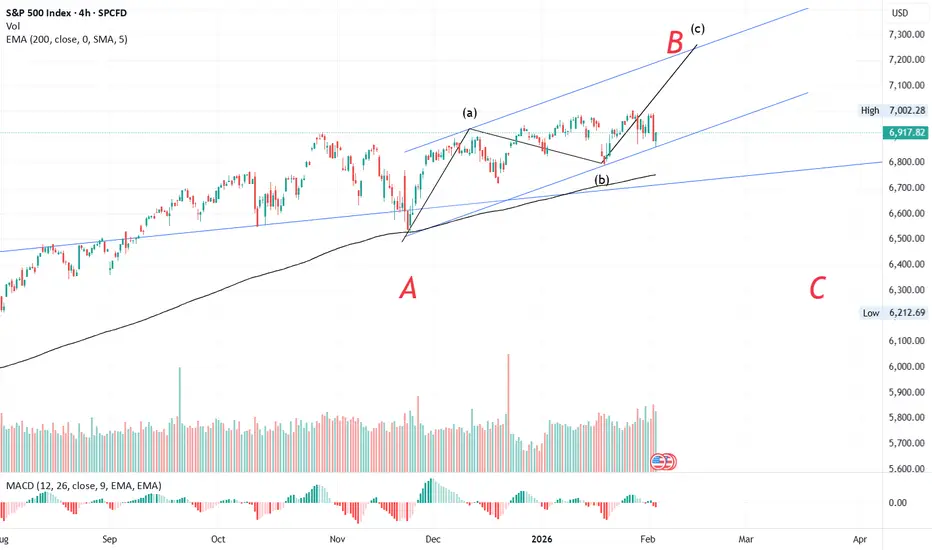
#S&P📊 S&P 500 Wave Analysis Update
The S&P began its corrective phase on 29 Oct 2025, forming its A wave by 21 Nov 2025. From there, the index rallied into its B wave, retracing more than 61.8%, which signals the development of a flat correction.
Breaking down the B wave:
- The a wave formed on 5 Dec 2025.
- The subsequent b wave retraced less than 61.8%, indicating a zig-zag structure.
- This sets the stage for the c wave, which has the potential to extend towards the 7200–7300 zone.
Open Interest (OI) Analysis for Futures & Options TradersOpen Interest Analysis for Futures & Options Traders
Open Interest (OI) is one of the most powerful yet misunderstood tools in the derivatives market. While price and volume tell traders what is happening, open interest helps explain why it is happening and who is likely behind the move. For futures and options traders, OI analysis provides insight into market participation, strength of trends, potential reversals, and the behavior of smart money.
This makes OI a critical component for traders dealing in index futures, stock futures, options, and commodity derivatives.
What Is Open Interest?
Open Interest refers to the total number of outstanding derivative contracts (futures or options) that are currently open and not settled. Each contract represents a buyer and a seller, and open interest increases when new positions are created and decreases when positions are closed or squared off.
Key points:
OI increases when a new buyer and new seller enter a trade
OI decreases when an existing buyer and seller close their positions
OI does not change when one trader transfers a position to another
Unlike volume, which resets daily, open interest is cumulative and reflects ongoing market commitment.
Difference Between Volume and Open Interest
Many traders confuse volume with open interest, but both serve different purposes.
Volume measures how many contracts were traded during a specific period
Open Interest measures how many contracts remain open at the end of that period
High volume with low OI suggests short-term activity or intraday trading, while rising OI indicates fresh positions and conviction. Professional traders always study price, volume, and OI together.
Why Open Interest Matters in Trading
Open interest is important because it:
Confirms trend strength
Identifies new money entering or leaving
Signals long buildup or short buildup
Helps detect trend exhaustion
Improves options strategy selection
Reveals support and resistance zones
In derivatives trading, price movement without OI confirmation is often unreliable.
Open Interest Analysis in Futures Trading
1. Price Up + OI Up → Long Buildup
This indicates new buyers are entering the market with confidence.
Bullish trend confirmation
Strong upward momentum
Suitable for trend-following strategies
Example: Index futures rally with rising OI often suggests institutional buying.
2. Price Down + OI Up → Short Buildup
This signals fresh short positions entering the market.
Bearish trend confirmation
Indicates strong selling pressure
Often seen during market breakdowns
Professional traders use this to stay aligned with downside momentum.
3. Price Up + OI Down → Short Covering
This move is driven by short sellers exiting their positions.
Temporary rally
Weak bullish structure
Often occurs near resistance or after panic selling
Such rallies may fade once short covering ends.
4. Price Down + OI Down → Long Unwinding
This shows existing long positions are being closed.
Bearish but often near support
Indicates trend exhaustion
Can lead to sideways movement or reversal
Smart traders watch for price stabilization after long unwinding.
Open Interest Analysis in Options Trading
Options OI provides even deeper insights because it shows market expectations across strike prices.
Call Option Open Interest
High Call OI indicates resistance
Call writing suggests bearish or neutral outlook
Call buying suggests bullish expectations
Put Option Open Interest
High Put OI indicates support
Put writing suggests bullish or neutral outlook
Put buying suggests bearish expectations
Put-Call Open Interest Ratio (PCR)
The PCR is calculated as:
PCR = Total Put OI / Total Call OI
Interpretation:
PCR < 0.7 → Overly bullish (market may correct)
PCR between 0.7–1.2 → Balanced market
PCR > 1.3 → Overly bearish (market may bounce)
PCR is best used as a sentiment indicator, not a standalone signal.
Open Interest Shifts and Strike Price Analysis
Options traders closely watch:
Change in OI rather than absolute OI
OI buildup near key strikes
Unwinding before major breakouts
If heavy Call OI at a strike starts unwinding while price approaches it, that resistance may break. Similarly, Put OI unwinding near support can signal downside risk.
Max Pain Theory and OI
Max Pain refers to the strike price where option buyers experience maximum loss and option sellers gain maximum profit at expiry. Markets often gravitate toward this level close to expiry due to option writers’ influence.
While not exact, Max Pain combined with OI analysis improves expiry-day precision trading.
Intraday OI Analysis
For intraday traders:
Rising price + rising OI = trend continuation
Sudden OI drop = position exit or profit booking
OI spikes near VWAP = institutional activity
Intraday OI analysis is especially effective in index futures and liquid stock futures.
Common Mistakes in Open Interest Analysis
Using OI without price confirmation
Ignoring OI change and focusing only on absolute values
Misinterpreting short covering as trend reversal
Trading OI without understanding market context
Over-relying on PCR alone
OI should always be part of a broader trading framework.
Combining OI with Technical Analysis
The best results come from combining OI with:
Support and resistance
Trendlines
Moving averages
Volume profile
Price action patterns
For example, a breakout above resistance with rising volume and rising OI is far more reliable than price alone.
Role of Open Interest for Smart Money Tracking
Institutional traders rarely chase price. They build positions gradually, which reflects in:
Rising OI at key price zones
Stable price with increasing OI (accumulation)
Sudden OI drop after sharp moves (distribution)
OI helps retail traders align with smart money behavior rather than emotional price moves.
Conclusion
Open Interest analysis is an essential skill for futures and options traders who want to understand market structure, sentiment, and positioning. While price shows the outcome of trading decisions, open interest reveals the commitment and conviction behind those decisions.
When used correctly, OI helps traders:
Confirm trends
Spot reversals early
Identify strong support and resistance
Improve risk management
Trade with institutional flow rather than against it
However, open interest should never be used in isolation. Its real power emerges when combined with price action, volume, and market context. Traders who master OI analysis gain a significant edge in navigating the complex world of futures and options trading.
Part 5 Best Trading Strategies Simple Example to Understand
Scenario
Nifty at 21500
You expect it to go to 21650.
Call Option Buy
Buy 21500 CE
If Nifty moves up → premium increases → profit
If Nifty falls → premium collapses → loss
Put Option Buy
Not useful in this scenario
Option Seller’s View
If seller expects market to remain sideways:
Seller sells 21600 CE
Seller sells 21400 PE
Both sides decay → seller profits
How Regulations Shape the Crypto Market1. Why Governments Regulate Crypto
Regulators intervene primarily to address risk, stability, and control. Cryptocurrencies challenge the traditional financial system in several ways:
They bypass banks and intermediaries
They enable anonymous or pseudonymous transactions
They operate across borders instantly
They introduce volatile, speculative assets
From a government perspective, unchecked crypto adoption can threaten monetary policy, capital controls, tax collection, and consumer protection. High-profile failures—such as exchange collapses, fraud, hacks, and stablecoin de-pegging—strengthened the case for regulation.
Thus, regulation aims to:
Protect investors and consumers
Prevent money laundering and illicit finance
Maintain financial stability
Integrate crypto into existing legal frameworks
2. Regulation and Market Legitimacy
One of the most important effects of regulation is legitimization. When governments define legal frameworks for crypto, institutional investors gain confidence to participate.
Clear rules allow:
Banks to offer crypto services
Asset managers to launch crypto funds and ETFs
Corporations to hold crypto on balance sheets
Payment firms to integrate blockchain rails
For example, regulatory approval of Bitcoin ETFs in some jurisdictions significantly boosted market participation and liquidity. Regulation transforms crypto from a speculative fringe asset into a recognized financial instrument.
However, legitimacy comes at a cost—compliance.
3. Compliance Reshapes Crypto Businesses
Crypto regulation fundamentally changes how companies operate. Exchanges, wallets, and DeFi platforms must adapt to rules traditionally applied to banks and financial institutions.
Key compliance requirements include:
KYC (Know Your Customer)
AML (Anti-Money Laundering) checks
Transaction monitoring
Licensing and reporting obligations
This reshapes the market in several ways:
Smaller or undercapitalized projects exit
Well-funded players gain dominance
Decentralized ideals face practical limits
As a result, the industry becomes more institutionalized and consolidated. While this reduces fraud and instability, it also raises concerns that crypto is becoming “traditional finance with blockchain branding.”
4. Regulation and Innovation: Constraint or Catalyst?
A common argument is that regulation stifles innovation. Overly strict or unclear rules can push developers offshore or discourage experimentation. Startups struggle with compliance costs, and decentralized protocols face legal ambiguity.
However, smart regulation can accelerate innovation by:
Providing legal clarity
Attracting long-term capital
Encouraging responsible product design
Jurisdictions with balanced frameworks often become crypto hubs, attracting talent and investment. Innovation thrives when builders understand the rules of the game instead of operating in legal grey zones.
The key issue is not regulation itself—but how well it is designed.
5. Impact on Decentralization and DeFi
Decentralized finance (DeFi) presents the biggest regulatory challenge. DeFi protocols operate without central entities, making enforcement difficult.
Regulators struggle with questions like:
Who is responsible for a smart contract?
Can code be regulated like a company?
How do you apply KYC to decentralized protocols?
As a result:
Some DeFi platforms introduce front-end restrictions
Developers geo-block certain regions
Governance tokens come under scrutiny
Regulation may push DeFi toward hybrid models, blending decentralization with compliance. While purists argue this undermines crypto’s core philosophy, others see it as necessary for mass adoption.
6. Stablecoins and Monetary Control
Stablecoins sit at the intersection of crypto and traditional money, making them a top regulatory priority. Because stablecoins resemble private digital currencies, governments fear loss of monetary sovereignty.
Regulation of stablecoins focuses on:
Reserve transparency
Issuer accountability
Redemption guarantees
Systemic risk
Strict oversight transforms stablecoins into regulated financial products rather than experimental tokens. This increases trust and usability but limits flexibility.
At the same time, regulatory pressure on stablecoins has accelerated the development of Central Bank Digital Currencies (CBDCs), as governments seek state-controlled digital alternatives.
7. Global Regulatory Fragmentation
Crypto is global, but regulation is local. Different countries take vastly different approaches, creating fragmentation.
Some embrace crypto as innovation
Some impose heavy restrictions
Some ban it outright
This creates regulatory arbitrage, where businesses move to friendlier jurisdictions. Capital, developers, and liquidity flow toward regions with clearer and more favorable rules.
Over time, this competition may push governments to refine policies or risk falling behind in financial innovation.
8. Market Volatility and Regulatory News
Regulation heavily influences crypto market psychology. Announcements related to bans, approvals, taxation, or enforcement actions often trigger sharp price movements.
Markets react because regulation affects:
Liquidity access
Institutional participation
Project survival
Legal risk
In this sense, regulation has become a macro driver for crypto markets, similar to interest rates or inflation data in traditional finance.
9. Investor Protection and Retail Confidence
Regulation improves investor protection by:
Reducing scams and fraud
Enforcing disclosures
Holding platforms accountable
This builds retail confidence and encourages broader participation. While speculative excess may decline, the market becomes more resilient and sustainable.
A regulated environment favors long-term investors over short-term hype cycles.
10. The Future: Coexistence, Not Conflict
Crypto regulation is no longer about suppression—it is about integration. Governments increasingly recognize that crypto is not disappearing. The challenge is to harness its benefits while managing its risks.
The future likely includes:
Regulated centralized platforms
Semi-compliant DeFi structures
Tokenized real-world assets
Blockchain-based financial infrastructure
Rather than killing crypto, regulation is shaping its evolution from rebellion to infrastructure.
Conclusion
Regulation is one of the most powerful forces shaping the crypto market. It determines who can participate, how businesses operate, and which innovations survive. While excessive regulation can slow progress, thoughtful frameworks create stability, trust, and long-term growth.
Crypto’s journey is no longer about avoiding regulation—but learning to grow within it. The projects and ecosystems that adapt intelligently will define the next phase of the digital financial revolution.
Event-Driven Earnings Trading: A Complete ExplanationWhy Earnings Are Market-Moving Events
Every publicly listed company reports earnings quarterly. These reports include:
Revenue
Profit (net income, EPS)
Operating margins
Forward guidance
Management commentary
Markets are forward-looking. Prices already discount expectations well before earnings are released. When actual results differ from expectations, the stock must quickly reprice—sometimes violently.
That repricing creates opportunity.
Expectations vs Reality: The Real Driver
A common mistake beginners make is assuming:
“Good earnings = stock goes up”
“Bad earnings = stock goes down”
In reality:
Good earnings can crash a stock
Bad earnings can rally a stock
Why? Because the market reacts to the difference between expectations and outcomes, not the outcome alone.
Example:
Expected EPS: ₹10
Actual EPS: ₹9.80
Even though the company is profitable, missing expectations can trigger selling.
On the other hand:
Expected EPS: ₹5
Actual EPS: ₹6
Even weak companies can rally if they outperform expectations.
Types of Event-Driven Earnings Trading Strategies
1. Pre-Earnings Positioning
This strategy involves taking positions before earnings based on:
Technical structure
Institutional positioning
Options data (implied volatility, open interest)
Past earnings behavior
Common pre-earnings approaches:
Volatility expansion trades
Range breakout anticipation
Trend continuation into earnings
Risk here is high because earnings outcomes are uncertain. Many professional traders reduce size or hedge risk using options.
2. Earnings Volatility Trading
Earnings bring a volatility spike. Option premiums rise sharply before the event due to uncertainty.
Traders exploit this by:
Buying volatility if they expect a large move
Selling volatility if they expect muted reaction
Key concept: Implied Volatility (IV)
IV rises before earnings
IV collapses immediately after earnings (IV crush)
Understanding IV behavior is crucial for earnings traders.
3. Post-Earnings Reaction Trading
This is one of the most popular and safer approaches.
Instead of predicting earnings, traders react to:
Price gaps
Volume expansion
Trend confirmation or failure
Post-earnings trading focuses on:
Gap-and-go setups
Gap fill trades
Trend reversals
Momentum continuation
This approach lets the market reveal direction first, reducing guesswork.
Earnings Gaps and Market Psychology
Earnings often cause price gaps, where a stock opens significantly above or below the previous close.
There are different types of gaps:
Breakaway gaps – start of a new trend
Continuation gaps – confirm an existing trend
Exhaustion gaps – signal trend reversal
Understanding the context is more important than the gap size.
For example:
A gap up after a long rally may fail
A gap up after consolidation may lead to strong continuation
Role of Institutional Investors
Institutions dominate earnings reactions because:
They control large capital
They model earnings far in advance
They trade based on guidance and long-term outlook
Key signs of institutional behavior:
Heavy volume after earnings
Sustained price movement beyond the first hour
Failure or success of VWAP levels
Retail traders often lose money by reacting emotionally, while institutions trade systematically.
Options and Earnings Trading
Options are deeply linked to earnings events.
Key concepts:
Implied Volatility (IV) rises before earnings
IV Crush happens immediately after
Directional move must exceed implied move for profit
Popular earnings option strategies:
Straddles and strangles
Iron condors
Call/put spreads
Options allow traders to:
Limit risk
Trade volatility instead of direction
Hedge equity positions
However, options require precise understanding. Without IV knowledge, earnings options trading can be costly.
Risks in Earnings Trading
Earnings trading is not easy money. Major risks include:
Overnight Gap Risk
Prices can move sharply outside trading hours.
False Breakouts
Initial moves can reverse quickly.
Liquidity Traps
Wide bid-ask spreads post-earnings.
Emotional Trading
Fast moves trigger fear and greed.
Risk management is non-negotiable:
Smaller position size
Predefined stop-loss
Accepting uncertainty
Combining Technicals with Earnings
The best earnings traders don’t rely only on fundamentals.
They combine:
Support and resistance
Trend structure
Volume analysis
Market sentiment
Broader index behavior
A strong earnings report in a weak market may still fail. Context always matters.
Earnings Season and Market Cycles
Earnings seasons create:
Sector-specific volatility
Index-level moves
Rotation between industries
Smart traders:
Track sector leaders
Watch correlated stocks
Avoid overtrading every earnings event
Not every earnings report is tradable. Selectivity is a key edge.
Who Should Trade Earnings?
Earnings trading suits:
Disciplined traders
Those comfortable with volatility
Traders who can react quickly
Options traders with IV knowledge
It is not ideal for:
Emotional traders
Over-leveraged accounts
Beginners without risk control
Final Thoughts
Event-driven earnings trading is not about predicting numbers—it’s about understanding expectations, volatility, and crowd behavior. Earnings are moments when uncertainty collapses into clarity, and price adjusts rapidly.
The real edge comes from:
Preparation over prediction
Risk management over excitement
Reaction over opinion
When done correctly, earnings trading can be one of the most powerful tools in a trader’s playbook—but only for those who respect its speed, risk, and complexity.
Part 2 Technical Analysis Vs. Institutional TradingHedging with Options
Options are powerful risk-management tools.
Portfolio hedging during market crashes.
Protect profits without exiting positions.
Institutional investors heavily rely on options for downside protection.
For example, buying index puts during uncertain periods can safeguard long-term investments.
How One Quant Giant Quietly Reshaped Global MarketsJane Street Impact
Jane Street is not a household name like Goldman Sachs or JPMorgan, yet its impact on modern financial markets is enormous. Founded in 2000, Jane Street is a quantitative trading firm and liquidity provider that operates across equities, ETFs, bonds, options, and cryptocurrencies in markets around the world. Its influence is subtle but powerful: tighter spreads, faster markets, changing trading strategies, and a new reality for both institutions and retail traders.
1. Market Liquidity: Making Markets “Always On”
One of Jane Street’s biggest contributions is liquidity provision. The firm acts as a market maker, constantly posting buy and sell quotes. This ensures that traders can enter or exit positions quickly without massive price slippage.
Before firms like Jane Street dominated market making:
Spreads were wider
Liquidity was inconsistent
Large trades caused sharp price moves
Jane Street changed this by using sophisticated algorithms that continuously adjust prices based on real-time supply, demand, and risk. The result is:
Narrower bid–ask spreads
Deeper order books
More stable short-term pricing
For investors, this reduces transaction costs. For traders, it means faster fills—but also tougher competition.
2. ETFs and Price Efficiency
Jane Street is one of the largest ETF market makers in the world. ETFs rely on a mechanism where prices stay close to their underlying assets through arbitrage. Jane Street plays a key role in this process.
Their impact includes:
Keeping ETF prices aligned with net asset value (NAV)
Enabling massive ETF growth globally
Making passive investing cheaper and more reliable
Without firms like Jane Street, ETFs would trade with larger discounts or premiums, reducing trust in the product. Their efficiency helped fuel the explosion of ETFs across equities, commodities, bonds, and thematic strategies.
3. Volatility: Reduced on Average, Sharper in Extremes
Jane Street’s presence generally reduces everyday volatility. Constant liquidity smooths price movement during normal conditions. However, in extreme events, the picture changes.
During market stress:
Algorithms widen spreads
Liquidity can temporarily vanish
Prices can move suddenly and violently
This doesn’t mean Jane Street causes crashes, but it highlights a new reality: modern markets are stable—until they aren’t. When risk models flip to “defensive,” liquidity providers step back simultaneously, amplifying sudden moves.
4. Speed and the Rise of Microstructure Trading
Jane Street operates at ultra-high speed, reacting to market signals in microseconds. This reshaped market microstructure in several ways:
Price discovery happens faster
Arbitrage opportunities disappear quickly
Traditional discretionary trading edges shrink
For slower participants, this creates frustration. Patterns that once worked for minutes now work for seconds—or not at all. This is why many retail traders feel markets have become “harder” or “unfair,” even though they are technically more efficient.
5. Impact on Retail Traders
Jane Street doesn’t trade against retail traders directly in a predatory sense, but its presence changes the game:
Positive impacts
Lower spreads
Better execution prices
Easier entry and exit
Negative impacts
Fake breakouts due to liquidity probing
Stops hunted in low-liquidity zones
Retail strategies losing edge faster
Many retail traders unknowingly trade against sophisticated liquidity models. This is why modern trading education increasingly emphasizes:
Market structure
Liquidity zones
Institutional footprints
6. Institutional Trading and Strategy Evolution
Jane Street forced traditional institutions to evolve. Old-school floor trading and manual arbitrage could not compete with algorithmic precision.
As a result:
Banks adopted quant desks
Hedge funds invested heavily in data science
Trading shifted from intuition to probability models
Risk management also improved. Jane Street is known for strict risk controls, scenario testing, and disciplined capital allocation. This professionalized trading across the industry.
7. Cultural Impact: Redefining What a Trader Is
Jane Street changed the identity of a “trader.” Today, traders are often:
Mathematicians
Engineers
Physicists
Data scientists
The firm’s culture emphasizes:
Collaboration over ego
Continuous learning
Intellectual honesty
This influenced the broader finance world, making quantitative skills more valuable than aggressive personalities or gut instinct.
8. Regulatory and Ethical Implications
Jane Street operates within regulations, but its scale raises questions:
Should ultra-fast firms have speed advantages?
Is liquidity real if it disappears during crises?
Do algorithms create unequal access?
Regulators worldwide now focus more on:
Market fairness
Order-to-trade ratios
Algorithmic risk controls
Jane Street’s success indirectly pushed regulators to modernize frameworks designed for a pre-algorithm era.
9. Global Impact, Including Emerging Markets
Jane Street trades globally, including emerging markets through derivatives, ETFs, and arbitrage links. This has several effects:
Faster price transmission from global cues
Increased correlation across markets
Reduced inefficiencies
For countries like India, this means domestic markets respond more quickly to global flows. While this increases efficiency, it also reduces insulation from global shocks.
10. The Bigger Picture: Markets as Machines
Jane Street symbolizes a broader shift: markets are no longer human-driven arenas—they are machine ecosystems. Prices move not because of stories alone, but because of models reacting to probabilities, correlations, and risk constraints.
This doesn’t eliminate opportunity—it changes it. Traders who understand liquidity, structure, and behavior thrive. Those relying only on indicators struggle.
Conclusion
Jane Street’s impact on financial markets is profound yet understated. It improved liquidity, tightened spreads, enhanced ETF efficiency, and pushed trading into a new quantitative era. At the same time, it raised the bar for participation, forcing traders and institutions alike to adapt.
Jane Street did not “break” the markets—it rewired them. Understanding its role helps explain why modern price action behaves the way it does: fast, efficient, occasionally ruthless, and deeply structural.
In today’s world, trading is no longer about beating the market emotionally—it’s about understanding the systems that move it. Jane Street is one of the architects of that system.
Momentum Patterns in Cryptocurrency MarketsUnderstanding Momentum in Crypto Markets
Momentum refers to the speed and strength of price movement in a particular direction. In crypto markets, momentum is driven by a combination of factors such as liquidity inflows, news events, social media hype, whale activity, derivatives positioning, and macroeconomic sentiment.
Unlike equities, where institutional flows dominate, crypto momentum often begins with retail enthusiasm and is amplified by leverage in futures markets. This creates exaggerated price movements, making momentum patterns more pronounced and more frequent.
Why Momentum Is Stronger in Cryptocurrencies
Cryptocurrency markets exhibit stronger momentum patterns than most traditional assets due to:
High Volatility – Daily moves of 5–15% are common.
Leverage Availability – Futures allow 10x–100x leverage, accelerating trends.
24/7 Trading – No closing bell means trends evolve continuously.
Narrative-Driven Moves – News, tweets, and narratives can trigger instant momentum.
Lower Liquidity in Altcoins – Small capital inflows can cause explosive price action.
These characteristics make momentum trading especially attractive—but also risky.
Major Momentum Patterns in Cryptocurrency Markets
1. Breakout Momentum Pattern
Breakouts occur when price moves beyond a well-defined resistance or support zone with increased volume.
Crypto-specific traits:
Breakouts often happen during low-liquidity periods.
Fake breakouts are common due to stop-hunting.
Volume confirmation is crucial.
Strong breakout signals include:
Expansion in volume
Large candle bodies
Open Interest increasing with price
Breakout momentum works best in high-liquidity coins like Bitcoin, Ethereum, and top-tier altcoins.
2. Trend Continuation Momentum
Once a trend is established, crypto markets often show extended continuation phases.
Common continuation patterns include:
Bull flags
Bear flags
Ascending or descending channels
Consolidation above key moving averages
In strong bull markets, cryptocurrencies can remain overbought for extended periods, making traditional indicators less effective. Traders who wait for “cheap” prices often miss the move entirely.
3. Parabolic Momentum Pattern
Parabolic moves are unique to crypto markets and occur when buying pressure becomes exponential.
Characteristics:
Steep price angle
Increasing candle size
RSI staying above 70 for long periods
Media and social hype at extremes
While parabolic momentum can produce massive gains, it is unsustainable. The end often comes with a sharp vertical drop, trapping late buyers.
4. Momentum Divergence Pattern
Divergences occur when price continues to make higher highs or lower lows while momentum indicators fail to confirm.
Common divergence types:
Bearish divergence (price up, momentum down)
Bullish divergence (price down, momentum up)
In crypto, divergences are early warnings, not immediate reversal signals. Strong trends can ignore divergences for extended periods, especially in Bitcoin during macro-driven cycles.
5. Mean Reversion Momentum Exhaustion
Crypto markets frequently experience momentum exhaustion, where price moves too far too fast.
Signs include:
Long wick candles
Declining volume at highs
Extreme funding rates
Overcrowded long or short positions
This often leads to sharp pullbacks or sideways consolidation rather than immediate trend reversal.
Momentum Indicators Commonly Used in Crypto Trading
Relative Strength Index (RSI)
RSI measures momentum strength but behaves differently in crypto:
RSI above 70 can persist for weeks
RSI below 30 often leads to short-term bounces
RSI mid-range (40–60) signals consolidation
Moving Averages
Momentum traders watch:
20 EMA for short-term momentum
50 EMA for trend confirmation
200 EMA for macro bias
Strong momentum often keeps price above key EMAs with shallow pullbacks.
MACD
MACD works best on higher time frames in crypto. Frequent false signals appear on lower time frames due to volatility.
Volume and Open Interest
True momentum requires participation:
Rising price + rising volume = healthy momentum
Rising price + falling volume = weak momentum
Rising Open Interest confirms leveraged participation
Role of Derivatives in Crypto Momentum
Futures and options markets significantly influence momentum patterns.
Key elements:
Funding rates reflect crowd bias
Liquidations accelerate momentum
Stop-loss cascades amplify moves
Large liquidation events often create forced momentum, leading to exaggerated candles known as “liquidation wicks.”
Momentum Across Market Cycles
Bull Market Momentum
Strong continuation patterns
Shallow pullbacks
Altcoins outperform Bitcoin
Narratives dominate fundamentals
Bear Market Momentum
Sharp relief rallies
Lower highs and lower lows
Momentum fades quickly
Volume dries up
Understanding the broader cycle is critical because the same momentum signal behaves differently depending on market conditions.
Risks of Momentum Trading in Crypto
Momentum trading is not without danger.
Major risks include:
Fake breakouts
Sudden reversals from whale activity
News-driven volatility
High leverage liquidation
Risk management is essential. Stop-loss placement, position sizing, and avoiding emotional entries are more important than indicator selection.
Best Practices for Trading Momentum in Crypto
Trade in the direction of the higher-time-frame trend
Use volume and Open Interest confirmation
Avoid chasing late-stage parabolic moves
Combine price action with momentum indicators
Respect volatility—reduce leverage during high uncertainty
Successful momentum traders focus not on predicting tops or bottoms but on participating in the middle of the move.
Conclusion
Momentum patterns in cryptocurrency markets are powerful, fast-moving, and emotionally charged. They arise from a unique blend of retail behavior, leverage, narrative influence, and structural market features. While momentum can generate outsized profits, it demands discipline, adaptability, and strong risk management.
By understanding breakout momentum, trend continuation, parabolic phases, divergence signals, and exhaustion patterns, traders can better navigate crypto’s volatile landscape. In a market where prices can double or halve in days, mastering momentum is not optional—it is essential.
Part 1 Intraday Institutional Trading Moneyness of Options
ITM, ATM, OTM based on underlying price.
ATM options are most sensitive to price moves.
OTM options are cheap but decay fast.
Implied Volatility (IV)
Measures expected movement.
High IV = high premium.
IV crush happens after events (e.g., RBI meeting, Fed decision).
Commodity Trading: Energy, Metals & Agricultural MarketsCommodity trading involves buying and selling physical goods or their derivative contracts with the objective of profit, hedging risk, or portfolio diversification. Unlike equities (which represent ownership in companies), commodities are tangible assets such as crude oil, gold, wheat, or natural gas. These markets play a critical role in the global economy because commodities are essential inputs for energy production, manufacturing, construction, and food security.
Commodity trading is broadly divided into three major categories:
Energy Commodities
Metal Commodities
Agricultural (Agri) Commodities
Each category has unique drivers, risks, and trading characteristics.
1. Energy Commodity Trading
Energy commodities are among the most actively traded commodities globally. They are highly sensitive to geopolitical events, economic growth, and supply disruptions.
Major Energy Commodities
Crude Oil (WTI & Brent)
Natural Gas
Heating Oil
Gasoline
Coal (limited exchange trading)
Key Market Drivers
Supply & Demand Balance
OPEC+ production decisions
US shale oil output
Refinery capacity
Geopolitical Factors
Middle East tensions
Russia–Ukraine conflict
Sanctions and trade restrictions
Economic Growth
Strong economies increase fuel demand
Recessions reduce consumption
Seasonality
Natural gas demand rises in winter
Gasoline demand peaks during summer travel
Inventory Data
Weekly reports like EIA crude oil inventories
Trading Characteristics
High volatility
Strong trend-following behavior
Heavy participation by institutions, hedge funds, and governments
Prices often react sharply to news and data releases
Trading Instruments
Futures contracts (most common)
Options on futures
Commodity ETFs
CFDs (in some markets)
Energy trading is popular among short-term traders due to sharp intraday movements, but it also attracts hedgers like airlines and oil producers.
2. Metal Commodity Trading
Metals are divided into Precious Metals and Base (Industrial) Metals, each serving different economic purposes.
A. Precious Metals Trading
Major Precious Metals
Gold
Silver
Platinum
Palladium
Key Drivers
Inflation & Interest Rates
Gold performs well during high inflation
Rising interest rates often pressure prices
Currency Movements
Strong US Dollar usually weakens precious metals
Safe-Haven Demand
Economic crises, wars, or market crashes boost demand
Central Bank Buying
Especially important for gold
Trading Characteristics
Gold is relatively less volatile than energy
Silver is more volatile due to industrial usage
Strong correlation with macroeconomic indicators
Gold is often used as a hedge against inflation and currency risk, making it popular with long-term investors as well as traders.
B. Base (Industrial) Metals Trading
Major Base Metals
Copper
Aluminium
Zinc
Nickel
Lead
Key Drivers
Industrial & Infrastructure Demand
Construction
Manufacturing
Electric vehicles and renewable energy
Economic Growth Indicators
GDP growth
PMI data
Supply Constraints
Mining disruptions
Environmental regulations
China’s Demand
China is the largest consumer of base metals
Trading Characteristics
Strongly cyclical
Move with global economic cycles
Copper is often called “Dr. Copper” because it signals economic health
Base metals are ideal for traders who closely follow macro and industrial trends.
3. Agricultural (Agri) Commodity Trading
Agricultural commodities represent soft commodities derived from farming and livestock. These markets are deeply influenced by natural and seasonal factors.
Major Agricultural Commodities
Grains: Wheat, Corn, Rice
Oilseeds: Soybean, Mustard
Softs: Sugar, Coffee, Cotton
Livestock: Live Cattle, Lean Hogs
Key Market Drivers
Weather Conditions
Rainfall, droughts, floods
El Niño and La Niña effects
Crop Reports
USDA acreage and yield reports
Sowing and harvesting data
Seasonality
Planting and harvest cycles
Government Policies
Minimum Support Prices (MSP)
Export/import restrictions
Global Demand
Population growth
Biofuel usage (corn → ethanol)
Trading Characteristics
Often range-bound, except during supply shocks
Highly seasonal
Can experience sudden spikes due to weather news
Agri trading is popular among farmers and food companies for hedging, as well as speculators who understand seasonal cycles.
Commodity Trading Instruments & Markets
Common Trading Instruments
Futures Contracts (primary instrument)
Options on Futures
Spot Markets
ETFs / ETNs
Commodity Mutual Funds
Indian Commodity Exchanges
MCX (Multi Commodity Exchange) – Energy & Metals
NCDEX – Agricultural commodities
Global Commodity Exchanges
CME Group (USA)
LME (London Metal Exchange)
ICE Exchange
Risk Management in Commodity Trading
Commodity markets are volatile, so risk management is critical:
Use stop-loss orders
Proper position sizing
Avoid over-leveraging
Understand contract specifications (lot size, expiry)
Be aware of rollover risks
Professional traders focus more on capital protection than profit chasing.
Advantages of Commodity Trading
Portfolio diversification
Inflation hedge
High liquidity (especially energy & metals)
Opportunities in both rising and falling markets
Risks Involved
High volatility
Leverage risk
Sudden policy or weather-driven shocks
Global geopolitical uncertainty
Conclusion
Commodity trading in Energy, Metals, and Agricultural markets offers diverse opportunities for traders, investors, and hedgers. Energy commodities provide high volatility and strong trends, metals reflect macroeconomic and industrial health, while agricultural commodities are driven by seasonality and weather. Successful commodity trading requires a solid understanding of fundamental drivers, technical analysis, and strict risk management.
When approached with discipline and knowledge, commodities can be a powerful addition to any trading or investment strategy.
Part 4 Institutional VS. Technical1. Delta
Measures how much the premium changes with a ₹1 move in the underlying.
Call delta: +0.0 to +1.0
Put delta: –0.0 to –1.0
High delta = faster premium movement.
2. Gamma
Measures how fast delta changes. Used to evaluate momentum and risk.
3. Theta
Measures time decay—how much premium decreases as expiration approaches.
Sellers benefit from theta.
Buyers lose value daily.
4. Vega
Measures sensitivity to implied volatility (IV).
Higher IV → higher premium.
5. Rho
Impact of interest rates (less important for short-term traders).
Equity Market Trends: An In-Depth Analysis1. Defining Equity Market Trends
At its core, an equity market trend refers to the general direction in which stock prices move over a period. These trends can be upward (bullish), downward (bearish), or sideways (neutral/consolidation). Bullish trends indicate sustained buying pressure, reflecting optimism about the economy or specific sectors. Conversely, bearish trends signify prolonged selling pressure, often triggered by negative economic signals, corporate earnings disappointments, or geopolitical tensions. Sideways trends occur when the market fluctuates within a range without a clear directional bias, often reflecting indecision among investors.
Trends are influenced by a combination of fundamental, technical, and behavioral factors. While fundamental factors relate to corporate earnings, macroeconomic indicators, and monetary policies, technical factors focus on price patterns, moving averages, and market volumes. Behavioral factors capture investor psychology, herd behavior, and sentiment-driven trading.
2. Historical Trends and Market Cycles
Historically, equity markets exhibit cyclicality. Markets move in long-term secular trends, lasting several years, superimposed with short-term cyclical fluctuations driven by economic and corporate cycles. For instance, the post-World War II era saw sustained growth in global equities, punctuated by periods of correction during recessions, oil crises, and financial meltdowns such as the 2008 Global Financial Crisis.
Equity markets often follow the four phases of market cycles:
Accumulation Phase: Smart money or institutional investors begin buying stocks at undervalued levels.
Mark-Up Phase: Rising prices attract broader participation, leading to bullish trends.
Distribution Phase: Early investors start booking profits, slowing growth.
Mark-Down Phase: Pessimism prevails, resulting in sustained declines.
Recognizing these phases helps investors anticipate trend reversals and manage risk effectively.
3. Key Drivers of Equity Market Trends
Equity trends are shaped by a multitude of interconnected factors:
a. Macroeconomic Indicators
Economic indicators such as GDP growth, inflation, interest rates, unemployment, and industrial production heavily influence stock market trends. For example, strong GDP growth and low unemployment generally foster bullish sentiment. Conversely, rising inflation or tightening interest rates may trigger bearish trends as borrowing costs increase and corporate profits are pressured.
b. Corporate Earnings
Earnings growth is a primary determinant of stock performance. Consistently strong earnings growth supports rising stock prices, while disappointing results can trigger corrections. Investors often rely on forward-looking earnings estimates to gauge potential market directions.
c. Monetary and Fiscal Policy
Central bank policies, including interest rate adjustments and quantitative easing, directly impact equity markets. Lower interest rates reduce borrowing costs, making equities more attractive relative to fixed-income securities. Similarly, fiscal stimulus measures, such as tax cuts or government spending, can boost investor confidence and drive market rallies.
d. Global Events
Equity markets are increasingly interconnected. Geopolitical tensions, trade wars, pandemics, and technological disruptions can create volatility. For example, the COVID-19 pandemic caused a sharp market sell-off in early 2020, followed by an unprecedented recovery fueled by global stimulus.
e. Sectoral Trends
Not all sectors move in unison. Technology, healthcare, energy, and financials often exhibit independent trends based on sector-specific developments. Investors track sector rotation strategies to capitalize on these divergences, moving capital from overvalued sectors to those with higher growth potential.
4. Technical Analysis and Trend Identification
Technical analysis plays a critical role in identifying and confirming market trends. Common tools include:
Moving Averages: Indicators like the 50-day and 200-day moving averages help identify bullish or bearish momentum. A crossover between short-term and long-term averages often signals trend reversals.
Trendlines and Channels: Connecting price highs and lows visually highlights the market’s direction.
Momentum Indicators: Tools like RSI (Relative Strength Index) and MACD (Moving Average Convergence Divergence) help assess whether the market is overbought or oversold.
Volume Analysis: High trading volumes during price increases suggest trend strength, while low volumes may indicate weakening momentum.
Technical analysis provides insights into entry and exit points, trend duration, and potential reversals, complementing fundamental analysis.
5. Investor Behavior and Sentiment
Equity trends are also heavily influenced by behavioral finance. Psychological factors, such as fear, greed, and herd mentality, often exaggerate market movements. For instance:
Fear-driven sell-offs can lead to panic-induced bearish trends.
Speculative bubbles form when optimism drives overvaluation, as seen during the dot-com bubble of the late 1990s.
Market sentiment indicators, such as the VIX (Volatility Index), measure investor anxiety and help anticipate trend shifts.
Understanding sentiment allows investors to make contrarian moves, buying during pessimism and selling during irrational exuberance.
6. Recent Equity Market Trends
In the past decade, global equity markets have exhibited several notable trends:
Technology-led Bull Market: Growth in digitalization, cloud computing, and AI has fueled long-term bullish trends in technology stocks.
Sustainable and ESG Investing: Increasing focus on environmental, social, and governance factors has shifted capital toward sustainable investments, impacting sector trends.
Market Volatility: Geopolitical tensions, inflationary pressures, and interest rate cycles have resulted in alternating bullish and bearish phases.
Retail Investor Influence: Platforms enabling easy stock trading have introduced new dynamics, contributing to rapid price swings and short-term trends.
Emerging trends include AI-driven investment strategies, algorithmic trading, and growing interest in thematic and global ETFs, further diversifying equity market behavior.
7. Risk Management in Trending Markets
While trends offer opportunities, they also carry risks:
Trend Reversals: Markets can suddenly reverse due to economic shocks or geopolitical events, causing significant losses.
Overvaluation: Extended bullish trends may lead to asset bubbles.
Liquidity Risks: Sudden sell-offs can strain liquidity, especially in small-cap stocks.
Investors manage these risks through diversification, hedging strategies, and systematic monitoring of trend indicators. Setting stop-loss limits and maintaining a balanced portfolio are essential for capital preservation.
8. Conclusion
Equity market trends are a dynamic interplay of economic fundamentals, corporate performance, investor sentiment, and global events. Understanding these trends requires a holistic approach that combines macro analysis, technical tools, behavioral insights, and risk management. Long-term success in equities depends on recognizing the market cycle, tracking macroeconomic shifts, and identifying sector-specific opportunities.
While trends offer avenues for wealth creation, they demand disciplined investment strategies, continuous learning, and the ability to adapt to changing market conditions. With globalization, technological innovation, and increasing retail participation, equity market trends are becoming more complex, volatile, and interconnected, presenting both opportunities and challenges for investors worldwide.
In essence, equity market trends are not just about price movements—they are reflections of economic realities, corporate health, investor psychology, and global dynamics. By studying trends rigorously, investors can navigate the uncertainties of the market, capitalize on growth opportunities, and safeguard their investments against volatility. In the modern financial ecosystem, staying attuned to equity market trends is both an art and a science, requiring analytical acumen, emotional discipline, and strategic foresight.
S&P 500: Late-Stage Structure Worth WatchingThe S&P 500’s recent advance is showing overlapping price action and narrowing ranges , raising the possibility of a developing Ending Diagonal near the highs.
Internally, the move lacks impulsive strength , with Wave (v) struggling for follow-through and RSI hovering around the mid-50s, suggesting momentum is not confirming price . This behavior is more typical of a terminal phase than a trend expansion.
That said, this is not a confirmed top . A break below the lower diagonal would support the bearish case, while strong acceptance above recent highs would invalidate the diagonal view.
For now, this remains a caution zone , not a conviction call.
Disclaimer: This analysis is for educational purposes only and does not constitute investment advice. Please do your own research (DYOR) before making any trading decisions.
Part 2 Technical VS. Institutional Common Options Trading Strategies
Options trading is not limited to buying calls and puts. Some widely used strategies include:
Covered Call: Holding a stock and selling a call option to earn premium income.
Protective Put: Buying a put option to protect a stock holding from downside risk.
Straddle: Buying both a call and a put at the same strike price to profit from high volatility.
Strangle: Similar to a straddle but with different strike prices.
Spread Strategies: Using multiple options to limit risk, such as bull spreads and bear spreads.
These strategies allow traders to tailor risk and reward according to their market outlook.
Is this a Top in US500 Bearish Divergence + Rising WedgeThe US500 is forming higher highs in price, while the RSI is showing a clear bearish divergence, failing to confirm the move and indicating weakening momentum. Additionally, the price action is developing a rising wedge pattern, which typically signals exhaustion. A decisive close below the lows of the past two sessions could confirm a short-term top, especially amid ongoing negative geopolitical developments.
Part 11 Trading Master Class With Experts What Are Options?
Options are derivative contracts, meaning their value is derived from an underlying asset such as:
Stocks
Index (Nifty, Bank Nifty)
Commodities (Gold, Crude)
Currency pairs
ETFs
An option gives the buyer the right, but not the obligation, to buy or sell the underlying asset at a fixed price within a specific period.
There are two main types of options:
1. Call Option
A Call Option gives you the right to buy the underlying asset at a fixed price.
2. Put Option
A Put Option gives you the right to sell the underlying asset at a fixed price.
That “fixed price” is called the strike price, and the last day on which you can exercise the option is called the expiry date.
SPY - Hope it tops this time :)US markets have been super resilient, sucking capital from across the world.
We have a good pattern in place, as the triggers for pushing the market up have been reducing with time, with everything running quite thin.
The rally has been quite low on breadth and is supported on weak pillars - but still has been resilient and all selling have been bought into.
Let's see if it breaks and sustains this time.
We need a 10-15% (ideally + 20%) fall in US for money to flow into emerging markets :)
It is a good time to try some positional shorts with SL as 7k.
View void if we sustain above 7k.